
Quick Answer
Start by shortlisting 2-3 cities and ranking them on inventory depth, total monthly reality, stay feasibility, and work-community fit. For first moves, higher-option markets like New York City or Los Angeles are usually safer because backup listings are easier to find. Then verify property terms line by line on Coliving.com and coliving.community before paying any non-refundable deposit. Commit only after your stay path, move-in timing, and written host terms all line up.
Choose Your Best Coliving City With a Relocation-First Lens#
The right coliving city is one you can actually move into on your dates, under terms you can sustain, with a stay path you can realistically keep. Treat this as a relocation decision, not a popularity contest.
City buzz is only a starting signal. A place can look active online and still miss your move window because live inventory is thin, minimum stays do not fit your plan, or the remaining options push you onto waitlists. That is where people lose time and, sometimes, money.
The simplest way to decide is to run it in a fixed order. First lock your move date. Then define an acceptable stay length. Then test supply and terms city by city. If a city fails one gate, demote it quickly and move on. That keeps you from spending a week optimizing for a place that cannot support the move you are actually trying to make.
Use these four filters in order:
- Move Horizon Fit
Start with your move date, then map cities to real booking windows. Current listing snapshots show move-in months such as March 2026 and April 2026, which gives you a practical timing check. If your target month is close, favor cities showing active availability now instead of leaning on reputation.
- Stay-Length Reality
Match your intended stay to live filters before you shortlist. Current filters show minimum stays at 1, 2, 3, 6, and 12 months. If most options in a city force a longer stay than your contract horizon or savings runway allows, that city is weaker than it first appears.
- Supply Reliability
Treat directory counts as snapshots and recheck them before you pay anything. One filtered view shows 0 colivings in Bourg-Saint-Pierre, while a United States filtered view shows 1 coliving. Another market view includes a waiting-list prompt for new homes. Low or volatile supply is a common failure mode, so keep 2 to 3 cities active until one property is fully confirmed.
- Terms and Acclimation Friction
Review host terms alongside local settling friction. Filters like expected minimum stay and badges such as no security deposit let you compare commitment and cash exposure quickly. In one city example, moving as a foreigner is described as challenging, with coliving positioned as one way to ease acclimation. If host terms look clear but day-to-day acclimation looks harder than you want right now, keep that city as a backup and secure a cleaner primary option first.
In practice, this order protects you from the most expensive mistake: paying early in a city that looked good during discovery but falls apart once timing, terms, and fallback options are checked.
Leave this section with three concrete outputs: a shortlist of 2 to 3 cities, a booking order with primary, backup, and fallback, and a timeline tied to your move date. Those three outputs set up the rest of the article.
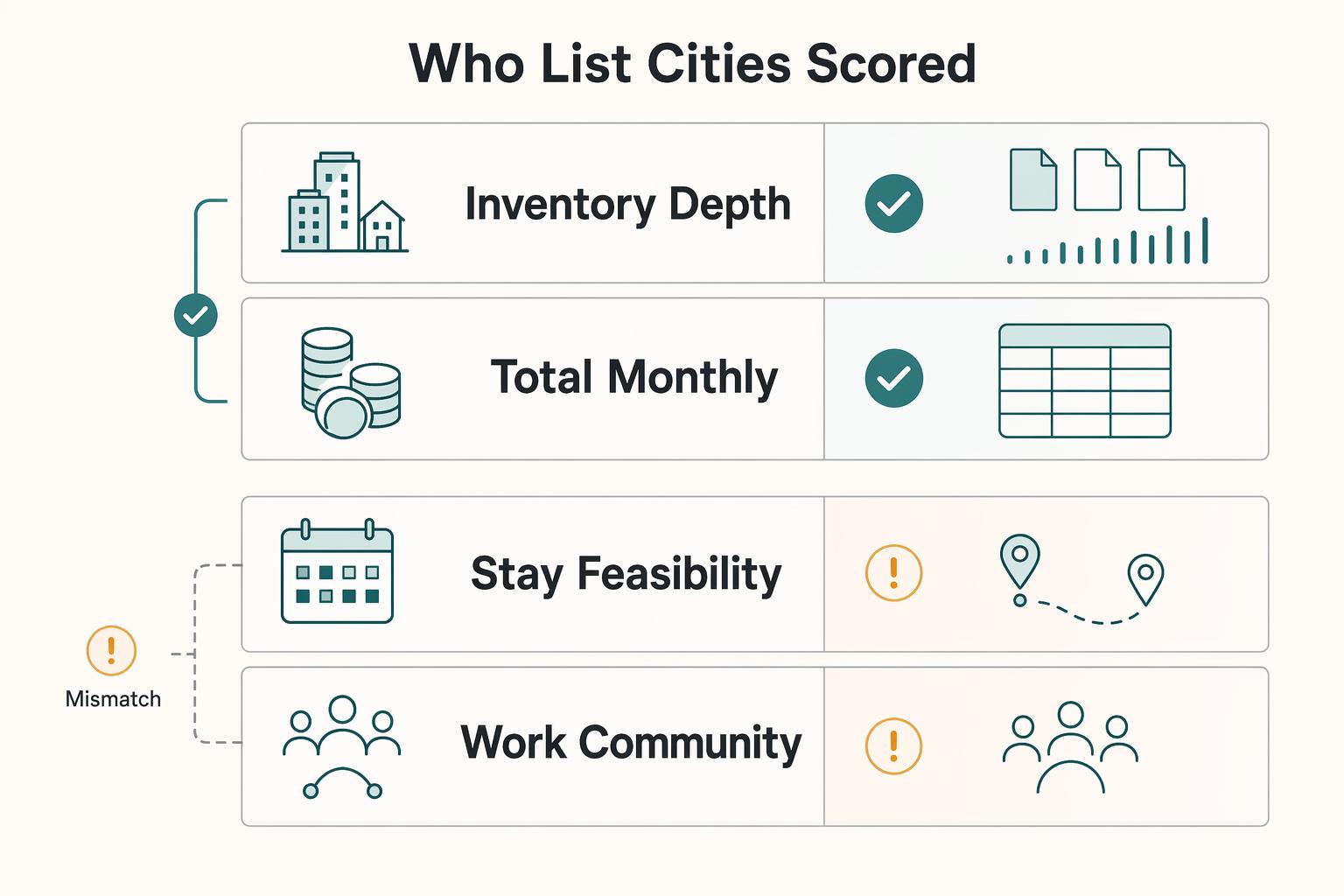
Who This List Is For and How Cities Are Scored#
Start with a scorecard, not a popularity list.
| Criterion | Weight | What to check |
|---|---|---|
| Inventory depth | 35% | Viable options after your real filters; live matches can show 0 results with Show 0 colivings |
| Total monthly reality | 30% | Monthly coliving cost, general living cost, and your fixed spend; treat published ranges as anchors |
| Stay feasibility | 20% | Stay path and timing requirements before any non-refundable payment |
| Work-community fit | 15% | Private room setup, shared spaces, included utilities, optional community events, plus your own location and amenity needs |
This approach is for remote professionals planning a real move on a fixed timeline. It is not built for pure bargain hunting. If your only goal is the lowest advertised rent, you will get more value from raw price filters than from a weighted decision method like this one.
The point here is to reduce avoidable risk before cash leaves your account. That means scoring cities on the things that decide whether a move works in practice, not just whether a listing looks good in a screenshot.
Use this weighted scorecard:
- Inventory depth (35%)
Score cities by viable options after your real filters, not by hype. A filtered remote-worker snapshot can show 0 results with Show 0 colivings. When live matches are thin, one declined request or one date change can break the whole plan.
- Total monthly reality (30%)
Compare monthly coliving cost and general living cost, then add your fixed spend. Treat published ranges as anchors, not guarantees, such as Sarajevo at $400-$700/month and Lisbon at $600-$1,200/month in one affordability roundup. A low starting price can still produce a higher real monthly total once add-ons and local spend show up.
- Stay feasibility (20%)
Confirm your stay path and timing requirements before any non-refundable payment. If that path is still fuzzy, keep the city as a backup even if the housing photos and amenities look strong.
- Work-community fit (15%)
Score daily fit with concrete signals: private room setup, shared spaces, included utilities, optional community events, plus your own location and amenity needs. The target is steady work output after move-in, not a strong first-week social impression.
Apply the same rubric to every city and write down why each score exists. You are not trying to find a perfect destination. You are building a decision you can defend when one listing disappears, one date changes, or one host reply comes back vague. A simple score with clear notes beats a good feeling.
One practical rule of thumb follows from that. If this is your first relocation, start with broader-market options like New York City or Los Angeles, then confirm live availability before you commit. If this is move three or later, niche cities can work better because your filters and fallback process are usually tighter by then. It also helps to keep ranking context in perspective. One 2018 analysis used 9 digital-nomad factors, and a 2024 critique called generic best-city lists useless. That is exactly why this piece uses a relocation-first method.
Quick Comparison Table for Fast Shortlisting#
Use the table to cut the field fast, then move straight to verification. The quickest way to waste time is to overread city content before checking whether anything workable is actually bookable on your dates.
Run the same first-pass screen everywhere: target reliable internet, prefer fiber at 1 Gbps where available, check 14-30 night discount windows, and pressure-test total monthly reality before any non-refundable payment. Then verify property-level details for your exact dates and confirm terms, fallback options, and total monthly cost in writing before you pay.
| City | Best For | Inventory Signal | Budget Predictability | Stay Friction | Community Style | Main Risk |
|---|---|---|---|---|---|---|
| San Francisco | Broad opportunity set, often better for a second move | Cross-check Coliving.com and coliving.community; divergence status is unconfirmed here | Needs line-by-line verification | Confirm terms in writing before deposit | Validate at the property level | Committing before backup options are confirmed |
| New York City | First relocation with many fallback options, strong first-move profile | Cross-check Coliving.com and coliving.community; divergence status is unconfirmed here | Needs line-by-line verification | Confirm terms before non-refundable booking | Validate at the property level | Paying for speed without validating day-to-day fit |
| Los Angeles | First relocation with multiple district options, strong first-move profile | Cross-check Coliving.com and coliving.community; divergence status is unconfirmed here | Needs line-by-line verification | Confirm contract terms before payment | Validate at the property level | Choosing on headline appeal instead of routine fit |
| Austin | Connectivity-first planning, strong first-move profile | Confirm live listings for your exact dates | Medium if you cap housing and coworking; day passes are often cited around $20-$35 (verify current) | Confirm prepayment terms in writing | Validate at the property level | Assuming one neighborhood pattern applies citywide |
| Atlanta | Practical shortlist with backup planning, often better for a second move | Cross-check Coliving.com and coliving.community; divergence status is unconfirmed here | Needs line-by-line verification | Confirm lock-in terms before payment | Validate at the property level | Thin backup plan if first option falls through |
| Sedona | Lifestyle-led move with strict tradeoffs, only when lifestyle priority dominates | Cross-check Coliving.com and coliving.community; divergence status is unconfirmed here | Needs line-by-line verification | Confirm minimum-stay commitment before payment | Validate at the property level | Limited fallback options during target windows |
| Honolulu | Lifestyle-first relocation with disciplined planning, only when lifestyle priority dominates | Cross-check Coliving.com and coliving.community; divergence status is unconfirmed here | Needs line-by-line verification | Confirm payment terms before booking | Validate at the property level | Real monthly spend can exceed first listing expectations |
| Montreal | Structured reset with careful sequencing, often better for a second move | Cross-check Coliving.com and coliving.community; divergence status is unconfirmed here | Needs line-by-line verification | Confirm legal and housing sequencing before commitment | Validate at the property level | Timeline mismatch between paperwork and move-in |
If two cities are close, pick the one with clearer verification answers, not the better headline. If they are still tied, run a 7-day test with furnished sublets, coliving, or weekly extended-stay options, then commit where your work output stays stable. What matters is not which city wins online. It is which one keeps your routine predictable under real constraints.
Best Cities for Fast Network Effects and Job Density#
Dense markets can pay off when access is the point of the move, but they punish loose planning. San Francisco, New York City, and Los Angeles are worth considering when you need faster network effects and job density, as long as you treat them as operating environments rather than brand names.
This is not a fixed ranking. Evidence for a strict SF, NYC, and LA order is limited here, so treat each city as a working hypothesis until property terms are confirmed in writing. Before paying anywhere, verify the same basics: a private bedroom plus shared amenities, all-inclusive pricing, and flexible tenancy terms.
In this category, the real distinction is not the city's reputation but whether the specific property you can book fits your dates, budget tolerance, and weekly work cadence.
- San Francisco
Choose San Francisco when startup access matters more than most other filters. If in-person proximity is the reason for the move, it can be the right call. The tradeoff is cost volatility, and that can erase the upside quickly if your budget tolerance is low. It makes sense when access is worth the swings and your full monthly total is clear before you commit. If the terms are vague, move to your backup city instead of waiting for clarity at the last minute.
- New York City
New York City is strongest when client density and frequent client-facing work are the priority. It can support a high volume of meetings and relationship building. The tradeoff is pace and cost pressure, which can cut into focus if you arrive without clear boundaries. Use it when client density matters more than weather or lifestyle preferences, and only after you validate total monthly spend. If your schedule depends on quiet deep-work blocks, confirm that setup at the property level before you book.
- Los Angeles
Los Angeles works best for hybrid schedules that depend on recurring in-person touchpoints. It can fit plans that need city-based flexibility without assuming one neighborhood pattern. The tradeoff is coordination friction across spread-out areas when routine planning is weak. Choose it when repeat in-person sessions drive outcomes and logistics still look predictable after property-level checks. If commute assumptions are doing too much work in your plan, treat that as a red flag.
Use Outsite Pacific Heights, Outsite Mission, and FISH Living as comparison rows in your shortlist, not as proof of neighborhood outcomes. A common failure mode here is visible inventory that still misses your exact move-in window. Confirm availability timing and tenancy terms in writing. If two of these cities score similarly, pick the one with clearer terms and the cleaner all-inclusive cost breakdown. For a related read, see The Best Digital Nomad Communities to Join.
Best Cities for Cost Control and Focused Work Rhythms#
If your main goal is lower downside and steadier focus, this group deserves a hard look before the dense hubs. Austin, Atlanta, and Ann Arbor can all work well for that, but none should be treated as an automatic budget win.
At the property level, look for a minimum 100 Mbps internet signal, a dedicated workspace setup, weekly or monthly lease flexibility, and a real monthly cost that goes beyond headline rent. If any of those points is unclear in writing, keep searching.
That discipline matters because calmer, lower-noise markets can create a false sense of safety. A city can look affordable and still fail because lease terms are rigid, internet reliability is uncertain, or fallback inventory is too thin for a last-minute adjustment.
- Austin
Austin fits well for a solo consultant building runway. It gives you room for focused work while still offering enough community activity to keep pipeline conversations moving. Only commit when month-to-month switching is explicit in the lease terms. If switching rules are vague, treat that as budget risk rather than minor admin friction.
- Atlanta
Atlanta can be a practical choice for a small distributed team sprint. Prioritize all-inclusive setups with furnished housing, internet, and shared work areas so the team can start quickly. Confirm exactly what is included before you pay a deposit. That early clarity prevents week-one friction around utilities, workspace, and coordination.
- Ann Arbor
Ann Arbor is better suited to a longer skill-building phase where deep work quality matters more than nonstop networking. It works best when workspace conditions and lease terms are documented up front. If your goals are delivery-heavy and social activity is optional, this profile can outperform higher-noise markets.
Use a simple decision rule here: if your pipeline is unstable, choose the city-property option with lower downside and easier month-to-month switching, even if the social scene is smaller. Also keep the inventory tradeoff in view. When a city has fewer viable listings than New York City in your shortlist, fallback options can narrow fast if a booking fails late.
Before you pay, build one proof pack per property with internet speed evidence targeting 100 Mbps minimum, lease term details covering weekly or monthly flexibility, itemized monthly costs beyond accommodation, and visa checks for extended stays. The failure mode to avoid is familiar: you lock in a low headline price, then find rigid terms, a weak workspace setup, or extra living costs in week two.
Best Cities for Lifestyle-Led Coliving Without Losing Productivity#
Lifestyle-led coliving only works when work conditions are locked first. Reverse that order and seasonality, host variance, or a community-cycle mismatch can quietly undercut delivery.
There is no universal winner in this group. Honolulu, Sedona, and the Puerto Escondido, Oaxaca, and Montreal cluster each offer a different fit profile, so the right move is to compare them with the same checklist instead of deciding from vibes.
The tradeoff is straightforward. Lifestyle upside is real, but variance is higher. Decision quality comes from applying the same checks consistently, not from how inspiring a city looks online.
- Honolulu
Honolulu can be a strong option for lifestyle-first planning if you also set explicit weekly output targets. It works best when workspace reliability and housing terms are already confirmed. The tradeoff is travel logistics and seasonality friction when timing is tight. Choose it only when move timing, workspace reliability, and a backup option are already confirmed. If any one of those three is weak, keep it as a secondary pick.
- Sedona
Sedona is better for focus-heavy periods where routine matters more than constant social activity. It can support a calmer cadence with protected deep-work blocks. The tradeoff is community-fit variance during your specific dates. Pick it for a build phase with defined weekly deliverables and clear terms in writing. If your work depends on frequent in-person meetings, test the logistics first.
- International cluster: Puerto Escondido, Oaxaca, Montreal
This cluster suits people who want a meaningful environment change without giving up delivery standards. The upside is choice across different community styles. The tradeoff is higher variance between locations, so assumptions do not transfer cleanly from one city to the next. Shortlist two options, then compare spaces like Casa Flow, Co404 Oaxaca, and Nomad Coliving using the same proof pack rather than brand perception. That keeps you from overweighting vibes and underweighting operations.
A simple rule helps here. Choose Sedona when focus and routine are the top priority. Choose Puerto Escondido or Honolulu only when travel timing and seasonality risk are acceptable for your case. Before you pay, get written confirmation of internet quality, quiet-work setup, minimum-stay terms, and included shared amenities. A common failure mode is booking for vibe first, then discovering the live community cycle does not match your work rhythm. Related reading: A Freelancer's Guide to Professional Liability (E&O) Insurance.
How to Vet Listings Before You Pay a Deposit#
A good listing is not enough. What matters is whether the terms are clear, current, and consistent in writing. Run one repeatable pre-deposit process across every property, and treat any mismatch as a reason to pause.
Each discovery source has a different job:
- Coliving.com
Use it to build and compare options, then verify listing details directly with the host before payment. A third-party review describes broad platform reach across more than 70 countries, but treat that as directional rather than confirmed platform data.
- coliving.community
Use it as a second lens on how a property is presented, not as proof that current terms or availability are accurate.
- Reddit (
r/digitalnomad)
Treat posts as anecdotal signals only. If a claim matters to your decision, verify it with the host in writing.
Once a property survives that first pass, ask for a clear proof pack:
- Current photos or a current walk-through video
- Internet reliability details and what happens if service drops
- Cleaning cadence for shared and private areas
- Guest policy and how enforcement works
- Exact minimum-stay terms, including extension and early-exit handling
- Refund wording and one consistent payment currency across quote, invoice, and payment page
A simple host message usually speeds this up. Ask for the latest terms in one reply, and confirm that the quote, invoice, and payment page match exactly. If any part changes across messages, pause and move to backup properties. Consistency is not a nice extra here. It is the core prepayment safety check.
Slow, vague, or inconsistent replies on policy questions are enough reason to drop the property and keep the city. Move quickly to your backups. The clearest deal-breakers are also the most common ones: unclear refund terms, a pricing currency that changes across messages, and no recent resident feedback you can cross-check.
Relocation Timeline and Paperwork Checklist by Move Horizon#
Bookings should follow legal and document readiness, not the other way around. Secure legal-stay feasibility before any non-refundable coliving booking, then run the move across three horizons with one complete document trail.
| Horizon | Focus | Key checks |
|---|---|---|
| 6-8 weeks out | City shortlist and legal path | Keep two target cities plus one backup; confirm entry and stay document path; avoid non-refundable deposits until passport validity and stay-permission checks are complete |
| 3-4 weeks out | Booking and contingencies | Book only after legal checks clear; save confirmations, payment receipts, and policy screenshots with amount, date, currency, and cancellation terms |
| Arrival week | Verification and backup | Reconfirm move-in terms in writing before check-in; keep one fallback property available for a short window; switch quickly if terms shift |
Use this sequence:
- 6-8 weeks out: city shortlist and legal path
Keep two target cities plus one backup. Confirm your entry and stay document path first. Do not place non-refundable deposits until passport validity and stay-permission checks are complete. If those checks are still in progress, use that time to tighten property comparisons and keep your backup city warm.
- 3-4 weeks out: booking and contingencies
Book only after legal checks clear. Save confirmations, payment receipts, and policy screenshots the same day you pay so each transaction has amount, date, currency, and cancellation terms in one place. That prevents week-of-move confusion when you need to verify what was promised and what was paid.
- Arrival week: verification and backup
Reconfirm move-in terms in writing before check-in. Keep one fallback property available for a short window. If terms shift from what you approved, switch quickly instead of negotiating after move-in. Late improvisation is usually more expensive than early backup planning.
Your proof pack should include:
- Passport-validity proof and copies of entry and stay documents
- Booking confirmations for primary and backup properties
- Insurance records aligned to travel dates
- A payment-proof folder with receipts, card or transfer confirmations, and host messages
Document hygiene matters as much as document collection. Keep file names clear by date and property, store screenshots with policy text visible, and keep one index note linking each payment to its terms. That makes disputes easier to resolve and future moves easier to repeat.
For U.S. persons, add a finance and tax checkpoint early. If foreign financial accounts are involved, FBAR reporting with FinCEN may apply, so confirm your position with a qualified tax professional. FinCEN Form 114 entries are recorded in U.S. dollars and rounded up to the next whole dollar, so $15,265.25 becomes $15,266. Non-U.S. currency values are converted using the Treasury rate for the last day of the calendar year. A negative computed maximum account value is entered as 0 in Item 15. If spouses are involved, the BSA E-File flow allows one digital signature, Form 114a is retained by the filer and not sent to FinCEN, and if spouse filing conditions are not met, each spouse files a separate FBAR reporting the full jointly owned account value.
Pick Two Cities, Pressure-Test Them, Then Commit#
After all the comparison work, the decision should get simpler, not more abstract. Do not pick one headline city and call it done. Build a short, repeatable comparison, then commit only when one option clearly holds up under real operating conditions.
Run the final pass like this:
- Primary Option A
Choose your strongest candidate and verify the exact setup you will use: private room quality, shared workspace fit, and internet expectations. Treat connectivity as important, but not guaranteed in every property. If one requirement is unclear, keep asking before payment.
- Primary Option B
Choose a second city and run the same checklist in the same order. Keep side-by-side notes so the decision is based on comparable evidence rather than city reputation. This is the fastest way to pressure-test your own assumptions and avoid single-option bias.
- Fallback Option
Keep one backup ready in case terms change late. Your fallback should meet the same standard for written confirmations, explicit terms, and day-one workability. A fallback is only useful if you can activate it fast without restarting discovery from scratch.
Not all locations are equally suited to nomad work life, so keep city appeal separate from property reality. Pressure-test each property against one rule set, and drop any option that still depends on assumptions. Commit when your legal-stay path is clear for your case, housing terms are explicit, and the day-to-day setup looks credible for consistent delivery. Once one option passes, book it and keep every confirmation in one folder.
If you want cleaner cross-border payment records and documentation during relocation, request access where supported. To confirm what is supported for your specific country or program, Talk to Gruv.
Frequently Asked Questions
What actually makes a city one of the best cities for coliving?
Use four signals together: affordability, space quality, community fit, and daily lifestyle fit. One source frames strong cities as places where those factors align, not where one metric looks great in isolation. If a city is cheap but weak on living setup or community, it may underperform once you are there.
Should I choose a high-inventory city or a smaller coliving market first?
If this is your first relocation, broader inventory can give you better fallback options when a listing changes. A smaller market can still work when your preferences are clear and you can handle narrower backup choice. In the United States, a 2019 snapshot described a still-growing market with about 30 operators and close to 3,500 rooms, which helps explain why optionality varies by city.
Which budget number is more trustworthy: city averages, listing counts, or from prices?
Treat from prices as directional, not decision-ready. Claims like rates starting at $100 per month in some cities can be real in narrow cases, but they are not a market baseline. A safer method is line-by-line bundled cost comparison, since one listing may include rent, utilities, Wi-Fi, and cleaning while another does not.
How far in advance should I book coliving for a one- to three-month stay?
Do not assume a single lead-time rule applies, and avoid fixed timing claims. Book when two conditions are true: your timeline is clear and your backup options are still viable. If either is uncertain, keep searching instead of forcing a deposit date.
What paperwork should I prepare before relocating to a new coliving city?
Do not assume a single paperwork checklist applies. Keep your documents organized in one place, and verify destination-specific requirements directly for your case before payment and before arrival.
Are curated picks on `coliving.community` better than larger directories on `Coliving.com`?
There is no evidence here that one is universally better. Use both to broaden discovery, then compare listing terms, inclusions, and flexibility line by line.
How do I avoid choosing a city that looks good online but fails in real life?
Run the same search in multiple variants: coliving, co-living, and co living, then check beyond page one. Results can change based on where you search from, so repeat checks from different locations when possible. Then verify listing-level details before paying, including what is included and how flexible the lease terms are.
Try a related tool
Researched and edited by the Gruv editorial team. Gruv builds cross-border billing, payouts, and finance-operations software for global businesses.
Sources
Includes 2 external sources outside the trusted-domain allowlist.
Educational content only. Not legal, tax, or financial advice.
Related Posts
The Best Digital Nomad Communities to Join
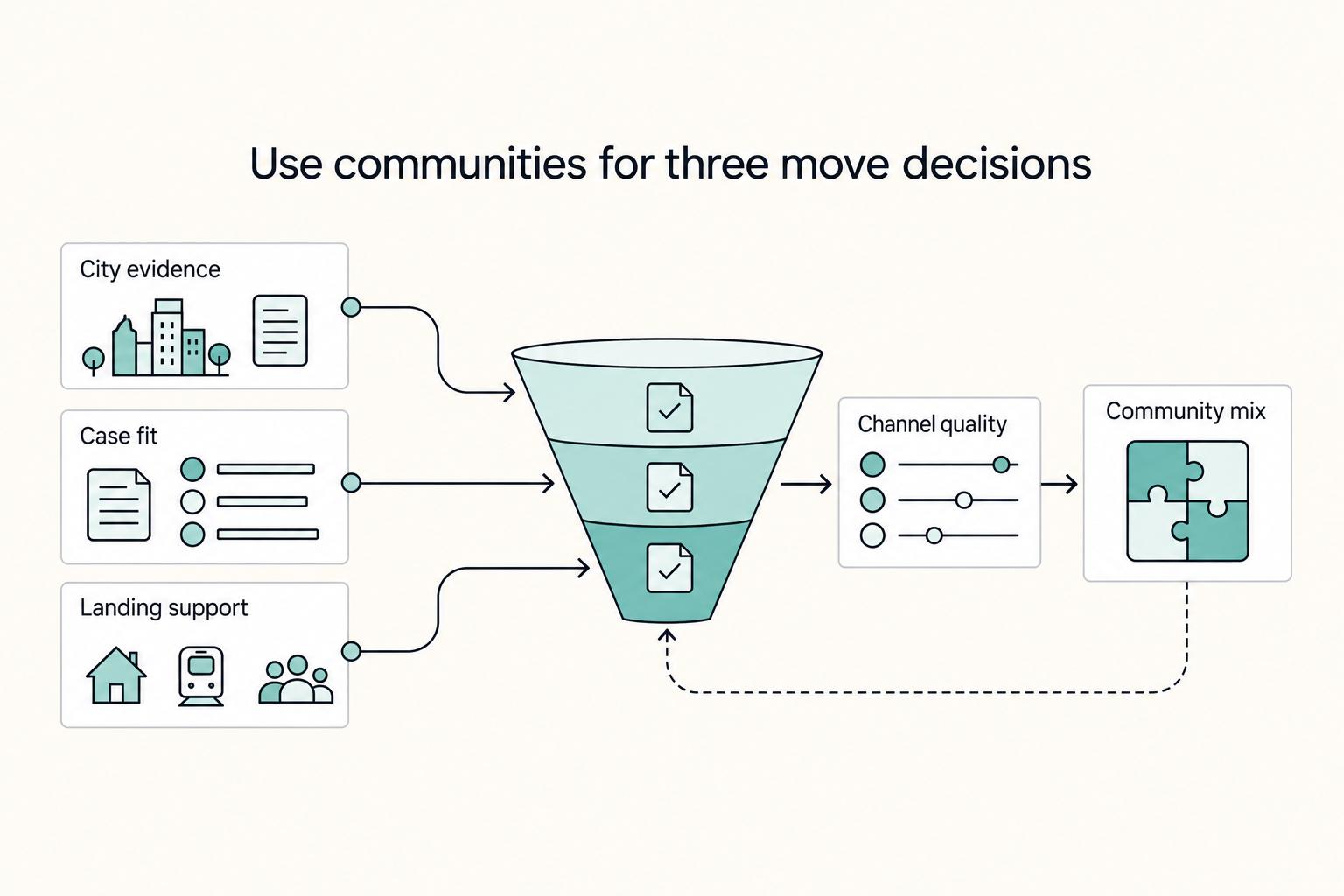
If your move date is real, use communities to answer three decisions in order: which city stays on your list, whether your case actually fits, and whether your landing week is covered. Judge every channel by outcomes, not activity. If it does not give you evidence you can use, stop giving it time.

A Freelancer's Guide to Professional Liability (E&O) Insurance
Set explicit checkpoints in your risk worksheet: day 30 intake review, day 60 contract review, day 90 claim-readiness review, and a 12-month renewal review.

The Freelance Payment Penalty: A Modeled Audit of Platform Fees, FX Spreads, and Payout Delays
The money rarely disappears through a single, easy-to-spot fee. The real loss is stacked. A marketplace takes its commission, a processor adds a charge for international cards, a bank or payment company converts the currency at a spread, a platform holds the funds before release, and a wire sheds a little to intermediaries on the way in. Each layer looks defensible on its own, but the worker feels the combined result as a smaller deposit and a later payday.