
Quick Answer
For mostly-GBP work, start with Starling’s no-monthly-fee sole-trader account, Monzo’s business plans and Mettle’s no-maintenance-fee account, checking eligibility and transaction charges. For regular foreign-currency receipts, quote Wise Business’s UK routes; confirm product eligibility before considering Revolut Business or Airwallex. Test statements, exports and return handling. Track HMRC deadlines and applicable MTD duties alongside onboarding; tax-account readiness is not a universal bank-opening gate.
What to Look for in a UK Freelancer Account for Payment Operations#
If you're choosing a UK bank account for freelance work in 2026, do not start by looking for a universal winner. Start with operational fit: how money comes in and goes out, who needs access, and whether your records stay complete for tax filing.
| Checkpoint | Timing | Notes |
|---|---|---|
| Tell HMRC if newly registering or restarting and a return is required | 5 October 2026 | 2025–26 tax year (6 April 2025–5 April 2026); check your registration circumstances |
| Standard paper return | 31 October 2026 | HMRC must receive it by the deadline |
| Standard online return and tax payment | 31 January 2027 | Separate payment-on-account instalments can also apply |
| Reactivate an existing Self Assessment account | Before filing where applicable | Tax-account access is separate from bank onboarding |
| Check MTD and filing route | Based on income and circumstances | Use compatible software if required; some returns need commercial software or another route |
That fit depends on your operating model and business structure. HMRC is clear that structure affects tax treatment and legal responsibilities. A sole trader is personally responsible for business debts, unlike limited company owners whose responsibility is limited to their financial investment.
So this guide compares UK options by operational fit, not brand hype. Use it to narrow the field based on how your setup actually runs. Then verify live provider terms before you commit.
Sole traders normally register for Self Assessment when gross trading income exceeds GBP 1,000 in a tax year; check exceptions and other reasons a return may be required. Keep bank statements and receipts from the start. For the 2025–26 tax year, tell HMRC by 5 October 2026 if a return is required and you are newly registering or restarting after not filing the previous year. The standard paper deadline is 31 October 2026; online filing and payment are due 31 January 2027. Payments on account can also be due 31 July. Tax registration and filing are separate from bank onboarding; meet the provider’s actual account-opening requirements.
Keep these checkpoints in view from day one:
- For the 2025–26 tax year, tell HMRC by 5 October 2026 if a return is required and you are newly registering or restarting after not filing the previous year. The standard paper deadline is 31 October 2026; online filing and payment are due 31 January 2027. Payments on account can also be due 31 July. Tax registration and filing are separate from bank onboarding; meet the provider’s actual account-opening requirements.
- Making Tax Digital for Income Tax applies from 6 April 2026 to qualifying sole traders and landlords with over GBP 50,000 qualifying gross self-employment/property income on the 2024–25 return, subject to eligibility and exemptions. It requires compatible software, digital records and quarterly updates, as well as the annual return. A bank feed alone does not satisfy those duties.
- Retain statements, receipts and dated submission evidence; confirm any reactivation or alternative filing route with HMRC.
The aim is practical: narrow the choice by scenario and leave with an implementation checklist you can use right away.
At-a-glance comparison of UK freelancer banking options#
Use these UK product terms as a starting shortlist, then test the exact account and plan against your legal structure and transaction mix. Prices checked on 2 October 2026 can change; current tariffs and individual eligibility control the decision.
| Provider / product | UK price starting point | Fit and conditions | What to test |
|---|---|---|---|
| Starling sole-trader account | No monthly account fee; other tariff charges can apply | UK sole traders meeting residency/activity requirements; domestic-first option | Cash/foreign-payment charges, exports and support |
| Monzo Business | Pro GBP 9/month; Team from GBP 25/month; compare Lite for basic needs | UK sole traders and qualifying limited companies; paid features vary by plan | Accounting access, cash charges and exact plan needs |
| Mettle | Mettle has no account-maintenance fee, but cash deposits cost GBP 2.75 and cash withdrawals GBP 1 each; optional Mettle+ costs GBP 4 a month. Included FreeAgent requires at least one transaction monthly; optional FreeAgent features can cost extra. | UK-based sole traders and limited companies with up to two owners; check access restrictions | International receipts, cash use and FreeAgent conditions |
| Wise Business | Wise Business’s UK page lists a GBP 50 setup fee for its full feature set/account details, no holding fee, and currency-dependent sending/conversion fees from 0.24%. The starting rate is not a quote for every corridor; check the actual route, funding method and receive charges. | International collections/conversions; it is an e-money product rather than a bank deposit | Actual corridor quote, receiving rail and export trace |
| Revolut | Revolut Business Basic starts at GBP 10 a month, with plan allowances and additional transaction/FX fees. UK sole traders should check Revolut Pro first: current Business help and legal pages differ on sole-trader eligibility, so obtain confirmation for the exact product before applying. | Pro and Business are different products; confirm eligibility and contracting entity | Plan allowances, FX conditions and deposit-protection disclosure |
| Airwallex | Airwallex Explore is GBP 19 a month excluding VAT, waived if qualifying deposits total GBP 10,000 during the monthly subscription or combined Wallet balances are at least GBP 10,000 at its end. Transaction fees still apply. Confirm that the UK business account supports your legal structure before applying. | Candidate for an eligible business needing international collections/payouts | Direct-product legal-form eligibility, FX/transfer charges and exceptions |
A low monthly fee can still leave significant cash, FX or receiving costs. Compare the same transaction basket across candidates, and retain the tariff and actual quote used in your calculation.
Wise Business’s UK page lists a GBP 50 setup fee for its full feature set/account details, no holding fee, and currency-dependent sending/conversion fees from 0.24%. The starting rate is not a quote for every corridor; check the actual route, funding method and receive charges. UK volume discounts are advertised above GBP 20,000 or equivalent; inspect how the actual quote applies them rather than treating that threshold as a flat rate.
For UK Wise card cash use, the current business page lists GBP 250 monthly withdrawals per account without a Wise ATM fee, then 2.69% on the amount above that threshold. ATM operators may add charges, and conversion fees can apply. Check the account’s current location-specific limits rather than assuming all withdrawals are free.
UK account structure and compliance baseline#
Treat the UK baseline as a checklist to verify, not something to assume. The following items need a pre-approval check: sole-trader use of personal current accounts, FSCS limits or eligibility, and HMRC and MTD obligations.
| Decision area | Verification status | What you still need before approval |
|---|---|---|
| Personal versus business account | Sole traders are not legally required to have a business bank account; personal-account terms may prohibit business use | Confirm permitted use; a limited company needs its own business account |
| Protection and account ownership | FSCS covers eligible bank deposits up to GBP 120,000 per eligible person, per authorised firm from 1 December 2025. Accounts sharing a banking licence share the limit. E-money safeguarding is different from deposit protection; confirm the legal provider and product, including any legacy account. | Check the authorised firm, exclusions, shared licence and named account owner |
| HMRC and MTD records | Making Tax Digital for Income Tax applies from 6 April 2026 to qualifying sole traders and landlords with over GBP 50,000 qualifying gross self-employment/property income on the 2024–25 return, subject to eligibility and exemptions. It requires compatible software, digital records and quarterly updates, as well as the annual return. A bank feed alone does not satisfy those duties. | Test statements and exports through the applicable accounting/software workflow |
Retain current provider terms, clear ownership and permissions, and applicable UK tax guidance. Use dated records and actual transaction tests rather than archived community answers.
Scenario picks for operators who need speed and control#
Start with your operating pattern, not an app store rating. Once you know the pattern, hold every shortlist candidate to the same approval standard.
| Operating priority | First shortlist to test | What to verify first | Approval artifact to capture | Common failure mode |
|---|---|---|---|---|
| Domestic-cost-focused screening | Starling Bank, Mettle (validate live terms) | Edge-case charges, business-use terms, statement/export quality | Current fee page/version and business-use eligibility terms | Low headline cost that changes once non-standard payments or exceptions appear |
| Cross-border collections and conversions | Wise Business; Revolut or Airwallex only after exact-product eligibility confirmation | FX transparency, receiving routes, payout practicality, governing fee terms | Full pricing page or PDF, governing legal terms, sample payout quote | Percentage loading fees, route-specific receiving charges, or unclear fee precedence |
| Broader bank relationship depth or financing path | NatWest, HSBC, Barclays | Controls, onboarding requirements, escalation path, relationship fit | Product terms, account-opening requirements, named escalation contacts | Higher operational complexity and slower setup than expected |
If fixed domestic cost is your main goal#
For low fixed domestic cost, start with Starling’s no-monthly-fee sole-trader account and Mettle’s no-maintenance-fee account. Mettle has no account-maintenance fee, but cash deposits cost GBP 2.75 and cash withdrawals GBP 1 each; optional Mettle+ costs GBP 4 a month. Included FreeAgent requires at least one transaction monthly; optional FreeAgent features can cost extra. Compare cash and international charges before choosing.
Use your real payment shape to test the model before approval. If your close process depends on clean exports, run a real statement and CSV through your accounting flow first.
If cross-border is core, optimize for fee clarity first#
Wise Business’s UK page lists a GBP 50 setup fee for its full feature set/account details, no holding fee, and currency-dependent sending/conversion fees from 0.24%. The starting rate is not a quote for every corridor; check the actual route, funding method and receive charges.
| Provider | UK pricing | Eligibility / cost caveat |
|---|---|---|
| Wise Business | Wise Business’s UK page lists a GBP 50 setup fee for its full feature set/account details, no holding fee, and currency-dependent sending/conversion fees from 0.24%. The starting rate is not a quote for every corridor; check the actual route, funding method and receive charges. | Quote the actual corridor and receive rail |
| Revolut | Revolut Business Basic starts at GBP 10 a month, with plan allowances and additional transaction/FX fees. UK sole traders should check Revolut Pro first: current Business help and legal pages differ on sole-trader eligibility, so obtain confirmation for the exact product before applying. | Pro is distinct; obtain exact-product eligibility confirmation |
| Airwallex | Airwallex Explore is GBP 19 a month excluding VAT, waived if qualifying deposits total GBP 10,000 during the monthly subscription or combined Wallet balances are at least GBP 10,000 at its end. Transaction fees still apply. Confirm that the UK business account supports your legal structure before applying. | Verify direct-product legal-form eligibility before applying |
Revolut Business Basic starts at GBP 10 a month, with plan allowances and additional transaction/FX fees. UK sole traders should check Revolut Pro first: current Business help and legal pages differ on sole-trader eligibility, so obtain confirmation for the exact product before applying. Use the UK Business fee schedule for Business and the separate Pro/personal-plan terms for Pro; do not import US Personal Standard funding fees.
Airwallex Explore is GBP 19 a month excluding VAT, waived if qualifying deposits total GBP 10,000 during the monthly subscription or combined Wallet balances are at least GBP 10,000 at its end. Transaction fees still apply. Confirm that the UK business account supports your legal structure before applying.
When broader banking depth matters more than fastest setup#
If long-term relationship depth matters more than speed, compare NatWest, HSBC, and Barclays, then verify onboarding requirements and escalation paths directly. Approval should depend on concrete operating controls: onboarding requirements, ownership and permission structure, and the escalation path when payment operations stall.
Single account or two accounts#
Use one account when flows are mostly domestic and reconciliation stays clean. Add a second when cross-border activity is frequent, reconciliation effort rises, or you need failure isolation so one provider issue does not halt all money movement.
A practical structure can be one domestic operating account plus one cross-border payments account. It adds reconciliation overhead, but may improve control separation and resilience depending on your transaction mix and controls.
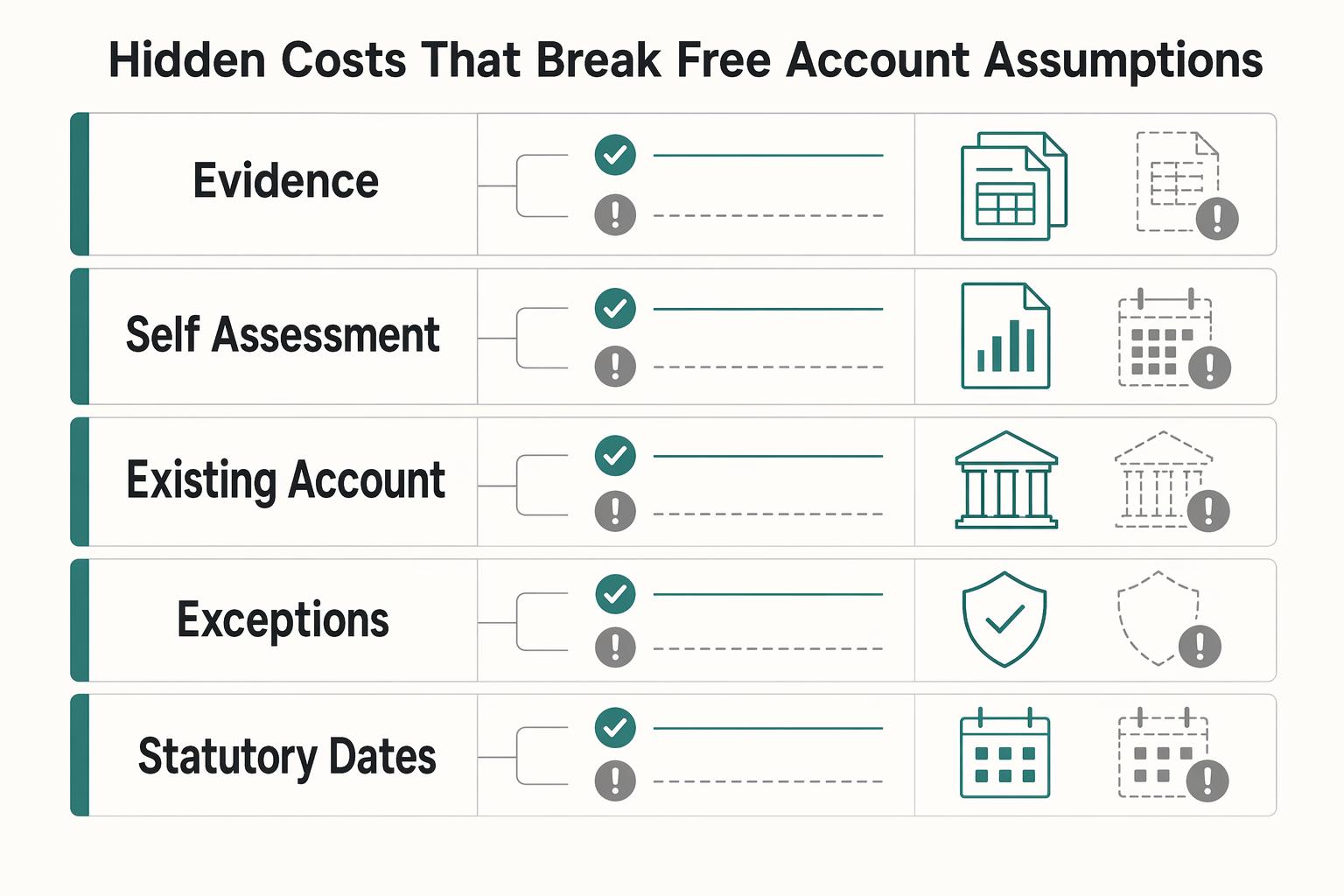
Hidden costs that break "free account" assumptions#
A zero monthly fee does not automatically mean low operating cost for tax operations. If recordkeeping or filing steps are weak, delay and penalty risk can outweigh the headline price.
Use a compliance-first matrix before approval so you separate what you can verify now from what can fail at filing time.
| Cost area | What triggers cost or friction | Knowable at onboarding | More visible after scale | Evidence to collect before approval |
|---|---|---|---|---|
| Recordkeeping | Missing bank statements or receipts needed for accurate returns | Yes | Yes | Sample statements/exports, receipt capture and archive process |
| Self Assessment registration | Not being ready to register when required | Yes | Sometimes | Applicable registration records and HMRC route, tracked separately from bank approval |
| Existing account status | Filing without reactivating an existing account | Sometimes | Often | Reactivation path and account-status checks |
| Filing route exceptions | Cases that cannot be filed through HMRC online | Partly | Often | Documented fallback route using commercial software or other forms |
| Statutory dates | Missing key notification or payment deadlines | Yes | Often | Controls for 5 October notification and 31 January payment dates |
The tradeoff is simple: low fixed cost still requires reliable compliance operations. If those controls are weak, the hidden cost shows up later as avoidable delay and risk.
Predictable now vs visible later#
At onboarding, you can usually verify whether records are usable, whether registration prerequisites are in place, and whether your filing path has exceptions. Later, risk usually shows up around deadlines and account-status checks during filing.
That distinction matters for tax operations. HMRC says you need records, including bank statements or receipts, to complete returns correctly. If those records are hard to extract or archive, the admin burden is real even when the account fee is low.
For Self Assessment operations, timing and process can create hidden cost too:
- For the 2025–26 tax year, tell HMRC by 5 October 2026 if a return is required and you are newly registering or restarting after not filing the previous year. The standard paper deadline is 31 October 2026; online filing and payment are due 31 January 2027. Payments on account can also be due 31 July. Tax registration and filing are separate from bank onboarding; meet the provider’s actual account-opening requirements.
- Prepare the identification and business information HMRC requires for your applicable registration route.
- Making Tax Digital for Income Tax applies from 6 April 2026 to qualifying sole traders and landlords with over GBP 50,000 qualifying gross self-employment/property income on the 2024–25 return, subject to eligibility and exemptions. It requires compatible software, digital records and quarterly updates, as well as the annual return. A bank feed alone does not satisfy those duties.
- Reactivate an existing tax account where necessary for filing and retain any alternative filing-route instructions.
Approval evidence to collect before sign-off#
For account approval, retain the provider tariff, eligibility and sample output. Separately, track your applicable tax administration records:
- Sample statements and exports, plus receipt evidence needed for recordkeeping.
- Applicable Self Assessment registration status and registration route, tracked on the tax calendar
- Existing Self Assessment account status and the reactivation path (if applicable).
- Filing-route instructions for cases that cannot use HMRC online filing.
- Calendar controls for key dates (including 5 October notification and 31 January payment).
Treat the monthly headline as one input alongside transaction costs, legal eligibility and tested records. Tax registration can proceed in parallel; it is not a universal account-opening condition.
Integration fit for finance and engineering teams#
Choose the bank-accounting setup that produces clear records and a reversible close, not the one with the smoothest app. If you cannot complete a sample close in Xero, QuickBooks, or FreeAgent without manual repair, do not standardize it.
HMRC guidance makes this operational rather than cosmetic: you need records, for example bank statements or receipts, so you can complete returns correctly. A practical pre-filing checkpoint is to confirm whether you need to send a tax return before registering, and to reactivate an existing Self Assessment account before filing to avoid delays. Weak statements, exports, or transaction detail can increase risk before Self Assessment and before the 31 January payment deadline.
What to compare across Xero, QuickBooks, and FreeAgent#
You do not need an abstract winner. You need a bank-to-ledger path that still works when something breaks.
| Test area | Xero | QuickBooks | FreeAgent |
|---|---|---|---|
| Reconciliation speed | Run a representative sample and count clean auto-matches vs manual recoding | Run the same sample and count manual touches to reach a clean ledger | Run the same sample and count manual touches to reach a clean ledger |
| Error recovery | Intentionally miscode or duplicate one entry, then verify trace, reversal, and clean re-close | Intentionally miscode or duplicate one entry, then verify trace, reversal, and clean re-close | Intentionally miscode or duplicate one entry, then verify trace, reversal, and clean re-close |
| Month-end close quality | Confirm a reviewer can tie ending balance to ledger using statements, receipts, and exports | Confirm a reviewer can tie ending balance to ledger using statements, receipts, and exports | Confirm a reviewer can tie ending balance to ledger using statements, receipts, and exports |
| Export fallback | Verify CSV or statement exports are complete enough if the live feed fails | Verify CSV or statement exports are complete enough if the live feed fails | Verify CSV or statement exports are complete enough if the live feed fails |
Minimum checks:
- Transaction metadata quality: confirm payee, reference, amount, date, refund markers, fee lines, and transfer direction survive into accounting records clearly enough for a second reviewer.
- Export reliability: confirm statements and exports remain usable if the live feed fails, because recordkeeping depends on retained evidence, not only synced views.
- Manual recoding load: measure recurring transactions that arrive without enough context and require repeated manual classification.
If manual recoding is high, treat it as a control risk. That risk matters even more if you later need commercial software or other forms because HMRC online filing does not cover every case.
App convenience versus operational control#
If you work solo, app speed can dominate. For finance ops and engineering owners, control matters more: can another person reconstruct activity, recover from a bad import, and produce an evidence pack without relying on phone screenshots?
This is where shortlists can break down. Product convenience helps onboarding, but finance quality usually depends on statement quality, export completeness, and consistent coding across close cycles.
Run a sample close before you commit#
Before rollout, run one close cycle with representative activity:
- Import or sync a few weeks of real transaction patterns, not only clean examples.
- Reconcile all items and count manual recodes, unmatched entries, and duplicate-risk cases.
- Break one entry intentionally to test recovery, not just the happy path.
- Save the evidence pack: bank statement, export file, receipts, and closing-balance tie-out.
Choose the option that completes this test with fewer manual fixes and clearer records, even if another app feels smoother day to day.
Cross-border payments and FX constraints#
Once your ledger path is stable, cross-border visibility becomes the next likely failure point. If you pay or collect in multiple currencies, choose the option that makes FX quotes, fees, and payment status auditable later, not just the one with the lowest monthly fee.
Domestic-first banks may fit mostly-GBP workflows. For foreign-currency receipts, contractor payouts or Swift flows, compare the exact bank tariff with Wise Business’s UK quote and eligible Revolut/Airwallex products. Confirm legal-form and product eligibility before pricing a candidate as available.
What to compare first#
| Option type | What current evidence supports | What you should verify for a UK rollout | Risk if you skip it |
|---|---|---|---|
| Domestic-first bank | Compare the current tariff for your actual flows | FX quote, receive/send rails, conversion/return records | Hidden spread or weak tracing |
| Wise Business | Wise Business’s UK page lists a GBP 50 setup fee for its full feature set/account details, no holding fee, and currency-dependent sending/conversion fees from 0.24%. The starting rate is not a quote for every corridor; check the actual route, funding method and receive charges. | Actual corridor, funding and receiving charges | One headline rate misses other charges |
| Revolut | Revolut Business Basic starts at GBP 10 a month, with plan allowances and additional transaction/FX fees. UK sole traders should check Revolut Pro first: current Business help and legal pages differ on sole-trader eligibility, so obtain confirmation for the exact product before applying. | Exact Pro/Business eligibility and UK plan terms | Wrong product or unpriced allowances |
| Airwallex | Airwallex Explore is GBP 19 a month excluding VAT, waived if qualifying deposits total GBP 10,000 during the monthly subscription or combined Wallet balances are at least GBP 10,000 at its end. Transaction fees still apply. Confirm that the UK business account supports your legal structure before applying. | Direct-product eligibility and route charges | Waiver misunderstood or product unavailable |
Where FX friction actually appears#
FX friction is usually cumulative, not one obvious fee.
| FX check | What to inspect | Grounded example |
|---|---|---|
| Quote timing | When the rate is shown and how long it is valid | If timestamping is unclear, finance cannot explain rate movement between approval and execution |
| Conversion visibility | Whether fees are shown separately or embedded in the rate | Wise UK Business shows mid-market exchange-rate pricing and separate currency-dependent fees |
| Payout state visibility | Whether operations can see payment status clearly | The section names pending conversion, sent, returned, and waiting on beneficiary details as states to track |
| Exception handling | How rejected payments, amended beneficiary details, and incoming Swift charges are recorded | Wise UK Business lists USD wire/Swift USD 6.11, GBP Swift GBP 2.16 and EUR Swift EUR 2.39 receiving fees |
The UK Wise Business page illustrates why receiving rail matters: incoming USD wire/Swift costs USD 6.11, GBP Swift GBP 2.16 and EUR Swift EUR 2.39 per payment, while listed domestic non-wire/non-Swift receipts are free. Correspondent charges can add cost. Test quote timing, conversion visibility, payout states and exception handling using the rails your clients actually send.
These are UK Business examples, not guarantees for every route or product. Use the current quote and governing schedule, and confirm whether the sender uses local rails or Swift.
The operator rule#
If your platform pays contractors in multiple currencies weekly, prioritize FX transparency and payout state visibility over the headline monthly fee. A higher fixed fee can still mean lower operational cost if finance can reconcile each conversion, trace returns, and investigate exceptions without relying on app screenshots.
Before approval, request a small evidence pack from each shortlisted provider. It should include the current UK fee schedule, governing terms, one sample FX quote, one completed multi-currency payout record, one failed or returned payment trace, and one statement or export showing original currency, converted amount, fee line, date, and payment reference. If these artifacts are hard to obtain, treat that as a control warning before you compare price.
Related reading: Best Digital Banks for Freelancers and Gig Workers Global Comparison.
Support quality and operational resilience checks#
Treat support as a control check, not a marketing line. If you cannot test escalation before rollout, treat the setup as an operational risk.
Any claim about fast help, priority handling, or 24/7 coverage is unverified until you can confirm the exact route your UK team would use during a real payment issue. Ask for named support channels, operating hours, what qualifies as a payments incident, how status updates are sent, and what evidence is required to trace a stalled transfer. If the answer is only "contact us in-app," with no documented next step, treat it as a weak control point.
| Check | What to verify before rollout | Why it matters when operations stall |
|---|---|---|
| Escalation path | Exact first-contact channel, required case data, and escalation route | Delays increase if finance has to assemble references and screenshots during an outage |
| Incident communication | Where service updates appear and whether case updates are available outside the app | Limited updates can lead to duplicate submissions, manual chasing, or weaker internal reporting |
| Evidence pack | Sample statement export, payment reference detail, and return or failure trace | Investigations are harder when records do not match payment identifiers |
| HMRC continuity | Who owns tax deadlines, account access, and fallback filing steps during disruption | Issues near filing deadlines can become compliance problems quickly |
Use bank statements and receipts to support your returns. For the 2025–26 tax year, tell HMRC by 5 October 2026 if a return is required and you are newly registering or restarting after not filing the previous year. The standard paper deadline is 31 October 2026; online filing and payment are due 31 January 2027. Payments on account can also be due 31 July. Tax registration and filing are separate from bank onboarding; meet the provider’s actual account-opening requirements.
Also confirm account status early. HMRC says you may need to reactivate an existing Self Assessment account, and filing without reactivation may delay the return. If online filing is unavailable in a specific case, the fallback is to use commercial software or other forms. Keep that fallback in the same outage checklist as payment tracing.
Implementation sequence for switching or adding banks#
Switch in stages: define the operating model, confirm provider eligibility, pilot limited volume and migrate with rollback rules. Track tax deadlines separately so changing the account does not interrupt recordkeeping or filing.
Step 1. Define the operating model and map control ownership#
Define the operating model first, whether that is a sole trader lane, agency lane, or mixed, and map control ownership before you open accounts. Your checkpoint is a one-page control map that names the account owner, payment approver, bookkeeping owner, and fallback owner.
| Operating model | What to map before opening accounts | Main control risk if skipped |
|---|---|---|
| Sole trader lane | Legal owner, account owner, tax-reporting owner, bookkeeping source of truth | Mixed records and unclear accountability |
| Agency lane | Invoice/payment ownership, approval rights, exception handling owner | Disputes and payment handling confusion |
| Mixed | Which flows follow which ledger path, and who owns each path | Reconciliation breaks across shared accounts |
Step 2. Map UK tax duties alongside provider onboarding#
For the 2025–26 tax year, tell HMRC by 5 October 2026 if a return is required and you are newly registering or restarting after not filing the previous year. The standard paper deadline is 31 October 2026; online filing and payment are due 31 January 2027. Payments on account can also be due 31 July. Tax registration and filing are separate from bank onboarding; meet the provider’s actual account-opening requirements.
Making Tax Digital for Income Tax applies from 6 April 2026 to qualifying sole traders and landlords with over GBP 50,000 qualifying gross self-employment/property income on the 2024–25 return, subject to eligibility and exemptions. It requires compatible software, digital records and quarterly updates, as well as the annual return. A bank feed alone does not satisfy those duties.
Then run a limited-volume pilot and inspect transactions end to end before scaling. Confirm your bookkeeping flow works in practice, including statement exports, payment references, and exception handling, not just headline integration claims.
Step 3. Execute a phased migration with explicit rollback criteria#
Execute a phased migration with explicit rollback criteria and a parallel-run period. Keep an exception log from day one with transaction date, reference, issue type, owner, and status.
Define rollback triggers in advance so decisions stay objective. Use measurable triggers, for example unresolved exceptions above your internal tolerance, rather than ad hoc judgment.
Step 4. Finalize governance artifacts and set a review cadence#
Finalize account ownership, approval rights, documentation standards and review cadence in writing. Keep applicable tax registration and filing records on their own calendar, and include the bank’s actual required verification evidence in the account go-live pack.
Related: The Best Business Bank Accounts for Freelancers.
Red flags that should pause selection#
Pause account selection for an unsupported legal structure or unusable records. Resolve tax registration and filing gaps as separate, time-sensitive tasks; they are not a universal condition for opening the bank account.
| Red flag | Why it matters in practice | What to verify before proceeding |
|---|---|---|
| Business structure and account setup are not aligned | HMRC says your business structure affects how you pay tax and your legal responsibilities. | Confirm whether you are operating as a sole trader or through a limited company, then verify the account is set up for that structure. |
| No clear plan to tell HMRC if a return is required | New or restarting filers who need a return must notify HMRC by the applicable 5 October deadline; check the tax year and circumstances. | Assign notification on the tax calendar; provider onboarding has its own requirements. |
| First-time filing path is unclear | First-time filers must register for Self Assessment before filing online. | Confirm registration status before relying on online filing. |
| Recordkeeping process is weak or undefined | HMRC expects records such as bank statements or receipts, and missing records can create filing friction. | Check that records will be captured and retained in a format you can use at return time. |
| Existing Self Assessment account is inactive with no reactivation plan | Filing without reactivating an existing account can delay the return. | Verify whether an account already exists and reactivate it before filing. |
A major pause point is a mismatch between business structure and account setup. HMRC states that business structure affects tax treatment and legal responsibilities. A sole trader is the simplest structure to set up and keep records for, but it carries unlimited liability. Limited-company owners are responsible for debts only up to their investment.
Missing tax registration or filing plans need a named owner and prompt action. For the 2025–26 tax year, tell HMRC by 5 October 2026 if a return is required and you are newly registering or restarting after not filing the previous year. The standard paper deadline is 31 October 2026; online filing and payment are due 31 January 2027. Payments on account can also be due 31 July. Tax registration and filing are separate from bank onboarding; meet the provider’s actual account-opening requirements. If the account makes required records harder to retain, choose a better recordkeeping route; do not turn filing access into an invented bank-opening prerequisite.
Decision checklist before you commit#
Do not commit on brand preference alone. Pick one primary option and one backup, then hold both to the same evidence standard so this stays an operating decision, not a subjective label.
Lock the shortlist before you debate finer points#
Use a fixed shortlist, for example: Starling Bank, Monzo, Mettle, Wise Business, and at least one full-service bank. This gives you a domestic lane, a cross-border lane where needed, and a fallback if onboarding or exceptions fail after go-live.
| Candidate | Role in your decision | What to prove before approval | Minimum evidence to keep |
|---|---|---|---|
| Starling Bank | Domestic-first option or backup | Legal setup and expected usage fit the terms; exports support your close process | Current fee schedule, sample statement export, support route |
| Monzo | Domestic-first option or backup | Same checks using your real transaction pattern, not a demo flow | Fee schedule, pilot transaction set, reconciliation notes |
| Mettle | Domestic-first option or backup | Same checks, including whether records are usable in bookkeeping | Product terms, sample month-end output, escalation path |
| Wise Business | Cross-border option or backup | Fees are acceptable for the currencies and routes you actually use; variable charges are understood | Current pricing pages, regulator-standardized fee document, test transfer evidence |
| One full-service bank | Resilience and fallback option | Opening path, operating contacts, and account ownership are clear enough to switch volume | Tariff, onboarding requirements, named support path |
If you cannot explain in one line why each candidate stays on or off the shortlist, you are not ready to approve.
Validate hard requirements, not brochure claims#
Map HMRC duties alongside account selection. Sole traders generally register when gross trading income exceeds GBP 1,000 for the tax year, subject to exceptions and other filing triggers. For the 2025–26 tax year, tell HMRC by 5 October 2026 if a return is required and you are newly registering or restarting after not filing the previous year. The standard paper deadline is 31 October 2026; online filing and payment are due 31 January 2027. Payments on account can also be due 31 July. Tax registration and filing are separate from bank onboarding; meet the provider’s actual account-opening requirements.
For online filing, you need your UTR, and HMRC says you may need to reactivate an existing Self Assessment account. Filing without reactivation can delay the return. HMRC also expects recordkeeping, including items such as bank statements or receipts. Run a pilot close with your real transaction mix and confirm your statements, references, and exports work cleanly in your bookkeeping workflow.
Also check filing-path constraints early. HMRC says its online filing service is unavailable for some cases, including partnerships, and points users to commercial software or other forms. In those setups, extra reconciliation work is a tax-admin risk, not a minor inconvenience.
Approve on evidence, then predefine your exit rule#
Approve after hidden-cost review, pilot evidence and escalation testing. Wise Business’s UK page lists a GBP 50 setup fee for its full feature set/account details, no holding fee, and currency-dependent sending/conversion fees from 0.24%. The starting rate is not a quote for every corridor; check the actual route, funding method and receive charges.
Set a review trigger before launch, for example 90 days. If support quality misses target, exception rates stay high, or reconciliation effort remains above plan, switch to the preselected backup instead of restarting the decision from scratch.
Before approval, run your shortlist through this payment fee comparison to pressure-test FX, transfer, and exception-cost assumptions against your real transaction mix.
Conclusion#
The right UK bank setup for freelance work is the one that fits your operating model and passes verification, not the one with the best marketing.
Use a staged decision path and keep the tradeoffs explicit:
- Shortlist by scenario: map your real payment flows first (for example, mostly UK payments vs regular cross-border activity), and keep at least one tested fallback.
- Check structure risk early: a sole trader is simpler to set up and keep records for, but you are personally responsible for business debts; a limited company is legally separate, and owner liability is limited to invested value.
- Pilot before approval: run a real month-end close and confirm your recordkeeping is complete, including bank statements or receipts needed for returns.
- Track the applicable tax year and filing route: for standard 2025–26 Self Assessment, notification where required by 5 October 2026, paper filing 31 October 2026, online filing/payment 31 January 2027; check payments on account and MTD duties.
- Validate filing mechanics: reactivating an existing Self Assessment account can help avoid filing delays, and some cases require commercial software or alternative forms instead of the standard online route.
Treat account choice as operational infrastructure. Approve only when the pilot proves the controls, and keep a tested fallback before full rollout.
Need the full breakdown? Read The Best Bank Accounts for Freelancers in the UK.
If your team wants one operational layer for collecting funds, tracking balances, FX conversion, and payouts with audit-ready controls, review Gruv payouts.
Frequently Asked Questions
Do UK freelancers need a business bank account, or can a sole trader use a personal current account?
A sole trader is not legally required to have a business bank account, but personal-account terms may prohibit business transactions. Check permission and separate records. A limited company is a separate legal person and needs its own business account.
Is Starling Bank really fee-free in practice, and what costs still need checking?
Starling’s sole-trader account has no monthly fee, but other tariff charges can apply, including cash and foreign-payment costs. Inspect the current schedule for your own transaction mix; no monthly fee does not mean every service is free.
Which banks are most commonly considered for UK freelancers in 2026?
No single market-wide UK popularity ranking for 2026 is independently verified. Build your shortlist from your own needs, and verify UK eligibility and pricing directly with each provider before deciding.
What should I compare first: fees, integrations, support quality, or FSCS protection?
FSCS covers eligible bank deposits up to GBP 120,000 per eligible person, per authorised firm from 1 December 2025. Accounts sharing a banking licence share the limit. E-money safeguarding is different from deposit protection; confirm the legal provider and product, including any legacy account. Wise’s UK e-money balance is safeguarded rather than covered as a bank deposit. Check each account’s own disclosure; Mettle bank deposits and legacy PPS e-money accounts have different protection.
When should I pick Wise Business, Revolut Business, or Airwallex over a domestic-first bank?
Consider a specialist when international collections, conversions or payouts are frequent, after checking legal-form eligibility. Wise Business’s UK page lists a GBP 50 setup fee for its full feature set/account details, no holding fee, and currency-dependent sending/conversion fees from 0.24%. The starting rate is not a quote for every corridor; check the actual route, funding method and receive charges. Revolut Business Basic starts at GBP 10 a month, with plan allowances and additional transaction/FX fees. UK sole traders should check Revolut Pro first: current Business help and legal pages differ on sole-trader eligibility, so obtain confirmation for the exact product before applying. Airwallex Explore is GBP 19 a month excluding VAT, waived if qualifying deposits total GBP 10,000 during the monthly subscription or combined Wallet balances are at least GBP 10,000 at its end. Transaction fees still apply. Confirm that the UK business account supports your legal structure before applying.
How do I verify HMRC and Making Tax Digital readiness before switching accounts?
Making Tax Digital for Income Tax applies from 6 April 2026 to qualifying sole traders and landlords with over GBP 50,000 qualifying gross self-employment/property income on the 2024–25 return, subject to eligibility and exemptions. It requires compatible software, digital records and quarterly updates, as well as the annual return. A bank feed alone does not satisfy those duties. Test the chosen accounting software and records, not just a bank’s marketing claim or price page.
Try a related tool
Researched and edited by the Gruv editorial team. Gruv builds cross-border billing, payouts, and finance-operations software for global businesses.
Sources
Includes 5 external sources outside the trusted-domain allowlist.
- business.gov.uk/support/accounting-tax-cashflow/getting-a-bu...trusted
- wise.com/gb/pricing/businesstrusted
- wise.com/help/articles/2949821/how-wise-keeps-your-mo...trusted
- airwallex.com/en-uk/pricingexternal
- gov.uk/government/publications/national-payments-vi...external
- gov.uk/self-assessment-tax-returns/registeringexternal
- help.airwallex.com/hc/en-gb/articles/900001757026-Eligibility-t...external
- help.revolut.com/help/setting-up-an-account/is-my-business-el...external
Educational content only. Not legal, tax, or financial advice.
Related Posts

High-Interest Business Checking Accounts for Freelancers
Choose a business account that accepts your legal form, owners and operating location before comparing its yield. This shortlist covers Bluevine and Axos business-checking products documented on their own sites. The recommendations below are based on published terms and illustrative arithmetic, rather than hands-on testing or an exhaustive ranking of every account.

The Best Business Bank Accounts for Freelancers
A US freelancer paid mainly by bank transfer has different needs from a studio taking cash, or a consultant holding foreign currencies before conversion. Compare the legal business type, owner location, collection methods and fees before choosing an account. A dedicated business account makes client receipts, delivery costs and owner draws easier to reconcile, but the account name does not itself create a separate legal entity.

Bank Accounts for Freelancers in Germany: Plans and Costs
For a freelancer in Germany, the best account is the one that accepts your business setup, receives your clients’ payments and produces records your bookkeeping process can use. A free account can fit a consultant with a few transfers; a photographer depositing cash or a studio issuing employee cards needs a different shortlist.