
Quick Answer
Yes, recording can be legal if you confirm consent before substantive discussion, then apply the strictest plausible rule when jurisdictions conflict. The article uses the Electronic Communications Privacy Act of 1986 and 18 U.S.C. 2511 as baseline context, but treats state standards as the practical control point. For interstate or cross-border calls, get explicit agreement from all participants or keep recording off. Capture proof in sequence: notice wording, each response, start or pause times, and storage path.
Introduction for freelancers who cannot afford a recording mistake#
A recording mistake can turn an ordinary client call into a dispute about what was said or agreed. If there is no audio or video file and no near-verbatim transcript, people can challenge what happened.
Treat recording as a risk decision, not a convenience setting. Use the approach below for calls that may involve more than one jurisdiction. It is not legal advice, and outcomes can change with jurisdiction and timing details. The goal is to make choices you can defend later.
Start with one practical move before your next meeting: decide in advance whether you will record, not record, or pause until you get legal confirmation. Making that call before people join prevents rushed decisions when the conversation is already moving.
By the end, you will have:
- A decision tree for when to record, pause, or skip recording.
- Consent scripts you can use live, including how to proceed if someone declines.
- Contract language checkpoints so call practice matches written terms.
- An evidence checklist for preserving what happened in a retrievable format.
When recording is appropriate, aim for a near-verbatim record. When recording is not appropriate or not possible, keep clean notes and metadata so you still have defensible evidence if a disagreement is formally reviewed. If you want a deeper dive, read Germany Freelance Visa: A Step-by-Step Application Guide.
Define the legal terms before you press record#
Define the legal frame before anyone records, and capture it in plain language. If consent status is unclear, pause and get explicit agreement first.
| Term | Article framing |
|---|---|
| One-party consent | At least one participant in the conversation consents to recording. |
| All-party consent | Used as a stricter model where every participant may need to consent before recording begins. |
| Two-party consent | A label used in call-recording law summaries for stricter consent requirements. |
| Implied consent | Do not assume this is sufficient; if consent status is unclear, get explicit agreement before recording. |
| Interception, wiretapping, eavesdropping | Legal framing categories that can appear in statutes or claims, even when your software uses simpler labels. |
This translation step matters. A record button describes an app action, not the legal category that may be disputed later. Keep notes and contract language aligned with legal terms.
Use federal context carefully. The Electronic Communications Privacy Act of 1986 is a baseline reference, and federal materials discuss consent-related interception exemptions. States can still impose stricter rules. Secret recordings can create litigation downside, not just evidence upside, so if there is doubt, stop and confirm consent before recording.
A common mistake is treating software labels as legal labels. If your app says "recording enabled," that status still does not answer whether consent was validly obtained for that call. Separate those questions in your notes: technical status, legal basis, and who confirmed consent.
When teams skip this definition step, disputes become harder to resolve because people use the same word to mean different things. Keep a short glossary in your client operations notes so everyone handling calls uses the same terms in the same way. Related: The Best CRMs for Freelancers to Manage Client Relationships.
Start with the federal baseline and then apply the stricter rule#
Use a two-step rule on every call: start with the federal baseline, then check whether a stricter state rule could plausibly govern. Federal summaries are a baseline, not a current 50-state compliance map.
Under the Electronic Communications Privacy Act, intercepting communications is generally restricted, with a consent-based exception described when one party has given prior consent. Treat federal one-party framing as a starting point for analysis, not automatic permission to record every client call.
Do not treat this as criminal exposure only. Federal summaries describe potential civil exposure, including damages, attorneys' fees, and possibly punitive damages. They also describe additional risk when someone later uses or discloses information obtained through illegal wiretapping or eavesdropping.
Use one rule every time:
- If federal and state standards appear to differ, use a conservative approach and follow the stricter plausible standard.
- If multiple states could apply, use the strictest plausible standard.
- If you cannot confirm the controlling rule before the call, do not record until explicit consent is captured.
Make this practical with short records. Log your assumed jurisdiction and consent model before the call. Then log whether consent was explicit and when recording started, paused, or was skipped. If a call is later challenged, this helps show a consistent decision path.
You can make this easier by using a simple pre-call note template with required fields. At minimum, require participant location, the rule you are applying, and the exact consent method used on that call.
This stricter-rule approach can reduce avoidable arguments later. Instead of debating whether you guessed right in real time, you can show a consistent path that favored the more protective standard when uncertainty existed. You might also find this useful: How to Overcome Financial Anxiety as a Freelancer.
Know where all-party consent risk is highest in U.S. client work#
Take a conservative position in U.S. client work. If any participant is in a state with all-party consent risk, treat the call as all-party consent until you verify the current rule.
Use state lists as risk flags, not a definitive legal map for every call. California and Maryland are clear all-party-risk examples, and one example shows that a California or South Carolina participant can trigger a prior-consent requirement.
Do not rely on an old 50-state chart. State rules can change, summaries age quickly, and a visible publication date does not guarantee current accuracy. Verify the controlling state rule before recording, and use this snapshot in prep notes:
| State-risk snapshot | What to assume before recording | Pre-call check |
|---|---|---|
| States explicitly flagged in your current materials (for example, California and Maryland) | Higher risk that explicit consent from every participant is required | Ask each participant for clear verbal consent before recording starts |
| Any participant location you have not verified yet | Do not assume one-party rules apply; state requirements may be stricter | Verify the current state rule and log when you verified it |
Operational rule: confirm participant location at call start, then log how consent was captured, by whom, and when recording began. If disclosure is given but clear consent is not captured, pause and get explicit acknowledgment before continuing.
In practice, this section is about prioritization. You are not proving final legal outcomes during scheduling. You are identifying calls where recording risk is higher, then applying tighter consent behavior before the meeting can drift into substantive discussion.
A useful contrast is simple. If everyone is in a location you already verified and your contract language matches your script, recording may proceed once consent is clear. If even one participant location is uncertain, stop recording and resolve that uncertainty first.
Decide interstate and cross-border calls with one clear rule set#
Use one conservative rule for interstate and cross-border calls. If participant location or governing law is unclear before the meeting starts, get explicit consent from all participants or do not record.
In interstate calls, treat multi-jurisdiction uncertainty as the practical problem. If you cannot clearly identify which rules control, treat uncertainty as a stop sign rather than a judgment call.
In cross-border calls, assume stricter variance, not U.S.-only norms. Privacy rules differ by country, and a practice that seems acceptable in one place can create legal trouble elsewhere. U.S. cross-border policy analysis also flags conflicts with foreign law.
Use this verification checkpoint before recording:
- Confirm each participant's physical location at the start of the meeting.
- Confirm the governing-law assumption you are relying on for that call.
- Decide the mode before recording begins: explicit consent from all participants or no recording.
- Log who confirmed the decision and when. If location or governing law remains uncertain, do not record until both are clear and consent is captured.
This is where many freelancers need a hard boundary. If a client says, "Let's just start and sort this out later," that is exactly the moment to keep recording off. A delayed legal check is not a substitute for capturing consent before recording.
If you must continue the meeting without recording, switch immediately to structured notes. Record who attended, what was approved, what is pending, and what decisions require written confirmation after the call. You preserve momentum without creating avoidable recording risk.
Run consent in-call with scripts that actually create proof#
If you want evidence that is easier to defend in a dispute, use a fixed consent script before recording starts. Capture clear verbal agreement from the people who must consent.
A defensible record is usually a sequence you can replay later: who joined, what notice was given, who said yes or no, and when recording began.
A script matters because consistency can drop under time pressure. People may shorten language or assume prior consent carries forward. Using the same sequence each time reduces those shortcuts.
Follow one fixed in-call sequence#
- Identify participants first. Confirm each person by name and ask whether anyone else is present or listening.
- Give notice at the beginning of the call. State that recording is planned, through an automated message or a spoken disclosure.
- Request consent in the right mode. Use one-party or all-party language based on the jurisdictional rule you selected.
- Confirm acknowledgment out loud. Ask each required participant for a clear yes or no by name.
- Start recording only after acknowledgment. State that recording is now on and log that moment in your notes.
If any required answer is unclear, keep recording off, repeat the question once in plain language, and continue without recording if consent is still not clear.
The sequence should happen before substantive discussion, not midway through it. If people start talking business first, pause the substance, run consent, then restart. That pause may feel awkward, but it helps keep your record defensible.
Script lines for one-party, all-party, and refusal#
| Script | When to use | Line |
|---|---|---|
| One-party | Use one-party language based on the jurisdictional rule you selected. | Before we continue, I plan to record this call for project accuracy. Do you agree to recording? |
| All-party | Use all-party language based on the jurisdictional rule you selected. | I will record only if everyone agrees. I am asking each person now. Please answer yes or no when I call your name. |
| Refusal | If someone declines recording. | Thanks for telling me. I will not record. I will take written notes instead. Are you okay to continue without recording? |
| Late-joiner | When a new participant joins. | Quick notice for the new participant. Recording stays off until I get your answer. Do you agree to recording? |
One-party script:Before we continue, I plan to record this call for project accuracy. Do you agree to recording?All-party script:I will record only if everyone agrees. I am asking each person now. Please answer yes or no when I call your name.Refusal script:Thanks for telling me. I will not record. I will take written notes instead. Are you okay to continue without recording?Late-joiner script:Quick notice for the new participant. Recording stays off until I get your answer. Do you agree to recording?
Use the refusal script without defensiveness. A clean no-recording transition can protect the relationship and keep the meeting productive. It also reduces the chance that someone later disputes consent quality.
Why implied consent is weaker evidence#
Implied consent usually means someone keeps talking after notice. That is a passive signal, not explicit agreement.
Passive continuation can add context, but it is easier to dispute than a clear verbal yes. Because jurisdictions still differ on secret-recording boundaries, relying on passive behavior alone can be a higher-risk position. If you proceed without explicit consent, detailed notes matter more: disclosure wording, participant list, each response, and the exact point recording started or stayed off.
If implied consent is all you have, the strength of your proof depends more on your records. That means your timing notes and script language need to be precise enough that a third party can understand the sequence without guessing.
Keep an evidence pack you can produce in a dispute#
Build the evidence pack immediately after each call. In practice, this helps you answer questions quickly instead of reconstructing events from memory.
Minimum evidence pack#
| Item | What to capture |
|---|---|
| Timestamp | When notice was given, when consent was confirmed, and when recording started or stayed off. |
| Participants | Everyone on the call, including late joiners. |
| Consent statement | The notice and request wording, plus each person's response. |
| Recording status | On, off, paused, or resumed, with time markers. |
| Storage location | The exact path or record ID for the recording and notes. |
If a dispute is framed as wiretapping or eavesdropping, this pack helps answer an early question quickly: did recording begin before or after consent?
For each item, capture enough detail to verify sequence. "Consent obtained" is not enough by itself. A stronger entry notes who answered, what they said, and when recording was activated relative to that answer.
Retention and access controls that preserve auditability#
Use controls that protect integrity and privacy without making retrieval harder:
- Keep backup redundancy so one storage failure does not erase the record.
- Make a copy promptly after the call and verify files open.
- Restrict access to need-to-know people and log access or exports.
- Set a written retention policy with counsel, rather than assuming one universal private-sector rule.
Stored electronic communications can be subject to legal process. Under 18 U.S.C. 2703, disclosure paths differ based on storage duration, including a warrant path for content in electronic storage for 180 days or less.
Access control failures can happen during convenience sharing. Someone exports a file "just for review," and the trail disappears. Keep one rule: if a recording leaves its primary location, log who exported it, why, and where it went.
Failure modes that increase exposure#
One failure mode is an incomplete log, not the call itself. If consent proof is missing or unclear, exposure rises even when you believed consent existed.
Implied consent may be argued when notice is announced and the other person stays on the call, but this is fact- and jurisdiction-specific rather than a universal rule. If any required field is missing at call close, treat the pack as incomplete and fix it the same day.
Another failure mode is mismatched records. The audio file exists, but the note says recording stayed off, or the note shows consent but no timing marker. Reconcile those gaps immediately while memory is fresh.
A practical end-of-day check helps: open each call record, confirm timestamps, confirm participant list, and confirm storage path. If one field is missing, close the gap before you move on.
Put Governing Law, Jurisdiction, Dispute Resolution, Termination, Limitation of Liability, and Indemnification in your client contract#
Contract language should match how calls are handled in practice. If terms and behavior drift apart, disputes can get harder and more expensive before the facts are even reviewed.
- Governing Law and Jurisdiction: State-level differences can change when recording is legal, so avoid one-size-fits-all assumptions and align law/forum choices with your consent handling.
- Dispute Resolution: Define process, not just labels. A strong clause identifies covered disputes, the institution, and key details, including seat. A common structure is mediation first, then final and binding arbitration if unresolved.
- Termination: If you include recording-related obligations, state post-engagement handling clearly so expectations are explicit at closeout.
- Limitation of Liability and Indemnification: If these clauses are included, define the scope for recording-related claims clearly.
If you are deciding between forum paths, treat timing as a practical factor. Commercial arbitration is often cited at about 14.5 months to award. U.S. district civil cases are often cited at a 33.7-month median from filing to trial. These are directional benchmarks, not guarantees.
Before you send a contract, cross-check it against your live call script. If the contract implies one consent posture but your script uses another, update one of them before the first recorded meeting.
Keep clause language usable by non-lawyers who run calls. The person asking for consent should be able to connect contract terms and recording behavior without legal translation in the moment.
Avoid the mistakes that trigger claims fast#
Many recording-related problems come from process failures, not complex legal theory. Common failures are recording before disclosure, unclear consent, and sharing beyond the stated purpose.
Do not record until disclosure is delivered and consent is clear for that call. Give disclosure at the beginning, including why you are recording and how the recording will be used, stored, and protected. If you need stronger proof, capture active consent before recording starts.
Do not treat one-party consent as universal. Requirements vary by jurisdiction, and U.S. approaches are not uniform. If location or consent standard is unclear, use an all-party script or do not record.
Keep scripts aligned with your current disclosure and consent process. Reusing old language can create confusion about purpose and data handling. Update the call script when recording practices change, and retire prior versions promptly.
Use this pre-record checkpoint every time:
- Confirm participant locations when needed to apply the right consent standard.
- Deliver disclosure at call start, including purpose and data handling.
- Ask for explicit consent where higher-consent rules may apply.
- Document the disclosure and consent outcome for the call.
Even when recording is lawful, sharing beyond the original purpose can create new privacy and consent risk. Limit access to the disclosed purpose, and document any secondary-use decision.
If you cannot verify consent requirements, participant location, or intended use, do not record. Continue with notes and resolve the gap before the next call.
When mistakes happen, contain them fast. Stop recording, document what happened, preserve the current files, and consider legal review before any further use or disclosure of the recording.
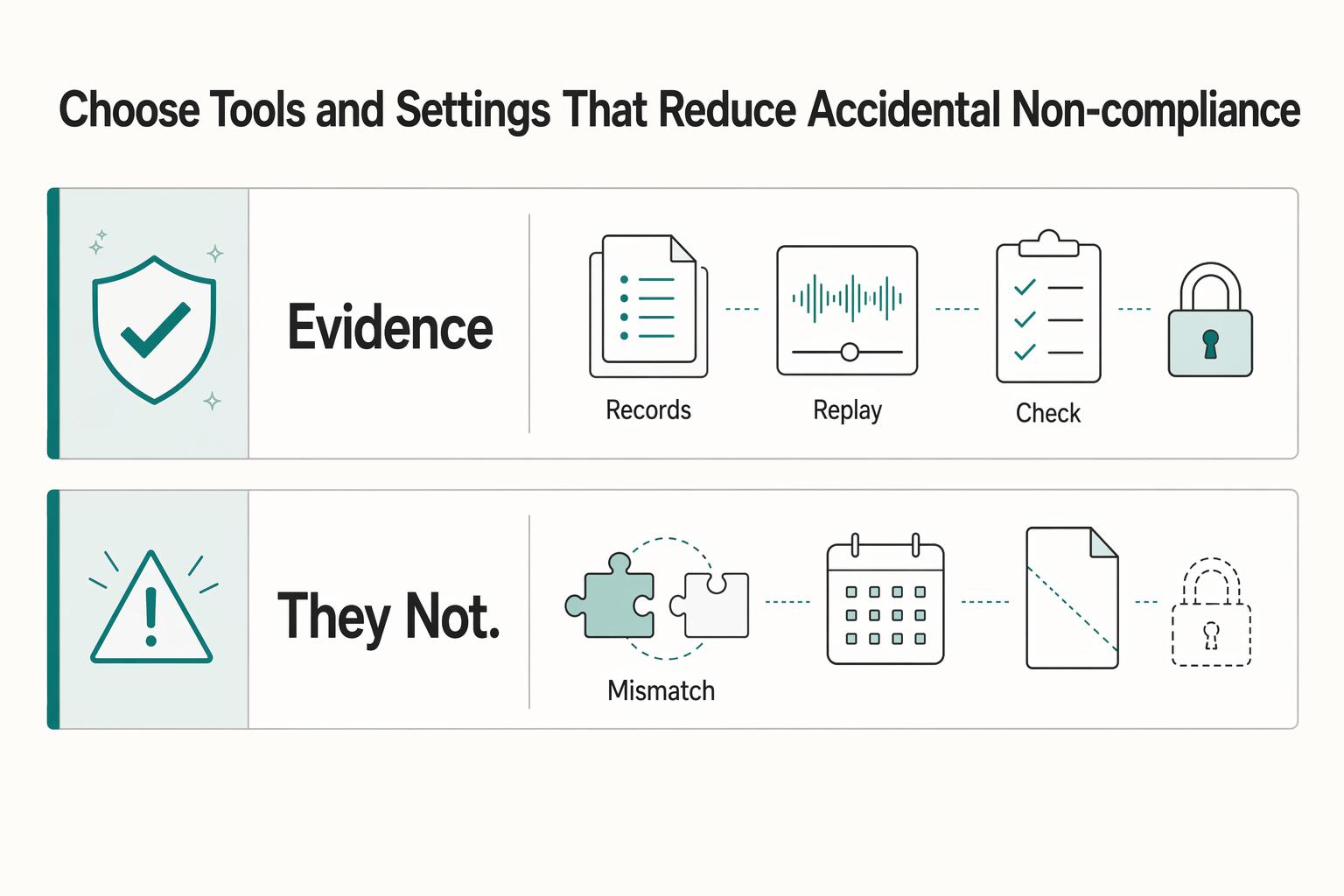
Choose tools and settings that reduce accidental non-compliance#
Tool settings should enforce the behavior you already decided on. They reduce accidental drift, but they do not prove legal sufficiency by themselves.
- Confirm with your platform's documentation and legal counsel whether recording must be gated behind a consent checkpoint in a CRM or dialer.
- They do not define required pre-record fields or a mandated non-recorded path for pending consent.
- They do not provide jurisdiction-aware recording prompt logic.
- They do not establish a required prompt sequence for disclosure, purpose, consent request, acknowledgment, and recording.
- They do not require storing consent metadata separately from transcript content.
- They do not define a specific no-consent, no-recording fallback workflow.
Treat configuration as behavior design, but validate control design against applicable law, legal advice, and platform documentation.
Run periodic internal checks by replaying the process as if you were a new teammate. If the tool behavior conflicts with your approved policy, correct the order and logging approach based on your validated requirements.
Use a pre-call and post-call checklist every time#
A checklist is a practical hard gate before, during, and after recorded meetings. It keeps behavior consistent under pressure and protects trust when someone questions what happened.
Pre-call:confirm who is on the call, the consent approach you plan to use, and any recording terms already agreed.In-call:run the script, request explicit consent, and confirm recording status before substantive discussion starts.Post-call:save the consent record and recording details, then restrict access to need-to-know users.Escalation:if any uncertainty remains, stop recording and escalate to counsel before the next call.
Use explicit consent as your default whenever possible. After the call, keep consent details easy to retrieve so you can quickly show what was agreed, when, and how recording was handled.
Non-compliance can lead to legal actions, fines, lawsuits, and trust damage, and severe cases can create broader business disruption. This checklist supports compliance and documentation, but it is not legal advice.
To make the checklist stick, assign ownership by stage. One person confirms pre-call fields, the host runs in-call consent, and one person closes the post-call record. Clear ownership can reduce skipped steps.
A short weekly review can also help. Pick recent calls, confirm the checklist was followed, and fix repeated misses in script language, meeting setup, or storage habits. Want a quick next step for "legality of recording client calls"? Try the SOW generator.
Conclusion with the one decision that keeps you safest#
Use one default rule: if key facts are unclear, get explicit all-party consent or do not record, then escalate to counsel. That default reduces uncertainty without guesswork.
Federal law is a baseline, not full protection. Under 18 U.S.C. §§ 2510 and 2511, one-party consent is the federal floor. States may impose stricter rules under eavesdropping, wiretapping, or intercepted-communication laws. Every state except Vermont has at least one law restricting eavesdropping or recording of private conversations, so meeting only the federal floor is not enough by itself.
This is a risk-control issue, not just a legal theory issue. Violations can create both criminal and civil exposure, and older statutes do not always map cleanly to modern communication tools. When interpretation is uncertain, pause and escalate.
Before your next client call, use a short checklist:
- Verify the current rule using a reliable state-by-state summary before recording.
- Ask for explicit consent before recording starts.
- If consent or legal context is unclear, do not record and get legal review.
Clear scripts and consistent pre-call checks help, but generic legal summaries are not a substitute for legal advice. Use guides to prepare, and treat edge cases as counsel issues, not quick judgment calls.
Frequently Asked Questions
Is it legal to record a client call in the U.S.?
Sometimes, but not in every situation. Legality depends on the facts, including consent and whether there is a reasonable expectation of privacy. Check the consent standard before each call, not after. If you discover uncertainty during the call, pause recording immediately and switch to notes.
What is the federal rule under 18 U.S.C. § 2511, and when can state law still control?
Section 2511 is framed around intentional interception of wire, oral, or electronic communications, not just a recording label. In some contexts, state-law one-party consent can affect whether conduct violates the federal rule. The exact outcome is fact-specific, which is why the stricter-rule approach is practical when state standards may be more restrictive for the same call facts.
Which states are commonly treated as all-party consent states?
This guide does not provide a definitive, current 50-state list. Treat static lists as risky because rules can change and details matter. If you are unsure, verify current state law before recording and treat watchlists as a screening aid rather than final authority.
What should I do if my client is in another state during the call?
Confirm participant location before the call and log it in your notes. Do not assume your usual in-state practice applies to every interstate call. If consent requirements are unclear, get explicit agreement from everyone or do not record. If the meeting must continue on schedule, proceed without recording and send a short written recap afterward.
Can I rely on “this call is recorded” notice as implied consent?
Do not assume notice alone is enough in every case. This guide does not establish that notice by itself is always legally sufficient. Ask for explicit verbal consent and confirm it before recording starts. If your records do not clearly show who agreed and when, treat that as risk and get legal guidance for your specific situation.
What should freelancers keep as proof of consent if a dispute happens?
A practical evidence pack can include: call date and time, participant names, the consent script used, each response, recording start status, and storage location. Label the consent basis and limit access to need-to-know users. Good records reduce confusion, but legality still depends on the specific circumstances. If retrieval is slow, improve naming, folder structure, and metadata fields.
Try a related tool
Researched and edited by the Gruv editorial team. Gruv builds cross-border billing, payouts, and finance-operations software for global businesses.
Sources
- en.wikipedia.org/wiki/Telephone_call_recording_lawstrusted
- ftc.gov/business-guidance/resources/complying-coppa-...trusted
- guides.sll.texas.gov/recording-laws/audio-recordingtrusted
- ncbar.gov/for-lawyers/ethics/rules-of-professional-con...trusted
- sec.gov/files/ctf-written-input-daniel-bruno-corvelo...trusted
Educational content only. Not legal, tax, or financial advice.
Related Posts

Germany Freelance Visa Application Path for Freiberufler and Gewerbe
Choose your track before you collect documents. That first decision determines what your file needs to prove and which label should appear everywhere: `Freiberufler` for liberal-profession services, or `Selbständiger/Gewerbetreibender` for business and trade activity.

Best CRM for Freelancers Who Need Reliable Client Follow-Up
If your client work is solid but your admin lives across email, notes, calendar alerts, and a spreadsheet, your CRM choice will succeed or fail on operations, not features. That is why so much advice on the **best crm for freelancers** misses the real issue. The main risk is not choosing a tool with too few buttons. It is choosing one that looks polished in a demo but still lets follow-ups slip when work gets busy.
How to Overcome Financial Anxiety as a Freelancer
**This gets easier when you replace "hoping you get paid" with simple controls that make cash timing and next steps obvious.** Treat your money stress like an operations issue, not a personality flaw. You do not need more motivation. You need clearer terms, visibility, and escalation rules. As a business-of-one, your job is to make cash outcomes boringly predictable.