
Quick Answer
Use a staged buying process: pick per-word, hourly, per-article, or retainer based on scope certainty, then lock terms before negotiating price. In practice, that means a signed rate agreement plus clear acceptance criteria, revision limits, and response windows. Next, run paid trials on one standardized brief and compare revision logs, approval timestamps, and turnaround results. This sequence prevents low quotes from becoming expensive through rewrite churn and extra reviewer time.
Set Rates by Market, Scope, and Quality Bar#
This is a buyer-side guide for founders and operators deciding what to pay, not a self-pricing post for writers. If you are setting budgets, opening a new content lane, or comparing vendors across markets, the hard part is not finding numbers. It is deciding which ones are actually useful.
That matters because freelance writer rates are easy to compare on the surface and easy to misread in practice. A low per-word or hourly quote can still become the expensive option if it creates revision churn, misses publishing windows, or forces your team to spend extra time rewriting, briefing, and chasing responses.
Published guidance varies widely. Even benchmark-style reports say their findings are not hard rules, and anecdotal channels can leave you with a pile of conflicting opinions. That spread is useful for market sentiment, but not strong enough on its own to set policy or budgets.
The practical question is not "what is the cheapest rate I can get?" Ask instead, "what will this writer or vendor cost us to brief, review, revise, approve, and ship at the speed we need?" That total delivery cost determines whether the spend is efficient.
Two writers with similar headline pricing can land very differently once you factor in turnaround time, included revision rounds, subject-matter fit, and the amount of operator oversight required.
That is why the path through this article is deliberately operational. First, we define the main pricing models clearly, because buyers can end up comparing unlike-for-like quotes and assume they are looking at the same thing. Then we look at benchmarks the right way, as directional inputs rather than budget truth. After that, we match pricing model to scenario, because the right choice for a pilot launch is not always the right choice for an ongoing SEO production lane or a regulated content expansion.
From there, the focus shifts to control points. If you want clean comparisons, finalize deliverable definitions before debating discounts or rate increases. In practice, that means getting the minimum document set in place early: a rate agreement, a scope of work, a revision policy, and an SLA with response windows. One detail that matters later is whether you can trace what was promised against what was delivered. Keep the first pilot evidence pack simple but real: delivered drafts, revision logs, approval timestamps, and whether the writer hit the agreed turnaround time.
Do not scale based on a good sample article or a promising quote sheet alone. Run a pilot, check quality and cycle time, and only then decide whether the pricing model holds up under actual operating conditions.
Start with clear pricing definitions before comparing numbers#
Compare rates only after you label the pricing model, because each model prices a different unit of work.
| Model | Definition | Best for |
|---|---|---|
| Per-word pricing | Ties price to word count | Content with stable length and lighter research |
| Hourly pricing | Ties price to time spent | Assignments where scope can expand during research and reporting |
| Per-article pricing | Sets one price for one deliverable | Repeatable deliverables with a defined format and review flow |
| Retainer agreement | Recurring arrangement for ongoing writing support | Steady publishing needs where ongoing availability matters |
- Per-word pricing ties price to word count. Many writers default to it because it feels straightforward, but it works best when length is a reasonable proxy for effort. Best for: content with stable length and lighter research.
- Hourly pricing ties price to time spent. Writers often use it when research effort is high or variable. Best for: assignments where scope can expand during research and reporting.
- Per-article pricing sets one price for one deliverable. In a Peak Freelance survey summary of 213 writers, per-project pricing was reported as the most popular model. Best for: repeatable deliverables with a defined format and review flow.
- Retainer agreement is a recurring arrangement for ongoing writing support, and terms vary by agreement. Best for: steady publishing needs where ongoing availability matters.
Then normalize what is included before you compare numbers. The same headline rate can reflect different deliverables, research load, and revision expectations, so unmatched quotes are not true like-for-like comparisons. If you also need to manage execution after selection, The Best Project Management Tools for Freelance Writers may help.
Use benchmarks as directional inputs, not budget truth#
Use benchmarks to pressure-test your assumptions, not to set budget in isolation. A published number can orient the conversation, but it cannot replace scoped quotes tied to your actual deliverable, revision load, and timeline.
Weight sources by fit to the decision#
Give the most weight to sources that actually match writer-compensation decisions. The US Bureau of Labor Statistics page for Writers and Authors includes a 2024 median pay figure of $72,270 per year, but it is an Occupational Outlook wage reference, not a freelance rate card. Treat it as broad context, not a direct rule for freelance contract pricing.
Exclude sources that are not pricing benchmarks#
Some inputs look quantitative but are not relevant to freelance writing procurement. An AI inference budget strategy article and a venture valuation post may be useful in their own domains, but they should not anchor writer budget decisions. Keep your benchmark set narrow and comparable, then let scoped quotes determine the final budget. For a related decision step, see Freelance Sales Qualifying That Protects Your Time and Pipeline.
Choose the pricing model by delivery risk and planning horizon#
Choose a pricing model based on how uncertain the work is and how far ahead you can plan, not on unit price alone. Use this as an operating heuristic, not a universal rule.
A low headline rate is not automatically the better deal. If scope, assumptions, and delivery terms are unclear, price alone is a weak comparison.
| Model | Budget predictability | Revision exposure | Speed-to-publish | Management overhead |
|---|---|---|---|---|
| Per-word pricing | Medium when length is stable; lower when it is not. | Can rise if revision expectations are not explicit. | Medium; can slow if decisions focus on word count over deliverable quality. | Medium; needs count tracking and tighter scope notes. |
| Per-article pricing | Higher when format and scope repeat. | Medium; clearer when included revisions are written down. | Often faster for repeatable formats tied to a defined deliverable. | Low to medium after scope is standardized. |
| Hourly pricing | Medium to low without controls; better for ambiguous discovery work. | Transparent on effort, but cost can drift without boundaries. | Medium; can move quickly when assumptions are agreed early. | Higher; requires check-ins, time controls, and clear approvals. |
| Retainer agreement | Higher across a month or quarter when planned output is known. | Medium; can expand if "ongoing" work is not tightly defined. | High once intake and cadence are stable. | Lower after setup if briefs and review paths stay consistent. |
Use decision rules as planning defaults, not hard laws#
If your output is repeatable and volume is clear, start by testing per-article or retainer options. If requirements are still changing, test hourly with explicit controls such as time caps, approver ownership, and short scope-change notes. Reconfirm after a few cycles instead of locking the model too early.
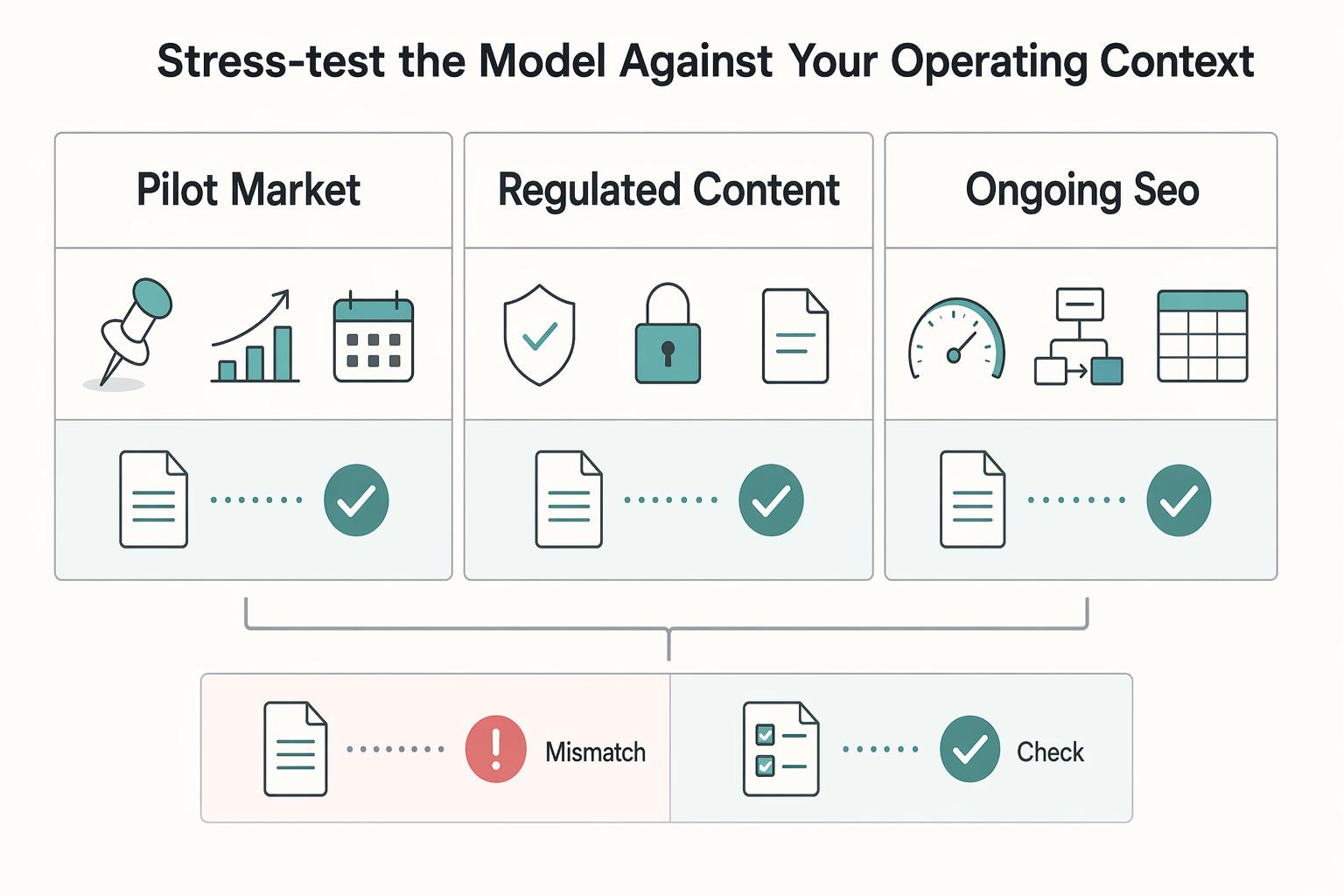
Stress-test the model against your operating context#
For a pilot-market launch, prioritize flexibility and learning speed, then tighten structure as scope stabilizes. For regulated-content expansion, prioritize clear scope boundaries and review ownership before optimizing unit price. For ongoing SEO production lanes, prioritize throughput consistency and approval flow once briefs and cadence are standardized.
| Context | Prioritize | Note |
|---|---|---|
| Pilot-market launch | Flexibility and learning speed | Tighten structure as scope stabilizes |
| Regulated-content expansion | Clear scope boundaries and review ownership | Before optimizing unit price |
| Ongoing SEO production lanes | Throughput consistency and approval flow | Once briefs and cadence are standardized |
The tradeoff many teams miss is straightforward: the lowest unit rate can still lose when delivery terms are weak. Before you compare quotes, require one-page clarity on deliverable definition, assumptions, revision policy, turnaround expectations, and approval path. If those are unclear, treat it as scope risk first, then pricing. If you need a quick next step on freelance writer rates, browse Gruv tools.
Lock terms in documents before discussing rate increases or discounts#
Lock operating terms before you discuss any rate increase or discount. Finalize deliverable definitions and review boundaries first, then negotiate price, because reversing that order turns price into a proxy fight about scope.
Use a small document set, with a clear job for each:
| Document | What it should answer | Non-negotiables to state clearly |
|---|---|---|
| Rate agreement | What is being charged, when, and on what basis | Price basis, payment trigger, version date, who approves changes |
| Scope of work | What the writer is delivering | Deliverable definition, format, length or range if relevant, research expectations, acceptance criteria |
| Revision policy | What changes are included versus new work | Included revision rounds, what counts as a revision, what triggers a new quote |
| Service-level agreement (SLA) | How both sides respond and what happens if work stalls | Response windows, turnaround expectation, blocker handling, escalation path |
Scope and acceptance criteria are the core controls. If reviewers cannot tell whether a draft is approved or needs changes without inventing new standards, you are not ready to debate price.
Revision terms are usually where cost drift starts. Before kickoff, confirm whether multi-stakeholder feedback is included in stated rounds or treated as separate work.
For ongoing work, connect SLA terms to internal procurement hygiene. Keep the rate agreement, scope, revision policy, and SLA together as one dated, versioned vendor packet so later pricing decisions are auditable. When you communicate a rate change, keep it direct and polite, and anchor it to updated terms; that reduces avoidable friction and makes decisions easier to defend. If you want a deeper dive, read How to Price a Copywriting Project.
Compare market rollout options before committing to a global rate card#
After you lock scope, revisions, and SLA, avoid a single global flat rate card in early expansion. Use market bands first, then narrow only after delivery quality, throughput, and payout operations are consistently comparable.
A flat number can make planning look clean while hiding the variables that actually change execution: local talent depth, language/editorial complexity, payout friction, and compliance overhead.
| Rollout option | Local talent depth | Language and editorial complexity | Payout friction | Compliance overhead |
|---|---|---|---|---|
| Adjacent market, same working language | Often easier to test quickly | Usually lower adaptation burden | Verify payment rails before launch | Start with your current template, then confirm fit |
| New language, established demand | Requires tighter specialist screening | Higher risk if native editorial judgment is needed | Validate setup and failure handling early | Expect more review of terms and approvals |
| Fragmented or early-test market | Unknown until pilot hiring starts | High variance across briefs and tone | Treat as operationally uncertain until proven | Plan for exceptions during onboarding and approvals |
Why bands are safer early#
Bands let you price against observed delivery instead of assumptions. Set an initial band by market cluster, then adjust only after pilots show whether writers can meet the same acceptance criteria, revision boundaries, and response windows under comparable briefs.
Constraints that change rollout outcomes#
- Onboarding friction: Track time to first approved draft by country, not just quoted rates.
- Contract enforceability: Confirm your standard agreement can be signed and used without repeated exceptions.
- Payout operations: Verify required payment data, reliability of your method, and clear ownership of failed-payment resolution.
Use channels as signals, not pricing authority#
Upwork and Reddit can help with sourcing signals, but they should not set final contract terms on their own. For broader directional input, use larger-sample evidence such as the University of Toronto Scarborough Global Survey on Freelancing (more than 75 contributing platforms; almost 1900 freelancers) and structured fee-range material like AWAI's 2025 guide covering fee ranges for the Top 80 copywriting project types. Then finalize terms through paid pilots, signed documents, and observed delivery performance. For the post-selection relationship system, see Freelance Client Retention: Weekly Systems for Repeat Work and Long-Term Relationships.
Run a pilot wave with verification checkpoints before scaling spend#
Do not scale spend until a small paid pilot proves a writer can meet your brief, turnaround expectations, and approval standard at the agreed rate. The goal is to verify delivery reliability, not just compare quotes. Keep the sequence fixed so results stay comparable:
- Shortlist writers in the same lane and market.
- Issue one standardized brief to each candidate with the same scope, acceptance criteria, revision policy, and deadline.
- Sign a rate agreement before trial work begins.
- Run paid trial assignments.
- Review quality, cycle time, and revision load before expanding volume.
Use the same brief structure across the cohort. If one writer gets a clean SEO brief and another gets a vague research-heavy assignment, you cannot trust the comparison. Keep format, word-count range, source expectations, and voice notes consistent; only localize inputs when needed.
What to collect from each pilot#
Require a lightweight evidence pack for every trial assignment:
| Evidence item | What to collect |
|---|---|
| Delivered drafts | First submission and final approved version |
| Revision logs | What changed and why |
| Approval timestamps | Submission to signoff |
| SLA adherence | Response windows and committed turnaround time |
Without revision history and timestamps, you are judging the final file, not the delivery process behind it.
Pass, fail, and what to change#
Set pass/fail checkpoints before review. If a writer repeatedly misses turnaround time, gets stuck in heavy revision loops, or cannot keep voice consistent across similar assignments, treat that as a model or vendor-fit issue.
Use the result pattern to decide the next move. Strong quality with weak cycle time usually means tightening the SLA or reducing assignment complexity before scaling. Stable cycle time with recurring rewrites usually means fixing the brief first, then reassessing the vendor. If both are unstable, switch writer or model before increasing budget.
This is how you avoid pilot activity that looks busy but is not ready to scale. Let the evidence pack, not the pitch, decide whether the rate deserves more budget.
Spot the failure modes that make "cheap" rates expensive#
A low headline rate is only useful if your pilot evidence proves the work stays controlled as scopes broaden and timelines speed up. Treat common "cheap rate" failure modes as items to verify, not assumptions to trust.
- Scope of work: Under per-article pricing, confirm you are comparing the same work bundle before you compare prices.
- Revision policy: Do not assume fixed-fee stability unless your pilot shows revisions stay bounded in practice.
- Imported benchmarks: If someone cites The Freelancer's Year, Amy Suto, or EFA Editorial Rates, use them as directional context, not stand-alone buying rules for your case.
- Operating lens: As delivery pressure shifts toward broader scope and faster timelines, favor setups where you can clearly direct the work, not just buy the lowest quote.
Related: Raising Your Rates: How to Do It Without Losing Clients.
Conclusion#
The useful decision here is simple: choose the pricing model that matches your operating conditions, not the benchmark that looks cheapest on a spreadsheet. Different models can all be appropriate in different circumstances, and the sources behind common pricing references are clear that survey findings are not hard rules. That matters because a low unit price can lose value quickly if it brings weak scope control, extra revision loops, or missed turnaround commitments.
If you only keep one principle, keep this one: price is a contract outcome, not just a market number. Per-word pricing is commonly used in freelance journalism. Per-hour pricing commonly applies to retainer arrangements. Per-project pricing can work when one rate covers one or more content assets. None of those tells you what your total delivery cost will be until the rate agreement, scope of work, revision policy, and SLA are explicit. Before you debate discounts, verify that acceptance criteria, included revision rounds, response windows, and approval ownership are written down. If those details are missing, you are not comparing rates yet. You are comparing guesses.
A practical next step is to build three things before you scale any content lane:
| What to build | What it should contain | What to check |
|---|---|---|
| Comparison table | Pricing model, deliverable type, revision exposure, turnaround expectation, management overhead | Whether the model matches your planning horizon and review load |
| Contract packet | Rate agreement, scope of work, revision policy, SLA | Whether acceptance criteria and change-request rules are unambiguous |
| Pilot cohort | A small set of writers using the same brief and review standard | Delivered drafts, revision logs, approval timestamps, and SLA adherence |
That last point is often where teams save money. Do not roll out a global rate card from Reddit threads, survey averages, or one marketplace quote. Run a pilot cohort first, then compare actual cycle time and revision load across the same assignment. One failure mode to watch for is treating cheap first-draft pricing as savings even when it creates hidden editing labor inside your team. Another is assuming a benchmark range applies across all segments and assignments when the source itself shows variation.
So if you are deciding on freelance writer rates, make the next move operational: one comparison table, one contract packet, one pilot cohort. Then scale only what clears your quality bar and your delivery bar. And if cross-border payout operations are part of the rollout, talk to sales early to confirm market coverage and implementation constraints before writer onboarding starts.
For a step-by-step walkthrough, see Build a Freelance Content Calendar That Survives Client Work.
Frequently Asked Questions
How much should we pay a freelance content writer when launching in a new market?
Start with a pilot budget and a market band, not a single inherited number. Rates vary widely by experience, and one cited personal span moves from $15/hour to $750/hour over 8 years, which is useful mainly as proof of dispersion, not as a buying target. If budget fit is tight, source across freelancer marketplaces and validate quality before locking longer-term spend.
Is there a standard freelance writer rate we can apply across all countries?
No. Writer pricing varies widely, so do not assume a universal cross-country rate applies. If you are expanding, set rates by market instead of applying one global number.
Is per-word pricing or per-article pricing better for SEO and editorial consistency?
This guide does not establish one model as universally better for SEO or editorial consistency. It does include one writer’s report that starting around $.04/word-$.08/word led to low-quality, low-priced work. Whichever model you choose, set scope and revision terms before work starts.
When does an hourly pricing model outperform a retainer agreement?
A freelancer's hourly rate is described as covering taxes, expenses, non-billable time, and desired annual income, so variance is normal. If you use hourly, set clear limits and approvals before work starts.
Can we use Reddit or EFA benchmarks as final budget numbers?
Not as final numbers based on this evidence. This section’s support does not establish benchmark figures from Reddit or EFA, so treat them as non-authoritative inputs here. Final pricing should be validated against your own trial assignments and contract terms.
What must be included in a rate agreement before starting work?
At minimum, make the pricing model, scope, and revision expectations explicit before work starts, then validate with initial paid work. Low sticker rates alone are not enough to judge total delivery cost.
Try a related tool
Researched and edited by the Gruv editorial team. Gruv builds cross-border billing, payouts, and finance-operations software for global businesses.
Sources
- bls.gov/ooh/media-and-communication/writers-and-auth...trusted
- clame.nyu.edu/HomePages/E1FA4B/316850/b2b-saas_content_wri...trusted
- cs.cornell.edu/courses/cs1110/2014fa/assignments/assignment...trusted
- ecfr.gov/current/title-2/subtitle-A/chapter-II/part-200trusted
- heritageproject.caltech.edu/interviews/charles-r-trimbletrusted
- homepages.math.uic.edu/~leon/mcs360-f07/projects/3-4/dictionary-lar...trusted
- legis.iowa.gov/docs/aco/bulletin/09-17-2025.pdftrusted
- newlondonct.gov/filestorage/7495/7518/7577/7579/40361/40363/...trusted
Educational content only. Not legal, tax, or financial advice.
Related Posts
How to Price a Copywriting Project
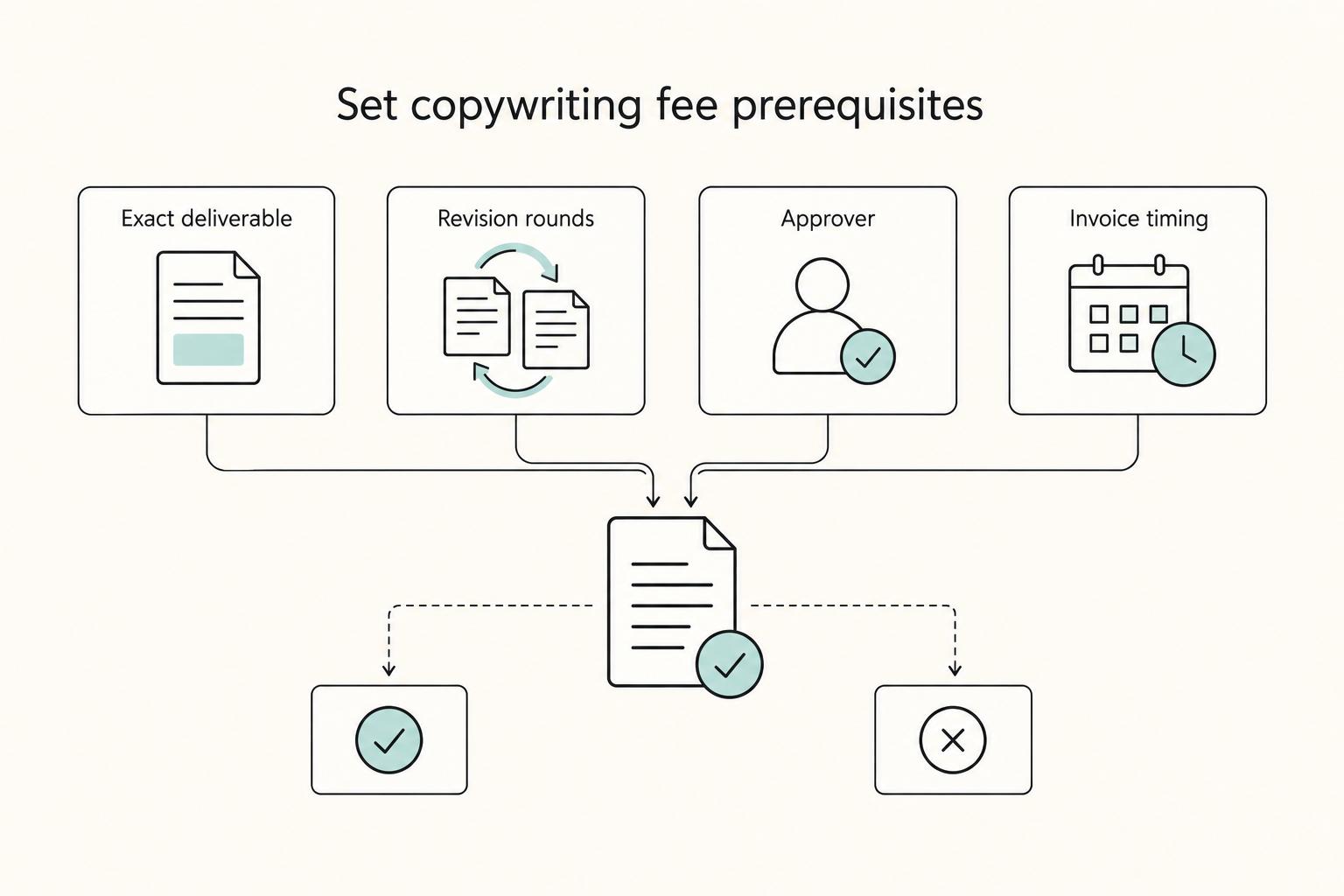
If you want fewer payment arguments later, set the project fee around decisions you can document: the scope of work, exact deliverables, clear payment terms, and a dated invoice schedule. That keeps pricing tied to what the client is buying, instead of quietly agreeing to extra work, open-ended revisions, or approval delays that eat margin.

Raising Your Rates: How to Do It Without Losing Clients
Before finalizing execution decisions, validate wording against guidance from [pon.harvard.edu](https://www.pon.harvard.edu/daily/negotiation-skills-daily/principled-negotiation-focus-interests-create-value/), [law.cornell.edu](https://www.law.cornell.edu/wex/mutual_assent), [hbr.org](https://hbr.org/2021/06/if-youre-going-to-raise-prices-tell-customers-why).
The Best Project Management Tools for Freelance Writers
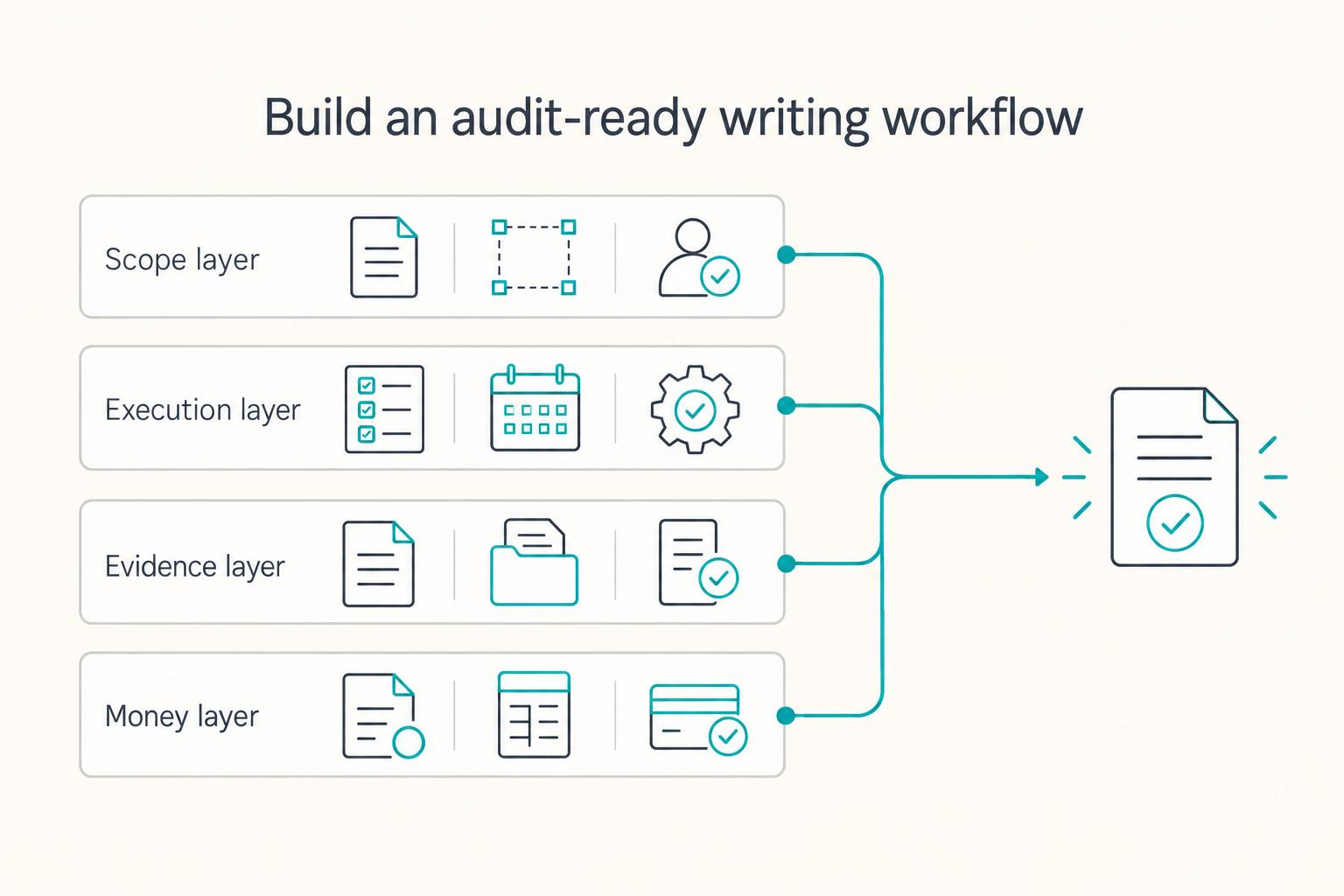
**Build one traceable system for scope, execution, and billing, and give each tool one clear job.** Freelance writing ops is not "a writing project." It is overlapping deadlines, revision cycles, approvals, and payment triggers. When you can't reconstruct what happened, you lose time, margin, and sometimes trust.