
Quick Answer
List the exact pages or assets, estimate research, writing, review and coordination effort, then check that estimate against your sustainable rate. Choose an exact project fee or agree a time-based budget. Document included revisions, acceptance criteria, the reviewer, change approval and installment dates before starting.
Price the Deliverables and the Work Behind Them#
If you want fewer payment arguments later, set the project fee around decisions you can document: the scope of work, exact deliverables, clear payment terms, and a dated invoice schedule. That keeps pricing tied to what the client is buying, instead of quietly agreeing to extra work, open-ended revisions, or approval delays that eat margin.
Start with the pricing method that matches copywriting work#
A project fee is a useful starting point for defined website pages, campaigns or emails. ProCopywriters’ pricing guidance distinguishes fixed-scope work from uncertain or ongoing work that may suit time-based billing. Choose the model for this engagement: strategy, research and review effort matter even when the final copy is short.
Per-word pricing can reward length when the better headline or email is shorter. It can still fit standardized content if research, revisions and minimum fees are specified. Hourly pricing can cover discovery, editing or ongoing work; it does not become invalid once you know the scope. Set a budget and approval point for additional time so the client is not buying an unlimited bill.
Build the fee around what must be true before work starts#
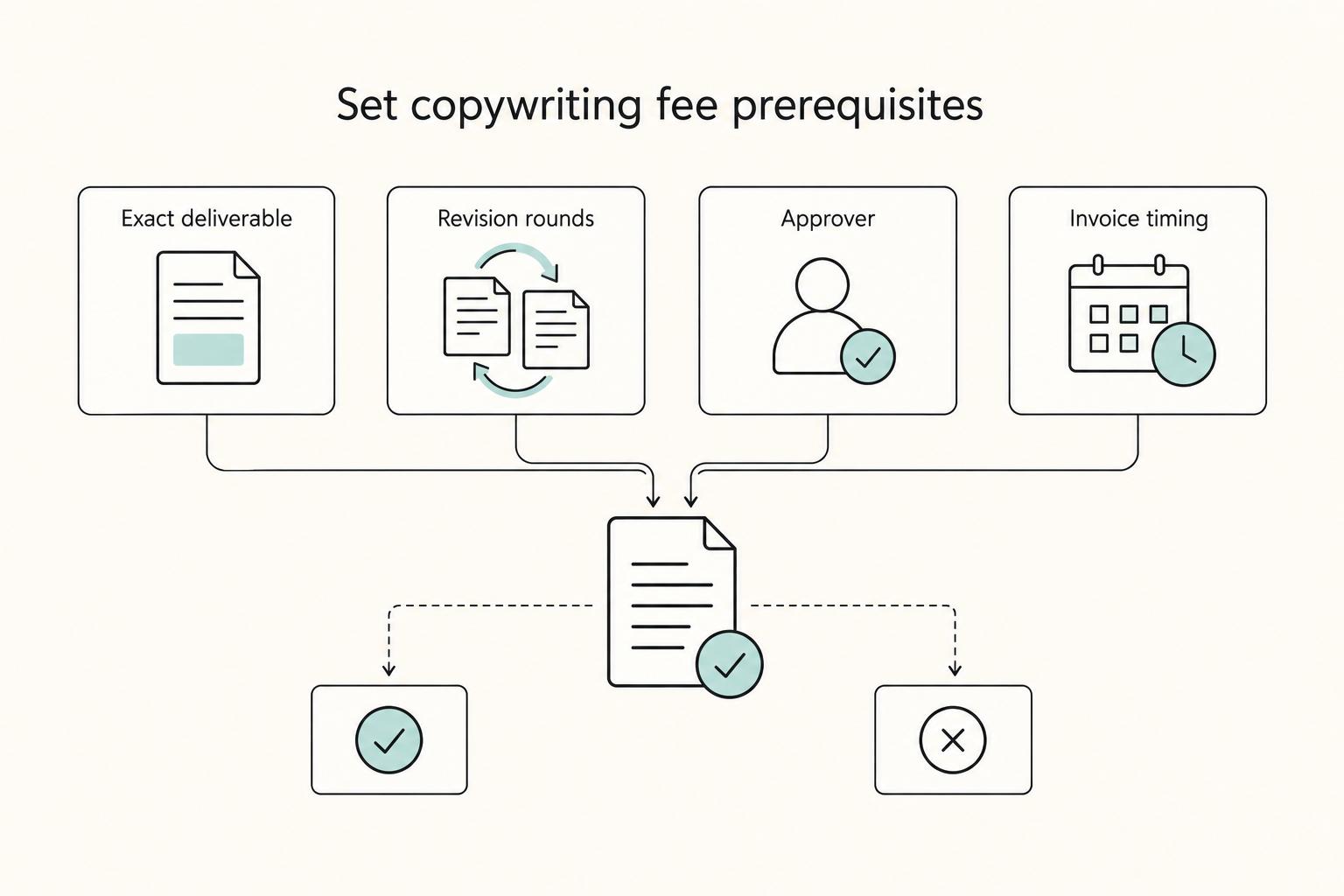
Before you finalize the fee, answer these four questions in writing:
- What are the exact deliverables?
- How many revision rounds are included?
- Who approves the work?
- When do invoices go out, and when are they due?
If one of those answers is missing, state the assumption and keep the offer provisional until the client confirms it. A usable quote identifies both the fee and the work it covers.
Published rates show how an individual writer packages work. Elna Cain’s guide lists $0.50–$0.80 per word for SEO posts up to 2,000 words and $400 per email, or $2,000 for five. Its page heading and body contain different year references, so treat those as the writer’s examples rather than a current market benchmark. Compare the research, revisions, rights and deliverables included before borrowing a number.
Remove the silent yeses that can cause disputes later#
A lot of project friction starts with an accidental promise. "Website copy" can turn into ten pages instead of five. "Two revisions" can become six rounds of stakeholder comments. "Quick approval" can become two weeks of silence while your final invoice waits.
So your opening quote should include a short evidence pack: scoped deliverables, revision limit, approval contact, timeline assumptions, and invoice dates. If those items do not appear in the proposal or statement of work, you are relying on memory and goodwill.
For a freelance writer, the real win is not just booking the project. It is booking work you can deliver, get approved, and invoice without a cleanup project later. That starts with getting the right inputs before you put any number on the page.
What to Prepare Before You Quote Any Copywriting Project#
You can give a ballpark on the first call if you state the assumptions and that it is not the final offer. Gather the full brief before issuing a formal quote, including a validity date. A range for five existing pages is not a commitment to rewrite seventeen pages from scratch.
| Preparation item | What to capture | Quote status |
|---|---|---|
| Minimum evidence pack | Client goal, current assets, exact deliverables, and what "done" means | Use a formal quotation or proposal once the core inputs are documented |
| Commercial boundaries | Who is giving feedback and how timeline decisions will be handled | If approvals or timing are unclear, keep the number as a ballpark rather than a final quote |
| Value and scope | Value of the work, actual workload, and stated assumptions | State assumptions clearly so scope creep does not turn into unpaid work |
| Baseline economics | Your billable-rate method before setting the project fee | Use the baseline math to convert internal numbers into a project quote |
Gather the minimum evidence pack.
Capture the client goal, existing assets, exact deliverables and definition of done in a brief or project record. Susan Greene’s example starts with 10–17 pages and two or three paragraphs per page. The range still needs resolution: list which pages need editing, which need new writing and who supplies source material.
Set commercial boundaries before you finalize the fee.
Confirm who is giving feedback and how timeline decisions will be handled. If approvals or timing are still unclear, label your number as a ballpark rather than a final quote. Then send a formal quotation or proposal after you have the full project details.
Tie price to value and scope, not guesswork.
Your quote should reflect both the value of the work and the actual workload, with assumptions stated clearly. This helps prevent scope creep from turning into unpaid work later.
Pull your floor before you set the project fee.
Work out your baseline economics first using your billable-rate method, then convert that into a project quote. If you have not done that math recently, use How to Calculate Your Billable Rate as a Freelancer before you price anything.
For website work, attach a page inventory to the brief: page name, purpose, approximate length, source material and required review. That inventory distinguishes an edit from a new page before either changes the fee.
Choose the Pricing Model With Clear Decision Rules#
Use a project fee when scope is stable and you can estimate the work. For open discovery, consider hourly billing with an agreed budget and a review checkpoint before fixing production scope. Ongoing work can also remain hourly, use a day rate or use a retainer with defined capacity.
Each model shifts risk differently. Project fees give clients more cost certainty and can reward your efficiency when scope is defined. Hourly pricing is practical when scope is uncertain or ongoing. Per-word pricing can misalign incentives for copy, because outcomes often come from sharper, shorter messaging rather than more words.
| Model | Best fit | Margin risk to you | Admin burden |
|---|---|---|---|
| Per-word rate | Volume-led writing where word count is the main output | Higher if research, revisions, or strategy drive the work | Moderate, because scope exceptions still need handling |
| Hourly rate | Unclear, evolving, or ongoing work | Lower early, since time is billed | Higher, because time tracking and reporting are continuous |
| Project fee | Clearly defined deliverables and acceptance criteria | Lower when scope is tight; higher when scope is vague | Lower after sign-off, because billing and expectations are simpler |
Choose terms the client can administer. A day rate buys a specified block of time; a retainer buys agreed recurring work or availability. State the day length, deliverables or capacity, expiry of unused time and rules for overages. Neither model creates unlimited revisions or a promise of a particular sales result.
Choose a project fee when the work is defined#
Use a project fee when you can clearly state what is included and what "done" means. If deliverables, revision limits, approval path, and acceptance criteria are all written and specific, fixed pricing is usually the cleanest choice.
Start hourly when scope is still moving#
For hourly discovery, specify the rate, authorized hours, reporting and output. Illustrative terms: up to five hours at $75 per hour to produce a brief and page inventory, billed for actual time with a $375 cap. Get approval before exceeding the cap. At the checkpoint, agree production separately; do not charge again for discovery tasks already completed.
Treat per-word as a limited-fit model, and use hybrid when needed#
A per-word fee can suit volume-led content, but distinguish a length target from a fixed payment for a headline or campaign. A value-informed project fee can reflect the importance of the work without making payment contingent on sales. If you agree a performance bonus, define the metric, data source, measurement period and attribution separately from the base fee.
A hybrid can combine paid discovery with a fixed production fee after the brief is agreed. Continuing hourly may also suit the job. State whether discovery is separate or credited against the project total; do not silently add it twice. Once billing is agreed, use the free invoice generator to show the correct phase and any credit.
Build a Project Fee From Scope Not Guesswork#
Build the internal floor from estimated effort and your sustainable rate, then choose an exact fee for the defined scope and value. An internal estimate supports the offer; it does not turn an agreed fixed fee into an hourly bill when you work faster or slower.
Itemize the work in units you can count#
Price the work from effort drivers you can name: assets, research depth, interviews, meetings, revision cycles, and final deliverables. Research and client coordination are part of the job, and they can materially change effort.
Illustrative five-page website: Home, About, two Services pages and Contact, with two interviews and two consolidated revision rounds. Estimate four hours for brief and research, two for interviews, ten for drafting, four for revisions, two for meetings and two for handoff: 24 hours. Add four hours of uncertainty reserve. At an internal $75 rate that already covers overhead, 28 × $75 = a $2,100 floor. You might quote an exact $2,400 production fee, leaving $300 above that planning floor. These are your example assumptions, not a market rate or a guarantee of profit. State whether taxes or separately agreed expenses are additional; do not add overhead again if the rate already covers it.
Turn assumptions into priced conditions before signature#
A strong quote states scope, inclusions, exclusions, assumptions, timeline, and payment terms. This is what makes the fee defensible when the project shifts.
State assumptions as priced scope: five named pages, two interviews, two review rounds and client source material by the agreed date. If a client requests seven pages before accepting the quote, issue an updated offer. If terms are already agreed, propose a change order and obtain approval; an assumption changing does not authorize you to alter the signed fee unilaterally.
Confirm acceptance criteria in writing before work starts#
Define acceptance against the agreed brief, factual inputs, formats and deliverables. Name the reviewer and review period, require specific nonconformities and say how you will correct them. Approval of copy is not a promise that a campaign will achieve a sales target unless a separate performance obligation actually says so.
For example, the reviewer has five business days to approve the submitted version or identify where it misses the brief. Agree what late feedback does to scheduling and escalation. Silence does not become acceptance merely because this guide uses a deadline. Follow any explicit contractual acceptance rule and keep covered corrections separate from new creative directions.
Compare staged fee structures in How to De-Risk a Fixed-Price Project with a Phased Payment Schedule.
Write a Statement of Work That Prevents Scope Creep#
Use the SOW to distinguish included revisions, corrections needed to meet the brief and added scope. A new page, audience or campaign can require a change order; correcting your failure to deliver an agreed requirement is not automatically a paid extra.
| SOW element | What to state | Role |
|---|---|---|
| Deliverables | Exact assets and format | In scope |
| Timeline | Key stages and review windows | Sets review timing |
| Acceptance criteria | How work is approved | Approval standard |
| Exclusions | What is not included in this fee | Out of scope |
Write the SOW so inclusion and exclusion are obvious#
List exact assets and formats, review windows, acceptance criteria and exclusions. In the five-page example, the client supplies product facts and claims substantiation; you deliver copy in the agreed document format. Translation, design, CMS upload and ad variants are excluded unless listed. Name any client compliance review needed before publication.
If the document is vague, scope creep and deadline slippage become more likely.
Define the change order path before extra requests happen#
For a request outside the agreed scope, pause that added work, estimate the fee and schedule impact and obtain the authorized client’s written approval. Continue existing duties as required by the contract. Use the amendment or purchase-order process actually agreed; federal procurement change-order rules do not govern an ordinary freelance engagement by default.
State the mechanics in plain language:
- What triggers a change order, including added assets or a changed brief
- Who can approve it on the client side
- How price and timeline are adjusted when scope changes
Example: the client adds a sixth service page. Offer a $300 fixed addition covering its research, draft and the two agreed review rounds, with a two-business-day extension. It is an illustrative offer, not an automatic charge or an hourly overrun bill. Record approval before starting the extra page.
Add downside protection and handoff terms#
Set practical enforcement terms in writing so the project stays workable when conditions change:
- Revision rounds, what counts as a round and the standard for correcting covered defects
- Cancellation or pause terms: notice, fees earned, any agreed cancellation charge, advance credits or refunds and rights to completed work
- Late approval consequences, such as schedule shifts and re-planning agreed before work starts
Define handoff files, the agreed payment conditions and the license or ownership transfer that applies. Give the client sufficient review access before acceptance. File delivery and rights transfer are separate events; do not assume you can withhold something the contract already requires you to provide. Check added requests, delayed feedback and early cancellation before signing.
A cancellation calculation should credit money already paid against amounts due. A $900 advance is not automatically a $900 cancellation penalty on top of earned work; define how it is applied and whether any unearned amount is refundable.
Set Payment Terms That Protect Cashflow From Day One#
Agree staged billing that suits the engagement. In the illustrative $2,400 production project, invoice $900 at kickoff, $900 on delivery of the first draft and $600 on final acceptance. Those installments total $2,400; the advance is part of the fee. If the capped discovery phase was separately billed, show that separate amount clearly rather than implying it is included in this total.
Split payment across the project timeline#
Write the invoice event and payment due date separately. For the example, agree kickoff payment before production and a stated due period for later installments. If a draft-delivery invoice is due before final approval, client silence on the final does not postpone that earlier invoice. If the final invoice requires acceptance, use the agreed review and escalation process rather than inventing acceptance after the deadline.
| Payment term | Meaning | Timing |
|---|---|---|
| Net 30 | Due 30 days from the contractually defined invoice date or receipt event | Name the starting event and calendar-day rule |
| Net 60 | Due 60 days from the agreed starting event | Not a calendar-month shortcut |
| 2/10 Net 30 | 2% discount if eligible payment is made within ten days; otherwise full payment within thirty | State the starting event, eligible amount and whether payment must be received |
For a $900 invoice, an agreed 2% early-payment discount is $18, so eligible payment is $882. Otherwise $900 remains due on day 30. Define the date from which each window runs and how tax, expenses or partial payments affect the discount. These are negotiated terms, not a universal clock beginning on receipt.
Define late-payment consequences before work starts#
State any late-payment charge and suspension terms before work starts, within applicable law. Define notice, cure and affected work, and follow those terms if payment becomes overdue. A late invoice does not by itself authorize every penalty, cancellation or withholding of files. Resolve disputed amounts through the agreed process and keep undisputed payment obligations clear.
This is especially important if the project could become end-loaded. When most payment sits behind final approval, delays can trap cashflow; staged invoices reduce that risk by aligning payment timing with delivery progress.
Keep payment instructions and records clean#
List accepted payment methods directly in your terms, and keep one complete record trail for the project: signed proposal, SOW, invoice IDs, delivery confirmations, and approval notes. The goal is operational clarity: what is due, when it is due, and what changes if payment is late.
Check the buyer’s billing requirements before kickoff: legal entity, invoice address, purchase-order number if required, currency and payment route. Those details help a valid invoice reach the person who can pay it.
Handle Revisions and Change Requests Without Killing Margin#
Define revisions as changes within the agreed brief, with included rounds and consolidated feedback. Distinguish new direction from corrections needed to meet an existing requirement; a revision cap should not convert your own nonconforming delivery into a new fee.
Separate revision from new scope. Polishing wording for the agreed audience can be included. Changing the audience, strategy or asset count may require a change order. In the five-page example, fixing a product name you copied incorrectly is a covered correction; writing for a newly chosen buyer segment is a scope change.
Define a round and the included cap. For example, two rounds each mean one consolidated response from the named reviewer on a submitted version, followed by your revised draft. State the review period, any length or effort boundaries and how additional rounds are priced. Keep the correction process for missed requirements distinct.
Quote extra work before starting it. Hold the added request while you agree its price, deliverable and schedule impact in writing. Use an agreed fixed addition or time-based rate, as appropriate; you cannot impose a higher rate retrospectively. Continue unaffected work under the existing agreement unless it permits a broader pause.
Step 4: Batch feedback and log approvals. Require one consolidated client response per round so you are not reworking conflicting comments across multiple threads. After each round, confirm in writing what changed and whether the draft meets the agreed acceptance criteria to prevent later disputes about what was included.
For conflicting feedback, ask the designated reviewer to resolve the conflict before you revise. Log which instruction governs the next version, rather than treating every stakeholder email as another authorized round.
Run Delivery and Invoicing in the Right Order#
Use the order your contract specifies. One workable advance-funded sequence is agreed kickoff payment, review-copy delivery, covered revisions, documented acceptance, the acceptance-triggered final invoice and handoff once its agreed payment condition is met. Delivery-triggered or calendar invoices follow their own events; not every invoice waits for final approval.
Confirm the agreed kickoff conditions. If the contract requires a paid advance, verify receipt before production. If the buyer has agreed credit terms, follow that schedule instead. Keep the signed scope and invoice schedule together so both parties can identify the event that makes each amount due.
Deliver review copies and resolve feedback. Record the version, delivery date and reviewer. Correct departures from the brief under the agreed acceptance process. For added scope, use the actual amendment and purchase-order path before doing that added work; do not pause all contracted work automatically.
Record acceptance and invoice at the agreed event. Request written approval or specific issues against the criteria. An amendment signature changes scope; it is not the same as acceptance of a draft. If feedback is late, send a reminder and follow the agreed escalation or scheduling rule. Invoice delivery or calendar milestones when due; use acceptance for the final invoice only if that is the agreed trigger.
Complete the agreed handoff and retain the record. If final editable files and the rights grant are conditioned on full payment, confirm payment and deliver the identified files under that clause. If the contract requires earlier delivery, honor it. Keep the contract, SOW, invoice schedule, approved changes, invoice IDs, versions, acceptance messages and payment records together.
Copy and Use This Pricing Checklist on Every New Client#
Use this checklist to turn the brief and internal calculation into an exact offer, then document how approval, changes and payment will work.
Confirm the job in writing before you quote.
Document scope, deliverables, timeline, responsibilities, and acceptance criteria in the SOW. Also state what is excluded and how approval works so scope boundaries are clear.
Choose the pricing model with a rule, not a guess.
Choose a project fee for defined production, or time-based billing with a budget and approval rule. For a hybrid, agree discovery first and production later; specify any credit so the same work is not charged twice.
Lock protection terms before kickoff.
Document review rounds, covered corrections, written change approval and cancellation terms. Name the cancellation trigger, earned fees, any additional charge and advance credit or refund. NWU’s Nation agreement lists 50% for assigned work rejected without a revision request and 75% after a requested revision. Those are publication-specific terms, not default cancellation percentages for freelance copywriting.
Stage payments to protect cash flow.
Agree installment amounts, invoice events and due dates before work starts. In the example, $900 + $900 + $600 = $2,400. Keep the advance within that total and show separately billed discovery or agreed taxes and expenses distinctly. Mirror the schedule in the proposal, SOW and invoices.
Use approval deadlines and payment gates.
Name the reviewer, review period, acceptance standard and late-feedback process. A five-business-day review period is an illustrative negotiated option, not a legal default or automatic deemed acceptance. Keep approvals with the delivered versions and invoices. Release files and grant rights at the events the contract actually specifies.
Compare scope boundaries for another creative engagement in How to Price a Branding Package for a New Business.
Frequently Asked Questions
How do I price a copywriting project if the scope is still unclear?
Use a paid discovery phase with an agreed rate or fixed discovery fee, budget limit and output, such as a brief and page inventory. Before fixing production, document the deliverables, review rounds, reviewer and invoice events. State whether discovery is separate or credited against production. Avoid committing to a production fee while leaving the client free to redefine the job.
Is a per-word rate ever a good choice for copywriting work?
Yes, for standardized content where length is a useful unit and research and review are defined. Name the minimum fee, length range and included revisions. Illustratively, 1,000 words at $0.50 produce a $500 writing fee; do not automatically reduce that to $125 if an agreed editing pass compresses the same deliverable to 250 words. Agree the billable unit or fixed fee beforehand, rather than penalizing useful editing.
When should I use an hourly rate instead of a project fee?
Hourly can suit evolving discovery, interviews, editing or ongoing work, including work with a clear brief. Specify the rate, authorized budget, reporting and approval before extra hours. Choose a project fee when an exact scope and estimate make cost certainty useful. You can convert a later production phase to fixed pricing by agreement, but it is not a mandatory progression.
What should I include in a quote besides deliverables and timeline?
Include an exact fee or rate and budget, scope and exclusions, assumptions, quote validity, review rounds, acceptance criteria, reviewer, change approval, invoice events and due dates. Define cancellation and handoff or rights terms too. A reader should be able to distinguish a covered correction from a paid new request and know when payment becomes due.
Which contract terms reduce scope creep and delayed payment the most?
Define included rounds and consolidated feedback, a written path for added scope and a specific review window with late-feedback consequences. Tie each invoice to its agreed event and due date. Correct work that misses an existing requirement through the covered process; do not charge every request beyond a round cap as if it were new scope.
Should I show my internal hourly math to clients or only the project total?
For a fixed fee, show the exact total, deliverables and assumptions; your internal effort calculation can remain internal. Faster or slower work does not change that agreed fee by itself. For hourly work, share the rate, estimate or cap and reporting. Use How to Calculate Your Billable Rate as a Freelancer to check your internal floor.
How do I price website copy when page count and revision volume may change?
Inventory pages and distinguish editing from new writing before fixing the total. Susan Greene’s guide uses $100 for editing and $150 for new writing as explicitly illustrative per-page figures, not actual market rates. Define the pages, research and included review rounds, and quote additions before starting them. Avoid a commitment to Home, About, Services and an unspecified number of extra pages.
Try a related tool
Researched and edited by the Gruv editorial team. Gruv builds cross-border billing, payouts, and finance-operations software for global businesses.
Sources
Includes 6 external sources outside the trusted-domain allowlist.
- elnacain.com/blog/copywriting-ratesexternal
- nwu.org/journalism-division/the-nationexternal
- procopywriters.co.uk/guidance/pricingexternal
- procopywriters.co.uk/guidance/contractsexternal
- susangreenecopywriter.com/articles/how-to-price-a-copywriting-project....external
- susangreenecopywriter.com/articles/pricing-copywriting-project.htmlexternal
Educational content only. Not legal, tax, or financial advice.
Related Posts
How to Calculate a Freelance Rate You Can Actually Get Paid On
A workable rate is not the neat number a calculator produces. It is the number that still works after you account for real billable capacity, non-client time, scope drift, and the gap between sending an invoice and receiving cleared cash. Start with hourly math even if you do not plan to bill hourly, then turn that number into a quote with clear `payment terms`.

The Freelance Payment Penalty: A Modeled Audit of Platform Fees, FX Spreads, and Payout Delays
The money rarely disappears through a single, easy-to-spot fee. The real loss is stacked. A marketplace takes its commission, a processor adds a charge for international cards, a bank or payment company converts the currency at a spread, a platform holds the funds before release, and a wire sheds a little to intermediaries on the way in. Each layer looks defensible on its own, but the worker feels the combined result as a smaller deposit and a later payday.

How to Respond to a Subpoena for Business Records
Move fast, but do not produce records on instinct. If you need to **respond to a subpoena for business records**, your immediate job is to control deadlines, preserve records, and make any later production defensible.