
Quick Answer
To calculate FBAR maximum account value, identify each foreign account's highest value during the calendar year in local currency, then convert non-U.S. dollar amounts using the year-end conversion approach and round the result up to the next whole U.S. dollar. File if one account's maximum or the aggregate of account maxima exceeds $10,000, and document the evidence supporting each peak.
What FBAR Maximum Account Value Means#
One of the biggest FBAR risks is not realizing a filing may be required. Another is being unable to support the maximum account value reported. Teams are exposed when records are incomplete, ownership or signature authority is unclear, or different groups rely on different source data for FinCEN Form 114.
This guide gives you a practical, repeatable way to calculate maximum account value for FBAR purposes. It helps you compute the number, show how you got there, and escalate instead of guessing when facts are unclear. In multi-account, cross-border operations, this is as much an evidence and control problem as an arithmetic one.
The rule-level trigger is straightforward. A U.S. person with a financial interest in or signature authority over foreign financial accounts must file if the maximum value of one account, or the aggregate of maximum values across accounts, exceeds $10,000 at any time during the calendar year. Weak account inventories and weak value support create two different failure modes: missed accounts and unsupported values. Identify each account's annual peak, use periodic statements only when they fairly reflect that peak, convert non-U.S. dollar values using the year-end conversion approach, round reportable amounts to whole U.S. dollars, and document any exceptions before submission through the BSA E-Filing System.
"Reasonable approximation" still requires discipline. If statements clearly capture the yearly high, they can support the reported value. If available records suggest a higher intra-period balance, treat that as an estimation risk and escalate.
This is an operational guide, not legal advice. Where ownership, authority, missing records, or amount-unknown handling such as item 15a is ambiguous, escalate to tax counsel before filing.
Scope and filing trigger you are actually testing#
Scope comes before arithmetic. Under the Bank Secrecy Act (BSA), Treasury can collect information from U.S. persons tied to foreign financial accounts, and the report is filed on FinCEN Form 114 with the Financial Crimes Enforcement Network (FinCEN), not with the IRS, even though the IRS enforces FBAR rules.
Define who is in scope#
This process applies when a U.S. person has a financial interest in, or signature or other authority over, a foreign financial account. In this context, U.S. person includes U.S. citizens, resident aliens, trusts, estates, and domestic entities. In practice, test both ownership and authority, not just the name on the account statement.
Before you calculate anything, confirm each account has an identified owner, a defined authority type, and a clear determination that it is outside the U.S. If any of those fields are unresolved, treat your value calculation as preliminary.
Separate the per-account test from the aggregate test#
Value each account separately first. The maximum account value is a reasonable approximation of that account's greatest value during the calendar year. Then test the aggregate maximum account value by combining those per-account maxima.
The filing trigger is met if one account's maximum exceeds $10,000, or if the aggregate of maximum values across accounts exceeds $10,000 at any time during the calendar year.
Stop if ownership or authority is unclear#
If your account inventory or authority map is incomplete, resolve scope before finalizing calculations. For filers with fewer than 25 accounts who cannot determine whether aggregate maximum account values exceed the threshold, complete the account sections and check item 15a as amount unknown.
Prerequisites and evidence pack before you calculate#
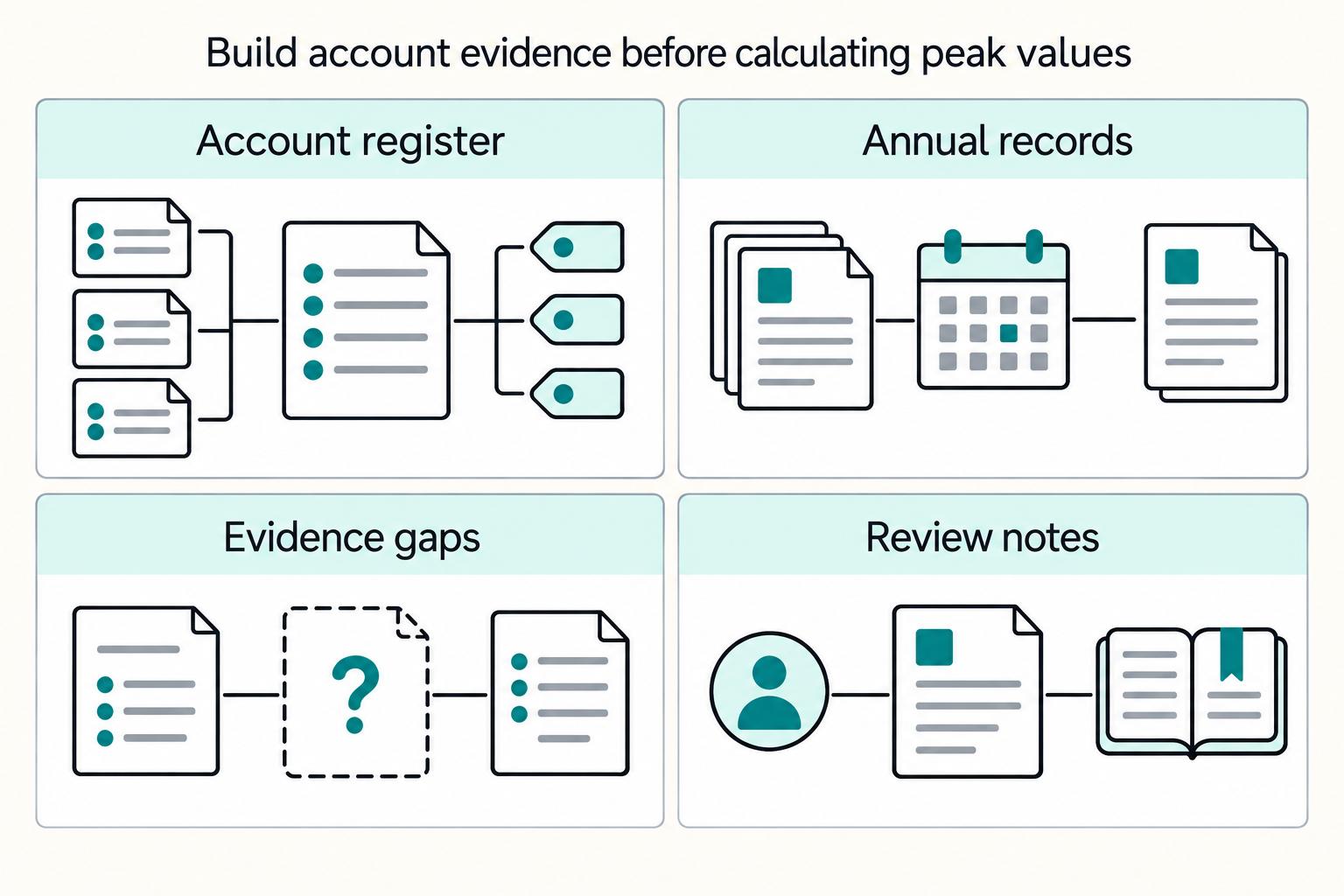
Do not start with math. Start by building a reviewable file so each account value can be traced back to supporting records.
Build a complete account register#
Create one register for all in-scope accounts and use it as the index for the rest of the file. If an account entry is incomplete or cannot be tied to clear supporting records, resolve that before you calculate.
Assemble evidence before selecting peaks#
Collect the account records you already rely on for the year, then document any gaps up front. When records are missing or uneven, note what is unavailable and what support was used so the file shows how each value was derived.
Apply case-file controls from the start#
Treat this as case-file work, not ad hoc spreadsheet work. The IRS FBAR procedures include sections for Program Controls, FBAR Case File Assembly, and FBAR Documents Outside of Case Folder, which supports keeping documentation organized and traceable.
Use internal controls that keep the file defensible, with clear change history and review notes tied to account-level decisions. Keep support in one controlled location rather than scattered across inboxes, chats, and shared drives.
Escalate estimation risk before finalizing totals#
If available records do not fairly show the annual peak, flag estimation risk for compliance review before totals are treated as final. The goal at this stage is simple: a complete, defensible evidence pack. The calculation comes after that.
For a step-by-step walkthrough, see Do I Need to File an FBAR for a Company Account I Have Signature Authority Over?.
Step 1 capture each annual peak in local currency#
Start by selecting one annual high for each foreign financial account in that account's own currency. Do not convert to U.S. dollar yet.
For FBAR purposes, maximum account value is a reasonable approximation of the greatest value during the calendar year, including nonmonetary assets. Your file should show why the selected value is reasonable.
Identify one native-currency peak for each account#
Work account by account. If there are multiple accounts, value each one separately. For each account in your register, record:
| Field | What to record |
|---|---|
| Peak value | Peak value in local currency |
| Date or period | Date or statement period tied to that peak |
| Evidence source | Evidence source reference |
| Value basis note | Whether the value is exact or a reasonable approximation |
If you cannot tie one selected high to one supporting source for an account, stop before FX conversion.
Compare statements and ledger activity before selecting the peak#
Periodic statements are usable only when they fairly reflect the account's true annual maximum.
If records do not point to the same high, use a reasonable approximation of the greatest value reached during the year and document the basis at the account level. Keep the note specific enough that a reviewer can follow the decision later. If records conflict and you cannot support a clear peak, escalate the account instead of forcing a value.
Record the non-cash valuation method with the selected peak#
If an account includes nonmonetary assets, document the valuation basis beside the selected peak and tie it to the supporting record. Also flag edge cases now. If a valuation later results in a negative amount, Item 15 is reported as 0.
Run an internal reviewer checkpoint before FX conversion#
Before you convert anything, run an internal completeness check. Confirm each account has:
- one selected annual peak in local currency
- one supporting evidence source
- one note explaining why the source fairly reflects the annual maximum, or why an approximation was used
- one valuation-method note where non-cash assets are involved
Only move to conversion after each account passes this completeness check.
Related reading: Account Updater Services: How to Automatically Refresh Expired Card Data Before Payments Fail.
Step 2 convert peaks to U.S. dollar correctly#
Once peaks are set, conversion should be mechanical. For each non-U.S.-currency account, convert the Step 1 peak to U.S. dollars using the year-end rate rule, not the account's peak-balance date.
Apply the Treasury rate using the year-end date rule#
Use Treasury's Financial Management Service rate when available. The exchange-rate date anchor is the last day of the calendar year. If a currency has multiple rates, use the rate that applies to conversion into U.S. dollars on that year-end date.
Keep the inputs consistent across accounts:
- the highest annual value in local currency from Step 1
- the applicable year-end rate into U.S. dollars
| Scenario | Rate to use | Record in your file |
|---|---|---|
| Treasury rate available | Treasury's Financial Management Service rate | Rate reference tied to account and reporting year |
| Currency has multiple quoted rates | Rate applicable to conversion into U.S. dollars on the last day of the calendar year | Short note on which quoted rate was used |
| No Treasury rate available | Another verifiable exchange rate | Source of the rate and note that Treasury rate was unavailable |
Treat missing Treasury rates as exceptions#
Use another verifiable rate only when no Treasury Financial Management Service rate is available, and document the source at the account level. Keep the exception trail clear so a reviewer can trace the number back to its rate source.
If your team uses an assumptions log or reviewer approval for alternative rates, keep that as an internal control, not a substitute for source capture.
Round exactly for FinCEN Form 114#
For Item 15 on FinCEN Form 114, record the converted amount in U.S. dollars rounded up to the next whole dollar. Example: $15,265.25 becomes $15,266. If the value is negative, enter 0 in Item 15.
Document converted values after review#
After conversion and rounding are reviewed, keep the U.S. dollar figures and rate-source notes together as your filing record for the year.
Before moving on, confirm each account shows the Step 1 local-currency peak, the year-end rate source, the converted U.S. dollar amount, the Item 15 rounded value, and any non-Treasury-rate exception note. If you later find an FX error, update the affected account calculations and keep a clear record of the correction.
Step 3 complete per-account fields and aggregate test#
Once values are converted, finish the filing logic in two passes: complete item 15 for each account, then run the $10,000 threshold test on those finalized values.
Enter each account into item 15#
On FinCEN Form 114, if you have more than one account, value each account separately for item 15 Maximum account value. Use the finalized U.S. dollar amount for that account.
Before running the threshold test, confirm each in-scope account has:
- one final item 15 amount in U.S. dollars, rounded up to the next whole dollar
- a separate item 15 value for each account
If a determined value is negative, enter 0 in item 15 for that account.
Total the aggregate maximum account value#
After all accounts have item 15 values, total those per-account maximums for the aggregate test. The filing trigger is $10,000. If one account maximum exceeds $10,000, or if the aggregate of multiple account maximum values exceeds $10,000 at any time during the calendar year, an FBAR must be filed. If the person did not have $10,000 of maximum value or aggregate maximum value at any time in the year, no FBAR is required.
Handle unresolved values without forcing unsupported numbers#
Do not force unsupported amounts into item 15.
For the FinCEN amount-unknown case, if a filer has financial interest in or signature authority over fewer than 25 accounts and cannot determine whether aggregate maximum account values exceeded $10,000, complete the appropriate account sections and check item 15a (amount unknown).
Decision rules for approximation versus escalation#
The key judgment is not whether you can produce a number. It is whether the records fairly support that number. Use approximation only when they do. If they do not, escalate before submitting FinCEN Form 114.
| Situation | Decision rule |
|---|---|
| Evidence is complete, or gaps are explained, with no unresolved contradiction that could change the peak | Proceed with a documented reasonable approximation for item 15. |
| Records are missing, incomplete, or contradictory in a way that could change the peak | Treat this as an accounting gap and escalate for factual reconstruction before filing. |
| Facts are mostly known, but reporting treatment is unclear | Treat this as a legal uncertainty and escalate to an FBAR compliance specialist. |
| Filer has financial interest in or signature authority over fewer than 25 accounts and cannot determine whether aggregate maximum account values exceeded $10,000 | Consider item 15a (amount unknown) as a limited exception, and document why aggregate determination is not possible. |
When you proceed with approximation, your file should show the selected peak and supporting statements or exports. It should also show any missing-period explanation, the exchange-rate source for the last day of the calendar year when needed, and the rounded item 15 amount. The aggregate test does not replace per-account support. Each account still has to be valued separately.
The FBAR is filed with FinCEN, not the Internal Revenue Service (IRS), and the IRS reference guide is meant to support consistent examiner administration. Keep each decision traceable in a short memo or log: issue raised, evidence reviewed, decision taken, rationale, and date.
Related: How to Price a Bookkeeping Service for Small Businesses.
Special cases that break naive calculations#
Some cases go wrong because the math is hard. Others go wrong because the facts are mixed. When ownership, authority, timing, or form-selection facts are unclear, do not force a number into the calculation. Classify the case first, document what is known, and escalate any unsupported assumption before filing FinCEN Form 114.
Classify shared-control accounts before valuing them#
Treat jointly held accounts, delegated signers, and mixed financial interest plus signature or other authority as separate fact patterns in your workbook. This guide does not set a hard FBAR treatment rule for those scenarios, so the control here is classification plus escalation, not guesswork.
For each flagged account, record who is on the account, who can move funds, and what evidence supports that label. If those facts are unclear or conflicting, pause valuation and resolve classification first.
Isolate multi-currency timing mismatches#
If statement peaks and internal ledger snapshots disagree, treat that as a timing exception that needs review. This guide does not provide a fixed method to resolve statement-versus-ledger timing conflicts, so document the mismatch and escalate when it could change the annual high.
If the mismatch is explainable and does not change the selected peak, proceed with a clear note. If it could change the peak, route it for reconstruction or specialist review before submission.
Separate FBAR from Form 8938 before threshold testing#
Do not treat Form 8938 as a substitute for FBAR, or FBAR as a substitute for Form 8938. They are separate regimes, and a filer may need to file one or both.
| Point to verify | FBAR | Form 8938 |
|---|---|---|
| Form name | FinCEN Form 114 | Form 8938 |
| Where it is filed | Filed directly with FinCEN (BSA E-Filing System) | Attached to the annual tax return and filed by that return's due date, including extensions |
| Core trigger in this guidance | Aggregate foreign financial accounts exceed $10,000 at any time during the calendar year | Specified foreign financial assets exceed the applicable reporting threshold, with $50,000 cited as a baseline for certain taxpayers |
| Replacement rule | Does not replace Form 8938 | Does not replace FBAR |
| Return dependency | Separate from IRS return filing | If no income tax return is required for the year, Form 8938 is not required |
Quarantine negative-value and correction scenarios#
Do not improvise field logic for negative balances or corrections. This guide does not cover a broader correction method beyond the field rules already noted, so keep these cases in an exception queue until you confirm current filing treatment.
Preserve the underlying records and get current-instruction or specialist confirmation before final filing. If a correction could change the annual maximum, rerun the account-level support instead of patching only aggregate totals.
Internal controls for teams handling high-volume cross-border payouts#
For teams handling volume, this is usually more reliable as a controlled close activity, not a once-a-year spreadsheet scramble. A practical internal setup is to assign finance ops to build the evidence, use maker-checker review before values are finalized, and add compliance sign-off before filing FinCEN Form 114.
Assign named owners for each control point#
Give each account population one owner and one reviewer. A practical split is this: finance ops prepares the account register, peak-value support, and conversion support. A second reviewer confirms each account is valued separately for Item 15. Compliance releases filing after reviewing exceptions.
| Role | Responsibility |
|---|---|
| Finance ops | Prepares the account register, peak-value support, and conversion support |
| Second reviewer | Confirms each account is valued separately for Item 15 |
| Compliance | Releases filing after reviewing exceptions |
Use a simple gate. Each account should have an owner tag, an evidence source, and a reviewer mark. This helps reduce the risk of accounts being missed between treasury, payments, and tax.
Tie the evidence back to systems of record#
Build the maximum-value trace from payout and balance records, then reconcile it to the statement support used for FBAR. Periodic account statements can be used for maximum value only when they fairly reflect the annual maximum, so document how the selected value is a reasonable approximation of the year's greatest value.
For each account, keep the statement period supporting the selected peak, the extract timestamp or report ID, the selected local-currency maximum, and any reconciliation note. For non-U.S. currency accounts, keep the exchange-rate source used for conversion.
Route unresolved mismatches to the exception queue. If statement and record differences could change the annual high, do not force a number into the final workbook.
Run quarter-close dry runs before year-end#
Quarter-close dry runs can help you catch inventory gaps, missed peaks, and exception-handling issues before annual filing pressure hits. That keeps year-end work in confirmation mode instead of full reconstruction.
At year-end, convert non-U.S. currency values using the Treasury Financial Management Service rate for the last day of the calendar year. If no Treasury rate is available, use another verifiable rate with a documented source. Then round up to whole U.S. dollars for Item 15.
Gate sign-off with an exception threshold and escalation rule#
Set a documented internal threshold for unresolved exceptions that blocks filing approval. Keep that threshold tied to whether unresolved issues could affect the aggregate maximum and the $10,000 filing trigger.
If the threshold is crossed, defer sign-off and escalate to risk leadership. Before submission through the BSA E-Filing System (the online filing channel for FinCEN Form 114), confirm required filing elements are recorded, since missing required elements can cause rejection.
Common mistakes and how to recover before filing deadline#
Late-stage fixes can fail when teams patch the total instead of fixing the account-level support. If a problem appears near the deadline, rework the file in order: per-account peaks, conversions, evidence, then form-specific logic.
Recompute from per-account maxima, not averages#
A common error is treating FBAR like average-balance math. FBAR uses a cumulative test: if 2 accounts have a combined balance above $10,000 at any point in the calendar year, both are reportable. Recover by recalculating each account's peak balance first, then rebuilding the aggregate test from those finalized account-level figures.
Checkpoint: each worksheet line should map to one account, one peak balance, and one support record. If that chain is missing, the value is not ready for FinCEN Form 114.
Standardize FX inputs and rerun affected accounts#
If preparers used different exchange-rate sources, treat the conversion set as inconsistent. Re-run affected non-USD accounts with one documented methodology already approved in your process, and log the source and assumptions so review is repeatable. Avoid partial fixes. A mixed-method file is harder to validate and easier to misstate.
Rebuild approximation support from account records#
Another common failure mode is a selected peak with weak support. Recover by pulling the relevant account records, tying them to the chosen high, and documenting any assumptions or gaps in your workpapers.
Your evidence set should make the selected local-currency peak traceable and reviewable. If support is not strong enough to defend the selected high, escalate instead of forcing precision.
Separate FBAR and Form 8938 before final review#
Do not merge FBAR (FinCEN Form 114) and Form 8938 into one ruleset. They are separate obligations. Filing Form 8938 does not replace FBAR, Form 8938 is attached to the annual return, and FBAR is filed directly with FinCEN.
Before filing, run two distinct review tracks and decide whether your case requires Form 8938, FBAR, or both. If review discussion drifts into Form 8938 thresholds while validating FBAR maximum account values, pause and reset scope.
If you want a deeper dive, read FBAR and FATCA Reporting for US Expats.
Final pre-filing checklist you can copy into your close process#
Before you file electronically through the BSA E-Filing System, run this final control check so each reported value is traceable to your records.
| Check | What to confirm |
|---|---|
| Account inventory | The account inventory used for filing is complete and consistently documented |
| Maximum account value support | Each reported maximum account value has supporting records and internal review |
| Non-USD conversions | Conversions are documented using the Treasury Financial Management Service rate for the last day of the calendar year |
| Filing timeline | The annual FBAR due date is April 15 and the automatic extension to October 15 is reflected if needed |
| Form carryover | Finalized values are correctly carried into FinCEN Form 114, and exception notes are recorded in the workpapers |
| Archive package | One complete filing package is archived: submitted FBAR, value worksheet, FX source record, and submission confirmation |
- Confirm the account inventory used for filing is complete and consistently documented.
- Confirm each reported maximum account value has supporting records and internal review.
- For non-USD accounts, confirm conversions are documented using the Treasury Financial Management Service rate for the last day of the calendar year.
- Confirm your filing timeline reflects the annual FBAR due date (April 15) and the automatic extension to October 15 if needed.
- Validate that finalized values are correctly carried into FinCEN Form 114, and record exception notes in your workpapers.
- Archive one complete filing package: submitted FBAR, value worksheet, FX source record, and submission confirmation.
If an error is found after filing, file an amended report by submitting a new FBAR, checking the Amend box in Item 1, and entering the Prior Report BSA Identifier for website-filed corrections.
Before sign-off, run your numbers through the FBAR calculator and attach the output to your review packet so assumptions and totals stay traceable.
Conclusion#
Accurate FBAR reporting is usually won or lost in documentation, not arithmetic. The core controls are straightforward: value each account separately, apply one documented conversion method, and escalate unresolved gaps before filing FinCEN Form 114.
Put the checklist into your close cycle#
Do not treat this as a once-a-year scramble. Build the pre-filing checklist into your close process so the account register, statement collection, FX source log, and reviewer sign-off are updated while records are still accessible.
A filing-ready record should show, for each foreign account:
- one peak value in local currency
- one evidence source that fairly reflects that peak
- one U.S. dollar conversion source
If any of these are missing, the record is not filing-ready, even if the aggregate total looks clean.
Run a dry run before year-end pressure hits#
A periodic dry run is not a legal requirement, but it is a practical control for multi-account, multi-currency environments. It helps catch common rework drivers early: incomplete statements, inconsistent exchange-rate handling, and missing account records.
Keep the method consistent. For non-U.S. currency accounts, use the Treasury Financial Management Service rate for the last day of the calendar year when finalizing year-end reporting. If no Treasury rate is available, use another verifiable exchange rate and retain the source in your workpapers.
Escalate ambiguity instead of forcing precision#
A precise-looking number without support is a control failure. FinCEN's standard is a reasonable approximation of the greatest account value during the calendar year, so if records do not fairly support the peak, escalate instead of guessing.
Make escalation explicit. Operations can close record gaps, and legal or FBAR specialists can resolve interpretation issues, including whether item 15a (amount unknown) applies for certain filers with fewer than 25 accounts who cannot determine aggregate maximum values. Also apply field rules as written: if a computed value is negative, enter 0 for item 15, and record monetary entries in U.S. dollars rounded up to the next whole dollar.
Keep the filing trigger in view. FBAR applies when the aggregate of maximum account values exceeds $10,000 at any time during the calendar year, even though each account is still valued separately for item 15. Strong documentation protects your team whether values are exact or reasonably approximated under FinCEN and IRS guidance.
If you need this control flow embedded in your payout operations with policy gates and audit-ready records, talk to Gruv to confirm fit for your market and program.
Frequently Asked Questions
Do I use the daily peak or can I rely on periodic statements for FBAR maximum account value calculation?
Use the account's annual peak, not an average. Periodic statements can support the value only when they fairly reflect the true annual maximum. If records do not clearly capture the peak, document the approximation and confirm the current method in the FinCEN Form 114 instructions before filing.
Which exchange rate date should I use when converting to U.S. dollar for FinCEN Form 114?
The guide uses the last day of the calendar year as the exchange-rate date anchor. Use Treasury's Financial Management Service rate when available, or another verifiable rate if no Treasury rate is available, and document the source. Apply the method consistently and confirm the current FinCEN Form 114 instructions if needed.
Should I round, truncate, or report cents for item 15 Maximum account value?
The guide says Item 15 is reported in U.S. dollars rounded up to the next whole dollar. Do not leave cents in the final Item 15 amount, and enter 0 if a determined value is negative. If needed, confirm the current formatting rule in the FinCEN Form 114 instructions and document what you applied.
Is the filing threshold tested per account or by aggregate maximum account value?
FBAR uses both per-account values and the aggregate test. Value each account separately for Item 15, then combine those maxima for the threshold test. Filing is triggered if one account exceeds $10,000 or if the aggregate of maximum values exceeds $10,000 at any time during the calendar year.
What should I do if I cannot determine an exact maximum account value for one account?
Do not force an unsupported precise number. Document the records you have, the gap, and why the exact maximum cannot be determined. If the records do not fairly support the peak, escalate before filing.
How is FBAR reporting different from FATCA Form 8938 in practice?
FBAR and Form 8938 are separate filings with separate thresholds. FBAR is FinCEN Form 114 and is filed directly with FinCEN. Form 8938 is attached to the annual tax return and filed by that return's due date, including extensions. One does not replace the other.
If I only have signature or other authority, do I still include that account in my process?
Yes, keep the account in your process and test it for scope. The guide applies when a U.S. person has financial interest in, or signature or other authority over, a foreign financial account. If final treatment is unclear, flag it and resolve the issue through technical review before filing.
Can I use Form 8938 thresholds as a shortcut for FBAR decisions?
No. FBAR and Form 8938 must be evaluated separately because they have different filing rules and thresholds. The article uses an FBAR $10,000 aggregate test and treats Form 8938 as a separate regime with its own applicable reporting threshold. Filing one form does not replace the other.
Researched and edited by the Gruv editorial team. Gruv builds cross-border billing, payouts, and finance-operations software for global businesses.
Sources
- bsaefiling.fincen.gov/docs/XMLUserGuide_FinCENFBAR.pdftrusted
- bsaefiling.fincen.gov/resources/FinCENFBARHelp.pdftrusted
- federalreserve.gov/boarddocs/supmanual/bsa/97bsaman.pdftrusted
- fincen.gov/reporting-maximum-account-valuetrusted
- fincen.gov/report-foreign-bank-and-financial-accountstrusted
- irs.gov/businesses/comparison-of-form-8938-and-fbar-...trusted
- irs.gov/pub/irs-pdf/p5569.pdftrusted
- sec.gov/Archives/edgar/data/1893645/0001213900220464...trusted
Educational content only. Not legal, tax, or financial advice.
Related Posts

The Freelance Payment Penalty: A Modeled Audit of Platform Fees, FX Spreads, and Payout Delays
The money rarely disappears through a single, easy-to-spot fee. The real loss is stacked. A marketplace takes its commission, a processor adds a charge for international cards, a bank or payment company converts the currency at a spread, a platform holds the funds before release, and a wire sheds a little to intermediaries on the way in. Each layer looks defensible on its own, but the worker feels the combined result as a smaller deposit and a later payday.

How to Respond to a Subpoena for Business Records
Move fast, but do not produce records on instinct. If you need to **respond to a subpoena for business records**, your immediate job is to control deadlines, preserve records, and make any later production defensible.

A US Expat's Guide to Investing in UCITS ETFs to Avoid PFIC Issues
The real problem is a two-system conflict. U.S. tax treatment can punish the wrong fund choice, while local product-access constraints can block the funds you want to buy in the first place. For **us expat ucits etfs**, the practical question is not "Which product is best?" It is "What can I access, report, and keep doing every year without guessing?" Use this four-part filter before any trade: