
Quick Answer
Set recovery objectives for payment intake, event processing, payout execution and reporting, then select patterns that can prove both downtime and data-loss limits in drills. Map dependencies that must recover together. Run failover and return as controlled phases, and require safe replay and reconciliation checks before declaring success.
How to Set Recovery Targets for Payment Infrastructure#
Disaster recovery for payment infrastructure is an architecture decision, not just a documentation exercise. Use RTO, RPO, failover planning, and data-protection strategy to decide what you build and how you run it.
RTO is the maximum acceptable time a service can be unavailable after disruption. RPO is the maximum acceptable data-loss window, measured in time. They are independent targets: a reporting domain might tolerate 30 minutes of downtime and a six-hour data gap, while payment instructions and ledger records may need much tighter protection.
In practice, the tradeoff is direct. Tighter RTO targets push you toward high-availability design and automated failover. Tighter RPO targets push you toward continuous data protection, more frequent backups, and enough storage capacity to support that cadence.
Map application dependencies before choosing patterns. For an RPO of 15 minutes, demonstrate a usable and consistent recovery point no more than 15 minutes before the disruption, including backup completion or replication lag. For an RTO of two hours, include the time needed to restore the application and validate its required service path.
Set targets for individual payment workflows and their records, then account for dependencies that must recover together.
The planning principles apply across clouds, but provider mechanisms and limits differ. Validate the selected services, regions and recovery operations instead of assuming equivalent product coverage.
Define RTO and RPO in payment terms#
Set two targets for each payment function: Recovery Time Objective (RTO) and Recovery Point Objective (RPO). RTO is the maximum acceptable time a service can be unavailable after disruption. RPO is the maximum acceptable data-loss window, measured in time. They are related, but independent, so you should set them based on actual risk, not by habit.
In payment operations, missing RTO means extended downtime in critical workflows. Missing RPO is a different failure: service can return while some recent payment data is permanently lost, with potential financial and regulatory consequences.
Do not use one platform-wide target. Recovery objectives should vary by application and business criticality, so set separate RTO and RPO decisions for each critical payment function.
Validate each target in a recovery drill. For RPO = 15 minutes, measure the age and completeness of the latest usable recovery point. For RTO = 30 minutes, measure from the agreed outage start to the required service being restored and verified.
For adjacent architecture work, see Building a Multi-Tenant Payment Platform with Defensible Data Isolation.
Break the platform into recovery domains before choosing architecture#
Define recovery domains before you pick backup or replication patterns. Otherwise, your RTO/RPO targets can look clean on paper and still break on hidden dependencies during an incident.
Start with the usual DR sequence: business impact analysis, then dependency mapping. For each domain, ask one practical question: can it fail, recover, and be verified without forcing the rest of the platform to recover first?
A practical split is:
| Domain (example) | First dependency question | Recovery proof signal |
|---|---|---|
| Request intake | Can intake recover without waiting on non-intake services? | A controlled request is accepted and creates the expected record/event |
| Asynchronous processing | Can delayed events be replayed safely? | Replay completes and duplicate handling behaves as expected |
| Core data updates | Which upstream writes and downstream reads block recovery? | Replayed and new updates align with expected data state |
| Scheduled/batch jobs | Can batch processing resume independently? | Batch state and downstream handoffs align |
| Reporting exports | Is reporting freshness coupled to core processing? | Export timestamps and counts match the restored data window |
Treat this as a working split, not a universal model. The point is to separate domains that have different business impact and different restore paths.
Before you tighten objectives, check for coupling. Shared queues, shared schemas, or provider control-plane limits can prevent independent recovery; if they do, document that dependency and account for it in design and target setting.
Provider scope can also shape domain design. For example, OCI Full Stack DR is scoped to resources in the same tenancy and does not currently support cross-tenancy DR, so isolation and recovery assumptions should stay inside those boundaries.
Once the domains are clear, document per-domain procedures and review them periodically. Keep each one explicit enough to run under stress, with clear restore steps and verification checks.
If you want a deeper dive, read How to Create a Disaster Recovery Plan for a SaaS Business.
Match DR patterns to business impact and tolerance#
Pick a DR pattern that fits the domain's business impact and tier target for RTO and RPO. The practical sequence is simple: classify by criticality first, then map each domain to a strategy that balances recovery capability and cost.
| Example recovery domain | Business tolerance to establish | Design consequence |
|---|---|---|
| Payment instruction and ledger state | Which acknowledged records must survive, and which uncertain outcomes require investigation? | Protect instruction identity and reconcile with provider evidence before execution resumes |
| Client-facing payment intake | How long can intake stop or queue safely? | Size a recovery path and any safe degraded mode to that downtime target |
| Reporting exports | How stale can reports be while the core ledger remains protected? | Recover exports from authoritative records without treating report freshness as ledger RPO |
| Development or archive services | What can be restored later without affecting payment processing? | Consider lower ongoing capacity with a tested backup/restore path |
Read these patterns as tradeoffs, then verify them against dependency and business-priority checks.
| Pattern | Recovery work | Tradeoff to test |
|---|---|---|
| Backup and restore | Restore data, infrastructure and application configuration | Lower standby cost; restoration and deployment must fit the target |
| Pilot light | Activate application services around a protected core | Test activation, capacity and dependencies |
| Warm standby | Scale an already functioning reduced-capacity environment | Test capacity ramp-up and data currency |
| Hot standby / active-active | Use a fully provisioned passive site, or serve traffic from multiple sites respectively | Test traffic changes, write coordination and recovery from corrupted data |
AWS documents these approaches as different operating patterns, rather than guaranteed recovery times. Choose using your own loss and downtime targets, then test traffic switching and controlled return-to-primary. Retain point-in-time recovery for corruption or deletion that live replication could propagate.
Choose replication strategy by data class, not by database brand#
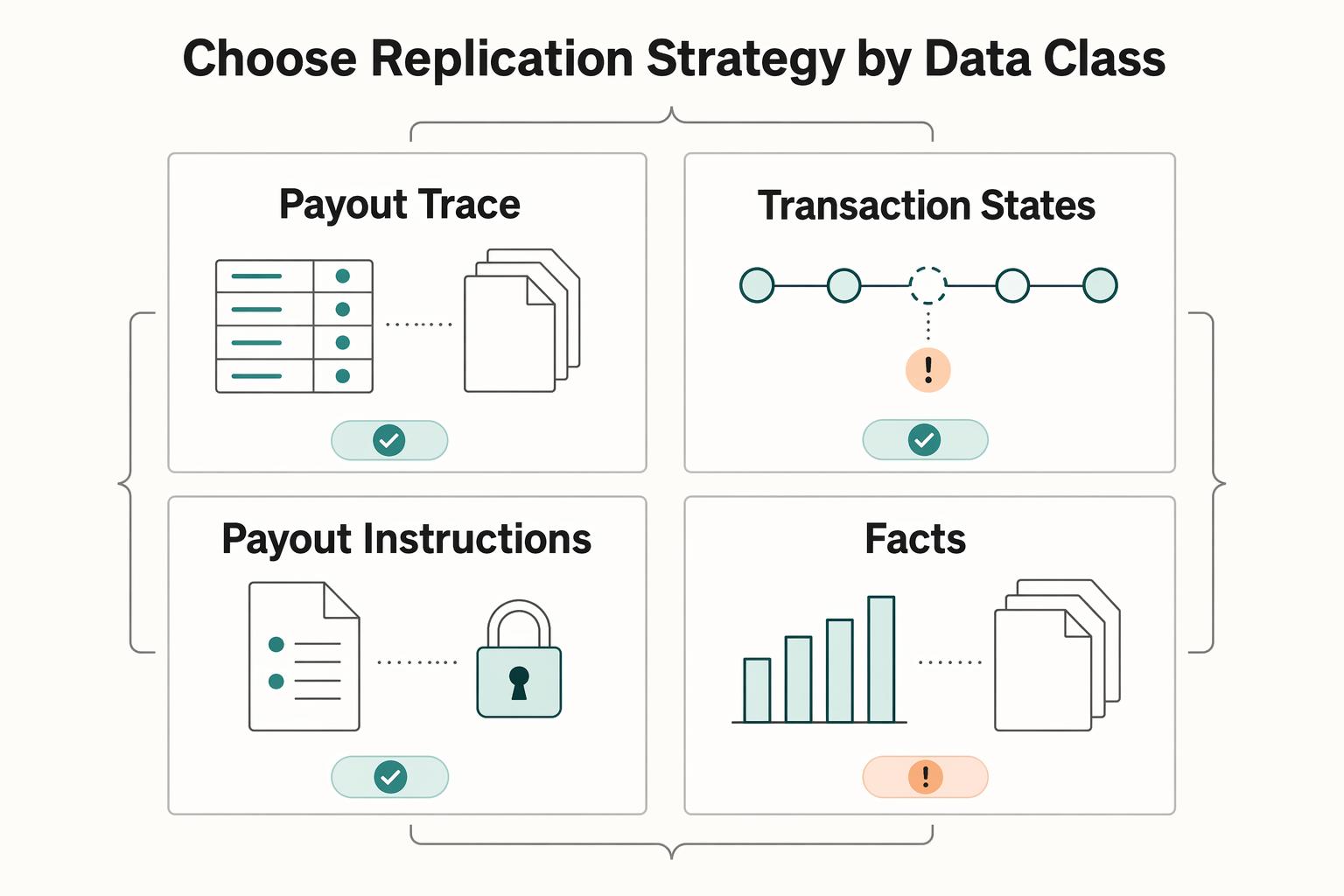
Choose replication by loss posture for each data class, not by database feature checklists. In practice, ledger events, transaction states, payout instructions, and audit artifacts can have different recovery needs, so one replication mode for everything is usually the wrong default.
Because RTO and RPO are independent, set both for each class before picking a method. You can recover service quickly and still lose recent data. You can also keep a tighter data window and still miss recovery-time expectations. A good planning checkpoint is to audit each class by data type, transaction volume, and system criticality.
Measure the usable recovery point for each class, including completion lag and consistency between related stores. A nominal 15-minute backup schedule can miss a 15-minute RPO if the newest copy has not completed or cannot be restored.
| Data class | Protection to evaluate | Recovery validation |
|---|---|---|
| Ledger events | Durable replicated records plus point-in-time backup | Balances and postings reconcile; the latest recoverable commit is known |
| Transaction states | Replicated state and retained event history | Internal state agrees with provider outcomes, with uncertain attempts held for investigation |
| Payout instructions | Durable instruction identities and attempt records | No instruction is issued again merely because restored state lacks a completion record |
| Audit artifacts | Protected copies with required version history | Evidence remains readable, complete and linked to the correct transaction |
Before cutover, document your recovery and reconciliation sequence in runbooks and test it. The useful proof is whether you can report the last protected timestamp, restore completion time, and what was reconciled after recovery for each data class.
Engineer failover and fallback paths for idempotent money movement#
Treat the switch away from primary and the return path as two separate recovery phases that you need to exercise end to end, not as a simple traffic toggle. In money movement systems, operational risk can rise around repeated instructions and unclear signals during disruption, so the design and the runbooks both need to make those repeats explainable under pressure.
| Recovery area | What to cover | Why it matters |
|---|---|---|
| Retries and replays | Set a clear rule for how the system classifies a repeated instruction during an incident; re-run in-flight scenarios; include accidental deletion or misconfiguration | Operators can explain what happened and why the system took that path |
| Webhooks | Treat external notifications as signals that must be checked against internal recovery state; document disagreement cases and missing or unclear signals in the main playbook | Keeps the incident process focused on validation and troubleshooting, not assumptions |
| Failback | Use explicit readiness checks for return-to-primary; capture cutover and failback timestamps, what was validated, what exceptions were found, and how they were resolved | Going back without clear validation and operator verification can reintroduce uncertainty at the worst moment |
Make retries behave like replays#
Preserve the logical instruction ID and provider attempt reference across recovery. Fence the old writer before activating a new one, and recover internal duplicate-detection state with the ledger. Provider idempotency works within its documented scope and retention window; it does not make a new key or another provider safe after an uncertain first attempt.
Exercise an in-flight payment whose provider response was lost. Confirm the original outcome using the provider’s status or reconciliation evidence before another execution, and retain an investigation exception when it remains unknown. Test deletion and misconfiguration as well as regional outage.
Treat webhooks as lagging evidence, not instant truth#
External events may be delayed, repeated or delivered out of order. Follow the provider’s signature-verification requirements, deduplicate processing and retrieve current payment state where needed. Compare that state with the recovered ledger instead of assuming the newest event received is the newest event that occurred.
Document how your team handles disagreement cases and missing or unclear signals during recovery. DR guidance treats troubleshooting common issues as part of execution, so this should sit in the main playbook, not as an afterthought.
Treat failback as a gated return, not a reset#
Return-to-primary should have explicit readiness checks, just like the initial switch. Going back without clear validation and operator verification can reintroduce uncertainty at the worst moment.
Capture cutover and failback timestamps, the checks performed, any exceptions and their disposition. Set an exercise cadence for the service’s risk and repeat tests after material changes; an untested return path can undo a successful failover.
Keep compliance controls alive during incidents#
Recovery is incomplete if control evidence does not survive the same event. Treat incident behavior for controls and records as part of your design, and validate it with legal and compliance teams for each program.
Define degraded mode before a vendor outage forces it#
If a critical dependency is impaired, predefine incident states and decision ownership so your operators are not improvising under pressure. Document what happened and why, with an auditable trail rather than silent exceptions.
Do not assume a universal bypass, hold, or release rule for screening, onboarding, or payouts during incidents; those decisions are program-specific and should be explicitly approved.
For each affected action, capture:
- affected record ID
- unavailable dependency
- incident window and decision timestamp
- temporary status during the outage
- decision owner
- outcome after recovery
Treat tax artifacts as recoverable records, not side files#
Restore the tax forms your payment model actually uses together with payee identity, form version, validation status and the reporting or withholding decision record. Access controls and document history should survive recovery with the forms.
| Record | Restore check |
|---|---|
| Payee documentation | The applicable W-8 or W-9 form and its version remain linked to the payee |
| Reporting population | Required reportable payments are reconciled rather than lost from a restored export |
| Withholding decisions | The decision, supporting documentation and responsible owner are recoverable |
| Filing workflow | Submission receipts, unresolved exceptions and applicable deadlines remain visible |
An incomplete restored record needs an exception owner and a deadline-aware recovery action. A personal FEIE eligibility calculation or FBAR filing is not a general platform payment-recovery control; include such data only when it belongs to the service you actually operate.
Expect timelines to move during real-world disruptions#
A technical outage does not itself extend a filing or payment deadline. Have the responsible team verify any applicable relief and retain the official notice supporting the decision; keep required submissions visible while records are recovered.
Record the legal or operational basis for any temporary control change and its restoration check. An unavailable vendor should not silently turn required screening into an approved result.
Sequence implementation to avoid hard-to-untangle platform debt#
Use a phased sequence so recovery restores service behavior, not just infrastructure. The order matters because it keeps dependencies visible while the design is still easy to change.
| Phase | Main actions | Checks or evidence |
|---|---|---|
| Phase 1 | Set domain-level RTO and RPO, then map dependencies; document the application entry path, state store, event path, external dependency, and who confirms business recovery | Data restoration alone is not enough if users or operators still cannot access the application path they need |
| Phase 2 | Implement replication, idempotency, traffic switching, and recovery verification | Run a restore drill that checks the application endpoint is reachable, restored state aligns with the defined RPO posture, and recovery and replay behavior is controlled to avoid unintended duplicate effects |
| Phase 3 | Harden production operations after the mechanics are proven in drills; assign clear incident ownership and make invocation steps explicit | Keep a Recovery Plan artifact with trigger conditions, approvers, restoration order, rollback conditions, required post-incident evidence, and a defined testing checkpoint |
Phase 1. Set domain-level RTO and RPO, then map dependencies#
Start by setting domain-level Recovery Time Objective (RTO) and Recovery Point Objective (RPO), then map dependencies. RTO is the maximum acceptable downtime, and RPO is the limit on acceptable data loss. Set both by business impact and system criticality, not with one default target.
For each payment workflow, document the application entry path, state store, event path, external dependency and owner of business recovery. Some components must recover together; represent that coupling in the plan rather than declaring each microservice independent.
Phase 2. Implement core controls, then run a restore drill#
Once the domains are defined, implement core controls for replication, idempotency, traffic switching, and recovery verification. This keeps data survival, replay handling, and cutover behavior explicit before you rely on automated switching.
For each domain, run a restore drill that checks:
- the application endpoint is reachable
- restored state aligns with the defined RPO posture
- recovery and replay behavior is controlled to avoid unintended duplicate effects
Phase 3. Harden production operations after drills prove the mechanics#
Harden production operations only after the mechanics are proven in drills. Assign clear incident ownership across engineering and payments ops, and make invocation steps explicit so time is not lost deciding how to start recovery.
Keep a concrete Recovery Plan artifact with trigger conditions, approvers, restoration order, rollback conditions, and required post-incident evidence. Include a defined testing checkpoint and treat failback as its own risk decision rather than an automatic step.
Test for reality, not paper compliance#
A DR program is only real if it works under failure, not just in documentation. Mark a drill as successful only when you restore within the declared Recovery Time Objective (RTO), keep data loss within the declared Recovery Point Objective (RPO), and confirm business operations can close the affected period without creating new issues.
Declare pass/fail before the drill#
Set success criteria before the exercise starts: recovery domain, incident type, start signal, stop signal, and explicit pass/fail checks.
Keep technical and business outcomes separate:
- RTO: did service return within the target window (for example, 2 hours)?
- RPO: did restored data stay within the allowed loss window (for example, 15 minutes)?
- Business outcome: can teams complete reconciliation and handle customer impact without unresolved exceptions?
Do not collapse this into a single "recovered" label. Recovery speed and data currency are different objectives.
Run drills for the failures that actually happen#
Use targeted drills that reflect real risk:
- Outage drills: verify service restoration within the RTO window.
- Ransomware drills: verify you can restore clean, usable data, not just restore quickly.
If infrastructure appears back but transactions fail, data is corrupted, or operations cannot close the loop, treat the drill as failed.
Use Chaos Testing selectively at critical boundaries#
Apply Chaos Testing where boundary failures are most likely to break recovery. The goal is to expose where recovery fails, not to create broad disruption.
Tight RTO targets usually require high-availability design and automated failover, while stringent RPO targets require continuous protection and frequent backups. Test those outcomes directly.
Measure closure, not just restoration#
A drill is complete only when both technical restore and business closure are validated. Capture evidence that includes:
- Start and end timestamps
- Recovery point used
- Data completeness checks
- Reconciliation outcome
- Support-ticket impact during the drill
In ransomware scenarios, treat "backup exists" as insufficient. Backups can exist and still fail at restore time, so test data cleanliness and usability, not just backup presence.
For a fuller cost view, read Building Payment Infrastructure In-House: Engineering, Compliance, and Maintenance Costs.
Prevent the failure modes that break trust first#
Focus first on the failures users feel immediately: service unavailability and data gaps or loss. Hitting RTO alone is not enough because RTO and RPO are independent and can fail separately.
Build the evidence pack executives and auditors will ask for#
Your recovery story is only credible if you can prove what happened quickly from one repeatable evidence set. Keep it compact, consistent, and tied to the payments annex in your contingency plan rather than spread across tickets, chat, and ad hoc exports.
Put the payments annex in one place#
Keep one short annex that defines scope, owners, dependency assumptions, and the declared recovery objectives for each payment domain. This keeps contingency decisions and disaster recovery aligned: disaster recovery covers IT restoration after a major event, while contingency planning covers broader disruption scenarios.
Use a simple check: you should be able to answer from that annex alone who owns payout recovery, what it depends on, and what counts as success.
Keep drill proof, not just drill notes#
For each drill, preserve durable evidence, not just a pass/fail summary:
- Start and end timestamps
- Restore logs
- Reconciliation outcomes
- Unresolved exceptions
- Corrective actions opened after the exercise
NIST’s contingency-planning guidance provides a reference for exercises and plan maintenance for federal information systems. If you use it as a planning framework, define the testing frequency and required evidence for your applicable controls and risk profile.
Make traceability and retrieval boring#
Make end-to-end traceability easy to reconstruct from one evidence set, including the identifiers and records your workflow already uses. A practical test is whether you can reconstruct one transaction path end to end without cross-team screenshot hunts.
If examiner or legal requests are realistic for your business, treat these as useful implementation patterns rather than rule text: content-addressed storage for integrity proof, standardized Preservation Bundles for retrieval, and legal-hold controls to reduce accidental deletion risk during active inquiries.
Conclusion#
Disaster recovery only counts if you can restore critical capabilities within declared RTO and RPO targets and prove the recovered state is usable. Set those targets from business requirements, not defaults, because RTO and RPO are independent and tighter values create different architecture and operational burdens.
Keep downtime and data-loss targets separate, and verify both against the restored service and records. Faster traffic switching cannot compensate for missing payment instructions, and recent replicated data cannot compensate for an unusable application.
Set targets at the workflow and record level, while accounting for components that must recover together. When domains share dependencies, include their recovery sequence and timing in the design and drill rather than assuming independent restoration.
Use two checks as your release gate for DR readiness:
- Validate recovery time and application function in failover testing, not just service boot.
- Do not trust an untested plan. Credibility comes from drills that show restore time and recoverable data age hold up in practice.
A practical next step is a short domain-by-domain decision matrix your engineering and operations teams can review together before the next release.
Frequently Asked Questions
What is the difference between RTO and RPO in payment infrastructure?
RTO is the maximum acceptable outage duration after a disruption. RPO is the maximum acceptable data-loss window, measured backward from the disruption to the last acceptable recovery point. You need both, because fast recovery without recent recoverable data can still create serious operational impact.
How do I choose replication and backup strategy when RTO is strict but RPO is moderate?
Choose a pattern that restores service within the downtime target while keeping a usable data recovery point inside the loss window. For example, a reporting domain might accept 30 minutes RTO and six hours RPO. That example does not establish an acceptable loss window for ledger entries or payout instructions; set those targets separately and reconcile external outcomes.
When should I use backup and restore, pilot light, warm standby, or hot standby?
Universal thresholds for choosing among those patterns are not established. Use your declared RTO and RPO as the decision anchors: aggressive RTO usually requires more availability automation, while stringent RPO usually requires more continuous data protection and backup frequency. If a pattern cannot reliably meet both objectives, it is not the right fit for your risk tolerance.
How often should we test failover targets?
Choose a test cadence based on criticality, material changes and applicable controls. During each exercise, measure both restoration time and the age and consistency of the usable recovery point. A 15-minute backup schedule alone does not prove a 15-minute RPO.
How do we sequence DR work without creating integration debt?
Set RTO and RPO first, then prioritize implementation work based on which objective is hardest to meet. Tighter RTO usually drives high-availability design and automated failover, while tighter RPO usually drives continuous protection and more frequent backups. Use those objectives as independent decision criteria when sequencing recovery work.
Which provider constraints should the recovery plan verify?
Verify supported regions, tenancy/account boundaries, recovery operations and external dependencies for the selected products. Oracle’s Full Stack DR FAQ requires same-tenancy resources and excludes cross-tenancy DR; it describes broader on-premises, hybrid and multicloud recovery as roadmap while noting limited database role transitions for Oracle Database@Azure. Test the actual scope you intend to use.
Researched and edited by the Gruv editorial team. Gruv builds cross-border billing, payouts, and finance-operations software for global businesses.
Sources
Includes 3 external sources outside the trusted-domain allowlist.
- csrc.nist.gov/pubs/sp/800/34/r1/finaltrusted
- docs.stripe.com/error-low-leveltrusted
- docs.stripe.com/webhookstrusted
- irs.gov/instructions/iw9trusted
- irs.gov/instructions/iw8trusted
- docs.aws.amazon.com/whitepapers/latest/disaster-recovery-workloa...external
- learn.microsoft.com/en-us/azure/well-architected/design-guides/d...external
- learn.microsoft.com/en-us/azure/reliability/concept-redundancy-r...external
Educational content only. Not legal, tax, or financial advice.
Related Posts

The Freelance Payment Penalty: A Modeled Audit of Platform Fees, FX Spreads, and Payout Delays
The money rarely disappears through a single, easy-to-spot fee. The real loss is stacked. A marketplace takes its commission, a processor adds a charge for international cards, a bank or payment company converts the currency at a spread, a platform holds the funds before release, and a wire sheds a little to intermediaries on the way in. Each layer looks defensible on its own, but the worker feels the combined result as a smaller deposit and a later payday.

How to Respond to a Subpoena for Business Records
Move fast, but do not produce records on instinct. If you need to **respond to a subpoena for business records**, your immediate job is to control deadlines, preserve records, and make any later production defensible.

A US Expat's Guide to Investing in UCITS ETFs to Avoid PFIC Issues
The real problem is a two-system conflict. U.S. tax treatment can punish the wrong fund choice, while local product-access constraints can block the funds you want to buy in the first place. For **us expat ucits etfs**, the practical question is not "Which product is best?" It is "What can I access, report, and keep doing every year without guessing?" Use this four-part filter before any trade: