
Quick Answer
Yes - adaptive pricing subscription checkout can improve signup outcomes, but only when you validate the full billing path. In the article, Stripe reports positive test results and support across new cross-border subscriptions on Checkout, Payment Links, and Elements with Checkout Sessions, while also noting conversion fees and renewal variability from exchange-rate movement. The practical move is to run a controlled holdback, review early renewals, and expand only in markets where conversion lift and effective margin both clear your threshold.
Adaptive pricing in subscription checkout is a revenue decision first, not a cosmetic checkout tweak#
Adaptive pricing in subscription checkout is a revenue decision first, not a cosmetic checkout tweak. When you show a local currency price to a buyer in another market, you change signup conversion, effective margin, and what the customer expects to see at renewal.
So the right lens is broader than checkout UX. Stripe defines Adaptive Pricing as a feature that converts prices to a customer's local currency using its exchange rates. Stripe says the feature is generally available for new cross-border subscriptions on Checkout, Payment Links, and Elements with Checkout Sessions. For operators, that leads to two practical questions: where is it actually supported in your current subscription path, and what happens after the first successful payment?
The upside is worth taking seriously, but with the right caution. In company material dated March 19, 2026, Stripe reports an A/B test across 1.5 million subscription checkout sessions with 4.7% higher conversion and 5.4% higher LTV per session. Help docs also say enabling the feature has been associated with higher international revenue on average. Those are useful signals, but they are still vendor-reported signals. Throughout, this article separates what the documentation and help center explicitly confirm from what still needs account-level validation on your side.
The tradeoff is not subtle. Stripe also states that the exchange rate shown to customers includes a conversion fee of between 2% and 4%, and that recurring subscription payments can vary based on exchange rates. So a localized first checkout can help demand while also creating margin pressure or renewal surprise if you do not watch the full billing path. If your business is sensitive to churn after the first invoice, renewal behavior matters as much as the initial lift.
Before you consider rollout, verify the exact surface powering your current flow. "We use Stripe" is not enough. You need to know whether your subscription checkout runs through Checkout, Payment Links, or Elements with Checkout Sessions. Stripe's published support guidance ties availability to those surfaces, and the docs include testing guidance for local-currency presentment on Checkout and Payment Links. That is useful, but it does not mean every eligibility edge case is fully specified.
So the goal here is straightforward: help you decide where Adaptive Pricing belongs in cross-border subscriptions, how to test it without guessing, and how to avoid unit-economics surprises once real renewals start coming in. If you are evaluating this feature, treat it as a market-by-market monetization experiment with finance, product, and support implications, not as a switch you enable globally and hope works out.
For transfer-pricing context when local prices affect related entities, use How to Use a 'Cost-Plus' Model for Transfer Pricing.
Define Adaptive Pricing in subscription terms#
Adaptive Pricing for subscriptions means customers start and pay in local currency, and that local amount can change at renewal because exchange rates are applied each billing cycle.
| Scope area | Current guidance |
|---|---|
| Applies to | New cross-border subscriptions |
| Supported surfaces | Stripe Checkout, Stripe Payment Links, and Stripe Elements via Checkout Sessions |
| Existing subscriptions | Not automatically impacted |
| Supported methods | Card, Link, Apple Pay, and Google Pay for cross-border subscriptions |
This is subscription-pricing behavior, not just a translated checkout amount. Recurring payments can vary with exchange-rate movement, so the signup experience and renewal expectations need to be managed together.
Stripe's stated subscription scope is specific:
- It applies to new cross-border subscriptions.
- It is positioned on Stripe Checkout, Stripe Payment Links, and Stripe Elements via Checkout Sessions.
- Existing subscriptions are not automatically impacted.
- For cross-border subscriptions, supported methods are card, Link, Apple Pay, and Google Pay.
Use that definition as a starting point, then verify your live path. The docs define core behavior but do not fully resolve every eligibility or stability edge case. The at-least-4% stability buffer is described as account-team gated, so treat rollout claims as directional until you validate them in your own markets and billing setup.
For hybrid subscription and usage billing, read Hybrid Pricing Models: How to Combine Subscription Fees Plus Usage Charges on a Single Invoice.
Compare one-time localization and subscription localization#
One-time localization is judged mostly at the first charge; subscription localization has to stay credible on every billing cycle after signup. If renewal sensitivity is a churn risk in your model, treat subscription-localization design as a core retention decision, not just a checkout optimization.
| Dimension | One-time localization | Subscription localization |
|---|---|---|
| Pricing stability | Can be more stable when you set manual local prices, since prices do not change unless you update them | Can be less stable when pricing uses real-time exchange rates each billing cycle, so local renewal amounts can vary |
| Operational burden | Narrower focus on first-purchase outcomes | Ongoing focus across signup and future charges, including renewal communication and support load |
| Renewal risk | Low recurring expectation risk because there is no renewal cycle | Higher risk of trust friction if the customer-facing amount changes over time |
| Measurement window (Checkout Sessions) | Checkout Sessions outcomes for one-off payments (top-of-funnel and first charge) | Checkout Sessions outcomes at signup, plus early renewal performance across subsequent billing cycles |
The economics also behave differently over time. Stripe notes a currency conversion fee, and the 2-4% fee can increase presented price; for subscriptions, that sits on top of billing-cycle FX movement rather than ending at one transaction.
Use two windows when you evaluate rollout. First, measure Checkout Sessions performance at signup. Second, review early renewal cohorts to see whether variable renewal amounts and conversion-fee exposure are creating retention or margin pressure that offsets first-checkout gains.
For annual-versus-monthly packaging choices, read Annual vs. Monthly Subscription Pricing: How to Structure Plans That Maximize ARR and Reduce Churn.
Build the economics scorecard before rollout#
Build one scorecard that covers both signup and early renewals before rollout, or you will miss the real tradeoff. Treat success as a combined product-and-finance outcome: stronger signup performance, stable early renewal behavior, and acceptable effective margin after FX movement and conversion fees.
Use two lenses. The session lens uses checkout reporting and Acceptance analytics to track payment success rate and network authorization rate at signup. The subscription lens tracks early billing-cycle renewal outcomes, where localized recurring prices can vary with exchange-rate updates.
Do not collapse this into one headline KPI. A market can lift signup conversion and still fail the economics if the 2-4% conversion fee raises presented price, renewal amounts move, or failed payments increase. Set a strict rule: if local presentment improves top-of-funnel results but weakens effective margin after FX and conversion fees, keep rollout limited to markets that still clear your bar.
| Metric | Owner | Data source | Review cadence | Go/no-go threshold definition |
|---|---|---|---|---|
| Signup conversion rate | Product | Checkout reporting and experiment view | Daily during launch, then weekly by market | Define the minimum uplift vs. control or baseline, only if downstream metrics stay within tolerance |
| Signup authorization rate | Product / payments | Acceptance analytics | Daily after the processing window closes | Define acceptable movement vs. baseline or control; conversion lift with weaker authorization is not a clean win |
| Early renewal retention | Product / finance | Subscription cohort reporting from renewals | Weekly by cohort through early billing cycles | Define the maximum allowed drop vs. comparable markets or holdback groups |
| First-attempt subscription failure rate | Finance / rev ops | Revenue-recovery analytics | Weekly | Define the maximum allowed worsening by market and plan |
| Recovery rate on failed subscription payments | Finance / payments | Revenue-recovery analytics | Weekly | Define the minimum recovery level needed to protect expected value |
| Effective margin by market | Finance | Paid subscription invoices plus FX and fee model | Weekly during rollout, then month-end | Define a company floor after presentment effects, FX movement, and conversion fees |
Two checks help prevent bad decisions. First, Acceptance data is processed daily from 12:00 PM UTC to 11:59 PM UTC, so read it after the cycle closes. Second, include paid-invoice presentment_details (presentment_amount, presentment_currency) so finance can compare customer-facing price to realized economics.
Also note a known dataset gap: revenue-recovery analytics covers recurring subscription payments only and excludes the first invoice payment after a trial. If trials are material in your motion, track that first post-trial invoice separately.
Use vendor results as signal, not as your threshold policy. Stripe reported an A/B test across 1.5 million subscription checkouts with average lifts of 4.7% conversion and 5.4% LTV per session, while also noting optimization estimates are not guarantees. Set your own market-level thresholds before launch.
If you cannot produce this scorecard before rollout, you are not ready for broad enablement. Start in markets where you can review session outcomes, invoice presentment, and early renewals together each week, then expand only when those numbers align.
For a step-by-step walkthrough, see How to Conduct a Functional Analysis for Transfer Pricing.
Choose the right integration surface and confirm eligibility#
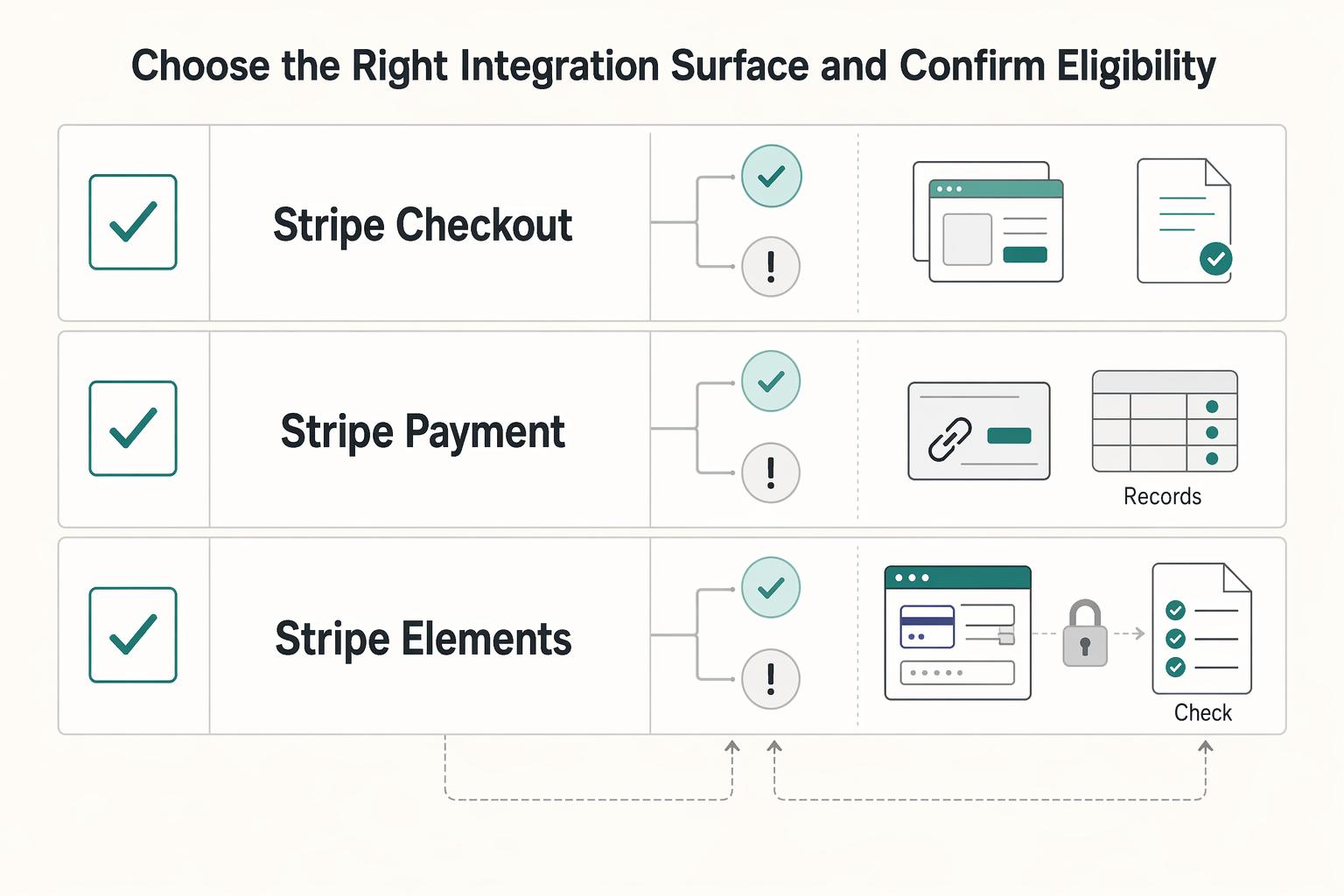
Confirm which surface actually powers your subscription checkout in production, then verify eligibility for that exact path before testing. For new cross-border subscriptions, Stripe documents Adaptive Pricing on Stripe Checkout, Stripe Payment Links, and Stripe Elements with Checkout Sessions. It is not supported on the Payment Intents API.
Map your live funnel first, not your internal labels. Checkout Sessions can power different payment UIs, so "we use Elements" is not enough unless you confirm the subscription flow is using Checkout elements rather than Payment Intents.
| Surface | What Stripe confirms | Practical fit | Verification check |
|---|---|---|---|
| Stripe Checkout | Supported for new cross-border subscriptions | Lower-friction hosted checkout | Confirm the live flow is sessions-based |
| Stripe Payment Links | Supported, and Adaptive Pricing is always enabled | Fastest path when engineering bandwidth is limited | Confirm account and market eligibility with support |
| Stripe Elements | Supported only with Checkout Sessions via Checkout elements | Better control for instrumentation and rollout design | If the flow is Payment Intents API, this support does not apply |
If you need the lowest implementation friction, Payment Links is the fastest route and Stripe positions it as a no-code subscription setup path. If you need tighter experiment and event control, prioritize Elements with Checkout Sessions and verify the implementation path directly.
Maintain an eligibility matrix by country/program, integration surface, payment methods, support case link, last verified date, and known limits. Stripe also states cross-border subscriptions here support only card payments, Link, Apple Pay, and Google Pay, so do not assume one-time payment-method coverage carries over.
Treat this as launch control, not admin work. Stripe notes that disabling Adaptive Pricing is not retroactive for already-converted Checkout Sessions or active subscriptions already paid in local currency.
For related-entity pricing governance, read Transfer Pricing for Small International Businesses with Related Entities.
Run a controlled rollout with decision gates#
Run the rollout as a controlled experiment, not a broad launch: start with a narrow cross-border cohort, keep a real holdback group, and gate expansion on renewal behavior as much as signup lift.
Keep a real control group#
Use a randomized holdback design so eligible sessions are split between localized pricing and a control path. That gives you causal evidence, not noisy before-and-after comparisons, and aligns with how controlled experiments are defined in A/B testing practice.
If you have per-session control, use it to phase by market, traffic slice, or subscription cohort. Stripe's adaptive pricing parameter supports incremental rollout and granular control, which is the practical mechanism for this setup. Before you read results, confirm treatment and holdback are on the same integration surface, payment-method scope, and geo-eligibility rules.
Do not skip control because external results looked strong. Stripe reported an A/B test (March 19, 2026) across 1.5 million subscription checkouts with 4.7% higher conversion and 5.4% higher LTV per session; that is a reason to validate in your own mix, not bypass testing.
Use a sequence that respects subscription risk#
Sequence the rollout to protect renewal quality, not just first-session conversion.
| Phase | What you do | Decision gate before expansion |
|---|---|---|
| Baseline | Capture pre-launch signup, authorization, support, and early renewal metrics for the target cohort | Baseline window is stable enough for treatment-vs-control comparison |
| Limited launch | Enable localized pricing for a small eligible market/cohort slice | Treatment and holdback assignment works correctly in production |
| Signup review | Compare conversion and authorization outcomes between groups | Lift is not explained by traffic mix, promo changes, or channel skew |
| Renewal review | Wait through first renewal window; inspect renewal amounts, retries, and support contacts | No renewal instability or customer confusion that outweighs signup lift |
Keep renewal checks explicit. Stripe support docs state recurring subscription payments can vary by exchange rates each billing cycle, and failed-payment retries can apply the exchange rate at retry time. A cohort can look good at signup and still degrade later if renewal outcomes create confusion.
Gate rule: do not scale if early conversion gains are offset by higher renewal volatility, retry oddities tied to repricing, or increased tickets about unexpected local-price behavior.
Before each expansion step, inspect a sample of treatment and control subscriptions end to end: signup session behavior, displayed currency, first invoice outcome, and retry pricing when failures occur.
Record decisions like a finance change, not a UI tweak#
Log every launch, pause, rollback, and expansion with product, finance, and ops sign-off. Tie each entry to cohort, markets, integration surface, payment methods, test dates, baseline window, signup outcomes, renewal observations, and the explicit decision reason.
| Log field | What to include |
|---|---|
| Scope | Cohort, markets, integration surface, and payment methods |
| Timing | Test dates and baseline window |
| Performance | Signup outcomes and renewal observations |
| Decision | Explicit decision reason |
| Evidence | Metric snapshots, relevant support-ticket patterns, notes on FX-related renewal behavior, and the linked approval/support case |
| API note | If rollout required the adaptive pricing parameter on a newer API version, note Stripe's stated 72-hour rollback window |
Store evidence with each decision: metric snapshots, relevant support-ticket patterns, notes on FX-related renewal behavior, and the linked approval/support case. If rollout required adopting the adaptive pricing parameter on a newer API version, note Stripe's stated 72-hour rollback window because it changes your response options during early rollout risk.
For another pricing model where outcome rules matter, see How to Use Performance-Based Pricing for Your Freelance Services.
Handle failure modes before they hit revenue#
Revenue risk usually appears after signup, when customer expectations and internal assumptions drift. Before you expand, lock three controls: clear renewal messaging, written validation notes, and a recurring market review loop.
| Control | What to lock | Checks |
|---|---|---|
| Renewal messaging | State that renewals can vary with FX, currency stays the same, and a retry amount can differ from the original billed amount | Fix plan-page or billing copy that implies a fixed local renewal amount before rollout |
| Validation notes | Keep an internal note with the exact behavior confirmed in your account, on your integration surface, and on what date | Include presentment_details checks for presentment_amount and presentment_currency, and any Help & Support case reference |
| Recurring market review | Run a monthly review before expanding any market | Review failed renewals, dispute reasons, and margin deltas by market; pause expansion where retry failures, amount/currency confusion disputes, or weaker margin after FX effects are increasing |
Close the renewal expectation gap#
The main risk is renewal surprise. Stripe says recurring subscription payments can vary with exchange rates, Stripe won't send customer communications about those price changes for you, the subscription currency stays locked unless canceled, and failed-payment retries can apply the exchange rate at retry time.
So your checkout language should state this plainly: renewals can vary with FX, currency stays the same, and a retry amount can differ from the original billed amount. If plan-page or billing copy implies a fixed local renewal amount, fix it before rollout. Stripe also describes a stability buffer of at least 4% for more stable local prices, but that is a setting to verify, not a substitute for clear messaging.
Write down what you actually validated#
Internal confusion starts when teams treat partial docs or noisy tests as policy. Stripe notes that pages loading Stripe.js can also load hCaptcha, and support warns that blocking hcaptcha.com or subdomains can break CAPTCHA-dependent flows.
Keep an internal validation note with the exact behavior you confirmed in your account, on your integration surface, and on what date. Include event checks for presentment_details (presentment_amount and presentment_currency) for the first charge and any retry path you test. If support clarified a rule, attach the Help & Support case reference so finance, ops, and product all work from the same answer.
Treat community posts as leads, not policy#
Community posts are useful for spotting edge cases, but they are still anecdotes. If a thread suggests a risk, turn it into a check: reproduce it in test or low-volume production, confirm with support if it matters, and record the result.
Also plan for rollback limits. Stripe says disabling Adaptive Pricing doesn't affect Checkout Sessions already converted, so a late correction may only limit new exposure. Before expanding any market, run a monthly review of failed renewals, dispute reasons, and margin deltas by market, and pause expansion where retry failures, amount/currency confusion disputes, or weaker margin after FX effects are increasing.
For platform pricing tradeoffs by billing unit, use Usage-Based Pricing for Payment Platforms: Per-Transaction vs. Subscription.
Apply clear decision rules by business profile#
Match rollout to your binding constraint, not to feature availability.
| Business profile | Decision rule | What to verify before wider rollout |
|---|---|---|
| Growth is blocked by new-geo checkout drop-off | Prioritize Adaptive Pricing for new cross-border subscriptions where abandonment is already high. | Validate market-level checkout completion and authorization across localized presentment vs original-currency choice, and confirm presentment_details (presentment_amount, presentment_currency) is present in events. |
| Margin is the constraint | Expand only if conversion and authorization gains outweigh FX effects plus the embedded 2-4% conversion fee. | Review cohort economics by market, not just first-charge volume. If localized presentment lifts completion but weakens net revenue, keep rollout selective. |
| Renewal predictability or team capacity is the constraint | Roll out conservatively, in fewer markets first. | Renewals can vary by billing cycle with real-time exchange rates, so monitor early renewal cycles as closely as first checkout. Use session-level adaptive_pricing control (2024-11-20.acacia) for incremental rollout, and expand only after telemetry and support signals stay clean. |
Keep two implementation checks explicit in every profile. First, for cross-border subscriptions, supported methods are limited to card payments, Link, Apple Pay, and Google Pay. Second, if your team cannot review market-by-market telemetry from Checkout Sessions, the rollout is too wide.
For contractor-pricing and fee comparison context, read A Deep Dive into Deel's Pricing and Fees for Contractors.
Conclusion#
The smart way to handle adaptive pricing in subscription checkout is to treat it like a controlled commercial decision, not a dashboard toggle. Any improvement in signup conversion or authorization is useful only if early renewals, support load, and margin still hold up. If those measures split apart, keep the feature narrow by market instead of forcing a global rollout.
For most teams, the practical order is simple:
- Confirm eligibility for your account, region, and the exact surface you use today.
- Instrument Checkout Sessions and downstream subscription events before changing anything.
- Launch by cohort, not globally, using session-level control where possible.
- Review results with product and finance together before expanding.
That sequence matters because the platform gives you a real control point. The newer session parameter can override the Dashboard default per session, which is what makes incremental rollout possible. The docs also say this sessions-based API is the recommended path for most developers, while the lower-level Payment Intents route requires significantly more code and ongoing maintenance. If your team is short on engineering time, start with Checkout Sessions and spend your effort on measurement, not custom plumbing.
Your verification checkpoint should go beyond the first successful charge. For recurring subscriptions, help docs say relevant events expose presentment_details, including presentment_amount and presentment_currency. That is the evidence pack you need to confirm what customers were actually shown and billed in local currency, especially when renewals may vary because exchange rates change. The 24-hour exchange-rate guarantee is helpful at checkout, but it does not remove renewal price movement later.
The main tradeoff is still economics versus predictability. Help docs say localized presentment can include a 2 to 4% conversion fee in the customer price, and support docs also note that subscription payments may vary by billing cycle. So a win on first-checkout completion can still become a problem if customers are surprised at renewal, if payment failures rise, or if support tickets start clustering around local-price confusion. One more operational warning: disabling Adaptive Pricing does not retroactively change already converted sessions or active local-currency subscriptions, so rollback is not a clean reset.
That is why market-by-market discipline matters more than vendor headline claims. Use the platform's controls, trust your own data, and keep notes on what the docs confirm versus what your account behavior actually shows. If you want a broader pricing design lens after this, How to Handle Multi-Currency Pricing for Your SaaS Product is the natural next read.
Frequently Asked Questions
What is adaptive pricing for subscription checkout?
Adaptive Pricing is a Dashboard feature that converts prices to a customer’s local currency using Stripe-provided exchange rates. For subscriptions, that means a customer can start and pay in local currency while you still settle transactions in one of your settlement currencies and keep the price you set in your integration currency.
How is subscription adaptive pricing different from one-time checkout localization?
For a one-time purchase, the main question is whether local-currency presentment helps that single checkout complete. For subscriptions, you also have to manage what happens on later billing cycles, because the docs say recurring subscription payments can vary based on exchange rates. That makes subscription localization a pricing and retention decision, not just a first-charge conversion tactic.
Can renewal amounts still change after a customer signs up in local currency?
Yes. The docs say subscription local prices use real-time exchange rates for each billing cycle, so the local amount can vary over time. If renewal predictability matters, the checkpoint is not just the signup event. Review early invoices and payment events to confirm the presentment amount and currency behave the way your team expects.
Where is adaptive pricing currently supported across Stripe Checkout, Payment Links, and Elements?
The docs say it is available for new cross-border subscriptions on Checkout, Payment Links, and Elements with Checkout Sessions. That sessions-based flow supports both one-off payments and subscriptions, but do not assume full parity in your account without checking the exact surface and payment methods you use. The docs also note that subscription support is limited to payment methods that work with both your integration currency and the customer’s local currency.
Will adaptive pricing always improve conversion rate and authorization rate?
No. Stripe presents it as directional upside, not a universal guarantee, and cites higher international revenue on average rather than a promise for every market or subscription mix. You should test by country, payment method, and currency choice, then compare outcomes against a control path before expanding.
How should we evaluate unit economics impact when FX and conversion fees move?
Start with the hard cost mechanic. The docs say the localized presentment rate can include a 2 to 4% conversion fee, which increases the customer’s purchase price, and the customer avoids that fee if they choose to pay in your integration currency. Then measure both the first charge and the first renewal cycles, because FX movement can change local prices over time. A useful red flag is a market where completed checkouts rise but net revenue quality worsens once you factor in renewal behavior, payment failures, and support contacts about currency confusion.
How broad is the local-currency footprint, and does that mean we should roll it out everywhere?
The docs describe local-currency presentment in more than 150 countries, with an exchange rate guarantee stated for 24 hours. That reach is useful, but it is not a rollout instruction. You still need account-level verification, market-level telemetry, and a reason to believe the economics work in that specific cross-border subscription cohort.
Try a related tool
Researched and edited by the Gruv editorial team. Gruv builds cross-border billing, payouts, and finance-operations software for global businesses.
Sources
Includes 1 external source outside the trusted-domain allowlist.
- ai.stanford.edu/~ronnyk/GuideControlledExperiments.pdftrusted
- docs.stripe.com/payments/currencies/localize-prices/adaptive...trusted
- docs.stripe.com/payments/checkout/build-subscriptionstrusted
- stripe.com/blog/producttrusted
- stripe.com/blog/testing-the-conversion-impact-of-50-plu...trusted
- support.stripe.com/questions/adaptive-pricing-for-subscriptionstrusted
- support.stripe.com/questions/adaptive-pricingtrusted
- statsig.com/perspectives/holdout-testing-explainedexternal
Educational content only. Not legal, tax, or financial advice.
Related Posts
Hybrid Pricing Models for One Subscription and Usage Invoice
Treat this as a billing and operations project, not just a pricing exercise. A hybrid pricing model can be commercially strong. The real test is whether you can put a recurring subscription fee and usage-based charges on a single invoice without forcing Finance to stitch things together at month-end.
Annual vs Monthly Subscription Pricing to Maximize ARR and Reduce Churn
Annual vs monthly billing is an operating decision before it is a pricing-page choice. It affects when cash is collected, how much commitment is required upfront, how cancellation works, and how finance tracks collected cash versus recognized revenue.

Choosing Per-Transaction or Subscription Pricing for Payment Platforms
For a payment platform, the right pricing model is the one your unit economics and billing operations can actually support, not the one that looks cleanest on a pricing page. In practice, teams usually choose among three mechanics: usage-based billing, per-transaction pricing, and recurring subscriptions, or combine usage-based and recurring charges where supported. Each one changes revenue behavior, invoice logic, and margin risk.