

Quick Answer
Payment orchestration is a control layer that coordinates provider selection, payment states and reporting across available payment paths. Evaluate it when routing work, regional coverage gaps or reconciliation effort justify its cost. Pilot one flow and test unknown outcomes, duplicate prevention and settlement matching before widening traffic.
How payment orchestration works in practice#
Payment orchestration puts provider selection and payment-state handling in one control layer. The decision is whether that added layer solves a measurable routing, coverage or reporting problem in your current stack.
At a practical level, payment orchestration means putting gateways, processors, acquirers, and other payment providers behind one control layer. Teams typically use that layer to route transactions and unify reporting across multiple PSP relationships, using rules based on cost, success rates, customer preferences, and regional requirements. The appeal is straightforward: a centralized layer can help improve payment performance and conversion without hardwiring every provider decision into checkout.
The tradeoff is just as real. This approach can improve routing and finance visibility, but it also adds implementation and governance work across payment methods, gateways, and acquiring banks. You are adding routing logic and reporting expectations across providers, and unclear ownership can make payment issues harder to diagnose. That leads to four practical decisions:
- Is the problem urgent enough to act now?
A POP becomes more compelling when failed payments, regional acceptance gaps, or fragmented finance matching already create measurable cost.
- Is your first goal performance, coverage, or control?
Some teams need better routing. Others need broader regional or payment-method coverage. Others mainly need cleaner reporting and close processes.
- Which architectures are actually in scope?
This article compares practical cross-border platform options: single PSP, multi-provider, orchestration platform, and hybrid models, without vendor ranking.
- How strong is the evidence?
Measure the cost of your own failed payments and reporting work before comparing orchestration proposals. Category growth and vendor uplift claims do not establish the benefit for your traffic, payment methods or support workload.
For a step-by-step walkthrough, see What Is Bank Remittance? How Platforms Send Payment Advice to Contractors.
Selection Criteria and Who This List Is For#
This article is most useful if you are evaluating payment orchestration for a cross-border setup with multiple PSPs, regional variation, or growing finance complexity. If your flow is mostly domestic and stable on one PSP, read this as planning context; moving to a more complex model may be a lower-priority decision.
- Best fit: multi-PSP teams with real routing choices
This is most useful for platform founders, product leads, finance ops, and engineering owners coordinating local and global PSP relationships through one orchestration layer.
- Lower urgency: single-PSP teams with limited near-term change
A gateway-only setup can be enough in the near term, but it concentrates risk: if your only gateway goes down, acceptance can stop until your team switches manually.
- How each option is evaluated
Every path is judged on the same four criteria: reliability, total cost, operational complexity, and reporting visibility. Reliability means practical multi-provider routing and failover behavior, and total cost should include any orchestration platform fees on top of processor costs.
- Baseline requirement across all options
Before you choose an architecture, confirm clear operating ownership and the staff know-how to manage and optimize routing and failover behavior. If ownership is unclear during a provider timeout or routing-rule change, fix operating readiness first.
Option 1 Single-PSP Architecture for Fast Launches#
If speed matters more than optionality, a Single-PSP architecture can be a practical starting point. Early-stage teams often pick one PSP because fast onboarding and low complexity matter more than multi-provider routing at this stage.
Best fit#
This fits when your payment setup is still simple and you do not need dynamic routing yet. One provider integration keeps Payment Gateway and Payment Processor operations straightforward, reducing setup drag while you validate demand.
Where it wins#
The main advantage is focus. You avoid maintaining separate integrations across multiple PSPs, gateways, or acquirers before you need them, which lowers integration overhead and shortens the path to production.
Before you commit, make the tradeoff explicit. Define who owns PSP incident response, how support handles provider outages, and what signals trigger a second-provider review.
Where it breaks#
The weakness is concentration risk. With one PSP, you typically lack true cross-provider Fallback Routing during outages or performance issues. If expansion or provider diversification arrives earlier than expected, you can end up adding providers one by one later and taking on the same integration burden you postponed.
Option 2 Multi-Provider Payment Stack for Regional Coverage#
A Multi-Provider Payment Stack can be a practical next step when your problem is regional coverage, not advanced routing. You add the Payment Service Provider (PSP) and Acquirer relationships needed for local market fit and Local Payment Methods, while accepting more operational overhead because each provider brings different APIs, authentication, and reporting.
When this is the right move#
Choose direct multi-provider integration when one provider cannot cover the country or payment method you need. Compare actual authorization outcomes for comparable traffic rather than assuming one acquirer is better for an entire country.
This path is mainly about market access. If one PSP is stronger for cards in one country and another is stronger for local methods elsewhere, stitching providers together directly can help you go live before you commit to a full Payment Orchestration Platform (POP).
What you gain and what you do not#
You gain broader Local Payment Methods, more options for regional acceptance strategy, and some resilience through manual or rule-based switching. If a provider underperforms for a specific country or payment method, you can move traffic for that slice.
What you do not get by default is automatic retries or fully managed backup routing. Those sit at the control-layer level, not as a built-in outcome of having multiple direct provider integrations.
Where the operational cost shows up#
The cost shows up in duplicate integration work and finance overhead. Without a unified API layer, each added provider usually means another direct integration, which raises complexity and cost as APIs, auth models, webhooks, and reporting formats diverge.
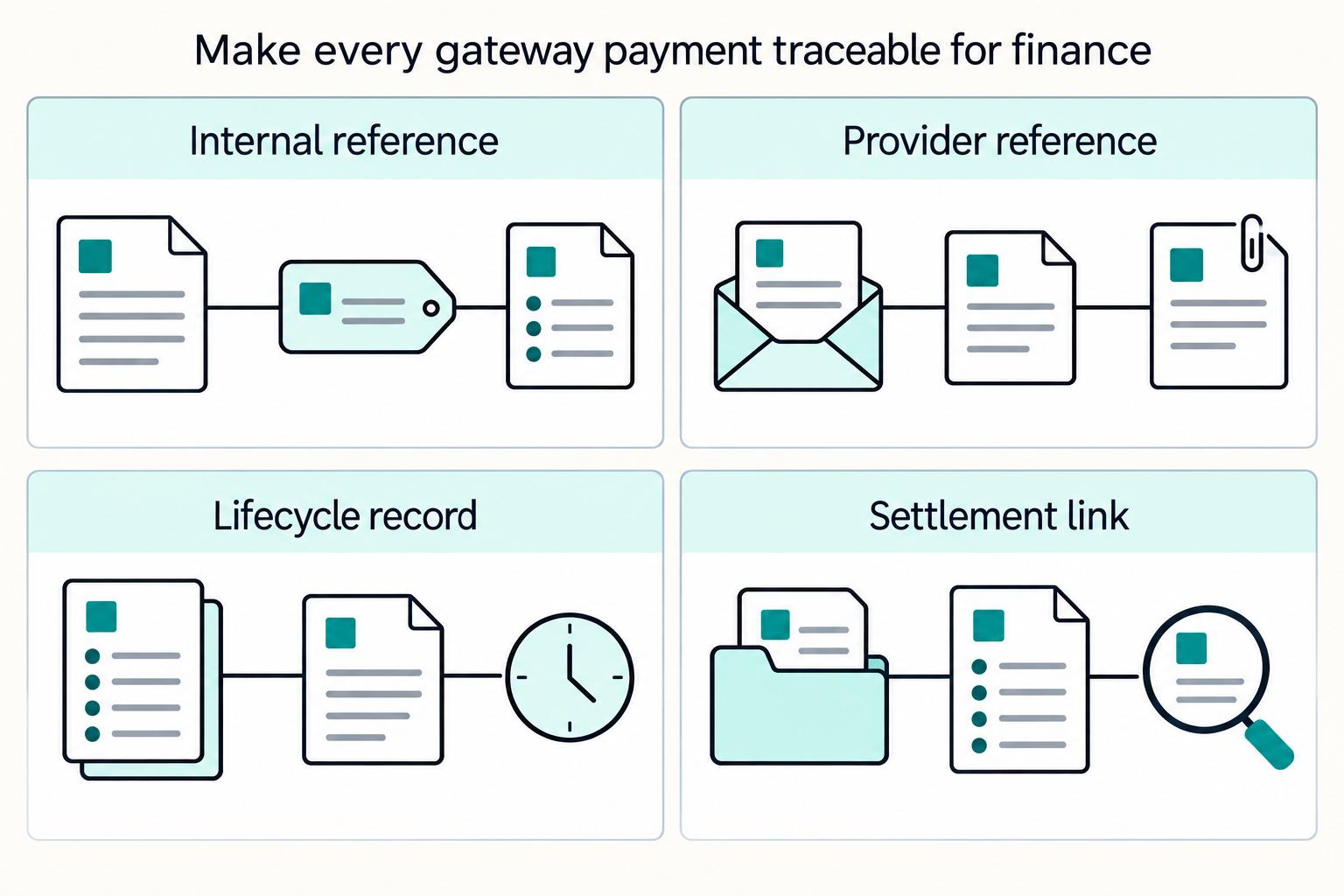
Finance matching can also get harder because teams must align separate settlement, refund, and dispute outputs that were not designed to match. Before you expand, define shared transaction references, confirm teams can trace the same transaction across provider reports with one internal payment ID, and keep a simple provider-by-country evidence pack with:
- supported payment methods and owning PSP or acquirer
- API and authentication requirements per provider
- reporting exports needed for payments, refunds, disputes, and settlements
- manual switching rules, escalation contacts, and incident ownership
A practical use case#
A marketplace entering new countries may use this as a bridge to get local coverage now, then add a POP layer later if volume and failure costs justify it.
Use this option when the pain is regional acceptance gaps. Move to a POP sooner if the pain is already failed payments, cross-provider retries, or unified reporting.
Option 3 Payment Orchestration Platform for Reliability at Scale#
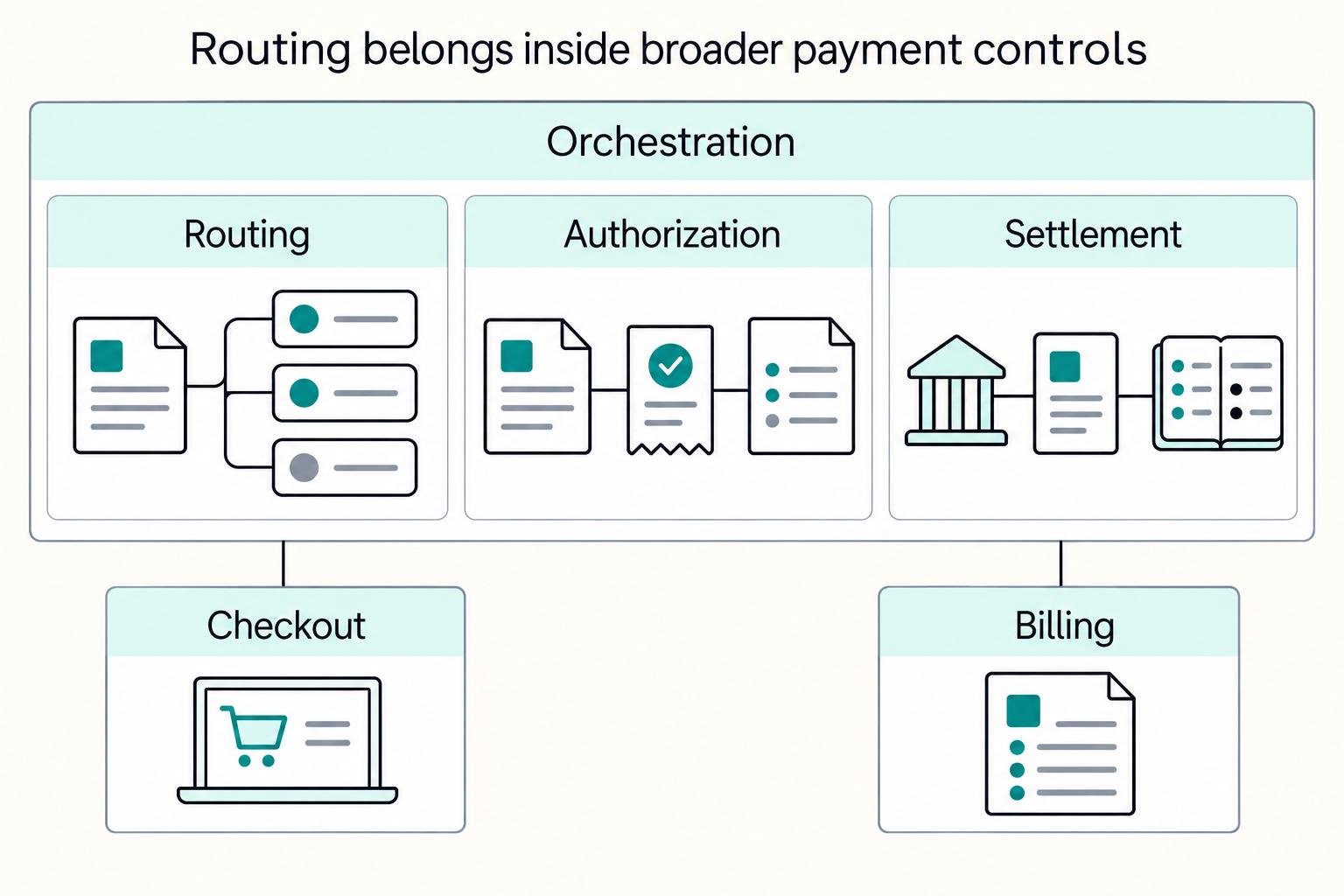
When coverage is no longer the main issue and failed payments are getting expensive, a Payment Orchestration Platform (POP) can be the next step. A POP adds a control layer between checkout and billing, often through a single API integration, and centralizes Transaction Routing across multiple providers.
In practice, this becomes the architecture answer once fragmented payment logic starts hurting reliability. It does not replace your Payment Gateway, processor, or PSP. It connects them and centralizes control over how transactions are routed, authorized, and settled.
When this is the right move#
Choose this path when reliability, not regional access, is your binding constraint. It is often strongest for multi-region platforms where provider downtime, processing delays, or uneven PSP performance are already visible in checkout outcomes.
The value is that routing decisions move out of scattered provider integrations and into predefined rules. Those rules can use inputs like fee, success rate, customer location, currency, and compliance requirements, with backup paths when a primary route fails or degrades.
This also gets more compelling when finance has outgrown stitched exports. A strong platform should provide reporting and integrations with cross-provider visibility, so teams can see which provider, region, or payment method is associated with performance drops.
What you actually gain#
The main gain is one control plane for failed-payment handling, backup routing, rule management, and shared analytics across providers. Instead of hard-coding provider logic into each checkout path, you define and adjust routing in one place.
A control layer can reroute an eligible, definitively failed attempt. An unanswered request is different: a timeout may follow a successful authorization. Resolve the original outcome before creating an attempt at another provider. A key used at one provider does not make a second provider deduplicate that payment.
Where teams get this wrong#
A common mistake is treating a POP as plug-and-play. These platforms require careful implementation, and managing multiple providers through one layer can still be costly and complex.
Weak routing design is the next problem. If your rules are poor, the platform can centralize bad decisions faster, including shifting traffic to routes that are weaker for a given currency, slower, or more expensive. Dependency is another risk. Third-party orchestration can add security and compliance exposure, so vendor review cannot be an afterthought.
Another failure mode is assuming backup paths work because they appear in a diagram. Provider downtime and processing delays hurt less only when secondary routes are correctly configured, monitored, and tested.
What to verify before you commit#
Before rollout, ask for proof on three fronts:
- Routing logic: confirm which rule inputs are actually available, including fee, success rate, location, currency, and compliance conditions.
- Failure handling: simulate provider downtime and processing delays, then verify backup routing behavior against real rule outcomes.
- Finance visibility: verify unified reporting across providers and key payment events, not just authorization dashboards.
A practical evidence pack is simple: sample logs for primary and backup routes, the reporting fields finance will receive, and clear ownership for routing-rule changes and incident escalation. If one transaction cannot be traced across authorization, reroute, and settlement views, expect month-end friction.
A practical use case#
Use a POP when failed authorizations directly translate to lost revenue, the platform already runs multiple PSPs across regions, and finance needs one reporting view instead of provider-by-provider stitching.
If you want a deeper dive, read Payments Orchestration: What It Is and Why Every Platform Needs a Multi-Gateway Strategy.
Option 4 Hybrid Model for Platforms With Complex Payout Operations#
A hybrid model can be useful when you want centralized routing for acceptance and your organization already runs payouts on a separate operating surface. Use a Payment Orchestration Platform (POP) as a control layer for inbound routing. For payouts, keep workflows separate only if that matches your internal controls, reviews, and finance routines.
This split can be easier to govern when incoming and outgoing flows are handled by different teams and processes. Checkout is typically optimized for authorization performance, provider choice, and fallback routing. Payout operations may require different review and reconciliation workflows.
Best for#
Consider this model when multi-provider acceptance is already justified, but one stack is starting to blur operational ownership. A common signal is routing and conversion work moving quickly while reconciliation mismatches and close cycles still create drag.
For example, a marketplace may need centralized checkout routing while its payout team works from separately governed payee approvals and settlement records. The split is useful only if both teams can trace the same business transaction and its exceptions.
Why the hybrid split works#
The benefit is separating concerns when the work is genuinely different. On the acceptance side, orchestration is a control layer, not the processor. That lets you route by location, currency, transaction size, or past results across multiple PSPs. If PSP variability is already showing up in reliability, cost structure, or reconciliation practices, centralized routing can reduce manual switching and related errors.
Hybrid is a choice about operating boundaries, rather than a guarantee of better performance. A bundled provider may reduce connector work; a separate orchestration layer may offer more routing control. Compare the contracts, access and reporting of the proposed arrangement.
Where teams get burned#
A common cost is governance complexity: two surfaces, two sets of decisions, and more handoffs. If routing and connector operations are split, make escalation paths explicit or operational friction can persist.
Another risk is assuming one reliable provider path covers the whole system. Fault isolation still matters, so one PSP connector issue should not stop other provider paths. If traffic is concentrated across providers, verify connector-level monitoring and backup behavior directly.
What to verify before rollout#
Before rollout, validate a small evidence pack across acceptance and finance operations:
- one traceable transaction from authorization and route choice into downstream finance reporting
- one simulated provider degradation test showing other PSP paths continue working
- one clear operating map for routing changes and mismatch handling
A practical pattern is keeping multi-provider acceptance for routing flexibility while maintaining a separately governed payout path when your operations require it. Treat this as an operating choice to test, not a universally proven architecture for payouts. Related: What Is Payment Orchestration? How Platforms Route Transactions Across Multiple PSPs.
Side-by-Side Comparison of the Four Paths#
These four paths describe different choices about integration and ownership. A gateway carries payment details to processing; it may support more than one processor. An orchestration layer coordinates the available provider paths. The useful comparison is what your team must integrate, control and reconcile.
| Architecture | Integration and control | Reporting responsibility | Useful when |
|---|---|---|---|
| Single PSP | One main integration and provider dependency | Match internal records to that provider and bank activity | Current coverage and operations are sufficient |
| Direct multi-provider | Your team owns connectors and routing behavior | Normalize multiple provider reports and exceptions | Specific methods or markets require another provider |
| Orchestration layer | Central rules over supported provider connectors | Verify which events and exports the layer normalizes; finance still closes mismatches | Provider variation and routing work justify the added layer |
| Hybrid acceptance and payouts | Separate governed flows with explicit handoffs | Link collection and payout records without confusing their states | Different teams or controls already govern the two flows |
Decision Rules for Choosing Now Versus Later#
Choose based on the bottleneck you already have, not the architecture that sounds most advanced. If pain is not material, keep your Single-PSP Architecture and set a defined review checkpoint instead of adding Payment Orchestration early.
| Current pain | Prioritize | Check first |
|---|---|---|
| Checkout failures in an otherwise healthy footprint | Routing depth before provider breadth: transaction routing, payment retries, and backup paths | Segment failures by card BIN, currency, amount, customer location, acquirer status, approval history, and fraud signals |
| Regional acceptance gaps | Added PSP and local payment methods coverage first | Confirm gaps with actual demand and decline patterns by country or payment method |
| Month-end close is breaking | Architecture that improves finance matching and shared cross-provider visibility | Match one payment across internal records, PSP records, and bank activity without manual stitching |
| No pain is yet material | Defer the extra layer for now | Revisit when repeated routing failures, regional acceptance friction, or reporting drag become clear |
If your decision is leaning toward pilot or rollout, use the Gruv docs to map retries, webhook statuses, and integration ownership before you build.
Implementation Checkpoints by Team#
The success or failure of an orchestration rollout usually comes down to ownership, evidence, and rollback discipline. Before you widen traffic, define the objective, required evidence, and rollback trigger for each provider path.
| Checkpoint | Define before rollout | Validation point |
|---|---|---|
| Product | Routing objectives for each payment gateway, where you prioritize authorization rate, where you prioritize cost, and who resolves conflicts between those goals | One owner for rule changes and one escalation path for exceptions |
| Engineering | API path, QA coverage across transaction types and edge cases, and mapping metadata and business logic to a new schema | Re-test critical transaction and settlement flows end to end |
| Finance ops | Shared identifiers, required settlement files or exports, and the exception queue for unresolved mismatches | Trace a payment across internal records, payment processor reports, and acquirer reports without manual stitching |
| Compliance | Policy gates, audit-trace requirements, and a documented signoff path across product, engineering, finance, compliance, legal, and security | Show why a transaction followed a path, which policy allowed it, and where supporting records are stored |
| Rollout sequence | Pilot one flow, validate failure handling, then expand | Route only part of traffic first; if the pilot is not clean, pause and fix the failing layer before broadening rollout |
1. Product checkpoint#
Set routing objectives for each Payment Gateway before any rule goes live. Document where you prioritize Authorization Rate, where you prioritize cost, and who resolves conflicts between those goals.
Use a simple routing matrix by market, currency, payment method, and provider, with one owner for rule changes and one escalation path for exceptions. If a path appears to improve approvals but raise cost, define in advance when that tradeoff is acceptable and when it requires finance or leadership review.
2. Engineering checkpoint#
Test provider errors and asynchronous outcomes before enabling broader routing. Keep a durable internal payment ID and separate attempt references. Suppress a new charge while the earlier attempt is pending or already authorized, and validate event deduplication before posting. Stripe’s error-handling guidance explains why a timeout or server error can leave the first outcome uncertain.
If the layer normalizes provider data, document the mapping for amount, currency, provider reference, authorization, capture, refund and settlement. Preserve the original provider fields for investigation. Test both the mapped state and the money record, rather than treating a successful API response as proof of settlement.
3. Finance ops checkpoint#
Define Reconciliation artifacts before launch so finance can trace a payment across internal records, Payment Processor reports, and Acquirer reports without manual stitching.
Agree on shared identifiers, required settlement files or exports, and the exception queue for unresolved mismatches. Assign explicit ownership for first review, handoff, and close decisions, because operations fragment quickly when transaction visibility is not centralized.
4. Compliance checkpoint#
For Cross-border Payments, confirm policy gates and audit-trace requirements before activating new provider paths. Expansion across markets can add local acquirer and PSP relationships that are harder to manage without clear controls.
Define a documented signoff path across product, engineering, finance, compliance, legal, and security. You should be able to show why a transaction followed a path, which policy allowed it, and where supporting records are stored.
5. Rollout sequence#
Roll out in phases: pilot one flow, validate failure handling, then expand. Start with one checkout flow, region, or payment method, and route only part of traffic first to reduce risk.
Before increasing traffic, verify failure handling and post-settlement finance matching. If the pilot is clean, expand to more regions and methods. If not, pause and fix the failing layer before broadening rollout.
Failure Modes That Break Routing and Reconciliation#
Implementation quality matters more than simply having orchestration in place. Teams can adopt orchestration and still face the same payment issues if routing, failover, and operational workflows are not validated in practice.
| Failure | Why it matters | Control to test |
|---|---|---|
| Timeout treated as failure | The original provider may have authorized the charge | Resolve the original state before a fresh-provider attempt |
| Successful retry hides weak first attempts | Aggregate approvals conceal excessive attempts and cost | Compare first-attempt and unique-payment outcomes |
| Backup shares a dependency | One outage can disable both paths | Test connector and access isolation |
| Settlement mapping loses provider detail | Authorization views cannot close the bank match | Retain attempts, captures, refunds, fees and settlement references |
Related reading: What Is a Payment Aggregator? And How Is It Different from a PayFac or MoR?.
Conclusion#
The right architecture is the one that solves your current constraint, not the one that sounds most advanced. Decide based on where failure cost is highest, where expansion pressure is real, and where cross-provider reporting complexity is slowing decisions.
Start with a stack review: measure failed-payment impact, required regional coverage and reporting effort. Use those results to scope one pilot with clear payment-state and settlement evidence.
Frequently Asked Questions
What is payment orchestration in one sentence?
Payment orchestration is the process of managing multiple PSP and payment gateway relationships in a single system. In practice, it centralizes routing, monitoring, and retries across providers instead of managing each connection separately.
How is payment orchestration different from a payment gateway?
A payment gateway is the customer-facing interface that captures payment details and passes them to processing. Orchestration is the layer that coordinates multiple PSPs, acquirers, or banks through a central hub. If you only run one provider, a gateway may be enough. If you need control across multiple paths, orchestration is the relevant model.
When does a platform actually need a payment orchestration platform?
Evaluate orchestration when provider variation, regional coverage gaps or reporting work create material cost. Compare that cost with migration, ongoing fees and support ownership. Stable operations on one provider may justify waiting.
Which problem should teams solve first with orchestration: failed payments, expansion, or reporting?
Start with the problem that is already creating the biggest business impact. If failures are the issue, prioritize routing and retries. If expansion is blocked, prioritize provider and payment-method coverage. If visibility is weak, prioritize unified cross-provider monitoring. Sequencing should follow current constraints, not a fixed template.
How are routing, retries, and failover different in practice?
Routing chooses the provider for an initial attempt. A retry repeats an eligible operation after checking its state and the provider’s retry contract. Failover changes the path when the original provider cannot serve it safely. An uncertain first outcome must be resolved before creating a new charge elsewhere; provider-local idempotency is not cross-provider duplicate protection.
Can payment orchestration improve authorization rates and reduce processing costs?
It can, but those outcomes are not guaranteed. Context-aware routing and backup retries can recover some failed payments, and a unified dashboard can help teams compare approval rates and adjust routing. The tradeoff is that orchestration can also add cost and operational complexity.
What should finance, product, and engineering each own in an orchestration rollout?
Product can own routing objectives, engineering the connectors and payment-state controls, and finance the settlement match and exception closure. Record the actual owner for rule changes and incidents. Tax, disputes and merchant-of-record duties depend on separate contracts and responsibilities.
Try a related tool
Researched and edited by the Gruv editorial team. Gruv builds cross-border billing, payouts, and finance-operations software for global businesses.
Sources
Educational content only. Not legal, tax, or financial advice.
Related Posts
When Platforms Should Move to Payment Orchestration and Multi-Gateway Routing
Payment orchestration can become a practical priority when payment performance and finance operations start limiting growth, not just checkout delivery. A single PSP can be the right setup for a long time. But once approval paths, provider constraints, or reconciliation workload start affecting outcomes, you need a clearer strategy than adding providers ad hoc.
What Is Payment Orchestration? How Platforms Route Transactions Across Multiple PSPs
Payment orchestration coordinates payment providers, routing decisions, attempt history and operational reporting through a shared control layer. It becomes useful when checkout traffic needs more than one PSP and separate integrations make outcomes harder to explain. One integration can simplify access; it does not automatically settle funds or reconcile every connector.

Churn Benchmarks by Industry: Metrics, Cohorts and Targets
A payment platform can lose a merchant account, a paying software subscriber or recurring transaction revenue. Those are different outcomes. Before comparing churn by industry, define which relationship can churn and what event ends it. A merchant with no transactions this month is not necessarily a canceled subscriber; a failed renewal attempt is not necessarily a lost customer.