

Quick Answer
Treat the IRC 6013g election nonresident spouse decision as optional unless your records cannot support the filing position without it. For the election year, the return must be joint and include the election statement, and while the choice remains in effect both spouses are treated as U.S. residents for federal income tax purposes with worldwide income reporting. Use it to solve a defined filing gap, not as a default shortcut, then document annual review and escalation triggers.
What the 6013(g) election changes#
IRC Section 6013(g) is not just a one-year filing step. It is an ongoing compliance decision. If you choose to treat a nonresident spouse as a U.S. resident for federal income tax purposes, that treatment continues for later tax years while the choice remains in effect.
Start at the election-year filing checkpoint. The return must be a joint income tax return for the year you make the choice, and the IRS example shows the choice made by attaching a statement to that joint return. If the filing package is not joint, or the election statement is missing, you have filing risk.
Next, lock down scope. While the choice is in effect, both spouses are treated as U.S. residents for federal income tax purposes, and each spouse must report worldwide income for the election year and later years unless the choice is ended or suspended. In practice, this is where teams need durable records rather than one-time preparation.
The tradeoffs should also be explicit in your internal decision record. Generally, neither spouse can claim tax treaty benefits as a resident of a foreign country while the choice is in effect. Social Security and Medicare withholding may also not fully align, because the nonresident spouse may still be treated as a nonresident for those purposes.
Use this explainer as a control framework. Confirm the joint return and whether the election statement is attached, align worldwide-income support across both spouses, and make sure your return workpapers, internal memo, and withholding assumptions reflect the same status treatment. IRS practice-unit material may help frame audit considerations, but it is not binding legal authority on its own.
Start with the terms that drive every decision#
Get the labels right first, because downstream filing and control decisions depend on them. For an IRC 6013(g) election analysis, a nonresident alien is a person who is neither a U.S. citizen nor a U.S. resident under IRC 7701(b)(1)(A), and this path applies when the other spouse is a U.S. citizen or U.S. resident.
IRC Section 6013(g) lets that nonresident spouse be treated as a U.S. resident for defined tax purposes. It is not a blanket rule for every U.S. tax. In your memo, state who was nonresident, who was a citizen or resident, and that both spouses made the election voluntarily. IRS practice-unit guidance says the IRS cannot compel it.
The key scope terms are Chapter 1 and Chapter 24. This treatment affects core income tax treatment and income tax withholding at source, not just return labels. Your return position, withholding assumptions, and internal memo should all line up.
The joint return point is practical but limited. 26 U.S.C. 6013 generally allows a single joint return, while also stating that no joint return is allowed if either spouse is a nonresident alien at any time during the taxable year. The election is what can open the joint-return route, but joint filing is only one consequence of a status choice that can continue in later years.
Keep one boundary explicit: this election does not make the spouse a resident for all U.S. taxes. IRS practice-unit material cautions that certain taxes are outside that treatment, including self-employment tax and tax under IRC 1411.
Confirm eligibility before anyone drafts election language#
Do not draft election language until the spouse profile and consent are documented. If any gate is uncertain, pause and escalate to tax counsel before filing.
The baseline here is narrow. This path is for a nonresident alien individual married to a U.S. citizen or resident alien, and both spouses must choose the election voluntarily. The IRS practice unit is useful for this profile test, but it is not binding authority, and it shows a last-update date of 08/28/14, so edge cases should be treated as counsel questions.
Use an internal pre-check grid so teams do not mistake "joint return" for proof of eligibility.
| Eligibility gate | What to have on file before drafting | Suggested owner |
|---|---|---|
| Spouse profile matches the election path | Records showing the couple fits the nonresident-alien / U.S.-citizen-or-resident spouse profile | Tax, with legal support as needed |
| Nonresident alien status is documented | Tax analysis supporting nonresident alien status for that spouse | Tax |
| Other spouse's U.S. status is documented | Documentation supporting U.S. citizen or U.S. resident status for the other spouse | Tax |
| Both spouses consent | Written confirmation that both spouses are making the election voluntarily | Tax with legal review |
Treat this grid as a control, not a substitute for primary authority. It helps prevent late-stage failures where key facts or consent were assumed rather than documented.
For operations, you can collect identity fields (SSN or ITIN) in your intake packet, but they are not established as election-validity elements. Use primary authority or specialist advice for filing-mechanics requirements.
Map what the election changes and what it does not#
Treat the election as a defined tax-status choice, not a cross-border reporting cure-all. Once eligibility is confirmed, lock the scope into your internal memo. If you are relying on resident treatment for joint filing, say exactly what scope you are relying on and have tax counsel validate the statutory basis. This section is about boundary control, not a substitute for statute text or counsel-reviewed scope language.
Separate the tax election from the reporting regimes around it#
The election can change who is tested for certain reporting, but it does not remove the reporting tests. For Form 8938, a nonresident alien who elects resident treatment for filing a joint return is treated as a specified individual for that form's purposes.
| Reporting point | Grounded rule |
|---|---|
| Specified individual status for Form 8938 | A nonresident alien who elects resident treatment for filing a joint return is treated as a specified individual for that form's purposes. |
| Form 8938 baseline trigger | The IRS states a baseline trigger of $50,000 and also notes that higher thresholds can apply for some joint filers and taxpayers residing abroad. |
| Form 8938 filing mechanics | Form 8938 is attached to the annual income tax return and filed by that return due date, including extensions. |
| No-return condition for Form 8938 | If no income tax return is required for the year, Form 8938 is not required. |
| FBAR filing | FBAR (FinCEN Form 114) is a separate filing with its own trigger and agency. |
| FBAR trigger | The supported FBAR trigger here is aggregate foreign account balances exceeding $10,000 at any time during the calendar year. |
That means you still need to run the Form 8938 threshold analysis. The IRS states a baseline trigger of $50,000 and also notes that higher thresholds can apply for some joint filers and taxpayers residing abroad. If no income tax return is required for the year, Form 8938 is not required.
Form 8938 and FBAR are separate controls#
Do not collapse these into one filing step. Keep them as separate controls with separate owners if needed.
- Form 8938 is attached to the annual income tax return and filed by that return due date, including extensions.
- FBAR (FinCEN Form 114) is a separate filing with its own trigger and agency.
- Filing Form 8938 does not satisfy FBAR.
- The supported FBAR trigger here is aggregate foreign account balances exceeding $10,000 at any time during the calendar year.
- For non-willful FBAR violations, a civil penalty may be imposed up to the $10,000 penalty amount, adjusted for inflation.
- Form 8938 instructions also preserve separate section 6038D reporting obligations.
Verification checkpoint before rollout#
Before tax, legal, payroll, or finance publishes guidance, verify that the memo does all three:
- states the election scope you are relying on without presenting it as a universal fix
- separately addresses Form 8938, section 6038D, and FBAR (FinCEN Form 114)
- states the key filing mechanics: Form 8938 is attached to the return, and filing it does not satisfy FBAR
If your memo says a joint-return election resolves foreign reporting by itself, rewrite it before rollout.
Decide when to elect and when to rely on existing residency status#
If existing resident status is supportable with records, treat the election as optional, not automatic. A Section 6013(g) choice can add tax and reporting consequences, so use it to solve a real filing problem rather than to move faster.
The practical question is simple: do you need the election, or do your facts already support the result without it? The practitioner material in this record warns that electing can pull a nonresident spouse's worldwide income into U.S. taxation, and that the added reporting and tax obligations may outweigh the benefits in some cases.
Start with the status you can prove#
The IRC Section 6013(g) election treats a nonresident spouse as a U.S. resident for the entire tax year. Filing without that election means relying on the status your current facts and records can support, rather than using the election as the bridge.
If your file already supports that status, document and defend that conclusion. If confidence is low, the election may be a cleaner route, but it is not a free shortcut. Under Section 6001, tax-liable persons must keep records, render statements, and make returns as required by the Secretary, so unresolved records are a control gap, not a drafting detail.
Compare the two paths like an operator#
Use this as an operational framework, not a definitive legal comparison.
| Criteria | Rely on existing status without a new election | Elect under Section 6013(g) |
|---|---|---|
| Status certainty | Depends on how complete and consistent your records are | Depends on whether the election is appropriate and well documented |
| Upfront documentation burden | Document underlying status facts | Document an affirmative election decision |
| Ongoing monitoring load | Can stay high when core status facts remain uncertain | May reduce status-test uncertainty, but can expand tax and reporting consequences |
| Return-position risk if assumptions fail | Position can be challenged if status facts are weakly supported | Position can be challenged if election downside was not fully assessed before filing |
| Exposure tradeoff | Focus on whether status was correctly established from records | Practitioner material flags possible U.S. taxation of worldwide income and possible FBAR/FATCA obligations |
When uncertainty should slow you down#
Uncertain or conflicting records raise misclassification risk on a Joint tax return. In that situation, early specialist review is usually more valuable than filing speed.
Use the review to answer a narrow question: is the non-election status supportable on the current record, and what proof is missing if not? A complete primary-authority comparison of election versus presence-based residency is not provided here. The eCFR excerpt is labeled authoritative but unofficial, so validate final legal wording against current primary authority before filing.
A workable decision rule#
A simple sequence keeps this decision disciplined:
- Test whether non-election status is already supportable with records. If yes, analyze the election as optional.
- Model downside before electing. Check whether worldwide income inclusion or extra FBAR/FATCA work changes the decision.
- Escalate early when facts are unstable. Uncertain status facts are a specialist issue, not a speed issue.
For this Section 6013(g) decision involving a nonresident spouse, do not elect by default. Elect when it resolves a real filing gap that your existing record does not solve cleanly, and when you are prepared to carry the added compliance burden. For a step-by-step walkthrough, see First-Year Election for US Tax Residency.
If your status evidence is still fragmented, run a pre-check in the tax residency tracker before finalizing your filing path.
Build an election package your audit team can defend#
Build the packet around one verifiable fact pattern: for the year you make the choice, you file a joint return and attach the election statement. Organize the file so a reviewer can confirm what was filed, for which Taxable year, and that the statement and return were submitted together.
Keep the record easy to audit:
- Final joint return for the election year
- Final election statement attached to that return
- Filing evidence showing what was submitted
- Clear year linkage across the packet
If that linkage is missing, your audit defense is weaker because the filing record is incomplete.
Anchor controls to authority, not habit#
Use internal controls, but label them accurately as internal controls. Tax and legal sign-off, version history, immutable timestamps, and reviewer names may help internal defensibility, but they are not established as Internal Revenue Service (IRS) validity requirements.
Apply the same standard to drafting sources. Forum posts, practitioner summaries, and older training material are not substitutes for primary authority. The IRS LB&I practice unit excerpt expressly says it is not an official pronouncement of law.
Use a one-page submission checklist#
Before filing, confirm the basics in one place:
| Checklist item | What to verify |
|---|---|
| Election-year return | The election-year return is a joint return for the correct Taxable year. |
| Election statement | The final statement in the packet matches the statement attached to the filed joint return. |
| Spouse identifiers | Any spouse identifiers your team tracks internally reconcile to the filed return. |
| Approvals and history | Internal approvals and document history are complete and stored with filing evidence. |
If the file cannot clearly tie the statement to the return that was actually filed, treat that gap as a rework trigger and a material audit-risk issue.
Add a short scope note to the packet: while the choice is in effect, both spouses are treated as U.S. residents for federal income tax purposes and must report worldwide income, but IRS guidance also notes that the nonresident spouse may still be treated as a nonresident in some withholding contexts.
Run annual controls because the election can outlive the original team#
The election-year packet is only the start. Your annual control should verify that the prior filing position tied to IRC Section 6013(g) still matches current facts, decision-makers, and filing plans for the new Taxable year before Joint tax return prep moves ahead.
Treat this as an internal control, not an IRS-stated annual filing requirement. Each year, either confirm the current approach or escalate for specialist review.
What to confirm each year#
Keep the attestation short and specific. One page is often enough if it states the year reviewed, the reviewer, and the conclusion. At minimum, confirm:
| Annual review item | What to confirm |
|---|---|
| Taxable year | The Taxable year under review. |
| Spouse-status assumptions | The spouse-status assumptions used for that year. |
| Intended filing approach | The intended filing approach for that year's Joint tax return. |
| Material events | Whether any material event changed who makes tax decisions, which deadlines apply, or whether the current approach should be revisited. |
Do not default to "same as last year" without verification. Election-related decisions can involve tax and non-tax tradeoffs, so changed facts should be documented and escalated early.
Tie the review to close, not memory#
Put this review into your existing year-end close, return data gathering, extension planning, and sign-off cadence. That timing matters. The source guidance shows that filing sequence and timing after a spouse's death can change outcomes, and fiduciary decisions during administration are tied to deadlines following the date of death. A routine file can become deadline-sensitive quickly after a life event.
In the case study, a death on October 24, 2023 drove final personal return timing: due April 15, 2024, with extension to October 15, 2024. It also shows how decision-makers can shift to fiduciaries such as an executor or trustee.
Keep a review log that survives turnover#
Maintain a standing annual review log so the next team can follow the file. For each year, record who reviewed, when they reviewed, what year they covered, and whether the result was "continue current approach" or "escalate."
A useful entry should link to the original election packet and attach the current-year attestation. Avoid leaving the only evidence in email threads or draft-return notes.
If someone cites an IRS bulletin highlight or synopsis as support, treat it only as a research lead. IRS bulletin synopses state that they may not be relied on as authoritative interpretations. If you want a deeper dive, read How to Make the '6013(g) Election' to Treat a Non-Resident Spouse as a Resident for Tax Purposes.
Handle termination events as high-risk compliance incidents#
If a termination event is suspected, stop return prep and open a tax and legal incident review before filing. Treat this as a control decision first: freeze prior assumptions until your team verifies what happened, when it took effect, and who is authorized to act.
Use explicit escalation labels in policy so no one has to guess: Revocation, Death, Legal separation, Decree of divorce, Separate maintenance, and Secretary termination. Treat those as internal review labels only, and confirm the statutory 6013(g) mechanics with the IRS or qualified counsel.
Do not assume you can true it up later. The highest risk is filing off informal signals instead of verified, dated records and clear decision authority.
Treat potential one-way risk as operational: once a termination path may be in play, escalate before filing. Confirm any specific re-election restriction, waiting period, or scope for the same two individuals with primary IRS authority before including those details in policy.
Document the legal text used at the time of review. The eCFR can support incident records because it provides historical versions and shows freshness markers such as "up to date as of 4/02/2026" and "Title 26 was last amended 3/20/2026." But it also says it is authoritative but unofficial, so it should not be your only legal source.
| Escalation label (internal only) | First action | Evidence required for internal review | Required approvers |
|---|---|---|---|
| Revocation | Pause filing work and open incident review | Dated, controlled record supporting the event | Tax owner and legal reviewer |
| Death | Freeze assumptions and open incident review | Dated, controlled record supporting the event and current decision authority | Tax owner and legal reviewer |
| Legal separation | Escalate before using prior filing assumptions | Dated, controlled record supporting the event | Tax owner and legal reviewer |
| Decree of divorce | Remove prior assumptions from active return workflow until cleared | Dated, controlled record supporting the event | Tax owner and legal reviewer |
| Separate maintenance | Keep incident open until status is verified | Dated, controlled record supporting the event | Tax owner and legal reviewer |
| Secretary termination | Open legal-source review immediately | Dated, controlled record supporting the event | Tax owner and legal reviewer |
Keep records that survive audits and staff turnover#
Keep one controlled file that lets a reviewer trace the election from the original filing to current-year treatment. The legal anchor is IRC §6001: tax-liable persons must keep records, statements, and returns, so your file needs to be retrievable, not just complete on filing day.
Build one evidence pack, not scattered attachments#
For a 6013(g) file, start with the joint return for the election year and the attached election statement. The IRS ties the choice to that joint return filing, so that linkage is your core proof set. Include, in one place:
- the filed election statement and the exact joint return it was attached to
- filing details that let you retrieve that return and attachment quickly
- internal reviewer notes (if your process uses them), with dates
- dated records showing whether the choice stayed in effect or was ended or suspended
- later-year return support while the choice remains in effect
Protect PII without breaking traceability#
Use restricted storage for full records and masked views for routine access, while preserving a clear trail back to the filed return and status record. That is an internal control choice, not a stated IRS architecture requirement.
Link tax and withholding records where treatment decisions meet#
Keep related withholding records with the election file when they explain reporting outcomes tied to the election. Document boundary cases clearly: while the choice is in effect, spouses are treated as U.S. residents for federal income tax purposes, but the nonresident spouse may still be treated as a nonresident for Social Security and Medicare withholding. Also keep any treaty-position analysis in the same file, since treaty-resident benefit claims are generally restricted while the choice is in effect.
Use a retention map so records stay distinct#
Separate core tax records from optional operating notes. Keep returns, attached statements, status reviews, and records supporting treatment in the core set. Keep drafts and superseded working notes in an optional set with stricter cleanup. If you are unsure whether a document supports current-year or later-year treatment, keep it until tax and legal clear disposal.
Escalate early when facts move outside your control#
Escalate before filing whenever key facts are uncertain and the filing impact is hard to reverse. If residency facts conflict, joint-return facts are unclear, or foreign-asset reporting may apply, pause and hand off instead of filing through ambiguity.
A resident-treatment election for a joint return can expand the reporting analysis. For Form 8938, a nonresident alien who elects resident treatment for a joint return is treated as a specified individual. That does not automatically require Form 8938, but it does require a threshold and account-classification review. If Form 8938 is required, attach it to the annual return, file by that return's due date (including extensions), and state the applicable calendar year or tax year.
Set explicit handoff triggers so edge cases do not sit unowned:
- Conflicting residency facts: escalate when internal records do not align on resident status.
- Unclear joint-return facts: escalate when core filing facts are missing or inconsistent.
- Foreign-asset reporting signals: escalate when data suggests potential Form 8938 review or FinCEN Form 114 exposure.
Use a pre-filing signoff note that records who reviewed, what remained unresolved, and why the filing position was still supportable. Keep the supporting evidence with that note.
Do not treat Form 8938 and FBAR as duplicates. Filing Form 8938 does not remove the FinCEN Form 114 requirement, and some account types may be excluded from Form 8938 reporting, so classification decisions can change scope materially.
Confirm what varies by country and program before publishing internal guidance#
Treat this as a U.S. tax election rule, not a global compliance shortcut. Focus here is on Internal Revenue Code mechanics for IRC Section 6013(g), and adjacent reporting or payroll outcomes may still vary by program and jurisdiction.
At the U.S. federal level, the baseline is clear: if eligibility conditions are met, spouses may choose to treat the nonresident spouse as a U.S. resident by attaching a statement to a joint return. For the year the choice is made, a joint return is required, and while the choice remains in effect, both spouses are treated as U.S. residents for federal income tax purposes. But that treatment does not carry cleanly across every program. The IRS notes a concrete mismatch: for Social Security and Medicare withholding, the nonresident spouse may still be treated as a nonresident.
Use public summaries for orientation, not final policy language. IRS LB&I practice units are audit guidance, not controlling legal authority. Summaries may not resolve current statement wording, attachment mechanics, or timing details, and they do not automatically settle treaty position, FATCA/Form 8938, FBAR, or non-U.S. reporting outcomes.
How to confirm safely#
Use a simple sequence before publishing guidance:
- Check current IRS primary guidance first. Confirm current return instructions and whether your election statement language still matches current requirements.
- Get qualified tax counsel on edge wording. Prioritize this when your draft includes timing assumptions, treaty language, or payroll-treatment notes.
- Then update internal policy text and templates. Record the review date, the authority checked, and the approver.
Before publishing, confirm that your guidance states the election's exact scope and separately lists items that still require jurisdiction-specific or program-specific review.
Conclusion#
Treat the IRC Section 6013(g) election as an ongoing control, not a one-time filing step. The key risk is persistence: IRS practice-unit language says the treatment applies for the election year and subsequent years until terminated or suspended.
Run the control in three parts. First, confirm that both spouses actually chose the election and that the eligibility facts were true. Second, keep a defensible file: the filed joint return, election-related filing records, filing proof, and support for eligibility facts. Third, review annually instead of assuming the original filing resolved everything.
Keep scope tight. The materials describe effects under Chapter 1 and Chapter 24 and tie filing consequences to Sections 6012, 6013, 6072, and 6091. They also caution that this does not make the nonresident spouse a resident alien for every U.S. tax on income.
Treat source quality as a control checkpoint. The IRS practice unit (DCN JTO/9431.02_09(2014), last update shown as 08/28/14) says it is not an official pronouncement of law and cannot be relied on as legal authority. The June 10, 2024 IRB synopsis language gives the same warning. Use those summaries for orientation, then confirm current primary authority before filing or updating policy.
Document stable facts early, and escalate when facts move or scope is unclear. Suspected termination or suspension events, unclear marital-status facts, or disagreements about election effects should be resolved before filing, not after.
Frequently Asked Questions
Who can make a `IRC Section 6013(g)` election for a `Nonresident alien spouse`?
At the end of the tax year, the couple must be married, with one spouse a U.S. citizen or U.S. resident and the other a nonresident spouse. For the election year, the IRS says you must file a joint income tax return. Confirm those year-end facts before drafting or filing the election.
What exactly does the election change for `Chapter 1` and `Chapter 24` treatment?
IRS materials describe the election as treating the nonresident spouse as a U.S. resident for tax purposes, and an IRS LB&I practice unit links that treatment to Chapter 1 and Chapter 24. That same IRS public summary also says Social Security and Medicare withholding may still treat the spouse as a nonresident. While the choice is in effect, neither spouse can generally claim treaty benefits as a resident of a foreign country. The LB&I practice unit is not an authoritative pronouncement of law, so confirm primary guidance before treating that Chapter framing as dispositive.
Does a `IRC Section 6013(g)` election expire automatically after one `Taxable year`?
The IRS summary in this record does not describe it as one-year-only. It says the choice applies for the election year and later years unless ended or suspended. If internal guidance treats it as an automatic annual reset, that should be corrected.
When does the election terminate, and what events count as `Revocation` or `Legal separation`?
Do not treat this as a complete termination-trigger list. Do not publish a definitive list of events, including revocation or legal separation, from secondary summaries alone. If a potential trigger occurred, pause and confirm current IRS primary guidance before filing.
Can the same spouses elect again after a termination event like `Secretary termination`?
This grounding set does not answer re-election after termination events. A firm yes or no would overstate what is supported here. Treat re-election as unverified until current IRS authority or qualified counsel confirms it.
If a spouse already meets the `Presence test`, is a `IRC Section 6013(g)` election still needed?
Residency can arise under the substantial presence test, and a person can be dual-status in the same tax year, but that does not mean the election is unnecessary whenever the test is met. Do not assume the election is always required once that test is met, either. Compare the filing outcome using supportable records before defaulting to election-based resident treatment.
What minimum documents should be retained to defend the election with the `Internal Revenue Service (IRS)`?
The concrete filing artifacts are the election-year joint return and the statement attached to make the choice. A complete IRS recordkeeping checklist is not provided here, so treat any broader "minimum documents" list as unverified until current primary guidance is confirmed.
Try a related tool
Researched and edited by the Gruv editorial team. Gruv builds cross-border billing, payouts, and finance-operations software for global businesses.
Sources
Includes 1 external source outside the trusted-domain allowlist.
- ftb.ca.gov/file/personal/residency-status/part-year-and...trusted
- irs.gov/individuals/international-taxpayers/nonresid...trusted
- irs.gov/individuals/international-taxpayers/tax-resi...trusted
- taxpayeradvocate.irs.gov/wp-content/uploads/2020/08/nta_2002_annual_r...trusted
- maroofhs.com/post/a-practical-guide-to-the-irc-6013g-and-...external
Educational content only. Not legal, tax, or financial advice.
Related Posts
How to Make a 6013(g) Election for a Nonresident Spouse
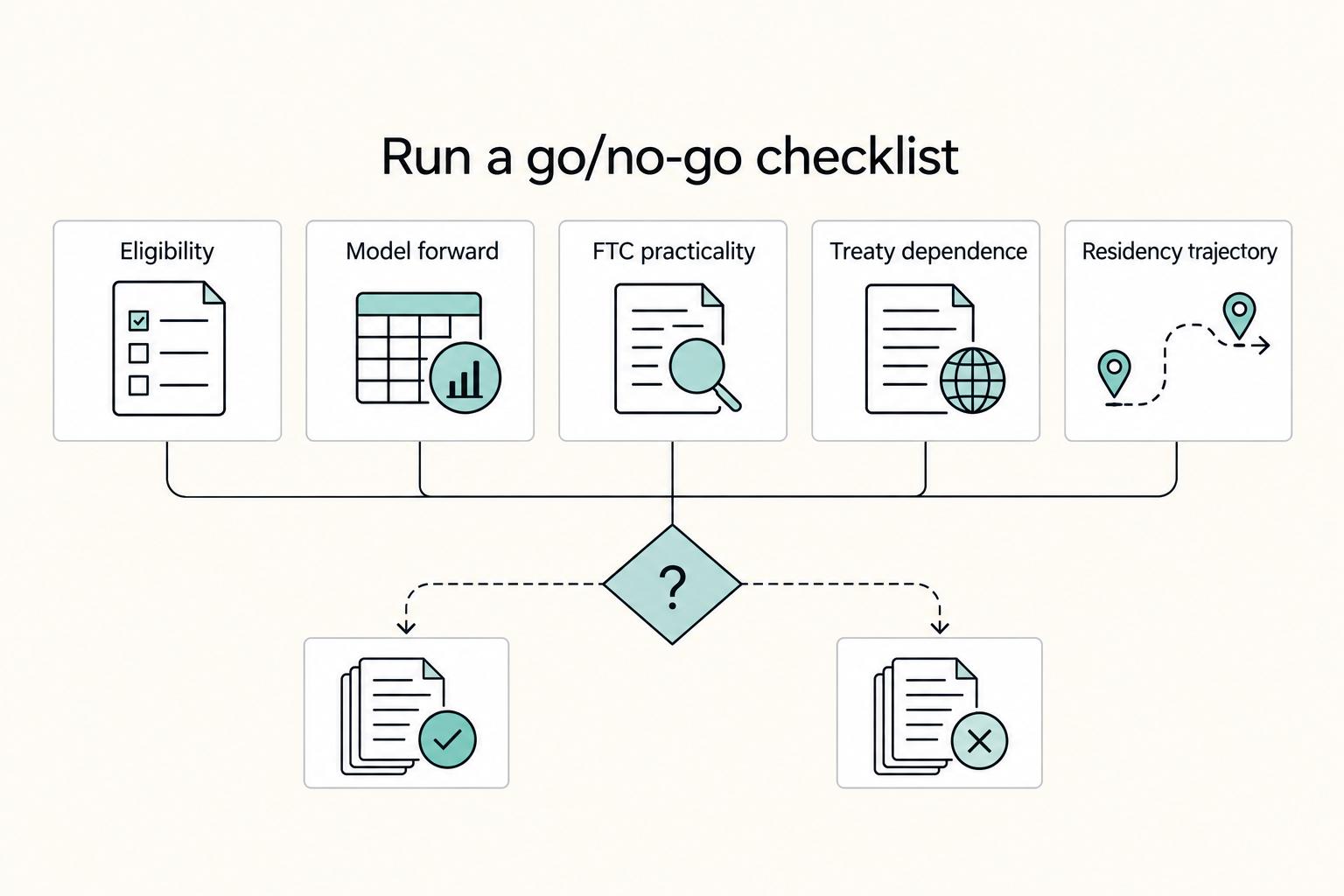
A **6013(g) election** lets some married couples treat a **[nonresident spouse](https://www.irs.gov/individuals/international-taxpayers/nonresident-spouse)** as a U.S. resident for tax purposes so they can file **Married Filing Jointly (MFJ)** instead of **Married Filing Separately (MFS)**. The core question is simple: does the benefit of joint filing outweigh the cost of pulling the nonresident spouse into broader U.S. tax reporting? For some couples, MFJ improves the result. For others, it creates more exposure than value. As a practical default, you should not elect until you have modeled both filing paths and pressure-tested treaty and foreign-income consequences.

The Circle of Competence for Freelance Consultants
Treat your **circle of competence for freelancers** as a decision boundary, not a branding slogan. Whatever market you target, your circle is the work you can reliably perform well because you know where your competence begins and ends.

The Best Community Platforms for SaaS Businesses
Start by classifying the job. If you want access to other people's audience, ideas, or conversations, you are choosing a community to join. If you want a place your customers or members use under your brand, with your rules and structure, you are choosing software you will need to operate every week.