
Quick Answer
Model both paths before you elect. A 6013(g) election non-resident spouse decision can improve a joint return, but it also pulls the nonresident spouse’s worldwide income into U.S. reporting and may narrow treaty-based positions while active. Start by confirming status requirements at the end of the year, then compare separate and joint outcomes using realistic cross-border credit assumptions. If minor changes in income, foreign tax, or treaty facts flip the result, keep the default separate approach.
The 6013(g) Election: A Strategic Decision Matrix for Global Professionals#
A 6013(g) election lets some married couples treat a nonresident spouse as a U.S. resident for tax purposes so they can file Married Filing Jointly (MFJ) instead of Married Filing Separately (MFS). The core question is simple: does the benefit of joint filing outweigh the cost of pulling the nonresident spouse into broader U.S. tax reporting? For some couples, MFJ improves the result. For others, it creates more exposure than value. As a practical default, you should not elect until you have modeled both filing paths and pressure-tested treaty and foreign-income consequences.
By default, a joint return is generally barred if either spouse is a nonresident alien during the tax year. This election is the exception. At year-end, one spouse must be a U.S. citizen or resident and the other must be a nonresident alien.
| Decision lens | Potential upside if you elect MFJ | Main exposure if you elect |
|---|---|---|
| Filing status | Joint filing treatment, including broader joint-rate treatment and standard deduction rules; verify the current amount | You leave the default separate-filing position |
| Income scope | Joint filing may lower total tax in some fact patterns | Both spouses report worldwide income for the election year and later years while active |
| Credits | Foreign Tax Credit may reduce double taxation on foreign-source income | FTC cannot offset U.S. tax on U.S.-source income |
| Treaty position | Some treaty outcomes may still be available in limited cases | Generally, foreign-resident treaty benefits are restricted while the choice is in effect |
| Liability and compliance | One combined return may simplify top-line filing status | Both spouses are jointly liable for the full tax, and the nonresident spouse enters ongoing U.S. compliance |
That table captures the real decision frame. The election is not just a filing-status optimization. It is a trade. You may get a better joint-return result, but you do so by expanding the reporting perimeter and accepting a compliance posture that can last beyond the year in front of you. Many couples stop at the line that says "Married Filing Jointly." That is usually too early.
A better way to think about it is to break the decision into three questions. First, are you even eligible at year-end? Second, if you are eligible, does the combined tax result still hold once both spouses' worldwide income and any credit limitations are actually modeled? Third, if the answer is still yes, can you execute the filing cleanly enough that the return is complete, supportable, and easy to explain later? If you cannot answer yes to all three, the election usually stops making sense quickly.
The same election can look very different depending on the household. If the nonresident spouse has modest foreign income and a likely path toward U.S. tax residency anyway, the tradeoff can be easier to justify. If the nonresident spouse has significant foreign income, lives in a low-tax environment, or depends on treaty-based treatment, the cost side of the analysis becomes much heavier. That is why broad statements like "joint is better" or "joint gets the bigger deduction" are not enough. You need a decision matrix, not a slogan.
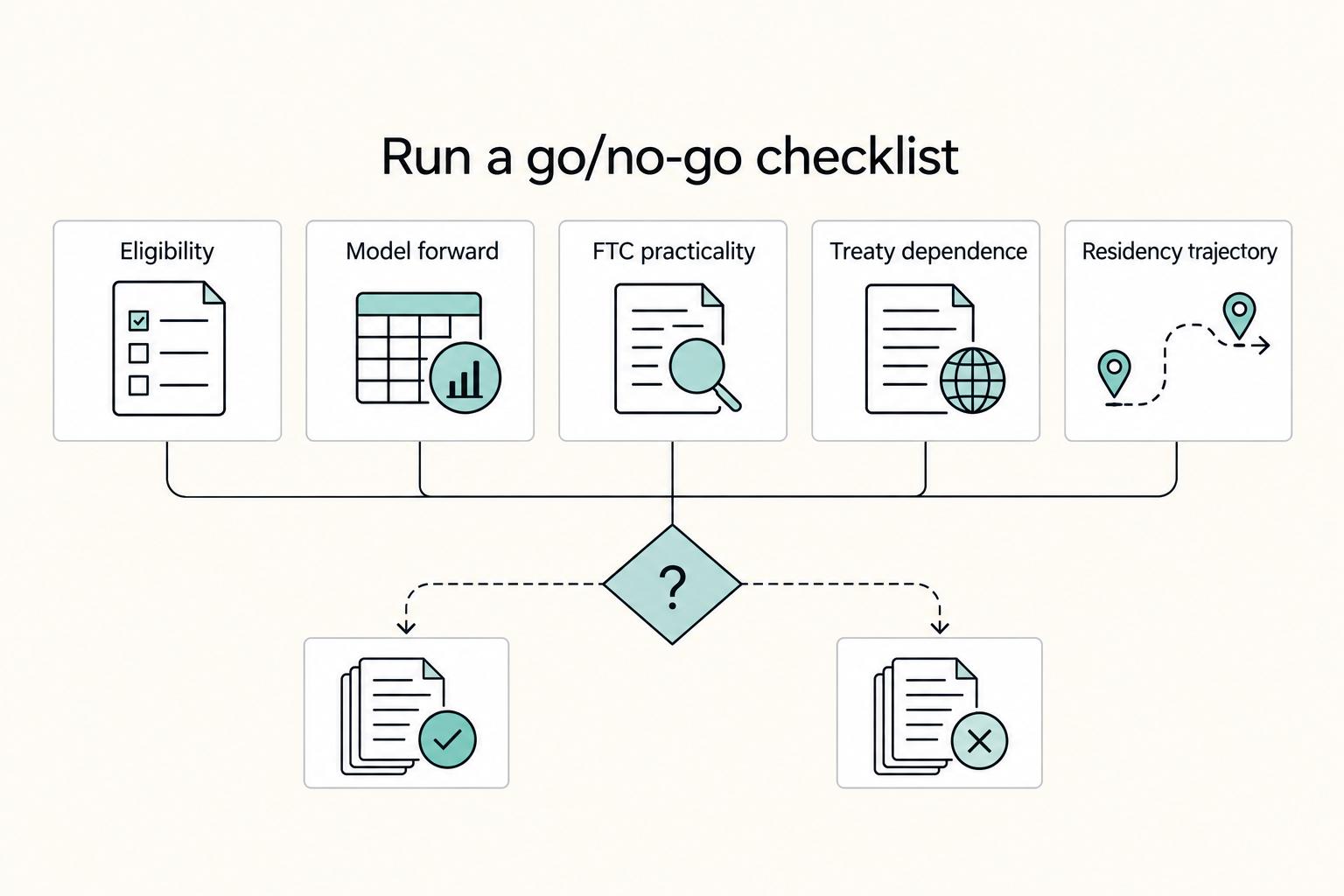
Step 1. Run a go/no-go checklist#
Use this checklist first. If the election fails on any of these points, the rest of the analysis usually does not save it.
| Checklist item | What to verify | Caution |
|---|---|---|
| Eligibility | At year-end, one spouse must be a U.S. citizen or resident and the other a nonresident alien | If you cannot state the year-end status cleanly, stop and resolve that first |
| Model forward | If your spouse's income is likely to rise, check whether the longer-range math still works | A narrow current-year win can disappear quickly |
| FTC practicality | Confirm foreign taxes are meaningful, documented, and sufficient to support the model | Low-tax or zero-tax fact patterns are a warning |
| Treaty dependence | Verify what treaty treatment is restricted and what may still qualify under exceptions | Treaty-sensitive households often undervalue what they are giving up |
| Residency trajectory | Check whether U.S. tax residency is expected soon or whether long-term foreign residence is more likely | Long-term non-U.S. life with growing foreign income usually makes defaulting to no safer |
- Confirm eligibility. At year-end, one spouse must be a U.S. citizen or resident and the other a nonresident alien.
- Model forward, not just this year. If your spouse's income is likely to rise, treat that as a default no unless the longer-range math still works.
- Test FTC practicality. Credits can help when meaningful foreign income tax is paid. Low- or zero-tax jurisdictions are a red flag.
- Check treaty dependence. If either spouse depends on treaty benefits, verify what is restricted and what may still qualify under exceptions.
- Map residency trajectory. If U.S. tax residency is expected soon, electing now may be easier to justify. If long-term non-U.S. life with growing foreign income is more likely, defaulting to no is usually safer.
If the election still looks viable after this screen, move to a breakeven model before you file anything. Do not treat this checklist as a formality. It is there to eliminate weak cases early, before you spend time building a joint-return model that was never realistic.
In practice, most bad elections look questionable on this first pass. The hard part is that couples often ignore the warning signs because the immediate filing-status benefit feels concrete while the compliance cost feels distant. Your goal here is to force that distant cost into the present decision.
Start with eligibility and pin it to the year-end facts, not to a rough memory of where each spouse lived during the year. If your timeline is messy, write it out. The election turns on year-end status, so your first task is to make that point clear and documented. If you cannot state the year-end status cleanly, stop there and resolve that before doing anything else.
Next, model forward, not just this year. This is where elections that look attractive on a snapshot basis start to fall apart. A narrow current-year win can disappear quickly if the nonresident spouse is likely to earn more, receive more foreign investment income, or continue building a life outside the United States. If the only reason the election works is that this year happened to be unusually low-income or unusually well-taxed abroad, you are not looking at a durable planning move. You are looking at a temporary coincidence.
Then test FTC practicality in a literal way. Do not assume that "foreign tax exists" means "the U.S. result will be neutralized." What matters is whether the foreign taxes are meaningful, documented, and sufficient to support the model you are relying on. Low-tax or zero-tax fact patterns are a warning because the election expands the income base without providing much credit support on the other side. Even in higher-tax settings, make sure your model is based on actual foreign-tax records, not estimates that may later change.
The treaty-dependence check is equally important because treaty-sensitive households often undervalue what they are giving up. If your current filing posture or expected treatment depends on foreign-resident treaty benefits, do not wave that away as a technical detail. It is often the detail that decides the case. Before you elect, identify exactly which parts of your position depend on treaty treatment. Then verify whether those positions still hold, are restricted, or need to be rethought if the election is in effect.
Finally, map the residency trajectory instead of treating the election as a one-year puzzle. If U.S. tax residency is likely to arrive soon anyway, some of the longer-term compliance concerns may be less decisive because the household is heading into a fuller U.S. reporting environment regardless. If, by contrast, the expected reality is continued foreign residence with growing foreign earnings, foreign accounts, and foreign tax complexity, the election is often harder to defend. A household with a short runway into U.S. residency is not in the same position as a household planning to stay primarily abroad.
One useful habit is to ask one more question after each item: "If this assumption worsens slightly, do we still elect?" If the answer becomes no after a small change, you already know the case is weak. That is exactly the kind of fragility you want to identify before filing.
Step 2. Model breakeven before filing#
A same-year tax win is not enough on its own. What matters is whether the result still holds once you include worldwide income, likely FTC limits, and the possibility that your facts change next year.
| Stress test | Change to model | What the article says |
|---|---|---|
| Higher spouse income | Increase the nonresident spouse's income | If modest changes flip the result, treat the election as fragile |
| Lower foreign taxes | Reduce the foreign-tax support or test lower foreign taxes | The path should still make sense if foreign tax drops |
| Treaty-sensitive assumption | Remove the treaty-sensitive assumption that made the model work | If the answer changes quickly, mark the election as unstable |
| Next filing cycle | Look at the next filing cycle instead of just this one | A same-year tax win is not enough on its own |
Build your MFS baseline first. Then build an MFJ version that includes both spouses' worldwide income. Map likely FTC offsets and apply the source-income limitation correctly. Compare the net outcomes, then ask what would change the decision. If modest changes such as higher spouse income, lower foreign taxes, or treaty-position shifts flip the answer, treat the election as fragile.
In practice, that fragility matters more than a narrow one-year benefit. If the model only works under a tight set of assumptions, that is usually a sign to stay with the default separate-filing position.
The best way to do this is to build the two paths as if you were trying to prove yourself wrong. Start with the MFS baseline because that is your default world. Make it complete, not approximate. Use the filing position you would actually take if you did nothing special. That gives you a real control case instead of a rough estimate.
Then build the MFJ version from the ground up, not by simply changing the filing-status line and assuming the rest follows. The whole point of the election is that the nonresident spouse is treated differently for tax purposes, so your model needs to reflect that change all the way through. Include the nonresident spouse's worldwide income for the year, use a consistent approach for any foreign-currency conversions, and tie the amounts back to source records you can retain. If you are relying on foreign taxes to support the result, make sure the model traces to actual foreign-tax documentation rather than broad assumptions.
At that point, compare the two paths in a structured way. Do not ask only, "Which one produces the lower tax today?" Ask instead:
- Which path is more stable if income changes modestly?
- Which path is more exposed if foreign tax drops?
- Which path depends on a treaty position that may no longer work?
- Which path creates a compliance burden that continues after the current year?
- Which path would still make sense if you looked at the next filing cycle instead of just this one?
That is the real breakeven test. You are not looking for the path that wins by a small amount under a perfect set of facts. You are looking for the path that still makes sense after normal life events occur.
A practical way to stress-test the model is to rerun it under a few nearby versions of your facts. Increase the nonresident spouse's income. Reduce the foreign-tax support. Remove the treaty-sensitive assumption that made the model work. If the answer changes quickly, mark the election as unstable. Unstable tax positions are not automatically wrong, but they are poor candidates for an election that broadens reporting and can remain relevant after the current year.
Also look at the quality of the win, not just its size. A strong case is one where MFJ still looks sensible even after you account for worldwide income, documentation work, and likely future facts. A weak case is one where MFJ wins only because one variable happened to line up favorably this year. That is exactly the kind of case people regret later, because the first year looked fine and the later years did not.
Another good discipline is to keep a short written note with the model explaining what the decision depends on. For example, if the election only works because foreign taxes are currently high or because one spouse is expected to move into U.S. tax residency soon, write that down. That note will help you later when you revisit whether the election still makes sense, whether it should be revoked if allowed, or whether the household's facts have changed so much that the original rationale no longer applies.
If you cannot build a model that you could explain calmly to a reviewer six months later, you probably do not have a strong enough case to elect. The goal is not to create a clever spreadsheet. The goal is to arrive at a filing position that remains coherent once the details are examined.
Step 3. Execute in sequence#
Execution is mostly about documents and timing. If you decide to elect, get the filing mechanics right the first time so the return is supportable and easy to defend later.
| Filing item | Action | Key detail |
|---|---|---|
| Identification | Confirm the nonresident spouse has an SSN or ITIN to appear on the return | Check current IRS requirements and filing mechanics before submission |
| Election statement | Attach a signed election statement to the first joint return | Include each spouse's name, address, and identification number |
| Return form | Use Form 1040 or 1040-SR for the election year return | Do not file Form 1040-NR for the election year return |
| Retention file | Keep a clear retention file | Signed election statement, ID records, FX conversion support, and foreign-tax records |
| Final verification | Do a final verification pass before you submit | Eligibility facts, joint filing throughout, complete identifying information, and current submission mechanics |
Prepare documentation first. The nonresident spouse needs an SSN or ITIN to appear on the return, so confirm current IRS requirements and filing mechanics before you submit. Attach a signed election statement to the first joint return, including each spouse's name, address, and identification number.
Use Form 1040 or 1040-SR for the election year return, not Form 1040-NR, and complete filing-status steps as currently instructed. Keep a clear retention file with the signed election statement, ID records, FX conversion support, and foreign-tax records for any FTC claim. Confirm the latest filing requirements and mailing details before submission, since procedures can change.
The sequence matters more than people expect. A lot of filing pain comes from trying to solve the identification, statement, and support issues at the very end, after the tax numbers are already drafted. That creates avoidable errors. A cleaner process is to build the support file first and then prepare the return around it.
Start by gathering the core items you know you will need. That usually means confirming both spouses' names, addresses, and identification details exactly as they should appear. It also means assembling the records that support worldwide income included in the model and organizing the foreign-tax records you will rely on if you expect FTC relief to matter. Keep those items in one file from the start. If you scatter them across email threads, banking folders, and old return workpapers, the filing becomes harder to review and easier to challenge later.
Next, prepare the election statement carefully. Since it is attached to the first joint return, treat it as part of the return package, not as an afterthought. Make sure the identifying information matches the return exactly. Small inconsistencies are not strategic issues, but they create unnecessary friction. A return that is internally consistent is easier to process, easier to retain, and easier to explain if questions arise.
Then make sure the return form and filing path match the election you are making. The choice to elect has consequences for which return you file, so verify that the return package reflects that choice from the outset. It is worth doing a final "filing logic" review before submission. Are both spouses shown the same way across the return and statement? Is the filing status consistent throughout? Is the identification information complete? Are the worldwide-income figures and any related support tied to the records in your file?
Your retention file is not just for this year. Build it so future-you can understand the decision without reconstructing the entire process. At minimum, keep the signed election statement, copies of the filed return, the identification support you used, the foreign-currency conversion support applied in the workpapers, and the foreign-tax records behind any credit claim. If you modeled both MFS and MFJ before choosing, keep that comparison too. The model itself is often the best evidence that the filing position was considered carefully rather than chosen casually.
Common execution problems tend to be operational rather than conceptual. A spouse's identification number is still unresolved when the filing deadline approaches. The return figures are ready, but the support for foreign taxes is incomplete. The election statement exists in draft form but is not signed consistently. The couple decided to elect based on a rough estimate and never updated the model with the final numbers. None of those issues changes the legal concept of the election, but each one can turn a manageable filing into an avoidable mess.
Before you submit, do a final verification pass with this checklist:
- The year-end eligibility facts are still the same as the ones you modeled.
- The return reflects joint filing all the way through.
- The signed election statement is attached to the first joint return.
- Each spouse's identifying information is complete and consistent.
- Worldwide income included in the filing matches the records you retained.
- Any FTC amounts are supported by the foreign-tax records in your file.
- You have a saved copy of the full package and know the current submission mechanics.
That last step matters because filing procedures can change, and the cost of checking is low. The broader point is simple: if you decide to elect, make the file clean. A clean file reduces stress now and helps later if you need to revisit the election's ongoing effect, answer questions, or decide whether keeping the election in place still makes sense.
If you want a deeper dive, read the digital nomad tax guide. Before you file, run your facts through a structured residency log so your election decision and documentation stay consistent across tax year changes: Use the tax residency tracker.
Frequently Asked Questions
When is this a bad fit?
It is often a poor fit when the nonresident spouse has substantial income in a low-tax setting, the household depends on treaty benefits, or foreign income is expected to grow quickly. If your model only looks favorable in one narrow year, treat that as a warning. A one-year win is not enough if the surrounding facts point the other way.
Can we revoke it later?
Yes. Either spouse can revoke by the return due date for the tax year, with a signed revocation statement. The election can also end through other triggers such as death, legal separation, or inadequate records, and if a prior election was terminated, you generally cannot make a new one later. Do not treat revocation as an easy escape hatch. Compare the original model with current facts before you decide.
Does this change immigration status?
No. This is a tax-status election, not an immigration-status change. IRS guidance also notes that withholding treatment for Social Security and Medicare can still differ while the election is in effect. Keep those systems separate in your planning and do not assume every payroll or withholding consequence follows automatically from the filing election.
When should you escalate to a cross-border tax professional?
Escalate when you have business income, FTC complexity, treaty-sensitive positions, uncertain long-term residency plans, or a model that flips when small assumptions change. A good rule is simple: if you cannot explain to yourself, in plain language, why MFJ still works after worldwide income, treaty limits, and likely future facts are included, get help before filing. For broader context, read Gruv's guide on tax implications of a US citizen marrying a non-resident alien and 183-Day Rule Explained: Stop the Tax Myths Before They Cost You. If your matrix result is borderline, get a second set of eyes before submitting: Talk to Gruv.
Try a related tool
Researched and edited by the Gruv editorial team. Gruv builds cross-border billing, payouts, and finance-operations software for global businesses.
Sources
Educational content only. Not legal, tax, or financial advice.
Related Posts

Digital Nomad Taxes in 2026 With a Defensible Filing Plan
With digital nomad taxes, the first move is not optimization. It is figuring out where you may be taxable, where filings may be required, and what proof supports that position.

183-Day Rule Tax Myths That Trigger Residency Filing Mistakes
If you are a mobile freelancer or consultant, start here: the "183 day rule tax" idea is not a single universal test. It is a shortcut phrase people use for different residency rules that do not ask the same question. If you mix federal and non-federal residency logic, you can create filing risk even when your travel calendar looks clean.
Tax Implications of a US Citizen Marrying a Non-Resident Alien
Use **Married Filing Separately (MFS)** as your default unless you can clearly support **Head of Household (HOH)** or you intentionally make the resident election and file jointly. The core tradeoff is straightforward: baseline filing treatment versus broader reporting while the election is in effect.