
Quick Answer
Use WebSockets for payment status tracking only when operators need live, low-latency sequence visibility and delayed snapshots could cause the wrong action or extra support work. Keep REST for commands and current-state reads, persist backend events as the source of truth, and treat the socket as a visibility layer with explicit reconnect, fallback, and verification rules.
Why Real-Time Payment Status Tracking Matters#
If you are evaluating real-time payment tracking over WebSockets, start with the operating question, not the protocol question. Can you deliver live status updates that stay traceable through reconnects, retries, and support escalation?
This guide is for CTOs, engineering leads, and solution architects who need real-time payment or payout visibility without creating integration debt. WebSockets can improve live delivery by keeping a persistent, bidirectional client-server connection open, but the transport does not define business truth on its own.
The scope here is intentionally narrow: platform payments and payout visibility. We are focused on transaction timelines, payout state changes, and operator-facing status updates, not market-data streaming patterns.
A practical starting point is to compare the transport options before you commit:
| Option | Communication model | What to remember |
|---|---|---|
| HTTP | Stateless request-response, unidirectional | A request-response baseline for request-driven flows |
| Webhook | One-way notification over HTTP | Useful for event delivery, but still one-way |
| WebSocket | Persistent, full-duplex, bidirectional | Supports live, event-driven status UX without polling, but requires connection-state management and adds operational complexity |
At Gruv, "real-time" is not enough. Visibility has to hold up through compliance gates, audit-ready records, idempotent retries, and ledger-first traceability. The standard is simple: when a status changes, your team should be able to trace that update through event history to the ledger record that shows what happened.
That's the lens going forward. We will look at where WebSockets are worth the complexity, where HTTP or webhooks are enough, and how to keep payment status explainable under normal failure modes. Speed matters, but dependable traceability matters more. We also cover the webhook side in Webhook Implementation Guide: Real-Time Payment Notifications.
Define Real-Time Payment Tracking in Operator Terms#
In operator terms, "real-time" is not about claiming instant speed. It is about showing payment status quickly enough to support a decision, while keeping that status clear and explainable.
Use this distinction to keep definitions precise:
| Term | Operator meaning |
|---|---|
| Absolute Real-Time | The theoretical instant an event occurs. |
| Functional Real-Time | The point where additional speed no longer creates meaningful user benefit. |
For payment tracking, functional real-time is often the right target. A faster delivery channel can improve update speed, but transport alone does not establish business truth. You still need clear status definitions and finality rules so support and operations can tie each visible status to a backend event or reference record.
Set expectations carefully. Real-time is context-dependent, and speed is often balanced against security, analytical value, or system stability. A key risk is a fast status that is unclear or misleading.
That distinction matters most when teams are under pressure. An operator looking at a payout detail page does not need a claim that the screen is "instant." They need to know whether the status is current enough to act on and whether it might still change. They also need to know where to look if the visible state conflicts with a customer report. If the UI answers those questions consistently, you have functional real-time. If it cannot, shaving a little transport delay does not solve the real problem.
For more on the support and operations impact, see Payment Status Visibility: How Real-Time Payout Tracking Reduces Support Load.
Decide When WebSockets Are Worth It#
Use WebSockets when a live screen needs low-latency updates and clear sequence visibility, and a delayed snapshot could drive the wrong action or extra support work. Otherwise, start with selective polling.
This is a tradeoff decision, not a default architecture choice. REST polling and WebSockets can both deliver the latest state, but they differ in latency behavior, sequence visibility, and operational load.
| Transport | Latency fit | Order-of-events fit | Support burden |
|---|---|---|---|
| REST API polling | Best when updates can wait for the next check (for example, every 5 seconds) | Weak for step-by-step visibility because you read snapshots, not each transition | Low to medium. Stateless requests are simple to scale, but frequent polling adds waste |
| WebSocket channel | Best when the UI needs low-latency, event-driven updates | Strong for live sequence display, but only if you implement sequencing and replay controls | High. You must run connection lifecycle, reconnects, heartbeats, and stale-session handling |
WebSockets are most useful when operators need to see state changes as they happen in a live detail view or operations console. If updates are low-frequency and async handling is acceptable, selective polling is usually the better first version. Polling is viable when instant updates are not required, and you should define terminal states that stop the loop, for example once status is success, to avoid needless traffic and stale spinners.
Do not over-credit the protocol. WebSockets alone do not guarantee ordering, durability, or replay safety. If your team cannot yet operate reconnect, retry, and replay behavior, defer a full rollout. Common production failure modes include silent connection drops, idle connection termination, and infrastructure pressure from connection count, file descriptors, and heartbeat overhead at scale.
A good test is to ask what goes wrong if the user misses one transition. If the answer is "nothing important, because the next snapshot is enough," you probably do not need a socket yet. If the answer is "support may take the wrong action, the operator may retry too early, or the timeline will become hard to explain," then the extra complexity is easier to justify. The decision is less about whether WebSockets are modern and more about whether delayed visibility creates operational cost.
If your decision table points to a mixed REST + WebSocket architecture, use the Gruv docs to map event handling, retries, and status surfaces before implementation.
Pick the Right Transport Mix for Each Payment Surface#
After you decide a socket is justified, do not use it everywhere. Use HTTP request-response for commands and snapshots, and reserve a WebSocket channel for surfaces where a person truly needs live status changes. If you also use backend notifications, for example webhooks, handle them in backend flows your service persists and reconciles.
That split keeps each surface aligned to its job. Command paths need a direct response. Live UI views may need a persistent channel for visibility, but that channel should not be treated as the system record.
Match the transport to the job#
For command actions, prefer the REST API. Creating, retrying, canceling, or confirming is a request-response interaction, and the caller should get an immediate response and then fetch the latest state as needed. This keeps the action path explicit: the caller knows whether the command was accepted, and the follow-up read shows current system state.
For backend status ingestion, keep notification handling in backend-owned HTTP paths, including webhook-style callbacks when you use them. Persist what arrives, tie it to internal payment records, and reconcile when needed.
For live UI status, WebSockets fit when low-latency sequence visibility is genuinely needed. The tradeoff is operational complexity: unlike stateless HTTP, the server must manage connection state. That means you are responsible not only for sending updates, but also for defining fallback behavior when a socket is unavailable.
| Transport | Primary consumer | Protocol behavior | State handling | Typical fit |
|---|---|---|---|---|
| REST API | Browser or backend caller | Stateless, unidirectional request-response | No persistent per-client connection state | Commands, snapshot reads |
| Backend HTTP notifications (including webhooks) | Backend service | HTTP notification flow | Persist and reconcile in backend systems | Backend notifications |
| WebSocket API | Browser client | Persistent, full-duplex channel over one TCP socket | Server must manage connection state | Live status views |
A useful way to think about it is user intent. If the user is asking the system to do something, use REST. If the user is watching a process unfold and needs to see changes without refreshing, use a socket. Keep browser live updates as a visibility layer, and keep authoritative state in backend systems.
Make fallback and verification explicit#
A transport mix only works if fallback behavior is explicit. Treat the handshake as a hard checkpoint. The HTTP/1.1 upgrade path is optional, so clients cannot force a protocol switch. If the upgrade succeeds, the server returns 101 Switching Protocols, and Upgrade must also appear in the Connection header. If the server returns a normal 200 OK, no socket was established, so the client must fall back to standard HTTP behavior.
Auth should be explicit too. One documented pattern is issuing a JWT and validating it when the client opens the socket. WebSocket connections commonly run as ws on port 80 or wss on port 443.
Keep connection state separate from payment state. A connected socket means the channel is open, not that a payment is confirmed.
Make fallback visible to operators and in logs. If the client drops back to HTTP behavior after a failed upgrade, that should not look identical to a healthy live session.
Define the Payment Status Model Before You Open a Socket#
Define your payment status model before you stream anything over WebSocket. An open session is transport, not business truth, and this is where payment timelines can start to drift.
Canonical states before provider events#
Set one canonical status model that your REST API, webhook ingestion, support tools, and UI all use, then map provider events into it. If you skip this, the UI can drift toward "last message seen" instead of "current payment state."
If your product exposes outcomes such as success, pending, held, returned, failed, or investigation required, document what each one means in your program. This article does not establish universal RTP or ACH debit transition or finality rules, so treat those as explicit product decisions, not assumptions.
For each state, your status table should define business meaning, allowed prior states, required evidence before emit, terminal versus still-changeable behavior, and support guidance.
That table should be usable by more than engineering. Product should be able to review it for copy and expectation-setting. Support should be able to use it during escalation. Engineering should be able to implement it without inventing edge behavior during a live incident. If a state label sounds clear in a design review but produces confusion when a case reaches operations, the model is not ready yet.
Write transition rules teams can actually run#
Transition rules need to be specific enough that product, support, and engineering make the same call under pressure. "Pending" is not practical unless you define what it can become next and what evidence allows that move.
For RTP and ACH debit, keep rail-specific notes in your own model for terminal versus reversible handling in your program. If a rule is uncertain, mark it as uncertain and keep customer-facing language conservative.
Operationally, this means writing transitions as decisions, not vague descriptions. What evidence lets a payment move from pending to success? What evidence forces it into held instead? What should the UI show if the backend has received a signal but has not yet persisted the event that would justify the transition? Those are the questions that surface during incidents, and they should already have answers in the model.
Make every update traceable#
Every live status update should trace back to a persisted backend record. Persistent connections can improve real-time visibility, but they also add connection-state complexity, so backend history must remain the source of truth.
For each accepted update, persist enough detail to reconstruct the decision path, such as an event identifier, provider reference, internal payment ID, mapped canonical status, and recorded time. Consider showing a status as final in the UI only after backend history can point to the stored event that produced that state, based on your policy.
This is also what keeps support timelines from turning into arguments about which screen was right. If the visible status can be tied to one persisted event and one mapped state decision, the discussion becomes factual. You can see what arrived, what was stored, how it was mapped, and why that became the operator-facing state. Without that chain, teams end up debating transport behavior instead of resolving the payment record.
For examples of where real-time payment flows matter most, see Real-Time Payment Use Cases for Gig Platforms: When Instant Actually Matters.
Design Connection Lifecycle and Session Controls#
Once your status model is fixed, treat connection lifecycle as a product contract, not just transport plumbing. An open WebSocket alone does not prove the client is current, so define session controls before you call the system production-ready.
Open and close sessions on purpose#
Open and close behavior should be explicit and observable. A WebSocket starts with an HTTP upgrade, so confirm the expected 101 Switching Protocols response and record the open event with a connection ID, authenticated subject, subscribed scope, and recorded time.
Closing should be explicit too. WebSocket shutdown uses a close frame and closing handshake, so define when clients should close and reconnect instead of assuming a long-lived session is always valid. In load-balanced deployments, decide early whether session affinity is required so client messages stay on the same server during a session.
The practical goal is to remove ambiguity from session history. When a user reports a frozen status timeline, your team should be able to answer basic questions quickly. Did the session open? What scope did it subscribe to? When did it stop being trustworthy? Was the close expected or not? If those answers live only in ad hoc logs, recovery gets slower and root-cause analysis gets weaker.
Do not rely on handshake context alone#
Document your auth and session model clearly, including how renewal and revalidation are handled in your implementation. The key design choice is whether checks happen only at connect time or also at message time.
That matters because WebSocket does not provide built-in per-message metadata the way HTTP requests do. The handshake establishes the connection. It does not describe each later operation, so use a message envelope pattern for the metadata you need for traceability and authorization checks.
At minimum, document these session fields:
- connection ID or session ID
- tenant, account, or user scope
- subscribed channel or topic scope
- client-generated request or correlation ID
- recovery context marker used by your protocol
Those fields are not implementation trivia. They let you explain why a client was allowed to receive a given update, how recovery was handled after interruption, and whether the client view aligned with backend records during recovery.
Separate connected from current#
Treat connected and current as different states. A persistent socket can still carry stale application context, so define explicit checks for transport health and data freshness.
Track both liveness and currency with signals your system can verify. If the socket remains open but backend state advances while the client view does not, flag the session for recovery.
This distinction is easy to skip in early prototypes because the happy path makes them look identical. In production, they can diverge. A client can be technically connected yet operationally behind. If your dashboards only show connection count, you may think the feature is healthy while users are staring at old state. Separate indicators for open sessions and current sessions make that problem visible sooner.
Reconnect with a recovery point, not wishful thinking#
Reconnect behavior needs to be designed before launch. The specific mechanics are implementation-specific, but reconnecting without a validated continuity check can leave client state ambiguous.
Define a recovery path for cases where continuity cannot be proven. Validate this by dropping a connection during live updates and confirming the rebuilt timeline matches persisted backend history without silent gaps.
In practice, the decision tree should be simple for the client: continue stream-based recovery only when continuity can be validated; otherwise run a clean snapshot recovery path.
For incident review, retain an evidence pack with the open event, close reason, reconnect attempts, and recovery outcome. That turns "the socket was connected" into an auditable explanation.
Prevent Duplicate or Out-of-Order Status Updates#
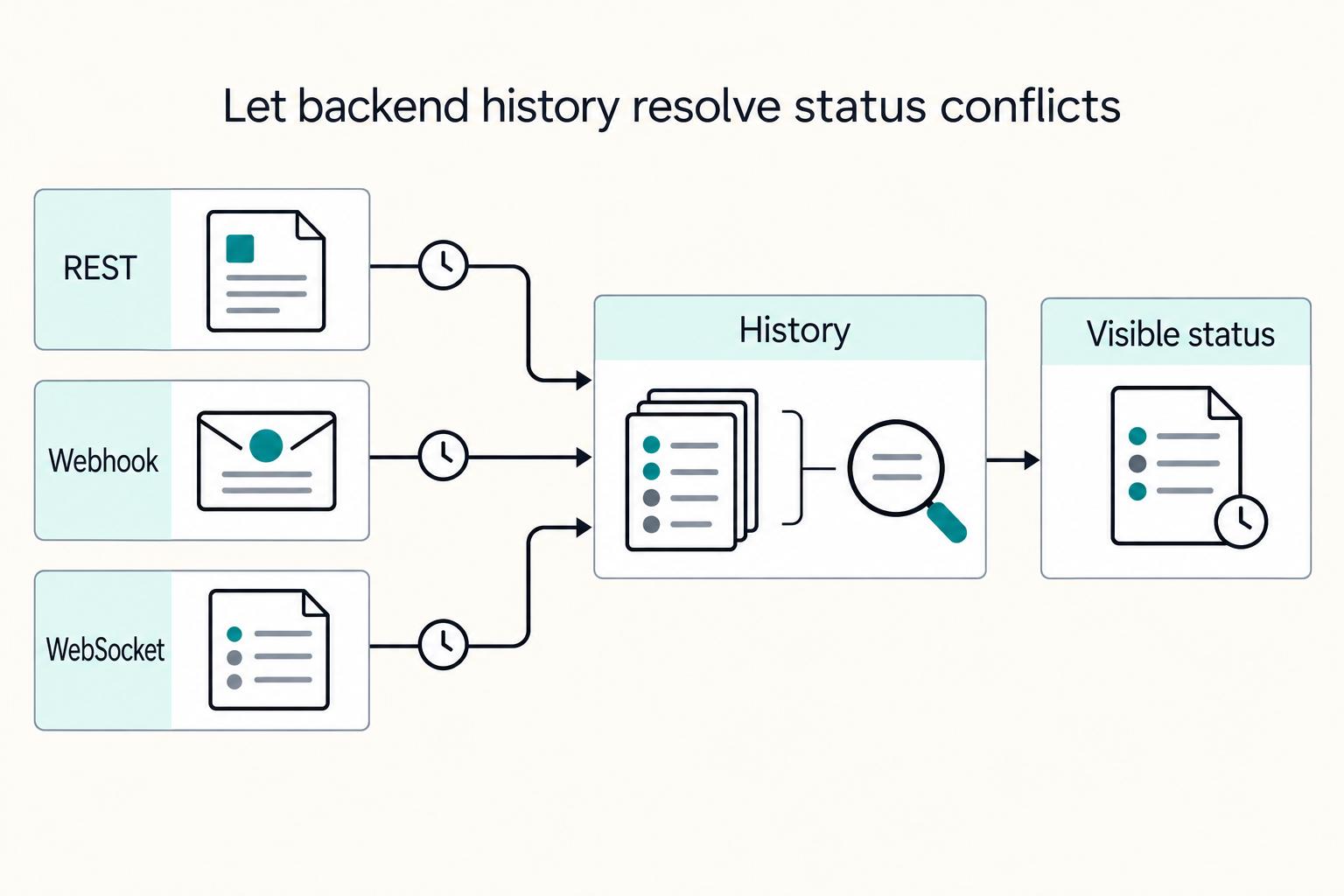
Preventing timeline drift usually requires one conflict rule across every delivery path, not just the socket. When REST reads, webhooks, and WebSocket pushes all describe the same payment, treat client-visible status as provisional until it reconciles to backend event history.
Make backend history the tie-breaker#
A stateless REST read gives you a snapshot. A WebSocket gives you event-driven updates that reduce repeated polling. That speed is useful, but arrival order alone is not proof of correctness. If two updates disagree or appear out of order, hold the visible status, reconcile against persisted history, then decide whether the event is a duplicate, a delayed delivery, or a recovery issue.
This is where mixed transports often show inconsistencies first. One system optimizes for delivery speed, another for durable storage, and a third for operator visibility. If each one resolves conflicts differently, the same payment can appear settled in one place and unresolved in another. A single backend tie-breaker rule prevents the UI from drifting into its own version of truth.
Add a clear verification checkpoint#
Before marking a status final in the UI or support timeline, verify:
- the update matches a persisted backend event
- the update is consistent with the client's last confirmed backend reference
- the source channel and reconcile decision are recorded for incident review
If you already run a webhook-to-queue-to-WebSocket flow, keep checkpoints at each stage so you can trace what happened end to end.
The checkpoint does not need to be complicated, but it does need to be consistent. Operators should know when they are seeing a fast signal that is still being reconciled and when they are seeing a state that has cleared that verification step. That one distinction prevents many false assumptions during support escalations.
Why generic streaming guidance is not enough#
Generic WebSocket examples usually focus on chat, gaming, or notifications. Those patterns help with transport design, but payment status tracking often needs stronger conflict handling when status decisions must be explainable during audits and support reviews. Use generic streaming examples as transport comparisons, not as integrity standards.
Persistent connections are also harder to run than stateless HTTP, and infrastructure can add failure modes, including load balancer compatibility constraints. In mixed transport systems, the safest rule is simple: backend event history decides conflicts, and transport arrival is delivery detail.
That framing keeps your architecture honest. A fast feed is helpful. A replayable, explainable timeline is what operations actually need. Generic streaming guidance can show you how to keep messages moving, but it usually does not tell you how to defend a status decision after duplicates, delayed arrivals, or reconnect gaps. Payment systems need that extra layer by default.
Build Operator Visibility from Event to Ledger#
Operator visibility works best when you can trace each transaction through one record from user action to ledger outcome. Treat the support timeline as a view of that record, not a separate source of truth.
Design one trace path#
Define one path of checkpoints for each transaction and keep appending to the same record as events arrive. At minimum, capture signing, submission to a node (for example via RPC), node validation, pending observations, and final ledger inclusion so responders can follow what happened end to end.
Real-time messages can be useful delivery signals, but they are not final truth by themselves. Show a status as final only after it maps to a persisted transition and still aligns with the latest ledger record.
A strong trace path also reduces handoff friction. Support should not need separate tools for different event views and ledger results just to answer one customer question. The more those views resolve back to the same transaction record, the easier it is to explain what happened without reconstructing the story from separate systems.
Build the incident evidence pack up front#
Prepare incident evidence before failures happen, and make it retrievable from the transaction record. Keep the pack compact and consistent so support and engineering can review the same facts quickly.
- raw event payload as received
- checkpoint log for signing, node submission, and node validation
- pending-state observations from more than one node when available
- ledger outcome and timestamps for key transitions
Keeping raw payloads alongside normalized fields helps when parsing logic changes or an integration misinterprets an event. It also helps you avoid hindsight reconstruction. During an incident, teams can waste time trying to infer what the system saw. A prepared evidence pack shortens that loop. You can compare the raw payload, stored transitions, and visible outcome in one place and decide whether the issue was mapping, timing, or node-view disagreement.
Alert on visibility failures, not just hard failures#
Do not wait for explicit failures before alerting. Focus on the visibility breaks that make operators lose trust:
| Visibility issue | Definition |
|---|---|
| Unclear pending state | The transaction is still pending with no clear confirmation or failure outcome |
| Node-view mismatch | Different nodes report different pending views for the same transaction |
| Trace gap | Expected checkpoints are missing from the transaction path |
Pending states can be unclear, and different nodes can disagree on what looks latest. Route alerts to the full trace record so responders can verify history instead of reacting to a single event stream.
This is an important shift in operating mindset. A transaction system can be technically up while still failing the visibility contract. If operators cannot tell whether a status is late, stale, or conflicting, the system is already creating support risk. Alerting only on hard outages misses the class of problems that most often erode confidence in real-time tracking.
Related: End-to-End Payments Visibility: How CFOs at Platform Companies Track Every Dollar in Real Time.
Handle Country and Program Variance Without Breaking the Product#
Treat country, rail, and program variance as explicit capability data, and surface it before a user starts a flow. Feature availability can vary, so state what is available for this route and what is not.
| Surface | Required behavior |
|---|---|
| UI | Disable unsupported actions with a reason |
| API | Return an explicit unsupported-feature response instead of letting requests fall into vague pending states |
| Transaction record | Save a capability snapshot, including a checked-at timestamp and the country or program code used for that decision |
| Product copy | Use qualifiers such as 'where supported' and 'when enabled' and prefer 'may receive' unless the capability flag is present and the feature is enabled |
Use one product rule in both UI and API: expose capability flags and fail clearly when a feature is unavailable. Save a capability snapshot on the transaction record, including a checked-at timestamp and the country or program code used for that decision, so support can verify why a feature was blocked.
If you align copy to external real-time messaging expectations, keep qualifiers intact. Use "where supported" and "when enabled." Do not promise universal behavior across routes, and prefer "may receive" unless the capability flag is present and the feature is enabled.
Users should not have one experience in the UI, a different expectation in API behavior, and a third explanation from support. Store the capability decision on the transaction record so operations can answer the common question, "Why was this action unavailable here but not there?" That preserves trust better than a generic pending state that leaves everyone guessing.
Roll Out in Phases with Verification Gates#
A phased rollout works best when each phase has explicit pass-or-fail gates. Without those gates, teams can get stuck in a permanent pilot.
| Phase | Focus | Proof point |
|---|---|---|
| Phase 1 | Establish a baseline status flow and make failure handling explicit | Your status model and source-of-truth path work |
| Phase 2 | Add faster real-time delivery on the surfaces that need it, while keeping a fallback path during rollout | Live delivery improves the right surfaces without hiding fallback behavior |
| Phase 3 | Harden behavior for replay, disconnect or reconnect, and ordering edge cases | The system still behaves predictably when sessions break, events replay, or transport order becomes unreliable |
One practical sequence is:
- Phase 1: establish a baseline status flow and make failure handling explicit.
- Phase 2: add faster real-time delivery on the surfaces that need it, while keeping a fallback path during rollout.
- Phase 3: harden behavior for replay, disconnect or reconnect, and ordering edge cases.
Use one consistent rubric for go or no-go decisions at each gate: latency, coverage, uptime, integration effort, pricing, and docs or support.
The important discipline is to make each phase prove something different. Phase 1 proves that your status model and source-of-truth path work. Phase 2 proves that live delivery improves the right surfaces without hiding fallback behavior. Phase 3 proves that the system still behaves predictably when sessions break, events replay, or transport order becomes unreliable. If you try to prove all of that at once, teams often mistake a working demo for an operable system.
Launch checklist:
- Transport decision signed off.
- Sequence and ordering rules tested.
- Operator dashboards live.
- Incident runbook drafted.
- Known caveats documented.
- Deployment gates wired into CI/CD or rollout tooling (CLI, rollout controller, or API).
Treat the checklist as an operating readiness list, not just a release formality. If dashboards are missing, you may not know whether clients are current. If the runbook is missing, support will likely improvise during the first stale-session incident. If caveats are undocumented, product and support copy can drift. Verification gates matter because they force those dependencies into the launch plan before users are relying on the feature.
Conclusion#
Fast updates create value only when status meaning and verification are clear. Before you implement WebSockets for real-time payment status updates, make sure support, finance, and engineering can interpret the same status history the same way.
WebSockets are a transport choice, not business truth. They give you a persistent, bidirectional channel for live delivery, but the tradeoff is operational: long-lived connection state, higher complexity, and more resource pressure than stateless HTTP request-response.
A practical next step this week is to run one payout flow through your transport decision table:
- Do users need live updates, or is polling every 5 seconds enough?
- Is a server-to-server webhook sufficient for confirmation?
- What exact current-state response will REST return after reconnects or status disputes?
Then define canonical status transitions before implementation: allowed states, terminal states, what evidence moves state forward, and the identifier that ties each event to backend truth.
Use this sequence: persist durable backend confirmation, expose current state via REST, then add WebSockets only where latency materially improves the experience. Polling can be a valid bridge. In the example above, checks run every 5 seconds and stop when success is observed.
Final rule: treat live updates as fast signals, and verify final state against backend event history. Define the truth, persist the truth, expose the truth, then stream the truth where speed matters.
When you are ready to validate rail coverage, compliance gates, and rollout sequencing for your payout flows, talk with Gruv.
Frequently Asked Questions
When should we use WebSockets instead of REST polling for payment status tracking?
Use WebSockets when a live screen needs low-latency updates and polling delay would cause confusion or the wrong action. They fit event-driven delivery and sequence visibility on one persistent connection. If updates are infrequent and the next snapshot is enough, REST polling is usually the simpler first version.
What does “real-time payment visibility” mean for operations teams in practice?
In practice, it means seeing status changes quickly enough to act while keeping the timeline current and explainable. Operations should monitor feed health and freshness, not just whether a socket is open. Heartbeats and stale-feed signals should help show when a session is connected but not current, and the latest status should trace back to stored history.
Can we rely on WebSockets alone, or do we still need webhooks and REST APIs?
Do not rely on WebSockets alone. Keep REST for commands and current-state lookup, and use WebSockets for fast live visibility. Backend notifications such as webhooks can still be useful for persisted backend flows, because a browser-connected feed is not a substitute for backend records.
How do we prevent duplicate or out-of-order status updates after reconnects?
Do not treat arrival order as proof after reconnects. Reconcile received events with persisted backend history before marking a status final. Use one backend tie-breaker rule across REST, webhooks, and WebSocket delivery paths so duplicates, delays, and recovery gaps do not create timeline drift.
Are Real-Time Payments (RTP) capabilities and Request for Payment (RFP) available in every market?
No. This article says to treat RTP and RFP availability as provider-dependent and avoid universal promises. Use conditional language such as where supported until your own coverage is confirmed.
How do WebSockets compare with HTTP/2 or HTTP/3 for payment-status delivery?
This article's grounded distinction is that WebSockets support persistent, full-duplex messaging on one connection, which fits subscription-style live status updates. It does not make performance claims about HTTP/2 versus HTTP/3. For payment-status delivery, the more important question is whether the transport supports recovery, fallback, and status verification.
What is the minimum viable implementation before production hardening?
Start with a clear status model, a REST path for current state, and a WebSocket channel only on surfaces that truly need live updates. Use wss and require authentication for private feeds. Before hardening, define heartbeat monitoring, stale-session handling, and reconnect-time state verification.
Try a related tool
Researched and edited by the Gruv editorial team. Gruv builds cross-border billing, payouts, and finance-operations software for global businesses.
Sources
Includes 4 external sources outside the trusted-domain allowlist.
- das.nebraska.gov/materiel/purchasing/6264/1%20Hamilton%206264...trusted
- esma.europa.eu/sites/default/files/2024-07/ESMA75-453128700...trusted
- kgi.georgetown.edu/wp-content/uploads/2026/01/Defining-_Real-Ti...trusted
- michigan.gov/dtmb/-/media/Project/Websites/dtmb/Procureme...trusted
- ably.com/topic/websocket-architecture-best-practicesexternal
- ably.com/topic/websocket-vs-restexternal
- blog.logrocket.com/websocket-tutorial-socket-ioexternal
- blog.postman.com/how-do-websockets-workexternal
Educational content only. Not legal, tax, or financial advice.
Related Posts

Real-Time Payout Tracking for Platforms That Reduces Support Load
Faster rails do not fix unclear payout state. Payout tracking matters when each payout can be followed from authorization through reconciliation, not when disbursement is merely faster.
End-to-End Payments Visibility: How CFOs at Platform Companies Track Every Dollar in Real Time
For a Chief Financial Officer, real-time visibility is an operating decision before it is a reporting feature. If teams are not aligned on ownership and proof for each money event, a live dashboard exposes that gap faster. That is broader than a simple payment-status view. Risk can appear at handoffs, especially when a payment event cannot be tied cleanly to bank data and back to ledger records.
When Instant Payout Matters for Gig Platform Payments
Instant payout is a tool, not the goal. The real operating decision is where instant timing creates measurable value, where batch timing is enough, and where both should run side by side.