
Quick Answer
Choose a unit buyers can forecast and billing can trace. Test the price and included usage against heavy consumption and higher delivery cost; a base fee alone does not protect margin. Define billable completion, event deduplication, effective prices and late corrections before launching.
If you are pricing AI products, do not treat usage-based monetization as a last-step packaging exercise#
If you are pricing AI products, do not treat usage-based monetization as a last-step packaging exercise. The hard part is that AI usage can drive cost up quickly while the value delivered is often less obvious, so your charge metric, billing model, and guardrails need to be decided together.
Stripe describes usage-based billing simply: you charge customers based on how much they use the product or service. That makes it a natural fit for AI, but not an automatic one. A pure usage model can align with cost and still be hard for customers to adopt if spend is difficult to predict. A flat subscription can feel simpler and still come under pressure if heavy usage pushes costs up behind the scenes. Hybrid pricing sits between those extremes by combining fixed recurring revenue with variable usage.
What to prepare before you set prices#
Set these four items before you debate plan names or headline rates. If you do not, early issues usually show up as margin surprises, billing exceptions, or finance questions you cannot answer cleanly.
-
Build a baseline economics sheet first. Map each core user action to Cost of goods sold (COGS), expected revenue, and expected Gross margin. This is critical in AI products because costs can rise quickly while value can be harder to define. For every chargeable action, you should be able to explain both the direct cost and what the customer is paying for.
-
Define segments and buying motion before you pick plan shape. Subscription pricing and Usage-based pricing do not behave the same across self-serve, sales-led, and enterprise contexts. Enterprise buyers often prioritize predictability, and sales-led motions are usually a better fit for complex deals with negotiation or custom terms. If procurement needs spend certainty, a pure usage model can still slow the deal.
-
Lock billing constraints before launch. Decide whether you need Prepaid plans or Postpaid plans, and whether billing must follow Calendar billing or Anniversary billing. Prepaid mechanics can run through billing credits, while postpaid accuracy depends on consistent in-period usage reporting. Confirm your billing cycle anchor early because it sets future invoice dates.
-
Prepare a launch evidence pack. Keep target outcomes, pricing hypotheses, billing rules, and the minimum data needed for Revenue recognition in one place. Finance needs a defensible way to measure progress as performance obligations are satisfied. If you cannot clearly show which events support invoicing and which support recognition, do not launch broadly yet.
Pick a value metric customers understand and finance can audit#
Choose a metric customers can forecast and finance can reconcile from usage logs to invoices. Your Value metric should match both how customers perceive value and how your product incurs cost.
Step 1: Score metric candidates side by side#
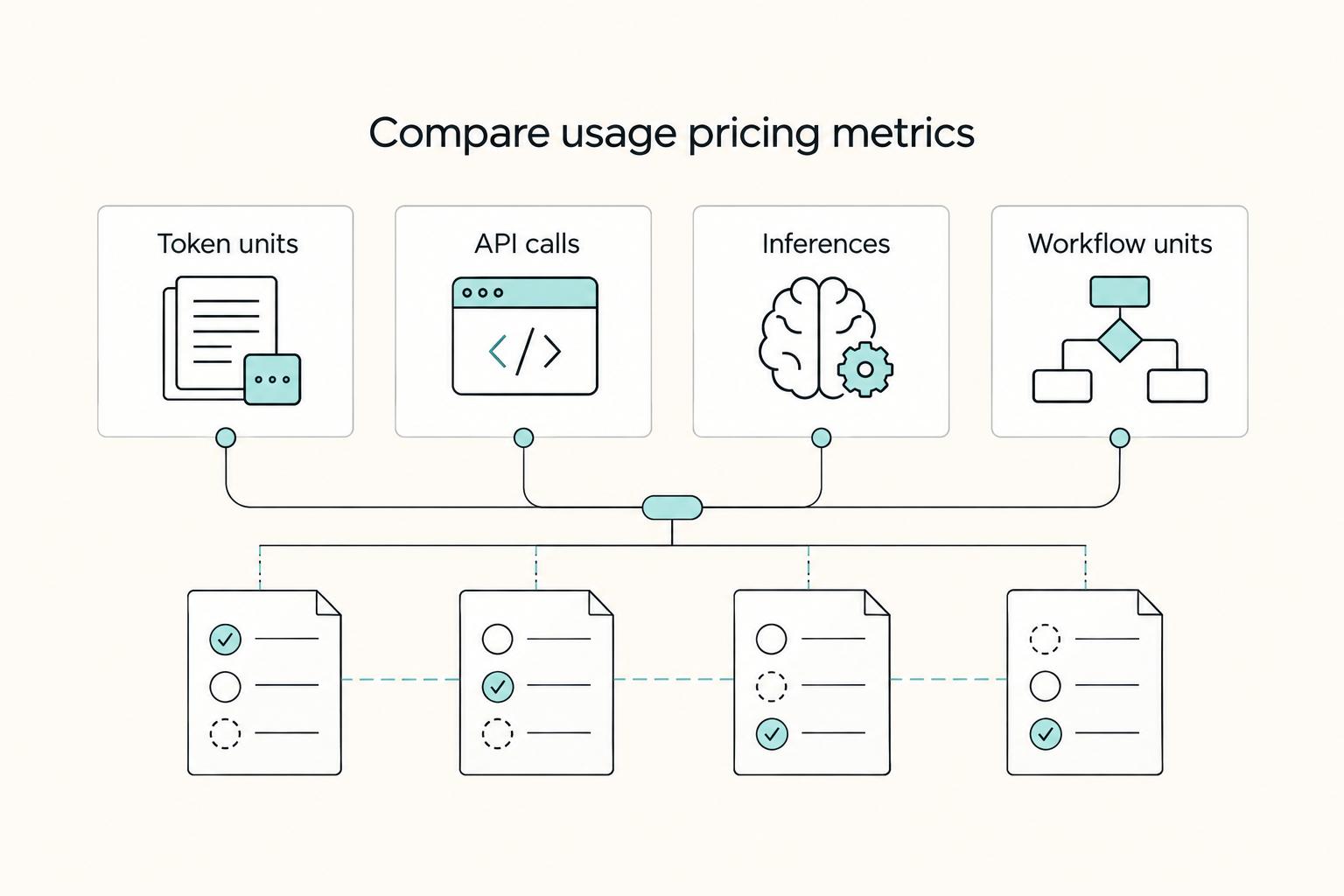
| Metric candidate | Buyer clarity | Spend predictability | Auditability | Best fit |
|---|---|---|---|---|
| Token-based pricing | Low to medium outside technical teams | Low to medium when prompt and output length vary | High when token counts are captured reliably | Developer tools, model access, technical buyers who reason in tokens |
| API call pricing | Medium to high | Medium when request patterns are stable | High because calls are discrete events | Platform APIs and products where request volume is easy to observe |
| Inference-based pricing | Medium for technical users, lower for business buyers | Medium | Medium to high when each inference is metered cleanly | AI features sold as model runs or generations |
| Workflow or outcome units | High when mapped to a business task or result | Medium to high when tied to known business activity | Medium because completion rules must be explicit | Resolution, documents processed, approved tasks, successful outcomes |
Token pricing is often cost-precise, but it can confuse non-technical buyers. Outcome or workflow units are often clearer commercially, but only if completion rules are explicit enough to avoid billing disputes.
Step 2: Match the metric to the buyer#
Technical buyers may prefer tokens or API calls; business buyers may budget by completed document review. Keep the customer’s value measure, your billable unit and your supplier cost meter separate: input/output length, model choice, tool calls and internal retries can change cost per completed review.
If your metric mirrors backend consumption but not the customer's mental model, pricing will feel opaque.
Step 3: Reject metrics you cannot meter, reconcile, and explain#
Run two checks before launch.
- Finance check: trace a billed unit to Usage metering evidence and into invoicing support; reject the metric if that trail is not clean. For licensed IP arrangements, confirm Revenue recognition treatment carefully, since sales/usage-based royalty recognition has specific scope and timing requirements.
- Procurement check: explain the unit to a non-technical reviewer and ask for a next-quarter spend forecast. If they cannot estimate without engineering translation, expect friction in enterprise review and renewal.
For example, define one billable review as a document delivered successfully after required checks. Count the completion once under its durable task ID. Failed or cancelled attempts and internal retries are not extra billable reviews in this illustrative policy; their costs still belong in delivery costs.
Choose the pricing structure that fits your cost volatility#
When usage drives cost variation, compare a hybrid plan with a capped subscription and pure usage pricing. A base fee provides committed revenue, but sufficient rates, included quantities, cost controls and collection determine whether margin holds.
Step 1 Compare the three structures against your real cost pattern#
Use your actual economics, not intuition. In AI products, flat assumptions can fail quickly because each query carries real cost.
| Structure | What it gives you | Main risk | Best fit |
|---|---|---|---|
| Usage-based pricing | Revenue tracks consumption | Spend can feel less predictable; accuracy depends on metering | Technical buyers, transparent usage, costs that scale with activity |
| Subscription pricing | Predictable invoices and easier budgeting | Margin pressure if usage grows faster than seats or plan price | Stable workloads, low volatility, clear usage guardrails |
| Hybrid pricing model | Predictable base plus expansion upside | More operational complexity; requires strong billing observability | Early AI products with uneven demand or uncertain usage |
If one account can generate far more usage than another on the same plan, pure subscription is high risk unless included usage is tightly defined and enforced.
Step 2 Reject flat-only when usage swings drive cost swings#
Use a simple rule: if behavior causes large COGS variation, do not rely on Subscription pricing alone without strict guardrails. Seat-only plans are easy to forecast, but they can under-monetize when usage rises without seat growth.
Step 3: Stress-test a hybrid plan#
Illustrative monthly plan: $100 includes1000 completed reviews, with each additional review at$0.08. At1500 reviews, the bill before tax is$100+(500×$0.08)=$140. Assume delivery cost is$0.02 per review plus$20 of allocated delivery/support cost: totalCOGS=$50 and gross margin=($140−$50)/$140=64.3%.
At3000 reviews the bill is$260 and the same cost assumptions produce$80COGS and69.2% margin. If cost per review rises to$0.06, COGS becomes$200 and margin falls to23.1%. These are invented inputs, not provider prices or a target margin. Reprice future offers, change delivery costs or agree lawful usage limits before scaling; a hybrid label does not repair the cost increase.
Step 4 Define expansion and overage logic before launch#
Document these before sales exceptions appear:
- What is included in the base plan
- What event moves an account into a higher tier
- How overages are rated, invoiced, and collected
If you allow overages to avoid service interruption, account for collections risk and make usage-to-invoice traceability explicit. Hybrid works when packaging, metering, and billing observability are designed together.
For the broader SaaS usage-pricing model, read A Guide to Usage-Based Pricing for SaaS.
Build packages and guardrails that protect margin at scale#
Your package design should make margin protection explicit before launch. Define usage rails, set guardrails, and document billing exceptions before sales negotiates them ad hoc.
Step 1 Define package rails in commercial terms. For each plan, specify three items with no ambiguity: included usage, what happens after included usage is consumed, and whether the account is prepaid or postpaid. Prepaid plans can use billing credits applied to usage-based charges, while postpaid plans bill after consumption. If you offer both, define whether upgrades or downgrades apply immediately or at renewal, and which usage event triggers a tier move.
Create two sample invoices now: one prepaid account staying within included usage, and one postpaid account crossing included usage into overage. If finance cannot trace line items to metered usage, or sales cannot explain overage logic in one sentence, your packaging is still too loose.
Use margin and usage alerts to trigger review. Stripe billing thresholds can bring forward an invoice, but delayed aggregation can overshoot the threshold. An alert or invoice is neither a hard usage cap nor guaranteed payment.
If you promise a spend limit, enforce it in the service’s admission logic and account for in-flight work. Any restriction or move to prepaid capacity must honor existing entitlements, contract change rights and required notices.
Step 3 Translate raw usage into task language buyers can forecast. Keep value distinct from raw usage in customer-facing packaging. Your backend meter may be Inference-based pricing or API call pricing, but quotes and invoices should map that meter to a business task buyers can forecast.
A technical team may understand "one million API calls." A business buyer may need "up to X automated document reviews" or "Y generated summaries." If procurement cannot estimate spend from package language, friction is likely later.
Separate fixed-fee changes from metered usage. Stripe’s proration mechanism applies to eligible advance subscription charges; usage-based charges are not prorated. For usage, record the rate, allowance and effective time that apply to each event, then bill the actual units under that policy.
Agree whether changes take effect now or at renewal and preserve the billing-period boundaries and time zone. For this example, plan changes take effect at the next renewal; existing monthly usage retains its original price and allowance.
Instrument billing operations before you launch#
Do not launch broadly until billing is operationally provable. You should be able to trace a billed unit from product event to invoice line, and finance should be able to explain how prepaid usage, overages, and plan changes are handled.
Keep a durable task/event ID, account, unit, quantity, occurrence timestamp and time zone, billing period, and applicable price/plan version in the local record. Preserve completion evidence and original attempts. Define how acceptance, reversals and customer-requested reruns affect billability; this example charges each successful task once and requires a new agreed task for separately billable work.
Run routine reconciliations from product telemetry to billing summaries, then from billing summaries to invoice lines. If the same customer action produces different counts across systems, fix that before rollout.
Step 2 Automate rating, invoicing, credits, and dispute handling. Usage rating is where uploaded usage becomes payable amounts during bill runs, so manual handling does not scale. Build automation with explicit triggers, conditions, and actions for invoice creation, threshold notices, credit handling, failed-payment follow-up, and dispute evidence submission where eligible.
Keep the order form, applicable plan terms, invoice, event summary and customer notices accessible. Use the actual provider or network dispute deadline for the case.
Step 3 Set revenue recognition checkpoints with finance before go-live. Define checkpoints based on how you charge: in arrears for actual usage or upfront for prepayment or commitment. Topic 606's core principle is to recognize revenue in a way that reflects transfer of promised goods or services for expected consideration, so your policy should map contract terms to real billing behavior.
Cash received, a credit balance consumed and an invoice issued are separate from revenue earned. Finance should map them to performance obligations actually satisfied, including unused commitments and corrections; an operational review does not postpone required accounting.
Test duplicate, delayed, rejected and corrected events before launch. Provider processing can be asynchronous: a request acknowledgement does not prove successful aggregation or invoice inclusion. Reconcile the local event ledger to accepted meter totals and invoice lines, and investigate rejected or missing usage.
Reuse provider identifiers and idempotency keys within their documented scope and time window, alongside durable local deduplication. In this example, late events received before invoice finalization enter their original period after review; after finalization, preserve the original invoice and use an approved linked adjustment or credit under the contract. Never silently rewrite a finalized bill.
Run a 90-day rollout with checkpoints and kill switches#
Do not roll new pricing to everyone at once. Use a pilot-first rollout over roughly 90 days as a working cadence, then expand only when the economics and operations stay stable.
| Phase | Focus | What to review |
|---|---|---|
| Days 1-30 | Validate the Value metric with a limited cohort | Keep the first group small enough for product, finance, and support to review accounts manually; review billed usage against Cost of goods sold (COGS) each week |
| Days 31-60 | Expand by cohort, not by announcement | Expand a limited cohort only after reviewing cost, complaints, bill accuracy and collections. This rollout sequence alone does not establish causal effects. |
| Days 61-90 | Lock pricing rules into operations | Freeze rating logic, included usage, overage treatment, and plan-change handling in Billing automation; finance should be able to trace contract terms, usage, invoice output, and any exception |
| Kill switches | Use risk controls | Pause new sales or cohort expansion when economics fail. Honor paid entitlements and contract rights; enforce only agreed usage limits with required notice. |
Common pricing mistakes and how to recover#
If your pilot exposed repeated exceptions, treat them as pricing design faults, not edge cases to patch over.
| Mistake | Recovery | Key detail |
|---|---|---|
| Metric is too complex or opaque | Use one primary metric and store usage in raw, unaggregated form | Finance should be able to verify lineage from event to rated charge, and someone outside product should be able to trace one invoice line back to original events |
| Cost variation undermines margin | Reprice future offers, adjust delivery cost or agree sustainable usage allowances | Stress-test volume and per-task cost; hybrid alone is no guarantee. |
| Weak plan-change rules | Record fixed-fee treatment and version metered usage rates at their effective time | Stripe usage charges are not prorated; fixed advance charges have separate rules. |
| Scaling before operations are stable | Pause scale until Billing automation and Revenue recognition controls are stable | Do not scale until finance can consistently explain timing, credits, overages, and plan changes |
For payment-platform monetization by transaction or subscription unit, use Usage-Based Pricing for Payment Platforms: Per-Transaction vs. Subscription.
Before expanding the pricing pilot#
Approve a sample invoice and a stressed cost case, reconcile every billed unit to its event record, and test a late-event adjustment. Expand only when customers can predict the charge and finance can explain its economics.
Frequently Asked Questions
What is the best pricing model for AI products today?
Choose from the customer’s buying unit, delivery costs, usage distribution and ability to meter and collect. Test a subscription with explicit limits, pure usage and hybrid pricing against the same workload scenarios.
When should I choose Token-based pricing instead of Workflow-based pricing?
There is no universal threshold for this choice. Token-based pricing is usually easier when usage is clearly metered and you can explain the charge metric in plain terms. If customers buy completed tasks or business outcomes rather than model inputs, workflow-based packaging may be easier for them to evaluate and budget.
How do I avoid margin collapse with Usage-based pricing?
Calculate gross margin as revenue minus deliveryCOGS, divided by revenue, and test both volume and cost-per-task increases. Include failed attempts and internal retries in costs even when they are not billable. Alerting, rates and lawful service limits must work together; a credit bundle or base fee alone does not protect margin.
Should early-stage teams start with Subscription pricing or a Hybrid pricing model?
Start with the model your buyers can budget and your delivery economics can sustain. Hybrid can recover variable consumption while providing a base commitment; a capped subscription can also work when its allowance and price cover expected costs.
What minimum data is required to launch usage-based billing safely?
Keep durable event/task identity, customer mapping, successful-completion evidence, units, occurrence time, billing period and price version. Preserve local deduplication and reconcile provider errors, accepted meter totals and invoice lines. Finance also needs the contract and evidence of satisfied performance obligations.
How should I handle Proration and plan changes without creating billing disputes?
Document effective time, period boundaries, fixed-fee treatment and the applicable usage rates and allowances. Stripe does not prorate usage-based charges; eligible fixed advance fees have separate proration rules. Show customers the intended result before they accept changes.
What are the first warning signs of Revenue leakage?
A practical warning sign is weak traceability between invoices and underlying usage events. If usage appears in product logs but cannot be reconciled to billed amounts, metering and billing may be drifting apart. A simple control is to sample invoice lines and trace them back to original usage records.
Try a related tool
Researched and edited by the Gruv editorial team. Gruv builds cross-border billing, payouts, and finance-operations software for global businesses.
Sources
Includes 4 external sources outside the trusted-domain allowlist.
- docs.stripe.com/billing/subscriptions/usage-basedtrusted
- docs.stripe.com/billing/subscriptions/usage-based/billing-cr...trusted
- stripe.com/blog/a-framework-for-pricing-ai-productstrusted
- stripe.com/resources/more/ai-monetization-strategiestrusted
- asc.fasb.org/layoutComponents/getPdfexternal
- blog.alguna.com/value-metric-pricingexternal
- bvp.com/atlas/the-ai-pricing-and-monetization-playbookexternal
- ifrs.org/issued-standards/list-of-standards/ifrs-15-r...external
Educational content only. Not legal, tax, or financial advice.
Related Posts

SaaS Usage-Based Pricing for Predictable Cashflow and Fewer Disputes
If you are considering **saas usage-based pricing**, treat it as an operations and collections decision first. Pricing works best when the usage unit can be measured, shown on the invoice, and explained by someone outside your product team.

Usage-Based Billing for B2B SaaS Platforms That Teams Can Operate
Usage-based billing works best when customer value rises with measurable consumption rather than with a fixed license. It can improve pricing fit, but only if pricing logic, billing data, and finance controls are designed together from the start.

Choosing Per-Transaction or Subscription Pricing for Payment Platforms
For a payment platform, the right pricing model is the one your unit economics and billing operations can actually support, not the one that looks cleanest on a pricing page. In practice, teams usually choose among three mechanics: usage-based billing, per-transaction pricing, and recurring subscriptions, or combine usage-based and recurring charges where supported. Each one changes revenue behavior, invoice logic, and margin risk.