
Quick Answer
Define the client benefit, scope, rights and assumptions, then quote a fee the client can assess and your delivery costs can support. Choose billing separately: a value-informed fixed fee is not automatically a performance bonus. Agree advance treatment, milestone review and invoice due dates, document authorized scope changes, and reconcile actual receipts without double-counting revenue or fees.
Why higher project fees can still create cashflow stress#
Higher fees can improve project revenue, but they do not guarantee steady cashflow. You can send a larger bill and still face payment delays.
Value-based pricing sets fees by client-perceived value. Even with that model, payment reliability still depends on contract terms, approval checkpoints, and billing triggers. If those controls are loose, a strong quote can still turn into slow collections.
State the total fee, included work, taxes, expenses and optional additions plainly. Do not use a sector-specific rule as a universal creative-services rule: the FTC unfair-fees rule, effective May 12, 2025, covers live-event tickets and short-term lodging. Applicable local pricing, surcharge and consumer rules still need separate consideration for your engagement.
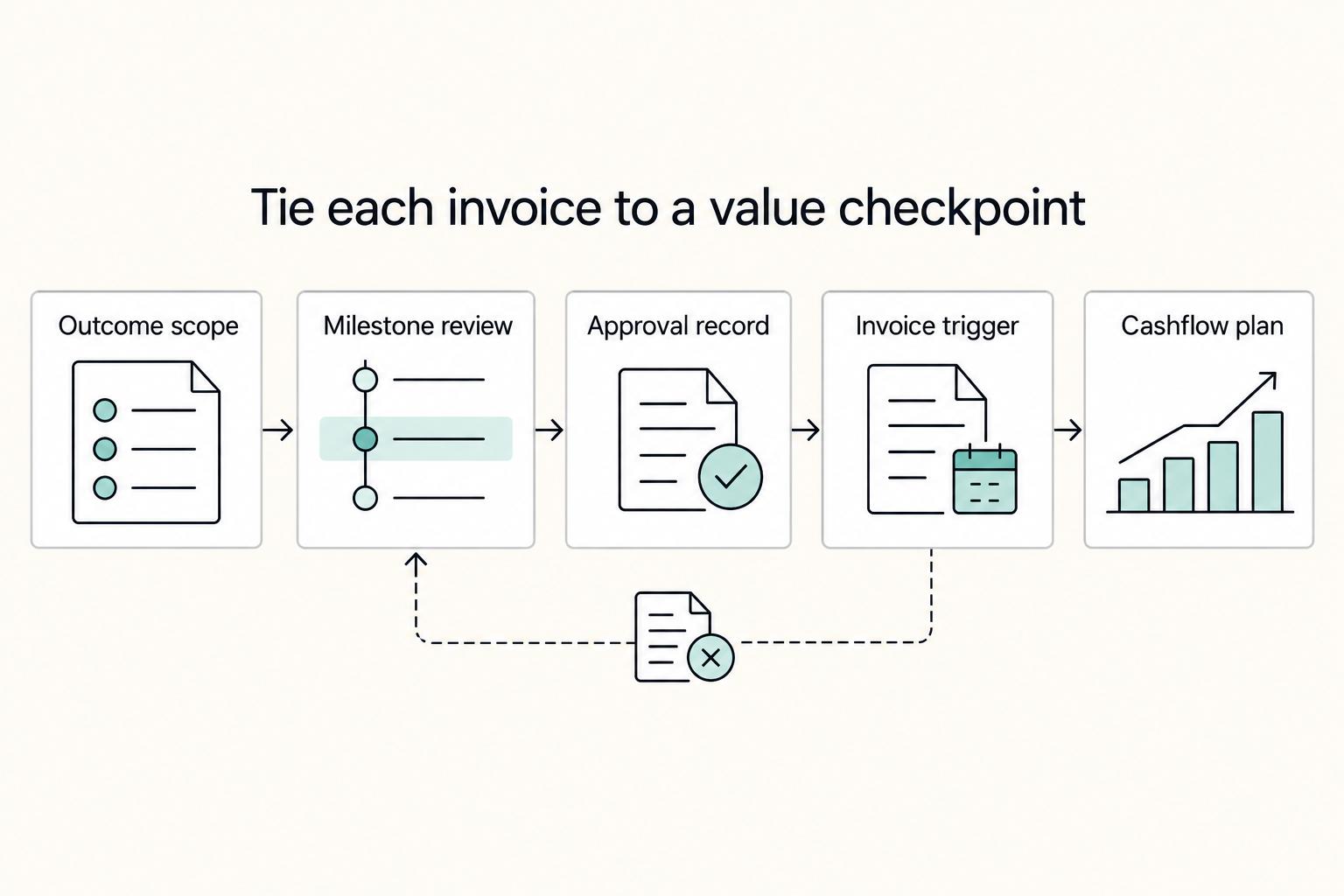
Treat pricing and payment as linked decisions. Pricing addresses the benefit the client expects; payment design states invoice triggers, due dates and any agreed conditions for moving to the next phase. A value-informed fixed fee does not become contingent on business results unless the agreement expressly makes it so. Use this sequence:
- Define the model in plain language.
- Decide fit before you quote.
- Quantify value with outcomes the client already tracks.
- Set terms before work starts.
- Lock a billing schedule tied to clear decision points.
- Plan for exceptions early, including holds and disputes.
Once the schedule is agreed, put its milestone names, amounts and due dates into the invoice generator so the client can match the request to the contract.
What value-based pricing means in plain language#
Value-based pricing means price follows customer-perceived value, not effort alone.
In plain terms:
- Value-based pricing: price anchored to customer-perceived value.
- Cost-based pricing (cost-plus): price anchored to delivery cost, then marked up.
The buying conversation changes with the model. Cost-led pricing focuses on inputs and markup. Value-led pricing focuses on customer benefits and how success will be judged. That shift is useful only when both sides agree on what success looks like before delivery starts.
This is not a license to charge more without structure. You still need defensible scope, a clear success definition, and payment controls before you quote. A strong value narrative with weak approvals can create tension after kickoff.
Use this pre-quote check:
- Describe the desired result in the client's language.
- List success measures the client already tracks.
- Confirm what proof they will accept for approvals.
- Tie that proof to billing triggers in contract terms.
Keep internal pricing guardrails so quotes stay sustainable. If scope, proof, and price stop matching, reduce scope, change format, or decline.
One practical detail helps here: write two short versions of your offer before sending. One version states the client outcome and proof of completion. The other states your internal delivery assumptions and guardrails. The client sees the first. Your team validates against the second. Keeping both in the same draft package helps you make consistent decisions.
When value-based pricing beats hourly pricing and when it does not#
Value-based pricing is often a better fit when the client can clearly state the outcome and how it will be judged. If scope is still moving, hourly pricing or time and materials is often safer because requirements can evolve while work is in progress.
Value-based describes how you choose a price; fixed-fee, hourly and time-and-materials describe how you charge. They can overlap. You can use client value to choose a fixed fee, while using hourly discovery to define a later phase. Performance-contingent compensation is a separate arrangement requiring explicit metrics, attribution, measurement and payment terms.
| Model | Use it when | Main tradeoff |
|---|---|---|
| Value-informed price | Outcome is clear and impact can be judged | Can be a fixed fee; expected business impact is not automatically a payment condition |
| Hourly pricing | Work pace and exploration matter more than fixed outcomes | Better efficiency can limit upside |
| Time and materials | Scope and quality are expected to evolve | Total cost is less predictable |
| Fixed-fee pricing | Scope is stable enough to lock by phase or milestone | Less flexibility on scope or timing |
Choose the pricing rationale and billing method separately. A fixed $6,000 fee can reflect expected client value while still being payable for specified deliverables, rather than only after a sales target is reached.
For comparison, a hypothetical 15% media-spend commission on a $100,000 buy gives a $15,000 fee, regardless of demonstrated business benefit. Hourly economics work differently: at an assumed $100 per hour, a task completed in 10 hours bills $1,000, while the same task in 6 hours bills $600. A fixed fee can preserve the price when efficiency improves, provided the promised work is delivered. These are illustrations, not market benchmarks.
A useful way to choose is to test decision quality, not confidence in the room. If the client can name the approver, success evidence, and scope boundaries without hesitation, value-based pricing may be worth testing. If those answers keep changing between calls, hourly or T&M may be a better temporary fit until the decision path stabilizes.
For new relationships, a short fixed-fee or T&M phase can reduce risk when scope is uncertain, with value pricing introduced later if proof and boundaries become clear. Use this as a working checkpoint, not a universal threshold:
- Write the target outcome in one client-approved sentence.
- Agree on success measures they already use.
- Define what can change without repricing and what triggers a new quote.
- Pick phase one based on scope certainty, then revisit model choice after delivery evidence.
Run a fact-find before you quote any number#
Run a structured fact-find before any value quote. Without it, pricing can turn into guesswork.
| Packet item | Details |
|---|---|
| Desired future state | One-sentence desired future state. |
| Current baseline | Current baseline for each selected metric, with snapshot date. |
| Constraints | Scope limits, timeline, dependencies, and approvals. |
| Success criteria | Draft success criteria tied to deliverables. |
| Payment terms | Payment terms and billing triggers in the initial quote. |
| Assumptions | Written assumptions and what triggers a change order. |
There is no universal formula for value pricing, so anchor your quote in measurable factors the client already tracks and in the context they operate in. Start by clarifying the desired future state, current baseline, and non-negotiable constraints.
In the value conversation, keep metrics short and verifiable. If a metric cannot be confirmed in an existing client report, treat it as context, not a pricing anchor. That single rule can reduce overpromising.
Use a pre-quote packet like the one above, and include payment terms in the first quote so critical details are not deferred. Putting terms in the first quote can reduce avoidable friction and keep expectations aligned.
Run one internal checkpoint before quoting: identify who is likely to validate outcomes after delivery. If ownership is unclear, flag it as a risk and consider a short discovery phase first.
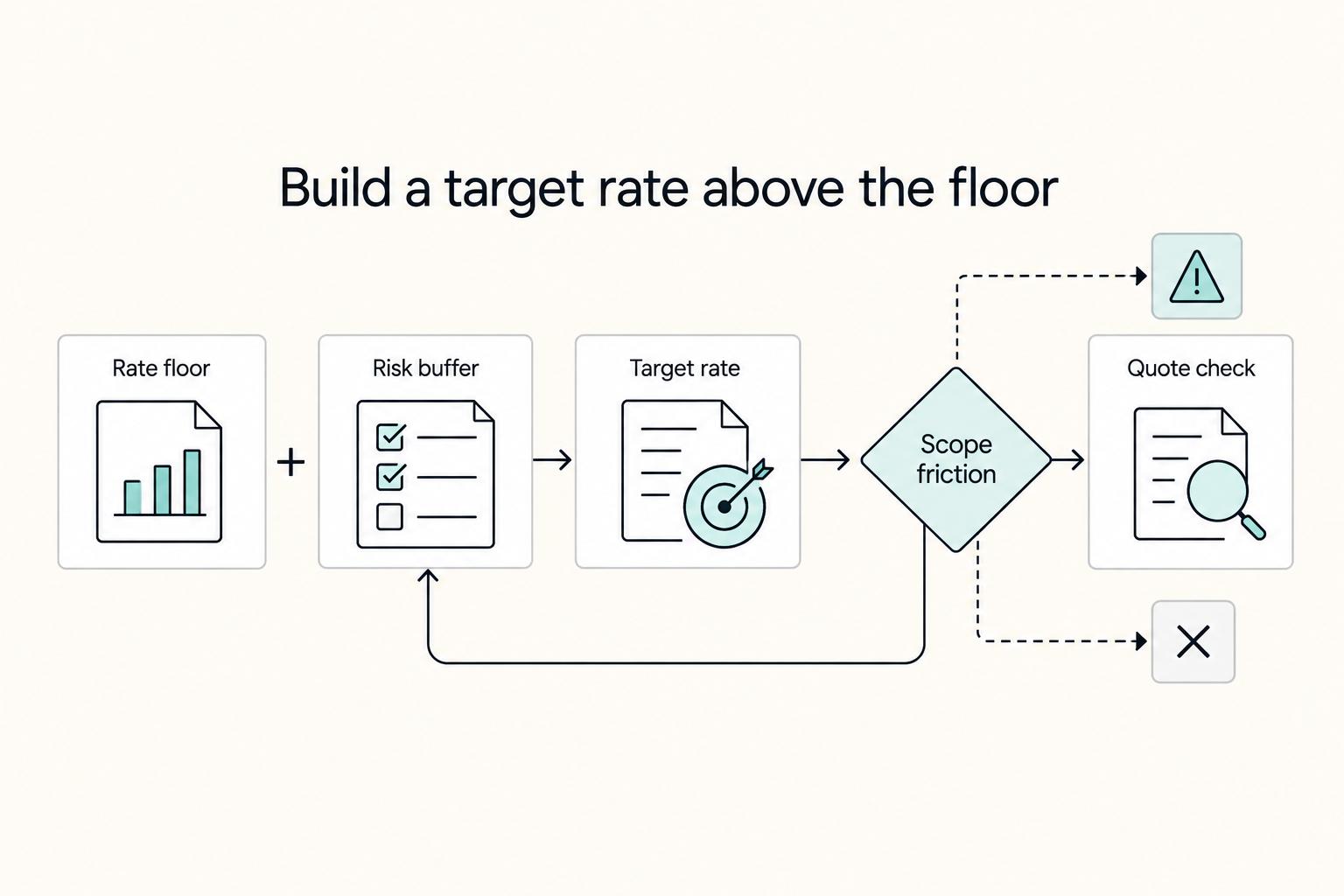
Build your internal cost floor from your own delivery estimate. For an assumed 30-hour phase at an internal cost of $80 per hour plus $600 of project expenses, delivery cost is $3,000. At a $6,000 fee, the contribution before unallocated overhead and tax is $3,000, or 50% of the fee. A cost floor helps test viability; it does not determine what a buyer will value.
Two process details improve quality without adding complexity. First, keep a one-page summary that captures only agreed facts, open questions, and unresolved assumptions. Second, ask the client to confirm that summary before drafting final terms. That confirmation step can create a cleaner handoff from discovery to pricing and may reduce later disputes about what was discussed.
Turn client outcomes into a pricing guidance range#
Present priced options when different scopes would help the client choose. Separate the expected-benefit scenarios from the packages you sell: a larger package is not proof of a more certain result. The selected package needs an actual fee and scope before signature.
Worked example with assumed client data: a page receives 10,000 visits per month and converts 2% into orders. A projected rise to 3% would add 100 orders per month. At $40 contribution per extra order, that is $4,000 per month, or $24,000 over six months. For a $6,000 fee, projected net benefit is $18,000 and illustrative ROI is ($24,000 − $6,000) / $6,000 = 300%. This excludes other implementation costs and assumes the lift persists and is attributable to the work; it is not a guarantee. Confirm traffic, contribution, seasonality and other campaigns before using it.
| Illustrative option | Included scope | Fixed fee | Estimated delivery cost | Contribution before overhead/tax |
|---|---|---|---|---|
| Core | One page concept and two revision rounds | $4,000 | $2,000 | $2,000 / 50% |
| Target | Two page designs, two revision rounds and handoff | $6,000 | $3,000 | $3,000 / 50% |
| Expanded | Target package plus agreed implementation support | $9,000 | $5,000 | $4,000 / about 44.4% |
These package figures are assumed examples, excluding tax and unlisted expenses. Check each cost estimate and available capacity. If ten extra hours at $80 are absorbed into the Target package, cost becomes $3,800 and contribution falls to $2,200, about 36.7% of the $6,000 fee. Extra effort caused by correcting your own failure to meet agreed requirements is not automatically chargeable scope.
Stress-test the value estimate independently of the package. A lift of only 0.5 percentage points in the example adds 50 orders per month, or $12,000 contribution over six months. At the same $6,000 fee, illustrative ROI falls to 100%. Neither scenario changes the fixed fee by itself. Any contingent bonus or agreed adjustment needs its own signed terms.
How you present the range matters as much as the numbers. Walk through each option in the same order every time: expected outcome, included scope, excluded scope, approval checkpoints, and change trigger. That order can reduce price-first negotiation and keep the discussion grounded in value and risk.
A simple closing question also helps decision quality: "Which option matches your current confidence and internal approval path?" It can move the buyer away from pure discount behavior and toward fit.
Package offers that protect margin and prevent scope creep#
Offer packaging can protect or erode margin. When scope gets vague, your value-pricing logic gets vague too.
Define each offer in plain language: target outcome, included deliverables, and excluded work. Put those items in the proposal before pricing discussions close so expectations are aligned.
A practical rule keeps this clean: keep pricing conversations anchored on outcome value rather than hours. The same deliverable can justify very different fees when the expected outcome value changes.
Execution is usually where this breaks. Clear package language makes it easier to structure pricing conversations and handle objections when they come up.
Use this quick fit test during negotiation:
- If the client values the expected benefit and the scope is workable, test a value-informed offer.
- If procurement needs an effort estimate, explain the estimate and the chosen billing method without turning projected hours into an unintended fee cap.
- If budget, authority or expectations remain incompatible after discussion, revise the offer or decline new work.
When a request sits in a gray zone, avoid instant commitments in the meeting. Clarify how it affects the agreed outcome and pricing before moving forward.
Set contract terms that protect cashflow before work starts#
Set payment timing before kickoff. A strong pricing strategy helps, but clear payment terms are what make cashflow predictable in practice.
| Clause | What it states |
|---|---|
| Deposit/start condition | State the amount, due date, credit/refund treatment and whether receipt is an agreed condition for starting. |
| Milestone map | List submitted work, acceptance criteria, review period, invoice trigger and due date. |
| Late payment remedy | Define permitted interest, notice, cure and suspension rights subject to the agreement and applicable law. |
| Restart conditions | Agree the cure, restart decision and revised dates following a lawful pause. |
| Chargeback or provider hold | Record the actual affected payment, response deadline and any contractual right to limit work; a hold does not automatically postpone all obligations. |
For every milestone, define the submission, approver, review period and invoice trigger. If approval is a condition for the next phase, state it prospectively with a route for delayed review or disputed defects. Existing invoices remain due under their terms; your internal approval queue cannot add a new payment condition. Do not make payment depend on the sales projection unless a separate contingent fee was agreed.
These are payment subjects to resolve, rather than a complete contract. Include scope, rights, revisions, termination and responsibility for dependencies elsewhere in the agreement.
A failure mode is strong scope language paired with weak payment language. Clear terms make early conversations firmer and help reduce ambiguity around approvals and billing. If a client cannot commit to clear approvers or billing timing, start with hourly pricing while scope is still exploratory.
A practical document check helps before signature. Confirm that proposal language, contract milestones, and billing due dates use matching labels. If names differ across documents, teams may struggle to trace what was approved, which can create avoidable disputes. Label consistency is simple, and it can prevent costly confusion.
Also decide where approvals live before kickoff. Email thread, signed milestone note, or client portal can all work, but mixing channels can create evidence gaps later. Choose one channel for formal approvals and state it in writing.
Design an invoice schedule clients can approve without delay#
Example negotiated schedule for the $6,000 Target package: $1,800 advance before starting, $2,400 after the agreed design milestone, and $1,800 after handoff, with the latter two due within 14 calendar days of their respective invoice triggers. Define the review period and dispute route in the contract. The advance is credited toward the $6,000 price; its refund treatment follows the agreed terms and applicable law. These amounts and dates are examples.
Before sending an invoice, check the agreed trigger and list its milestone, amount, tax treatment and due date. Attach acceptance evidence when it is relevant or required; an advance or hourly invoice may be due without deliverable approval. Distinguish acknowledgement, acceptance and payment authorization.
If it helps with approvals, attach a compact evidence bundle to each billing request:
- Submitted or accepted deliverable reference matching the contractual milestone, as applicable.
- Acceptance note or a dated record of outstanding review and the applicable contract process.
- Authorized change order when scope or price changed; internal paperwork does not cancel other amounts already due.
Use one channel for billing and status updates from issue to payment confirmation so the history stays easy to verify. Where enabled, Gruv invoices and payment links can provide a traceable status path.
If scope changes, agree a prospective amendment or separately priced discovery phase before switching billing methods. You cannot unilaterally pause a fixed-fee invoice schedule or begin charging hourly for the same promised work. Keep corrections within agreed requirements separate from additional client requests.
A useful pre-send checkpoint is to read the request as if you were procurement seeing it for the first time. Can you identify deliverable, acceptance proof, amount due, and due date in one pass? If not, revise before sending. Clear expectations at this stage can reduce misunderstandings and improve the odds of timely payment.
Keep issue, trigger, due, approval and actual receipt dates as separate fields. Suppose the $1,800 advance is received and the $2,400 milestone is paid through a processor that deducts an assumed $72 fee. Bank cash for that receipt is $2,328, but the invoice receives $2,400 credit. Total price credited is $4,200 and $1,800 remains due; the processor fee is your expense under these assumptions, not a new client balance. Reconcile net cash, gross settlement and fees without recording a second sale.
Handle change orders payment holds and chargebacks without panic#
When exceptions happen, treat them as documented commercial events in your contracting or procurement life cycle, not ad hoc negotiations. Clear records and named owners help keep resolution organized.
For an additional request outside scope, log the deliverable, price and timing impact and get authorized written agreement before extra work. For example, one extra page at an agreed $600 increases the $6,000 package to $6,600; record its invoice trigger and tax treatment separately. A defect correction needed to satisfy the original promise does not become a change order just because it requires more hours.
Record whether a delay concerns client review, an overdue invoice or a provider restriction. Limit new exposure or suspend active work only under the operative contract and applicable law, including required notices. Fund your own supplier obligations by their actual due dates; a client hold does not automatically delay them.
Read the provider dispute notice and its actual response deadline, then assemble a concise pack that addresses the stated reason: contract, delivered work, acceptance, communications, invoice and relevant amendments. For Stripe disputes, submission is final and cannot be supplemented afterward; banks do not inspect external links. Include the relevant evidence in supported files before submitting. An evidence pack improves the record but does not guarantee a win.
Use a short escalation ladder so decisions do not stall:
- Project lead for first formal notice and fact check.
- Finance contact for billing and payment trail review.
- Executive contact for stalled commercial decisions.
- Collections or legal advice as appropriate, respecting the applicable dispute process, law and any contractual prerequisites.
Close each project with a short debrief on where the invoice schedule or revision boundary failed, then update templates before the next kickoff.
When pressure is high, consistency matters more than speed. Use one incident note format for every exception: issue summary, affected milestone, current status, owner, and next decision point. A consistent note format can reduce confusion across project, finance, and leadership contacts.
Treat post-incident updates as required, not optional. If a hold or dispute is resolved, record what changed and which document helped reduce repeat risk. That small discipline can improve future contract language and make each cycle easier to manage.
Choose payment rails and compliance checks for cross-border clients#
Set payment rails and compliance checks before contract signature, and keep that separate from pricing. Value-based pricing can stay tied to outcomes while payout method and timing may vary by country pair.
A cross-border payment moves funds between countries, so decide by corridor first, not by tool brand. If settlement constraints are unclear after proposal approval, run a short fact-find before final signature instead of patching terms later.
Before signing, confirm program limits in writing and store them with the deal record:
- KYC and AML gates, and where applicable KYB gates, before first payout.
- Payout availability for the target country and expected timeline ranges.
- Required remittance fields so each payment request can be reconciled.
- Named owners for exceptions, including rail-change approval.
Keep one traceable status trail per payment request from issue date to settlement confirmation, including currency, selected rail, status changes, and exception notes. That trail can make delays easier to resolve because the timeline is already documented.
A corridor check should identify usable receipt timing, fees, required details and a recovery contact. If a transfer has an unknown status, trace it with the provider before sending a replacement; changing rails while the original may still complete can create duplicate payment.
If capability or timing is uncertain, state it in proposal and contract notes before work starts. Where enabled, Gruv Virtual Accounts and Payouts can reduce manual handoffs while preserving status visibility, but confirm availability before signature.
A practical habit is to maintain a corridor summary for active country pairs. Include selected rail, required compliance checks, expected timing range, and escalation owner. Keep it brief and update it whenever a payout exception occurs. Over time, this can reduce repeated discovery work and improve proposal accuracy.
Ship the first 90 days of your transition from hourly to value-based#
Treat the first 90 days as a controlled shift, not a full cutover. Keep payment-rail and compliance choices separate from pricing decisions, and keep hourly work available while you build a deliberate, research-backed pricing discipline. Use this timeline as a practical framework, not a validated formula.
| Period | Focus | Key actions |
|---|---|---|
| Month 1 | Keep hourly as fallback while you learn | Run a fact-find on every qualified lead before quoting; use a short hourly discovery block before moving to a value quote if ownership is unclear; test one pricing guidance range each week; keep a short review note after each proposal cycle. |
| Month 2 | Standardize terms before proposal velocity increases | Use one reusable pre-send packet with contract terms, invoice schedule, revision boundary, and change-order language; verify assumptions are explicit and ownership is clear; check that proposal scope labels match contract milestone labels and billing labels exactly. |
| Month 3 | Review outcomes and rebalance offer mix | Review your internal outcomes, then rebalance fixed-fee and retainer offers; keep fixed-fee where scope stays stable, and use retainers where priorities shift often; do a short post-project debrief on every closed engagement. |
Use proposal and delivery records to test the transition. Track quote acceptance, estimated versus actual cost, scope changes and days from invoice to usable receipt. A higher accepted fee is only one measure: an offer that consumes more delivery time or creates a funding gap may be less sustainable.
Month 1 Keep hourly as fallback while you learn#
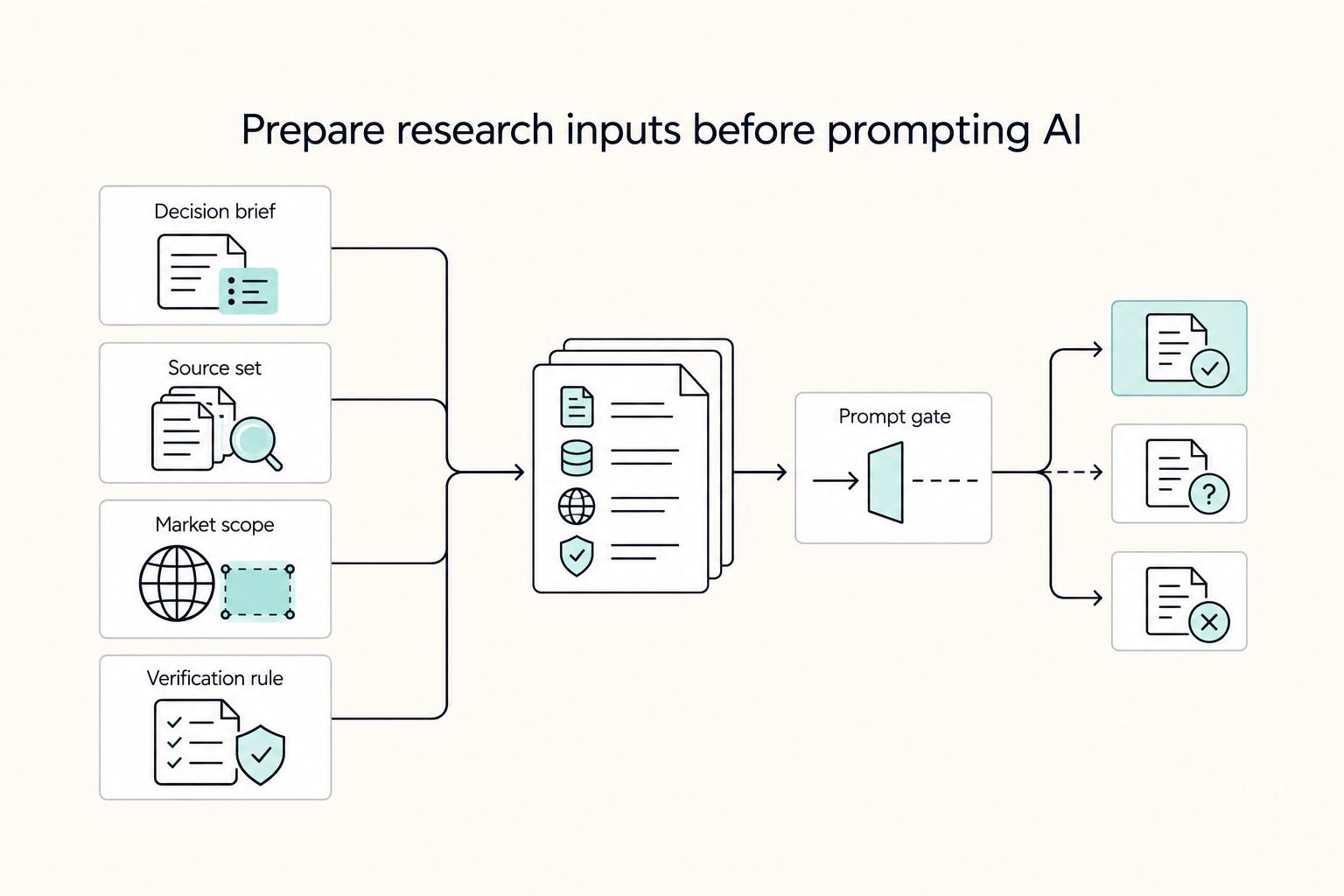
Run a fact-find on every qualified lead before quoting. Capture the client goal, current baseline, and outcome owner on their side. If ownership is unclear, run a short hourly discovery block before moving to a value quote.
Test one pricing guidance range each week. Present low, target, and high options tied to assumptions and confidence. Then check your floor with How to Calculate Your Billable Rate as a Freelancer.
Keep a short review note after each proposal cycle. Record what the client questioned first, where approval slowed, and whether your assumptions held. This can help you spot patterns without adding heavy admin.
Month 2 Standardize terms before proposal velocity increases#
Stop rewriting core terms from scratch. Use one reusable pre-send packet with contract terms, invoice schedule, revision boundary, and change-order language.
Before sending, verify assumptions are explicit and ownership is clear. Then run one quality gate: check that proposal scope labels match contract milestone labels and billing labels exactly. Small wording drift across documents can create avoidable rework.
Month 3 Review outcomes and rebalance offer mix#
Review your internal outcomes, then rebalance fixed-fee and retainer offers. Keep fixed-fee where scope stays stable, and use retainers where priorities shift often.
Do a short post-project debrief on every closed engagement, even clean ones. Note which assumptions stayed true, where boundary pressure appeared, and which approval checkpoints worked best. Use those findings to tune your default package and terms for the next month.
One-page pre-send checklist#
- Fact-find is complete and the client-side outcome owner is identified.
- Pricing range is documented with assumptions and an internal floor check.
- Contract terms, invoice schedule, revision boundary, and change-order language are attached.
- Scope assumptions and approval points are stated in plain language.
- Team has reviewed baseline math and discovery inputs from How to Calculate Your Billable Rate as a Freelancer and How to Use AI for Market Research in Your Freelance Business.
Reuse the pricing and payment records on the next project#
Use one repeatable rule: price for outcomes, then document scope and payment expectations clearly from the start.
The fee should reflect expected client impact, not effort alone. Time and costs still matter for your internal floor, but client-facing pricing should follow outcomes.
Before sending a full value quote, apply a strict filter: if expected outcomes are unclear, pause and run a short discovery phase. Requote after the baseline and responsibilities are clear.
Once scope is confirmed, document what "done" means in writing and revisit it when requests change.
Use honest comparisons. If an actual $2,000 option and a $5,000 option differ in usage rights, support or scope, show those differences. Do not invent a market price or imply a discount from a figure the client cannot meaningfully compare.
Carry one final operating habit into every project: keep decisions in a single written trail. That record can keep discussions focused and make the next project easier to price.
Next step: run this checklist on your next proposal, then refine it after each project.
- Confirm the desired future state and success metrics before final pricing.
- Confirm scope boundaries and how scope changes are handled.
- Confirm your price has a clear value rationale, not just a market guess.
- Use anchoring only when the comparison is honest and relevant.
- After close, review what changed in scope, then update your template.
Frequently Asked Questions
What is value based pricing for creatives, in one practical definition?
Value based pricing for creatives uses the client’s expected benefit and willingness to pay to inform the fee. Document the work and assumptions clearly. The chosen fee may be fixed; it is not automatically conditional on achieving a sales, traffic or revenue target.
Value-based pricing vs hourly pricing. Which one should I use on my next project?
Use value pricing when the client can define the outcome and how success will be judged. Use hourly or time and materials when scope and effort are still uncertain. If clarity is partial, run a short discovery phase first, then reprice after the baseline is clear.
How do I set a value-based price without guessing or overpromising?
Run a fact-find and estimate benefits with stated assumptions, then price concrete scopes. In the example, a projected $24,000 six-month contribution supports discussing a $6,000 fee, while the $3,000 estimated delivery cost tests viability. The 300% illustrative ROI is a projection, not a promised result. Check your floor with the freelance rate guide.
What questions should I ask in a value conversation before I send a quote?
Ask what outcome must change, what the current baseline is, and who owns that outcome on the client side. Confirm approval authority and decision timing before you quote. Lock usage rights early because duration, geography, media, and exclusivity can materially change price.
What payment terms best protect cashflow on value-priced creative work?
Agree advance treatment, invoice triggers, review periods and due dates before starting. The example $6,000 package uses $1,800, $2,400 and $1,800 payments. Specify permitted late-payment remedies and notices; internal approval delays do not create new conditions for invoices already due.
How do I prevent scope creep when I am not billing by time?
Define revision boundaries and obtain authorized written agreement for additional work, with fee and timing impacts. Corrections required to meet the original scope remain distinct. Agree usage rights such as duration, geography, media and exclusivity; expanded use needs the relevant permission and terms rather than an automatic unilateral fee.
When should I avoid value-based pricing and use fixed-fee or time and materials instead?
Use discovery or T&M where responsibilities, scope or effort remain uncertain. A fixed-fee phase works when the promised deliverables can be defined, and that fee can still be informed by client value. Choose the billing method separately from whether the business-benefit estimate is useful.
Try a related tool
Researched and edited by the Gruv editorial team. Gruv builds cross-border billing, payouts, and finance-operations software for global businesses.
Sources
Educational content only. Not legal, tax, or financial advice.
Related Posts
How to Calculate a Freelance Rate You Can Actually Get Paid On
A workable rate is not the neat number a calculator produces. It is the number that still works after you account for real billable capacity, non-client time, scope drift, and the gap between sending an invoice and receiving cleared cash. Start with hourly math even if you do not plan to bill hourly, then turn that number into a quote with clear `payment terms`.
How to Use AI for Market Research in Your Freelance Business
AI appears to be shifting freelance demand in different directions, so your research process needs to stay fast and evidence-led. Across more than 3 million postings, one analysis covering about one year before and after ChatGPT reported 20 to 50 percent declines in jobs involving writing and translation skills, while demand for machine learning skills grew 24 percent and AI chatbot development nearly tripled. That split is why the work has to stay disciplined, not just fast.

The Freelance Payment Penalty: A Modeled Audit of Platform Fees, FX Spreads, and Payout Delays
The money rarely disappears through a single, easy-to-spot fee. The real loss is stacked. A marketplace takes its commission, a processor adds a charge for international cards, a bank or payment company converts the currency at a spread, a platform holds the funds before release, and a wire sheds a little to intermediaries on the way in. Each layer looks defensible on its own, but the worker feels the combined result as a smaller deposit and a later payday.