
Quick Answer
Do not slow every payout by default. Keep hard release gates such as authorization, identity, and sanctions or AML decisions inline, then use risk-tiered friction and post-release monitoring for everything else based on rail choice, reversibility, and evidence quality.
Balancing Payout Speed and Fraud Control#
Payment speed and fraud control are a sequencing decision, not a tug of war. If you run contractor, seller, or creator payouts, the core question is which checks must finish before funds move on Real-Time Payments (RTP), and which checks can continue after release without creating avoidable exposure.
That distinction matters because RTP means immediate processing and final receipt of funds, with clearing and settlement on initiation. In practice, RTP processing can be about 10 seconds and available 24/7/365. In that context, a manual review step that takes 5 to 10 minutes is typically too slow for a real-time release path.
The practical comparison is inline control versus post-release control. As a framing reference, the BIS fast-payments report ties speed to continuous availability, while the OCC payment systems handbook treats real-time payments as a distinct risk category with governance, internal-control, reporting, and audit expectations. Some checks must run before release because they determine whether the payment should proceed at all. Others are better after release, where they help detect patterns, investigate behavior, and tighten future decisions. When teams blur those categories, they either over-hold clean payouts or release too quickly and miss a late-arriving signal.
A useful decision point is three outcome lanes:
- Approve when risk is low and evidence is complete.
- Step up authentication when uncertainty is meaningful but not enough for a full block.
- Route to review when doubt is material.
Real-time risk scoring supports this moment by evaluating trustworthiness as the transaction occurs and routing to approve, step-up, or review.
It is also important to plan for failure modes. A one-time verification result can become stale quickly; a signal that was clean at onboarding can be compromised hours later. If later withdrawals inherit trust by default, speed can come from outdated assumptions rather than current risk.
The tradeoff is real: tighter controls can block good users, while looser controls can admit bad actors. TSYS's analysis of faster-payments fraud supports selective restriction over blanket slowdown: as fraud liability rises, institutions tend to keep RTP available while increasing restrictions and fraud detection intensity.
This article is built to help compliance, legal, finance, and risk owners make defensible release decisions: what must happen before release, what can run after, and what evidence should support why a payment was fast, slow, held, or returned.
At-a-glance comparison for speed and fraud control choices#
For most payout programs, risk-tiered friction is the strongest default: keep low-risk payouts fast, and add friction only when signals are borderline or high risk.
| Decision criterion | Default fast release | Risk-tiered friction | Hold-until-review |
|---|---|---|---|
| Best fit by rail | Best when evidence is complete and current, especially on instant rails such as FedNow and SEPA Instant | Best cross-rail operating model for FedNow, SEPA Instant, and Same-Day ACH when you need both speed and control | Can fit Wire transfer and some SWIFT flows when service commitments can absorb pre-release review |
| Fraud-loss containment | Weakest when release relies on onboarding-only trust or static KYC | Stronger, because approve / step-up / review happens at transaction time with current signals | Can contain more pre-release risk, but depends on review quality and queue discipline |
| False-positive burden | Lower at release, with more risk shifted to post-release losses and investigations | Usually more balanced: step-up for borderline cases, not for every payout | Highest burden from broad holds, including clean payouts |
| Customer impact | Fastest release, but trust damage is higher when fraud passes through | Better balance for most programs: fast path for low risk, friction where uncertainty is meaningful | Highest delay and friction, with higher risk to payout expectations |
| Reimbursement exposure | Harder to defend when weak or stale evidence supports release | More defensible when each release reflects a documented risk decision | May reduce some exposure, but does not prevent every scam pattern and can create delay disputes |
| Investigation workload for payout batches | Lower upfront effort, more reactive casework later | Moderate and targeted toward borderline/high-risk cases | Highest queue pressure, especially during volume spikes |
| APP scam posture | Weak when all authenticated payments are treated as equally safe | Preferred default: APP scams often sit in the borderline zone where selective step-up and review are most useful | Better reserved for clear high-risk cases, not as the universal default |
Timing is the deciding constraint. Real-time risk scoring is built for decisions in milliseconds, not minutes, so manual queues are a poor fit for instant-release paths.
A practical pattern is Green / Orange / Red triage: Green pays, Orange triggers risk-based authentication or another step-up check, and Red routes to review or reject. This is usually more effective than blanket slowdown for APP exposure because it targets uncertainty instead of slowing every payout.
One control check is non-negotiable: confirm that “current evidence” is actually current. One-time onboarding trust can go stale quickly, so inherited trust without fresh signals can turn the fastest lane into the weakest lane.
For auditability, store more than a model score: capture the release reason, selected lane, and mapped controls. A threats-versus-controls summary is a practical format for showing why a payout batch was released, stepped up, or held.
What payment latency means in control design#
Payment latency in control design is your pre-clearance decision window, not a generic push to "go faster." The clock that matters is click-to-answer time, because fraud and compliance checks must finish before payment clears.
In that window, decision time is consumed by steps like authentication, data lookup, model scoring, and rule evaluation, alongside your KYC and AML decision path. A practical checkpoint is the full path from user action to system answer, not just model runtime.
One cited fast-path example budgets 50 to 100 milliseconds for the full decision flow, often one-tenth of a second or less. That is why dependency delays can be as important as scoring quality.
| Comparison point | Platform latency | Rail latency |
|---|---|---|
| What it means | Time your controls spend deciding whether to release | Time tied to the rail after you submit payment instructions |
| Where it shows up | Pre-clearance decision path | Post-submission processing on rails such as RTP, CHAPS, or SEPA Instant |
| Common mistake | Ignoring slow internal dependencies | Expecting rail choice to fix pre-release control delays |
This distinction keeps teams from tuning the wrong layer. If your stack is already slow before release, changing rail does not remove that bottleneck; instrument each pre-release step and find where the budget is being consumed.
"Faster" is also not one KPI. Track decision speed with control quality: overly strict controls can block legitimate users, while overly permissive controls increase attacker success. Also track evidence freshness, because static onboarding trust can become stale and change hours later.
Inline checks versus post-release checks by risk tier#
The practical split is to keep release-critical decisions inline and move the rest to step-up checks or post-release monitoring. On fast-payment flows, where processing is real time or near real time and expected to run near 24/7, each added dependency uses scarce decision time.
Risk-tier matrix#
| Control group | Pre-release mandatory | Conditional step-up inline | Post-release monitoring (streaming) |
|---|---|---|---|
| Identity and release entitlement | Confirm the payer or payee profile is in a releasable state and the request is authorized before funds move | Add stronger authentication or manual confirmation when your policy flags elevated scam or context risk | Watch for behavior drift after release, such as sudden destination changes, repeated payout attempts, or linked-account activity that changes risk |
| Sanctions and AML gating | Complete the sanctions or AML release decision before submitting the payment instruction | Escalate ambiguous matches, missing customer data, or higher-risk corridor context to human review before release | Monitor for late list updates, new adverse signals, and network patterns that should trigger investigation or future holds |
| Transaction integrity | Run duplicate, amount, formatting, and account-routing checks before release | Add beneficiary-change review, out-of-pattern amount review, or extra approval when the request departs from normal behavior | Alert on unusual clusters, repeated retries, and anomalies that were not visible in the inline window |
| Evidence and audit trace | Capture decision timestamp, policy version, input status, and release outcome before payout | Require override reason and approver when a step-up is bypassed | Link alerts, returns, case notes, and ledger events to the original release record |
A strong checkpoint is not just that a model produced a score. It is whether you can show, for a sampled payment, that identity status and sanctions/AML release decisions were complete before release, with timestamps aligned to ledger posting.
If-then rules that keep speed honest#
You do not need blanket slowdown; you need explicit branching rules.
- If your jurisdiction or transaction context is higher risk under your policy, require stronger inline controls before release.
- If risk is low and evidence is complete, current, and internally consistent, allow faster release and rely on post-release monitoring for pattern-level issues.
- If an upstream signal is delayed, stale, or unavailable, treat that as unresolved risk and route to hold, retry, or escalation rather than a fast pass.
A missing response from an identity vendor, sanctions feed, or account-intelligence source is not a clean pass. It is an unresolved condition.
FedNow and SEPA Instant versus SWIFT and wire#
For FedNow and SEPA Instant, teams usually keep inline checks narrow to items that can change an immediate release decision. In near-real-time environments, long enrichment chains or nonessential lookups can consume the decision window without improving the decision.
For SWIFT and wire flows, core release gates still apply, but some products have more operational time to resolve data-quality issues or run additional approvals before release. Either way, extra inline work earns its place only if it can materially change release or hold.
Failure modes that decide whether this split works#
Delayed upstream signals are a primary failure mode. A payout can look clear at release time, then a vendor update, list refresh, or linked-risk signal arrives later. At that point, the task is containment, investigation, and evidence preservation.
Asynchronous returns are another failure mode. In legacy direct-debit examples, final status can arrive at T+2 or T+3, so "submitted" is not the same as "resolved."
The third failure mode is weak case linkage after payout completion. When alerts arrive after funds move, teams need the payment ID, decision timestamp, policy version, override/approver record (if any), and ledger events in one case file.
For instant-payment contexts, keep inline checks focused on hard release gates plus defined step-ups for higher-risk tiers. For slower release contexts, use extra time only for pre-release checks that can change the decision, then document outcomes with the same discipline across policy, controls, risk assessment, reporting, and audit.
How rail choice changes your fraud and reimbursement posture#
Rail choice is a fraud and reimbursement governance decision, not just a speed setting. If payout urgency is high but sender or beneficiary context is weak, avoid defaulting to the fastest settlement path and use the rail where intervention, case handling, and refund operations are clearly documented and executable. If same-day delivery is enough, a documented same-day ACH payout policy can be safer than defaulting to the fastest rail.
Do not use rail folklore as policy#
Generic assumptions about rail behavior are not enough to govern real payouts. Before you promise speed, document what is actually true in your operating model for each rail.
| Rail | Minimum check before promising speed |
|---|---|
| RTP | Confirm escalation path, intervention contacts, response timing, and case ownership with your partners and internal teams |
| Same-Day ACH | Confirm exception handling, intervention ownership, and how refund operations are triggered and tracked |
| Wire transfer | Confirm manual intervention points, escalation ownership, and how decisions are evidenced in case records |
| SWIFT | Confirm correspondent escalation path, required message completeness, and investigation handoff requirements |
The control that matters is whether incident leads can execute the process quickly with a clear owner, payment reference, and case trail.
ISO 20022 data quality is part of fraud control posture#
Treat ISO 20022 as a control-quality issue, not only a format migration task. Payments modernization discussions already raise concern about whether fraud measures are keeping pace with ISO 20022, cross-border payments, and real-time payments. If party and payment-context fields are weak, both release-time triage and later investigation quality degrade.
Regional variance changes governance requirements#
Market rules can shift liability and control expectations, so your rail policy cannot be one global assumption set. In the EU, the cited direction under PSD3/PSR is toward stronger fraud-prevention duties and more scam liability on PSPs, and Verification of Payee is becoming mandatory on Instant Payments Regulation timelines, including 9 October 2025 for euro-area Member States.
Practical rule: choose rails only after you map intervention options, refund operations, and data-quality requirements by market and keep fraud, AML, and case-management workflows aligned.
Policy gates that prevent speed from bypassing compliance#
After rail selection, the operating rule is straightforward: do not let release speed outrun due diligence. Your release policy should require completed KYC or KYB (based on payee type), completed AML/CFT customer due diligence, and decision evidence linked to the payout record before funds move. If a market or program supports payee confirmation, treat it as a gate; if it does not, tighten first-release human review instead of releasing blind. Your vendor risk assessment framework should cover the identity, sanctions, and account-intelligence inputs behind that decision.
Minimum gates before release#
Use gates based on what you are proving for that payout:
- KYC for individual payees (or controlling individuals, where relevant)
- KYB (Know Your Business) for business payees, seller entities, or counterparties
- AML/CFT screening and customer due diligence completion before release
- Payee verification when the market/program offers it
- Evidence linkage so the release decision and supporting checks are attached to the payment record
According to the World Bank fast-payments model, CDD/KYC Credential Issuance through TACH and Confirmation/Verification of Payee are checkpoint use cases, and Customer Due Diligence: AML/CFT Compliance sits inside the legal and policy design layer. Reflect that directly in your policy by stating which checkpoints are mandatory in each market and which depend on program availability.
Approval boundaries#
Keep boundaries simple and enforceable under time pressure:
- Auto-approval: only clean cases with complete, current, internally consistent evidence
- Compliance sign-off: missing, stale, contradictory, or incomplete due-diligence evidence; unresolved screening alerts; unavailable or inconsistent payee verification; retries that need manual override
- Legal review before release: disputes over beneficiary ownership/authority, sanctions-interpretation issues, or liability-sensitive duplicate/evidence conflicts
How MoR and VBAs change ownership at payout time#
MoR and VBA structures can change where checks are performed, where evidence is held, and who owns escalation at payout time. Document that operating ownership explicitly for KYC, KYB, AML/CFT, payee checks, and incident handling. For VBAs, make sure you can retrieve the mapping between virtual account, underlying beneficiary, screening decision, decision owner, and final ledger event without reconstructing the case manually.
Idempotency and traceability are release controls#
Treat idempotency and ledger traceability as release controls, not engineering nice-to-haves. Each payout attempt should stay tied to one stable request identity and one auditable decision trail so retries do not create duplicate releases or fragmented evidence.
Model-driven fraud controls can improve decision quality, especially where rule-only systems produce high false positives or miss newer patterns. But streaming signals, device profiling, and continuous feedback loops should support release decisions, not replace preserved release evidence. For any manual approval, retain the exact inputs reviewed at decision time.
Escalation ownership when fraud risk and payout urgency conflict#
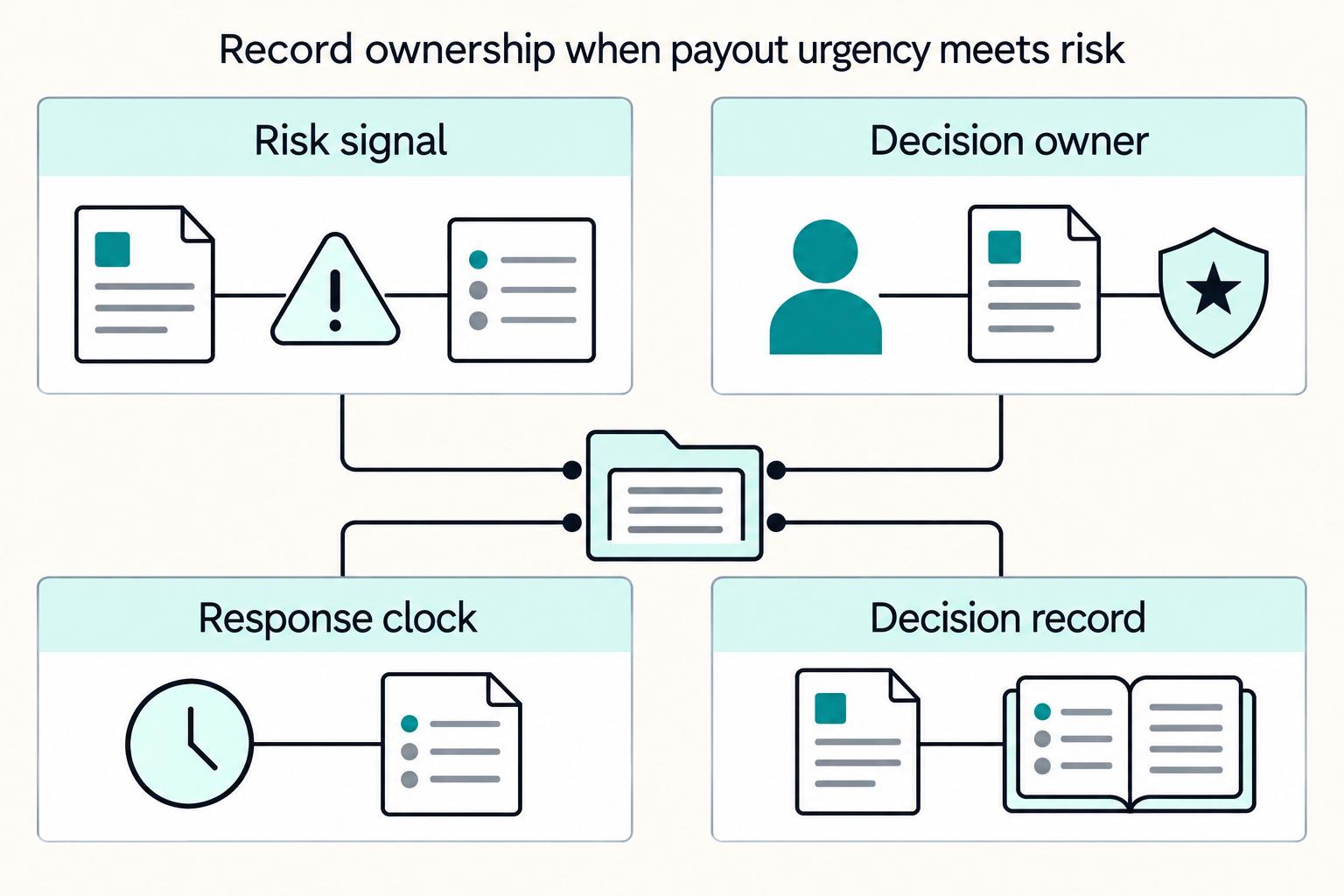
When fraud risk and payout urgency conflict, decisions should follow a preassigned escalation matrix, not queue pressure. Your matrix should name the decision owner at each severity level and state who can release only clean cases versus who must take over when risk signals appear.
Define handoff triggers in policy language your teams can execute under pressure, including APP-scam indicators, AML/CFT alerts, and repeated payout anomalies. Because risk profiles differ by institution and program, keep the ownership model tailored by market, product, and payment flow instead of forcing one global path.
For each escalated case, require a response clock and a documented outcome:
releaseholdrejectinvestigate
Record the rationale, decision owner, and evidence reviewed at decision time so the trail is usable for management reporting, board-level oversight, and internal audit.
The monthly evidence pack regulators and auditors expect#
Use one repeatable monthly evidence pack that lets an independent reviewer reconstruct each payout decision end to end. There is no single regulator-issued template here, so defensibility comes from consistent structure, clear ownership, and traceable case evidence. It also helps when the pack can be reconciled back to the held-funds and liabilities view your finance team uses.
A strong pack is sample-ready, not presentation-first: it should show what was decided, what changed, what failed, and what is still open.
What to include every month#
Keep the same core sections each month so changes are explainable:
| Evidence area | What to include | Why it matters |
|---|---|---|
| Decision log | Case ID, rail, outcome, decision owner, rationale, evidence reviewed, timestamp | Shows escalation rules were applied to real cases |
| Rule and control changes | What changed, why, who approved, expected impact | Shows control changes are governed and reviewable |
| Trend notes | False-positive themes, suspected false-negative themes, repeated anomalies, operational/customer impact | Shows you are learning from control performance |
| Exceptions and open items | Overrides, policy exceptions, unresolved investigations, aging, next-action owner | Shows known weaknesses are tracked to closure |
Add short analyst notes where trends changed after a rule or process change so reviewers can follow judgment, not just counts.
Traceability across the payment path#
For sampled cases, make traceability explicit from request through review to final ledger posting. If your program uses RTP, SWIFT, or SEPA Instant, keep the same internal evidence chain across those rails even when rail behavior differs.
For each sampled case, capture:
- request creation and internal case/payment ID
- KYC, KYB, and AML/CFT gate outcomes at decision time
- confirmation/verification of payee result, if used
- rule/scoring outputs used at release time
- approval or escalation record
- release instruction record
- ledger posting reference, including retry/correction notes
Policy-gate evidence that is defensible#
“Passed onboarding” is usually too broad on its own. Keep the specific gate result in force at release time, plus the linked record used to support that result.
When used in your flow, retain identifiers and timestamps for artifacts such as:
- Trust Framework records
- Confirmation/Verification of Payee records
- Data-Sharing Verifiable Credential records
- CDD/KYC credential issuance through TACH records
Also keep unresolved control notes visible. The source guidance supports that many incidents come from basic, preventable weaknesses, so open weaknesses and aging should stay in your evidence pack until resolved. A metric shape like terminated access remaining active for 45 days can be useful as internal caution context, but not as regulator-grade proof by itself.
Benchmark hygiene for TTS and GNN claims#
Treat Transaction Trust Score (TTS) and Graph Neural Network (GNN) claims as secondary unless you can validate methodology internally. If methodology is unclear, place them in a clearly labeled benchmark appendix, not in core control evidence.
At minimum, require clarity on:
- predicted outcome
- population
- observation period
- false-positive and false-negative behavior
- control point in the payment path
Apply the same caution to external benchmarks generally. Even credible publications may disclaim guaranteed data accuracy, so use them as context unless validated for your policy decisions.
Failure modes competitors skip and how to catch them early#
The most common miss is scope, not effort: teams treat narrow or off-topic evidence as if it validates payment-speed control decisions. Use the monthly evidence pack to prove source fit, coverage, and traceability before you treat any result as policy-ready.
Compare the evidence gap, not just the headline KPI#
| Failure mode | What looks healthy at first glance | Early checkpoint to run | Evidence to retain |
|---|---|---|---|
| Scope trap | A report looks rigorous and methodical | Confirm whether it directly addresses your payment-control question or only a limited subtopic | Source-fit note, decision owner, inclusion/exclusion rationale |
| Source-fit trap | A government or institutional document appears authoritative | Verify the document topic matches the control decision you are making | Topic check record, document label/identifier, reviewer note |
| Recordkeeping trap | Conclusions are documented but hard to reconstruct | Require traceable IDs and timestamps for sampled decisions and supporting records | Case ID, decision timestamp, linked source record, audit trail note |
| Benchmark-transfer trap | External findings are used as operating proof | Keep external findings as context unless you validate them internally for your workflow | Validation status, assumptions log, monthly exception note |
Scope is where defensibility usually breaks#
A source can be high quality and still be too narrow for your decision. RAND’s technical reports are peer reviewed, but RAND also describes report findings as potentially limited in scope. Treat that as an internal rule: rigor does not equal full coverage.
Topic fit is a hard gate, not a soft preference#
If a source does not match the payment-control question, do not use it as direct support. For example, the provided House hearing document is about the opioid crisis, so it is not direct evidence for payment-latency fraud controls even though it is an official record.
Traceability is the early warning system#
If an independent reviewer cannot reconstruct a decision, your controls are not audit-ready. Keep document checkpoints and identifiers visible in your evidence pack so each conclusion can be traced back to a specific record rather than a summary statement.
Scenario-based recommendations for common platform models#
Choose your release posture by payout model, not by a blanket speed target. In most cases, tiered friction is more defensible than universal delay: keep fast release where evidence is complete, and add review where fraud risk is harder to unwind.
| Platform model | Recommended release posture | What to emphasize before release | What to retain as evidence |
|---|---|---|---|
| Contractor payouts across many countries | Tiered friction on RTP and other rails, not a universal hold | KYC, KYB, and AML release gates; step-up review when beneficiary context is thin or cross-border data is incomplete | Entity verification status, sanctions/AML result, jurisdiction tag, release decision timestamp, escalation owner |
| Creator withdrawals through VBAs | Tight onboarding and a stricter first-withdrawal decision, then behavior-based monitoring for later withdrawals | User profile checks, device metadata, transaction history, and behavioral signals before first release | Onboarding file, first-withdrawal decision log, model reason codes, linked ledger event |
| Enterprise payouts with strict audit needs | Favor the rail and configuration that produce the cleanest evidence trail, even if raw speed is lower | Approval checkpoints, interpretable model outputs, and complete payment records | Payment message ID, approval record, exception rationale, ledger posting link, case notes |
For cross-border contractor payouts, avoid slowing everything equally. Added latency does not fix weak identity or entity evidence; hard-gate release on complete, attributable KYC/KYB/AML checks tied to the exact payout request.
For creator withdrawals through VBAs, put the heaviest scrutiny at onboarding and first withdrawal, then shift to adaptive monitoring. Static rules alone are increasingly insufficient as adversaries adapt, so use multi-source signals and keep model outputs interpretable enough for compliance review.
For enterprise-heavy flows, prioritize reconstructable decisions over raw speed. If a release cannot be explained from retained records without rebuilding the case, use the slower but cleaner path.
Decision checklist before you change payout speed settings#
Treat a payout speed change as a control change, not just a configuration update. Before you shorten holds or expand fast release, confirm rail-specific constraints, who can stop a release, and whether your records can explain decisions after the fact.
| Checkpoint | What to verify | Red flag before rollout |
|---|---|---|
| Rail scope | For FedNow, SEPA Instant, SWIFT, CHAPS, and Same-Day ACH, confirm rail-specific constraints and intervention options with your bank or provider terms | One assumption is being applied across all rails |
| Control ownership | Define who can release, hold, reject, and override across compliance, legal, finance, and ops | Alerts fire, but no one has clear authority to pause payouts |
| Evidence readiness | Test sampled transactions and confirm decision records and payment/ledger records are complete and attributable | Teams must rebuild cases from ad hoc chat threads or manual exports |
| Controlled launch | Set stop conditions tied to fraud outcomes, exception load, and customer-impact signals before launch day | The pilot can continue even when exceptions or complaints rise |
A useful governance anchor is the OCC Payment Systems booklet (Version 1.0, October 2021). It is not a direct rulebook for every non-bank platform, but it clearly separates Product-Specific Risks for real-time payments, Wire Transfer Transaction and Settlement Flow, Risk Assessment, Internal Control Questionnaire, and Management and Board Reports. That separation is a practical signal to review rail choice, controls, and reporting as distinct decisions, not one “faster payouts” project.
Final check before rollout: sample payments across at least two rails and confirm you can show why each payment was released at that speed from retained records. If you cannot, pause the speed change.
Also assume static rules can fall behind changing attack tactics. A controlled launch helps you avoid reading higher completion rates as success when fraud is only being discovered later and exception handling is getting overloaded.
Conclusion#
Ultimately, a defensible release model beats both instant-by-default payouts and blanket delays. The practical goal is to make release decisions, post-release monitoring, and escalation ownership explicit so speed and fraud controls are applied intentionally.
Real-time payments can process in about 10 seconds and run 24/7/365, while cited manual review averages 5 to 10 minutes. That timing mismatch means pre-release controls must be designed for the real-time window, not assumed to be covered by human intervention.
Use a clear control split:
- Keep mandatory compliance checks inline before release.
- Apply selective restrictions to decide which payments are eligible for real-time processing.
- Rely on post-release surveillance only where you accept the operational consequences.
This aligns with the grounded evidence: stronger detection helps, but restricting RTP eligibility is also an important mitigation lever.
What breaks execution is usually blurred ownership. If rail constraints, compliance checks, and operational handling are all treated as one generic "risk review," you lose decision clarity and auditability. Separate them so you can move quickly where justified and slow down only when risk signals require it. That operating split works better when your vendor risk assessment framework and your same-day ACH payout policy use the same evidence and escalation standards.
For your next policy review cycle, use three checks:
- Reconstruct sampled payouts end to end using payment details, timestamps, review outcome, override notes, and final release/hold/reject state.
- Compare real-time and human-review paths; if the fast path depends on 5 to 10 minute queues, tighten real-time eligibility rules.
- Test resiliency alongside fraud controls; outages can be severe, including a documented case of 5 million failed transactions during a 10-hour outage.
The operating question is not "How fast can we pay?" It is "Which payments are safe to release fast, which should be slowed, and can we prove why afterward?" Use the comparison table, escalation rules, and checklist above as your baseline. If a speed change weakens release explainability, evidence quality, or outage handling, it adds risk instead of reducing it. If you cannot answer that clearly, we recommend treating the speed change as unapproved until the evidence is complete.
Frequently Asked Questions
What does payment latency mean in fraud prevention for platforms?
Payment latency is the decision window before funds are released, not just rail settlement speed. In practice, that window includes scoring, rule checks, and any step-up review you apply. If you only track settlement speed, you can miss the control layer that actually drives fraud outcomes.
Should we slow down all payouts to reduce fraud risk?
Usually no. Real-time rails can leave less time to detect fraud, but overly aggressive controls also increase false declines and customer friction; one cited source says false positives can cost 5-13x more. A safer pattern is risk-based friction, such as step-up checks for borderline cases instead of slowing every payout.
What is the minimum governance model to balance speed and fraud risk across markets?
Keep it defensible: require a documented pre-release risk checkpoint and a retained reason for each release, hold, or rejection decision. One policy should not be assumed to fit every market, because RTP consumer rules and reimbursement expectations vary by region. Where scam regulations are missing, post-fraud handling can be less predictable and may rely on investigations and blocking future transactions.
How do RTP rails like FedNow and SEPA Instant change required controls?
They compress the intervention window, so meaningful fraud decisions need to happen before release. FedNow is framed as supporting safe, efficient instant payments, but that framing does not mean one control setup transfers cleanly across all RTP rails. Validate rail and partner constraints market by market before reusing settings.
What evidence should we maintain for regulator, partner bank, or internal audit questions?
Keep records that let you reconstruct a payment from decision to ledger outcome without relying on memory or chat logs. That typically includes payment details, timestamps, risk or review outcome, any override note, and the linked ledger entry. Your practical test is whether a sampled case clearly shows why it was released fast, slowed, held, or rejected.
Are published fraud-versus-latency claims reliable enough to set policy without internal validation?
No. At least one cited source is explicitly promotional, so external performance claims should not be treated as policy-ready evidence on their own. Use them as hypotheses, then validate against your own traffic, false-positive rates, exception volume, and post-release losses before changing payout settings.
Try a related tool
Researched and edited by the Gruv editorial team. Gruv builds cross-border billing, payouts, and finance-operations software for global businesses.
Sources
- auditor.ca.gov/reports/2025-601trusted
- bis.org/cpmi/publ/d154.pdftrusted
- congress.gov/crs-product/R46332trusted
- dodcio.defense.gov/Portals/0/Documents/CMMC/AG_Level2_MasterV2....trusted
- fastpayments.worldbank.org/sites/default/files/2026-02/ID%20Meets%20Ins...trusted
- federalreserve.gov/econres/notes/feds-notes/offline-payments-im...trusted
- govinfo.gov/content/pkg/CHRG-115hhrg30951/html/CHRG-115h...trusted
- occ.gov/publications-and-resources/publications/comp...trusted
Educational content only. Not legal, tax, or financial advice.
Related Posts
Vendor Risk Assessment for Platforms: How to Score and Monitor Third-Party Payment Risk
Use this guide to build a practical, defensible approach to scoring and monitoring payment-adjacent vendor risk, with clear escalation points and named ownership. It is for compliance, legal, finance, and risk teams that need decisions and evidence that will hold up under scrutiny.
Same-Day ACH for Platforms: How to Speed Up Contractor Payments Without Wire Transfer Fees
The goal is simple: cut avoidable wire use without making contractor payouts less reliable. That is where Same-Day ACH earns its place. Nacha describes it as the faster payment method on the ACH Network. It also notes that it can support same-day pay for many gig and contract workers, with settlement that can occur within a few hours.
What Is a Balance Sheet? How Payment Platforms Account for Held Funds Reserves and Liabilities
If you own payouts, the core question is not what sits on the balance sheet. It is what obligation you can prove, what amount should stay held, and what can safely move. For finance, ops, and product teams dealing with balance sheet treatment for payment platforms - held funds, reserves, and liabilities - that distinction matters more than tidy labels. If your team cannot explain that distinction at release time, your close process is weaker than it looks.