

Quick Answer
Start with an Elixir-first setup for scheduled contractor payouts in PLN, then add Express Elixir, BlueCash, or BLIK only if delay creates real operating cost. The article’s decision path is to define the payout job, map PSP/Issuer/Acquirer/Merchant roles, and review the BLIK Payment System Regulations version approved on 11 June 2025 before build. Keep KNF supervision questions in a named issue log and treat unresolved role scope as a launch blocker.
Why this Poland payout guide is different#
Treat Poland as an operating decision, not a feature request. For a platform, the real question is not whether you can add BLIK quickly. It is whether your contractor payout model can run on Polish rails with acceptable launch risk, clean reconciliation, and a compliance position you can support with documents.
Step 1. Start from the payout job#
This guide is written for operators deciding whether Poland works for ongoing contractor disbursements, not for someone chasing a one-off payroll answer. That changes the lens. Elixir is an electronic interbank clearing system that handles transfers in PLN. BLIK, by contrast, is a payment scheme within the meaning of the Act of 19 August 2011 on payment services, operated by Polski Standard Płatności S.A. as a payment organisation.
Those facts are not interchangeable. If your team starts with "Can we add BLIK?" instead of "What payout job are we solving?", you can end up designing around familiarity instead of contractor payout fit. Start by writing your target flow in one line, including payout frequency, urgency, and whether funds must arrive as a PLN bank transfer.
Step 2. Separate what is public from what still needs legal interpretation#
Public BLIK materials help because they show what the scheme itself covers. The BLIK Payment Scheme regulations, in the version approved on 11 June 2025, explicitly include participation in the scheme and system, obligations of PSPs and participants, processing of complaints and other notifications, and clearing and settlement of mobile transactions. The regulations also reference the Act of 19 August 2011 on payment services and the Act of 24 August 2001 on settlement finality in payment and securities settlement systems.
That gives you a factual base, but it does not finish the compliance analysis. BLIK's public site says the service is available to entities holding a National Clearing Agent licence issued by the Polish Financial Supervision Authority (KNF). That KNF-linked gate matters. Public sources still do not settle how your exact platform role, provider stack, and payout model fit that gate. If that point is unclear, treat it as a launch blocker, not a cleanup item for later.
Step 3. Use this guide like a decision memo#
Use this guide the way you would use an internal decision memo. Separate known facts from open issues. On the known side, the National Bank of Poland's December 2025 oversight report for 2024 explicitly evaluated Elixir, Express Elixir, Euro Elixir, and the BLIK mobile payment system. It also references rule changes in the BlueCash instant payment system. On the unknown side, supervisory scope and role-specific obligations still need counsel.
What matters in practice is your evidence pack: the exact public documents you relied on, your role map, and a short issue list for KNF questions. The common failure mode is assuming a scheme rulebook answers supervisory scope. It does not. If you cannot tag each assumption as either "publicly evidenced" or "needs legal confirmation," you are not ready to commit engineering time.
What to prepare before you commit engineering time#
Do not commit engineering time until four decisions are written in a short prep pack. Most delays here come from locking in the wrong worker model, rail, or unanswered KNF-linked supervision question.
| Prep item | What to include | Grounded note |
|---|---|---|
| Payout job | Payout frequency, expected delivery time, and currency | The first split is usually PLN versus euro: Elixir is KIR's interbank clearing system for PLN transfers, while Euro Elixir operates within SEPA infrastructure |
| Worker assumption | Whether the relationship is a contract of employment or a contract of mandate | Employment rights and obligations are determined primarily by the Labour Code; a contract of mandate is regulated by the Civil Code and is performed without subordination to the other party |
| Evidence pack | Target flow diagrams, entity-role mapping, and current currency handling | At minimum, identify who acts as the Payment Service Provider, who is the Merchant if that role exists, and how the stack handles PLN and SEPA payouts |
| Supervision owner | One go/no-go owner and an issue log on scheme participation and exact role | BLIK states service availability is tied to entities holding a National Clearing Agent licence issued by PFSA/KNF |
-
Define the payout job in Poland in one sentence. State payout frequency, expected delivery time, and currency. In practice, the first split is usually PLN versus euro: Elixir is KIR's interbank clearing system for PLN transfers, while Euro Elixir operates within SEPA infrastructure.
-
Validate your worker assumption before flow design. In Poland, an employment relationship is established by a contract of employment, and rights and obligations in that relationship are determined primarily by the Labour Code. A contract of mandate is regulated by the Civil Code, not the Labour Code, and is described as being performed without subordination to the other party. If your model starts to look employee-like, pause and get legal review before hard-coding a contractor path.
-
Assemble a minimum evidence pack counsel can review. Include target flow diagrams, entity-role mapping, and current currency handling. At minimum, identify who acts as the Payment Service Provider, who is the Merchant if that role exists in your flow, and how your stack handles PLN and SEPA payouts.
-
Assign one go/no-go owner for supervision questions. Public materials set clear edges: payment-services supervision is with the Polish Financial Supervision Authority, and BLIK states service availability is tied to entities holding a National Clearing Agent licence issued by PFSA/KNF. Keep an explicit issue log of known unknowns on scheme participation and your exact role, or engineering will make those decisions by implementation.
Related reading: Pay Contractors in Mexico With SPEI for Platform Operators.
Choose BLIK, Elixir, or hybrid based on payout job#
For most contractor payout flows in Poland, start with Elixir and add instant rails only when delay costs are materially higher than added operating complexity. BLIK is strong in consumer channels, but that alone does not make it the default for scheduled contractor disbursements.
Step 1. Rank the payout by real urgency#
Use the payout job, not brand familiarity, as your first filter. Elixir is Poland's core interbank PLN clearing rail, with settlement on business days in three sessions, so it usually fits scheduled weekly or monthly payout cycles.
Map your payout creation times to those sessions and check whether weekend or holiday delay is a real business problem. If it is not, Elixir is typically the cleaner starting point.
If timing is truly critical, evaluate instant rails. Express Elixir supports real-time domestic PLN transfers 24/7, including weekends and public holidays, and BlueCash is also an instant domestic PLN rail operating around the clock.
Step 2. Compare rails by operating burden, not just speed#
Choose the rail that meets delivery needs with the least avoidable operational drag.
| Rail | Delivery speed needs | Exception handling burden | Reconciliation complexity | Integration dependencies |
|---|---|---|---|---|
| Elixir | Best for scheduled, batch-oriented PLN payouts | Lower when payout timing fits business-day sessions | Lower to moderate with predictable session timing | Standard PLN bank-transfer path |
| Express Elixir | Best when payout must land quickly, including nights, weekends, or holidays | Moderate to high because availability may vary by bank | Moderate to high due to 24/7 operational states | Participating banks and bank-specific availability conditions |
| BlueCash | Similar fit to other instant domestic PLN payout needs | Moderate to high for the same instant-rail variability | Moderate to high with real-time exception states | Participating-bank behavior and provider setup must be confirmed |
| BLIK | Best when the flow is built around BLIK-supported mobile payment paths | Can be high for contractor payouts when flow is not consumer-style | Depends on the exact PSP and BLIK flow design | Bank mobile app participation and chosen BLIK payment path |
BLIK has clear consumer scale, including a reported 11% of household consumption in Poland by the end of 2024, and supports channels like online, P2P, and terminal payments. Treat that as market signal, not automatic proof it is the best rail for recurring contractor payouts.
Before you approve instant options, confirm recipient-bank support and operating conditions with your provider. For Express Elixir, availability conditions can vary by bank.
Step 3. Pick the defensible mix for your scenario#
For monthly marketplace payouts, the defensible default is usually Elixir first: predictable cycles, session-based operations, and lower always-on overhead. Add an instant fallback later for a limited urgent subset if needed.
For time-critical disbursement events, a hybrid is typically easier to defend: Elixir for standard cycles, Express Elixir or BlueCash when waiting for the next session creates material business impact. Use BLIK when the payout event genuinely depends on a BLIK-style mobile interaction, not just brand familiarity.
Map scheme obligations and KNF unknowns before build#
Treat BLIK scheme access and KNF supervision as two separate workstreams from the start. Use scheme documents to define what you must build, then use counsel to resolve supervisory-scope questions those documents do not answer.
Step 1. Anchor your scope in the BLIK documents, not marketing pages#
Start with the BLIK Payment Scheme and the BLIK Mobile Payments System Regulations. The regulations state that the scheme is within the meaning of the Act of 19 August 2011 on Payment Services and is closely linked with the BLIK Mobile Payments System operated by Polski Standard Płatności S.A.
Make document control your first checkpoint. Record the exact version reviewed, including the version approved on 11 June 2025, and map where your flow touches scheme rules versus the mobile payment system. If that version-and-role map is missing, legal review will stall.
Step 2. Extract the obligations the scheme materials clearly cover#
The regulations explicitly cover these operational areas:
| Area | Covered in regulations | Design note |
|---|---|---|
| Participation in the BLIK scheme and BLIK system | Yes | Treat as a build requirement |
| Authorization | Yes | Show who handles authorization |
| Clearing and settlement | Yes | Treat as a build requirement |
| Processing of complaints and other notifications | Yes | Show where complaints land |
| Alerts | Yes | Show how alerts are processed |
| Suspension and exclusion of a participant | Yes | Show what happens if a participant is suspended or excluded |
| Data archiving and reporting | Yes | Show what data is archived and reported |
These are build requirements, not later clean-up. Your design should show who handles authorization, where complaints land, how alerts are processed, what data is archived and reported, and what happens if a participant is suspended or excluded.
Step 3. Separate what is known from what needs KNF interpretation#
KNF competence is defined by statute, supervision includes payment services, and KNF issues licenses including for domestic payment institutions. That means scheme compliance and supervisory scope are connected, but not interchangeable.
| Area | What your team can evidence now | What needs legal interpretation | Launch impact |
|---|---|---|---|
| BLIK role and rule coverage | Regulation version, PSP operator role, flow diagrams, participant role map, complaint/alert handling design | Whether your entity role fits scheme participation as structured | Can block BLIK build approval if role map is unclear |
| Legal basis cited by scheme | References to the Act on Payment Services and the Act of 24 August 2001 on Settlement Finality in Payment and Securities Settlement Systems and the Rules for Monitoring These Systems | How those statutes apply to your model and contracts | Can block legal sign-off when regulated activity is ambiguous |
| KNF supervisory perimeter | Evidence that KNF supervises payment services and has licensing powers | Whether your platform, PSP, or another entity needs authorization or can rely on an existing licensed party | Potential launch blocker |
| Market infrastructure evidence | NBP oversight evaluation of BLIK alongside Elixir and Express Elixir | Whether that oversight context is relevant to your specific model | Usually not a standalone blocker |
Maintain a living "known vs unknown" log with owner, evidence, counsel question, and decision date. That keeps the team clear on whether Poland is only a scheme integration effort or also a KNF supervisory-scope issue.
If you are building the control layer behind contractor payouts, see our guide on How to Launch a Legal Compliance Platform for Freelancers and Handle Their Payments.
Define contractor legal and tax operating assumptions early#
Define your contractor boundary before you build payouts: in Poland, legal title drives obligations, not the payment rail. Entrepreneurs generally settle their own taxes and fund their own ZUS contributions, but insurance obligations can also attach to titles like employment or a mandate contract, so you still need platform controls.
Step 1. Set the operating boundary before launch. Do not activate a payout profile until the worker record includes the engagement basis, signed contract version, and a clear attestation of who handles tax and social contributions.
Step 2. Encode the boundary in product fields. Keep audit-ready metadata together: contract type, effective dates, compensation model, invoicing flow, and whether payout is tied to business activity or another legal title. Retain attestations, contract versions, payout approvals, and change history in the same record set. If you show tax guidance in product, keep it narrow: for business activity taxed on the PIT scale, advance-payment duties begin once income exceeds 30 000 zł, so avoid implying the platform calculates or remits those amounts for independent contractors.
Step 3. Keep contractor flows separate from employee-like patterns. Polish guidance treats work done under employer direction, and at employer-set place and time, as employment in substance; contract naming alone does not control classification. Avoid contractor payout designs that mirror employee management, such as fixed work schedules, mandatory place-of-work settings, or attendance-style approvals.
Step 4. Trigger legal review when control drifts. If compensation terms, required tooling, or day-to-day control move toward employer direction, pause rollout and get counsel review before scaling. This checkpoint is more important than rail integration details because payout design cannot correct a flawed classification assumption.
For a step-by-step walkthrough, see Gig Worker Tax Compliance at Scale: How Platforms Handle 1099s W-8s and DAC7 for 50000+ Contractors.
Implement payout execution and reconciliation controls in Gruv#
After contractor records are clean, the biggest payout risk is operational: duplicate disbursements, wrong ledger state, or weak traceability when a payout stalls. In Gruv, run payout execution as a controlled sequence rather than a single API call.
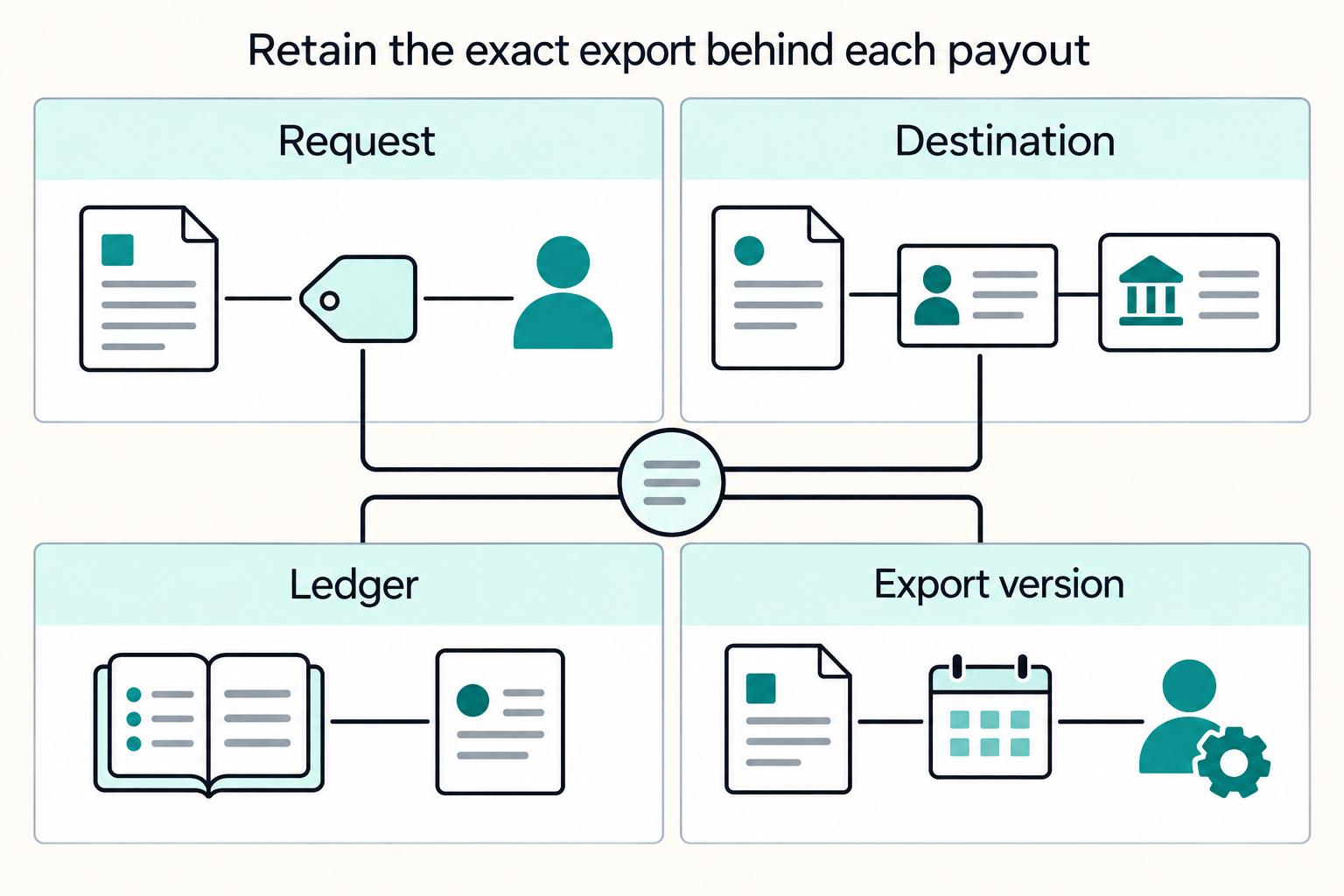
- Set a strict order of operations. Start with a payout request tied to the contractor, earning item, and approval record. Run policy gates before any provider call, then route to the provider, capture the provider reference, ingest status updates, and post ledger journals. Export reconciliation only when that chain is auditable.
Keep operational status separate from ledger truth. A payout can be submitted or provider_pending before it becomes settled or returned. Your timing model should stay rail-aware: Elixir settles on business days in three sessions, while Express Elixir runs 24/7 with a PLN 100,000 per-transfer limit.
- Use idempotency keys for every create and retry path. If a call times out or a worker retries, reuse the same idempotency key so the replay returns the original result instead of creating a second payout. This is the core of safe retry behavior.
The common failure is issuing a new key after an ambiguous response. If the first request may have succeeded, a new key can turn recovery into a duplicate payment attempt. Keep the idempotency key, internal request ID, and provider reference in one record.
-
Keep the audit trail explicit, including exception handling. Retain request payload version, approval actor, routed rail, provider reference, webhook event IDs, ledger journal IDs, and any return or reversal records. For BLIK-related flows, keep traceability that maps internal records to provider or scheme events. That aligns with the scheme's operational focus on areas such as settlement, complaints, alerts, and data archiving/reporting.
-
Add rail-aware verification and escalation checkpoints. Webhook pipelines should expect duplicate delivery, partial payloads, and out-of-order events. Reconcile wallet projections and payout-status logs against ledger truth at defined checkpoints, then queue unmatched items for review.
Use a clear escalation rule: if provider status, webhook history, and ledger posting still disagree after the expected rail window, stop automated retries and investigate. As one payments ops lead put it: "Most 'payment problems' look like money issues, but they start as workflow issues: missing data, unclear terms, weak approvals, and no reconciliation trail."
Related: How to Pay Contractors in Mexico: SPEI CoDi and SAT Compliance for Foreign Platforms.
Test failure paths before go-live#
Before go-live, test the failure states you least want in production. Recovery risk usually comes from ambiguous status, duplicate callbacks, and weak case handling.
| Test area | What to simulate | Verification |
|---|---|---|
| Rail timing | Elixir three-session timing and Express Elixir 24/7 timing, plus failed payout states and partial batch completion | Confirm one trace shows request ID, rail, provider reference, current operational status, and final ledger outcome |
| Ambiguous status recovery | Unclear provider status with retry using the original idempotency key | Hold the case and reconcile provider evidence against ledger state before retry |
| Webhook disorder | Duplicate delivery, partial payloads, and out-of-order events | Deduplicate by event identity or equivalent provider reference and avoid posting duplicate journals |
| BLIK authorization outcomes | PayU sandbox codes 200201, 500500, and 700701 | Validate positive, negative, and expired authorization outcomes against the expected final ledger state |
| Complaints and alerts | Complaint, notification, and alert workflows | Verify ownership, evidence capture, contractor-facing notice, and linkage back to the payout record |
- Test rail timing and broken-state behavior as normal operations.
Treat delayed settlement as expected, not exceptional. Elixir settles on business days in three sessions, while Express Elixir runs 24/7, so timeout rules, escalation timing, and customer messaging should be rail-specific. Include failed payout states, webhook lag, and partial batch completion in staging so teams can prove they can reconcile outcomes when processing is uneven.
Verification point: for each test payout, confirm one trace shows request ID, rail, provider reference, current operational status, and final ledger outcome.
- Freeze ambiguous payouts and recover with the same idempotency key.
If provider status is unclear, do not auto-release another payout. Hold the case, reconcile provider evidence against ledger state, and retry only with the original idempotency key. This is the key control that prevents duplicate payouts after timeouts or uncertain callbacks.
Where available, use provider ambiguity states directly. For example, PayU's WAITING_FOR_CONFIRMATION indicates capture is still pending on the merchant side and should stay in review until reconciliation is complete.
- Test webhook lag, disorder, and duplication explicitly.
Assume callbacks can repeat and arrive out of order. Your consumer should deduplicate by event identity, or equivalent provider reference, and avoid posting duplicate journals from repeated events.
For BLIK-related coverage, PayU sandbox codes 200201, 500500, and 700701 let you test positive, negative, and expired authorization outcomes. Validate that each case resolves to the expected final ledger state.
- Run complaint, notification, and alert workflows before launch.
BLIK regulations explicitly cover "PROCESSING OF COMPLAINTS AND OTHER NOTIFICATIONS" and "IX. ALERT PROCESSING" in the version approved on 11 June 2025. Your test pack should verify ownership, evidence capture, contractor-facing notice, and linkage back to the payout record.
Simulate P2P transactions and P2P-R transactions only if those flows are in scope for your contractor model and already confirmed with your PSP, bank, and legal review.
Common mistakes and how to recover quickly#
After failure testing, the biggest launch risk is often decision framing, not code defects. The fastest recovery is to keep rail fit, scheme roles, and KNF interpretation in one pre-launch decision record.
- Re-rank rails against the payout job, not brand strength.
BLIK popularity alone is not a payout decision. Public figures show more than 2.4 bn BLIK transactions in 2024 with 37% year-on-year growth, while NBP reports 39% of retail payment count but only 2.3% of total value. That gap is a practical warning: high usage volume does not automatically mean best fit for contractor disbursements.
Recover by scoring rails against your actual payout pattern and reconciliation burden. Compare standard Elixir with business days and three sessions against Express Elixir with real-time 24/7 operation, and keep BLIK in scope only where the use case supports it. Verification point: for every rail you keep, document expected settlement timing, exception handling, and final reconciliation source.
- Treat KNF interpretation as an early blocker, not an end-stage filing task.
If you leave KNF questions to production week, teams often rely on partial English summaries. KNF's payment-services page references the Act on Payment Services of 19 August 2011, states the English text is informational, and notes the Polish Journal of Laws text is binding.
Recover with a blocking issue list before launch: question, owner, source document, attached evidence, whether Polish counsel review is needed, and target decision date. A usable evidence pack names the exact text relied on, such as the BLIK Payment System Regulations or the Act on Payment Services. Red flag: "legal is reviewing" with no visible issue record or go-live impact.
- Do not reuse consumer checkout assumptions for contractor payouts.
BLIK scheme materials cover participation and PSP obligations, which is not the same as a contractor payout operating model. Reusing checkout logic usually leaves gaps in exception ownership, status handling, and retained evidence when payouts are delayed or disputed.
Recover by separating flow specs and controls by use case. Your contractor payout flow should have its own status map, complaint path, and ledger posting rules. A common failure mode is inheriting shopper-facing statuses that are too vague for payout operations.
- Lock Issuer/Acquirer/PSP boundaries before scale.
Going live without a fixed role map creates avoidable operational risk. KNF describes payment processing as a multi-actor system with formalised procedures, and BLIK regulations define the Acquirer's execution role within the scheme.
Recover by freezing a signed role matrix and contract boundary map. Checkpoint: operations can identify the exact counterparty for scheme participation, settlement questions, complaints, and alerts. If that map is missing, scale amplifies routing errors.
Need a quick next step on Poland contractor payouts? Browse Gruv tools.
Final decision and copy-paste launch checklist#
Pick one primary payout rail for launch in Poland, and make the open compliance and operations risks explicit before money moves. This checklist does not prove KNF compliance by itself; it is a go-live control list.
- Confirm the primary rail and record why it fits contractor payout behavior.
Define your payout pattern in one sentence, whether scheduled, urgent, or mixed, then document the chosen rail, fallback path, and exception owner. Before go-live, make sure operations can explain delivery and recovery paths without product jargon.
- Keep a known/unknown log for KNF scope, licensing, and role mapping.
For each open item, record owner, source text, launch impact, and decision date. Include role mapping across PSP, Issuer, Acquirer, and Merchant, and include licensing questions because PFSA carries out licensing, regulatory, control, and disciplinary functions and issues licenses for domestic payment institutions. For BLIK work, anchor review to the BLIK regulations version approved on 11 June 2025, including obligations of PSPs and participants. Where KNF materials are in English, treat them as informational and rely on binding Polish legal text for final legal interpretation.
- Approve contractor assumptions against employment-relationship risk, not labels alone.
Validate when civil law contracts are appropriate and when facts could indicate an employment relationship. Do not treat contract naming as sufficient; onboarding checks, eligibility rules, and document retention should be in place before first payout approval.
- Validate payout controls end to end before live traffic.
Reuse the same idempotency key for the same logical payout request so retries stay safe. Keep traceability from request to provider reference to ledger records, and use provider timestamps when handling asynchronous events. Acknowledge webhooks before business logic; if no acknowledgment is received within 10 seconds, events can be marked failing and moved to retry behavior that can continue for up to 30 days.
- Run failure-path tests and sign go-live, rollback, and monitoring ownership.
Test duplicate callbacks, delayed delivery, ambiguous status, and partial batch completion. If ledger state, provider reporting, and webhook history do not align, pause new retries and reconcile first. Assign one owner each for monitoring, incident approval, and legal escalation before launch.
If you are documenting payout rules, approvals, and exception handling, see How to Write a Payments and Compliance Policy for Your Gig Platform.
Frequently Asked Questions
Can a platform pay contractors in Poland using BLIK, or is Elixir the safer default for recurring payouts?
BLIK is a real domestic PLN payment system operated by Polski Standard Płatności S.A. and available 24/7, but that does not make it the automatic first choice for recurring contractor disbursements. If your payouts are scheduled and batch-like, Elixir is usually the safer starting rail because it is the basic interbank transfer system and settles on business days in three sessions. Use BLIK only after you have confirmed the exact initiation model, participant roles, and exception ownership.
When should we pick Elixir vs Express Elixir vs BlueCash for contractor disbursements?
Pick Elixir when timing can follow business-day processing and you want the simplest fit for standard bank transfers. Pick Express Elixir or BlueCash when weekend, evening, or urgent delivery matters enough to justify instant-rail complexity. Before promising instant payouts, verify bank or provider participation and confirm transfer caps, because KIR’s clearing page shows a PLN 100,000 one-transfer limit in the instant context.
What do public BLIK Payment Scheme materials clarify, and what remains unknown for KNF compliance?
The BLIK Payment System Regulations clearly cover participation, complaint handling, authorization, and clearing and settlement. They also expressly tie the scheme to the Act on Payment Services of 19 August 2011. That gives you solid source material for role mapping and operating duties. What they do not do is settle your exact supervisory perimeter with the Polish Financial Supervision Authority for your platform model.
Does contractor tax responsibility under Polish practice reduce platform compliance duties?
No. Civil law contracts are separate from Labour Code employment relationships, but that does not automatically remove platform-side process duties. It also does not eliminate all contribution questions, since in some cases the ordering party may still pay health, accident, disability, and retirement insurance contributions.
What minimum evidence should we prepare before asking counsel for a KNF-related opinion?
Send counsel one evidence pack, not scattered screenshots. At minimum include your flow diagram, entity and role map, sample contracts, target rail choice, and the exact texts you relied on, especially the BLIK Payment System Regulations and the Act on Payment Services. A good verification point is whether each open question names an owner, source document, and go-live impact.
How should we design retries and reconciliation so payout failures do not create duplicate payments?
Do not assume retry or reconciliation mechanics are already defined. Define idempotency, status resolution, and retry ownership with your provider before go-live, and avoid issuing a second payout instruction while the first is unresolved.
If we launch with one rail first, what signals justify adding a second rail later?
Add a second rail when Elixir’s business-day, three-session timing is creating real operational pain, such as repeated urgent payout exceptions, weekend demand, or support volume you cannot absorb manually. Do not add one just because a rail is widely used for consumer payments. Before launch, you should already be able to name the settlement path, complaint path, and reconciliation source for the new rail.
Try a related tool
Researched and edited by the Gruv editorial team. Gruv builds cross-border billing, payouts, and finance-operations software for global businesses.
Sources
Includes 3 external sources outside the trusted-domain allowlist.
- biznes.gov.pl/pl/portal/0098trusted
- docs.stripe.com/api/idempotent_requeststrusted
- docs.stripe.com/webhookstrusted
- knf.gov.pl/en/CONSUMERS/POLISH_FINANCIAL_SUPERVISION_AU...trusted
- knf.gov.pl/en/MARKET/Regulations_and_practice/Payment_s...trusted
- blik.com/en/download/pobierz/blik-payment-system-regu...external
- blik.com/en/blik-as-a-growth-driver-for-the-economy-p...external
- developers.payu.com/europe/docs/payment-solutions/blik/testingexternal
Educational content only. Not legal, tax, or financial advice.
Related Posts
Pay Contractors in Peru with Yape, PLIN, and SBS Checks
Treat Peru as a posture decision, not just a rail decision. If you choose a local wallet-style method first, then sort out contractor status, tax data, and evidence later, you may get a smoother payout experience. You also raise launch risk in areas that are much harder to fix once money starts moving.

Pay Contractors in Mexico: SPEI, CoDi, SAT, and CFDI Decisions for Platforms
Mexico contractor payouts usually break for a simple reason: teams launch from a generic Latin America plan, then discover that payout rail choices, tax steps, and operating structure cannot be separated in practice. If you are evaluating multiple rails and operating models at the same time, you need Mexico-specific decisions before you send the first live payout.

How to Pay Contractors in Kenya with M-Pesa, PesaLink, and KRA Controls
Kenya is worth serious consideration for contractor payouts, but you should not greenlight a launch just because M-Pesa is familiar and PesaLink is on the shortlist. The real decision is practical. Confirm which rail fits your contractor base, put local compliance and tax controls in place before money moves, and keep enough evidence to explain each payout later.