
Quick Answer
Use an evidence gate before launch: in Kazakhstan, only approve contractor payout rails that show payout-specific proof, not merchant acceptance signals. Treat Kaspi QR and related QR narratives as directional until you have disbursement evidence with statuses and exceptions, assign named ownership for Order No. 614 and ITAS operations, and require transaction records that can be traced from creation to reconciliation.
What platform operators should verify before paying contractors in Kazakhstan#
Kazakhstan is worth a serious look, but only if you separate visible payment activity from proof that your contractor payout model will work. The common early mistake is treating a known local payments brand, a QR acceptance story, or a broad central bank initiative as if it already answers payout operations, FX handling, and reporting readiness.
A few things are publicly anchored. Joint Stock Company Kaspi.kz appears in a Form F-1/A filed with the U.S. Securities and Exchange Commission on January 16, 2024, under registration number 333-276293.
Separately, an IMF technical assistance report for the Republic of Kazakhstan, published on 14 Jan 2026, refers to digital tenge work and names both the National Bank of Kazakhstan and the National Payments Corporation of Kazakhstan. It follows virtual engagement in February to March 2024 and a mission to Astana and Almaty in May to June 2024. Those are useful market signals. They are not, on their own, evidence that a platform can pay contractors through a given rail with the controls finance and compliance teams need.
Before you begin#
Use this guide like a decision memo, not a market overview. Put every assumption into one of three buckets:
| Bucket | Definition |
|---|---|
| Confirmed now | Supported by a public filing, an institutional publication, or payout-specific provider material you can retain |
| Directional | Plausible and commercially interesting, but still missing proof on disbursement behavior, reversals, status reporting, or settlement detail |
| Must validate before spend | Anything that would force rework in product, treasury, finance ops, or filing if it turns out to be wrong |
The checkpoint that matters most at this stage is simple. For each rail or compliance assumption, ask what document or artifact would let you defend the decision six months later. A public filing, a regulator text, provider payout documentation, signed commercial confirmation, or a successful test transaction with traceable references all count. A sales deck, a merchant acceptance demo, or secondhand market chatter does not.
That is why this guide treats compliance evidence, rail fit, and reporting readiness as launch gates, not cleanup after launch. If your expansion case only works when an unverified payout path, FX interpretation, or institutional initiative behaves a certain way, pause before you scope engineering or commit GTM budget.
A common failure mode is shipping onboarding and payment initiation first, then discovering you cannot prove who was paid, in what currency, through which rail, or under what reporting logic. That is expensive to fix because the gap is usually in data capture and operating ownership, not just in code.
From there, the practical job is to narrow Kazakhstan to what you can verify today, then decide whether that narrower launch still makes business sense.
Need the full breakdown? Read How Platform Teams Pay Brazil Contractors with Pix.
What to prepare before you scope engineering#
Prepare an evidence-first launch slice before you create product tickets: if contractor profile, filing ownership, and payout rails are still assumptions, engineering will build on guesswork.
Step 1. Build a minimum evidence pack. Define the first contractor profiles, payout frequency, intended settlement currency, and whether payees are Kazakhstan residents. Keep it tight, but specific enough that finance, compliance, and product are working from the same scope. For each assumption, attach an artifact you can defend later.
Step 2. Assign ownership for Order No. 614 and ITAS now. Set one owner for Order No. 614 compliance analysis and one owner for ITAS filing operations, including backup coverage and approval order. Do this before legal interpretation is fully settled. The goal here is clear accountability, not pretending signer logic is already resolved.
Step 3. Inventory only named rails you can verify. List Kaspi.kz, Kaspi QR, Mastercard card payouts, and any bank-transfer path you can document, then tag each rail as confirmed, directional, or unknown for contractor disbursements. You can anchor Kaspi.kz to the SEC Form F-1/A context dated January 16, 2024 (registration no. 333-276293), but treat that as institutional evidence, not payout proof.
Step 4. Require explicit proof for NBK/NPCK and interbank QR-dependent assumptions. If roadmap decisions depend on NBK, NPCK, or interbank QR claims, require direct payout confirmation before committing engineering scope. The IMF publication date (14 Jan 2026) and engagement references are useful context, not production validation for settlement behavior, status reporting, or exception handling. Keep any rail off-roadmap until those mechanics are confirmed.
We covered this in detail in Pay Contractors in Mexico With SPEI for Platform Operators.
Step 1 map contractor payout needs to real rails#
Treat merchant acceptance and contractor disbursement as separate decisions, and only treat a rail as payout-ready when you can verify payout behavior and reporting.
Separate acceptance signals from payout evidence#
Kaspi QR and the Kaspi Business Mobile App should start on the acceptance side of your comparison, not the contractor payout side. If you do not have payout-specific confirmation, keep them as named rails to evaluate, not confirmed disbursement rails.
Apply the same filter to broad QR familiarity claims. Consumer or travel coverage through Alipay+ can be a demand signal, but it is not proof that contractor payouts are operationally suitable.
Also filter source quality by recency. The State Department page that includes Kazakhstan is explicitly archived and marked not updated, with coverage from January 20, 2021 to January 20, 2025, so treat it as context only rather than current production evidence.
Apply the mass payout decision rule#
If you need recurring mass payouts with reconciliation, do not assume Kaspi e-Wallet or Kaspi Gold debit card acceptance flows are enough without payout-specific confirmation.
Your decision test is simple: if a rail cannot show repeatable payout execution plus trackable status and exception handling for reconciliation, keep it out of committed launch scope.
Record knowns and unknowns in one table#
Use one evidence table per rail, and keep National Payment Corporation dependencies marked unresolved unless payout-specific relevance is explicitly confirmed.
| Rail | Eligibility | Operational fit | Reporting burden | Unresolved dependencies on National Payment Corporation |
|---|---|---|---|---|
Kaspi QR | Named rail; contractor payout eligibility unconfirmed | Unknown for contractor batch payouts, status tracking, and reversals | Unknown | Unresolved |
Kaspi Business Mobile App | Acceptance-side signal; contractor disbursement eligibility unconfirmed | Unknown for recurring contractor payout operations | Unknown | Unresolved |
Alipay+ consumer/travel QR coverage | Demand signal only | Not evidence of contractor payout suitability | Unknown | Unresolved |
Kaspi e-Wallet / Kaspi Gold debit card flows | Surface-level acceptance signal; recurring mass payout eligibility unconfirmed | Do not treat as sufficient without payout-specific proof | Unknown | Unresolved |
Expected outcome: every rail in your Kazakhstan shortlist is tagged Known, Directional, or Unknown based on retainable payout evidence, not acceptance narratives.
If you want a deeper comparison framework, read How to Pay Contractors in Sri Lanka: LankaPay and CBSL FX Rules for Platform Operators.
Step 2 apply platform reporting scope before product design#
Do not commit Kazakhstan reporting logic to product flows until you have the source text and a verified interpretation for your platform. If that evidence is not in hand, keep reporting-dependent scope uncommitted while you continue design elsewhere.
This is the same discipline as Step 1, now applied to compliance data instead of payout rails. A working payment route is not enough if you cannot explain why a transaction was treated as in scope, out of scope, corrected, or excluded.
Verify the rule before you model it#
Treat Order No. 614 as a document to verify directly, not a label to interpret from memory. Before adding onboarding logic or reporting fields, pin a small evidence pack to the ticket:
| Evidence item | What it covers | Note |
|---|---|---|
| Current Order No. 614 text | The text used by your legal or tax reviewer | Verify directly, not from memory |
| Written note on reporting scope | How your platform activity is interpreted for reporting scope | Pin it to the ticket before adding onboarding logic or reporting fields |
| Confirmed scope treatment | The scope treatment your reviewer expects you to apply | For every field you add, identify the reviewed note or output it supports |
| Sample extract or filing flow | A sample extract, template, or filing flow for your confirmed reporting channel | Include ITAS only if that is your confirmed route |
- the current Order No. 614 text used by your legal or tax reviewer
- a written note on how your platform activity is interpreted for reporting scope
- any confirmed scope treatment your reviewer expects you to apply
- a sample extract, template, or filing flow for your confirmed reporting channel (including ITAS only if that is your confirmed route)
A practical checkpoint is straightforward: for every field you add, identify the reviewed note or output it supports. If no one can tie it back, treat it as speculative.
Capture reporting attributes when the transaction is created#
Store reporting-relevant attributes at creation time and preserve them through corrections. If your confirmed process tracks items such as category, commissions, returns, or VAT treatment, record them on the source transaction rather than rebuilding them at month-end.
Test this early with a small sample across success, return, and correction states. You should be able to trace each record from creation to ledger to draft reporting output without losing the adjustment trail.
Close every month, including zero-activity months#
Set monthly close controls for Kazakhstan reporting based on your confirmed process, including no-activity periods where applicable. The control should show that scope was reviewed, the population was checked, and the filing or no-filing decision was retained.
Decision rule: if your product cannot consistently produce the required reporting dataset from source records for your Kazakhstan in-scope population, pause launch and fix data capture first.
For a step-by-step walkthrough, see How Platform Operators Pay Creators Globally Across YouTube, Twitch, and Substack.
Step 3 design FX handling that passes audit and filing checks#
Treat your FX design as provisional until you have a confirmed legal interpretation, because an exact conversion rule, timing rule, or filing check is not established. This information is archived and explicitly not updated, so treat it only as context and rely on current official sources before you commit irreversible product logic.
Build for auditability now, not certainty you do not yet have. At transaction level, retain original currency, original amount, any reporting-currency amount you apply, the rate source, and the rate date so finance can defend the trail without rebuilding history at month-end.
Before you mark FX handling as done, run one end-to-end sample and verify a clean trace from source amount to reporting-file line item. If that chain is incomplete, keep FX logic out of committed launch scope until your reporting interpretation is confirmed.
Step 4 run first-month operations with failure handling and reconciliation#
For month one, treat your operating sequence, failure buckets, and reconciliation outputs as internal controls you define and can defend, not externally validated requirements established here.
The evidence here is limited: the excerpts are filing-tag metadata (including date/period tokens like 2024-12-31, 2025-01-29, and 2024-04-01 to 2025-03-31), not payout runbook instructions. So your safest approach is to lock one clear operating design for the month, apply it consistently, and keep a review trail for every exception and close decision.
Use this as your minimum operating posture:
- Document one payout sequence and run it consistently for the full cycle.
- Define explicit exception categories instead of a single catch-all pending state.
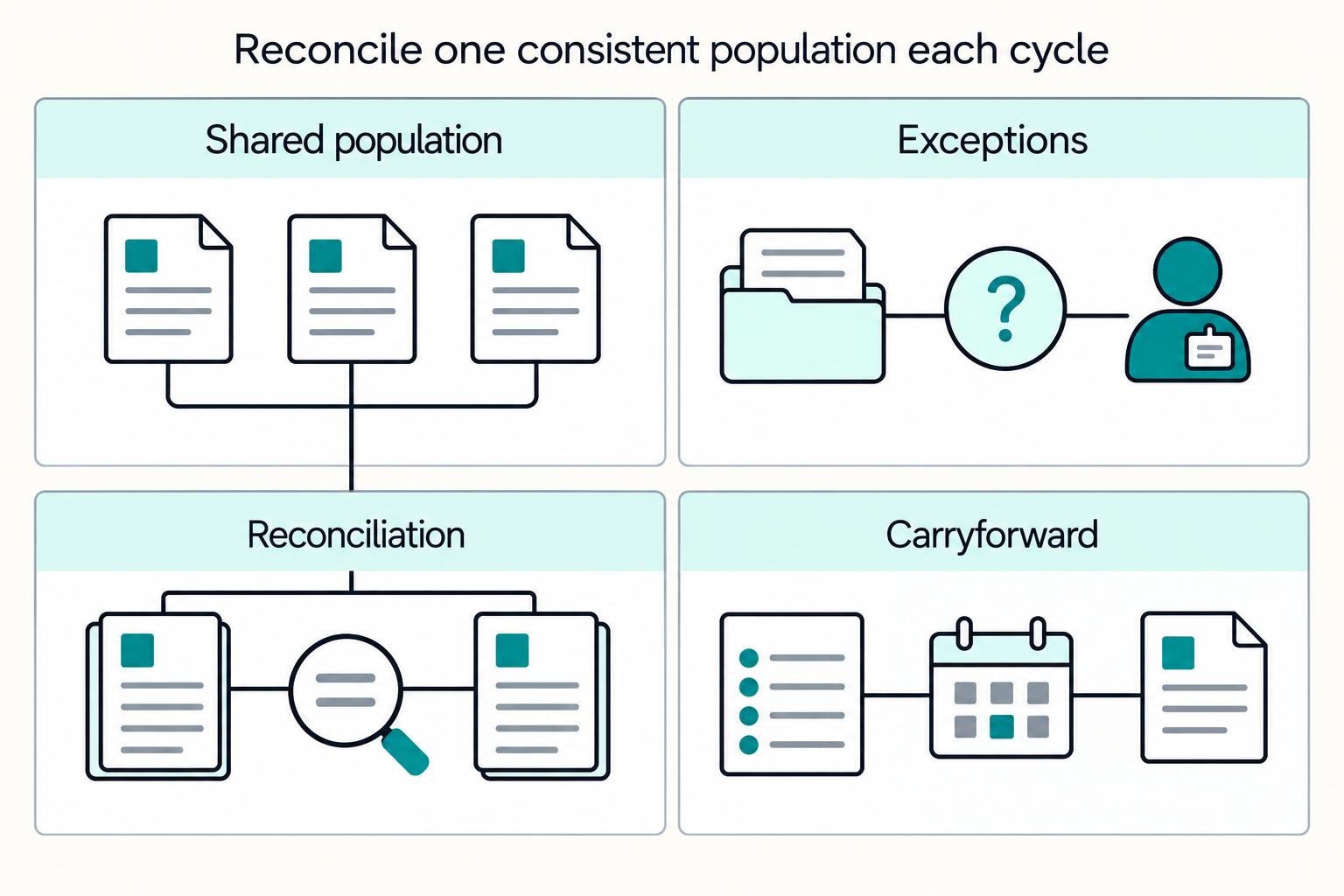
- Keep reconciliation outputs aligned to the same transaction population used for payout execution.
- Keep one sign-off pack that explains unresolved items, closures, and carry-forward decisions.
- If you plan to file through
ITAS, treat your extract and sign-off steps as internal governance checkpoints unless legal/reporting interpretation is separately confirmed.
Launch narrow, complete one clean cycle, then expand only after your exception handling and reconciliation process is consistently explainable.
Related: How to Pay Contractors in Ethiopia: Telebirr and NBE FX Rules for Platform Operators.
Step 5 decide launch now or wait for NBK QR clarity#
After one clean month on a narrow cohort, make a binary call: launch on rails you have already proven, or wait. Signals around the National Bank of Kazakhstan (NBK) and the National Payments Corporation of Kazakhstan (NPCK) are directional, not proof of contractor payout behavior. The IMF describes a second engagement with NBK and NPCK after a virtual engagement in February to March 2024 and an in-person mission in May to June 2024, which shows active work but not documented settlement or payout mechanics for your use case.
Set hard go-live gates#
Do not approve launch until you can show all three in one evidence pack:
- confirmed payout rail behavior, including test payouts, external references, and final statuses you can reconcile
- confirmed compliance dataset for your reporting flow
- confirmed ownership for filing, corrections, and nil-month decisions
Use one practical check: can finance ops rebuild a payout from payee approval through provider reference, ledger posting, and filing extract without tribal knowledge? If the answer depends on assumed QR interoperability behavior, you are still in discovery.
Choose the narrow launch or the broader wait#
Launch now if your confirmed bank or card rails can support the first contractor cohort with tight scope. Defer broader rollout if your model depends on NPCK-linked QR interoperability that is not yet clearly documented for your payout flow.
Treat source quality as a gate. If someone cites archived material as proof, stop and re-validate, because an archive that says content is not updated is not enough to sign off settlement, exceptions, or payout ownership.
This pairs well with our guide on Making Tax Digital for Income Tax and UK Platform Operators: Confirmed Rules and Open Scope Questions.
Common mistakes that cause rework in Kazakhstan launches#
Most rework in Kazakhstan starts when teams treat public company signals as operational proof. Avoid that by separating what investor documents confirm from what your payout and reporting flow must prove in your own tests.
- Using market visibility as payout evidence.
Public facts about Kaspi.kz, including its U.S. IPO, Nasdaq listing under KSPI, and ADS offering details, do not confirm contractor payout behavior in your system. Before launch sign-off, require payout-specific test evidence for your actual flow, including final statuses and ledger outcomes.
- Treating investor disclosures as a substitute for reporting design.
Investor materials can validate corporate context, but they do not define your transaction-level reporting dataset. Build and validate the reporting fields you need at transaction creation, then test whether a sample period can be reconstructed without manual patchwork.
- Deferring conversion and reconciliation rules until after go-live.
Teams create rework when currency conversion and reconciliation logic are left as "later" implementation details. Lock policy and data handling before launch, then run an end-to-end trace from original transaction values to reporting output.
- Leaving filing and correction ownership ambiguous.
Shared responsibility without one accountable owner creates late-cycle delays and preventable fixes. Assign a single owner, document approval steps, and confirm the process also covers periods with no activity.
Related reading: How Platform Teams Pay Contractors Across UAE, Saudi Arabia, and Egypt.
Conclusion#
The practical answer is simple: in Kazakhstan, commit only to the payout path and reporting logic you can prove with your own evidence today. Treat publicly visible NBK and NPCK engagement as market context, not as proof that contractor disbursements will work for your exact model.
That distinction matters because the public institutional signal is real, but limited. The IMF technical assistance report for Kazakhstan, published on 14 Jan 2026, describes next steps and considerations for the digital tenge and notes engagement with the National Bank of Kazakhstan and the National Payments Corporation of Kazakhstan. It includes a virtual phase in February to March 2024 and an in-country mission in Astana and Almaty during May to June 2024. What that gives you is evidence that policy and infrastructure work is active. What it does not give you is confirmed payout behavior for your contractors, your exception cases, or your monthly reporting obligations.
So the launch call usually comes down to two options. If you already have a documented rail that can show successful payout, rejection handling, provider references, and clean reconciliation, launch with a narrow contractor cohort and keep scope tight. If your commercial case depends on unproven interoperability or other local compliance and FX assumptions you have not validated, wait and close those gaps first.
A good final checkpoint is boring on purpose. Pick one sample Kazakhstan resident transaction and make sure your team can trace it from onboarding to payout result to ledger entry to reporting extract without a spreadsheet repair in the middle. If that trace breaks, or if finance cannot explain a rejected or delayed payout with source evidence, you are not ready to scale.
Launch checklist you can copy and paste#
| Control | What to verify | Red flag |
|---|---|---|
| Rail fit for contractor payouts versus merchant acceptance | Keep proof that matches your use case: one successful payout, one rejection, one delayed case, and provider references for each | Not just marketing language |
| Local scope logic for Kazakhstan residents | You can produce a clean resident-only population on demand from production data | Assumptions you cannot defend |
| FX reporting method | Store the original currency, converted amount, rate source, and rate date on every record | Any month-end process that recreates FX from memory or from a one-off spreadsheet |
| Monthly reporting ownership and sign-off controls | Name one accountable owner and one reviewer before go-live | Everyone assumes finance owns it, but no one can submit or approve corrections |
| First month reconciliation and exception handling | Close rejected beneficiary cases, returned funds, unmatched records, and delayed confirmations before widening volume | If you cannot explain every exception bucket at low volume, higher volume will only hide the problem |
-
Document rail fit for contractor payouts versus merchant acceptance. For each planned path, keep proof that matches your use case, not just marketing language. Minimum evidence pack: one successful payout, one rejection, one delayed case, and provider references for each.
-
Implement and test your local scope logic for Kazakhstan residents. Do not rely on assumptions you cannot defend. Verification point: you can produce a clean resident-only population on demand from production data.
-
Verify your FX reporting method before go-live. Where local reporting requires values in a specific currency, store the original currency, converted amount, rate source, and rate date on every record. Red flag: any month-end process that recreates FX from memory or from a one-off spreadsheet.
-
Assign monthly reporting ownership, nil-report handling, and sign-off controls. Name one accountable owner and one reviewer before go-live. Failure mode: everyone assumes finance owns it, but no one can submit or approve corrections.
-
Complete first month reconciliation and exception handling before scale-up. Close rejected beneficiary cases, returned funds, unmatched records, and delayed confirmations before widening volume. If you cannot explain every exception bucket at low volume, higher volume will only hide the problem.
You might also find this useful: How to Pay Contractors in Tanzania: M-Pesa Tanzania and BoT FX Rules for Platforms.
Frequently Asked Questions
Do foreign `internet platforms` paying Kazakhstan residents fall under the reporting obligations described in `Order No. 614`?
Do not assume that point is established; treat it as an open scope question, not a confirmed yes. If your launch depends on that answer, get a written local interpretation before go-live and keep it in your compliance file.
Is `Kaspi QR` enough to run contractor payouts, or is it mainly merchant acceptance infrastructure?
Based on the public materials in scope here, you do not have evidence that Kaspi QR is sufficient for contractor payouts. The Kaspi.kz documents in scope here establish public-company context, including 11,300,000 ADSs offered at $92.00 per ADS and Nasdaq listing under KSPI. They do not establish batch disbursements, beneficiary checks, or payout reconciliation. If you need contractor payouts, ask for payout-specific proof such as a successful transfer, a rejection, and a delayed case with provider references.
What exactly must be converted into `Kazakhstani tenge`, and when should the exchange rate be applied?
This guide does not specify the exact reportable amount that must be converted or the exact timing rule for the FX rate. Until you confirm the governing requirement, store the original currency amount, any KZT amount used for reporting, the rate source, and the date tied to that rate. If those fields are missing at transaction creation, finance may need to rebuild history later.
Does joining the `interbank QR System` through the `National Bank of Kazakhstan` guarantee contractor payout support?
No publicly available information justifies that assumption. What is documented is that an IMF mission had a second engagement with the National Bank of Kazakhstan and the National Payments Corporation of Kazakhstan in May-June 2024, after a virtual engagement in February-March 2024. That shows active institutional work, not guaranteed contractor payout capability for your use case.
What minimum data should be captured from day one to file through `ITAS` without month-end scrambling?
The exact ITAS field list is not provided here, so do not treat any public checklist as authoritative by itself. As an internal operations baseline, capture enough data to reconstruct scope and money flow end to end, such as residency status, transaction date, original currency and amount, any KZT conversion details, provider reference, and final status. A good checkpoint is whether one sample record can be traced from creation to payout result without manual patching.
How should operators treat Kazakhstan resident and non-resident transactions differently in reporting scope?
The exact legal boundary is not established, so avoid hard-coding assumptions you cannot defend. What you should do from day one is separate resident and non-resident records at onboarding and preserve that tag on each transaction. If you cannot produce a clean resident-only population on demand, your reporting design is not ready yet.
Try a related tool
Where Gruv fits
Researched and edited by the Gruv editorial team. Gruv builds cross-border billing, payouts, and finance-operations software for global businesses.
Sources
Includes 2 external sources outside the trusted-domain allowlist.
- 2017-2021.state.gov/report/custom/27c0326b35trusted
- 2021-2025.state.gov/report/custom/7429bd5f03trusted
- elibrary.imf.org/view/journals/019/2026/002/article-A001-en.xmltrusted
- elibrary.imf.org/view/journals/019/2026/002/article-A001-en.pdftrusted
- sec.gov/Archives/edgar/data/1985487/0000950170250359...trusted
- sec.gov/Archives/edgar/data/1985487/0001193125240086...trusted
- adb.org/sites/default/files/publication/843146/asia-...external
- ir.freedomholdingcorp.com/all-sec-filings/content/0000924805-25-000012...external
Educational content only. Not legal, tax, or financial advice.
Related Posts

Paying Contractors in Sri Lanka with CBSL and LankaPay Decision Checks
Start with regulatory certainty. For a platform operator, Sri Lanka should not be screened from a payout product page or a rail feature list first. Real institutional signals exist, but they still do not prove that your exact contractor payout flow is permitted, eligible, and operationally supportable.

Pay Contractors in Ethiopia with Telebirr and NBE FX Checks
Telebirr is a real payment service, with documented bulk disbursement and international-remittance capabilities. The useful question for a platform is which product, entity and funding path can pay its Ethiopian contractors for the stated commercial purpose. A local wallet transfer and a cross-border service payment require different evidence.

How to Pay Contractors in Tanzania with M-Pesa and BoT FX Boundaries
Tanzania is worth evaluating for contractor payouts, but the decision is not about market interest alone. It comes down to whether your model can operate inside Bank of Tanzania boundaries and still deliver a payout experience that finance, compliance, and contractor support can defend.