
Quick Answer
Yes: treat Hungary as a conditional launch and require document-backed proof before releasing contractor payouts. Use confirmed anchors like the MNB Payment Systems Report 2025 and Act CXXXIX of 2013, then keep contractor classification, withholding, and detailed FX application in an open-items register until validated. Operate with partner-led rail access by default, and release only when funding, quote validity, and reconciliation checkpoints are all satisfied.
Why this Hungary guide is different#
Step 1 Anchor your decision in confirmed infrastructure facts#
Use this guide to make a rollout decision, not to collect payment trivia. For Hungary, start narrow and on solid ground. The MNB Payment Systems Report 2025 explicitly covers both VIBER and ICS. It also says that one of the Magyar Nemzeti Bank's core responsibilities is to promote the smooth execution of payments and support reliable, efficient financial market infrastructures. That gives you two firm anchors from the start: confirmed rails and confirmed institutional ownership.
The report is also clear about its purpose. It is meant to improve transparency around MNB activity in payments and overseen infrastructures. So when this guide talks about MNB, VIBER, or ICS, it is translating published rail facts into operator decisions. It does not treat public payment statistics as proof that your contractor payout product is ready. Even the 2024 data point that 42% of all payment transactions in Hungary were electronic tells you more about market digitization than about launch readiness.
Step 2 Separate what is known from what still needs validation#
The practical rule is simple: rely on the rail facts and quarantine everything else until you validate it. From the current source set, you can confirm the role of the MNB, the fact that VIBER and ICS are core infrastructure topics in official reporting, and the legal backdrop tied to Act CXXXIX of 2013 on the Magyar Nemzeti Bank.
What remains unconfirmed matters just as much. You do not have confirmed answers for detailed VIBER participation eligibility, ICS settlement timelines or finality promises for your use case, contractor classification, withholding, or labor-law requirements. SEPA or euro-area context may matter later, but available materials alone are not enough to answer product, legal, or treasury design questions for Hungary.
Set a strict verification checkpoint. Every country assumption in your launch file should either cite an exact document, such as the MNB Payment Systems Report 2025, or be labeled as an open item with an owner and due date.
Step 3 Make the outcome a go or no go on operational readiness#
The decision here is not "Is Hungary attractive?" It is "Can you operate contractor payouts in Hungary with evidence, controls, and fallback handling?" If you cannot name the settlement route you expect to rely on, the documents backing that route, and the open legal or compliance questions still pending, the right answer is no go for now.
A common failure mode is confusing infrastructure visibility with launch permission. Teams see VIBER, ICS, and broader European payment context, then jump straight into product build. That is backwards. Move only when your evidence pack clearly separates confirmed rail facts from unresolved legal and compliance questions, and when someone on your side is accountable for closing each unknown before money moves.
Decide whether Hungary fits your contractor payout model#
Treat Hungary as a routing decision, not an EU branding signal. From the current evidence, you can rely on EU VAT administration options, but not on payout-operating assumptions.
Step 1 Anchor the call in confirmed facts#
Confirmed: Hungary is listed among participating EU countries for VAT Cross-border Rulings, and OSS allows a taxable person to register in one Member State for covered VAT declaration and payment across qualifying EU cross-border supplies.
Use that as tax-administration context only. It can reduce VAT administration sprawl, but it does not validate your contractor payout flow.
Step 2 Separate VAT convenience from payout readiness#
Do not treat "EU country" as shorthand for "our payout model will work." Payout currency, SEPA status, and rail-level contractor disbursement mechanics are not confirmed for launch design.
Before you build, split your launch memo into:
- confirmed VAT framework facts (CBR/OSS)
- unresolved payout-operating assumptions that still need evidence
Step 3 Apply a hard launch gate#
Delay launch if your operating model is still hypothetical. If you cannot document the payout route, conversion path, and day-one exception handling with explicit evidence, keep Hungary in validation status instead of shipping a partial rollout.
Prepare the evidence pack before any product build#
Start with evidence, not engineering. If your Hungary plan still depends on inference, pause build work until your evidence pack clearly separates confirmed artifacts from open legal, tax, and FX questions.
| Artifact | What is confirmed here | Use |
|---|---|---|
| General Business Terms and Conditions of the MNB | Named document to log with source URL, retrieval date, version or effective date, and owner | Governing artifact in the evidence pack |
| Business Terms and Conditions for the Interbank Clearing System | Named document to log with source URL, retrieval date, version or effective date, and owner | Governing artifact in the evidence pack |
| 2024 MNB annual report | Contents list includes "3.5 Payment Systems and Securities Settlement Systems" (page 42) and "3.3 Supervisory Activity and Consumer Protection" (page 30) | Orientation evidence and navigation context, not clause-level proof |
Step 1 Collect the governing artifacts you will rely on. Log the General Business Terms and Conditions of the MNB and the Business Terms and Conditions for the Interbank Clearing System as named documents, with source URL, retrieval date, version or effective date (if shown), and owner. Use the 2024 MNB annual report as orientation evidence: its contents list "3.5 Payment Systems and Securities Settlement Systems" (page 42) and "3.3 Supervisory Activity and Consumer Protection" (page 30). Treat that as navigation context, not clause-level proof.
Step 2 Keep a known/unknown register with owners. Track each item with statement, status, and owner. Mark only what your current source set directly supports as known, including VIBER and ICS items already evidenced in your pack. Keep contractor classification, withholding, and detailed FX rule application as unknown until explicitly validated.
Step 3 Map each unknown to a validation path before tickets open. Write a short decision memo with one line per unknown: what is unresolved, why it blocks product, compliance, or treasury design, who validates it (for example, MNB, local counsel, or your banking partner), and what evidence will close it.
Step 4 Add a hard verification checkpoint. No Hungary launch ticket should move forward unless every unknown has a named owner, due date, and acceptable evidence format. If your team cannot open one folder and see the artifact log, current register, and decision memo together, keep build work paused.
Choose your rail access model for HUF settlement#
Use indirect access through a regulated partner by default while your Hungary volume is still unproven. Do not assume usable VIBER policy text supports direct access, so treat direct-access assumptions as unconfirmed.
Step 1 Hold direct access to a higher proof bar#
Treat direct participation as an evidence claim, not a product preference. You need documented support for eligibility, operating obligations, settlement control, and fallback handling before you open a direct-access workstream.
That support is missing here. Keep the model partner-led unless you have written partner confirmation or a counsel memo tied to governing documents.
Step 2 Separate rail names from payout design#
Do not map payout logic to rail labels by assumption. The only concrete ICS artifact here is a visible document title (ICS_Business_terms_20220301_EN.pdf, shown as "BUSINESS TERMS AND CONDITIONS FOR THE INTERBANK ..."), which confirms a document exists but does not confirm processing rules or routing behavior.
Apply the same caution to VIBER in this section. For contractor payouts, ask your regulated partner which route they actually execute and reconcile for ordinary HUF disbursements, and what conditions trigger exceptions.
Step 3 Use entity names as validation targets, not confirmed roles#
| Entity | What available evidence confirms | What you still need before product design |
|---|---|---|
| Magyar Nemzeti Bank | Named institution in the broader evidence set | Any specific infrastructure role, rule, or participant obligation tied to your payout flow |
| KELER | Name appears in outline scope only | Whether it affects your contractor payout path |
| Hungarian State Treasury | Named entity to track | Whether it is relevant to your use case |
| Hungarian Post | Named entity to track | Whether it is part of any route you would use |
| Participating credit institutions | Relevant category for partner discussions | Which institution carries operational obligations and settlement dependency in your model |
Decision rule: start indirect, then revisit direct only after you have sustained scale and documented proof of control requirements and access path. Until then, prioritize evidence on who carries the obligations, who confirms execution, and which document governs disputes.
Map the contractor payout sequence end to end#
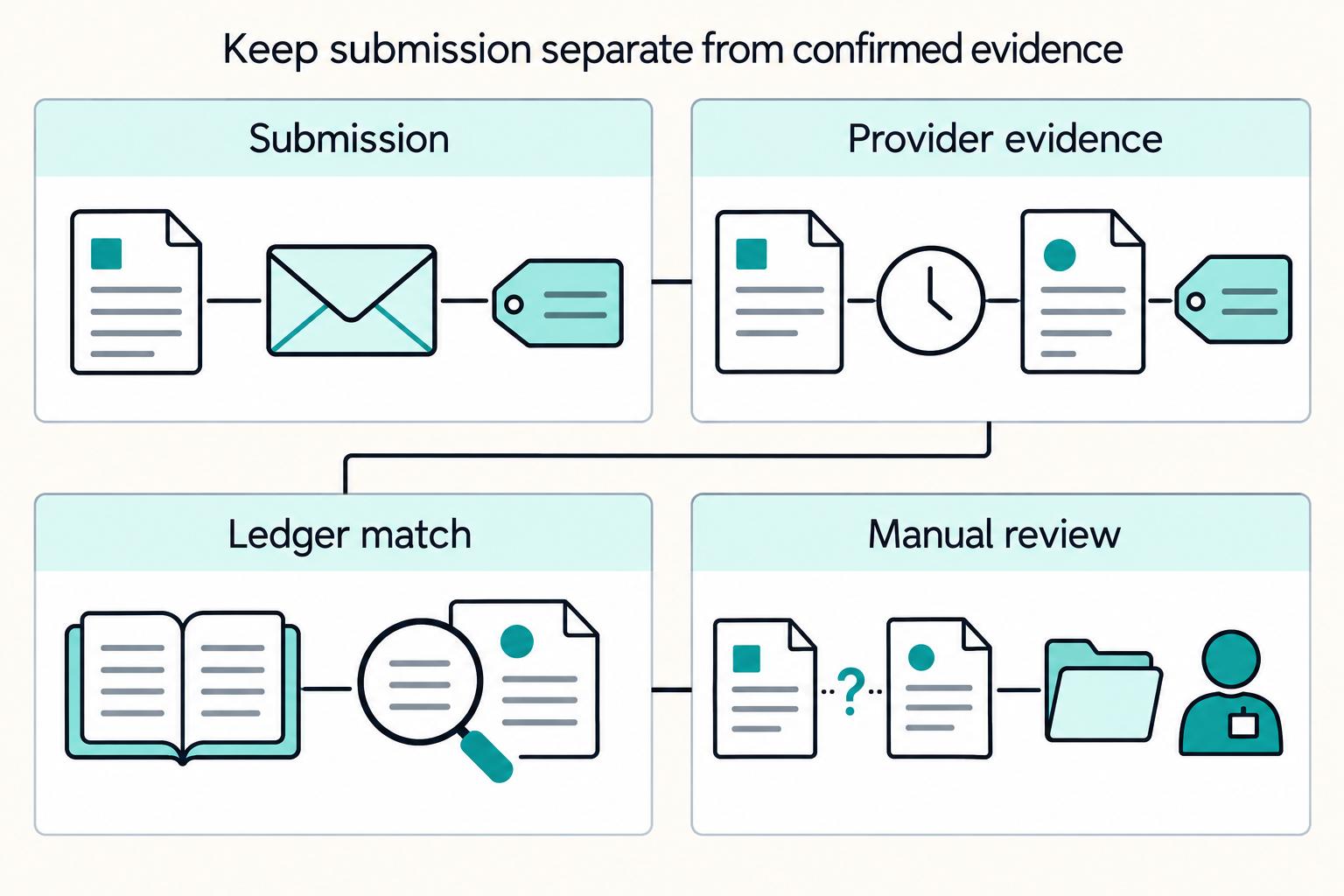
Build your payout flow around provider-confirmed events before launch. In Hungary, rail names are not enough to tell you what actually happened, so move states only on confirmed events.
| Stage | What to record | Handling |
|---|---|---|
| Onboarding and policy checks | Recipient approval, account validation, and a stored policy decision tied to a durable internal identifier | If ops cannot see who approved the recipient, which account details were used, and which policy decision cleared release, the flow is not production-ready |
| Funding and conversion decision | Whether the payout is funded in HUF or converted from another currency; if FX is used, tie the pricing decision to the same payout reference | If funds are not available, stop the flow in a visible blocked state |
| Submission and confirmation | One immutable transaction reference before sending the request, kept across later events; use states such as submitted, accepted, and confirmed | Do not promise timing based on SWIFT, VIBER, or ICS labels alone |
| Ledger posting and reconciliation | Internal reference, provider reference, amount, currency, beneficiary identifier, and confirmation timestamp | If references do not match, quarantine for manual review instead of forcing an auto-match |
| Retries and callbacks | Idempotent retries at request level; deduplicate by external event identifier; prevent duplicates on the immutable transaction reference | Avoid creating a new payout once provider acceptance or an external reference exists |
Step 1 Gate onboarding and policy checks. Allow payout creation only after recipient approval, account validation, and a stored policy decision tied to a durable internal identifier. If ops cannot see who approved the recipient, which account details were used, and which policy decision cleared release, the flow is not production-ready.
Step 2 Lock funding and the conversion decision. Record whether the payout is funded in HUF or converted from another currency as part of the transaction record. If FX is used, tie the pricing decision to the same payout reference. If funds are not available, stop the flow in a visible blocked state rather than letting it appear submitted.
Step 3 Separate submission from confirmation. Create one immutable transaction reference before you send the request to the provider, and keep it across all later events. Do not promise timing based on SWIFT, VIBER, or ICS labels alone. Reflect uncertainty with distinct states such as submitted, accepted, and confirmed for reconciliation.
The MNB 2023 annual report remains a high-level anchor here: it includes a section titled "Payment and securities settlement systems" (page 44) and audited financial statements beginning on page 97. Use your provider contract and statement format, not rail-name assumptions, to define what each external status means in product and ops.
Step 4 Post ledger states only when evidence matches. Define clear rules for internal posting, provider acceptance, and reconciliation readiness. Each completed payout should retain your internal reference, provider reference, amount, currency, beneficiary identifier, and confirmation timestamp. If references do not match, quarantine for manual review instead of forcing an auto-match.
Step 5 Make retries replay-safe, then test one pass and one fail path. Keep retries idempotent at request level and enforce duplicate prevention on the immutable transaction reference. When callbacks replay, deduplicate by external event identifier and avoid creating a new payout once provider acceptance or an external reference exists.
Before enabling Hungary in production, run one normal-path simulation and one failure-path simulation (for example, insufficient funds or unmatched reference). Ops and finance should be able to reconstruct each case end to end from request through reconciliation export without diving into engineering logs.
Plan FX and liquidity controls before you pay in HUF#
Before release, run two separate go/no-go checks: FX execution certainty and HUF liquidity certainty. If either check fails, the batch is not ready.
| Control area | Requirement | Action or tradeoff |
|---|---|---|
| Conversion authorization | Keep quote type, quote reference, acceptance time, expiry time, amount, and currency pair | Block conversion when the quote is no longer valid |
| Liquidity confirmation | Set prefunding and buffer rules so liquidity is confirmed at release, not assumed from earlier balance snapshots | If the HUF liquidity certainty check fails, the batch is not ready |
| Quote-window policy | Pick a window your current approval flow can consistently meet | Tighter windows usually reduce market exposure but increase retries and expired-quote handling; wider windows reduce operational friction but can increase pricing drift between estimate and execution |
| Escalation trigger | Require a complete exception record: payout reference, quote outcome, liquidity snapshot, operator decision, and final provider outcome | When quote-expiry or liquidity-miss rates breach your internal tolerance, pause batch release and switch to managed exceptions |
Step 1: Authorize conversion with executable quotes only. Use indicative pricing for estimates, not for payout release. For each conversion decision, keep a clear audit record of quote type, quote reference, acceptance time, expiry time, amount, and currency pair, and block conversion when the quote is no longer valid.
Step 2: Tie treasury policy to payment-system reality. The MNB's 2025 Payment Systems Report treats 3.1 VIBER and 3.4 Liquidity in Payment Systems as distinct topics, and states that promoting the smooth execution of payments is one of its main responsibilities under Act CXXXIX of 2013. Use that as your operating baseline: set prefunding and buffer rules so liquidity is confirmed at release, not assumed from earlier balance snapshots.
Step 3: Set quote-window policy as an explicit tradeoff. Tighter windows usually reduce market exposure but increase retries and expired-quote handling. Wider windows reduce operational friction but can increase pricing drift between estimate and execution. Pick a window your current approval flow can consistently meet, then monitor expiry frequency and estimate-to-execution variance.
Step 4: Define a hard escalation trigger. When quote-expiry or liquidity-miss rates breach your internal tolerance, pause batch release and switch to managed exceptions. In that mode, require explicit review and a complete exception record: payout reference, quote outcome, liquidity snapshot, operator decision, and final provider outcome.
Related: How to Pay Contractors in Ethiopia: Telebirr and NBE FX Rules for Platform Operators.
Build compliance gates and audit trails that survive review#
Treat this as a control-design problem: a payout is not release-ready unless finance and ops can reconstruct the full decision and outcome without engineering help.
Step 1 Keep one payout identity from request to final outcome, including retries. Use that single reference to connect decision history, provider events, ledger effects, and exceptions so one incident does not fragment across tools.
Step 2 Put release gates before provider submission, and tie them to your validated internal policy. If a required gate or approval rule is still undefined, pause rollout until the policy is explicit and operational.
Step 3 Keep records reviewable while limiting exposure in routine logs. Store sensitive details only in controlled case records, and use operational logs that still let teams trace what happened, when, and who approved or blocked it.
Step 4 Rehearse incident reconstruction before launch. Have finance and ops rebuild one successful payout and one blocked payout from operational systems alone. If they cannot do it quickly and coherently, treat controls as incomplete.
Related reading: How Platform Teams Pay Contractors Across UAE, Saudi Arabia, and Egypt.
Handle common Hungary rollout mistakes and recovery#
When a Hungary rollout slips, recovery usually starts by removing assumptions, not by layering on quick fixes. The pattern is usually the same: euro-first payout logic, contractor-rule decisions inferred from rail summaries, and release timing without explicit funding controls.
Step 1 Rebuild the payout path around HUF-first execution. If your current design treats SEPA reachability as enough for Hungary operations, pause and rework the decision points: funding currency, conversion timing, quote validation at release, payout currency, and exception handling. Recovery means a HUF payout can succeed, fail, retry, and reconcile without hidden euro dependencies.
Verification checkpoint: run one test payout and confirm ops can show where conversion was decided, which rate source was used, whether the quote was valid at release, and what happens when HUF funding is unavailable.
Step 2 Separate rail context from contractor-rule decisions. Use public VIBER/ICS summaries as infrastructure context only, not as proof for contractor classification, withholding, onboarding, or approval obligations. The 2023 MNB annual report table of contents lists "3.5 Payment and securities settlement systems" on page 44, which confirms topic coverage but does not, by itself, resolve your contractor-program rules.
If your evidence pack depends on summaries alone, pause scope and assign owners to close each legal/compliance unknown with accountable evidence. Also log unusable sources explicitly; in this research set, one referenced source returned access denied.
Step 3 Add release windows, prefunding checks, and incident handling before restart. Do not resume Hungary payouts until batch timing is explicit, available HUF funding is checked before submission, and ops has a written recovery path for missed windows, insufficient funds, and delayed confirmations. If timing or funding certainty is missing, hold the batch and route it to managed exception handling instead of forcing manual cleanup later.
Final recommendation and copy-paste launch checklist#
Launch Hungary only when HUF payouts, rail choice, and end-to-end traceability are proven in your own operating flow. If any of those are still assumptions, delay launch.
-
Confirm country fit. Document HUF-first payout capability and explicitly separate where SCT/SEPA applies from where HUF rail behavior applies. Use bank materials that distinguish these contexts (for example, separate SCT and HUF entries), and verify ops can release, fail, retry, and reconcile a HUF payout without hidden euro dependency.
-
Lock infrastructure choice. Choose your VIBER/ICS approach and record the direct-vs-indirect participation rationale in writing. Anchor eligibility review to named MNB materials, including the Business Terms excerpt (effective 2 February 2015) that lists "3.3.1. Regulations relating to direct participants of payment systems", then confirm current applicability with your banking partner.
-
Close unknowns before build freeze. Treat contractor classification, withholding, and FX-rule application to your exact flow as unresolved until evidenced. Assign an owner, due date, and evidence source for each item, and pin document versions because terms change (for example, the cited K&H amendment effective 1 April 2026).
-
Validate execution with one success and one failure path. Test from payout request through provider confirmation, ledger posting, and reconciliation export. Include a realistic failure case and confirm handling for business days and submission deadlines before promising timing outcomes.
-
Prove controls in production-like conditions. Ensure idempotent retries, duplicate prevention, cut-off handling, liquidity buffers, and quote-expiry handling are live. Keep routing intentional: one cited schedule lists Outgoing HUF transfer via Viber: HUF 11,000 / item, while also listing IG2/Giro HUF options with different fee structures.
-
Ship only when audit-ready. For a sample payout, ops and finance should be able to retrieve one continuous chain: request, policy decision, provider reference, ledger journal, and reconciliation export.
For a step-by-step walkthrough, see How Platform Operators Pay Creators Globally Across YouTube, Twitch, and Substack.
Frequently Asked Questions
Is Hungary euro-based for contractor payouts, or should we design for HUF first?
Design for HUF first. Available HUF rail and pricing signals mean that assuming euro by default can add conversion and reconciliation steps before you validate the actual payout flow. A good checkpoint is whether ops can release, fail, retry, and reconcile a Hungarian forint payout without hidden euro dependencies.
What is VIBER used for in Hungary, and when does it matter for a platform payout stack?
VIBER is a named Hungarian payment infrastructure topic in the MNB Payment Systems Report 2025, and it also appears in bank pricing. One concrete signal is BNP Paribas Hungary listing an "Outgoing HUF transfer via Viber" fee of HUF 11,000 / item. For you, that means VIBER matters when your banking partner routes HUF payments through it and when per-item cost affects batch design.
What is ICS, and how is it different from VIBER for practical payout operations?
ICS is also a distinct payment infrastructure topic in the same MNB report, separate from VIBER. The practical point is not to treat the two as interchangeable labels in product or treasury discussions. Because the operational rules aren't spelled out at that level, confirm with your bank which rail supports your payout product, status messaging, and exception handling.
Can a non-bank platform connect directly to VIBER, or is indirect access more realistic?
Direct non-bank platform access to VIBER is not proven. Until your banking partner and counsel confirm eligibility and contract structure, indirect access through a regulated institution is the more realistic assumption. A common failure mode is product scoping direct rail control that the platform is not actually allowed to hold.
Who regulates and operates the key payment infrastructure in Hungary?
The confirmed anchor is the Magyar Nemzeti Bank, which states that promoting the smooth execution of payments is one of its main responsibilities. The MNB report includes dedicated sections for both VIBER and ICS, so it is the right primary source for infrastructure context. If you need the exact operator split or participant roles, verify that in current MNB and partner documentation rather than inferring from summaries.
What are the operating-hour implications of VIBER for payout batch timing?
You should assume operating windows matter, but the exact cut-off times are not confirmed. Do not promise same-day HUF release until you have written bank confirmation of submission deadlines, confirmation timing, and what happens after a missed window. The verification detail that matters most is a dated timetable from your provider, not a generic rail description.
Which contractor payment and FX details are still unknown and must be validated before launch?
The big open items are contractor classification, withholding, onboarding obligations, and the detailed application of FX rules to your exact payout model. You also need current bank terms and pricing from your providers. For example, the cited K&H corporate payment terms note an amendment effective 1 April 2026 tied to Payment Requests and related complaint handling, which is a reminder to pin document versions in your evidence pack before go-live.
Try a related tool
Where Gruv fits
Researched and edited by the Gruv editorial team. Gruv builds cross-border billing, payouts, and finance-operations software for global businesses.
Sources
Includes 3 external sources outside the trusted-domain allowlist.
- ecb.europa.eu/pub/pdf/other/bluebookaccess2002en.pdftrusted
- elischolar.library.yale.edu/cgi/viewcontent.cgitrusted
- taxation-customs.ec.europa.eu/archives/taxable-persons/vat-cross-border-ru...trusted
- vat-one-stop-shop.ec.europa.eu/index_entrusted
- vat-one-stop-shop.ec.europa.eu/one-stop-shop_entrusted
- bnpparibas.hu/app/uploads/sites/13/2024/07/vallkondilista-...external
- giro.hu/storage/9eq74jNlm8VaO8G44dVjxPRsiv3SlGkMIAk2...external
- giro.hu/storage/cikKDvjGhr6brqcziLzjvsl8OVbF1cAIwD6G...external
Educational content only. Not legal, tax, or financial advice.
Related Posts

Paying Contractors in Sri Lanka with CBSL and LankaPay Decision Checks
Start with regulatory certainty. For a platform operator, Sri Lanka should not be screened from a payout product page or a rail feature list first. Real institutional signals exist, but they still do not prove that your exact contractor payout flow is permitted, eligible, and operationally supportable.

Pay Contractors in Ethiopia with Telebirr and NBE FX Checks
This brief is for platform founders and operators who need a go/no-go answer on Ethiopia before they spend engineering, compliance, or go-to-market budget. The real question is not whether contractors exist in Ethiopia or whether digital payments exist. It is whether your exact payout model looks feasible enough, based on actual evidence, to justify real work now.

How to Pay Contractors in Tanzania with M-Pesa and BoT FX Boundaries
Tanzania is worth evaluating for contractor payouts, but the decision is not about market interest alone. It comes down to whether your model can operate inside Bank of Tanzania boundaries and still deliver a payout experience that finance, compliance, and contractor support can defend.