
Quick Answer
For corporate transparency act freelance questions, the right move is a classification-first decision, not a blanket filing assumption. Current rule direction in the article narrows required BOI reporting to foreign-formed entities registered in U.S. jurisdictions, while U.S.-created entities are treated as exempt. Review each entity separately, document why you chose file, monitor, or escalate, and schedule re-checks.
Why this CTA article is different from what freelancers usually find#
Conflicting answers on BOI are not your fault. The rules changed, and some freelancer content online still reflects older assumptions.
Some posts were written when broad BOI filing expectations for corporations, S-Corps, and LLCs were the baseline, often tied to 2024 deadlines. On March 26, 2025, FinCEN issued an interim final rule summary that narrowed required reporting to entities previously defined as foreign reporting companies. It also exempted entities previously defined as domestic reporting companies. That is why older and newer posts can both sound certain while pointing to opposite actions.
The practical goal is to reach one of three outcomes for each entity you own or control:
Yes: filing appears required based on current classification facts.No: filing is not currently indicated based on current classification facts.Escalate: facts are unclear enough that you need qualified legal or accounting review before acting.
For each outcome, keep a short record with the date, what you checked, and why you made the call. Rule language can change again, and because the March 2025 rule was interim, a careful decision today still needs a scheduled re-check.
One boundary matters up front: this is entity-level BOI decision logic under the Corporate Transparency Act. It is not tax planning, and a Beneficial Ownership Information Report is not an IRS income tax filing.
If you searched corporate transparency act freelance, this article gives you classification logic instead of blanket statements. The decision turns on reporting-company status, exemption status, and re-verification timing.
What changed and why search results now conflict#
Search results conflict because older deadline-first guidance still ranks, while later rule framing changed what counts as a reporting company.
Many freelancer and CPA posts were built around broad BOI filing expectations and dates like January 1, 2025, then some shifted to March 21, 2025 during litigation-era changes. On March 26, 2025, FinCEN published an interim final rule summary stating that required reporting was narrowed to entities previously defined as foreign reporting companies, while entities previously defined as domestic reporting companies were exempted. That timeline drift is why different sources can sound equally confident but point to different actions.
Use source tiers before you act: FinCEN and U.S. Department of the Treasury materials are primary, while blog and explainer content is interpretive and can age faster.
Use this filter on any article:
- If it does not reconcile
domestic reporting companyandforeign reporting company, treat it as incomplete for decision-making. - If it relies on blanket deadlines without the March 2025 reframing, treat it as historical context, not an action trigger.
- If your formation or registration facts are unclear, pause and verify those facts first.
Before you decide to file, monitor, or escalate, confirm the latest FinCEN FAQ language and current rule framing. Keep a dated note of what you checked and which definition controlled your call.
What do key terms actually mean for a freelancer business?#
The key point is simple: filing obligations turn on classification, not on whether you call yourself a freelancer. Under the Corporate Transparency Act, Beneficial Ownership Information (BOI) is the data, and a Beneficial Ownership Information Report (BOIR) is the filing used to submit that data.
| Term | Definition in article | Article note |
|---|---|---|
| Domestic reporting company | Legacy-defined: an entity created by filing with a secretary of state or similar office in a U.S. State or tribal jurisdiction. | Appears as a legacy-defined category in the 2025 shift. |
| Foreign reporting company | Legacy-defined: an entity formed under foreign law and registered to do business in a U.S. State or tribal jurisdiction. | Required reporting was narrowed to entities previously defined as foreign reporting companies. |
| Beneficial owner | An individual who exercises substantial control, owns or controls at least 25 percent, or both. | BOI covers the entity, its beneficial owners, and in certain cases company applicants. |
The deciding label is reporting company, and filing depends on both reporting-company status and exemption status. In the current framing, required reporting was narrowed to entities previously defined as foreign reporting companies, while domestic reporting company appears as a legacy-defined category in the 2025 shift.
Use these working definitions:
Domestic reporting company(legacy-defined): an entity created by filing with a secretary of state or similar office in a U.S. State or tribal jurisdiction.Foreign reporting company(legacy-defined): an entity formed under foreign law and registered to do business in a U.S. State or tribal jurisdiction.Beneficial owner: an individual who exercises substantial control, owns or controls at least 25 percent, or both.
For BOI content, separate the entity facts from the people facts: BOI covers the entity, its beneficial owners, and in certain cases company applicants. Keep this separate from tax workflow too: BOI is a business compliance filing, and the submitter certifies the information is true, correct, and complete.
Practical sequence: confirm formation and registration details first, then apply reporting-company and exemption logic, then identify beneficial owners. If an initial report is required, current text includes a 30-calendar-day timing trigger.
Do you need to file BOI if you run an LLC or S-Corp?#
Start here: it depends on whether your entity is a reporting company and not exempt. Under current March 2025 agency language, entities created in the United States are exempt, while foreign reporting companies may still have filing obligations with limited exceptions.
Use this first-pass sequence before you decide:
- Confirm the legal form for each entity (LLC, corporation, S-Corp election, or professional LLC).
- Confirm where the entity was formed.
- Confirm whether it is registered to do business in any U.S. State or tribal jurisdiction.
- Check current reporting-company scope and exemption language.
- If the facts clearly fit an exemption, document "no filing currently indicated" with the date and a saved source snapshot.
Two cases need extra care. If the entity was formed under foreign law and registered in a U.S. State or tribal jurisdiction, treat it as potentially in scope and move to formal verification. If ownership or control is unclear, pause and resolve beneficial-owner status (substantial control or at least 25 percent ownership/control) before making any filing decision.
Keep one safeguard in your compliance file: if an entity later stops qualifying for an exemption, current rule text includes a 30-calendar-day filing trigger.
If you want a deeper dive, read Sole Proprietorship vs. LLC: The Definitive Guide for Global Freelancers.
How to classify your entity without guessing#
Start with verified entity records, not deadline chatter.
| Evidence item | What the record shows | Article use |
|---|---|---|
| Formation document | Where the entity was created. | Confirm formation and registration details first. |
| Registration record | Where it is authorized to do business. | Confirm formation and registration details first. |
| Secretary of state portal status | Current status from the secretary of state portal (or equivalent office). | Build a one-page evidence pack for each entity. |
| Plain-language current form line | Sole proprietor (unincorporated), corporation, or professional corporation. | Avoid relying on old assumptions after moving from sole proprietor to a corporation or professional corporation. |
Build a one-page evidence pack for each entity so a second reviewer can retrace your conclusion quickly:
- Formation document showing where the entity was created.
- Registration record showing where it is authorized to do business.
- Current status from the secretary of state portal (or equivalent office).
- A plain-language line on current form: sole proprietor (unincorporated), corporation, or professional corporation.
Then build a control map. List officers, managers, and owners, and mark who has substantial control and who owns or controls at least 25 percent. If delegated control appears in contracts but not in your notes, resolve that mismatch before you classify the entity.
A common failure mode is relying on old assumptions after moving from sole proprietor to a corporation or professional corporation. Because 2025 rule text changed scope, keep domestic-history facts separate from foreign-formed plus U.S.-registered facts, and treat the latter as a formal verification case.
Final checkpoint: if an independent qualified reviewer could not follow your logic from the file alone, you should escalate and keep written rationale with the evidence pack.
Which old deadlines still matter and which are now legacy?#
Old CTA/BOI deadlines are historical context, not stand-alone action rules.
| Date or period | Article framing | Current use |
|---|---|---|
| January 13, 2025 | Guidance referenced this as an active date over a short period. | Historical context, not a stand-alone action rule. |
| March 21, 2025 | Guidance referenced this as an active date over a short period. | Historical context, not a stand-alone action rule. |
| March 26, 2025 | BOI reporting was narrowed to entities previously defined as foreign reporting companies, and U.S.-created entities and their beneficial owners were described as exempt. | Verify a source reflects this scope change. |
| April 25, 2025 | For many existing foreign companies still required to report, the reported window extended to this date. | Relevant only for many existing foreign companies still required to report. |
Over a short period, guidance referenced different active dates, including January 13, 2025 and March 21, 2025. As of the March 26, 2025 scope change, BOI reporting was narrowed to entities previously defined as foreign reporting companies, and U.S.-created entities and their beneficial owners were described as exempt. For many existing foreign companies still required to report, the reported window extended to April 25, 2025.
Use a rule-currency check before you rely on any post or checklist:
- Note the publication date and last update date.
- Verify it separates domestic and foreign reporting company treatment.
- Verify it reflects the March 26, 2025 scope change, not only earlier reinstatement-era deadlines.
- Treat secondary summaries as directional until wording is confirmed in primary agency materials.
If a source fails any check, use it only for background context and do not act on it by itself. Document why the rule text you used was current at the time of your decision.
What records should you keep to stay audit-ready?#
Keep a dated BOI decision file for each entity so you can show how you reached your filing decision and when you rechecked it.
Use a simple four-part log:
- Entity classification: how you classified the entity at the time of review.
- Filing conclusion: file now, monitor, or escalate.
- Evidence reviewed: what records supported that conclusion.
- Re-check date: when you will revisit guidance and facts.
Keep BOI records tight and privacy-aware. Store only what you need to support your BOIR decision path, plus submission, update, or correction confirmations, because BOI handling involves sensitive personal data.
Use clear operational triggers to keep the file current:
- Owner-change trigger: review promptly when ownership information changes.
- Entity-change trigger: review when entity details you rely on change.
- Annual policy review trigger: an internal check to confirm your process still fits current guidance and facts.
If required BOI information changes, or you discover an inaccuracy in a submitted report, act within 30 calendar days.
Keep BOI and tax workflows separate:
| Record lane | What belongs there | Why separation helps |
|---|---|---|
| BOI compliance file | Decision log, BOIR support records, update/correction history | Keeps a clear trail for BOI decisions and follow-up actions |
| Tax file | Schedule SE workpapers, Form 8938 documents, FBAR support, return attachments | Avoids assuming tax filings satisfy BOI reporting duties |
What mistakes create real risk for freelancers?#
The biggest risks come from getting classification wrong and failing to document why.
The first mistake is using broad, older "small business" advice instead of applying the current reporting-company test. Current rule text narrows required BOI reporting to entities previously defined as foreign reporting companies, while entities previously defined as domestic reporting companies are exempt, so "all LLCs must file" is not a reliable conclusion.
The next mistake is missing jurisdiction facts. For foreign-formed entities, registration to do business in a State or tribal jurisdiction through a secretary-of-state-type filing can change the analysis. If you operate more than one entity, classify each one on its own facts.
Another common error is treating BOI like routine tax prep. Tax filing completion does not establish BOI status; start with entity facts and current BOI definitions, then apply timing rules only where they apply.
Documentation failures create avoidable exposure even when your conclusion is right.
- Red flag: you can state the conclusion but not the entity facts that support it.
- Red flag: your source set is old deadline content with no domestic-versus-foreign split.
- Red flag: you are not monitoring whether your current status still holds as rules and facts evolve.
- If you find a reportable change or an inaccuracy after filing, treat it as a 30 calendar day action window.
If you want a deeper refresher on terms before finalizing your decision record, review A Deep Dive into FinCEN's Beneficial Ownership Information (BOI) Reporting.
Related: A Deep Dive into the USA PATRIOT Act's Impact on FinTech and Banking.
A practical 30-minute compliance checklist you can run today#
Run this in order: classify each entity first, then decide whether filing is needed.
- Confirm legal form and registration facts for each entity.
Gather formation and registration records for every entity you control (LLC, corporation, S-Corp, or business trust). Confirm where each entity was created or registered through a secretary of state or similar office.
- Classify scope before deciding anything else.
Place each entity in one of three buckets: domestic, foreign, or unresolved. Current rule direction narrows required BOI filers to entities previously defined as foreign reporting companies, while U.S.-created entities are treated as exempt in current alert language.
- Map beneficial-owner candidates using both tests.
List people who may qualify through substantial control and people who may qualify through at least 25% ownership or control. If control rights are unclear, resolve governance facts before deciding.
- Record a decision with evidence attached.
For each entity, record one clear outcome: file now, monitor only, or escalate for legal/accounting review. Include classification, conclusion, documents reviewed, decision date, and why alternatives were ruled out.
- Set recurring and event-based rechecks.
Add a periodic review date plus triggers for ownership, structure, and jurisdiction changes. For in-scope entities, treat reportable changes as time-bound events with updates due within 30 calendar days, and apply the 30-day timing rule tied to U.S. business registration for newly registered foreign reporting companies.
If facts are clear, decide and document today. If facts are ambiguous, escalate before you file.
The bottom line for a freelancer in 2026#
In 2026, make a classification-backed decision you can defend, not a rushed filing decision.
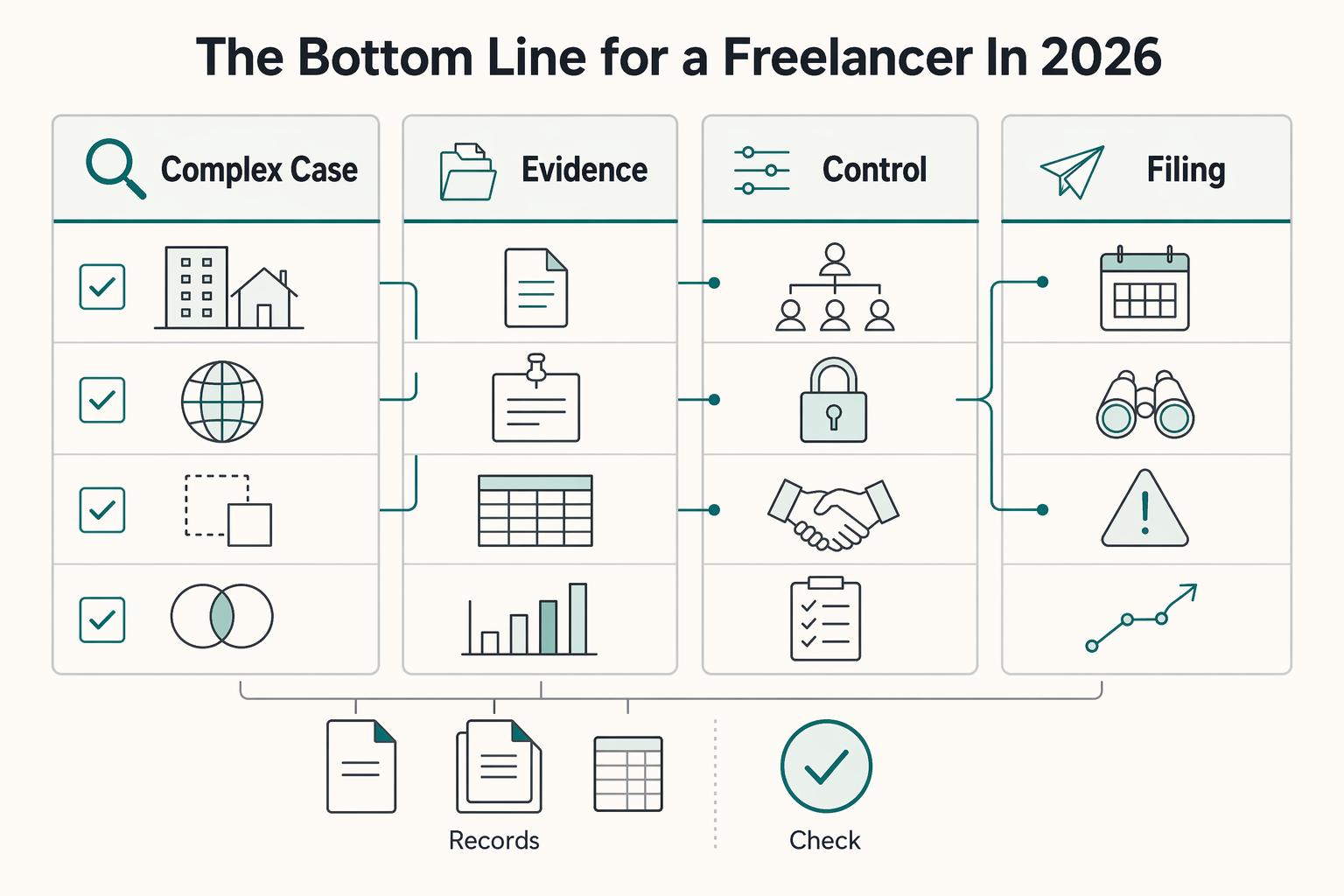
Under the current BOI rule direction, start by classifying each entity, then choose one path: file now, monitor, or escalate. This keeps you from acting on stale guidance and leaves your records audit-ready if guidance shifts.
Scope is the first checkpoint: current rule direction keeps required BOI filing focused on foreign reporting companies, while entities previously treated as domestic reporting companies are exempt from current reporting requirements. For entities that remain reporting companies, update obligations after a change are time-sensitive.
Use this closeout routine after each review:
- Confirm classification for each entity and label it
file,monitor, orescalate. - Save the supporting evidence pack in one place.
- Set a re-check date and triggers for ownership, control, structure, or jurisdiction changes.
- Re-validate against current agency language before any filing action.
If your setup crosses borders, entities, or control structures, escalate early and document the reasoning.
Frequently Asked Questions
Do freelancers still need to file Beneficial Ownership Information under the Corporate Transparency Act?
Some do and many do not. The difference is entity status. Current rule direction focuses BOI filing on foreign-formed entities that register to do business in a U.S. State or tribal jurisdiction, while current alert language says U.S.-created entities are exempt.
If I run a U.S.-formed limited liability company, am I automatically exempt?
Under current alert language, entities created in the United States are treated as exempt, including entities previously described as domestic reporting companies. For many U.S.-formed LLCs, that supports a documented "no filing currently indicated" result.
What if my company was formed outside the U.S. and registered in a U.S. State?
That is the main in-scope pattern to test carefully. If a foreign-formed entity is registered to do business in a U.S. State or tribal jurisdiction through a secretary-of-state-type filing, treat it as potentially reportable and verify timing immediately. For entities that become reporting companies on or after March 26, 2025, the initial BOIR window is 30 calendar days.
Is a Beneficial Ownership Information Report the same thing as a tax filing?
No. A Beneficial Ownership Information Report is filed through the BOI E-Filing channel, not through an IRS return process.
Are older Jan. 1 or Dec. 31 BOI deadlines still practical?
Not by themselves. Older deadline posts are historical context because prior deadlines were stayed and later revised through new rule actions.
Who counts as a beneficial owner in a single-member LLC with delegated managers?
Apply both tests: substantial control and at least 25% ownership or control. Delegating day-to-day management does not remove the need to identify who holds real control rights.
How often should I re-check FinCEN guidance if my entity structure does not change?
There is no fixed annual refiling rule when required information has not changed. If required information changes, file an updated report within 30 calendar days. Even without changes, monitor FinCEN guidance for updates.
Try a related tool
Researched and edited by the Gruv editorial team. Gruv builds cross-border billing, payouts, and finance-operations software for global businesses.
Sources
Includes 4 external sources outside the trusted-domain allowlist.
- boiefiling.fincen.gov/fileboirtrusted
- blog.freelancersunion.org/2024/08/27/updated-rules-on-corporate-transp...external
- blog.freelancersunion.org/2024/05/23/freelance-business-requirements-u...external
- cpaforfreelancers.com/freelance-businesses-must-file-beneficial-ow...external
- cpaforfreelancers.com/have-a-freelance-business-the-corporate-tran...external
Educational content only. Not legal, tax, or financial advice.
Related Posts

Sole Proprietorship vs LLC for Global Freelancers in 2026
For most freelancers in 2026, the practical default is still simple: use the simplest structure you can run cleanly, then formalize when risk actually rises. If your work is still in validation mode and the downside is contained, a sole proprietorship is often the practical starting point. When contract exposure, delivery stakes, or dispute risk starts climbing, forming an LLC deserves earlier attention.

Beneficial Ownership Reporting in 2026 for FinCEN BOI Decisions
Use this as an execution guide, not a legal memo. Your job is to make a current BOI decision, document why you made it, and avoid cleanup later. The outcome is straightforward: confirm whether your entity is in scope, prepare what you need if it is, and keep dated proof of the basis you used.

USA PATRIOT Act Fintech Duties in Bank Partnership Models
The tension is straightforward: you need fast onboarding and payments growth, but your controls still have to hold up under review. In that setting, weak controls are not just a back-office problem. They can shape day-one product choices such as what data you collect, when activity is paused, and how escalations are documented.