
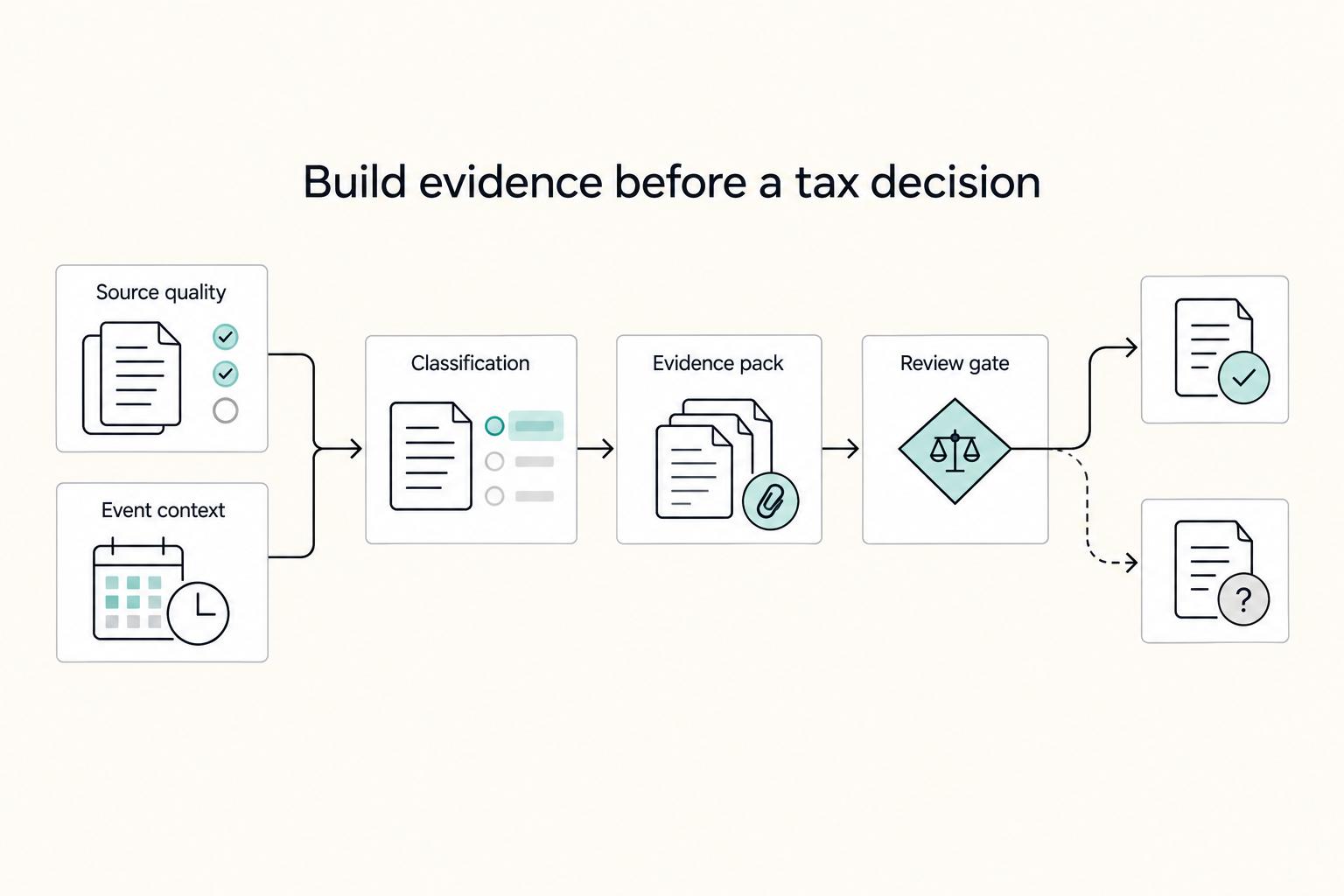
Quick Answer
Classify the event before trusting any rate in imposta sostitutiva italy. For freelance setup, a citation to Article 15 of DPR 601/1973 is a signal about context, not standalone proof of rule fit. Separate business income from property, lending, insurance, or Notes-related material, then verify applicability with Agenzia delle Entrate, INPS, or a qualified commercialista. If you cannot clearly define the triggering event, keep your conclusion provisional and pause filing decisions.
Start here if you are a freelancer in Italy and worried about imposta sostitutiva#
Start by classifying your tax context, not by copying a rate. Imposta sostitutiva can appear in different tax contexts, and the wrong label can push you into the wrong filing logic. As a freelancer, your first question is whether you are dealing with a freelancer operating issue or a different tax topic entirely.
Search results often blur separate topics under similar wording. In practice, freelance-income content can sit next to property-tax and capital-gains content, even though those follow different compliance paths.
Use this baseline: start from business income, then confirm which regime applies to your case. Keep income tax and social security separate in your head. Here, IRPEF and contributi previdenziali through INPS are separate obligations, not one blended payment.
The main confusion to avoid#
Do not treat property-tax examples as freelance defaults. If a page is mainly about IMU, municipality-level rates, cedolare secca on rental income, or five-year capital-gains assumptions, you are probably in a different branch.
That matters because these rules are context-specific. IMU can vary by municipality, and generic assumptions can turn into incorrect payments and penalties. Capital-gains assumptions can also fail in practice, including cases that end in an unexpected 26% bill.
What you should be able to answer by the end#
By the end of this guide, you should be able to answer one practical question: are you dealing with a freelancer operating-regime decision, or a different tax context that needs different rules and documents?
Use this quick checkpoint before trusting any page:
- freelance business income
- property ownership, rental income, or property disposal
- something you cannot classify yet
If you cannot clearly name the triggering event, do not rely on the rate you found.
How this guide helps you sort it fast#
This guide helps you classify first and calculate second. It gives you a plain-language definition, a triage table, decision checkpoints, a document checklist, and clear escalation triggers.
Keep one rule from the start: verify your situation with Agenzia delle Entrate, INPS, or a qualified commercialista. General guides are useful for orientation, but they do not replace personalized tax or legal advice.
Related reading: A Deep Dive into the German Trade Tax ('Gewerbesteuer') for Freelancers.
What imposta sostitutiva means and why the same term misleads freelancers#
For freelancers, the key point is simple: imposta sostitutiva is a label used across different legal contexts, not a single tax product. Do not treat it as one automatic rate for Regime forfettario.
You may also see it tied to legal references from other rule families. Treat those references as context signals first, not proof that the same rule applies to your activity. By themselves, such references do not establish which rule governs a specific freelancer case.
The practical risk is copying a valid number from the wrong branch. Nearby pages can mix freelancer topics with property, rental, lending, or mortgage content, and each has its own logic.
- Property and rental context can include IMU rates that vary by municipality (around
0.5%to1.06%),21%cedolare secca references, or five-year-rule misunderstandings that can trigger an unexpected26%bill. - Lending and mortgage context can include licensed-lender rules, affordability checks like
35%of net income, and document workflows such as passport/fiscal-code copies and translated or certified income documents.
Decision rule: if you cannot name the exact tax context first, do not rely on any imposta sostitutiva rate headline.
For a step-by-step walkthrough, see A guide to the 'One-Stop-Shop' (OSS) for VAT in the EU.
Use this triage to identify which imposta sostitutiva context you are actually in#
Use this as a routing step, not a legal conclusion. Do not treat this triage as strong enough to support precise tax-rule claims. The safest use of this triage is to avoid overconfident category choices, then verify against a readable authority source tied to your exact event.
| Triage signal | What this guide can support | What it cannot support |
|---|---|---|
| Your trigger event | You can define your event first (what happened, and in which document context). | Any definitive tax-rule outcome from this guide alone. |
| Source type | You can separate full-text sources from summary/snippet or access-gated pages. | Precise legal/tax conclusions based on snippet-only or gated content. |
| Topic fit | You can check whether a page is actually about your event type. | Definitive mapping of imposta sostitutiva contexts to freelancer compliance rules without further verification. |
A useful check is to write your trigger event in one line, then reject sources that do not clearly match it.
Also classify source reliability before you trust any conclusion:
- Verified enough for routing: you can read the full substantive text and it matches your event.
- Orientation only: summary pages, snippets, or high-level explainers.
- Unverified: access-gated or excerpt-only pages.
Some conference-paper references on this topic are login-gated and do not include full text, so treat them as unverified for precise tax conclusions.
Where regime forfettario fits for globally mobile consultants and where it does not#
From the accessible material here, the exact legal fit of Regime forfettario for globally mobile consultants is not established. Treat it as a classification to verify, not a catch-all label for every mention of imposta sostitutiva.
Use the label only as a working hypothesis until your filing position is clearly defined. The material you can actually read here does not support advisor-level conclusions about exact applicability, so keep your wording narrow and explicit.
For globally mobile consultants, residency may be relevant, but the legal outcome of residency status requires confirmation from authoritative sources. Keep any sequence you use provisional until classification is confirmed.
Use this checkpoint before planning:
- tax period you are reviewing
- assumed residency status for that period
- income type being classified, for example freelance consulting income
If any line is unclear, treat your conclusion as provisional.
Also watch for vocabulary drift. Do not assume that substitute-tax wording and ordinary income-tax wording, including imposta reddito persone fisiche, automatically point to the same rule set for your case. That legal mapping requires confirmation from authoritative tax sources.
If your mobility pattern or income profile is still unclear, pause optimization and confirm classification first. If residency is the open issue, work through a dedicated residency check, such as Tax Residency in Italy: A Guide for Freelancers and Nomads.
You might also find this useful: Italy Regime Forfettario for Freelancers Who Want Fewer Compliance Surprises.
What Article 15 of DPR 601/1973 covers and what it does not cover for this audience#
If a page cites Article 15 of DPR 601/1973, do not treat that citation as enough to classify your freelance tax position under Regime forfettario. For this audience, treat it as a context clue and verify applicability before you let it drive your filing logic.
Treat Article 15 as a context clue, not a freelancer shortcut#
In this approved source set, there is no authoritative legal text or tax-authority explanation that confirms what Article 15 specifically covers for your case. So you should not use this citation alone to decide whether your freelance income falls inside or outside a forfettario path.
The same caution applies to nearby references like Article 31 of DPR 601/1973 and DPR 917/1986. There is no supported basis to map those references to your freelance setup without further verification.
The source-quality check that matters most#
One concrete item to note is a "JULY 2022 | ISSUE 1 THE BUSINESS MAGAZINE." It states its content is "merely for reference and is not binding in any way." It also disclaims liability for errors or consequences from use.
So the practical rule is simple: if your Article 15 interpretation depends on that kind of material, treat it as background only, not as standalone authority.
Use this quick filter before trusting an Article 15 mention:
- Document type: Is it authoritative legal or tax-authority material, or just commentary?
- Date: A source dated July 2022, which is not enough on its own for a current interpretation.
- Case match: Does it clearly match your taxpayer profile and transaction type?
- Disclaimer language: "Reference only," "not binding," and liability disclaimers mean higher risk if used alone.
For this audience, the conclusion is narrow: an Article 15 citation may be relevant context, but it does not support using it as a standalone answer for freelance tax setup.
This pairs well with our guide on A Guide to VAT Registration for a UK Company Selling to the US.
Do not mix these non-freelance contexts into your forfettario decisions#
Use a hard separation rule here: if a source is about VAT administration, financing, insurance, or property transactions, do not use its tax language as a shortcut for a forfettario decision. Those contexts are not interchangeable with freelance income-tax logic.
Same words, different consequences#
| Context you may be reading | Language that can create drift | What is established | Safe action before any forfettario assumption |
|---|---|---|---|
| Financing | EU Banks, Italian branches of EU Banks, Italian securitization law, EEA white listed country | Do not use these terms as freelancer decision rules without further verification. | Stop rate mapping and classify the transaction separately first. |
| Life insurance | Substitute-tax wording tied to policy or investment outcomes | No life-insurance substitute-tax rule, threshold, or filing consequence is supported here. | Mark as unknown and use product-specific authority before deciding anything. |
| Property sale | Stamp duty, Registration tax, Mortgage tax | These terms are not validated here as forfettario triage rules. | Keep this separate from freelance income-tax decisions until verified. |
This points clearly to a VAT lane, not a forfettario lane:
- CBR covers advance rulings on VAT treatment of complex cross-border transactions, requested in the participating EU country where the person is VAT-registered.
- The cross-border SME scheme requires one prior notification in the Member State of establishment (MSEST) and starts only after the EX number is granted and confirmed.
- OSS is optional, uses one Member State registration, and OSS returns are additional, not a replacement for domestic VAT returns.
So when you see markers like EX number, MSEST, OSS filing cadence, or thresholds such as EUR 100 000 and EUR 10 000, treat them as VAT-administration signals, not imposta sostitutiva rate signals. If your scenario includes lending-security documentation, treat it as a separate context and pause forfettario assumptions until the rule family is verified.
Related: How to Conduct an SEO Audit of Your Freelance Website.
Decision checkpoints for freelancers before you trust any imposta sostitutiva claim#
Short answer: do not rely on an imposta sostitutiva claim until you verify source quality and confirm the event context. Key applicability points require independent verification.
Start with the event, then pause if it is unclear#
Before you use substitute-tax wording, write a one-line description of the event you are evaluating. If you cannot state the event clearly, treat the claim as unresolved. The same label can appear in different contexts, so selecting a tax lane is not settled here.
Confirm your legal and jurisdiction fit separately#
Do not treat general references as proof of your legal bucket, filing lane, or Italy-status fit. Use them only to flag what still needs verification from authoritative tax sources. If your Italy residency position is unclear, keep applicability as unknown until that point is resolved. If useful, review Tax Residency in Italy: A Guide for Freelancers and Nomads.
Run a strict source-quality gate#
Apply a fast rejection test before trusting any page:
| Source type | Example in article | Article treatment |
|---|---|---|
| Category or archive page | "sharia \ | NoahNephilim \ |
| Hosting or marketplace shell | Yumpu page "Villa erba - RM Auctions" | Not legal guidance |
| Popularity or metadata | "11.214 Visualizzazioni"; "09.01.2014" | Not proof of tax applicability |
Conservative rule when contexts conflict#
If two sources use the same label but appear to describe different contexts, mark the point as unknown and escalate before deciding. For this section, that is the only grounded low-risk path.
For a separate VAT topic, see A Guide to VAT MOSS for UK Freelancers Selling Digital Services to the EU.
Build your evidence pack before filing or signing anything#
Build an evidence pack before you file or sign anything. That makes your classification explicit, auditable, and easier to challenge before it turns into a filing mistake.
Start with a one-page classification memo#
Keep one page with your assumed tax context, the exact event you are assessing, and what you ruled out. Do not stop at the label imposta sostitutiva. On its own, it is too broad.
Make ruled-out paths explicit in plain language. If you cannot clearly state what you ruled out, treat the point as unresolved and pause decisions.
Save exact legal excerpts, not just bookmarks#
Store the exact legal text you used, plus the article reference, URL, and access date. If a document uses tax-residency terms, for example the Italian Guarantor definition tied to article 73, keep the excerpt itself, not only a note.
Tag each item by source type, for example official text, commentary, contract language, or explainer. That helps you avoid treating secondary material as if it were controlling legal text, especially when a source may be older, such as one finance source here that shows Last modified 22 January 2020.
| Evidence item | What to keep | Why it matters |
|---|---|---|
| Classification memo | Assumed tax context, event type, ruled-out alternatives, date | Shows your reasoning in one place |
| Legal reference file | Exact excerpt, article reference, URL, access date, source type | Preserves the basis of the decision |
| Transaction-context file | Contracts, invoices, payment trail, deal docs, related correspondence | Confirms the real context behind the label |
| Verification log | Issue, status, evidence, next step, owner/date | Keeps uncertainty visible and practical |
Keep context documents that can change classification#
Keep contracts, invoice trail, and documents showing whether a lending-security setup exists. These documents are context checks, not proof of a final tax result by themselves.
If records show financing markers, reclassify before relying on a substitute-tax assumption. Examples of financing context include a multicurrency revolving credit facilities agreement, "TAX GROSS UP AND INDEMNITIES," the term Italian Guarantor (article 73), and debt-securities prospectus language tied to CONSOB.
Add a verification log and keep unknowns visible#
Use a simple status log with only confirmed, unknown, and needs advisor. This keeps assumptions from being treated as verified facts.
If you capture crypto reporting material, for example Quadro RW / Quadro W and transaction-recordkeeping guidance, label it as crypto-context evidence only. Do not carry it into a freelance-income position just because the same substitute-tax label appears.
Need the full breakdown? Read A Deep Dive into the 'Dividend' Article of the US-Germany Tax Treaty for LLC Owners.
Before you file, run your facts through the tax residency tracker so your classification memo reflects the same assumptions you use in your filing plan.
Red flags that should trigger professional review immediately#
If your evidence file uses financing or securities documents to support a freelance tax position, pause and escalate. The main risk is classification drift, not math.
Financing language inside a freelance position#
Escalate when your reasoning leans on financing-context language, but you cannot show a clear legal bridge to freelance income.
Check the document itself. If it is a Prospectus and uses terms like Notes, Change of Control Event, issue price 98.874%, coupon 3.875 per cent. per annum, or maturity 4 September 2031, treat it as financing documentation, not freelancer tax guidance. Apply the same caution to bank or customer agreement packages, for example Appendix 11 Country Conditions Italy, and material describing conto corrente as a financial liquidity-management contract.
Also treat "regulatory approval" as a non-signal for tax relevance. A prospectus may explicitly state that approval is not an endorsement of the issuer or note quality, and investors are told to assess suitability themselves.
Mixed labels from different tax events#
Escalate immediately if the same memo blends labels from different tax events without proving the legal connection. That is a high-risk sign that one label may be getting reused in the wrong context.
A safe fix is to separate your evidence by event type and keep each position independent until a qualified advisor confirms alignment.
Residency uncertainty is not a minor gap#
If residency status for the period in question is unresolved, stop before filing. That uncertainty alone is enough to trigger professional review.
How to verify safely when sources conflict or key details are missing#
When sources conflict, verify in this order: classify the document context, confirm where the operative tax rule sits, then test applicability to your Regime forfettario facts.
1) Classify context before reading tax labels#
When the core document is a prospectus for the issue of Notes, treat it as a capital-markets context, not direct freelancer operating guidance. If the document is about Notes, interest payments, a coupon of 4 per cent. per annum, or a final amortisation date of 11 December 2030, it does not govern freelancer operating decisions.
If you cannot name the event type in one line, stop and do not use that source for filing decisions.
2) Confirm where the operative tax rule actually sits#
The prospectus language is conditional: interest to certain Noteholders may be subject to Italian substitute tax. It also points to the controlling detail in "Terms and Conditions of the Notes - Taxation" and "Taxation - Italian Taxation."
Before you rely on any summary sentence, make sure your evidence note includes:
- the exact excerpt you relied on
- the follow-on section name the document tells you to read
- a one-line event label for your case and the source context
Do not treat approval language as tax endorsement for your case. The prospectus says approval should not be considered an endorsement.
3) Validate applicability to your forfettario facts#
Only after steps 1 and 2 should you test fit with your facts. If a document does not address freelance-income facts directly, default to not applicable yet.
If legal references are cited without a clear bridge to your fact pattern, mark applicability as unknown and pause.
For each decision, use a short go or no-go note:
- Action: what you plan to apply
- Go only if: context, rule family, and applicability are all evidenced
- No-go if: the source is Notes-focused, approval language is carrying the argument, or a key fact is still unknown
The practical takeaway and your next moves this week#
Start with classification, not rates. Do not use any tax percentage until you can state the exact event in one clear sentence.
Start by ruling out the wrong lane#
Use the tables and checkpoints to eliminate mismatched contexts quickly. If your source is about Italian residential mortgages or property purchase costs, treat it as a property or financing branch, not a freelance-income branch. If it discusses debt securities, an issuance cap tied to share capital and reserves, or a required prospectus filing with CONSOB, treat it as a capital-markets branch.
Headline numbers are not enough on their own. Even in the mortgage source, averages are contextual and depend on loan type, term, and borrower profile, so a number without the right legal bucket is not a decision input.
Build the evidence pack now#
Make advisor review easier by sending a compact pack of facts:
- A one-page classification note: event, likely label, and ruled-out branches.
- The exact documents or excerpts you relied on where labels or context shift.
- Core legal artifacts, for example prospectus- or proxy-related documents, that show what kind of event this is.
- A short verification log with three statuses:
confirmed,unknown,needs advisor. - A freshness note for each legal source, for example if a summary was last modified on
22 January 2020, mark freshness as open.
Escalate unknowns before filing#
If your materials point to conflicting contexts, stop and escalate instead of guessing. In the SEC process example, operational risk centered on missing required evidence or a fixed submission deadline. That example shows both documentary proof requirements and a hard cutoff (5:00 p.m. Amsterdam time, July 19, 2013), which is a useful operational reminder.
Your move this week is simple: classify first, remove financing and property branches quickly, build the pack, and escalate unresolved core facts before relying on any imposta sostitutiva assumption. If residency status is still unclear, treat that as an open compliance item and use Tax Residency in Italy: A Guide for Freelancers and Nomads as the next checkpoint.
If you want a deeper dive, read our guide to a defensible 2026 filing plan.
If any core fact is still ambiguous after the checkpoints, contact Gruv to pressure-test your workflow and confirm the safest operational path.
Frequently Asked Questions
What does imposta sostitutiva mean in Italy for freelancers?
For freelancers, imposta sostitutiva is a label you need to classify by context, not one universal freelancer rule. The same label appears in different legal contexts, including financing, foreign-pension, and new-resident regimes. If you cannot classify the context in one line, do not rely on the rate or rule yet.
Is imposta sostitutiva one single tax rule across all situations?
No. The same label appears in separate regimes with different conditions and amounts: 0.25% in a finance context, an optional 7% in the cited Article 24-ter pension context, and a new-resident HNWI program described at €200,000 per year. The €300,000 figure is presented as proposed, not confirmed in force.
Does the financing-related substitute tax under Article 15 apply to freelance income?
Do not assume it applies. The finance or security material is conditional and tied to specific transaction markers, such as facility execution in Italy, minimum duration of 18 months and one day, and, in some cases, a security document executed as a notarial deed. If those finance markers are not present, treat it as not applicable unless you have a clear legal bridge to your facts.
When does imposta sostitutiva delle imposte sui redditi show up, and is it relevant to my case?
It appears in targeted substitute-tax regimes with defined eligibility, not as a blanket freelancer concept. Article 24-ter is tied to foreign-source pension income with residence-related conditions, including the previous five fiscal years and effectiveness for the first nine fiscal years after the option. That provision alone does not establish relevance for freelance business income.
Can I treat imposta sostitutiva and imposta reddito persone fisiche as interchangeable terms?
No. Substitute-tax wording is used for specific conditional or optional regimes, so do not treat it as interchangeable with general personal income-tax wording. If a source switches labels without explaining why, treat that as a stop signal and reclassify before filing.
What should I do first if I cannot tell which regime applies to me?
Start with a short classification note: income type, current residency status, the exact source you are relying on, and what you have ruled out. Then check for non-freelance markers like notarial deed, registration tax, mortgage tax, secured amount, or loan-duration conditions, which usually indicate a finance or property context. If residency is still unclear, resolve that before rate planning.
Try a related tool
Researched and edited by the Gruv editorial team. Gruv builds cross-border billing, payouts, and finance-operations software for global businesses.
Sources
- academia.edu/6199533/2005_Discussione_del_saggio_Le_origi...trusted
- diposit.ub.edu/bitstreams/ac9ce24e-ab54-4a02-8c63-80f59386c...trusted
- dypbs.edu.in/assets/document/DPU-Busin-Magazine.pdftrusted
- sec.gov/Archives/edgar/data/1619762/0001104659161163...trusted
- sec.gov/Archives/edgar/data/1024519/0001193125132548...trusted
- sme-vat-rules.ec.europa.eu/sme-scheme/cross-border-sme-scheme_entrusted
- taxation-customs.ec.europa.eu/archives/taxable-persons/vat-cross-border-ru...trusted
- vat-one-stop-shop.ec.europa.eu/one-stop-shop_entrusted
Educational content only. Not legal, tax, or financial advice.
Related Posts

Digital Nomad Taxes in 2026 With a Defensible Filing Plan
With digital nomad taxes, the first move is not optimization. It is figuring out where you may be taxable, where filings may be required, and what proof supports that position.

Tax Residency in Italy for Freelancers and Nomads
You can usually reach a defensible first view in one focused sitting: based on your facts, are you more likely tax resident in Italy right now or not. This draft is for freelancers and consultants who want a practical first pass on whether Italy tax residency is likely, then a low-stress routine to keep records aligned with that position.

How to Conduct an SEO Audit of Your Freelance Website
**Run a fundamentals-first SEO audit to prove what Google can access, understand, and rank. Then capture what you find in a way you can actually use.** If you run solo, you're the CEO of a business-of-one, and your website is one of your core operating assets. A site can look fine and still underperform. You need a workflow that forces reality. Not opinions, not tool scores, not vibes. Measurable checkpoints.