
Quick Answer
UK companies do not charge UK VAT on every sale to a US client; the treatment depends on whether the sale is goods, B2B services, or a B2C or special-rule service. Goods exports can be zero-rated when Notice 703 conditions and route-specific export and evidence deadlines are met. General-rule B2B services to a US business are usually outside UK VAT.
Expanding your UK business into the US market is a real milestone. It also brings up a question early, and often more than once: how do you handle UK VAT correctly?
Cross-border VAT rules are not always intuitive. When the treatment is unclear, that uncertainty can turn into invoice delays, client friction, and unnecessary HMRC risk.
You do not need to become a tax specialist overnight. You need a repeatable way to decide each sale, keep the right evidence, and report it consistently. The simplest approach is to work through the same three steps every time: Classify, Document, and Report. Done properly, that turns VAT from a background worry into a routine part of selling to US clients.
Step 1: Classify Your Supply - Goods or High-Value Services?#
VAT treatment starts with classification. Before you invoice, decide whether the contract is for goods, B2B services, or a B2C/special-rule service. That decision drives the UK VAT treatment from the start.
Use this first-pass route:
- Goods: You are shipping physical items from the UK to the US. These can be zero-rated if you meet Notice 703 export and evidence conditions, including the deadline for the actual export route.
- B2B services: You are supplying services to a US business. Under the general rule, services are taxed where the customer belongs, so this is typically outside the scope of UK VAT.
- B2C or special-rule services: If the customer is not in business, the default B2C rule is where the supplier belongs, unless a special rule applies, including some digital services.
| Supply type | VAT treatment label | Charge UK VAT? | Invoice implication | Why it matters later |
|---|---|---|---|---|
| Goods exported UK to US | Zero-rated export | No, if zero-rating conditions are met | Treat as zero-rated export, not a standard-rated UK sale | You must hold export evidence and apply the correct goods treatment |
| B2B services to a US business | Outside scope of UK VAT | No | Do not add UK VAT if B2B status is evidenced and the general rule applies | Outside-UK place of supply affects VAT treatment and taxable-turnover calculations |
| B2C or special-rule services | Depends on the rule that applies | Do not assume | Pause and verify before invoicing | Misclassification can change the VAT treatment completely |
For service businesses, the practical checkpoint is proving that the US customer is in business. HMRC allows non-VAT-number evidence routes for non-EU customers, so build a basic pre-invoice pack such as:
- Contract documents showing the customer's business identity and address
- Business letterhead or commercial website
- Publicity material showing business activity
- Fiscal certificate or other business tax documentation
If you cannot support business status, the default treatment is B2C.
Pause before invoicing when the facts are mixed, such as goods and services in one bundle, an unclear contracting party, or a service that may fall under a special rule. Verify the contracting entity, confirm business status, and check whether an exception overrides the general rule. If it still is not clear, get VAT advice before you lock in the treatment.
Keep the goods export proof and service customer-status proof in separate files so a reviewer can reconstruct each treatment.
Step 2: Build a Records File Another Reviewer Can Follow#
Build each company VAT file so another reviewer can follow the transaction without extra context: contract and buyer, invoice, export or business-status evidence, payment and VAT code.
HMRC Notice 703 sets the export proof route for goods, and VATPOSS06500 describes acceptable evidence that a non-EU customer is in business. Use the evidence track that matches the sale.
| Evidence track | What to collect | Why it matters | Where teams usually fail |
|---|---|---|---|
| Goods export | Sale record plus official or commercial export evidence under Notice 703 | Supports zero rating and links the sale to the goods leaving the UK | Invoice exists but export proof or timing is missing |
| B2B service buyer | Contracting entity, US location and evidence of business activity under VATPOSS06500 | Supports the customer-status decision for the general place-of-supply rule | Assuming a US address alone proves B2B status |
| Company VAT Return | Invoice, VAT code, Box 6 mapping and reconciliation to company ledger | Notice 700/12 includes both qualifying exports and outside-scope services in Box 6 | Treating outside-scope as exempt or omitting the sale from Box 6 |
| Registration monitoring | Rolling UK taxable turnover and any next-30-day expectation | Zero-rated UK exports count toward the threshold; general-rule services supplied abroad have a separate scope | Excluding every US sale from the registration calculation |
Goods export proof#
HMRC Notice 703 requires evidence of the sale and official or commercial evidence of export, as appropriate. The record must trace the goods from sale to export and identify the parties, goods, value, destination and transport route. For ordinary direct exports, export and evidence are normally due within three months of the time of supply; check Notice 703 for route-specific exceptions.
B2B service client-status proof#
HMRC VATPOSS06500 accepts evidence for a non-EU customer such as a business website, commercial documents or a fiscal certificate when a VAT number is unavailable. Keep enough to show the actual contracting customer is in business. If you cannot establish business status, start with the B2C rule and check whether a special service rule applies.
Minimum defensible evidence pack#
If one document is missing, do not guess. Start from the minimum file you can defend:
| File element | Include |
|---|---|
| Transaction | Contract, order or scope, customer legal identity, invoice and payment record |
| VAT basis | Goods export evidence or US customer business-status evidence, plus any special-rule check |
| Reporting | Company VAT code, Box 6 mapping, tax point and reconciliation note |
| Gap note | What is missing, what you checked, and who is responsible for closing the gap |
| Mixed or ambiguous cases | A short written rationale for the treatment you chose |
Add an internal note that states what is missing, what you checked, and who is responsible for closing the gap. For mixed or ambiguous cases, include a short written rationale for the treatment you chose.
File it so you can report from it#
A consistent folder structure saves time later. Use one company transaction file for the contract, invoice, customer or export evidence, payment, VAT treatment note and return reconciliation. Keep open evidence gaps visible until resolved.
For goods exports, monitor the Notice 703 export and evidence deadline. For UK VAT registration, monitor taxable turnover over rolling 12 months and any expected next-30-day threshold breach. Use the company's VAT period dates for its return and payment controls.
Keep company VAT registration, return and Corporation Tax administration separate from any director's personal Self Assessment.
If one customer buys both goods and services, keep separate treatment notes and supporting evidence for each element.
Step 3: Report with Confidence - Perfecting Your Invoice and VAT Return#
Once the classification is right and the evidence file is complete, reporting should be as mechanical as possible. Your invoice, VAT code, and return entry should all follow the file you already built, not a last-minute judgment call.
Build the invoice from the treatment, not from habit#
Invoices should reflect the treatment you decided, not whatever your last template happened to say.
| Invoice control | Requirement |
|---|---|
| Invoice number | Use a unique sequential invoice number |
| Time of supply | Keep this core field correct |
| Cross-border B2B wording | Use invoice wording checked against current HMRC guidance or qualified tax adviser records |
| Wording placement | Place it directly under line items or immediately above totals |
| Party mismatch | Pause and reconcile if the contract party, invoice party, and paying entity do not match |
For B2B services, start with place of supply. Under the general rule, if your business customer belongs outside the UK, UK VAT is not chargeable. Do not apply that automatically to every service sale to a US client, because special rules can apply in some cases.
When you build the invoice, make sure the basics are right first, especially the unique sequential invoice number and the time of supply. For cross-border B2B services, use invoice wording checked against current HMRC guidance or qualified tax adviser records, and place it directly under line items or immediately above totals so the client's AP team can process it quickly.
If the contract party, invoice party, and paying entity do not match, pause and reconcile that before you issue the invoice.
Route each sale into the return deliberately#
Do not post first and rationalize later. Start with the Step 1 classification, then confirm that the Step 2 evidence supports it before you code the sale.
| Sale type | VAT treatment | Return destination | If classification is uncertain |
|---|---|---|---|
| Goods export from the UK | Zero-rated only if export evidence is obtained and retained | For a VAT-registered company, include the net export value in Box 6 under Notice 700/12; confirm software mapping | Do not assume zero rating; hold for review if export proof is missing or inconsistent |
| B2B services under the general rule (customer belongs in the US) | Outside scope of UK VAT when place of supply is outside the UK | For a VAT-registered company, include the net value in Box 6 under Notice 700/12; confirm software mapping | Recheck whether a special rule applies before coding outside scope |
| Unclear or mixed case | Do not force a code from memory | Pause posting or use a temporary review code outside final return flow | Escalate with contract, invoice draft, and evidence pack attached |
Keep registration logic separate from return logic. Qualifying zero-rated goods exports are taxable supplies and count toward the £90,000 VAT registration test; general-rule services supplied where the US business belongs are outside UK VAT and are not UK taxable turnover. HMRC tests rolling 12-month turnover and expected turnover in the next 30 days. Notice 700/1 also describes voluntary registration for some UK-established businesses making overseas supplies.
Add hard controls before submission#
Two controls are worth prioritizing before you file: export-evidence timing for goods, and accurate digital filing.
For goods exports, track the applicable Notice 703 deadline. Ordinary direct exports normally require export and evidence within three months of the time of supply, but some routes have different periods. If proof is missing at the relevant deadline, review the VAT treatment before relying on zero rating.
For filing, rely on digital controls. VAT-registered businesses are generally required to file through functional compatible software and pay electronically, so invoice setup, coding, and tax-point accuracy are all part of compliance.
Use a simple US sales-tax risk screen#
A clean UK VAT position does not tell you whether the US side is clear. US indirect tax exposure is state-level, not federal, so screen risk by state:
| Risk level | When it applies |
|---|---|
| No action | No verified state trigger met based on your current facts |
| Monitor | Repeated sales into specific states, or sales approaching a state threshold and measurement period verified from current official state records or a qualified tax adviser |
| Escalate to advisor | Any potential state presence or a verified trigger crossed |
State rules differ by sales type, measurement period and presence. Check each relevant state tax authority's current rules before using any threshold in a US sales-tax decision.
Operator checklist before you file#
Use a short pre-submit check so filing stays tied to the underlying evidence:
- Confirm each sale still matches Step 1 classification: goods export, general-rule B2B service, or exception-for-review.
- Confirm Step 2 evidence is complete for that classification.
- Check invoice output: sequential number, correct time of supply, and verified cross-border wording in the correct location.
- Validate accounting or VAT code against evidence, not memory.
- For goods, confirm sale and export evidence met the Notice 703 deadline for the actual route.
- Run a pre-submit review of Box 6 postings, unresolved exceptions, and any live-guidance points that still need verification.
Check the company VAT registration test separately from the Box 6 reporting instruction; they answer different questions.
Before you send your next US invoice, use the free invoice generator to help standardize wording and keep records consistent for your return workflow.
Run the Same Classify, Document, Report Loop on Every Engagement#
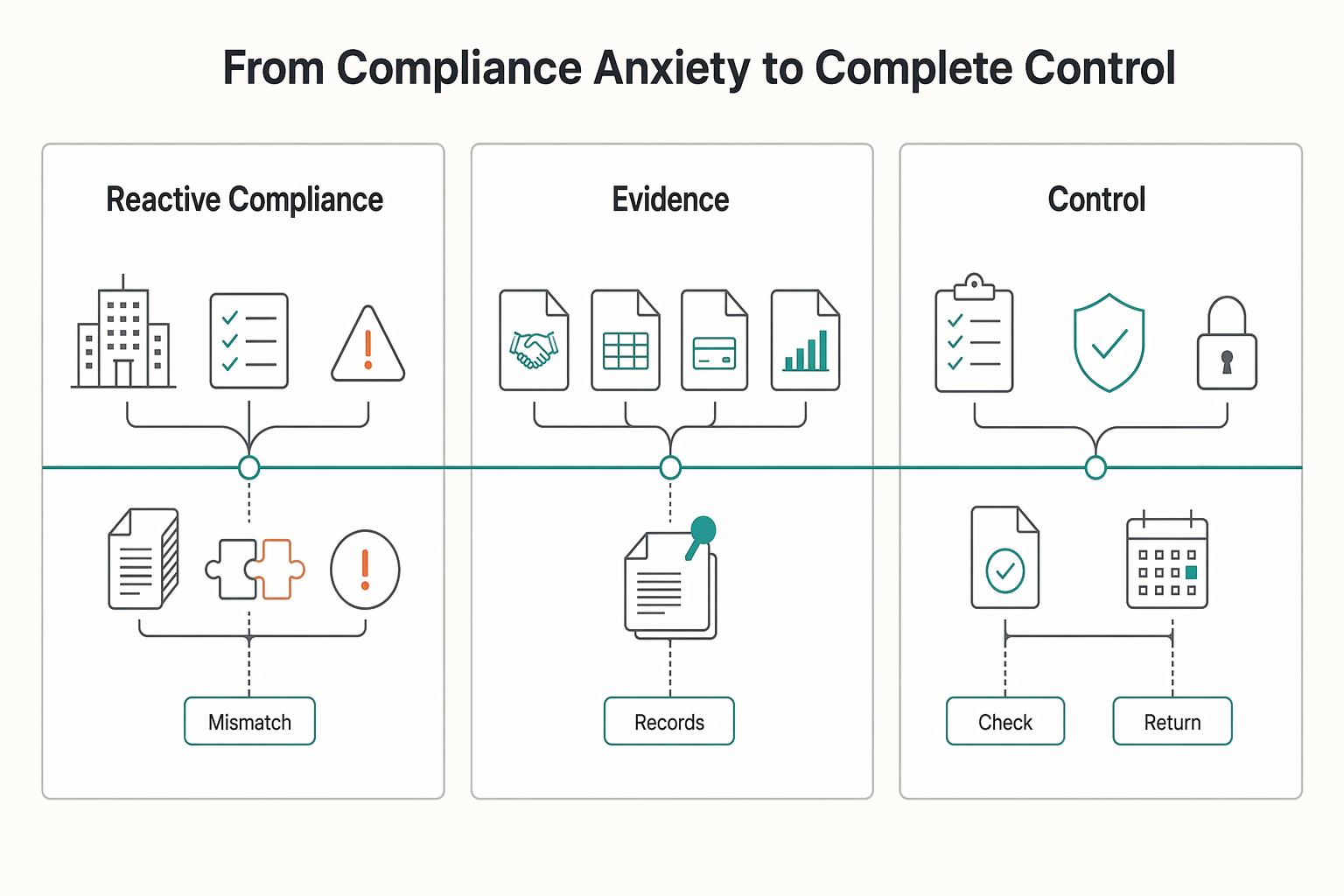
Control comes from running the same Classify -> Document -> Report loop on every engagement, then repeating it at month end.
In practice, classify the company's sale, collect the right export or buyer-status evidence, issue the invoice, and reconcile its VAT code and Box 6 entry to the same file. Monitor company VAT registration separately from return reporting. That sequence cuts avoidable rework and leaves a clearer HMRC trail.
| Approach | What happens in practice | Common failure point | Safer default |
|---|---|---|---|
| Reactive compliance | You invoice before classifying goods or services | The invoice and VAT code may apply the wrong treatment | Classify and collect evidence before issuing |
| Partial documentation | You keep only one or two records | You cannot clearly support what was filed | Keep one engagement file with key records and decision notes |
| Controlled workflow | You run the same checks each time and log decisions | Export proof or Box 6 mapping is checked too late | Check Notice 703 timing and reconcile the VAT Return before submission |
Keep the company's VAT checkpoints in view: monitor the registration threshold, obtain export proof on time, retain customer-status evidence and reconcile each VAT period through compatible filing software where required.
Use this quick checklist each cycle:
- Verify the company's VAT registration status, sales classification, tax point and supporting evidence.
- Record your decision notes and supporting records when the invoice is raised.
- Pause and get specialist advice if VAT treatment is unclear.
For mixed goods and service contracts, record the separate treatment of each element before filing.
If your client mix spans multiple countries and VAT treatment feels unclear, run a quick decision check with the VAT reverse charge checker.
Frequently Asked Questions
Do you charge VAT on consulting services to a US company?
For ordinary consulting supplied to a US business, the general B2B rule places the service where the customer belongs, so the UK company does not charge UK VAT. Keep evidence that the client is in business and check whether a special place-of-supply rule applies to the actual service.
What wording should you put on a UK invoice to a US client for services?
For a general-rule B2B service, state that no UK VAT is charged because the place of supply is outside the UK. Include the supplier and customer identities, a clear description, invoice date and number, amounts and payment terms. Use a different note if a special rule changes the result.
What documents count as proof of export for physical goods?
HMRC Notice 703 accepts official or commercial export evidence, as appropriate, together with sale evidence. Keep documents that clearly trace the goods, parties, quantities, value, destination and transport route. For ordinary direct exports, obtain the export proof within three months of the time of supply.
How do you prove a US client is a business for VAT purposes?
For a non-EU customer, HMRC VATPOSS06500 allows evidence such as a business website, commercial documents or fiscal certificate when there is no VAT number. Match that evidence to the contracting entity and retain it with the invoice. Without adequate business-status evidence, use the B2C starting point and check special rules.
Do you need to register for VAT in the UK if you only sell to US clients?
Possibly. Qualifying zero-rated UK goods exports count as taxable turnover toward the £90,000 mandatory registration threshold, measured over a rolling 12 months or where that amount is expected in the next 30 days. General-rule B2B services supplied where the US customer belongs are outside UK taxable turnover. Notice 700/1 also allows voluntary registration in some overseas-supply cases.
Does "no UK VAT" mean you do not have to worry about other taxes or filings?
No. A UK limited company still has company tax and accounting obligations, and US state sales-tax exposure may need a separate review. Keep company VAT, Corporation Tax and US-side checks in distinct records. A director's personal Self Assessment is a separate matter.
What if one contract includes services plus a deliverable, licence, or physical item?
Treat it as a review case, not a routine invoice. This section does not provide a verified single VAT treatment for mixed contracts. Document contract terms, pricing, and deliverables clearly, verify current VAT treatment before invoicing, and escalate if your file cannot clearly support the approach.
Try a related tool
Researched and edited by the Gruv editorial team. Gruv builds cross-border billing, payouts, and finance-operations software for global businesses.
Sources
Includes 2 external sources outside the trusted-domain allowlist.
Educational content only. Not legal, tax, or financial advice.
Related Posts

Digital Nomad Taxes in 2026 With a Defensible Filing Plan
With digital nomad taxes, the first move is not optimization. It is figuring out where you may be taxable, where filings may be required, and what proof supports that position.

Understanding the UK's Statutory Residence Test (SRT)
Treat SRT like ops, not folklore. You want a repeatable workflow you can run monthly so your tax-year answer is boring, documented, and easy to defend.

VAT for UK Freelancers Without Filing Surprises
For a UK-established freelancer, VAT begins with the value and location of supplies, not profit or a marketplace tax setting. Check whether registration is compulsory, establish the effective date, then connect invoices, digital records and VAT returns.