
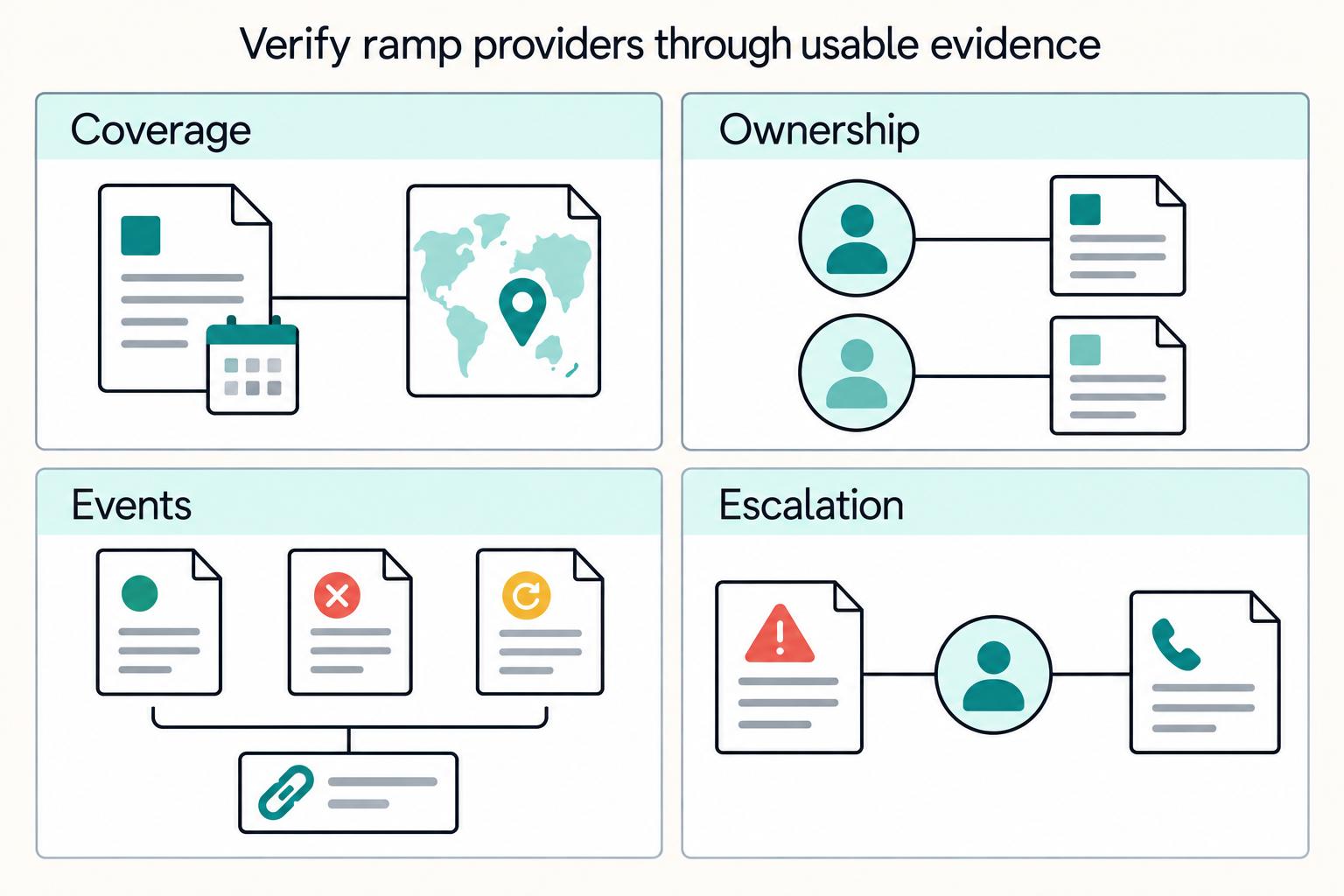
Quick Answer
First define who funds and receives the payment, countries, currency, token, chain and final rail. Consumer buy/sell ramps, crypto transfers and business-funded bank payouts require different product permissions. Choose the enabled provider path, then prove traceability and safe recovery for normal settlement, rejection and unknown execution before scaling.
Why On-Ramp and Off-Ramp Infrastructure Matters#
Choose infrastructure for the actual payout path: fiat funding, crypto delivery, or crypto conversion followed by a bank payout. A consumer buy/sell widget and a business disbursement program can share conversion technology while having different beneficiary permissions, compliance and recovery rules.
- What these platforms actually do
At the simplest level, on and off ramps exchange fiat currencies for cryptocurrencies and back again. They bridge traditional finance and digital asset markets. That definition is useful, but many teams stop there too early. For a platform, you need to decide whether your product needs fiat to crypto, crypto to fiat, or both before you compare vendors. The operating burden changes quickly once payouts, reversals, and support queues enter the picture.
- Why payout use cases are the real test
Business-focused crypto conversion is often framed as a practical tool for global operations, international payments, and multi-currency needs. That is why contractor, creator, and marketplace payouts can be more complex than a consumer buy flow. You are not optimizing for a one-time purchase. You are managing multiple moving parts at once: corridor coverage, the asset and currency path, and program-level compliance requirements.
A good early checkpoint is simple. Write down your launch corridors and program scope first, then ask each provider to confirm what is actually supported there. One risk is buying into a broad global story before you verify the specific countries, payout methods, and onboarding requirements that apply to your first release.
- What you should expect from this guide
From here, the focus stays on platform execution, not consumer trading or token speculation. You'll get a shortlist format you can use in a real buying process: who each option fits, the main pros and cons, and where teams get burned in production. We'll look at embedded ramp options, treasury-style conversion rails, and modular orchestration approaches through the questions that matter when you have four internal owners to satisfy: finance, ops, engineering, and compliance.
- The outcome to aim for
By the end, you should be able to choose an architecture, pressure-test providers, and align your launch plan across the people who will have to run it after signing. That means checking more than product screenshots. You want evidence that a provider can support your actual program boundaries and that your team knows where responsibility starts, where it ends, and what happens when a payout does not go to plan.
How to choose the right option for your platform#
Choose based on ownership first, then features. The right option is the one your finance, ops, engineering, and compliance teams can explain and run under audit.
| Area | What to confirm |
|---|---|
| Corridor coverage and payout methods | Exact launch path, supported fiat currencies, withdrawal methods, and written confirmation for launch countries and methods |
| Compliance ownership | Licensing coverage by jurisdiction and KYC, KYB, and AML responsibilities, with explicit escalation paths |
| API and integration quality | Implementation clarity, API support, and whether the model is custodial or non-custodial |
| Reconciliation and failure handling | Sample transaction exports, reference IDs, status states, and records for failed or returned transfers |
- Corridor coverage and payout methods
Define who funds the payment and who receives it, then list country, fiat currency, token, chain and payout method. USD to USDC is an asset pair, not a complete corridor. Specify whether the same user buys or sells crypto, a platform sends crypto to a contractor, or a business funds a third-party fiat payout. Get the provider’s approval for that exact use case.
- Compliance ownership
Treat this as the core decision point. Get a written split of licensing coverage by jurisdiction and KYC, KYB, and AML responsibilities. If your team cannot yet run KYB operations or review queues, prioritize providers with stronger managed compliance and explicit escalation paths.
- API and integration quality
"Has an API" is not enough. Look for straightforward implementation, clear API support, and fit with your operating model. Confirm whether the model is custodial or non-custodial, because that changes fund control and support burden when exceptions happen.
- Reconciliation and failure handling
For payout infrastructure, audit trail quality matters more than front-end polish. Ask for sample transaction exports, reference IDs, status states, and clear records for failed or returned transfers. If a provider cannot show request-to-settlement-to-exception flow, it is not ready for a serious platform payout program.
Related contractor payout design: Crypto Payouts for Contractors: How Platforms Can Offer USDC and Stablecoin Payments.
Comparison snapshot of the top platform approaches#
Compare the product permission and operating evidence, not provider counts. A ramp aggregator can expose many integrations without establishing that any supports your business, third-party beneficiaries or chosen token network.
| Path | Best for | Supported rails to confirm | Integration surface | Compliance model to pin down | Operational burden | Webhook reliability assumptions | Idempotent retry expectations | Reconciliation artifacts | Payout failure recovery ownership | Fee model transparency | Settlement claims language | "Global coverage" constraint check |
|---|---|---|---|---|---|---|---|---|---|---|---|---|
| Embedded ramp integration (for example, MoonPay) | Fast in-product launch | Confirm USD, USDC, BTC, ETH by country, method, and direction (on-ramp vs off-ramp) | Confirm exact API, SDK, and dashboard scope in writing | Get a written KYC/KYB/AML responsibility split and escalation path | Lower at launch, but exception work can grow | Treat webhook delivery behavior as a contract item, not an assumption | Define replay-safe handling before go-live | Require reference IDs, status history, timestamps, and failure codes | Define provider vs platform actions for rejects, returns, and user comms | Ask for line-item fee components | Treat "instant" as corridor-specific until documented | Treat "global" as jurisdiction- and program-dependent |
| Treasury-style fiat-crypto infrastructure (for example, OpenPayd) | Finance-led conversion and payout operations | Confirm account-level enablement for USD, USDC, BTC, ETH | Confirm API, dashboard, and any desk-assisted workflow boundaries | Document who owns checks, reviews, and approvals at each stage | Higher setup effort, with more internal control design | Get event and status behavior documented for your flow | Test retries against partial-failure scenarios | Require conversion refs, payout IDs, and statement/export mapping | Assign who executes retries, returns, and manual exception handling | Ask where pricing layers apply | Require settlement wording by corridor and rail | Validate where coverage depends on account setup |
| Modular software with licensed execution partners | Teams that want one control layer while changing licensed partners over time | Confirm the business use case, country, token and chain through each partner; software availability must be verified separately | Confirm the software API and each partner integration are available for the approved scope | Separate platform and software obligations from authorized partner custody, conversion and transfer | More upfront design discipline, less provider lock-in later | Define upstream/downstream webhook responsibilities clearly | Use idempotent keys and duplicate-posting protection across layers | Keep dual traceability: provider references plus internal ledger/event IDs | Define who triggers reroute/retry/manual override and who records it | Separate orchestration fees from provider fees | Require precise, non-generic settlement wording | Coverage still depends on underlying jurisdictions and enabled programs |
Many comparisons emphasize pricing models and settlement times, which helps with shortlisting. For platform payouts, you also need operating evidence: sample webhook payloads, retry and replay examples, failed payout cases, and reconciliation exports tied to provider references.
The practical checkpoint is simple: for one transaction, can your team trace request, settlement, failure, and recovery without spreadsheet patching? If not, the model is not ready yet.
For a step-by-step walkthrough, see Crypto Payouts for Contractors: USDC vs. USDT - What Platforms Must Know.
Embedded ramp providers for fastest in-product launch#
Embedded ramps can reduce the work of building a user buy/sell checkout. That is a useful fit when users fund purchases or sell their own assets; it does not by itself establish permission for a platform to disburse earnings to third parties.
| Item | Grounded detail | What to verify |
|---|---|---|
| Best fit | Embedded user buy/sell checkout | Whether the user owns the funding and proceeds, or you need a business payout product |
| Integration | MoonPay Ramps offers headless and hosted paths | Current methods, asset/network and country eligibility |
| Business disbursement | MoonPay Enterprise Pay Out is a separate product | Approved funding source, beneficiary types, limits and countries |
| Operating records | Request provider references, lifecycle events and settlement exports | Identity checks, ambiguous status, failures and supported recovery paths |
Why teams pick this path first#
MoonPay Ramps offers headless and hosted user buy/sell integrations with payment methods and identity checks. For business-funded local-currency disbursements, evaluate its separate Enterprise Pay Out product, which describes stablecoin receipt, conversion and bank settlement. Confirm the enabled product and beneficiary model before integrating.
For example, a creator buying USDC with their own card is a user on-ramp. A platform sending earned USDC to the creator’s wallet is a crypto transfer. Converting treasury USDC and paying the creator’s bank account is a third-party off-ramp/disbursement. Test and contract for the chosen path instead of treating all three as one widget feature.
What you give up as volume grows#
The tradeoff is control. As volume and exception cases increase, you may have less control over underwriting decisions, step-up checks, and corridor-specific policy behavior than you want for payout operations.
Check current country and method eligibility separately for buying, selling and business payouts. Broad coverage figures do not establish beneficiary eligibility, chain support, account limits or the contracting entity for your flow.
When this is the right move#
Choose embedded first when launch speed matters more than deep payout customization. It is often a strong phase-one choice if you plan a phase two for tighter payout controls.
Before signing, ask for:
- a sample webhook payload with provider reference IDs and status history
- a failed payout example with failure codes and retry behavior
- a reconciliation export that finance can map to your internal ledger
A failure to watch for is losing state clarity when asynchronous events arrive late or twice. Fix event mapping and reconciliation before changing architecture; an extra orchestration layer will not automatically repair an ambiguous provider lifecycle.
Treasury and institutional conversion rails for larger payout operations#
Treasury and institutional conversion rails are usually the better fit when finance needs tighter control and audit-ready conversion workflows more than the fastest in-app flow.
In a treasury model, the business controls its funding and release approvals while a contracted provider performs the authorized conversion and money movement. Confirm whether funds belong to the business or its customers; accepting and holding customer balances can change the legal and operational model.
OpenPayd’s on/off-ramp offering describes API, dashboard and desk-based conversion. Its page identifies separate fiat and digital-asset service entities and directs digital-asset information to experienced persons outside the UK. Treat those scope limits as part of diligence rather than assuming the group’s fiat permissions cover every crypto service.
The tradeoff is implementation weight. You take on more internal process design across KYB, compliance escalation, approval routing, and reconciliation. Before signing, ask for:
- a full conversion lifecycle example with reference IDs
- a settlement report finance can reconcile
- one failed or returned payout example shown end to end
Record the entity contracted for fiat services and the entity providing digital-asset custody, conversion or transfer. Check their authorized scope against the business, customers and countries in the launch file; a group-wide brand name does not establish a single worldwide permission.
A practical rule: choose this path when controlled conversion, approval discipline, and clear settlement evidence are mandatory. If your priority is still a fast consumer buy or sell experience, embedded ramps may remain the better near-term choice.
For treasury use, approve the conversion amount, beneficiary and fee quote together. A later bank return needs its own reconciliation and recovery decision; do not automatically unwind the crypto leg.
Modular orchestration with selected licensed partners#
A modular architecture separates your workflow software from the providers that custody, convert and transfer assets. Define the software’s policy, ledger and status responsibilities and the partner’s regulated execution responsibilities. For a Gruv evaluation, confirm the currently available integration and partner scope before relying on crypto coordination; this architecture description does not establish live Gruv ramp availability.
Your software layer can keep a common ledger and exception process while different partners serve different corridors. The benefit depends on mapping each partner’s actual states, fees and references; changing a partner still requires onboarding, policy and recovery tests.
Pros and cons that matter in practice#
Pros
- You can add or replace a market-access partner with less downstream rework.
- Your team can keep one reconciliation model and one internal status vocabulary while partner coverage changes.
- It can support a single control model across related money-movement flows where enabled.
Cons
- You must define canonical identifiers, state mapping, and async event normalization up front.
- Weak idempotency or unclear state mapping creates reconciliation drift and duplicate-posting risk.
- A second provider will expose unresolved assumptions from the first integration.
Control ownership to pin down before you commit#
| Layer | Primary owner in modular setup | What to verify in writing |
|---|---|---|
| Market access, custody, and conversion | Licensed ramp partner | Supported jurisdictions, assets, custody and conversion authorizations, and onboarding constraints |
| Policy and routing | Workflow software/platform (confirm enabled scope) | Whether routing and policy logic is configurable and audit-traceable |
| Ledger traceability | Workflow software/platform (confirm enabled scope) | How internal transaction IDs map to provider references end to end |
| Retry handling | Workflow software/platform (confirm enabled scope) | Idempotency key strategy and replay behavior for webhook retries |
| Payout status surface | Workflow software/platform (confirm enabled scope) | Lifecycle states, terminal outcomes, and exception visibility for ops |
Pilot one approved provider path first. Add a second only after mapping its distinct identifiers, states and recovery behavior to the same internal payment obligation. A common interface must retain provider-specific facts rather than hide them.
Modularity can reduce downstream rework when partners change, but adds interfaces, evidence joins and support coordination. A single enabled provider can be simpler for a narrow scope. Compare the total operating burden for your launch.
Before you sign, ask for operational artifacts, not slides: a transaction state map, sample webhook payloads, documented retry semantics, and one failed or returned payout trace.
Due diligence checks before you sign any provider#
Do not sign on demo quality. Sign on evidence your ops, finance, and engineering teams can use: coverage documents, compliance ownership, event artifacts, and finance-readiness answers in writing.
| Check | What you ask for | Pass evidence | Fail signal |
|---|---|---|---|
| Jurisdiction coverage | Written coverage docs for your launch markets and assets | A current document naming supported countries, currencies, and onboarding constraints | "Global" claims with no dated coverage document |
| KYC, KYB, AML ownership | A responsibility matrix for collection, review, and exceptions | Clear split between provider tasks and your platform tasks, including escalation ownership | "Shared compliance" language with no named owner |
| Webhook and event model | API docs plus sample payloads for success, failure, and return cases | Payload examples with event names and reference IDs | Happy-path diagram only |
| Incident escalation | Contract language or support terms for urgent issues | Named escalation path, response channel, and severity process | "Contact your account manager" with no formal process |
1. Coverage and compliance ownership. Start with documents, not assurances. On-ramp and off-ramp services handle fiat-to-crypto and crypto-to-fiat conversion, and centralized providers are commonly under regulatory oversight and often require KYC and AML procedures. Your key diligence question is simple: if a user or business fails review, who acts, who communicates, and who owns the audit trail?
2. Data artifacts before build. Require these artifacts up front: a sample payout status lifecycle, provider reference IDs, reconciliation exports, and dispute or return handling records. If a provider cannot map external transaction states to your internal ledger events, treat that as a no-go.
3. Tax and finance readiness. Define the value and currency used to settle the underlying contractor obligation, the conversion and network-fee entries, and the reporting data Finance needs. Payment or conversion support does not by itself establish tax-form collection or filing support. Record those dependencies separately with the tax owner.
4. Decision rule. Choose the provider with the clearest evidence pack, not the loudest claims. If options look similar, clearer state mapping and reconciliation artifacts are usually the safer operating choice.
Recover an unknown attempt without paying twice#
Give the underlying payable one stable obligation ID and each provider execution attempt its own ID. Reserve the payable amount before execution. If a request times out, record the attempt as unknown and query by its provider reference or supported idempotency key. Do not route a replacement to a second provider until the first attempt is confirmed not executed or an authorized recovery plan resolves the exposure.
Authenticate webhook events, retain their raw references, and deduplicate delivery separately from financial posting. Apply valid state transitions and query current provider state when messages conflict. Post each confirmed financial movement once under its own movement identity; late return or refund events are new linked movements, not a replay of the original payment.
For a hypothetical $1,000 contractor obligation, record the agreed denomination and who bears fees. If a conversion produces $990 of bank proceeds after $10 of agreed fees, settle only the amount and terms the contractor accepted. If the bank rejects the payout after conversion, track the returned fiat and its fees; do not mark a new crypto payment safe just because the bank leg failed. If the original crypto transfer already reached the intended wallet, no automatic bank-style reversal exists.
Implementation sequence for the first 90 days#
Phase the rollout in a fixed order: approve the corridor and beneficiary model, assign compliance owners, make execution and events retry-safe, prove the ledger-to-provider bridge, then test failure recovery before increasing volume.
| Step | Focus | Grounded detail |
|---|---|---|
| 1 | Lock the first corridor and asset scope | Define funder, beneficiary, source and destination countries, fiat currency, token, chain and final payout rail for the approved product |
| 2 | Set compliance gates before final API contracts | Decide who collects and reviews KYC, KYB, and AML requirements, who handles exceptions, and where audit evidence lives |
| 3 | Treat webhook idempotency as a pre-launch requirement | Prove replay-safe processing for asynchronous events and validate behavior for out-of-order events |
| 4 | Make reconciliation traceability visible by day 60 | Trace each payout from request to provider reference to settlement, including failed and returned flows |
| 5 | Scope tax/reporting now vs later, then gate scale on failure testing | Define valuation, fee and reporting records with Finance/Tax; test pre-execution rejection, ambiguous execution and supported bank returns |
-
Lock the first corridor and asset scope. Document funder, beneficiary, source and destination countries, fiat currency, token, chain and final payout rail for the approved product. Align product, compliance, finance and engineering on that complete scope before expanding.
-
Set compliance gates before final API contracts. Decide who collects and reviews KYC/KYB/AML requirements, who handles exceptions, and where audit evidence lives for pass, fail, pending review, and resubmission states.
-
Treat webhook idempotency as a pre-launch requirement. Prove replay-safe processing for asynchronous events so retries do not duplicate internal ledger postings, and validate behavior for out-of-order events.
-
Make reconciliation traceability visible by day 60. Finance ops should be able to trace each payout from request to provider reference to settlement, including failed and returned flows, with matching references across systems.
Scope finance reporting and failure recovery before scale. Confirm who records the contractor obligation, conversion valuation, network and provider fees, and any later adjustment. Test exception queues and authorized manual recovery. Tax exclusions or foreign-account reporting rules do not demonstrate that a ramp product can collect forms or file returns.
Retain the USDC contractor payout design alongside the selected provider’s product and corridor specifications.
Conclusion#
Choose a provider whose records explain each value movement. Link the internal obligation to funding, conversion, asset transfer and any bank payout as separate steps. Require evidence of the final recipient outcome appropriate to the rail; a conversion marked complete does not prove the recipient’s bank was credited.
Choose the product and ownership model for the actual flow. Embedded ramps can suit user buy/sell experiences. Treasury products can suit business conversion and approved beneficiary payouts. A modular software layer can coordinate enabled providers while they execute custody, conversion and transfer; confirm Gruv’s current integration scope separately. Assign compliance reviews, unknown-status resolution and recovery to named owners.
- Treat launch readiness as a cross-functional sign-off, not a feature milestone. Shortlist two options and run the same evidence test against both before you commit. The winner should arrive with documents and behavior you can validate, not just product claims.
Use this minimum evidence pack:
- jurisdiction and corridor coverage documents
- written KYC, KYB, and AML responsibility split
- webhook specs with idempotent retry expectations
- sample payout status lifecycle and provider reference IDs
- reconciliation exports for successful, rejected, and returned payouts
- incident escalation terms and manual override process
Engineering, Finance, Ops and Compliance should agree on the normal flow, a pre-execution rejection and any supported return path before increasing volume. If a provider portal shows completion but the underlying asset movement or bank payout cannot be reconciled, resolve that gap first.
Frequently Asked Questions
What is the difference between a crypto on-ramp and off-ramp for platform payouts?
An on-ramp converts fiat such as USD into crypto such as USDC, BTC, or ETH. An off-ramp does the reverse and turns digital assets back into fiat. For payouts, the practical difference is where value enters or exits your flow, which can change compliance and settlement operations.
How should a platform choose between embedded ramps and modular infrastructure?
Use an embedded product for an approved user buy/sell experience and a business payout product for treasury-funded disbursements. A modular software layer can retain one internal ledger and exception process across enabled providers, at the cost of more state mapping and support coordination. Compare actual fee quotes and custody responsibilities rather than assuming one model is cheaper.
What should finance teams verify before enabling USDC payouts?
Verify the token contract and chain, wallet or bank beneficiary, ownership of funds, authorized product, conversion quote and fee treatment. Match internal obligation and attempt IDs to provider references, chain transaction evidence where applicable, conversion results and bank payout records. A chain confirmation, completed conversion and credited bank payout are distinct milestones.
Which metrics matter most in the first 90 days after launch?
Track eligible attempts, pending-review age, completed recipient payouts, time to each settlement milestone and exception-resolution time by corridor. Count returns separately and exclude still-pending attempts from a completed-outcome success-rate denominator; report them alongside it.
Which failures should crypto payout teams test?
Watch for wrong-network or wallet details, expired quotes, funding shortfalls, pending reviews, unknown execution after a timeout, duplicate submissions and bank rejects or returns. Verify status before retrying. A completed blockchain transfer generally has no bank-style recall; recovery may require a new authorized transaction rather than a reversal.
How do KYC, KYB, and AML responsibilities usually split between platform and provider?
KYC in crypto is identity verification, and it is used to reduce risks such as money laundering, fraud, and terrorist financing. Providers may run verification before users can access certain actions, but the exact split of KYC, KYB, and AML responsibilities is not universal. Confirm the responsibility split in writing during onboarding and contracting.
Try a related tool
Researched and edited by the Gruv editorial team. Gruv builds cross-border billing, payouts, and finance-operations software for global businesses.
Sources
Includes 4 external sources outside the trusted-domain allowlist.
Educational content only. Not legal, tax, or financial advice.
Related Posts

USDC Contractor Payouts for Platforms and Stablecoin Rollout Decisions
If you are deciding whether to offer USDC contractor payouts, treat it first as an operating model decision: can you launch with clear eligibility, fallback payout paths, and audit-ready controls?

The Freelance Payment Penalty: A Modeled Audit of Platform Fees, FX Spreads, and Payout Delays
The money rarely disappears through a single, easy-to-spot fee. The real loss is stacked. A marketplace takes its commission, a processor adds a charge for international cards, a bank or payment company converts the currency at a spread, a platform holds the funds before release, and a wire sheds a little to intermediaries on the way in. Each layer looks defensible on its own, but the worker feels the combined result as a smaller deposit and a later payday.

How to Respond to a Subpoena for Business Records
Move fast, but do not produce records on instinct. If you need to **respond to a subpoena for business records**, your immediate job is to control deadlines, preserve records, and make any later production defensible.