
Quick Answer
Choose one client type, goal and scenario. Map the client's actions, touchpoints, questions and friction, marking evidence and assumptions. Add supporting actions, owners and next steps underneath. Review current and proposed future states separately, validate with client feedback and improve the most material touchpoint; a weekly review need not force a rule change.
Why most freelance journey maps fail in practice#
A customer journey map shows how a particular client tries to accomplish a goal through your service: what they do, which touchpoints they encounter, what they need to know and where they experience friction. An internal checklist alone misses that perspective. Add operating actions underneath the client experience so the map can guide the next inquiry, approval, invoice or follow-up.
| Breakdown point | Likely effect |
|---|---|
| Weak qualification before proposal | Can fill your calendar with low-fit calls |
| Vague scope before work starts | Can turn normal revision into repeated rework |
| Late approvals during delivery | Can push delivery past the intended handoff window |
| Payment delays at handoff | Can pull your time into status chasing instead of closing work |
| No retention rhythm after delivery | Can reduce repeat work |
Choose one client type and scenario, such as a small-business marketing lead hiring you for a landing page. Include the useful pre-purchase and post-purchase stages for that goal. NN/g's journey-mapping guidance describes a specific actor and scenario, phases, actions, thoughts/emotions and opportunities. Your project controls support that experience; they do not replace it.
Where execution can break:
- Weak qualification before proposal
- Vague scope before work starts
- Late approvals during delivery
- Payment delays at handoff
- No retention rhythm after delivery
When these points break down, costs can follow. Weak qualification can fill your calendar with low-fit calls. Vague scope can turn normal revision into repeated rework. Late approvals can push delivery past the intended handoff window. Payment delays can pull your time into status chasing instead of closing work. Missing retention follow-up can reduce repeat work.
Give active opportunities an operational status such as advance, clarify, pause, complete or decline, adapting the choices to the stage. Record scope, approval, invoice and follow-up information where relevant. A missing follow-up date need not stop an urgent delivery; use the record to assign the missing action. Link the map to your onboarding checklist so the client view and internal work remain connected.
Use this quick stress test before you trust your map:
- Can you identify the current stage for every active client without opening extra files?
- Can you show the document that proves the stage can advance?
- Can you name the next action and who owns it?
If those answers are unclear, improve the structure. Then check the client layer: can you state what this client is trying to achieve, what they find confusing and what evidence supports that interpretation? A map can be operationally tidy and still misrepresent the experience.
Set the right scope before you draw anything#
Decide whose experience and which scenario you will map. A buyer researching a first project, the approver reviewing a draft and the finance contact paying an invoice can have different journeys. Choose one primary point of view per map and annotate dependencies, or create separate linked maps when the perspectives differ materially.
Write the actor, goal, starting event and ending event at the top. For example: “A marketing manager needs a launch-ready landing page; map from seeking a designer to using the completed page and deciding whether to hire again.” Keep a current-state map of what happens today separate from the proposed future experience.
- Define one client type, scenario, goal and start/end boundary.
- Review recent messages, proposal feedback, approvals and closeout conversations; include stalled or lost projects where available.
- Record client actions, touchpoints and questions first, then your supporting work.
- Label assumptions and unanswered questions; plan client conversations or other research to check them.
Give each phase a clear boundary without forcing every client into a straight line. A buyer may revisit pricing after discovery or return a draft for an included revision. Show loops and exits where they occur. Proposal acceptance can close the buying phase while onboarding introduces a different question: “What do you need from me before work starts?”
Avoid mixing strategy discussion and stage design in the same pass. First decide what stages exist and where each one starts and ends. Then decide what to improve. This sequencing can cut debate and make the map easier to maintain.
The map's scope is useful when you can explain the client's goal and route through the scenario, identify the relevant handoffs and distinguish evidence from assumptions. Do not judge quality solely by how briefly you can describe an internal status.
Gather the minimum inputs for a 90-minute build session#
A 90-minute session can produce a first draft if you bring existing evidence; it does not complete customer research or guarantee a validated map. The schedule below is a suggested solo working format, not a universal project timeline.
Prepare a few recent project records, including a stalled or lost inquiry if you have one. Remove unnecessary personal information from the shared working copy. Note the source and date of each observation, and keep client statements distinct from your interpretation. Ask about actions and questions; do not infer an emotion solely because an invoice was late.
- Spend about 15 minutes defining the actor, goal and current-state scenario.
- Spend about 25 minutes ordering client actions and touchpoints from existing records.
- Spend about 25 minutes noting needs, friction and evidence gaps, with assumptions labeled.
- Spend about 15 minutes selecting an improvement and assigning its supporting action.
- Spend the last 10 minutes scheduling validation and a follow-up review. These times are suggested and add to 90 minutes; extend them where needed.
Use the same fields for each stage: client goal/action, channel, question or concern, supporting evidence or assumption, opportunity and your responsible next action. A source can be a dated message, a client interview note or an observed approval delay. Label a hypothetical question as hypothetical rather than presenting it as a real quote.
Before ending the session, run a verification pass:
- The actor, scenario and start/end boundary are explicit.
- Client actions and touchpoints appear separately from your task list.
- Claims about needs or emotions have evidence or an assumption label.
- Each priority opportunity has an owner, proposed action and review date.
- Validation is scheduled; check-ins fit the actual project length rather than mandatory Day1/30/60/90 milestones.
Finish with a readable draft, evidence gaps and a plan to validate the most important assumptions. A four-day job and a twelve-week retainer need different touchpoints; do not copy one follow-up calendar into every project.
Map stages from first inquiry to repeat work#
Use one stage path from first contact to repeat work so each handoff has an owner, a required document, and a clear done condition. Maps become practical when those stage boundaries are explicit.
Use stages that match the client's scenario. Awareness, comparison, commitment, onboarding, delivery/review, payment/closeout and repeat work can be useful starting labels, but they are not mandatory. Show the path the client actually takes, including revisits and exits, rather than filling a universal five-stage template.
| Stage element | What to define | Example artifact |
|---|---|---|
| Client action and touchpoint | What the client does and through which channel | Reads portfolio, replies to brief, reviews draft, receives and routes the invoice to finance |
| Need or concern | What the client is trying to understand or accomplish | Evidence-backed question; assumption labeled if unverified |
| Evidence | What supports the observation | Dated message, interview note or observed delay |
| Opportunity | A change that could improve the experience | Simpler comparison, clearer review instruction or billing detail |
| Supporting action/owner | What you or another party must do | Freelancer prepares scope summary; client names approver |
| Stage boundary and next step | What moves this scenario forward or back | Scope accepted, clarification requested or review returned |
Highlight the most consequential friction at each stage, while retaining other material issues. A single risk label can help prioritize, but it must not hide simultaneous problems such as missing review input and a disputed invoice.
Use a consistent stage card format in your map so reviews stay fast. If each stage is documented differently, friction hides in formatting noise. A consistent card also makes handoff clearer when a client contact or internal approver changes mid-project.
Ask questions from the client's perspective: can they judge fit, compare the scope and price, know what to provide, understand how to review a draft and pay without confusion? Add your next action beneath the relevant question. These supporting rows resemble a lightweight service blueprint, which maps how the service is delivered internally.
For each phase, record the observed transition or unresolved next step. Keep current-state facts visible even when they are messy; proposed checkpoints belong in the future-state version until they are tested.
Worked example: a marketing manager hiring a landing-page designer#
The table below is an invented first draft for a marketing manager launching a new offer. The goal is a usable landing page, not merely a signed proposal. Client questions are hypothetical prompts to validate, not interview quotes. In a real current-state map, replace them with dated evidence and label any remaining assumptions.
| Phase / client action | Touchpoint and hypothetical need | Friction to investigate | Your supporting action |
|---|---|---|---|
| Compare designers and inquire | Portfolio/email: can this person handle our launch? | Examples do not explain relevant scope or outcomes | Show a relevant example and ask about launch goal/timing |
| Agree the project | Discovery/proposal: what is included and what will it cost? | Client is unsure whether copywriting is included | State inclusions/exclusions and record agreed scope/payment terms |
| Provide inputs | Kickoff/brief: what do you need from our team? | Assets arrive piecemeal; approver is unnamed | Send a focused input list and agree who reviews |
| Review the first draft | Shared draft: what feedback do you need and by when? | Conflicting comments from two reviewers | Agree a consolidated review route under the existing scope |
| Pay and receive handoff | Invoice/handoff: what must finance do, and how do we use the page? | Purchase-order detail missing; handoff instructions unclear | Confirm billing requirements early and deliver the promised guide |
| Use the page / consider repeat work | Post-launch contact: what support remains available? | Client cannot locate the agreed support boundary | Restate the handoff/support terms and ask whether a useful follow-up is wanted |
In an invented sample, three of five comparable projects had a billing query about a missing purchase order: 3/5 = 60%. That is a small-sample observation, not a population estimate. Propose asking for billing requirements at agreement and using approved PO details on the invoice. For the next comparable projects, track missing-PO queries and days from invoice receipt to payment, and ask whether the invoice is clearer. Client mix and payment terms can also affect the result.
Maintain two versions: the current state shows the confusion as observed; the future state adds the early billing question and responsible action. Keep a validation note with source/date, which client role experienced the issue, whether it repeated and the next research question. A faster payment alone does not prove a better whole journey.
Install lead qualification rules that protect your calendar#
Protect your calendar at intake, because fast response without filtering can consume your time before you reach proposal. Qualification works best when it feels like triage, not sales theater, and when you sort leads into clear paths quickly.
| Lead source | Typical context | Common gap to clarify |
|---|---|---|
| Referral leads | Often arrive with trust | Scope detail can be thin |
| Inbound content leads | May know your approach | Timeline and approval path still need qualification |
| Platform leads | May have clear task detail | Decision authority can be unclear |
- Define pass and fail checks before the first call: budget fit, timeline realism, decision-maker access, and scope clarity.
- Use one consistent intake rule. Decline early when multiple core checks fail; if one key point is unclear, consider a scoped discovery step with a defined output and decision date.
- Separate first replies by channel intent. Referrals, inbound content, and platform leads need different opening questions.
- Track source, qualification result, and exit stage in your map so decisions reflect observed lead quality.
- Keep only rules that protect time and improve fit. Remove rules that add friction without improving decisions.
Make qualification criteria explicit but use judgment rather than counting failed boxes. Budget, timeline, scope and decision authority can each require clarification. One decisive mismatch may justify declining; several unknowns may simply justify a focused discovery conversation. Explain the next step to the client so qualification does not feel like an unexplained gate.
Channel-specific first replies help because incoming context differs. Referral leads often arrive with trust but thin scope detail. Platform leads may have clear task detail but unclear decision authority. Inbound content leads may know your approach but still need qualification on timeline and approval path.
At review, compare the stage where leads exit with their actual feedback. A post-proposal loss could reflect price, timing, a changed need or process friction, not automatically poor lead quality. Record what is known and ask where the reason is unclear.
Standardize onboarding so delivery starts cleanly#
Onboarding should gate the start of work, not just schedule kickoff. When start conditions are explicit, expectations are documented before tasks begin and delivery is easier to run consistently.
- Use one onboarding checklist before work starts, with the minimum inputs needed to begin consistently.
- Use a clear go or pause gate based on documented start conditions.
- If useful, add a lightweight Service-Level Agreement (SLA) for response behavior. Define who responds, where decisions are recorded, what counts as blocked work, and how escalation works.
- If change volume increases, capture mid-project changes in writing before accepting new tasks.
- Pilot this checklist on a small batch of onboardings, then keep only the steps that improve consistency under real workload.
Treat the onboarding checklist as a decision artifact, not a formality. If ownership or required inputs are unclear, delays can appear later during delivery.
Response expectations should be practical and agreed: channel, reviewer, expected turnaround and how a delay affects the schedule. A separate SLA is optional, not a mandatory document for every freelancer. Do not use a mapping rule to invent a new payment, service-pause or approval term after the contract is agreed.
If a needed input is missing, identify which tasks are blocked and agree the revised next step. Continue unaffected work where feasible under the agreement. Pausing every kickoff automatically can add friction when only one later task depends on the missing item.
Pilot the onboarding checklist, then remove items that create admin noise without reducing friction. Keep the items that consistently reduce friction during delivery.
Control delivery with sign-off and change discipline#
Delivery control comes from checkpoint decisions, not longer status updates. Use explicit checkpoint decisions and one written change path so scope, timeline, and approvals stay visible.
Without clear checkpoints, projects can drift into hidden rework. Tasks keep moving, but it becomes harder to see what is complete and what changed.
- Break delivery into milestones and define a clear decision at each checkpoint.
- Use one written path for changes and log each request so decisions stay visible.
- Test workflow changes with a small audience, refine based on results, and then roll out more broadly.
- Route chat requests through the same change path. If a request has not been reviewed yet, mark it pending rather than accepted.
- Review this control pattern after each project, adjust based on feedback, and update the map to reflect what actually worked.
If you use sign-off checkpoints, tie each one to a specific deliverable, reviewer, and decision. If sign-off is vague, final handoff can turn into another revision cycle instead of closure.
Distinguish an included revision, a correction of your own error and a genuine change to agreed scope. Log relevant requests, but reserve new price/timeline approval for changes that need it. A written record can be an accepted email or platform message where the agreement permits; a separately titled Scope Change Request form is not universally required.
List active milestones with their agreed review point, current progress, unresolved questions and pending requests. Work in progress is not automatically at risk because it has not yet reached sign-off. Prioritize overdue decisions or changes that actually affect scope or delivery.
Build payment reliability into the journey map#
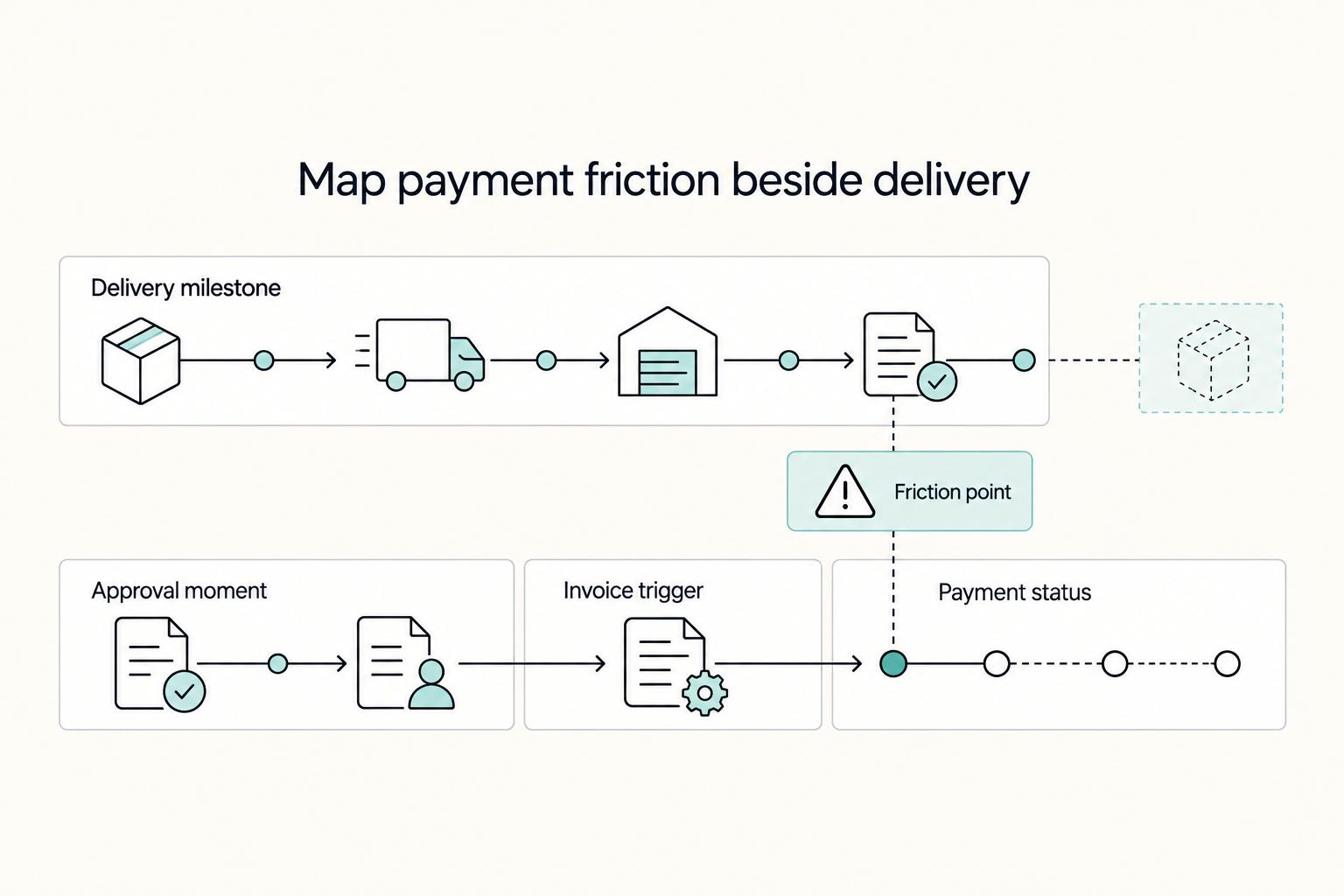
If payment touchpoints are not mapped beside delivery, related friction can show up too late. Put payment moments on the same journey path as approval decisions so pain points are visible earlier.
Map how the client experiences billing: when they learn the price, approve the purchase, receive the invoice and obtain confirmation. The existing diagram above is a conceptual view of delivery/payment touchpoints, not a complete client journey or a mandatory invoice sequence. Put the client's questions and the responsible supporting actions beside these points.
For an enterprise buyer, the finance team may require a purchase order or specific invoice fields before payment. Ask early rather than learning this after delivery. Keep the contract's payment trigger, invoice due date, client approval and actual settled payment as separate facts.
- Map payment-related touchpoints from first awareness through post-project follow-up.
- Place those touchpoints on the same timeline as delivery and approval moments.
- Mark where confusion, delays, or handoff friction repeatedly appear.
- Clarify language at each touchpoint so expectations are easier to understand.
- Move effective checkpoints into a future-state map, then retest when friction persists.
Keep payment touchpoints visible during project reviews, not only at handoff. Early visibility helps teams identify confusion sooner and adjust before issues compound.
Use the payment terms actually agreed and the applicable rules. Mapping a bottleneck does not authorize an extra late fee, a unilateral delivery hold or a move outside a platform's payment requirements. A workflow change may need client agreement before implementation.
Move the checkpoints that consistently reduce payment friction into your future-state map. If a checkpoint causes repeated confusion, rewrite it in simpler terms and test again.
Turn completion into retention and referrals#
Treat completion as a handoff point where you reinforce retention and referrals, with a short recap and a clear next touchpoint when appropriate.
A useful closeout note can record what was delivered and what the next step might be: continue, pause, or revisit later. That shared record gives both sides clearer context for future work.
Use closeout as more than a thank-you message. Confirm a shared understanding of what finished and whether a future check-in would help. This keeps post-project communication intentional and can make re-engagement easier.
Ask for a referral when appropriate and welcomed, after confirming the client received useful work. Make the request specific and easy to decline. A referral partner program is an optional tactic, not a necessary stage or an established retention result for every freelancer.
Between projects, keep follow-up intentional and light. Personalized touchpoints, including email-based follow-up, can support the relationship and help you stay positioned as a strategic partner.
Use a short review to identify the material retention issues and choose a manageable next action. A 20-minute slot and one improvement can be a useful starting format; they are not evidence of effectiveness or limits on how many risks you may address. Respect the client's preferences before scheduling outreach.
- Did the client receive a clear handoff and any support promised?
- Would a relevant follow-up help, and has the client welcomed that contact?
- Is a referral request appropriate, or would no additional ask be better?
Address a missing promised handoff or support action. An absent referral request is not automatically a gap. Mark follow-up as unnecessary where that fits the client's preferences; retention is not the same as repeatedly contacting every former customer.
Compare tool choices without over-engineering#
Pick the tool people can review quickly, then spend most effort on stage rules and checkpoints. Tool choice should reduce review time, not become another task to manage.
Set your filters before testing options: reviews, pricing, features, platform fit, region, support, and integrations. Add one map-specific check: can a reviewer identify the touchpoint, owner, and next decision without a live explanation?
| Need | Practical choice | Watchout |
|---|---|---|
| Fast solo drafting | A lightweight canvas or slide tool your team already uses | Polished visuals can hide missing decision rules |
| Shared editing during planning | A shared workspace with comments and easy handoff | Collaboration helps only if owner and done condition are explicit |
| Client-facing readout | A format clients can open and review quickly | Keep it summary-level and maintain one editable source of truth |
Use tools for clarity, not identity. If collaborators struggle to find status, simplify the stage card and handoff notes before changing platforms. In many cases, tool friction is really a documentation issue.
A practical test during selection is to hand the file to someone who was not in the last client call. Ask them to identify the current stage, pending decision, and required artifact for one active project. If they cannot do that quickly, improve structure before migrating.
Reassess tools when your current setup slows review or introduces handoff errors. Avoid migrating just to copy a template. Keep the stack stable until there is a clear decision benefit from change.
Common mistakes and how to recover fast#
A misaligned customer journey map can derail conversion and loyalty outcomes, even when it looks complete on paper. Protect your freelance customer journey map by correcting these failure modes early and documenting the recovery.
| Mistake | Recovery | Verification check |
|---|---|---|
| Using a generic template without adapting it to your business and customer goals | Define goals first, then rewrite Lead Qualification Criteria, Payment Terms, stage owners, and done conditions before client review | Every active lead has pass, pause, or decline status |
| Skipping Acceptance Sign-Off and debating what done means | Compare the existing agreement and records, clarify disputed acceptance with the client, and improve future terms | Every open milestone has a reviewer and decision state |
| Accepting informal requests without a Scope Change Request | Identify whether the request is included, a correction or extra scope; agree any necessary cost/timing change | New requests are logged before execution |
| Treating a platform like Upwork as the whole process | Keep native platform communications/payment requirements while maintaining a linked project map | Won projects move into your map with the same stage rules as other clients |
- Mistake: using a generic template without adapting it to your business and customer goals.
Recovery: define those goals first, then rewrite Lead Qualification Criteria, Payment Terms, stage owners, and done conditions before client review. If page one does not show who qualifies, when payment triggers, and how scope changes are handled, the map is not ready.
- Mistake: skipping Acceptance Sign-Off and debating what done means.
Recovery: compare the agreed acceptance criteria with the actual deliverable and record the disputed point. Agree a clarification or amendment where appropriate; you cannot impose new approval conditions retrospectively. For the next contract, specify deliverables, revision limits, reviewer and decision timing.
- Mistake: accepting informal requests without a Scope Change Request.
Recovery: log the request and check whether it is an included revision, a correction or additional scope. Continue agreed work where possible; get the necessary approval for new cost or timing before accepting the extra work. A message can serve as the written record where your agreement permits it.
- Mistake: treating a platform like Upwork as the whole process.
Recovery: keep the required platform communication, payment and dispute processes, while linking your own internal map to those records. Mapping does not authorize moving platform-earned payments outside its rules. Update the future-state proposal from real client feedback and observed exceptions.
To make recovery stick, tie each fix to one verification check. For qualification, verify that every active lead has pass, pause, or decline status. For sign-off, verify that every open milestone has a reviewer and decision state. For scope change control, verify that new requests are logged before execution. For platform intake, verify that won projects move into your map with the same stage rules as other clients.
Test a focused improvement when practical so results are easier to interpret. Correct urgent material issues promptly, even if more than one change is necessary. In a small freelance sample, before/after differences can reflect client mix or project complexity; they do not establish cause and effect by themselves.
Common red flags during review:
- Stage names are clear, but done conditions are missing.
- Payment terms are documented, but invoice status is not tracked.
- Scope changes are discussed in chat, but no written record exists.
- An agreed follow-up is due, but its owner or date is missing; record intentional no outreach separately.
When those red flags appear, avoid adding more design detail. Tighten the decision rules and evidence fields first. That is often the fastest route back to reliable execution.
Before adding a field, ask what decision it improves and whose experience it describes. Keep necessary internal identifiers linked to the map rather than filling the client view with tax or payment implementation details.
Put your map into weekly practice#
Review the map often enough to keep it useful; a weekly slot is a practical suggestion for an active freelance pipeline. Some weeks the right result is no rule change. Review evidence and assumptions, confirm the next action and address material problems when they occur rather than waiting for the weekly meeting.
Pick the most useful improvement or validation question and assign an action and review date. A narrow change can be easier to evaluate, but do not force an update merely to fill the log. Separate client-experience improvements from contract changes that require agreement.
Step 1 Review last week with real client evidence#
Review lead notes, proposal feedback, draft comments, invoice queries and closeout replies. Record the friction, stage and source, and ask the client about uncertain needs where appropriate. If no record exists, label a hypothesis and plan validation; you can investigate an important concern without falsely presenting it as proven.
During this step, resist the urge to solve everything. Capture one issue that repeated or created visible delay. Examples include unclear qualification at intake, a milestone waiting on approval, or an invoice status that remained unresolved. Focus on what happened, not on assumptions about intent.
Step 2 Pick map focus before editing any rule#
Choose a narrow pass when one issue repeats. Choose a wide pass when breakdowns span multiple touchpoints, especially from delivery into retention. Tradeoff: narrow passes resolve a specific bottleneck faster; wide passes reveal cross-stage issues but take longer to act on.
A narrow pass might update one acceptance checkpoint after repeated reopen loops. A wide pass might review handoffs from onboarding through invoicing when delays appear in several stages. Start with narrow passes, then run a wide pass when pattern drift appears across the map.
Step 3 Decide whether to change a rule, validate an assumption or keep the current approach#
Choose a focused change when practical and define what you expect to improve. Use the checklist below for supporting work, adapting it to the contract and scenario. It is an internal layer beneath the client journey, not a universal set of legal prerequisites.
- Client goal and scenario clear; qualification questions resolved enough to proceed
- Agreed scope, responsibilities and payment terms recorded
- Necessary kickoff inputs and response expectations agreed
- Milestone progress and required review/sign-off visible
- Revisions, corrections and extra-scope requests distinguished
- Invoice balances, disputes and settlement tracked
- Promised handoff complete; appropriate follow-up agreed or intentionally omitted
For reliability, each checked line should map to a visible record. If proof is missing, leave it unchecked and assign who will close it this week. Keep ownership explicit so unresolved items do not roll into the next review without action.
A practical sequence after checking the list:
- Identify the friction point and the evidence available.
- Choose a supported change, further validation or no change; record why.
- For a change, name its first application; for validation, name the question and next check.
This sequence keeps the review grounded in action instead of commentary.
Step 4 Schedule retention and watch for execution drift#
After completion, confirm the handoff and any promised support, then schedule a useful follow-up only where appropriate. Keep the client’s questions and preferences visible. End the review with an unresolved risk and an action if one exists; unsupported productivity multipliers do not tell you whether this client's experience improved.
Drift can appear when a stage closes without the expected evidence, an agreed scope change lacks a usable record, or a promised follow-up is postponed without updating its owner and date. Review those commitments while they are still small. An intentional decision not to contact the client is a valid outcome, and a review does not need to produce a new rule.
Finish the session with a short log entry that includes:
- The friction point and evidence reviewed.
- The decision: change, validation or no change, and its reason.
- The first application or validation action, if one is needed.
- The next check date when useful, and any intentional no outreach.
Over time, this turns your map into a reliable decision tool instead of a one-time planning artifact. The map stays useful because it evolves from evidence and keeps post-project stages visible, not because it looks polished.
Frequently Asked Questions
What is a freelance customer journey map?
A freelance customer journey map shows one client's actions, touchpoints, needs and experience while pursuing a goal through your service. It can cover inquiry, selection, onboarding, review, payment and later use. A task/status checklist supports delivery but is not a complete journey map without the client perspective.
Which stages should a freelancer include in a Customer Journey Map (CJM)?
Choose phases from a specific actor and scenario rather than a universal lifecycle. A first-time landing-page buyer may compare designers, agree scope, provide inputs, review drafts, pay and use the delivered page. Repeat clients may skip some steps, and finance or approver roles may need linked views.
How is a client journey map different from a sales funnel?
A funnel focuses on progression toward conversion. A journey map covers the broader client experience across touchpoints, including what happens after conversion during onboarding and beyond. They can share stages, but they are not the same tool.
What should happen before starting paid work with a new client?
Confirm the agreed scope, responsibilities, payment terms, necessary inputs and authority to proceed, using the contract and any platform requirements. The exact prerequisites depend on the work. A separate SLA, deposit or formal sign-off form is not universally mandatory, and a map does not create new contractual conditions.
When should I use a Current State Map versus a Future State Map?
Use a current-state map to describe today's experience, including delays, loops and evidence gaps. Use a future-state map to propose a better experience and the supporting actions needed. Keep assumptions labeled and test the proposed change with clients before presenting it as an observed result.
How do I reduce churn and increase repeat projects with journey mapping?
Use project records and client feedback to find problems that may discourage repeat work, such as unclear handoff or confusing billing. Improve an appropriate touchpoint and track what happens, while respecting contact preferences. Journey mapping does not guarantee retention or distinguish your change from every other influence on a repeat purchase.
What is the simplest tool stack for a solo freelancer to maintain this weekly?
A table in your existing spreadsheet, document or shared canvas can be enough. Keep the client actions/needs and supporting actions visible, link evidence, assign next steps and control shared access. Use a static export for client review when useful, with one editable source; a polished template is optional.
Try a related tool
Researched and edited by the Gruv editorial team. Gruv builds cross-border billing, payouts, and finance-operations software for global businesses.
Sources
Includes 2 external sources outside the trusted-domain allowlist.
Educational content only. Not legal, tax, or financial advice.
Related Posts

The Freelance Payment Penalty: A Modeled Audit of Platform Fees, FX Spreads, and Payout Delays
The money rarely disappears through a single, easy-to-spot fee. The real loss is stacked. A marketplace takes its commission, a processor adds a charge for international cards, a bank or payment company converts the currency at a spread, a platform holds the funds before release, and a wire sheds a little to intermediaries on the way in. Each layer looks defensible on its own, but the worker feels the combined result as a smaller deposit and a later payday.

How to Respond to a Subpoena for Business Records
Move fast, but do not produce records on instinct. If you need to **respond to a subpoena for business records**, your immediate job is to control deadlines, preserve records, and make any later production defensible.

A US Expat's Guide to Investing in UCITS ETFs to Avoid PFIC Issues
The real problem is a two-system conflict. U.S. tax treatment can punish the wrong fund choice, while local product-access constraints can block the funds you want to buy in the first place. For **us expat ucits etfs**, the practical question is not "Which product is best?" It is "What can I access, report, and keep doing every year without guessing?" Use this four-part filter before any trade: