
Quick Answer
Compare equivalent packages for stable outputs and screen candidates for evolving work. Both platforms support fixed-price and repeat hiring. Fiverr’s standard buyer charge is 5.5% plus $3.50 below $200; Upwork Basic is up to 7.99% plus a new-contract initiation fee. Freelancer fees are separate. Use the actual offer, assign a reviewer to the applicable delivery clock and test cost per accepted outcome.
Compare model fit before comparing fees#
Choose the buying workflow that fits the work, then compare the actual quote, fees and management effort. A well-defined package can save screening time; an evolving role needs room for discovery and changes. Neither marketplace guarantees the right freelancer or protects margin by itself. For repeat hiring, the decision depends on accepted output, total buyer cost and a workable relationship with the freelancer.
| Evidence to save | What it answers | What it cannot establish |
|---|---|---|
| Current official fee page | Published buyer and freelancer charges for a named plan | Your final checkout, tax or FX amount |
| Offer or checkout breakdown | Price and charges for the actual transaction | Quality of the future deliverable |
| Payment and dispute policy | Required funding, submission and response steps | A guaranteed refund or satisfactory result |
| Portfolio and paid pilot | Fit for your brief and actual review effort | Average performance across the marketplace |
| Forums and independent experiences | Questions to investigate with candidates | Current binding fee or protection terms |
The public prices below were checked on 5 October 2026. They describe standard purchases and Upwork Basic marketplace hiring, unless stated otherwise. Business plans, negotiated arrangements, promotions, taxes and currency conversion can change the amount payable. Save the actual offer and checkout breakdown rather than applying a comparison’s headline percentage to every contract.
Upwork Project Catalog also sells predefined, fixed-price services. Fiverr supports custom offers, eligible milestone orders and recurring services. The usual package-versus-job-posting distinction is therefore a useful starting point, not a boundary between what the platforms can do.
For a buyer, the best fee evidence is the charge shown for the intended order, plan and billing method. For a freelancer, it is the fee attached to that specific offer. Keep these two records separate: a buyer’s checkout percentage does not tell you how much the freelancer receives.
A freelancer may quote differently because the work takes longer, revisions are extensive or the platform deduction is higher. Compare quotes against identical deliverables before attributing the price difference to fees. A lower service-fee rate only increases earnings if the underlying price and work required stay comparable.
Use the same brief on both marketplaces: outputs, inputs, deadline, revision allowance, usage rights and a named approver. If the brief cannot describe an acceptable result, buy a small discovery stage before pricing full execution. This gives the later production quote a firmer basis.
At a glance comparison for speed cost control and risk#
Start with a package for an inspectable deliverable and a screened proposal for an evolving role. Either platform can serve either pattern if the candidate and contract structure fit.
| Criterion | Fiverr | Upwork | Decision implication |
|---|---|---|---|
| Starting route | Browse a Gig or request a custom offer | Post a job, invite talent or buy from Project Catalog | Compare the actual scope and candidate |
| Fixed output | Packages and custom offers | Fixed-price contracts and Catalog projects | Neither requires an open-ended role |
| Repeat work | Repeat orders; eligible subscriptions | Continuing hourly or fixed-price contracts | Confirm availability and handoff discipline |
| Freelancer deduction | 20% of completed purchase, including extras and tips | 0–15% per contract, shown before commitment and locked | Compare earnings at the quoted fee |
| Buyer charge | 5.5% plus $3.50 on each payment under $200 | Basic up to 7.99%; eligible US bank billing 3% | Check the billing method and transaction count |
| Starting a contract | Buyer fee applies to order payments | New-contract initiation fee $0.99–$14.99 | New contracts differ from added milestones |
| Review of delivered work | Ordinary digital orders: 3 days; milestone orders: 8 days | Fixed-price submitted milestone: 14 days | Assign an approver and calendar the actual deadline |
| Milestones | Eligible orders/custom offers; separately paid stages | Funded fixed-price milestones | Define scope and funding before each stage |
| Protection | Order review, revision and resolution procedures | Conditional fixed-price or hourly payment protection | Follow the relevant procedure; no quality warranty |
Sources for the fee rows: Fiverr client charges, Fiverr freelancer earnings, Upwork freelancer fees, Basic client charges and contract initiation. Later sections explain the review-clock exceptions. The fee rows describe published terms, while speed and fit require your own pilot.
If you want a fee-focused breakdown next, read The True Cost of Upwork Fees Before You Accept a Contract.
How the platform model changes monetization outcomes#
The buying model changes where you spend effort. A package puts inclusions and price in front of you early; a proposal lets you compare approaches before agreeing the work. Both can hide a mismatch if the scope omits the files, dependencies or revisions you actually need.
For a standardized task, compare a Fiverr package with a comparable Upwork Catalog offer. For a continuing role, compare a Fiverr custom or recurring arrangement with an Upwork hourly or staged fixed-price contract. Choose the workflow that lets you specify the output, inspect progress and pay for agreed work without repeatedly renegotiating basics.
| Unit economics lens | Package purchase | Screened ongoing engagement |
|---|---|---|
| Acquisition | Check inclusions and examples before checkout | Compare candidates, approach and availability |
| Fulfillment | Reuse a stable brief and acceptance test | Agree stages, responsibilities and change handling |
| Rework | Price omitted outputs or extra revisions separately | Separate corrections from genuinely new scope |
| Repeat path | Reuse the package only while scope stays stable | Keep a continuing contract only while terms still fit |
For example, a $120 image-editing package may cover ten images and one revision. If you need twenty images, source files and three rounds, compare the expanded quote rather than treating $120 as the complete price. Ask who supplies licensed assets and what usage rights are included; buying a file does not resolve every licence or third-party-rights question.
Label the work as scope clear or scope evolving. Start with a package when the output is stable; agree a paid discovery stage or screened proposal when it is not. Keep changes and approvals in platform records. For more on trust dynamics, read How to Compare Freelance Hiring Paths by Trust, Evidence, and Control.
Earnings and spend math under real hiring scenarios#
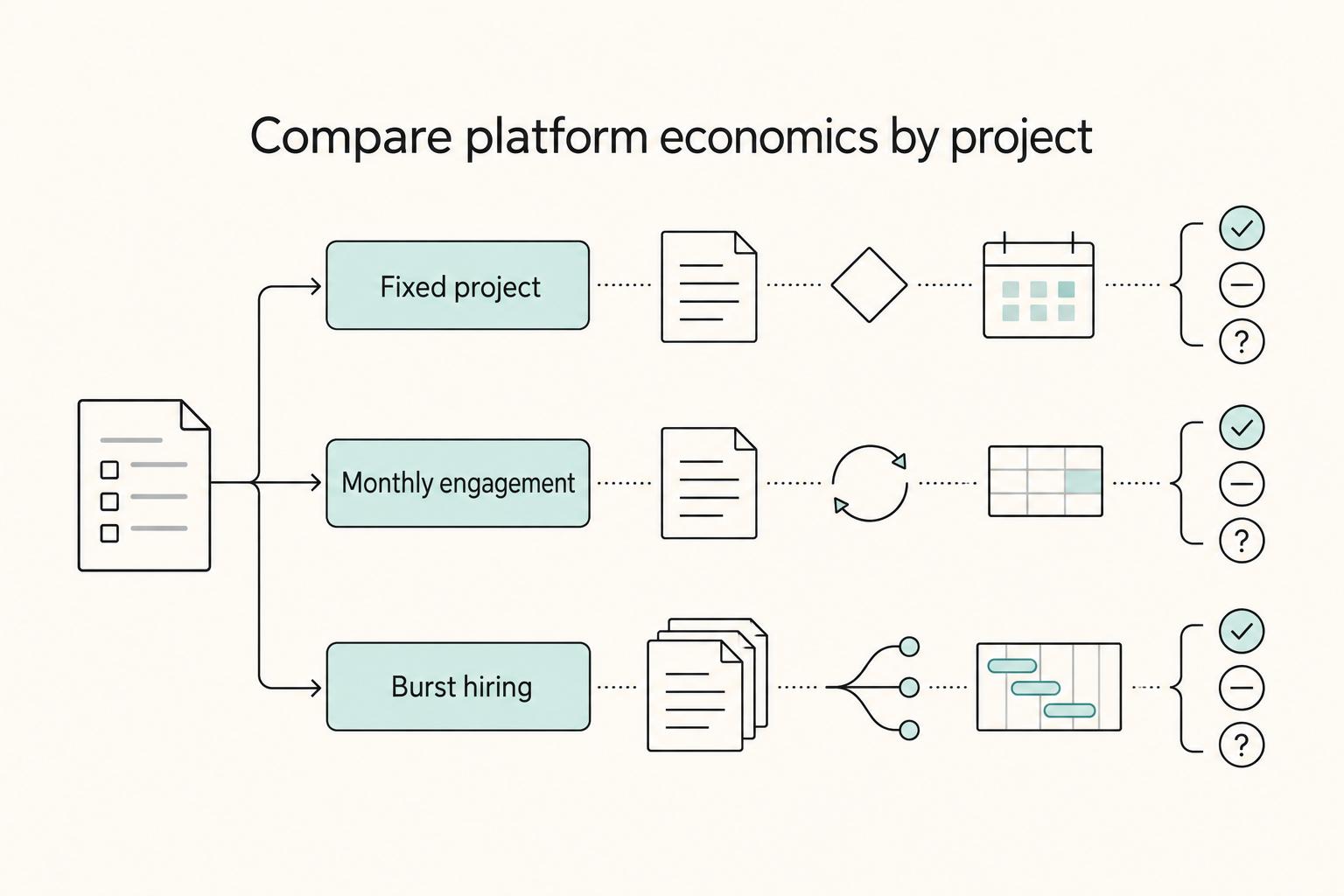
Model one-off work, monthly repeat hiring and a burst of specialist contracts separately. Percentage fees repeat with spend, small-payment surcharges repeat with transactions, and Upwork initiation fees repeat with new contracts. None of these behaves like compound interest.
Use two separate formulas:
- Buyer cash cost = agreed work price + buyer fees + applicable tax + payment/FX costs. Add internal management and replacement costs in a separate operating-cost view.
- Freelancer earnings after marketplace fee = work price minus that contract’s freelancer deduction. Subtract withdrawal/FX costs, business expenses and applicable taxes separately to estimate spendable income.
For standard Fiverr work, the freelancer receives 80% before taxes and later payout costs. For Upwork, use the actual 0–15% fee shown on the proposal or offer; it is fixed for that contract. These are earnings calculations, not after-tax take-home guarantees. A freelancer who wants $400 after only the marketplace deduction needs $500 at a 20% fee, $444.44 at 10%, or about $470.59 at 15%. Round and verify the actual offer.
How scenario math changes the decision#
| Hiring scenario | Fee pattern | Buyer risk | Freelancer consideration | Practical choice |
|---|---|---|---|---|
| One-off fixed-price job | One purchase or new contract | Small-order/starting fee plus mismatch and rework | Quoted deduction on that job | Match inclusions and inspectable output |
| Monthly repeat engagement | Percentage charge on each payment; surcharges depend on ticket size | Recurring budget plus manager time | Stable fee on an existing Upwork contract; Fiverr deduction on each purchase | Compare annual cost at actual transaction count |
| Burst of specialists | One starting fee per new Upwork contract; Fiverr charges per payment | More contracts and review deadlines | Different Upwork contracts may have different fees | Assign one owner per output; do not merge unrelated scopes just to save fees |
Illustrative USD comparison, before tax, FX, withdrawal costs, extras or internal time: for a $100 job, Fiverr’s buyer charges are $5.50 + $3.50, so buyer cash cost is $109 and freelancer earnings are $80. At an assumed Upwork Basic 7.99% buyer rate and a $4.99 initiation fee, buyer cost is $112.98. If that offer’s freelancer fee is 10%, earnings are $90. The assumed Upwork rates must match the actual offer and checkout; the client percentage and initiation fee are not universal quotes.
For twelve $500 payments, Fiverr’s standard buyer fee gives $527.50 per payment and $6,330 over the year; freelancer earnings total $4,800 before tax and payout costs. Under the same assumed Upwork 7.99%, 10% freelancer fee and one $4.99 initiation fee on a continuing contract, buyer cost is $6,484.39 and freelancer earnings total $5,400. Opening twelve separate Upwork contracts with that assumed starting fee would add $59.88 rather than $4.99, taking buyer cost to $6,539.28. Quotes, plan and billing method may change this ranking.
Verify before you scale#
Before standardizing on either platform, check the quote against the actual work and save the following evidence:
| Step | Detail | Track |
|---|---|---|
| Confirm charges | Save plan, currency, offer fee and checkout breakdown | Buyer fees separately from freelancer deduction |
| Validate delivery and payout | Run a small paid job; each party checks its own account | Buyer invoice; voluntarily shared fee/payout evidence without private bank details |
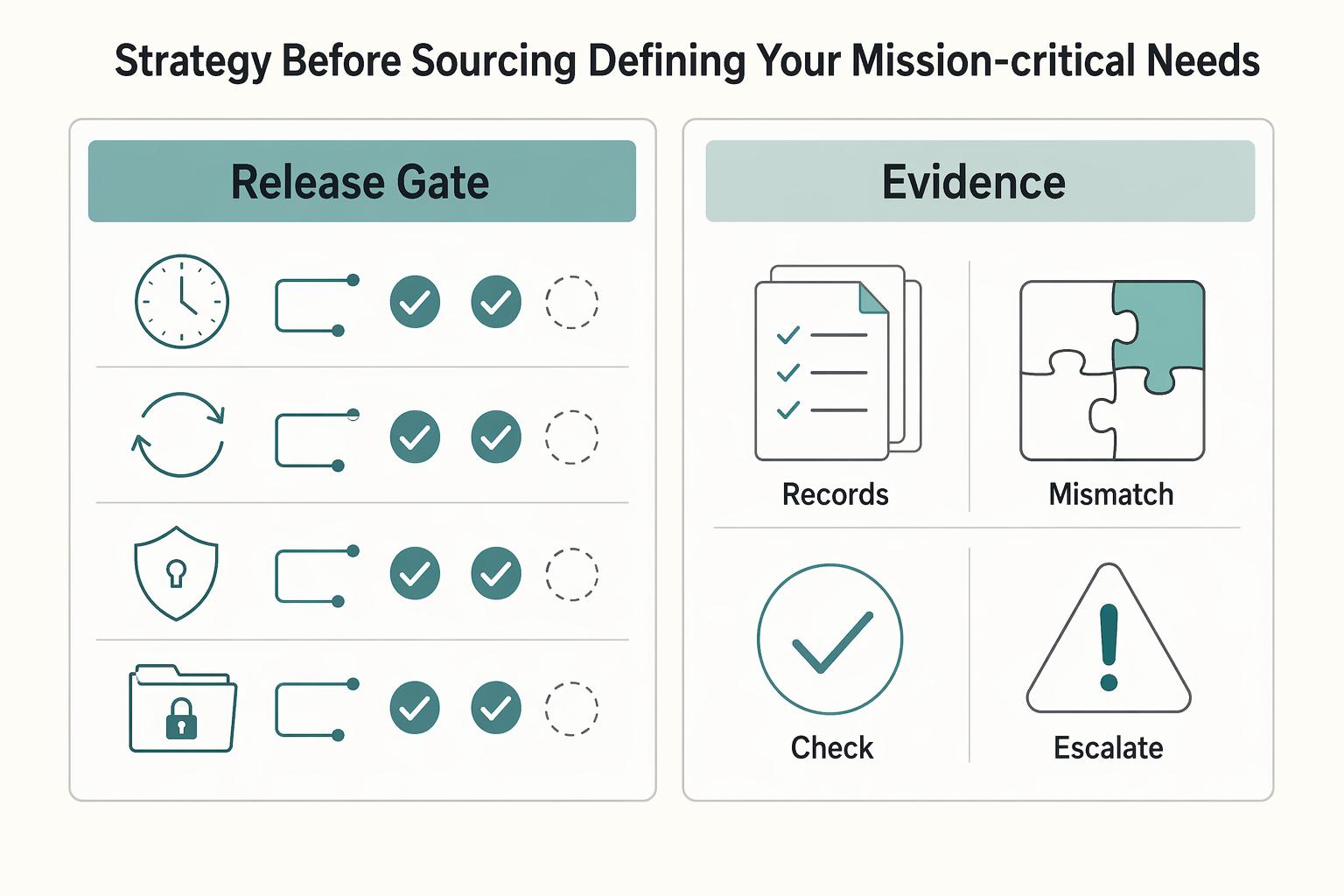
| Test the operating workflow | Use the same acceptance test and one named approver | Review hours, revisions, deadlines, replacement and final accepted output |
For burst hiring, five separate $100 Fiverr purchases cost $545 at standard published buyer charges. Five new Upwork contracts at the illustrative assumptions above cost $564.90. A candidate who needs less briefing or fewer corrections can still cost less overall. For other hiring routes, see 7 Upwork Alternatives for High-Earning Freelancers.
Protection reality where teams lose money and time#
Payment protection has procedural conditions. It is not a promise that every deliverable will meet your expectations. Write acceptance criteria and distinguish approving payment, funds clearing on-platform and money reaching a bank account.
On Upwork fixed-price contracts, a freelancer should start only against an active funded milestone, deliver the agreed scope and use Submit Work for Payment. Sending files only in Messages does not start the formal payment-review clock. Unfunded work or work outside the agreed milestone can fall outside protection.
| Protection lever | Fiverr procedure | Upwork procedure | Team action |
|---|---|---|---|
| Scope and funding | Record package/custom offer, requirements and paid stage | Agree funded milestone or hourly contract terms | Save outputs, exclusions, revision count and approved changes |
| Delivery review | Ordinary digital delivery has 3-day review; eligible milestones have 8 days | Fixed-price Submit Work starts 14-day client review | Use the formal request-changes/revision action before the applicable deadline |
| Evidence | Keep order messages, requirements, versions and review actions | Keep contract/milestone terms, submissions and relevant diary records | Archive one traceable record of each stage |
| Dispute path | Resolution Center for active orders; completed orders require support route | Fixed-price project-funds disputes or hourly dispute procedure | Follow the notice and response window; do not assume a guaranteed refund |
Use one hard rule: if delivery quality is subjective, write acceptance criteria before you approve any proposal or buy any gig listing. Replace vague asks like "make it modern" with checkable terms: assets included, file types, revision count, deadline, and final approver.
Minimum evidence pack: brief, acceptance criteria, examples, price, deadline, revision terms, and every scope change in platform messages. If work starts from off-platform notes that never get copied back, your protection position is weaker before anything goes wrong.
Fiverr’s ordinary order review automatically completes a digital order after three days without action. Accept, request revisions or extend review through the order controls; shipping orders use a different 14-day period. Fiverr milestones instead allow eight days to review a delivered stage, and ten days after acceptance to initiate the next one. Check which order type you bought rather than applying the three-day rule to all deliveries.
On Upwork fixed-price payments, the client has fourteen days after formal submission to approve or request changes; silence releases the funds automatically. A requested revision resets the review period on resubmission. If the client requests a refund from funded project money, the freelancer has seven days to respond or dispute. Released money then has a security hold before withdrawal, so release is not bank receipt.
Fiverr’s Resolution Center handles requests on active orders; the other party has forty-eight hours to accept or decline, and an unanswered request is automatically accepted. It is unavailable for completed or canceled orders. If the order has completed, use Customer Support rather than waiting for an active-order cancellation control to reappear. Save the order ID, agreed scope, delivery version and specific missing requirement.
When delivery fails, distinguish an in-scope correction from new work. Use the platform’s formal action, state the failed acceptance test, attach the relevant version and keep the response deadline visible. Do not assume a chat complaint stops an automatic approval clock. For an agreed cancellation or refund, reconcile the original price, fees and credit location before treating it as recovered cash.
Refunds can leave costs behind. Upwork’s client marketplace fee is nonrefundable even when the underlying payment is refunded. Its initiation fee is not returned after a freelancer has been paid, though the help page provides an exception for an unreleased fixed-price milestone. The freelancer service fee is returned on refunded earnings. Check the specific refund record on either platform; a platform credit and a refund to a payment method are different recovery states.
Hidden costs competitors gloss over#
Cost per accepted outcome includes buyer cash spend and the internal work needed to obtain usable delivery. Keep the components visible; a low checkout price can be outweighed by extra review and replacement effort.
For an illustrative $500 Fiverr order, buyer cash cost is $527.50. Four hours of internal review at an assumed $50 per hour adds $200, making the operating cost $727.50. The matching Upwork example costs $544.94 at the assumed fee settings; two internal hours bring it to $644.94. Those review times are hypothetical, not platform averages. A $17.44 checkout difference does not decide this example.
| Hidden cost bucket | How it shows up | What to track |
|---|---|---|
| Management time | screening, briefing, follow-up, reviews, revisions | internal hours from brief to accepted delivery |
| Replacement time | re-posting, re-buying, handoff after mismatch | extra spend and calendar delay |
| Communication overhead | repeated clarification, status chasing, scattered feedback | revision cycles and PM touchpoints |
| Opportunity cost | delayed asset, campaign, launch, or client delivery | days late and downstream work blocked |
Avoid counting the same effort twice. Put actual screening, briefing and review hours in the management line, and replacement expenditure in its own line. Record calendar delay separately unless you have a defensible financial estimate for the missed opportunity. Comparing days late is often more useful than inventing a dollar loss.
Upwork hourly protection requires eligible time logged with its desktop tracker, contract-related screenshots, meaningful memos, adequate activity, a weekly limit, verified identity and client billing, and an account in good standing. Manual, idle, unrelated or over-limit time does not qualify. This protects eligible freelancer payment, not a buyer’s satisfaction with the output.
Red flags to filter quickly#
| Red flag | Why it weakens the comparison |
|---|---|
| Fee claims from Reddit without a current Terms of Service or official fee-page check | not policy-grade evidence |
| Outdated examples or screenshots with no clear publication or update date | timing is unclear |
| Comparisons that combine buyer costs and freelancer costs into one number | economics look cleaner than they really are |
| Advice that treats one good or bad hire as proof of platform economics | single experiences are not proof |
| Comparisons that ignore failed hires, rework, or delayed delivery | the comparison is incomplete |
As an internal pilot, track two or three completed engagements with comparable briefs. Log buyer spend, internal hours, revision count, days to acceptance and replacement. Freelancers can calculate their own post-fee economics; a buyer need not demand personal bank statements or private tax information. Related reading: Freelance Sales Qualifying That Protects Your Time and Pipeline.
When a hybrid Fiverr and Upwork strategy wins#
A hybrid approach can be useful when work differs: try package buying for repeatable production and screened proposals for discovery-heavy work. Do not make the marketplace name a substitute for checking the person, offer and workflow.
For example, buy a small set of finished asset exports as a package, while hiring an analytics specialist against a paid diagnostic stage before implementation. Both purchases could happen on either platform. The production brief needs stable outputs; the diagnostic stage should end with a concrete plan you can evaluate.
| Task class | Starting route to test | Why |
|---|---|---|
| Clear SOP admin, list cleanup or data entry | Fiverr package/custom offer or Upwork Catalog | Defined volume and quality test support comparison |
| Asset resizing, upload support or transcript cleanup | Compare equivalent fixed-price packages | Inspect inclusions and revision terms before purchase |
| Strategy, setup, process redesign or ongoing analytics | Screened Upwork role or suitably scoped Fiverr custom arrangement | Agree discovery, stages, access limits and continuing availability |
Use one internal intake template across both platforms so outcomes stay comparable. Keep the same fields each time: objective, scope, inputs, acceptance criteria, due date, budget cap, owner, and performance measures (revision count, days to accepted delivery, replacement required or not).
If scope keeps changing, stop forcing the next request into the same production package. First define discovery outputs, price that stage and use it to agree execution scope. For sourcing options, read Where to Hire a Virtual Assistant Without Creating Compliance Risk.
Decision checklist for founders and finance operators#
Start with scope: stable acceptance criteria support a package comparison; evolving requirements support a discovery stage and more candidate screening. Fixed-price and long-term describe different dimensions: a continuing relationship can contain several fixed-price milestones.
Before checkout, agree who supplies assets and access, who approves delivery, what counts as a correction, what costs extra, and what happens if either party is unavailable. Paying for discovery can be sensible when the implementation price would otherwise rest on guesses.
Save the current official fee reference alongside the actual offer and checkout amount. Mark an unconfirmed optional cost as a budget assumption and resolve it before incurring that cost. Continue work covered by clear agreed terms; an internal research checklist is not a reason to withhold an already owed payment.
Require a minimum evidence pack before you scale spend:
- Pilot brief, inputs and permitted access
- Written acceptance criteria, file formats, revisions and usage rights
- Formal delivery and review deadlines with a named approver
- Accepted output, revision count and replacement record
- Actual buyer invoice and total cash spend
- Post-fee freelancer calculation where voluntarily shared, clearly before tax and later costs
If the pilot results differ by task class, keep a hybrid approach with one intake format and one review method. Revisit the routing when scope, candidate availability or actual costs change. For cash timing, see Getting Paid on Upwork Without Cashflow Surprises.
Conclusion#
Choose a marketplace workflow that fits the work, not a permanent brand winner. Equivalent packages can compete on either platform, and a continuing relationship still needs agreed scope and review controls.
For repeat hiring, compare annual cash cost and internal effort. A higher freelancer deduction may affect quotes, but do not add it to a buyer invoice a second time. Starting-fee and small-payment effects depend on how many actual orders or contracts you open.
The fee calculations are references checked on 5 October 2026. Keep the policy URL, plan, currency and actual checkout record with your budget assumptions. Recalculate if your billing method, contract structure or quote changes.
Keep three decisions explicit:
- Buying workflow and scope fit for the engagement
- Buyer cost and freelancer earnings as separate calculations
- Funding, formal submission, review deadlines and recovery steps
Run a small paid pilot, then record accepted output, actual fees, review time and any replacement cost. If different task classes favor different workflows, reuse the same intake and cost method across both marketplaces.
Scale the route that delivers usable work at a sustainable cost. A working relationship, clear stage boundaries and timely review usually matter more than a small headline fee difference. Talk to Gruv if you need to discuss payment operations for your own hiring workflow.
Frequently Asked Questions
What is the core difference between Fiverr and Upwork for business buyers?
Fiverr commonly starts with a Gig or custom offer; Upwork commonly starts with a job post and proposal, but also sells fixed-price Project Catalog services. Both support staged work. Compare the actual contract workflow and candidate rather than assuming one platform only does short jobs and the other only does ongoing roles.
Which platform is better for short one-off tasks versus ongoing work?
For a narrow, inspectable output, compare packages with matching inclusions. For changing requirements, screen candidates and agree a discovery stage before full implementation. Fiverr custom arrangements can support repeat work, and Upwork Catalog can support one-off tasks. The choice depends on scope, availability and your pilot’s accepted output.
How do freelancer fees and buyer fees change real project economics?
Buyer fees add to budget; freelancer fees reduce earnings. Fiverr’s standard deduction is 20%, while an Upwork offer shows its 0–15% contract fee. Buyer charges depend on platform, plan, transaction size and billing method. Use the worked examples above with your own checkout values; after-marketplace earnings are not after-tax take-home pay.
Is Fiverr or Upwork better for a team hiring in 2026?
Neither is automatically better. Compare the same output, current charges, candidate fit, manager time and response deadlines. Upwork may offer the workflow you prefer for a continuing role; a Fiverr package may suit a repeatable output. Both choices need written scope and timely review.
Can one company use both platforms without creating operational chaos?
Yes. Reuse one intake template, acceptance test and post-project record. Assign an owner to each order or contract and record its actual review clock. Keep buyer cash cost, internal time and accepted output comparable across platforms.
Which costs cannot a public fee chart settle?
It cannot settle your specific quote, tax, currency conversion, withdrawal cost, rework or replacement effort. It also cannot predict whether a candidate will deliver well. Published standard fees are useful inputs; the actual offer and a paid pilot provide the transaction and operating evidence.
How should we verify platform claims before committing annual budget?
Save the official fee references and actual checkout, then test a small paid scope with a named reviewer. Keep the brief, acceptance criteria, deliverable, revision count, buyer invoice and internal hours. Separately record the freelancer fee where voluntarily shared. For policy details, see What Freelancers Miss in Upwork and Fiverr Terms of Service.
Try a related tool
Researched and edited by the Gruv editorial team. Gruv builds cross-border billing, payouts, and finance-operations software for global businesses.
Sources
Includes 5 external sources outside the trusted-domain allowlist.
- help.fiverr.com/hc/en-us/articles/37553933600657-Paying-for-...external
- help.fiverr.com/hc/en-us/articles/9234443621137-Your-earning...external
- support.upwork.com/hc/en-us/articles/211062538-Learn-about-the-...external
- support.upwork.com/hc/en-us/articles/4660220468499-What-is-the-...external
- upwork.com/servicesexternal
Educational content only. Not legal, tax, or financial advice.
Related Posts
Where to Hire a Virtual Assistant Without Creating Compliance Risk
If you're looking for virtual assistant support, start with risk, not rates, badges, or platform feature lists. The best place to hire a virtual assistant is the one that matches your exposure on classification and oversight, then your internal requirements around data access, confidentiality, and service continuity.

How to Compare Freelance Hiring Paths by Trust, Evidence, and Control in 2026
In 2026, **freelance platform trust issues** can surface after work has already started, not just while you are scanning profiles. The real question is simple: when delivery gets messy, can you still prove what was agreed, control who approves payment, and show whether the work met the standard?

The True Cost of Upwork Fees Before You Accept a Contract
Before you price a project, separate freelancer deductions from client-side charges. If those lines get mixed, your margin math can fail before work starts, even when the quote looks reasonable.