
Quick Answer
Yes - use poland business harbour only after a live status check confirms your exact profile. Run the 15-minute gate across Gov.pl, the Ministry of Foreign Affairs, and PAIH, and log URL, check date, and exact wording before you spend on filings or travel. Historical details like the September 2020 launch, the 13.07.2021 expansion, or old visa counts are context, not approval for a 2026 case. If wording is mixed or undated, lock no-go and execute a fallback route.
What Poland Business Harbour Means for a 2026 Move#
You are here to make one practical call: is Poland Business Harbour usable for your case now, or should you switch routes? Treat this as a go/no-go decision, not a broad research exercise.
Historically, the Polish Government introduced Poland.Business Harbour in September 2020 and expanded it on 13.07.2021. The program was presented as support for IT specialists, startups, SMEs, and large companies relocating to Poland, with three paths: individual specialists, startups, and mature companies. The PBH Visa was described as a special visa that allowed work without a separate permit, and business support included a concierge channel with PAIH plus easier contact with accelerators, local governments, and Special Economic Zones.
That historical design does not confirm what is open today. One official snapshot referenced 13,565 issued visas, and the evidence here is dated 2021-2022. For a 2026 move, that date gap is the main risk.
In practice, usable means two things at once: current official wording exists, and that wording clearly fits your profile. If either piece is missing, the route is still uncertain. That distinction helps you avoid expensive preparation based on historical descriptions that may no longer apply in your case window.
Before you build a full dossier, run a quick verification pass. Keep an evidence log with page checked, date checked, authority name, and exact wording tied to your profile. If official channels conflict, treat the route as uncertain until you clarify it.
By the end of this guide, you should have:
- A decision path that separates historical PBH mechanics from current availability.
- A document checklist split between visa-stage and post-arrival residence-permit items.
- A practical execution timeline with checkpoints before filing and before irreversible spending.
If your goal is to work in poland with minimal rework, verification comes first. Once status is clear, execution becomes a sequence rather than a guess.
What Poland Business Harbour means and what is still uncertain#
PBH had a clear historical design, but you should verify current availability against live official wording before planning around it.
Historically, Poland.Business Harbour was described as a Polish government program focused mainly on foreign IT professionals, facilitating employment and relocation, and supporting company moves. Early framing also referenced Belarus, including new regulations described in December 2020.
Keep the labels separate in your notes. The PBH Visa was described as a visa path that did not require a work permit at the application stage, while a residence and work permit was treated as a separate downstream step. Historical descriptions also point to consular filing as a practical checkpoint.
The main uncertainty is timing. One description says Belarusian citizens were exempt from employer proof-of-interest, while a later one says that from February 1, 2022, all participants, including Belarusians, needed a partner-company invitation. Both may be true in different periods, which is why date context matters.
That timing split is more than a wording issue. It affects what you ask, which documents you prepare first, and whether you start paid steps. A historical rule can still help as context, but it cannot support a current go decision without current confirmation tied to your profile.
Use this filter before you spend money:
- Treat historical mechanics as context: partner-company invitation, consular PBH Visa filing, and company transfer support.
- Treat historical timing metrics as non-binding for a current case.
- Treat broader-scope language as unconfirmed until current official text matches your profile.
If you want a deeper dive, read Warsaw Digital Nomad Guide for 2026 Long-Stay Moves.
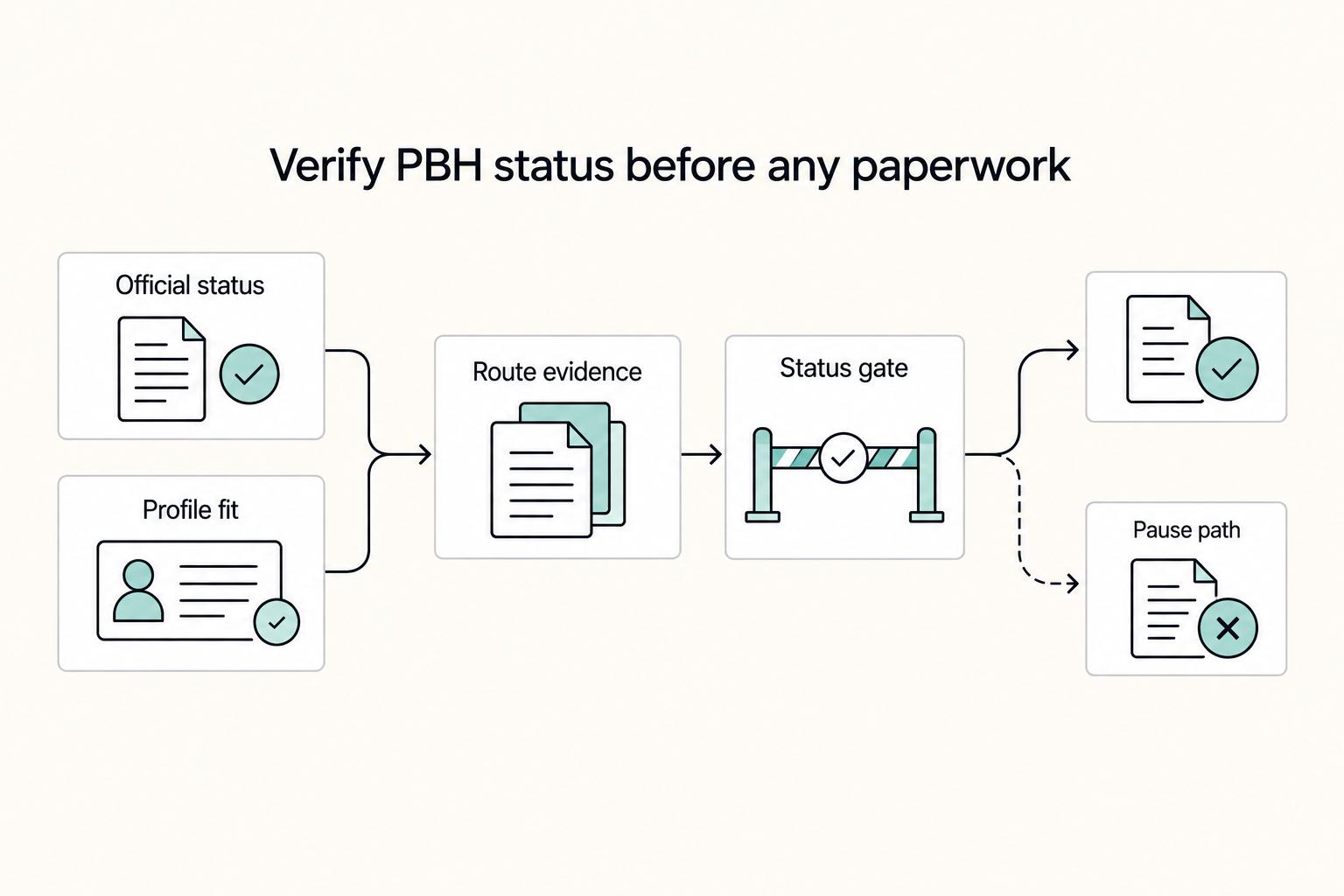
Verify current program status in 15 minutes before any paperwork#
Before you pay for forms, translations, or appointments, run a 15-minute status gate. If current official wording does not clearly cover your case today, treat PBH as unconfirmed and pause.
| Source | Date or type note | Why it does not confirm current PBH status |
|---|---|---|
| DOC/97/16 | Dated 15th July 1997 | Historical context |
| FederalRegister.gov item | U.S. proposed rule dated 02/25/2026; prototype edition is unofficial and does not provide legal notice | Does not confirm current PBH availability on its own |
| Congress.gov page | U.S. law (Public Law 119-60) | Not Polish visa-status guidance |
| 2024 PAIH investor guide | General investment context | Not explicit PBH status wording |
Those materials are useful as background, but none of them confirms current PBH availability on its own.
The goal of the status gate is disciplined speed. You are not trying to read everything. You are trying to reach one defensible decision line: confirmed for your case, or not confirmed yet. That clarity protects time and money before deeper preparation starts.
Use a fixed evidence log in this order:
- Check current official Poland government pages first.
- Check the Ministry of Foreign Affairs for matching wording.
- Check PAIH pages for any relevant relocation wording.
- Match page language to your case.
- Record URL, date checked, exact wording, and any source code shown, such as
DOC/97/16on historical material.
When you capture wording, avoid paraphrasing on the first pass. Copy the sentence, then add your plain-language interpretation in a separate note. This protects against small wording drift that can change the meaning of your decision later.
At the 15-minute mark, make a call. Proceed only if current official wording is clear and consistent for your case. If the wording conflicts, is undated, or appears only in third-party summaries, mark PBH as uncertain and switch to fallback planning.
Decide if your profile actually fits the intended PBH paths#
Do not assume fit from generic material. PBH eligibility is not confirmed, so keep your case marked uncertain until direct program wording covers it.
Use two separate gates: program status and profile fit. Even if a route appears to exist, that still does not prove it applies to your case.
The confirmed points below are limited to EU VAT context, not PBH eligibility:
- The materials are about VAT Cross-border Rulings (CBR) and One Stop Shop (OSS).
- Poland is listed as a participating country in CBR.
- A public CBR notice marker is dated 19 APRIL 2024.
- OSS has its own compliance logic, including scope-wide declaration and returns additional to regular VAT returns, which is operational context, not PBH fit proof.
This distinction matters in real planning. VAT material can make your document set look complete even when it does not answer your entry-route question. That creates a false sense of progress and can delay the one check that matters most: profile-specific confirmation from current PBH wording.
Before you prepare a dossier, run this triage:
- Label your case in one line by applicant type and intended route.
- Split open questions into two tracks: entry eligibility and post-entry operations.
- Tag each item as
PBH-specific evidenceorgeneral context; keep VAT items ingeneral context. - Treat route-fit claims as provisional until current official PBH wording confirms them.
If fit evidence is still missing by your checkpoint date, open fallback planning in parallel instead of assuming eligibility. Parallel planning is not overreaction. It is a control that keeps your timeline moving while uncertainty is still being resolved.
Choose your route with a clear go no-go decision matrix#
Make the route decision at a fixed checkpoint using only current, profile-specific evidence. With the material at hand, PBH-specific status is unknown, so PBH-first should stay no-go until stronger evidence is available.
Use a two-gate rule:
- Gate 1: route status clarity.
- Gate 2: profile match clarity.
- PBH-first is
goonly when both gates pass at the same time.
| Evidence state at checkpoint | Decision | Immediate action |
|---|---|---|
| Current official wording is clear and explicitly matches your profile | Conditional go | Proceed with PBH-first preparation, then re-check the same wording before filing costs |
| Wording is mixed, outdated, or does not map cleanly to your profile | No-go for PBH-first | Keep PBH in monitor mode and run your fallback plan |
| Evidence is unrelated or noisy, for example SEC filing content, old study flashcards, or pages with form-error text | Hard no-go | Stop PBH-specific paperwork until reliable, profile-specific evidence is available |
A matrix only helps if every outcome has an action attached. Write down who owns the next step, which document-pack version is active, and which route is primary after the checkpoint. Without that follow-through, teams tend to drift back into open-ended discussion.
Apply the same logic across applicant profiles. If official wording later does not match your profile, switch early instead of waiting under unclear criteria.
Use one checkpoint question and act on it: do you have current, profile-specific confirmation strong enough to justify PBH visa preparation? If yes, proceed. If no, lock no-go and continue your fallback plan.
If PBH is still unclear for your profile, pressure-test your fallback plan before you commit relocation dates.
Build your document pack before contacting offices#
Build a clean, profile-specific pack before you contact offices so your questions stay precise and you can adjust quickly if PBH status changes. Because non-official sources conflict on current program status, treat this as preparation, not proof that your route is confirmed.
| Folder | What to keep there | Stage or scope |
|---|---|---|
| 01_PBH_visa_stage | visa-stage records, appointment packet, and invitation-related documents | visa stage |
| 02_post_arrival_residence_permit | documents you may need after entry for residence-permit steps | post-arrival |
| 03_dependents_spouse_children | family-member records grouped per person, if relocation may include dependents | dependents |
| 04_contact_history_MFA_PAIH | your exact question, date sent, reply, and resulting decision | contact history |
For PBH prep, organize your core profile evidence in one consistent order, such as identity, qualifications, and IT-role fit. Add a one-page profile summary at the top so your route and open questions are clear at a glance. PBH is described as a national type D visa with in-person application on the referenced service page, so keep an appointment-ready document set.
A strong one-page summary usually includes three practical items: your route label, the exact confirmation you still need, and the date for your go or no-go decision. That keeps outreach focused and reduces back-and-forth with broad, unfocused questions.
Use separate folders like those above for your own tracking so stages do not get mixed.
Keep outreach short and auditable. When contacting the Ministry of Foreign Affairs or PAIH, state your applicant profile and route clearly, then ask one specific question tied to your case.
A tighter approach is one message per decision point, with one request for confirmation, one document reference, and one clear next action.
Use third-party timing and fee figures only as planning placeholders. One private source lists up to 1 working day for document processing, 3-5 working days for an electronic invitation, and fees of 11 euros service plus 35 euros consular. Confirm directly before any irreversible booking or payment.
Follow the individual specialist sequence if PBH is active#
Treat the individual-specialist track as pending until current official channels validate your exact route. Stay ready, but hold off on execution.
The material available here is not Poland visa procedure guidance. It includes a Colorado OEDIT annual report and a Quizlet study set, so it supports caution, not execution detail.
A key failure mode is using unrelated sources as execution guidance. A better path is controlled readiness: keep documents prepared, maintain your decision log, and hold any irreversible move until route confirmation is captured.
Use a simple gate before you act:
- Keep your document pack organized and ready.
- Mark this route as pending verification.
- Delay non-refundable bookings and fixed relocation commitments until status confirmation is documented.
For day-to-day execution, keep one short status note with three fields: current state, blocking question, and next authority check. That keeps the route moving without turning uncertainty into inactivity.
Keep post-arrival planning separate from pre-entry planning, with placeholders for items that still need confirmation. An avoidable failure is committing money or dates first and validating status later.
Related: The 2026 Global Digital Nomad Visa Index for 50+ Countries.
Follow the company relocation sequence for startup and employer-led moves#
Use a controlled company-entry sequence anchored in PAIH's Investor's Guide, not scattered outreach.
Start with a qualification pass. PAIH's guide covers options for foreigners establishing and operating a business and provides a step-by-step setup structure, so you can set your order of work before contacting multiple institutions. If your team is exploring a PBH route based on non-official advisory material, keep it as a separate track until availability is confirmed for your exact case.
Before sending external messages, prepare one reusable company brief:
- Legal profile: country of incorporation, ownership, and who is relocating.
- Entry shape: planned form, for example new entity or branch.
- Activity scope: what the Poland team will do in the first 12 months.
- Dependency list: permits, registrations, and office-location constraints.
- Decision log: date, recipient, exact reply, and resulting plan change.
The brief is not just for external outreach. It also keeps internal decision-making aligned when legal, finance, and relocation tasks move at different speeds. If one assumption changes, update the brief first, then update outbound questions and document priorities.
Sequence outreach deliberately. Begin with one primary channel, then expand only when your case requires it. If needed, ask whether a dedicated support channel exists for your case, but do not assume access or process details until confirmed in writing.
For location planning, keep requests specific: which authority handles your case, which documents are required, and what administrative duration applies. This aligns with the Investor's Guide focus on authority competence, required documentation, and proceeding duration.
As your map expands, confirm actor relevance before filing anything. Some ministries and enterprise agencies may be relevant in specific scenarios, but they are not automatically mandatory.
Keep one tradeoff visible: PAIH presents Poland as a stable investment environment while also noting broader uncertainty linked to the war in Ukraine. Continue execution, but hold irreversible commitments until authority scope and timing are documented.
You might also find this useful: Taxes in Poland for Foreigners and Freelancers.
Plan family relocation and settlement without last-minute surprises#
Keep family relocation conditional until your status path is documented in writing. Treat PBH-related dependent treatment as unknown until you have current, case-specific confirmation through official channels. Keep family commitments reversible until then.
Use two planning lanes and do not merge them too early:
- Entry logistics: travel timing and temporary settlement steps.
- Long-term stay administration: potential post-arrival residence follow-up, if applicable to your case.
Separate lanes reduce pressure when one part of the plan moves faster than the other. You can still gather school and housing options while keeping binding commitments flexible. This helps families stay prepared without turning uncertain status into sunk cost.
Before running principal-applicant and dependent tracks in parallel, set one decision gate:
- Route certainty documented from official channels.
- Dependent treatment clarified for your exact case.
- Tasks clearly tagged as pre-entry versus post-arrival.
- Major bookings kept refundable until those checks are complete.
Use the PAIH Investors' Guide as a sequencing anchor, not as proof of PBH family eligibility. Its "setting up a business step by step" and "employment of foreigners" coverage can help structure employer-side and household-side preparation while leaving PBH-dependent questions open until officially confirmed.
For school and housing, prepare options early and commit late. Build option checklists and fallback choices now, then lock decisions only after status milestones are confirmed. Keep one tradeoff visible throughout: PAIH describes Poland as a stable environment while also noting broader economic pressure linked to the war in Ukraine, so plan buffer time and budget to absorb delays.
Avoid the mistakes that create delays and rework#
Use current official page captures as your decision base, and treat summaries as background only. For PBH planning, keep every claim provisional until you log the exact wording and the date you checked it.
First-pass source checks help, but they are not enough on their own. Secure official pages should show HTTPS, and database indexing does not automatically mean endorsement. If a source is user-created or visibly old, do not use it as the basis for deadlines or commitments.
Keep a short evidence log that someone else can audit quickly. Record the exact page title, permalink when available, publication or update date when shown, and your check date so your decision trail stays clear.
Keep these working labels as placeholders in your tracker until official channels confirm how each term applies to your case:
| Working label | What to record now | Common mistake |
|---|---|---|
| PBH | Date-stamped wording from current official pages | Treating older descriptions as current criteria |
| PBH Visa | Date-stamped wording from current official pages | Inferring process details from secondary summaries |
| residence permit in Poland | Date-stamped wording from current official pages | Assuming term overlap without official confirmation |
A common failure mode is mixing notes from different dates into one summary paragraph. Then old and new wording start to look equally valid. Keep date-stamped entries separate, and mark replaced wording as superseded instead of deleting it.
Another avoidable mistake is waiting for perfect certainty before starting fallback preparation. A cleaner approach is checkpoint discipline: lock a decision date, keep major spend reversible, and run the fallback track in parallel when clarity is still missing.
Use a 30-60-90 day timeline to execute under uncertainty#
Use this timeline as a decision tool, not as an official process timeline for PBH.
| Phase | Primary focus | Key action or control |
|---|---|---|
| Days 1-30 | verify source freshness and route open questions | Build an authority map, log each page title and check date, and treat pages with an ARCHIVED CONTENT banner for January 20, 2021 to January 20, 2025 as historical context |
| Days 31-60 | prepare the dossier and sequence actions | Finalize working documents and submission order, and keep entry-stage items separate from post-arrival items |
| Days 61-90 | execute relocation only after dependencies are clear | Proceed with travel and setup after filing dependencies are met, then close in-country administrative follow-through |
- Days 1-30: verify source freshness and route open questions. Build an authority map for your questions and log each page title and check date. If a page shows an ARCHIVED CONTENT banner for January 20, 2021 to January 20, 2025, treat it as historical context, not current guidance. If the page states content is not updated, switch to a current source before making decisions.
- Days 31-60: prepare the dossier and sequence actions. Finalize your working documents and submission order for your case. Keep entry-stage items separate from post-arrival items so one track does not block the other.
- Days 61-90: execute relocation only after dependencies are clear. Proceed with travel and setup after filing dependencies are met, then close in-country administrative follow-through.
This timeline works best when each phase ends with a written decision note. At the end of the first phase, you should know which sources are current and which are only historical context. At the end of the second, your document pack and sequence should be ready to execute. At the end of the third, pre-entry and post-arrival tasks should be clearly separated in your records.
Use two checkpoints to avoid rework:
- Checkpoint A (before filing): No archived page is being used as current guidance, core claims are date-stamped, and unresolved questions are assigned to the right authority channel.
- Checkpoint B (before irreversible spending): Confirmed information is strong enough to avoid rebooking travel, losing deposits, or duplicating document work.
If key questions are still unresolved by Day 30, run a fallback route in parallel and keep major costs reversible while you continue targeted confirmations.
Treat timeline discipline as a stress-control tool. When each decision has a place and date, uncertainty becomes manageable work instead of constant background risk.
Conclusion#
The lowest-risk move is to separate historical PBH descriptions from what you can verify right now, then set a firm go or no-go date. Treat Poland Business Harbour as a possible route only after current official wording confirms it for your case.
Apply one quality filter before committing money or timelines: blog-style sources, for example posts with a visible date and author marker like 17 December plus a name, are background context. Unrelated documents, such as a 2021 U.S. SEC filing, should be removed from your visa decision set.
The practical objective is simple. Make one clear decision, document why you made it, and move the active route forward without delay. If current official wording supports your profile, execute in order. If it does not, switch routes the same week and keep your Poland plan moving.
- Run the status check and record exact wording.
- Lock a go or no-go decision by date.
- Start your document pack immediately after the decision, with separate entry-stage and post-arrival tracks.
When uncertainty returns, go back to the same controls: current official wording, profile-specific fit, and reversible commitments until checkpoint conditions are met. That discipline is what protects both speed and decision quality.
After you lock your visa route, set up a cleaner way to invoice international clients and manage cross-border payments: Explore MoR for freelancers.
Frequently Asked Questions
What is Poland.Business Harbour and is it still active?
Poland.Business Harbour includes the D23 visa route, and documented terms say D23 holders can work in Poland during visa validity without a separate work permit. Whether it is currently open is a live-status question. Check the latest wording on Gov.pl Visa and Q&A pages before you file or pay anyone. If current wording does not clearly map to your profile, keep the route marked uncertain.
Who was eligible for PBH when the program was operating normally?
There is no complete, current eligibility matrix by country or applicant profile. On record, employers could join through an official application form, with verification usually taking about 30 days. Historically, PBH beneficiaries could start business activity in Poland, including through CEIDG or at a city or commune office. Treat this as historical operating context, not as proof of current fit.
What benefits did the PBH Visa provide compared with standard routes?
The clearest documented benefit is work authorization during visa validity without a separate employment permit. To extend stay in Poland, a foreigner may apply for a residence permit at the Voivodship Office responsible for their place of residence. One planning limit is that the PBH Visa can only be obtained at Polish diplomatic missions outside the EU. In practical terms, that means entry-stage and post-arrival planning should remain separate in your document pack.
Is Poland.Business Harbour suspended for all applicants or only some pathways?
Do not treat either outcome as confirmed without an up-to-date official check. A private provider page says submissions are suspended indefinitely, but that does not by itself confirm official status. Treat it as a warning signal and verify on Gov.pl before filing, booking, or paying intermediaries. If official wording is mixed, treat PBH-first planning as uncertain and continue with fallback planning.
Can family members relocate under PBH, and what should be prepared separately?
Automatic family rights under PBH are not confirmed. Treat family relocation as a separate track with separate documentation and timing. If family treatment is still unclear at your decision checkpoint, keep major bookings reversible. Keep principal-applicant records, dependent records, and post-arrival items in separate folders so one unknown does not stall the full plan.
What should I do right now if PBH is unavailable for my profile?
Start with risk control: avoid paid visa-acquisition offers unless they align with official guidance, since Gov.pl warns about fee-based scams and says applicants should not incur program costs apart from medical insurance. In parallel, prepare an alternative visa path with a dated checklist so your timeline keeps moving. If any PBH-linked hiring still proceeds, make sure the employer keeps the required D23 visa scan in the employee personal file. The key is momentum with controls, not waiting for perfect certainty.
Try a related tool
Researched and edited by the Gruv editorial team. Gruv builds cross-border billing, payouts, and finance-operations software for global businesses.
Sources
Includes 4 external sources outside the trusted-domain allowlist.
- federalregister.gov/documents/2026/02/25/2026-03723/requirement-...trusted
- ewl.com.pl/ewl/en/poland-business-harbour-more-it-speci...external
- fragomen.com/insights/poland-business-harbour-program-exp...external
- gov.pl/web/diplomacy/poland-business-harbour--popul...external
- tdhj.org/blog/post/poland-business-harbourexternal
Educational content only. Not legal, tax, or financial advice.
Related Posts
Warsaw Digital Nomad Guide for 2026 Long-Stay Moves
If you want this move to hold up under pressure, treat it like an operating decision, not a lifestyle experiment. This piece is for people planning a serious stay in Poland, not a quick city hop. Start with legal clarity, then timeline, then spending. In practice, that order prevents rework.

The 2026 Global Digital Nomad Visa Index for 50+ Countries
Start with legal fit, not lifestyle filters. The practical order is simple: choose a route you can actually document, then decide where you want to live. That single change cuts a lot of wasted comparison work and stops you from falling in love with places that were never a real filing option.
Taxes in Poland for Foreigners and Freelancers
Start with your likely Polish tax residency status, because many later tax decisions depend on it. In practice, tax in Poland for foreigners is often less about memorizing rates and more about getting status, income scope, and documentation in the right order.