
Quick Answer
Start with a go, hold, or no-go decision before paying fees: confirm your setup fits remote work for employers outside the UAE, then align passport, insurance, and income evidence. Recheck official portal wording in your submission week because public benchmarks conflict, including USD 3,500 versus USD 5,000 and processing windows from 5-7 business days to 30-60 days. Keep flights and long leases reversible until status updates are clearly moving forward.
Sequence before you spend: a staged framework for the Dubai move#
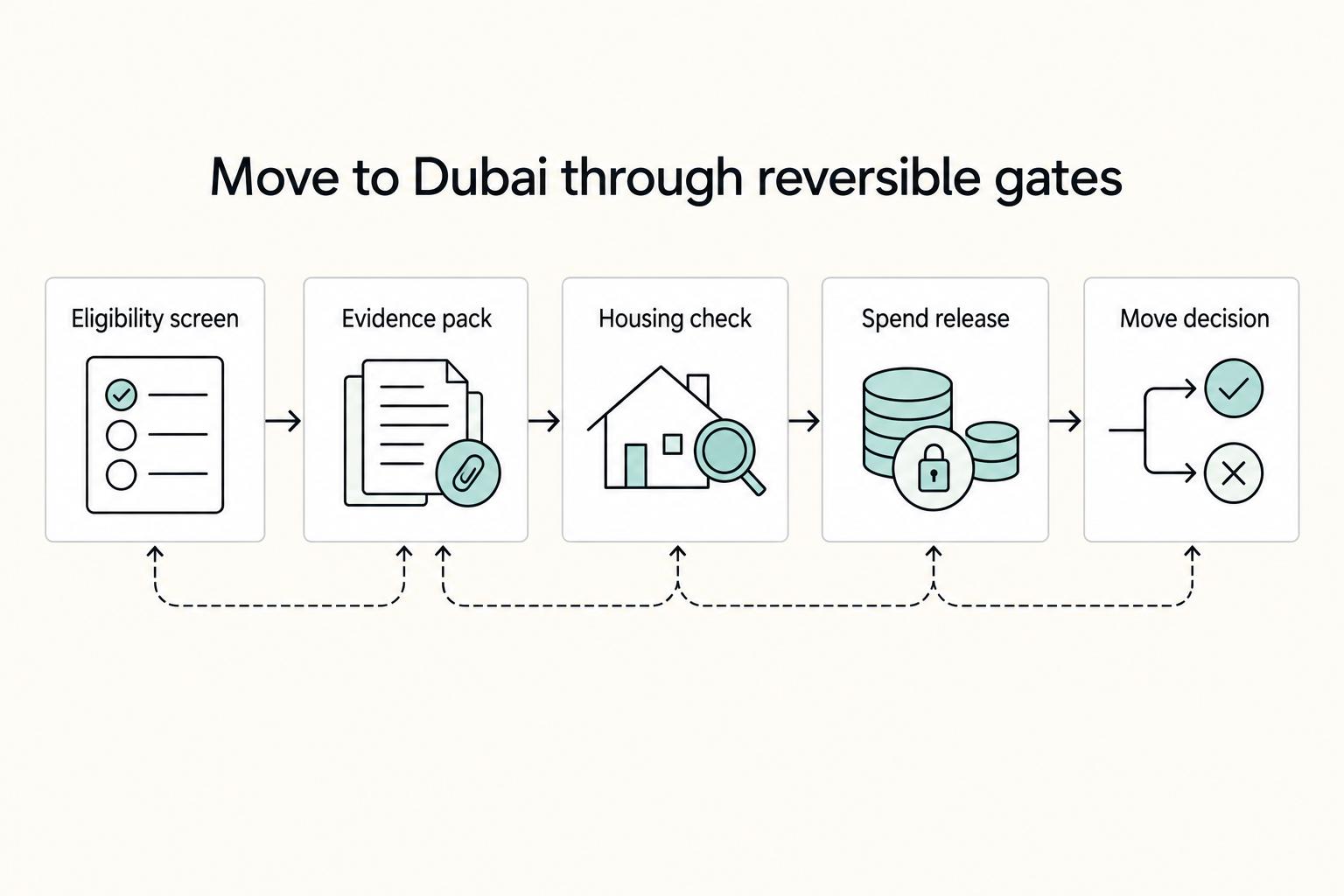
If this move works for you, it will work because you sequence decisions well and keep risk reversible until your status is clear. Treat this route as a chain of checkpoints, not one giant yes or no decision made under time pressure.
You will see several labels for the same path: Dubai Digital Nomad Visa, Virtual Working Programme, and Remote Working Visa Scheme. Public guidance describes it for remote workers and freelancers employed by companies outside the UAE, and for entrepreneurs with businesses registered abroad. One 2026 guide also describes a minimum income of USD 3,500 per month and a one-year term that may be renewable if you still qualify.
Do not decide everything at once. Separate reversible choices from irreversible ones. Reversible calls include temporary accommodation, shorter booking windows, and staged service setup. Irreversible calls include annual leases, large prepayments, and nonrefundable travel. Keep the second group on hold until status risk is lower.
Timing is the biggest planning variable, so build around buffer, not best case. Published estimates range from 5 to 7 business days after a complete application to 30 to 60 days. Right before submission, recheck current wording on official Dubai portals. Portal friction such as reCAPTCHA can slow direct confirmation, so do not leave verification to the last day.
Before you spend money you cannot easily recover, work through this sequence:
- Run a go or no-go screen so you know your work model fits the route and your income evidence supports the threshold you plan to use.
- Prepare documents early, then reconcile names, dates, and entity details across every file.
- Recheck core rules on official Dubai portals close to submission, and keep dated notes or screenshots of what you verified.
- Stage spending so major housing and travel commitments happen only after status risk drops.
Use one decision sheet with five fields: gate, current status, evidence file, next action, and spend allowed. Updating that sheet whenever status changes keeps choices consistent when visa, travel, and housing timelines start pulling in different directions.
If you are planning with a partner or team, agree in advance on who approves each irreversible spend. Clear ownership helps you avoid rushed yes decisions when a deadline tightens.
If you are moving with family, treat dependents as a separate gate with their own timing and cost assumptions. One guide says spouse and children can be included, but confirm current terms before you lock in costs.
The rest of this article follows the same order you should use in real life: fit, evidence, submission control, housing and budget tradeoffs, tax and payment records, then first-month execution.
Related: The Global Digital Nomad Visa Index: 50+ Countries Compared.
Start with the right visa mental model#
Treat this as a residency route built around remote work conditions, not a tourist-entry plan with paperwork patched in later.
If your plan works only if you enter first and sort out status afterward, pause before booking flights, signing a lease, or prepaying annual commitments. That is where avoidable cost exposure starts. People usually get into trouble when they treat sequencing as optional and hope timing gaps will somehow solve themselves.
The naming can distract you at exactly the wrong moment. Some people call it the Dubai Digital Nomad Visa. Others use Virtual Working Programme or Remote Working Visa Scheme. Use those labels to find the route, then confirm current naming and requirements on official immigration sources before you pay fees or hand over documents.
At this stage, fit matters more than logistics. A plan holds up when evidence, timing, and risk checks line up. It gets fragile when it depends on generic travel posts, stale forum threads, or assumptions borrowed from someone else's case.
A practical readiness test is simple: explain your work model, income proof, and tax position in one page without contradictions. If that summary is unclear, the move is not ready for paid steps.
Run this three-step screen first:
- Define your non-negotiables: intended stay length, dependent needs, renewal path, and whether you need a bridge to a longer-term residency option.
- Match income proof to your work type: employment contract and payslips, invoices and bank statements, or business ownership records.
- Treat tax exposure as a core gate, because longer physical presence can trigger residency and filing duties elsewhere.
Document consistency is often the hidden blocker. A common failure mode is a file set that looks fine on income but falls apart on names, dates, or entities once someone checks each page.
One operator rule matters here: reverify official wording near submission and update your checklist to match it. If tax exposure could change the move decision, finish that analysis before you commit money.
If you want a deeper breakdown, read Dubai virtual working program guide.
Run a go or no-go check before you gather documents#
Make the pass or fail call before you pay an advisor or build a full packet. If your setup does not fit this route cleanly, more paperwork mostly adds cost and delay.
Start with eligibility, not file volume. Public guidance describes this path for people employed by companies outside the UAE or running businesses based abroad. If your plan includes work for a UAE-based employer, or activity that would require a local trade licence, treat that as a no-go until official Dubai portals clarify it.
A one-page grid is enough to keep this honest:
Eligibility fit: employer or business is outside the UAE, and any local-work exposure is flagged for review.Passport: readable copy, identity details consistent, and validity questions marked for portal confirmation.Insurance: requirement status and acceptable proof marked for confirmation.Proof of income: evidence aligned to your work model, with threshold assumptions documented.
Set pass conditions before you collect files. Mark pass only when required evidence is identified and each unresolved item has an owner and deadline. If not, keep the case on hold and avoid discretionary spend.
This is also where you decide how much outside help you actually need. If fit is unclear, pay for targeted clarification first. If fit is clear, use advisor time for document quality and submission control rather than basic eligibility triage.
Handle conflicting guidance directly instead of hoping it resolves itself later. Some sources cite USD 3,500, others USD 5,000, and processing windows range from business days to several weeks. If a threshold or timing assumption changes your decision, verify it in the same week you plan to submit.
Treat consistency as its own gate, not as last-minute cleanup. Reconcile name, date, and entity mismatches before upload. A clean set is easier to defend and easier to update if a reviewer asks for one replacement file.
Keep tax assumptions in a separate lane. If your plan depends on a fully tax-free outcome, mark it unresolved until you confirm home-country obligations, especially for United States citizens and similar cross-border cases. For a deeper screen, review Living in a No-Tax Country: Is it Really Tax-Free for a US Citizen?.
Before paying fees, pressure-test assumptions with this visa cheatsheet for digital nomads.
Build your evidence pack in the order reviewers expect#
Once your go or no-go screen passes, the next job is to build one evidence pack that reads clearly under review and stays easy to update under pressure. Completeness matters, but coherence matters just as much.
Public guidance confirms that this route requires documents and a formal application process. Use the core set from your screen, then confirm final requirements close to submission. Blog guides are useful for orientation, but they should not become your final upload checklist.
Build the pack in the order a reviewer is likely to read it. Put identity first with readable copies of the identification documents currently requested. Put work and income second, grouped so one employment and earnings story is clear at a glance. Add insurance third, if currently required, with the latest acceptable proof and any pending confirmation noted on your side.
After the basic order is set, standardize the details across the whole packet. Use one spelling of your name, one date format, and one entity naming pattern in every document. Then run a quality pass on each file: opens cleanly, legible on screen, complete pages, and no cropped edges.
A simple naming rule helps when files are re-requested: category, person, date, and version in the filename. Keep that order consistent across document types so you can spot the latest version in seconds.
Before final upload, do a reviewer simulation on a separate device. Open the packet from first page to last and ask whether someone unfamiliar with your case could follow identity, work model, and income evidence without extra context.
If you share files with an advisor, keep two sets:
- A redacted set for advisory review.
- A full set reserved for formal submission.
Stop at the first conflict and fix it before submission. That habit removes a large share of avoidable back-and-forth.
Keep a short verification note in the same folder. Record what you checked, when you checked it, and where you saw the requirement. The note is for your own control. If wording changes or follow-ups arrive, you can immediately see which version of the rule your packet used.
Use explainers for context only. Several popular guides date from 2024 and earlier, so verify live requirements again right before filing.
Follow a realistic pre-move timeline#
Assume something will slip, then build your pre-move calendar so delays do not force expensive decisions. The point of a timeline is risk control, not just counting down to departure.
An eight-week structure is useful for sequencing, even though it is not an official UAE timeline. What matters is the discipline: move forward only when each checkpoint is clearly proceed; otherwise mark it fix or delay and protect flexibility.
Use this sequence to limit sunk-cost exposure:
Week 8 to 7: confirm the current process at the official Work Remotely from Dubai entry point and lock the checklist version for this submission cycle.Week 6 to 5: resolve inconsistencies in passport details, dates, and income evidence.Week 4 to 3: submit the application and maintain dated status notes until pre-approval.Week 2 to 1: book travel only after key approval gates are met and open issues are closed.
Build buffer between linked steps. If submission timing moves, update travel and housing in the same cycle so one delay does not create two separate cost problems.
The practical rule is simple: put submission ahead of major housing commitments. That is not a legal requirement. It is a risk-control choice that protects you from lease losses, flight changes, and deadline pressure if timing moves.
A 2021 process example shows a staged path: apply through the official entry point, clear document review for pre-approval, then complete in-country steps such as medical testing at a Medical Fitness Center, biometrics, and final residency artifacts. Use that as a process outline, then verify the current version before acting.
The same example lists split payments of 1251 AED early and 1140 AED after a positive fitness result. Treat those numbers as planning placeholders, not current guarantees. They are useful for staging cash flow, but they are not live fee confirmation.
Keep one fallback option in reserve, such as flexible temporary accommodation, in case your move date shifts. Once timeline risk is contained, the next task is clean submission and disciplined status control.
Submit cleanly and manage status like an operator#
At submission, precision beats speed. Use official channels, submit one coherent packet, and keep a simple status record from first upload to final outcome.
Third-party visa directories are fine for discovery, but they are weak tools during filing. They can mix tourist and residency paths, lag policy updates, or skip case details that matter for your specific documents.
Keep your status log short and consistent:
- Date and time of each check, in one timezone.
- Exact status text shown in the portal.
- What you submitted, corrected, or replaced.
- What remains open and the next checkpoint date.
Set a fixed cadence for status checks instead of constant refreshing. A predictable rhythm keeps records cleaner and lowers the risk of uploading the wrong file version under pressure.
This log does two practical jobs. First, it prevents memory drift when portal wording changes or a replacement file is requested. Second, it gives you a clean record if you need to explain delays to family, clients, or a landlord.
If a case stalls, respond with a clean packet built from your records and the latest official request, not a rewritten narrative. Follow the same pattern each time: confirm current wording, close the specific gap, and keep terminology consistent across updates.
Treat this as ongoing operating discipline, not a one-time admin step. The same records that support follow-ups also make later decisions better, especially when housing, monthly burn, and move-in timing start to depend on your approval window.
Choose housing with a work-first decision rule#
Housing is where remote workers most often lock in avoidable cost and stress. Choose a place that protects work reliability and cash flow before you optimize for extras.
In Dubai, rent is often the largest expat cost. Many landlords ask for annual payment up front, while some accept instalments. In practice, that term can matter more than headline rent, especially in your first months when visa timing, utilities, and routine spend are still stabilizing.
Treat the 05/03/2025 figures below as planning anchors, then verify current terms before signing.
| Area | Quoted one-bedroom band | Cash-flow implication | Verify before signing |
|---|---|---|---|
| Dubai Marina | £25,000 to £50,000 per year | Mid-range pricing can create larger upfront exposure | Annual versus instalment terms, utility expectations, and internet setup |
| Downtown Dubai | £25,000 to £50,000 per year | Similar pressure to Marina for many units | Payment schedule, total move-in amount, and realistic commute pattern |
| Jumeirah Village Circle (JVC) | £10,000 to £25,000 per year | Lower entry band can preserve month-one buffer | Instalment availability, AC condition, and building internet options |
| Deira | No range confirmed | Do not assume value without fresh quotes | At least three like-for-like listings and exact lease terms |
The tradeoff is straightforward. Mid-range bands can raise upfront cash risk, while lower quoted bands can preserve flexibility during the first months in the UAE. If budget stability matters more than prestige, a short initial stay in JVC or another area with fresh comparable quotes can reduce commitment risk while you test real operating cost.
That first housing choice also affects the rest of the plan, so compare listings on a like-for-like basis before you negotiate. Similar bed count, similar building condition, and similar payment terms are the minimum baseline. Without that, headline rent differences can hide a worse total deal.
Before any long lease, score neighborhoods against your actual working week:
- Commute friction: estimate weekly transit spend using your trip count and the Dubai Metro fare range of £0.50 to £1.50 per trip.
- Operating costs: include electricity and water at £120 to £300 per month and internet and TV at £50 to £150 per month.
- Heat resilience: assume heavy cooling use in summer and check whether your budget still holds in a high-usage month.
- Lease friction: confirm annual upfront versus instalments and write that exact term into your decision sheet.
When possible, use a two-step commitment path. Start with a shorter stay so you can test internet reliability, building response time, and commute pattern. Move to a longer lease only after those checks match your budget and workday needs.
Write a no-go rule before viewings: reject any unit that fails internet reliability, payment clarity, or basic building condition even if the rent looks attractive.
A common mistake is letting lower headline rent excuse weak internet, poor building reliability, or rigid payment terms. Do not trade away non-negotiables for a cheaper unit. Sign long term only after you have tested payment structure, operating cost, and a repeatable workday from that exact location.
Build a monthly budget that survives real life#
A budget that works only in a quiet month is a weak plan. Build two operating views before you lock recurring costs: one conservative month and one social month.
Start with estimates, then stress-test them against your routine. Tag each line as essential, discretionary, or unexpected so pressure points show up early. Social and travel spend usually overrun first because each purchase feels small until the totals stack.
Use three practical buckets:
- Essential costs: housing, core utilities, internet, insurance, and required work tools.
- Discretionary costs: dining out, local transport, events, short trips, and optional memberships.
- Unexpected costs: deposits, arrival purchases, and unplanned admin or travel items.
Build the two scenarios side by side for your likely neighborhood options, then compare the downstream effect on cash flow rather than looking only at monthly totals.
| Scenario | What to include | Decision use |
|---|---|---|
| Conservative month | Essential spend, minimum transport, and low social activity | Confirms your baseline is sustainable |
| Social month | Same baseline plus higher dining, events, and extra local travel | Confirms your plan still works during normal life |
Add a separate contingency line for unexpected travel and admin, then protect it. If either scenario fails after contingency, cut commitments first. The fix is usually smaller obligations, not a more optimistic spreadsheet.
Use a cash-flow calendar as well as monthly totals. Timing matters when rent, deposits, and setup costs cluster in the same period, and a plan that looks fine on paper can still create pressure if due dates stack.
For the first 60 days, reconcile planned versus actual spending each week. Early variance tells you whether housing, transport, or social habits are driving drift while changes are still easy to make.
Before you move on, revisit tax assumptions. A budget can look healthy while your filing position is still wrong, and that mismatch can undo an otherwise disciplined relocation plan.
Handle tax and residency claims with precision#
Most avoidable damage in this move happens when tax assumptions are made too early. Living in Dubai may change where you reside, but it does not automatically end filing duties in your home jurisdiction.
Treat tax residency as a hard decision gate. Visa approval and tax treatment can interact in timing, but they are not the same question. If you merge them, you risk making long commitments on top of an unsupported tax narrative.
Use state guidance as a complexity signal, not as a universal template. California says part-year residents can be taxed on worldwide income during their resident period and on California-source income during their nonresident period. It also treats services performed in California as California-source income.
The practical way to handle this is to separate status from outcome. Determine status first. Map income source second. Match filing steps third.
Use this checklist before major commitments, and rerun it whenever your facts change:
- Classify each relevant state first: resident, nonresident, or part-year where applicable.
- Map income by source before deciding what is taxable.
- Match forms to status, including nonresident or part-year returns where required.
- Confirm withholding certificates are complete before payment cycles begin.
- Keep written assumptions and support files so future rechecks stay fast.
For California, one concrete checkpoint in move-out cases with California-source compensation is Form 540NR. For withholding, an incomplete Form 590 certificate is invalid, and withholding may be optional when total California-source payments to a nonresident are $1,500 or less in the calendar year.
Another useful guardrail is to set expectations early. California describes residency as a facts-and-circumstances issue and says the FTB will not issue written opinions on whether you were a resident for a specific period. That makes chronology and records central to your position.
Keep a dated timeline of where you worked and when payments were earned. That timeline supports sourcing analysis and gives you a cleaner file if questions appear later.
New York guidance follows the same order of operations. Determine resident, nonresident, or part-year status first, then decide filing requirements. It also lists an income trigger above $4,000, or $3,100 if single and claimable as a dependent.
The operating takeaway is simple: keep visa work and tax work separate, then sync them by date and document history. If your move timeline changes, rerun both tracks before long leases, payroll changes, or any zero-tax assumption.
You might also find this helpful: Living in a No-Tax Country: Is it Really Tax-Free for a US Citizen?.
Set up payments and documentation for cross-border work#
Payment records are not just bookkeeping. They become evidence for renewal, support for tax filing, and protection when questions show up months later.
Treat each month as a compliance record. Align contract and invoice details every cycle: legal name, service period, currency, and payee account. If your contract started before relocation, keep the original agreement and document post-move service delivery terms in the same folder. This route is described as a one-year renewable virtual work residency permission, not permission to work for UAE companies.
Build your proof-of-income archive around the evidence types commonly expected by reviewers:
- Employees: recent payslips and the last three months of bank statements showing salary deposits.
- Business owners: business registration documents and three months of company bank statements.
- Month-end check: trace at least one paid invoice to its exact bank credit and note any FX or transfer-fee difference.
These controls matter because payment issues often appear first as document issues. A missing statement page, an entity-name mismatch, or an unexplained short payment can become hard to reconstruct later, especially near renewal.
Close each month only after contract terms, invoices, and bank credits reconcile cleanly. Leaving small mismatches unresolved is how renewal prep turns into a scramble.
If you are paid in multiple currencies, use one base reporting currency and reconcile the same way every month:
- Log invoice amount, invoice currency, issue date, and due date.
- Log received amount, settlement currency, and bank credit date.
- Save remittance advice with the matching invoice PDF.
- Record FX differences and fees in a monthly reconciliation sheet.
- Archive dated statements by month so prior versions remain available.
Watch two red flags early. First, this route is commonly described as limited to non-UAE clients and companies, so if a client shifts your contract to a UAE entity, pause and recheck eligibility before issuing the next invoice. Second, if deposits drop below commonly cited levels such as USD 3,500, or your case includes dependents where expectations may be higher, prepare support notes before renewal timing tightens.
Keep renewal-ready material in one indexed folder: bank statements, income records such as payslips or company bank statements, passport copy, active health insurance proof, and your contract and invoice trail for internal reconciliation. Track expiry dates in that same index so the file set stays close to review-ready.
Plan for delays, rework, and edge cases#
Assume rework is possible and design for it before you spend money. That one assumption protects both timeline and cash.
File quality deserves a dedicated pre-submission gate, especially because this route is commonly described as one year and early delays can compress every milestone that follows. A small document defect at the start can turn into rushed housing decisions, poor flight timing, and repeated follow-ups.
Use three internal checks on every submission or update:
- Identity details match across forms and supporting files.
- Insurance and financial documents are current for the exact version being submitted.
- Document dates and versions align across the packet.
Assign clear ownership, deadline, and proof for each check:
| Check | Owner | Deadline | Proof artifact |
|---|---|---|---|
| Identity consistency | You or advisor | Within 48 hours | One identity sheet with matching name, document number, and expiry across forms |
| Supporting-file currency | Document reviewer | Same business day | Latest versions of insurance and financial files prepared for submission |
| Date and version alignment | Finance admin | Before resubmission | One bundle with a consistent date window |
If your case is put on hold or rejected, pause and revalidate against official Dubai portals and your last submitted packet before uploading again. Then log only three items: what changed, why it changed, and which file proves the change. That keeps rework controlled instead of turning it into a moving target.
When you replace a file, archive the prior version instead of overwriting it. Version history makes follow-up questions easier to answer and reduces confusion across advisors.
Keep major commitments flexible until core UAE milestones are secure. Long leases, prepaid annual plans, early flight changes, and off-plan commitments reduce your options if timing slips. Relocation exposure can be material, with one cited range for a family at AED 40,000 to 60,000 and 5% VAT noted in general spending context. Off-plan purchases may also require 5% to 20% down before completion.
Keep the ID timeline in view as well. Emirates ID is mandatory for official services and identification, so upstream delays can block downstream tasks. Maintain one live folder for this visa track with passport copy, latest supporting files, and the latest submission record, and update it the same day any item changes.
Execute your first 30 days after arrival#
Your first month should be about control, not optimization. Secure the essentials, complete early admin in the right order, and delay major commitments until core milestones settle.
In the first 48 hours, lock temporary accommodation, activate a local mobile number, and create one document folder accessible from phone and laptop. Keep originals ready because some onboarding steps still require in-person attendance and physical documents.
Weeks 1 and 2 usually decide whether the move stabilizes or drifts into avoidable friction. Banking, accommodation, residency activation, and local setup can run in parallel, but delays often come from missing documents and poor sequencing. Bank account opening is a common bottleneck, and a missing stamped copy or signature can force rebooking and extra waiting days.
Reserve recurring admin blocks on your calendar during this first month. Treat them like client meetings so file checks, form updates, and follow-ups do not drift behind daily work.
Use this four-week execution grid:
- Week 1: stabilize housing basics, confirm reliable work connectivity, and enforce consistent file naming for all visa documents.
- Week 2: complete medical fitness tests and Emirates ID registration within the first two weeks, since these steps connect to banking and lease actions. If you are deciding between neighborhoods, test daily routine fit before signing a longer contract.
- Week 3: lock budget controls and recurring admin tasks so renewal prep and compliance checks do not drift.
- Week 4: run a full document audit and verify names, numbers, and dates are consistent across active records.
If visa status is still pending, keep housing and flight choices flexible. Exploring areas before signing an annual lease usually preserves options when timelines shift.
Close each week with one verification test: trace one real task from request to accepted outcome. If the same document gets requested twice, treat that as a process gap and fix naming or version control before the next submission. That habit turns the first month from reactive admin into a stable operating base.
Your next move#
The next smart action is to cut irreversible risk before you increase spend. Run a strict go or no-go screen, then complete a clean evidence pack before deposits, annual plans, or nonrefundable travel costs.
Use three gates:
Gate 1: Visa path fit- your setup aligns with a remote-work route and does not assume local employment permission.Gate 2: Document readiness- core files are current, legible, and consistent across names, dates, and entities.Gate 3: Submission confidence- you can complete the official portal flow and explain each uploaded file clearly.
Apply this decision rule:
Go- all three gates pass.Hold- one gate fails but appears fixable soon, so pause discretionary spending.No-go- major uncertainty remains on path fit, identity consistency, or tax assumptions.
If any gate stays ambiguous for more than one review cycle, pause new commitments and resolve that gate first. Clearing uncertainty early is usually cheaper than correcting commitments later.
Run a weekly review against those gates until the move is complete. Update only the facts that changed. That keeps decisions grounded and reduces drift from old assumptions.
Use one final payment rule: if your current file set cannot justify a spend today, defer it. That keeps money tied to verified progress instead of stress.
Before major spending, set up one secure master folder for sensitive records such as passport data, bank statements, payslips, and any medical test results your case requires. A practical checkpoint from firsthand process notes is to keep the last three months of bank statements ready, while treating that detail as case-specific rather than universal.
When details are unclear, verify official Dubai portals first. One firsthand account describes selecting a New Virtual Work Entry Permit option before document submission, but portal labels can change, so confirm live wording before acting. If you use an advisor, keep your own complete copy set and do not rely on forwarded screenshots as your primary record.
Keep commitments flexible until core status is confirmed: short stays before long leases, fewer nonrefundable costs, and tax planning kept separate from visa planning. If a source is stale, inaccessible, or too thin to support a decision, treat it as unverified and recheck official portals before spending.
As you finalize the move, use the tax residency tracker to keep your timeline and filing notes organized.
Frequently Asked Questions
Can I live in Dubai while working for a company outside the United Arab Emirates?
Yes. This route is available for remote workers and freelancers employed by companies outside the UAE, as well as entrepreneurs running businesses registered abroad.
How long does the Dubai Digital Nomad Visa usually last, and how does renewal work?
The commonly cited term is one year. Renewal is described as annual if you still meet eligibility, so plan for a recheck rather than an automatic extension.
What documents are typically required for the Virtual Working Programme application?
Third-party guides commonly list a valid passport, health insurance with UAE coverage, and proof of income or business registration. A typical flow is to create an account, upload required documents, and pay fees, and accurate, complete files are described as supporting a smoother process.
How long can processing take after a complete submission through official Dubai portals?
One commonly cited estimate is 5 to 7 business days after a complete application. Use that as a planning range, not a guarantee, and verify current timelines on the official Dubai portal before submitting.
Is Dubai expensive for digital nomads, and which costs usually drive the biggest overruns?
No single reliable monthly cost figure applies to all nomads in Dubai. A safer plan is to avoid locking major fixed commitments early while visa and admin steps are still in progress.
Which neighborhood is the better starting point for remote work: Dubai Marina, Downtown Dubai, Jumeirah Village Circle (JVC), or Deira?
There is no supported one-size-fits-all ranking across these areas. Start with short stays and choose based on day-to-day fit before signing a long lease.
What should United States citizens double-check before relying on "tax free" assumptions?
Zero income tax claims about Dubai do not resolve United States filing obligations. Keep tax planning separate from visa planning and confirm home-country obligations before making long-term financial decisions.
Try a related tool
Researched and edited by the Gruv editorial team. Gruv builds cross-border billing, payouts, and finance-operations software for global businesses.
Sources
Includes 1 external source outside the trusted-domain allowlist.
Educational content only. Not legal, tax, or financial advice.
Related Posts
Dubai Virtual Working Program for Nomads Who Need Certainty
Treat this as an execution guide, not a travel blog. Start by separating what is clearly stated from what still needs official confirmation before you pay, travel, or commit to housing dates.

The 2026 Global Digital Nomad Visa Index for 50+ Countries
Start with legal fit, not lifestyle filters. The practical order is simple: choose a route you can actually document, then decide where you want to live. That single change cuts a lot of wasted comparison work and stops you from falling in love with places that were never a real filing option.

Is a No-Tax Country Really Tax-Free for a US Citizen?
A no-tax destination can lower local income tax, but it does not end U.S. filing and reporting duties. U.S. citizens abroad are still taxed on worldwide income, and tools like the FEIE or Foreign Tax Credit are tied to filing a U.S. return.