

Quick Answer
If you receive payment, you normally supply your applicable tax form to the payer. If your business pays a contractor who withholds required tax details, identify the missing information and payment rules. Apply required backup withholding without waiting for an internal reminder deadline, and follow separate procedures for IRS mismatch notices.
First establish who is paying whom#
If you are a freelancer receiving payment from a client, you are normally the payee who supplies a Form W-9 when applicable. Your client’s refusal to give you its own W-9 does not automatically create a tax problem for your invoice. Ask why you need the form and whether you are actually making a reportable payment to that business.
The payer-side problem arises when your business pays a U.S. contractor or other payee and needs the payee’s taxpayer identification number (TIN) for information reporting. This guide addresses that situation, while distinguishing it from a customer who simply owes you money. The IRS Form W-9 collects the payee’s tax identity; it is not proof that an invoice is valid or paid.
For example, a designer billing a client $3,000 does not deduct backup withholding from money the client owes the designer. If the designer separately hires a U.S. illustrator for a reportable $3,000 service payment, the designer’s business is the payer for that second transaction. Keep the roles clear before sending reminders or changing payment handling.
Identify the actual missing information#
Request the payee’s tax name, classification and TIN through a secure process, using the applicable form. U.S. tax status is not determined solely by a mailing address or citizenship. A U.S. person, including a resident alien, generally uses W-9. A foreign payee needs the appropriate foreign-status or income documentation; do not demand a false W-9 certification simply to complete your vendor screen.
| Situation | What it means | Next action |
|---|---|---|
| Correct TIN supplied, W-9 unsigned | A signature is not required for every payment type | Check the certification rules for this payment before treating it as refusal |
| TIN missing or obviously malformed | Required tax identification has not been supplied correctly | Determine reportability and exemptions; apply backup withholding when required |
| A nine-digit name/TIN combination appears questionable | A formatting check does not prove an IRS match | Ask for correction and use eligible TIN Matching; distinguish an internal alert from an IRS notice |
| CP2100 or CP2100A notice | IRS has identified a reporting mismatch or missing TIN | Compare the notice with your records and follow the applicable notice procedure |
| Payee says it is foreign | The W-9 request may be inappropriate | Clarify tax status and choose the correct documentation and withholding regime |
Under the W-9 instructions, many ordinary nonemployee-service payments fall within the “other payments” signature rules: the correct TIN is required, but certification generally need not be signed unless the payee has been notified of a previously incorrect TIN. Other contexts and a requester’s need to establish U.S. status can require signing. Resolve the actual requirement rather than assuming any unsigned form triggers 24% withholding.
Send a specific request that the payee can resolve#
A useful request explains your role, the information needed and the secure return channel. Ask about the exact gap: missing TIN, inconsistent tax name or a required certification. Keep your internal response deadline separate from statutory withholding and filing deadlines. Repeated reminders do not postpone an obligation that already applies.
We are setting up your business as a payee for our service payments. Please provide your correct tax name and TIN through our secure collection channel, using Form W-9 if you are a U.S. person. If that form does not fit your tax status, tell us so we can request the appropriate documentation. Our finance contact can explain the missing field or certification.
If the concern is sharing an SSN, explain who will access the form and how it will be protected. Do not recommend inventing an EIN, using another person’s number or sending a TIN in a public message. Keep requests and responses in a restricted vendor file; ordinary invoice discussions should not display the full tax number.
Collect documents early, but do not treat an internal onboarding hold as a substitute for required withholding or assume it permits indefinite nonpayment of earned invoices. Identify the amount owed, payment terms and lawful payment treatment. A finance owner should resolve classification and exemptions before the next affected payment, with a recorded decision.
Apply backup withholding to the correct payments#
IRS backup-withholding guidance sets the rate at 24% for affected reportable nonpayroll payments. Determine the payment type, tax year, reporting threshold and applicable payee exemptions first. Refusal alone does not turn every invoice, reimbursement or payment to a corporation into a reportable nonemployee-compensation payment.
For 2026, the 1099-MISC/NEC instructions describe a $2,000 threshold for ordinary reportable nonemployee service compensation, replacing the earlier $600 threshold. Other payment categories have different rules, and backup-withholding reporting can apply regardless of amount when tax was withheld. Do not use one threshold for every 1099 category or tax year.
For a covered payment with a missing or obviously incorrect TIN, required withholding cannot wait for your “final refusal” notice. The IRS B-program guidance distinguishes obviously incorrect formatting from an otherwise plausible name/TIN mismatch. A number with the wrong digit count or alphabetic characters is different from a nine-digit combination that simply fails a preventive check.
Illustration: your business owes a U.S. individual contractor a reportable $3,000 service payment, the required TIN is missing, and no exemption applies. Backup withholding is $3,000 × 24% = $720; the contractor receives $2,280. Record $3,000 gross compensation, $720 federal tax withheld and $2,280 net paid. The $720 is money owed to the IRS, not a platform fee or a reduction in the contractor’s gross earnings.
If earlier payments were incorrectly paid without required withholding, preserve that history and address the payer’s exposure separately. Do not silently recover extra tax from a later invoice or change the original records to make them look compliant. Record when the missing-TIN condition was identified and the basis for any correction.
Handle IRS mismatch notices on their own timetable#
When CP2100 or CP2100A arrives, compare the listed name, TIN and account with your filed return and current records. A mismatch caused by your own transcription error requires different handling from a combination supplied by the payee. A preventive TIN Matching result is not itself the IRS notice that starts the formal B-notice procedure.
Publication 1281 explains first and second B notices. For the first applicable incorrect-name/TIN notice, send the First B Notice and Form W-9 within 15 business days of the IRS notice date or receipt date, whichever is later. If the required signed W-9 is not returned, begin withholding no later than 30 business days from that reference date; earlier commencement is permitted. Missing or obviously incorrect TINs have immediate-withholding rules rather than this response window.
A second qualifying notice within the prescribed three-year period uses a different procedure and generally requires validation from SSA or IRS rather than another W-9 alone. Track the notice history and the applicable start/stop deadlines from Publication 1281. A generic reminder sequence must not replace those notices or incorrectly restart the first-notice process.
Deposit and report the withheld tax#
Assign an owner to the withheld-tax liability as soon as payment is processed. Record the payment date, gross compensation, tax and net amount; reconcile those records to your tax deposits. The Form 945 instructions govern nonpayroll withholding reporting and deposit schedules, including monthly/semiweekly rules and exceptions. Determine the applicable schedule for the tax year; do not automatically hold the tax until the annual return is filed.
Report nonemployee compensation on 1099-NEC where that is the correct form, including backup withholding in the federal-tax-withheld field. Other income can belong on 1099-MISC or another return. Provide the recipient statement and file the applicable return even if the payee remains uncooperative; follow the filing channel’s missing-TIN instructions rather than fabricating a valid-looking number. A withheld amount must not disappear because vendor setup stayed incomplete.
Preserve the received forms, solicitation history, notices, payment calculations, deposits and filing acknowledgments under the applicable retention rules. Restrict TIN access and keep a correction history. Your file should explain what happened without forcing a reviewer to reconstruct sensitive details from ordinary email threads.
Electronic W-9 collection has its own IRS rules#
The requester instructions expressly permit electronic W-9 systems. They require integrity of submitted information, submission-access records, reasonable identification of the submitter, the paper form’s information and the ability to produce a hard copy. When a signature is required, the electronic signature and penalties-of-perjury statement must meet those instructions; a system need not add them where the form need not be signed.
Choose a collection method that supports those requirements and document its access controls and export capability. An emailed image or a checkbox is not automatically equivalent to a compliant required electronic certification. IRS rules for signing Forms 8878 or 8879 do not define your W-9 workflow.
For the underlying form fields, see Form W-9 for independent contractors.
Frequently Asked Questions
Does my client need to give me a W-9 before paying my invoice?
Usually you, as the payee, provide your tax details to the client when applicable. The client’s own W-9 is relevant if you are making a payment to it that requires that information. Do not reverse the payer and payee roles.
Does an unsigned W-9 always trigger backup withholding?
No. Signature requirements depend on the payment and certification context. Many ordinary nonemployee-service payments require the correct TIN without a signed certification unless the payee was notified of a previously incorrect TIN. Check the actual rules before treating a missing signature as a missing TIN.
Can I wait for a final reminder before withholding for a missing TIN?
Not when backup withholding already applies to the affected reportable payment. Your internal reminder deadline does not postpone the statutory obligation. Establish the payment’s reportability and exemptions, then handle it under the applicable rules.
Is an internal TIN mismatch the same as a CP2100 notice?
No. An internal or preventive matching result needs investigation. An IRS CP2100 or CP2100A notice has formal record-comparison and notice procedures, including different first and second B-notice handling.
Can I accept an electronic W-9?
Yes, through a system that satisfies the IRS requester instructions for data integrity, submitter identification, access records and reproducibility, plus the required electronic certification where applicable.
What happens to the tax withheld from a contractor?
It is a federal tax liability, not business revenue or a fee. Deposit and report it under the applicable rules, reconcile it to the gross and net payment, and report the withholding on the correct recipient information return.
Researched and edited by the Gruv editorial team. Gruv builds cross-border billing, payouts, and finance-operations software for global businesses.
Sources
- irs.gov/pub/irs-pdf/fw9.pdftrusted
- irs.gov/instructions/iw9trusted
Educational content only. Not legal, tax, or financial advice.
Related Posts

Germany Freelance Visa Application Path for Freiberufler and Gewerbe
Choose your track before you collect documents. That first decision determines what your file needs to prove and which label should appear everywhere: `Freiberufler` for liberal-profession services, or `Selbständiger/Gewerbetreibender` for business and trade activity.

Form W-9 for Freelancers Working Across Borders
**Form W-9** gives a requester your U.S. taxpayer name, identification number and applicable certifications for information reporting. Start by deciding whose tax status and income the form documents. A U.S. citizen living abroad normally remains a U.S. person for this purpose; a foreign contractor does not become eligible for W-9 just by obtaining a U.S. EIN.
How to Fill Out Form W-8BEN for a Foreign Freelancer
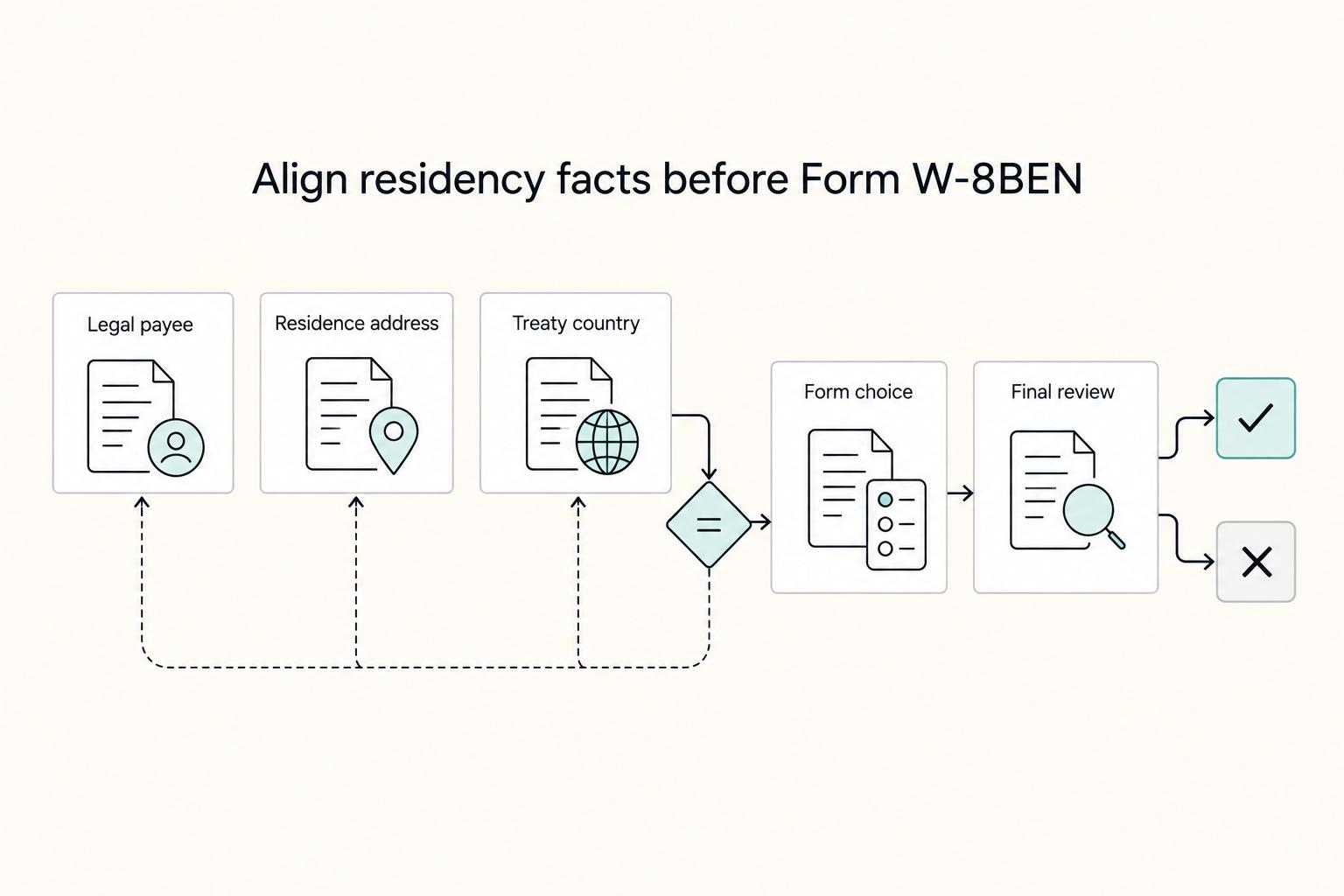
Form W-8BEN lets a non-U.S. individual document foreign status to a payer and, where eligible, claim treaty benefits. For a freelancer, the first decisions are who owns the income, where the services were performed, and whether this is the right certificate. A U.S. client does not by itself make your work U.S.-source income.