
Quick Answer
If your passport is lost or stolen abroad, first secure your email, banking, cloud accounts, devices, and SIM, then report the passport through your issuing authority's current process. Save proof of the report, file a police report if available, and prepare for the embassy or consulate with identity copies, passport photos, travel evidence, and an accepted payment method.
A lost passport abroad is not just a travel hassle. If you travel for work, it can disrupt meetings, expose accounts, and force rushed decisions under pressure. Basic advice to call the embassy and wait is not enough. You need a response you can use under stress: prepare before you leave, contain the damage fast, and handle the replacement like a business continuity problem.
This guide follows that sequence. It breaks the problem into three phases: pre-travel fortification, immediate triage, and business-focused recovery. The goal is simple. Losing one document should not take down your trip, your access, or your commitments.
Stage 1: Pre-Travel Fortification - The 90% Solution#
If Stage 2 is about fast action, this stage is about shrinking the problem before it starts. In most cases, the outcome depends less on luck than on whether you can prove identity, reach the right people, and access money without the missing document or device.
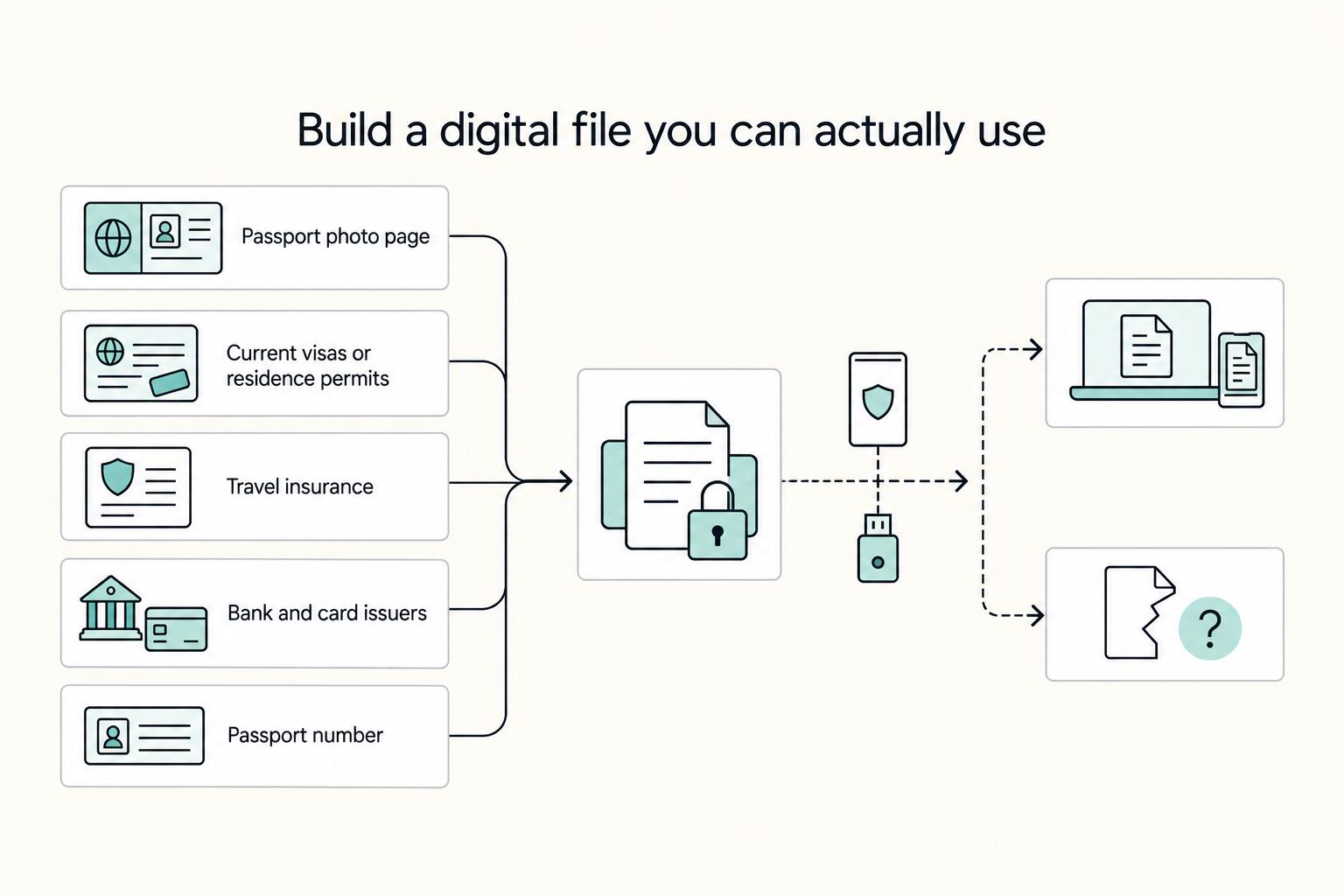
Build a digital file you can actually use#
A backup file only helps if you can trust it and open it when you need it. Keep sensitive credentials out of plain notes apps, and use protected storage (for example, a password manager's secure document area). CISA is explicit that storing passwords as plaintext in digital notes is not safe. Both the FTC and CISA recommend two-factor authentication or multifactor authentication, ideally with an authenticator app or security key when available. Include clear, readable copies of:
| Backup file item | What to save |
|---|---|
| Passport photo page | Clear, readable copy |
| Current visas or residence permits | Clear, readable copy |
| Travel insurance | Policy details and emergency assistance number |
| Bank and card issuers | Emergency contact numbers |
| Passport number | Recorded separately from the passport itself |
| Nearest embassy or consulate | Address and phone number |
| Replacement requirements note | One-page note updated only after checking your passport authority and nearest embassy or consulate |
- your passport photo page
- any current visas or residence permits
- your travel insurance policy details and emergency assistance number
- your bank and card issuer emergency contact numbers
- the passport number recorded separately from the passport itself
- the address and phone number of your nearest embassy or consulate
- a one-page note titled "replacement requirements" that you update only after checking your passport authority and nearest embassy or consulate
That last item matters because the rules are not universal. For U.S. citizens, replacing a passport abroad requires an in-person visit to a U.S. embassy or consulate. For UK citizens, an emergency travel document is for urgent travel when you cannot use your passport. It has conditions, including travel within 6 weeks and transit through a maximum of 5 countries. Country-specific requirements in that note remain pending until verified against current official mission, government, or source records before use.
Make sure you can open this file offline. A simple checkpoint is to put your phone in airplane mode before you leave and confirm you can still access the documents you need. Also remember that copies can help recovery, but Canadian government guidance is clear that they are not valid identification by themselves.
Split what you carry so one theft does not lock you out#
Physical redundancy is what keeps one lost bag from taking your ID, money, contacts, and recovery path with it: one missing item should not block identity proof, payments, and outreach at the same time.
| Item | Primary location | Backup location | Why this split reduces lockout risk |
|---|---|---|---|
| Passport | On your person when in transit | Secure accommodation storage when not needed | Keeps the document available for checkpoints but not exposed all day |
| Secondary photo ID | Separate wallet or inner compartment | Digital copy plus trusted contact copy | Gives you a second way to support identity if the passport is gone |
| Main payment card | Daily wallet | Separate bag or accommodation safe | Canadian guidance recommends a backup source of funds stored elsewhere |
| Emergency cash | Small amount in wallet | Separate stash in luggage or accommodation | Helps if cards are blocked or the wallet disappears |
| Bank and insurer contact sheet | Printed card separate from wallet | Secure digital copy | Lets you freeze cards and call assistance even if your phone or wallet is stolen |
One red flag: do not store full card credentials, PINs, or account passwords in plaintext in your backup file. What you want is recovery access, not a second theft opportunity. Save issuer contact paths, use a password manager, and test that you can sign in securely without relying on a single device.
Do a 15-minute readiness drill#
A short rehearsal before departure is usually enough to expose the weak points. Run through this once before you leave:
- Confirm your consular channels. Save the nearest embassy or consulate details for your destination. If you are a U.S. traveler, enroll in STEP and save the State Department numbers 1 (888) 407-4747 and 1 (202) 501-4444.
- Verify the insurance path. Find the emergency assistance number and review whether lost or stolen items are covered.
- Hand off to a trusted contact. Give them a secure copy of your document set, confirm how they should reach you, and note any country-specific process checks you still need to verify.
If you only do one rehearsal, test this failure mode: no passport, no wallet, low battery, weak internet. If you can still reach your documents, your issuer, and your consulate, your prep is good enough to matter.
Stage 2: The First 60 Minutes - Digital and Physical Triage#
In the first hour, prioritize containment: secure your digital access first, then start document reporting.
Do this first#
From a trusted device, run this checklist in order:
- change your primary email password first
- then secure banking, payment, and cloud storage accounts
- use device locator tools to lock a missing phone or laptop, and wipe it if recovery looks unlikely
- suspend your SIM or eSIM with your carrier
- test account recovery from that trusted device before signing out elsewhere
Do this next#
Once access is stable, report the missing passport through your issuing authority's current lost or stolen process. Use the official website, and treat saved notes or old screenshots as reference only. Procedures can change, so verify the live workflow before you submit.
Before moving on, save proof that your report was filed, such as a reference number, confirmation page, screenshot, or PDF in your backup folder.
Do this before leaving for police or consulate#
If local police reporting is available, file a report and leave with details you can reuse:
| Police report detail | What to capture |
|---|---|
| Incident summary | Short incident summary |
| Report reference | Report or case number |
| Station details | Station name, address, and contact details |
| Copy received | Paper, stamped, or digital |
| Translation status | Whether translation may be needed for embassy, insurance, or onward travel |
Requirements differ across embassies, insurers, and airlines. Capturing these details early reduces repeat trips and prevents weak documentation later.
If you want a deeper dive, read The 2026 Global Digital Nomad Visa Index for 50+ Countries.
Stage 3: The Next 72 Hours - Business Continuity and Recovery#
In this window, run four tracks in parallel: consular replacement, support escalation, stakeholder updates, and evidence logging. If you treat them as one workflow, you reduce delays and avoid documentation gaps later.
Prepare for the consular appointment#
Your fastest path is a complete, mission-specific file prepared before you leave for the post. Confirm current rules for your nationality and that embassy or consulate, since appointment and fee handling can vary by location.
| Country | Emergency document notes | Key limits or timing |
|---|---|---|
| U.S. | A consular section may issue an emergency passport when there is not enough time for a regular one | May be valid for up to 1 year |
| UK | Emergency travel document for urgent travel when you cannot use your passport | Online application; £125; usually ready in 2 working days; travel within 6 weeks; transit through a maximum of 5 countries |
| Canada | Emergency passport service | Not available at every post; replacement can be delayed if the loss is reviewed |
Use this checklist:
- Application and appointment: current replacement forms, appointment confirmation, fee instructions, and any local checklist. For U.S. cases abroad, replacement is in person, and posts commonly reference DS-11 and DS-64.
- Identity and citizenship: passport copy, national ID, driver's license, birth certificate copy (if relevant), and your old passport number.
- Incident record: police report or case number, short timeline, and location of loss. A police report can help, but U.S. guidance does not make it mandatory.
- Urgency proof: onward booking, required return evidence, or other travel timeline documents.
- Photo and payment: current passport photo and an accepted payment method.
Before traveling to the post, verify: your appointment is active, your payment method is accepted, and your files are usable offline and printable.
Country examples show why this matters. A U.S. consular section may issue an emergency passport when there is not enough time for a regular one, and it may be valid for up to 1 year. A UK emergency travel document is for urgent travel when you cannot use your passport; it requires an online application, costs £125, is usually ready in 2 working days, is for travel within 6 weeks, and allows transit through a maximum of 5 countries. For Canadians, emergency passport service is not available at every post, and replacement can be delayed if the loss is reviewed.
Activate support and communicate early#
Do not carry all admin work alone. Route each problem to the channel built for it.
| Support option | Use it when | Likely outcome |
|---|---|---|
| Card issuer/network emergency assistance | Cards are missing or you need access to funds | Card cancellation, replacement-card coordination, emergency cash support |
| Travel insurer | The incident may trigger interruption/cancellation or extra covered costs | Claim steps, required forms, evidence requirements, possible reimbursement per policy |
| Employer/client operations support | Travel disruption may affect meetings or delivery timing | Rebooking/logistics help, document support, schedule adjustments, expectation alignment |
Use one short update format for everyone: status, impact, mitigation, next update time.
Client-facing:
I had a travel document issue in [City]. I may need to move [meeting/delivery] by [timeframe]. I have started the consular replacement process and will keep work moving remotely where possible. I will confirm the next update by [date/time].
Internal:
My passport replacement is in progress at [post/city]. Current impact is [flight delay/meeting risk/none yet]. I need help with [rebooking, printing, expense approval, local courier]. I will update the channel again by [date/time].
Build an evidence log that will still make sense months later#
Assume you will need this file again for immigration, insurance, or tax documentation. Create one secure incident folder plus one separate backup copy with a trusted person.
Store scans/PDFs of:
- police report and case details
- consular forms, appointment confirmation, and fee receipts
- passport photos used
- replacement passport or emergency travel document
- rebooked transport and accommodation records
- key status emails/messages sent and received
Keep old and new passport details together so you can reconcile visa and border records later. If your status is digital, passport replacement may not complete the process by itself. In the UK, an eVisa is a digital immigration-status record, and you can apply online to transfer a visa to a new passport from outside the UK for £154, with a usual decision time of 3 weeks after identity proof.
For U.S. travel-history reconstruction, the I-94 tool can show arrivals and departures for the past 10 years, but CBP says it is a help tool, not an official legal record. For tax records, keep incident files with annual records and verify retention rules by jurisdiction. HMRC guidance, for example, says self-employed records should generally be kept for at least 5 years after the 31 January submission deadline for the relevant tax year. Related: Canada's Digital Nomad Stream: How to Live and Work in Canada.
From Crisis to Control: A Final Thought#
If you keep one playbook, keep this one: prepare before travel, triage immediately, then complete recovery end to end. That sequence turns a passport lost or stolen abroad from chaos into a checklist you can execute.
| Moment | Unprepared response | Prepared response |
|---|---|---|
| Before travel | No passport copy, no backup ID, no embassy contact saved | Secure digital copies and a separate physical backup, plus your passport number, itinerary, and consular contact details |
| First 60 minutes | Panic, retracing steps only, delayed account security | If other items were taken, lock down email, banking, cards, and devices first; then report the loss and contact the nearest embassy or consulate |
| Recovery | Assumes copies or old bookings will be enough | Bring identity proof, photos, travel evidence, and follow the post's current appointment, form, and fee instructions |
| Onward travel | Assumes any emergency document works like a full passport | Verify limits first: a UK Emergency Travel Document is usually for a single or return journey, and U.S. or EU emergency documents may also be limited in validity |
Your main checkpoint is always the issuing authority's current process at the specific post. For U.S. travelers, online reporting cancels the passport within 1 business day, and replacement abroad requires appearing in person at a U.S. embassy or consulate. Copies can speed recovery, but they are not legal travel ID. A common miss is stopping too early instead of confirming document limits, route constraints, or post-level review steps that can delay issuance.
Before your next trip, create a one-page recovery plan: document copies, passport number, nearest mission, backup payment method, emergency contacts, and your escalation path if travel is imminent. Country-specific items for your nationality and destination remain pending until verified against current official mission, government, or source records before use. Preparation cannot guarantee a smooth outcome, but it gives you a verified next step.
For a step-by-step walkthrough, see A guide to 'travel warnings' and 'advisories' from the state department.
Frequently Asked Questions
What is the very first thing to do if your passport is stolen?
Report the passport to your issuing authority right away. For a U.S. passport, you can submit Form DS-64 and contact the nearest U.S. embassy or consulate to start replacement and confirm timing. If your phone, wallet, or cards were also taken, secure those accounts immediately.
How can you best prepare for losing a passport abroad?
Keep one secure digital copy set and one separate physical backup of key identity documents before you travel. Include a passport copy, visa copy, secondary ID, old passport number, passport photos, and offline access to booking confirmations. Preparation will not remove consular requirements, but it can reduce delays.
Can you fly internationally if you lose your passport?
Contact your embassy or consulate about replacement or emergency travel documentation, and confirm with your airline what documents they will accept for your itinerary. For U.S. passports, once a passport is reported lost or stolen, it is invalidated and cannot be used even if you find it later.
What happens to your active visas if you lose your passport?
Visa handling can vary by country and visa type. After you have your replacement passport details, contact the visa-issuing authority to confirm the next steps for your case. Bring any available records, such as old passport and visa copies, to make that process easier.
How long does it take to get an emergency document?
Ask the embassy or consulate directly how long replacement or emergency issuance is taking at that post right now. Timing varies by post and case. In some situations abroad, a limited-validity passport may be possible when there is not enough time for a regular passport.
Do you need a police report to get a new passport from the embassy?
File a police report if it is practical and safe, then ask your embassy or consulate whether it is required for your case. Requirements can vary by country and post, so verify the rule directly before your appointment.
Try a related tool
Researched and edited by the Gruv editorial team. Gruv builds cross-border billing, payouts, and finance-operations software for global businesses.
Sources
- 2009-2017.state.gov/documents/organization/258336.pdftrusted
- cbp.gov/sites/default/files/2025-06/ttp_handbook.pdftrusted
- cisa.gov/resources-tools/training/cyb3rsmrt-use-passw...trusted
- cisa.gov/audiences/small-and-medium-businesses/secure...trusted
- consumer.ftc.gov/articles/use-two-factor-authentication-prote...trusted
- eeas.europa.eu/eeas/new-eu-emergency-travel-document_entrusted
- irs.gov/pub/irs-access/p2104_accessible.pdftrusted
- irs.gov/businesses/small-businesses-self-employed/ho...trusted
Educational content only. Not legal, tax, or financial advice.
Related Posts

The 2026 Global Digital Nomad Visa Index for 50+ Countries
Start with legal fit, not lifestyle filters. The practical order is simple: choose a route you can actually document, then decide where you want to live. That single change cuts a lot of wasted comparison work and stops you from falling in love with places that were never a real filing option.
Canada Digital Nomad Visa Planning for Visitor Status and Work Permits
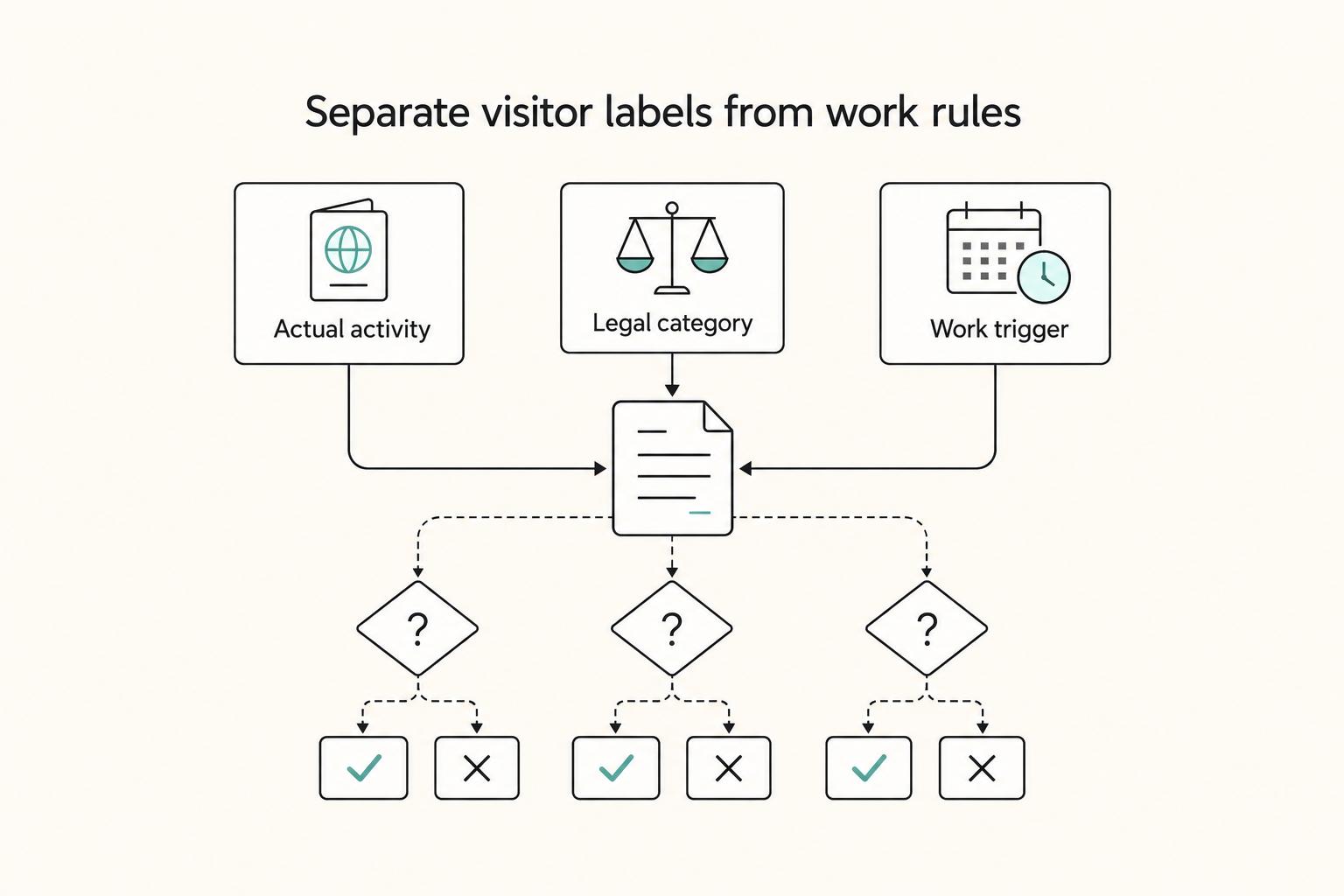
The phrase `canada digital nomad visa` is useful for search, but misleading if you treat it like a legal category. It is shorthand for existing Canadian status options, mainly visitor status and work permit rules, not a standalone visa stream with its own fixed process. That difference is not just technical. It changes how you should plan the trip, describe your purpose at entry, and organize your records before you leave.

Digital Nomad Pre-Travel Checklist for Long-Stay Moves
Set your departure dates first. Long-term travel planning breaks down when timing stays vague. Vague timing usually turns into rushed paperwork, rushed bookings, or unresolved home obligations.