

Quick Answer
Treat eor withdrawal penalty as the gap between approved payout and final credited funds, including visible charges, FX effects, bank deductions, retry costs, and delay impact. Keep IRS rules separate: the retirement lane uses the age 59½ test, a general 10% additional tax, and Form 5329, while platform comparisons depend on payout records and exception handling. Before committing, validate one real payout path in current terms, product screens, and written support replies.
- Use a net-settlement lens.
For buyers, the practical question is simple: what was approved, what arrived, and how long it took. Treat that end-to-end payout result as the real cost signal, then keep enough records to reconcile it later.
- Keep IRS "withdrawal penalty" rules separate from EOR payout costs.
In IRS retirement guidance, withdrawals before age 59½ are "early" or "premature" distributions, and an additional 10% tax generally applies unless an exception applies. The IRS also says most retirement plan distributions are subject to income tax and may also face that extra 10%, with Form 5329 used to report the additional tax or indicate the correct exception when needed. That is a retirement-tax framework, not a definition of EOR platform payout costs.
- Read this as a buyer-side comparison, then verify live terms before committing.
This guide compares Deel, Remote, and EOR-plus-payout-stack options to help you pick the lowest-surprise path for your use case. Use the conclusions as a decision aid, then confirm current terms, in-product details, and support answers before moving money. Related reading: A Guide to Employer of Record (EOR) Services.
Who this comparison is for and how to choose#
This comparison is for buyers who care more about predictable net payouts and clean reconciliation than the lowest headline fee. Use it whether you are making your first international hire or switching from an underperforming provider. Before you sign, use this scorecard:
- Pricing transparency: What is included in the base fee, and what is charged separately?
- FX methodology: What conversion spreads apply, and where can you verify them?
- Support model: Do you get a dedicated owner or ticket-only support, and what are the response times?
- Failure handling: How are payroll errors, compliance gaps, and payout exceptions handled in practice?
- Evidence quality: Will you have enough records to reconstruct what happened without manual guesswork?
Decision rule: if options look close, prioritize transparency and failure handling over the cheapest-looking quote. Hidden costs often show up months into the relationship, and weak support can leave important issues unresolved for days or weeks. Related: Separating Business and Personal Finances: An Important Step for LLCs.
Stop the terminology mistake before you compare platforms#
If you mix the two meanings of "withdrawal penalty," you will compare the wrong costs. Search intent here is mixed: many results are IRS retirement-tax content such as Topic no. 557, Form 5329 instructions, and Publication 575, not Employer of Record payout pricing.
- IRS early-distribution meaning. In IRS context, this is a tax-law issue: a 10% additional tax can apply to certain early distributions, generally before age 59½, and Form 5329 is used to report those additional taxes. This is separate from regular income tax and belongs to taxpayer filing rules under Section 72(t), not platform fee mechanics.
- Platform payout-cost meaning. This is platform-and-rail economics, not Section 72(t) tax treatment. Examples from provider docs include Deel's $5 same-currency cross-border fee and Remote's note that some SWIFT payouts may have correspondent-bank deductions in the $20 to $50 range.
- What this guide will not do. This section does not provide retirement-tax advice or eligibility conclusions for SECURE 2.0 exceptions, Notice 2024-55, or IRA-to-IRA rollover rules.
Quick checkpoint: if a source focuses on Topic no. 557, Form 5329, age 59½, or exception eligibility, you are in the retirement-tax lane, not the platform-comparison lane.
The real fee stack behind EOR withdrawal penalties#
Once you separate tax rules from payout mechanics, map the full fee stack. For this comparison, treat total cost as the gap between what was approved and what finally lands, then account for each source of that gap.
| Cost component | Where it usually appears | What to verify before you decide |
|---|---|---|
| Posted payout fee | Quote screen, confirmation, receipt, or terms | If no line item is shown, mark it unverified rather than zero. |
| FX spread | Embedded in conversion rate, not always labeled as a fee | Capture the quoted rate at submission and reconcile it against settlement records. |
| Intermediary-bank deductions | May appear only at final credit stage | Ask how short credits are explained and documented when received funds are lower than sent funds. |
| Failed payout retries / returns | Exception handling and support workflow | Confirm what evidence you get on failure, including reference, reason, and retried-transfer treatment. |
| Time-value loss from delay | Operational impact, not always a ledger fee line | Define what delay costs your operation and include it in platform comparisons. |
Use the same lens for both providers: check what is explicitly disclosed in-product and in current documentation, then test what remains implicit through reconciliation evidence.
A practical inspection order is quote shown, payout submitted, policy checks, provider routing, settlement, and final ledger review. This is a review sequence, not a claim about any platform's internal flow.
Your final check should reconcile approved amount, visible fees if any, conversion effect if relevant, transaction reference, and final credited amount. For recurring payouts, a periodic cash-verification cadence, for example a quarterly review, helps catch small deltas before they compound.
If two options look similar on posted fees, choose the one that gives clearer FX disclosure and cleaner exception-handling evidence. In this category, traceability is usually safer than a slightly cheaper first screen.
Compare options side by side before choosing#
Choose the option with the fewest unresolved unknowns, not the best-looking headline. Only treat claims as decision-ready if you can verify them in current terms, product UI, and written support replies.
Use this as a decision table, not a pricing table. Platform-specific fees, FX markups, payout timing, hold or return mechanics, dispute flow, and export quality are not confirmed here for Deel, Remote, Gruv-based stacks, or EOR plus external rails. So unknowns are marked explicitly.
| Option | Best for | Visible fees | FX spread transparency | Payout time windows | Hold / return behavior | Dispute path | Export quality | Pros | Cons | Concrete use case | Verification checkpoint |
|---|---|---|---|---|---|---|---|---|---|---|---|
| Deel | Teams already evaluating it as an EOR and willing to run a live test payout | Unknown from provided evidence. Confirm where fees appear, such as quote, confirmation, receipt, or post-settlement. | Unknown from provided evidence. If conversion applies, capture the submitted rate and compare it with settlement records. | Unknown from provided evidence. Get corridor-specific timing in writing. | Unknown from provided evidence. Confirm how holds, returns, and retries are shown and documented. | Unknown from provided evidence. Confirm ownership and escalation for "sent but not received." | Unknown from provided evidence. Request sample export fields such as ID, status, currency, and final amount. | Keeps evaluation focused if it is already shortlisted. | Easy to assume parity with other EORs without proof. | You plan to use it for EOR functions and need one end-to-end payout test before rollout. | Current terms, payout-flow screenshots, and one written support reply covering fees, FX evidence, timing, and exceptions. |
| Remote | Teams already evaluating it as an EOR and comparing on traceability | Unknown from provided evidence. Verify whether payout charges are shown before submission. | Unknown from provided evidence. Confirm what conversion and settlement evidence is available. | Unknown from provided evidence. Require route-specific timing, not generic estimates. | Unknown from provided evidence. Confirm behavior for pending, returned, or reviewed payouts. | Unknown from provided evidence. Get escalation path in writing. | Unknown from provided evidence. Request sample payout-history and exception exports. | Useful for like-for-like EOR comparison when held to the same evidence standard. | Brand-level comparisons can hide operational differences. | You are comparing it against another EOR and need reconciliation-grade evidence before commitment. | Current terms, product proof for fee and FX display, and a support ticket response on holds, returns, and disputes. |
| Gruv-based payout stack | Finance-minded teams that want explicit controls, traceability, and reconciliation evidence | Depends on selected modules or providers, so verify each fee layer separately. | Depends on the conversion route, so verify where quote and settled-amount evidence is recorded. | Depends on route and provider, so verify per route. | Depends on payout-leg ownership, so confirm where holds and returns are visible. | Can be split unless ownership is defined in writing. | Depends on selected tools, so request sample exports. | Lets you evaluate each layer by evidence quality instead of bundle assumptions. | More moving parts to verify, and unclear ownership creates risk. | You want EOR and payout decisions separated so reconciliation quality drives selection. | Provider map, written ownership split, sample exports, and documented handling for failed or short payouts. |
| EOR plus external payout rail | Teams using an EOR for employment scope but preferring a separate payout rail | Depends on both systems, so verify both sides and the handoff. | Depends on where conversion occurs, so confirm where the effective rate is set and evidenced. | Depends on rail and route, so verify the exact path used. | Higher risk of split explanations unless the handoff is documented. | Often cross-provider, so written ownership is required. | Often split across systems unless proven otherwise. | Fits teams with an existing preferred payout rail. | More points where fees, delays, or missing references can appear. | You keep EOR for employment scope and retain an external payout process. | Written handoff boundary, sample records from both sides, and confirmation of who explains short credits or returns. |
What to prioritize in this table#
The Verification checkpoint column is the decision gate. If a provider cannot satisfy that column with current terms, product proof, and written support responses, the option is not decision-ready.
Avoid false parity#
Do not assume two EOR options behave the same because the top-line positioning looks similar. Unknown operational details often become reconciliation problems when credited amounts or timelines differ from expectations.
Keep tax-penalty context separate#
Do not use IRA penalty guidance as a proxy for platform payout costs. IRA early-withdrawal rules, for example a general 10% penalty before age 59½ and up to 25% in the first two years for SIMPLE IRAs, are retirement-account tax rules. They are not evidence of EOR payout fee behavior.
Minimum proof before commitment#
Run one realistic payout scenario for each shortlisted option and save a proof pack. Keep the submission screen, visible fee line if any, quoted rate if any, payout or transaction reference, settlement record, and written exception-handling response. If the evidence is still thin, keep the option in not yet proven status.
Best picks when your top priority is predictable payout timing#
If timing is mission-critical, prioritize status transparency and retry controls over the lowest advertised fee. The practical split is straightforward: solo operators usually need the clearest ETA with minimal release gates, while teams need explicit approval states and exception ownership so delays do not compound across approvers and banks.
| Option | Best for | Timing signals | Main timing caveats | Expected timing note |
|---|---|---|---|---|
| Deel | Solo operators or lean teams that want in-app timing updates after submission | Dynamic ETA plus Withdrawal Tracker updates | ETA is an estimate, not a settlement guarantee; banks may not process on weekends or public holidays; failed or delayed withdrawals can require extra bank documentation; recall takes a minimum of 5 business days | Monthly withdrawals to the same account; cadence follows tracker updates and can shift around bank calendars |
| Remote | Teams that need visible approval stages and a documented retry path | Status labels show Awaiting Approval, Payment processing, and Funds Returned; failed invoice payments can be retried unless the invoice is disputed | Approval workflow can delay release; bank-detail mismatches can cause rejection or delay; SWIFT routes can depend on intermediary or correspondent banks | Once approved and paid via SWIFT, timing is usually 1 to 4 business days |
| Gruv-based payout stack | Finance-minded operators who want timing risk separated from EOR scope | Compliance-gated payouts, status tracking, idempotent retries, and audit-ready records, where enabled | More components mean ownership must be defined clearly, or exceptions can turn into cross-team ambiguity | Cadence depends on route, so validate it with a live test of status transitions and retry behavior |
| EOR plus external payout rail | Teams that already trust a separate payout rail and can document the handoff boundary | Can improve control if the external rail gives stronger tracking or recovery behavior | Two release points increase delay risk and create ownership problems when payments are pending or returned; sent is not the same as recipient settlement | The EOR releases first, then the rail settles on its own timeline |
Deel#
Best for: Solo operators or lean teams that want in-app timing updates after submission. Key pros: It provides a Dynamic ETA plus Withdrawal Tracker updates, which help you distinguish normal movement from a true stall.
Key cons: ETA is an estimate, not a settlement guarantee. It also notes that banks may not process on weekends or public holidays, and failed or delayed withdrawals can require extra bank documentation. If recall is triggered, Deel says it takes a minimum of 5 business days.
Failure mode and what to do next: If timing slips, check Withdrawal Tracker updates first, then respond quickly to any bank-document request. Concrete use case with expected cadence: Monthly withdrawals to the same account where you need a realistic arrival window. Cadence follows tracker updates and can shift around bank calendars.
Remote#
Best for: Teams that need visible approval stages and a documented retry path. Key pros: Its status labels show where time is being lost: Awaiting Approval, Payment processing, and Funds Returned. Failed invoice payments can be retried unless the invoice is disputed.
Key cons: The approval workflow itself can delay release because invoices must be reviewed and approved. Bank-detail mismatches can cause rejection or delay, and SWIFT routes can depend on intermediary or correspondent banks.
Failure mode and what to do next: If an invoice is stuck in Awaiting Approval, clear internal approval first. If payment fails, re-initiate when eligible. If a bank-transfer invoice still shows unpaid more than 1 business day after funds are received by Remote, escalate. Concrete use case with expected cadence: Team-run monthly contractor payouts with approval controls. Once approved and paid via SWIFT, timing is usually 1 to 4 business days.
Gruv-based payout stack#
Best for: Finance-minded operators who want timing risk separated from EOR scope. Key pros: You can design for operational clarity with compliance-gated payouts, status tracking, idempotent retries, and audit-ready records, where enabled.
Key cons: More components mean ownership must be defined clearly, or exceptions can turn into cross-team ambiguity.
Failure mode and what to do next: Treat the ledger and status surfaces as the source of operational truth. Predefine who handles held or returned states or unmatched items before rollout. Concrete use case with expected cadence: Keep EOR administration separate and choose payout modules for traceability. Cadence depends on route, so validate it with a live test of status transitions and retry behavior.
EOR plus external payout rail#
Best for: Teams that already trust a separate payout rail and can document the handoff boundary. Key pros: This can improve control if the external rail gives stronger tracking or recovery behavior.
Key cons: Two release points increase delay risk and create "who owns this" problems when payments are pending or returned.
Failure mode and what to do next: On rails with rollback behavior, a transfer can move backward and end refunded. sent is not the same as recipient settlement. Require written ownership for "sent but not received" before go-live. Concrete use case with expected cadence: The EOR releases first, then the rail settles on its own timeline. Use this only when the handoff timestamp, payout reference, and escalation owner are explicit.
Best picks when your top priority is minimizing FX leakage#
If payout timing is already acceptable, the main leakage risk is usually the exchange-rate margin plus route-specific fees, not just the posted transfer fee. If your invoice and payout currencies differ often, prioritize options with auditable quote-to-settlement evidence over marketing claims.
| Option | Best for | FX evidence | Main caveats | Verification step |
|---|---|---|---|---|
| Deel | Contractors who want a visible pre-confirmation estimate before a cross-currency withdrawal | Shows an estimate of applicable fees and exchange rates before you confirm; withdrawal fees vary by method | Fees and rates depend on method, currencies, and bank location; banks or financial institutions may add their own transaction or exchange fees; the pre-confirmation estimate is not final settlement proof | Capture the pre-confirmation quote, then compare it with the final credited amount after settlement; log any bank-side deductions separately |
| Remote | Teams or contractors who need stronger post-payout evidence for cross-currency review | Documents a fixed monthly FX rate for global payroll and billing; provides Wise payment receipts with fee and exchange-rate details; supports invoice CSV exports | The fixed monthly rate does not apply to every contractor path; some contractor payouts use an execution-day exchange rate; credit-card-funded contractor payouts have a separate 3.5% service fee | Confirm whether your flow is monthly-rate based or execution-day-rate based, then pair the Wise receipt with the invoice CSV export for the same period |
| EOR plus external payout rail with explicit rate receipts | Operators who convert often and want conversion-layer visibility beyond the EOR platform interface | A rail that exposes both fixed and variable conversion components helps separate visible transfer charges from FX-margin effects | More handoffs can mean more reconciliation overhead and more points for route-level deductions; added complexity may not improve decision quality if the rail does not provide both a pre-send quote and a final receipt | Use this when cross-currency withdrawals are frequent enough to justify regular corridor-level review |
| Withdrawal pattern | What usually matters most | Practical risk |
|---|---|---|
| Frequent small withdrawals | Fixed charges and route-level deductions can take a larger share each time | Death-by-a-thousand-cuts leakage |
| Batched larger withdrawals | Lower fixed-fee frequency, but FX spread quality on bigger amounts matters more | Larger absolute loss if conversion quality is weak |
Deel#
Best for: Contractors who want a visible pre-confirmation estimate before a cross-currency withdrawal.
Key pros: Deel says it shows an estimate of applicable fees and exchange rates before you confirm. It also states that withdrawal fees vary by method, which helps when comparing routes instead of assuming one flat platform fee.
Key cons: It also says fees and rates depend on method, currencies, and bank location, and that banks or financial institutions may add their own transaction or exchange fees outside its control. The pre-confirmation estimate is useful, but it is not final settlement proof.
Verification step: Capture the pre-confirmation quote in the withdrawal flow, then compare it with the final credited amount on your receiving bank statement after settlement. Log any bank-side deductions separately so you can distinguish platform pricing from bank-route costs. Use case: Best for occasional larger withdrawals where you can compare methods before each payout and reconcile results after settlement.
Remote#
Best for: Teams or contractors who need stronger post-payout evidence for cross-currency review.
Key pros: Remote documents a fixed monthly FX rate for global payroll and billing, and it clearly states that FX-fee responsibility can change by setup. It also provides Wise payment receipts with fee and exchange-rate details and supports invoice CSV exports for review workflows.
Key cons: The fixed monthly rate does not apply to every contractor path. It also documents non-guaranteed contractor payouts where the exchange rate is set on execution day, and it notes a separate 3.5% service fee for credit-card-funded contractor payouts.
Verification step: First confirm whether your flow is monthly-rate based or execution-day-rate based. After payout, pair the Wise receipt with the invoice CSV export for the same period to reconcile quote expectations against settled results. Use case: Strong fit for recurring cross-currency contractor payouts where finance needs defensible evidence for why settlement differs from invoice value.
EOR plus external payout rail with explicit rate receipts#
Best for: Operators who convert often and want conversion-layer visibility beyond the EOR platform interface.
Key pros: A rail that exposes both fixed and variable conversion components makes small-versus-batched analysis more reliable. It also helps separate visible transfer charges from FX-margin effects.
Key cons: More handoffs can mean more reconciliation overhead and more points for route-level deductions. If the rail does not provide both a pre-send quote and a final receipt, the added complexity may not improve decision quality.
Use case: Use this when cross-currency withdrawals are frequent enough to justify regular corridor-level review. In this setup, evidence quality should outrank convenience.
Best picks when your top priority is auditability and finance controls#
If controls are the priority, choose the setup that can reconstruct a payout from native records, exports, and exception history without screenshot chasing. This is usually where the decision weight shifts from price to evidence quality.
| Option | Best for | Records to verify | Main caution | Use case |
|---|---|---|---|---|
| EOR plus external payout rail with exportable receipts | Reconciliation-heavy teams that need payout-level references, downloadable histories, and a defensible record outside the EOR UI | A transaction reference, a final receipt that remains available after settlement, and records that can be matched across UI records, exports, and receiving-bank evidence | More handoffs increase mismatch risk and ownership disputes; if exception states are visible only through support threads, close and dispute work gets harder | Monthly closes across multiple payout corridors |
| Deel | Teams considering Deel that will treat controls capabilities as unverified until tested in a live flow | One payout traced from approval to settlement with a persistent reference and usable export artifacts | Payout-level references, downloadable histories, exception logs, and UI-versus-export consistency are not assumed; do not score controls quality highly without direct procurement verification | Run a full payout cycle, export the records, and confirm accounting can use those same fields later in a dispute |
| Remote | Teams evaluating Remote that want artifact-level proof before committing on controls | Records finance can archive and later use to reconstruct delayed or failed payouts | Those artifacts are not assumed to exist or be complete; if reconstruction depends on manual screenshots, expect weak dispute readiness | Viable when your controller requires one retained evidence pack per payout and rejects options with missing key export fields |
EOR plus external payout rail with exportable receipts#
Best for: Reconciliation-heavy teams that need payout-level references, downloadable histories, and a defensible record outside the EOR UI.
Key pros: This is often the easiest month-end path when the payout rail provides both a transaction reference and a final receipt that remains available after settlement. It also makes it easier to test whether the same payout can be matched across UI records, exports, and receiving-bank evidence.
Key cons: More handoffs increase mismatch risk and ownership disputes between providers. If exception states are visible only through support threads, close and dispute work usually gets harder.
Use case: Best fit for teams running reconciliation-heavy monthly closes across multiple payout corridors.
Deel#
Best for: Teams considering Deel that will treat controls capabilities as unverified until tested in a live flow.
Key pros: It can still work for strict finance review if your team can trace one payout from approval to settlement with a persistent reference and usable export artifacts.
Key cons: For this section, payout-level references, downloadable histories, exception logs, and UI-versus-export consistency are not assumed. Do not score controls quality highly without direct procurement verification.
Use case: Reasonable only after your team runs a full payout cycle, exports the records, and confirms accounting can use those same fields later in a dispute.
Remote#
Best for: Teams evaluating Remote that want artifact-level proof before committing on controls.
Key pros: It can be a strong controls option if it can provide records finance can archive and later use to reconstruct delayed or failed payouts.
Key cons: As with Deel, this section does not assume those artifacts exist or are complete. If reconstruction depends on manual screenshots, expect weak dispute readiness.
Use case: Viable when your controller requires one retained evidence pack per payout and rejects options with missing key export fields.
For global operators, controls also include tax-reporting readiness. Form 8938 is used to report specified foreign financial assets, and filing Form 8938 does not remove a separate FinCEN Form 114 filing requirement when FBAR otherwise applies.
For certain domestic corporations, partnerships, and trusts, the Form 8938 instructions cite a threshold of more than $50,000 on the last day of the tax year or more than $75,000 at any time. Form 8938 is attached to the annual return and filed by that return's due date, including extensions, and filers indicate the applicable calendar year or tax year.
So treat "FATCA support" as a verification item, not a marketing phrase. Ask whether records can be retained by year, tied to transaction references, and archived for later finance or tax review.
For a step-by-step walkthrough, see A Deep Dive into Deel's Pricing and Fees for Contractors.
Red flags that usually cost more than the visible withdrawal fee#
The biggest risk is usually not the posted withdrawal charge. It is missing evidence about how payouts, exceptions, and changes are handled. If an EOR cannot show current written policy plus sample payout records before signing, treat forecast confidence as low.
Unclear FX language#
A visible withdrawal fee is not enough if payout conversion details are unclear. Ask for one current worked payout example that shows quote currency, payout currency, rate timestamp, and final credited amount. If that example is missing or incomplete, treat total-cost forecasting as unproven.
Vague hold and return explanations#
A low fee does not help when funds pause and the reason trail is unclear. If policy text mentions reviews, holds, or returns but does not show what status history, reason text, or case reference you will receive, treat that as a material risk. For the providers in this review, hold durations, return codes, and release criteria are unknown unless shown in writing.
No escalation path for funds sent but not received#
"Support will investigate" is not enough for finance operations. You need a named owner, a persistent reference number, and a documented next step when one side shows sent and the other shows not received. For the providers in this review, a confirmed escalation path is unknown unless documented by the provider.
No clear change notice for payout routes or terms#
Changes to routes, terms, or market coverage can shift outcomes even when the visible fee looks unchanged. Ask where change notices are published, whether old notices remain archived, and which terms govern when a route or market changes.
Use operative terms, not summary language. As a general documentation standard, even IRS bulletin synopses state they "may not be relied upon as authoritative interpretations."
Vendor call checklist you should complete before signing#
Treat the vendor call as a hard gate. If a provider cannot answer clearly and show records live, treat payout operations as unproven regardless of headline price.
1. Ask the five questions that expose hidden payout cost and failure risk#
Use one checklist for Deel, Remote, and any alternative so procurement compares evidence quality, not marketing copy.
| Checkpoint | Ask exactly this | Pass if | Fail signal |
|---|---|---|---|
| Fee layers | "List every charge that can affect the final credited amount after approval, including provider fee, bank deductions, retry costs, or return-related charges. Which of these appear as separate records?" | The rep names each fee layer and shows where each appears in a record, export, or terms document. | They cite only one visible fee or answer in generalities such as "usually no extra cost." |
| FX spread method | "How is the exchange rate determined, when is it fixed, and where do I see the quote currency, payout currency, rate timestamp, and net settled amount?" | They show the method, timing, and exact record location for rate evidence. | They say "market rate" but cannot show timestamped proof or field-level output. |
| Settlement windows | "What statuses should I expect from submission to settlement, and what can move a payout from pending to hold, sent, returned, or settled?" | They walk through a sample timeline with statuses and timestamps. | They give a broad time estimate but no status sequence or exception path. |
| Return codes | "If funds are returned or rejected, what reason text or code will I receive, and where will that appear?" | They show a returned payout example or written explanation of what the user sees. | They say support will explain later, with no visible code, reason text, or history. |
| Dispute SLAs | "When one side shows sent and the recipient shows not received, what reference number, owner, and response path do I get?" | They define the handoff, case reference, and next step in writing. | No named owner, no case reference, and no documented escalation path. |
Strong answers stay auditable after the call. Weak answers sound polished but disappear when you ask where the evidence lives.
2. Require live evidence, not verbal reassurance#
Leave the call with artifacts, not promises. Ask for these three items during the meeting:
- Sample payout timeline: submission, any review or hold event, sent event, and final settlement or return, with timestamps and a persistent reference.
- Sample export: fields needed for reconciliation, for example payout ID, created and updated dates, currencies, rate timestamp when FX applies, fee amount, net amount, current status, and any exception or case reference.
- Record-level proof of fee and FX visibility: the exact screen location, export field, and policy text where these components appear.
3. Set internal decision gates before procurement sees the price#
Do not approve on headline pricing until evidence quality passes first. Use three outcomes:
- Pass: all five checklist items answered in writing, plus sample timeline and sample export shown.
- Conditional hold: one or two evidence items missing, and approval waits for written delivery.
- Fail for now: exception handling stays vague, fee or FX record visibility is not shown, or answers remain verbal only.
Keep this vendor-neutral: mark Deel, Remote, and alternatives as unknown until documented.
Use the same verification discipline used in legal research. Summary pages are not enough on their own. For example, FederalRegister.gov states it is not an official legal edition and points to the official PDF on govinfo.gov. Apply that standard here: retain operative documents, version dates, and document identifiers instead of relying on summaries or screenshots.
4. Finish with one hard signing rule#
If answers are vague on failure handling, do not sign until written confirmation is provided.
That confirmation should cover what happens when funds are pending too long, sent but not received, or returned. If those mechanics are not auditable before signature, treat risk as unresolved and pause the deal.
Before you sign, run your shortlisted options through this payment fee comparison tool using your real currencies, withdrawal sizes, and payout cadence.
The minimum evidence pack to keep after every withdrawal#
Keep a small evidence pack after every payout. It is the most reliable way to explain what actually happened later, instead of relying on memory or a single completed status.
1. Initiation snapshot#
Capture the submission record before funds move. Keep:
- Platform payout ID or transaction ID
- Approval date and time
- Source amount and payout currency
- Any visible FX quote and rate timestamp
- Visible fee
- Destination account label
- Related invoice, contract, or worker reference, if shown
Export the row when possible, then pair it with a screenshot of the exact fields.
2. Settlement proof#
When status moves to sent, settled, or returned, capture the payout again. Keep:
- Final status history
- Provider reference number, if available
- Settled amount and settlement date
- Receiving-side proof of the final credited amount, such as a bank line, wallet receipt, or account activity screenshot
Reconcile three figures every time: submitted amount, platform net settled amount, and final credited amount.
3. Exception and support trail#
If a payout is delayed, put on hold, returned, or marked sent but not received, keep a separate incident file with:
- Support chat exports or email threads
- Case IDs
- Return reason text or codes
- Resubmission confirmations
- Investigation timeline provided by support
This prevents "we remember the issue" from becoming the only record later.
4. Reporting and archive layer#
Use one order every cycle: capture at initiation, capture at settlement, reconcile at month-end, then archive with searchable naming. A practical naming pattern is YYYY-MM-DD_provider_payoutID_worker_currency_status, with four subfolders: initiation, settlement, support, and tax.
For U.S. reporting hygiene, keep records that support your Form 8938 and FBAR position when relevant:
- Form 8938 is attached to your annual return and filed by that return's due date, including extensions.
- Filing Form 8938 does not replace FinCEN Form 114, or FBAR, when FBAR is required.
- If no income tax return is required for the year, Form 8938 is not required.
- Thresholds are not one-size-fits-all, for example higher thresholds may apply for joint filers or taxpayers abroad.
- For specified domestic entities, instructions cite
$50,000at year-end or$75,000at any time during the tax year. - Form 8938 asks account-level questions such as number of deposit accounts and whether foreign deposit or custodial accounts were closed during the year.
If you operate in California or any state with its own documentation expectations, treat this pack as a floor and confirm state-specific requirements separately with your CPA or counsel.
Conclusion#
Start by separating the two meanings: retirement-plan withdrawal penalties and EOR payout friction are not the same thing. In the retirement context, the grounded rules here are about 401(k)-type withdrawals, including the age 59½ threshold and the general 10% early-withdrawal penalty. They also include hardship criteria and the SECURE 2.0 emergency-expense feature, up to $1,000 per year at adopting employers, starting in 2024.
For an EOR buying decision, use a practical order of operations:
- Check transparency first.
- Check FX behavior second.
- Check failure handling third.
- Use support quality as the final tie-breaker.
If your process drifts into plan-administrator forms or hardship-withdrawal instructions, you are back in retirement-plan territory, not an EOR payout comparison. Next, run one real payout scenario across your shortlist with the same setup each time. Keep the pre-submit and post-settlement evidence, then choose based on the most defensible net outcome.
If your shortlist is still close after testing one live payout scenario, talk to Gruv to confirm corridor coverage, policy gates, and exception handling for your exact setup.
Frequently Asked Questions
Are EOR withdrawal penalties the same as IRS early-withdrawal penalties?
No. Here, an eor withdrawal penalty means payout-related loss between approval and final receipt, such as method fees, FX costs, bank deductions, retries, or delays. IRS early-withdrawal rules are retirement-tax rules: early IRA distributions are generally before age 59½, and an additional 10% tax can apply unless an exception applies, reported on Form 5329.
What costs should I check first before withdrawing from an EOR platform?
Check the payout method fee, payout currency, and any FX quote shown before submission. Then confirm whether extra bank or intermediary charges can still apply. Deel says withdrawal fees vary by method and also notes separate transaction or exchange fees may apply, so capture the shown fee, currency pair, and destination method before you submit.
Is the biggest hidden cost usually the posted fee or the FX spread?
Do not assume one is always bigger. Depending on the setup, the visible fee, FX spread, or downstream bank deductions can each be the main driver, especially when invoice and payout currencies differ. Compare approved amount, conversion details, and final credited amount instead of judging from the fee line alone, and see How EOR Platforms Use FX Spreads to Make Money.
What can delay or block a withdrawal even when my balance looks available?
A payout can still stall when payment is still processing or when the receiving bank rejects the transfer. Remote status labels like “Payment processing” and “Funds Returned” help distinguish those cases. Deel also states failed withdrawals are returned to Deel Balance in three to five business days after failure, which can still affect cashflow timing.
Which documents should I keep for reconciliation, disputes, and tax reporting?
Keep four items: initiation snapshot, settlement proof, support trail, and receiving-side proof of the final credited amount. Remote payout receipts can include fee and exchange-rate details, which helps explain shortfalls. For tax records, keep documentation long enough to support return positions, and if FBAR applies, keep required foreign-account records for 5 years.
How do I compare Deel and Remote fairly when pricing pages are incomplete?
Run the same test case on both platforms: same worker country, source currency, payout currency, withdrawal method, and withdrawal size. Deel says fees vary by method, while Remote says FX and transaction cost responsibility depends on setup, and another Remote page states no transaction fees in a different contractor-payout context. Ask for written confirmation of who bears FX costs, whether correspondent-bank fees can apply, and what receipt or export fields you will receive.
When should I switch from one platform to a different payout setup?
Switch when outcomes stay hard to predict even after consistent evidence capture. Common triggers are repeated returned payouts, cross-currency withdrawals where FX or transaction cost responsibility is unclear, or records that are too thin to reconcile cleanly. If fee logic, failure states, and post-payout evidence are not clear enough for your finance process, a different setup is usually safer.
Try a related tool
Researched and edited by the Gruv editorial team. Gruv builds cross-border billing, payouts, and finance-operations software for global businesses.
Sources
Educational content only. Not legal, tax, or financial advice.
Related Posts

GDPR Compliance Checklist for Freelancers Working With EU Clients
Start by separating the decisions you are actually making. For a workable **GDPR setup**, run three distinct tracks and record each one in writing before the first invoice goes out: VAT treatment, GDPR scope and role, and daily privacy operations.

How LLC Owners Separate Business and Personal Finances
For an LLC, separating business and personal money is best treated as a weekly habit, not a one-time bank setup. It keeps records cleaner, cuts month-end cleanup, and creates clearer boundaries as the company grows.
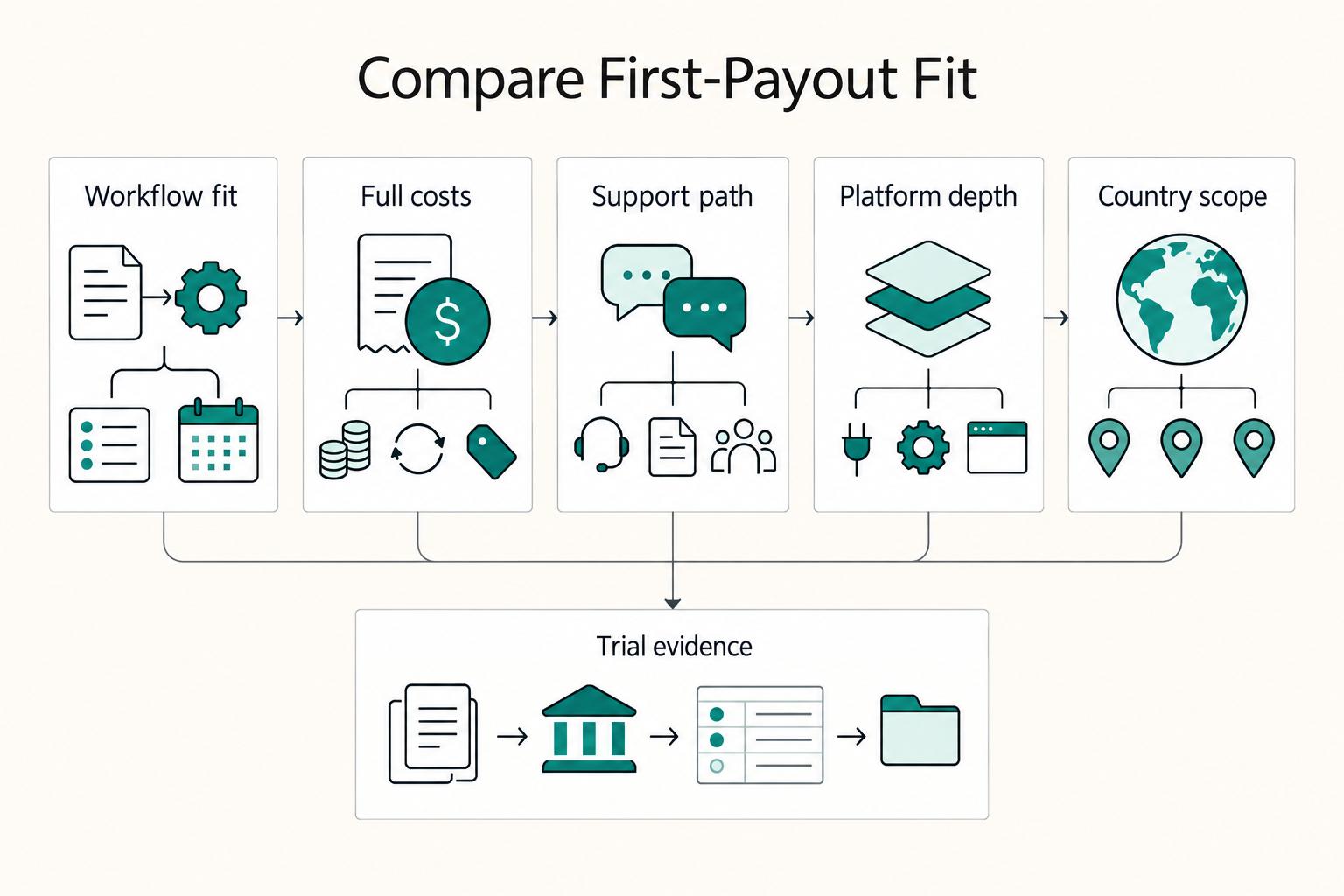
Deel vs Remote for Freelancers Who Need a Clear First-Payout Decision
Choose the platform that makes your first payout cycle predictable and your contracts easier to defend. This is an operating decision, not a brand contest.