
Quick Answer
The wash sale rule disallows a capital loss if you buy the same or a substantially identical security within 30 days before or after selling it at a loss. To avoid it, wait until day 31 to repurchase, use a replacement that is not substantially identical, and watch for trades across all accounts, including IRAs, spouse accounts, DRIPs, and automated platforms.
Why the Wash Sale Rule Exists and How It Applies#
As the CEO of your financial life, your primary mandate is to understand the operating environment. Many investors view the IRS wash sale rule as a punitive trap designed to penalize them. This is a fundamental error in thinking. A more powerful approach is to see the rule for what it is: a system parameter. The IRS simply wants to prevent investors from creating artificial tax deductions by selling a security at a loss only to buy it back immediately, maintaining their economic position while claiming a tax benefit.
Understanding this core mechanic is the first step in shifting from reactive compliance to early tax-loss harvesting. The wash sale rule is not a trap to be feared; it's a rule to be engineered around with precision.
The Rule's Core Mechanics You Can Control#
With a strategic lens, the rule's mechanics become clear system inputs you can control.
The 61-Day Window The entire system operates on a clearly defined timeline. A wash sale occurs if you sell a security for a loss and purchase the same or a "substantially identical" one within a 61-day period. This critical window covers:
- 30 days before the sale
- The day of the sale
- 30 days after the sale
To gain strategic control, map this timeframe against your trading calendar. When planning to sell a security to realize a loss, mark the date and explicitly block out the 30 days prior and the 30 days following. This simple act of visualization transforms an abstract rule into a tangible operating boundary. To be perfectly safe, you must wait until the 31st day after the sale to repurchase the security. Use the same timeline in A Guide to Tax-Loss Harvesting so your process stays consistent.
The True Consequences A wash sale violation doesn't mean your loss vanishes forever; it means the financial impact is deferred. For a CEO, understanding the precise effects on your portfolio's cash flow and long-term strategy is essential. When a wash sale is triggered, two things happen:
- The Loss is Disallowed (For Now): You cannot use the capital loss to offset capital gains on your current year's tax return.
- The Cost Basis is Adjusted: The disallowed loss is added to the cost basis of the new, repurchased shares.
This adjustment is where the deferral occurs. A higher cost basis reduces the taxable gain (or increases the deductible loss) when you eventually sell the new position. the holding period of the original shares is tacked onto the holding period of the new ones, which can help you qualify for more favorable long-term capital gains tax rates.
| Action | Initial State | After a Wash Sale Violation |
|---|---|---|
| Sell 100 shares of XYZ | Realize a $2,000 capital loss. | The $2,000 loss is disallowed for the current tax year. |
| Repurchase 100 shares of XYZ at $50/share | New cost basis is $5,000. | The disallowed loss is added to the new basis: $5,000 + $2,000 = $7,000. |
| Holding Period | Starts fresh on the day of repurchase. | The holding period of the original shares is added to the new shares. |
Your Entire Financial Universe Finally, you must recognize that the IRS defines your financial operations holistically. The wash sale rule is not confined to a single brokerage account. Its scope is absolute and applies across your entire financial universe, which includes:
- All of your taxable investment accounts, regardless of the brokerage firm.
- Your spouse's accounts.
- Any corporate entities that you control.
- Transactions involving your IRAs.
This broad application requires a centralized, CEO-level view of all trading activity. A siloed approach, where you manage one account without visibility into the others, is a direct path to unintentional compliance failures. If you invest across jurisdictions, review state tax rules for digital nomads in the same planning pass.
Are Your Automated Tools Creating Hidden Tax Liabilities?#
That holistic, CEO-level view becomes critically important when you introduce the powerful - and often opaque - layer of automation that drives modern investing. In your quest for efficiency, you have rightly adopted sophisticated tools. But their convenience can mask a significant compliance gap, turning helpful algorithms into generators of unintended wash sales. The core issue is that while you see your entire financial picture, your tools often don't. It's time to audit your automation and retake control.
The Robo-Advisor Audit#
Many robo-advisors offer "tax-loss harvesting" as a key feature. For you, however, whose financial life spans multiple accounts and institutions, a standard robo-advisor can be a silent risk. Because it lacks visibility into your other accounts (like a trading account at a different brokerage, or your spouse's IRA), its algorithm could unknowingly trigger a wash sale. You must verify its operational boundaries.
Perform this simple three-step audit:
- Step 1: Verify Coordinated Management. Ask your provider directly: Does their tax-loss harvesting algorithm monitor and coordinate trades across all accounts you have with that specific institution? Some do, but you cannot assume this is a default feature.
- Step 2: Identify External Blind Spots. Explicitly map out which accounts your robo-advisor cannot see. This includes accounts at other brokerages, your 401(k), and any accounts held by your spouse. These are your manual oversight responsibilities.
- Step 3: Review Replacement Security Policies. Understand which securities the platform sells and which it buys as replacements. This is important for making sure the replacements are not "substantially identical" and for anticipating potential conflicts with securities you hold elsewhere.
The Dividend Reinvestment (DRIP) Dilemma#
One of the most common and overlooked triggers of the wash sale rule is the automatic Dividend Reinvestment Plan (DRIP). You may execute a perfect tax-loss harvesting trade, only to have a small dividend automatically reinvested two weeks later, buying back one or two shares. That single transaction is enough to trigger a wash sale and invalidate a portion of your carefully planned loss.
The strategic case is clear: you must temporarily disable DRIPs for any security you intend to sell for a loss, and for any "substantially identical" securities. This is a targeted, temporary action you take during active harvesting windows to maintain absolute control over your transactions. For IRS mechanics and examples, keep Publication 550 open during planning.
Executing a "Manual Override"#
Think of this as taking direct command during a critical maneuver. To execute a tax-loss harvesting plan with surgical precision, you must create a "safe window" free from algorithmic interference. This means strategically pausing not just DRIPs, but any automated trading, rebalancing, or recurring purchases that could touch the security in question. By temporarily halting these automated functions, you make sure that your manual sale-for-loss is the only transaction within that asset class during your chosen timeframe. This manual override transforms you from a passive user of automated tools into a strategic operator who knows exactly when to let the algorithms run and when to take the controls.
The #1 Wash Sale Mistake: The Permanent IRA "Black Hole"#
While that level of control protects you from common automated pitfalls, it cannot undo the single most destructive mistake an investor can make: triggering the wash sale rule with an IRA. Most wash sale violations are recoverable inconveniences. This one is a catastrophic, permanent financial wound.
Understanding the Catastrophic Difference#
When you trigger a wash sale between two taxable brokerage accounts, the consequence is a timing issue. The disallowed loss is added to the cost basis of the new shares, meaning you effectively claim that loss later. The value of the tax deduction is deferred, not destroyed.
An IRA operates in a different financial reality. Because it's a tax-advantaged account, the concept of cost basis doesn't apply in the same way. If you sell a security for a loss in your taxable account and then repurchase a "substantially identical" one in your IRA within the 61-day window, the loss is disallowed - full stop. There is no cost basis adjustment in the IRA to preserve the value of that deduction. The disallowed loss simply vanishes into a regulatory black hole, gone forever.
According to the IRS, using a traditional or Roth IRA to buy substantially identical securities within 30 days before or after a loss sale in your taxable brokerage account will trigger the wash sale rule. Even worse, the IRS says you can't increase the tax basis of your IRA by the disallowed loss. The disallowed loss simply disappears.
The "Never-Ever" Protocol#
Given the permanent nature of this loss, your operational protocol must be absolute. This is a non-negotiable, bright-line rule: You must never purchase a substantially identical security in an IRA or Roth IRA within 30 days before or after selling it for a loss in a taxable account. Treat your taxable accounts and your retirement accounts as completely separate ecosystems during tax-loss harvesting season.
Scenario Analysis: The $10,000 Difference#
To see the devastating impact, consider these scenarios where you realize a $10,000 capital loss to offset other gains.
| Action & Result | Scenario A: Recoverable Wash Sale (Taxable-to-Taxable) | Scenario B: Permanent Loss (Taxable-to-IRA) |
|---|---|---|
| Step 1: The Sale | You sell 100 shares of Corp A in a taxable account for a $10,000 loss. | You sell 100 shares of Corp A in a taxable account for a $10,000 loss. |
| Step 2: The Repurchase | Within 30 days, you buy 100 shares of Corp A in another taxable account for $20,000. | Within 30 days, you buy 100 shares of Corp A in your IRA for $20,000. |
| The IRS Ruling | A wash sale is triggered. The $10,000 loss is disallowed for the current tax year. | A wash sale is triggered. The $10,000 loss is disallowed for the current tax year. |
| The Financial Outcome | The disallowed $10,000 loss is added to the cost basis of the new shares. Your new basis is $30,000 ($20k purchase + $10k disallowed loss). The tax benefit is deferred. | The disallowed $10,000 loss permanently disappears. The basis in your IRA is not adjusted. The entire tax benefit is lost forever. |
This single, preventable error completely erases a valuable tool for managing your tax liability.
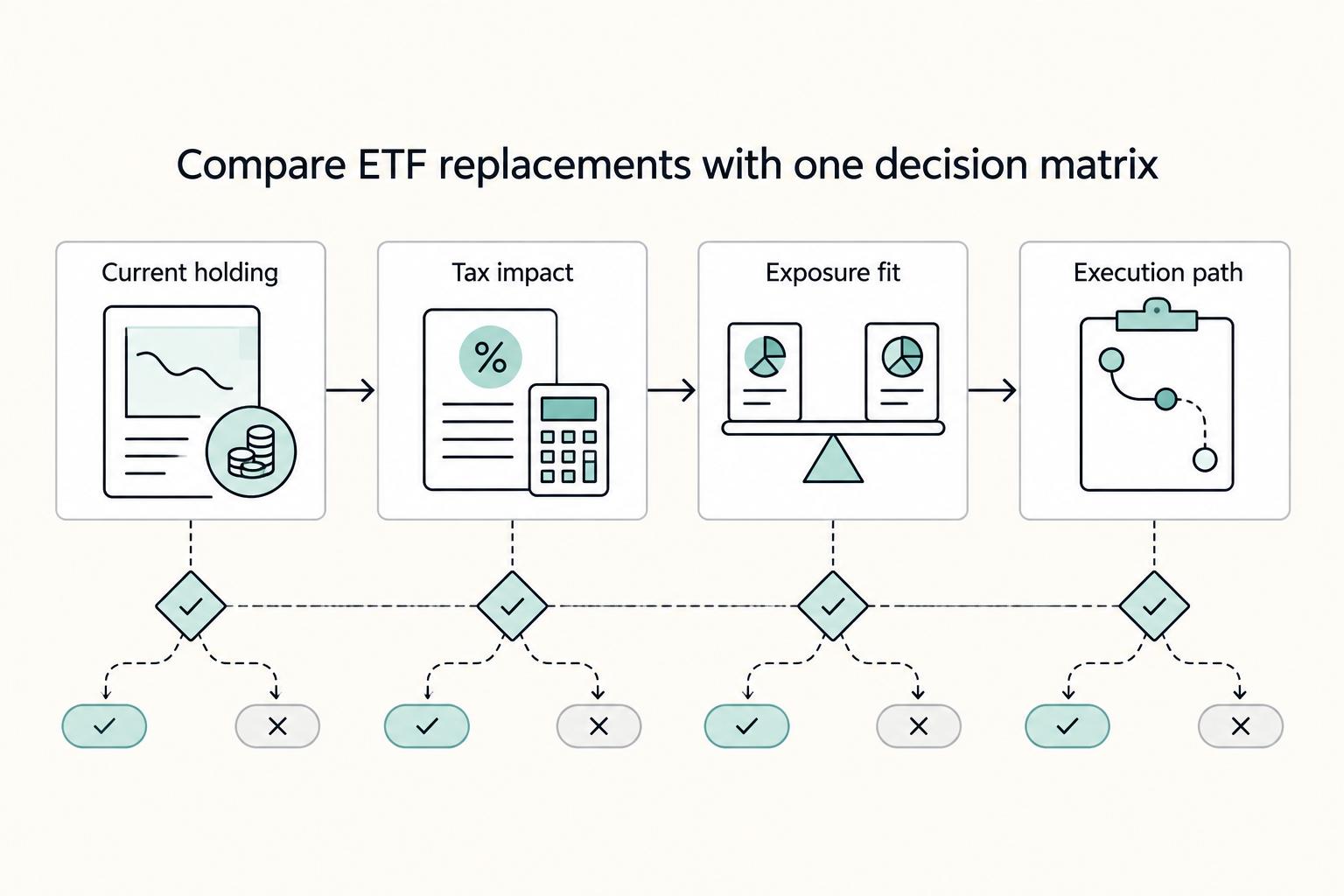
The ETF Replacement Matrix: A Framework for Decisive Action#
The "never-ever" protocol protects you from the IRA black hole, but what about the grayer area of replacing a security in your taxable accounts? Vague advice isn't practical. When executing a tax-loss harvesting strategy with ETFs, you need a clear, risk-mitigated framework for making confident decisions.
Moving Beyond Ambiguity#
The challenge lies in the IRS phrase "substantially identical." While the IRS has not provided a definitive test for ETFs, tax professionals have developed a clear hierarchy of factors to build a defensible position. This decision matrix moves you from ambiguity to control. For baseline definitions, use IRS Topic No. 409 and Investor.gov cost-basis guidance.
Factor 1: Different Issuers & Funds (The Safest Harbor)#
Your strongest defense is to sell a fund from one issuer and immediately buy a fund from a different issuer that tracks the same underlying index. For example, selling the Vanguard S&P 500 ETF (VOO) and purchasing the iShares CORE S&P 500 ETF (IVV).
While they both track the S&P 500, they are distinct financial products managed by different companies, with different CUSIP numbers and expense ratios. The consensus among tax experts is that these differences are sufficient to disqualify them as "substantially identical." This is the workhorse strategy for active tax-loss harvesting.
Factor 2: Different Underlying Indexes (A Higher Degree of Safety)#
To build an even more strong case, replace your sold ETF with one that tracks a similar but fundamentally different index. For instance, sell an S&P 500-tracking fund (VOO) and purchase a total stock market fund like the Vanguard Total Stock Market ETF (VTI), which tracks the CRSP US Total Market Index.
Here, the argument against them being "substantially identical" is overwhelming. One fund holds approximately 500 stocks, while the other holds thousands. For any investor with a very low tolerance for tax risk, this two-factor approach - switching both the issuer and the underlying index - offers the highest degree of safety.
| Replacement Strategy | Risk Level | Key Differentiator(s) | Example |
|---|---|---|---|
| Factor 1: Different Issuer | Low | Fund Issuer, CUSIP | Sell Vanguard S&P 500 (VOO) -> Buy iShares S&P 500 (IVV) |
| Factor 2: Different Index | Very Low | Underlying Index, # of Holdings | Sell S&P 500 ETF -> Buy Total Stock Market ETF |
Factor 3: Minor Considerations#
Factors like tracking error and expense ratios can be secondary, tie-breaking considerations. Keep compliance, guided by the first two factors, as the main decision driver. The primary objective is to maintain market exposure and harvest a legitimate loss. These minor points are for optimizing an already sound choice. For a quick execution worksheet, keep your plan in Gruv tools.
Conclusion: Know the Mechanics, Audit Your Automation, Log Each Sale#
For too long, professionals have viewed this IRS regulation as a punitive trap - a source of anxiety that complicates an already demanding financial life. That perspective is a liability. The rule isn't a threat to be feared; it is a system parameter to be mastered. By internalizing its mechanics, auditing your automation, and operating with clear frameworks, you fundamentally change your relationship with the rule.
You move from a reactive state of compliance anxiety to a early position of financial command.
This transformation is a tangible evolution in how you operate as the CEO of your own financial enterprise. Consider the two opposing mindsets:
| The Anxious Investor (Reactive) | The Strategic CEO (Early) |
|---|---|
| Worries about accidentally breaking the rule. | Knows the 61-day window and schedules trades accordingly. |
| Trusts automated tools like DRIPs and robo-advisors blindly. | Audits automation and uses a "manual override" to create safe harbors for tax-loss harvesting. |
| Vaguely avoids "similar" ETFs out of uncertainty. | Uses a clear decision matrix (Issuer > Index) to select compliant replacement assets confidently. |
| Sees a disallowed loss as a failure. | Views a disallowed loss as a deferral and a data point to refine future strategy. |
| Fears the IRA "black hole" scenario. | Institutionalizes a "never-ever" protocol for IRA repurchases as a non-negotiable risk control. |
Seeing the difference laid out so starkly makes the path forward clear. Every element of the wash sale rule is simply a business rule for the enterprise you run: "Me, Inc."
I use one control rule in my own process: I log each loss-sale date, I block the next 30 days, and we verify there is no IRA or DRIP repurchase before day 31.
By embracing this, you are no longer merely avoiding a penalty. You are deliberately and skillfully executing a sophisticated tax optimization strategy. You are leveraging the parameters of the system to protect your capital, enhance your returns, and solidify your control. If you want help setting up the workflow, talk to Gruv.
Frequently Asked Questions
What happens if I accidentally trigger a wash sale in my IRA?
The loss is permanently disallowed. Unlike a taxable account wash sale, there is no cost basis adjustment inside the IRA. The tax benefit is lost forever.
Does the wash sale rule apply to cryptocurrency?
Under current IRS guidance, no. The IRS classifies cryptocurrencies as property, not securities, and the rule governs securities. The article notes that lawmakers have proposed extending the rule to digital assets.
How do I avoid a wash sale when using a robo-advisor?
Verify whether the robo-advisor coordinates trades across all accounts it manages for you. Track the accounts it cannot see, such as outside accounts or a spouse's account. For manual tax-loss harvesting, consider pausing automated features to create a clean 61-day window.
Is selling VOO (Vanguard S&P 500) and buying IVV (iShares S&P 500) a wash sale?
The article says the strong consensus among tax professionals is no. Even though both funds track the S&P 500, they are issued and managed by different companies. That difference is generally viewed as sufficient.
What if I sell for a loss and buy the same security back on the 31st day?
You avoid the rule. The prohibited period ends 30 days after the sale, so a repurchase on day 31 is outside the window. Your capital loss remains deductible for that tax year.
Does the wash sale rule apply to capital gains?
No. The rule applies to capital losses, not capital gains. You can sell for a gain and buy back immediately without wash sale consequences.
Researched and edited by the Gruv editorial team. Gruv builds cross-border billing, payouts, and finance-operations software for global businesses.
Sources
Includes 1 external source outside the trusted-domain allowlist.
Educational content only. Not legal, tax, or financial advice.
Related Posts

Do I Have to Pay State Taxes While Living Abroad as a Digital Nomad?
Living abroad does not end `state income tax` exposure by itself. The first decision is practical: choose a filing position your facts can support, then build records that support the same story all year.
Tax-Loss Harvesting for U.S. Expats Living Abroad
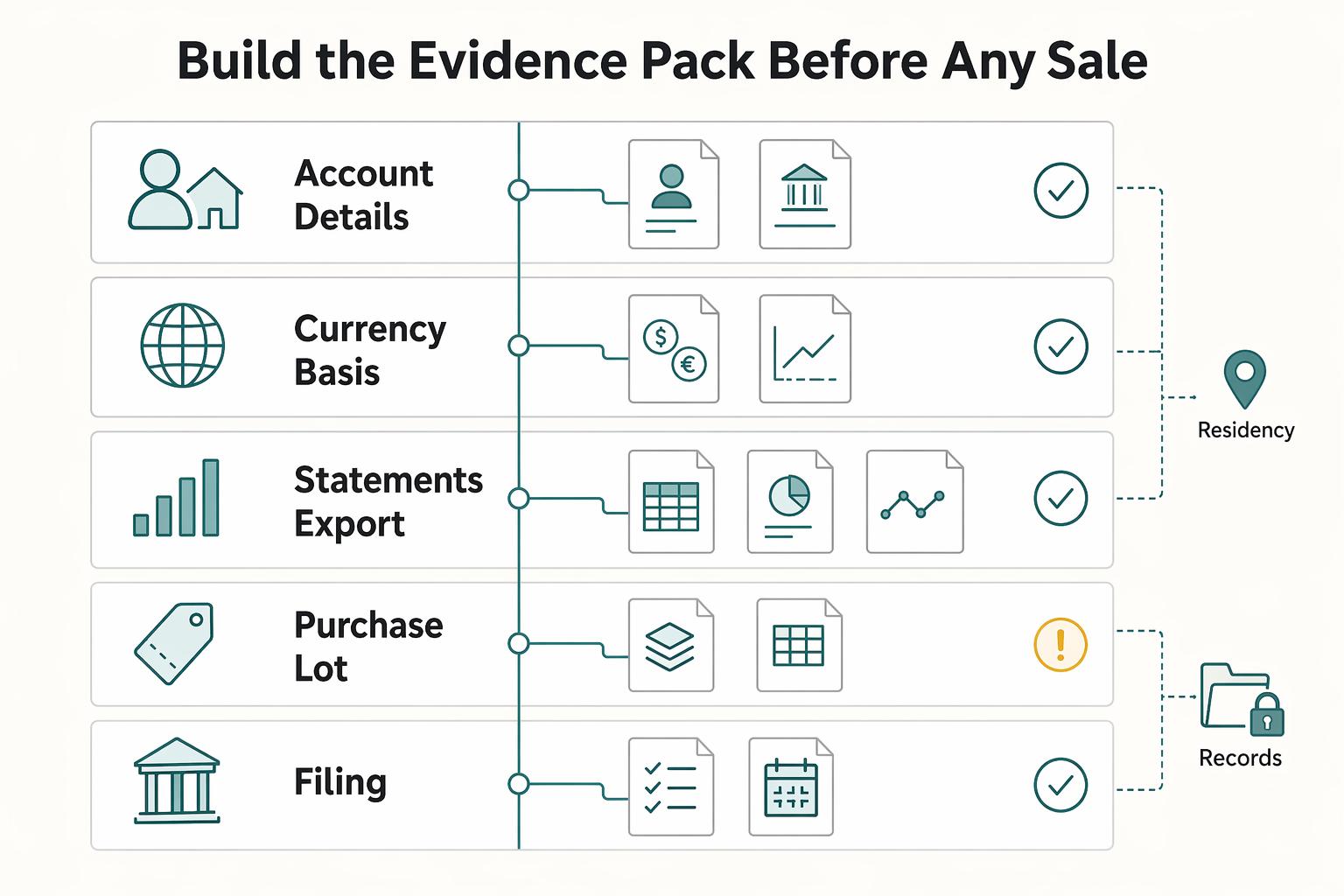
Before you sell anything, settle one question: which country may tax the sale, and which records will support the filing. If residency is clear, move on. If you see dual-residency signals or treaty uncertainty, stop and sort that out before you trade.

The Freelance Payment Penalty: A Modeled Audit of Platform Fees, FX Spreads, and Payout Delays
The money rarely disappears through a single, easy-to-spot fee. The real loss is stacked. A marketplace takes its commission, a processor adds a charge for international cards, a bank or payment company converts the currency at a spread, a platform holds the funds before release, and a wire sheds a little to intermediaries on the way in. Each layer looks defensible on its own, but the worker feels the combined result as a smaller deposit and a later payday.