
Quick Answer
Set clear expectations first, then prove them through repeatable behaviors. In pygmalion effect in management, start inward with a Personal Performance Charter and a Wins Dossier, then carry that standard into client and subcontractor work through written scope boundaries, named owners, and review checkpoints. A practical starting rule from the article is one substantive client reply within one business day, plus a change-request pattern that logs impact on time, cost, or resources.
At its core, the Pygmalion effect is the idea that high expectations drive higher performance. First identified in a school setting, the phenomenon showed that a teacher's belief in a student's potential could measurably improve that student's achievement. For an independent professional, that is not just an academic curiosity. It is a practical way to manage risk. You do not have a corporate hierarchy protecting your reputation, so you have to shape the expectations that define you.
This is not about managing employees. It is about signaling your value so clearly that clients, collaborators, and even you rise to meet the standard you set. In independent work, that plays out in three directions: inward on your own mindset and habits, upward on clients, and outward on collaborators.
How expectations become reality#
For an independent professional, this is not just theory. It is a loop you can design.
- Your belief shapes your actions: You see yourself as a high-value strategic partner, not just a freelancer. That belief affects the quality of your proposal, the confidence in your voice, and the price you are willing to hold.
- Your actions influence their beliefs: A client receives a carefully researched, value-focused proposal. They see you less as a task-doer and more as an expert. Their confidence in your capability rises.
- Their beliefs affect their actions: Because the client sees you as a partner, they give you more autonomy and take your judgment more seriously. They trust your process instead of micromanaging it.
- Their actions reinforce your belief: That trust gives you room to do stronger work, which reinforces your own standard. Good outcomes then confirm the client's expectations, leading to repeat work and referrals, and the cycle starts again.
The inverse matters just as much. The Golem effect is the pattern where low expectations lead to worse performance. When a client treats you like a disposable gig worker by micromanaging, questioning your expertise, or grinding on price, they are signaling low expectations. That can pull down your motivation, weaken the work, and confirm their poor opinion. Left alone, it becomes a downward spiral toward burnout and commoditization. Recognizing both dynamics is the first step toward shaping them in your favor.
Dimension 1: The Inward Application - Becoming Your Own Best Manager#
If you expect loose work from yourself, you usually get loose work. The inward application is simple: set a higher standard in writing, check whether your behavior matches it, and correct drift before clients or collaborators feel it.
Start with three concrete supports, not a pep talk. Your Personal Performance Charter is your private quality standard. Your Wins Dossier is your evidence file. Your high performance environment is the part of your calendar, desk, and software stack that makes good execution easier than sloppy execution.
Build your inward operating loop#
Use the same loop on every active project so your standard does not change with your mood:
| Step | What to do | Examples or notes |
|---|---|---|
| Set expectation | Write one specific, challenging expectation for the project or quarter. | "Send a substantive client reply within one business day"; "Flag scope changes before doing extra work." |
| Define behavior standard | In your Personal Performance Charter, list the few behaviors that produce that result. | response time standard; proposal and kickoff checklist; file naming and version control rule; meeting notes sent after calls; change request rule; pre-delivery QA pass |
| Review evidence | Check recorded proof, not mood. | sent emails, revision counts, missed deadlines, client praise, rework causes; effects were stronger when progress was physically recorded |
| Adjust process | If you missed the standard, change the process, not your identity. | "If a client asks for an extra item in chat, then I log it and answer with impact on time, cost, or resources." |
- Set expectation
Write one specific, challenging expectation for the project or quarter. Avoid vague goals like "be more responsive." Write "Send a substantive client reply within one business day" or "Flag scope changes before doing extra work."
- Define behavior standard
In your Personal Performance Charter, list the few behaviors that produce that result. Keep it practical:
- response time standard
- proposal and kickoff checklist
- file naming and version control rule
- meeting notes sent after calls
- change request rule for anything outside agreed scope
- pre-delivery QA pass
- Review evidence
Check recorded proof, not mood. A large review of 138 studies with 19,951 participants found progress monitoring improved goal attainment. Effects were stronger when progress was physically recorded. That means reviewing sent emails, revision counts, missed deadlines, client praise, and rework causes, not just asking yourself how the week felt.
- Adjust process
If you missed the standard, change the process, not your identity. Use an if-then rule: "If a client asks for an extra item in chat, then I log it and answer with impact on time, cost, or resources." That can reduce uncontrolled scope expansion instead of leaving you to absorb it silently.
What low and high self expectation look like#
| Pattern | Low self expectation behavior | High self expectation behavior | Likely impact on delivery |
|---|---|---|---|
| Client communication | Reply when convenient and hope it is enough | Reply within your stated window with next step and owner | Fewer client doubts, fewer chasing emails |
| Scope control | Do small extras without logging them | Record changes and confirm impact before work starts | Less scope creep and less margin loss |
| Quality review | Deliver after final draft feels "done" | Run the same QA check before every delivery | Fewer avoidable revisions |
Keep the evidence pack small and usable#
A Wins Dossier only helps if you can actually use it. Keep it to a simple document or folder with screenshots of praise, before and after results, solved problems, successful proposals, and notes on what you did well. Review it on a cadence you can sustain, for example a weekly check and a quick pass before pricing calls or difficult project updates.
One warning matters here. Feedback helps only when it is timely and useful. If your review habit turns into vague self-criticism or a giant checklist nobody could meet, it can hurt performance instead of improving it. Keep the charter short, review against evidence, and correct behavior early. That discipline carries forward into clearer client boundaries and steadier leadership when you start managing subcontractors. If this overlaps with your setup, see What to Do If You've Been Misclassified as an Independent Contractor. If you want a simple next step, browse Gruv tools.
Dimension 2: The Upward Application - Engineering Client Perception#
Your standards only help commercially when clients can see them. Use clear, repeatable signals so clients experience you as deliberate, interested, and reliable.
Research on leader-employee settings describes the Pygmalion effect as high expectations conveyed through observable behavior, and it describes trust as important for productivity. That is not direct freelancer-client evidence, so use it as a practical direction: if you want better client behavior, make your expectations visible early and reinforce them consistently.
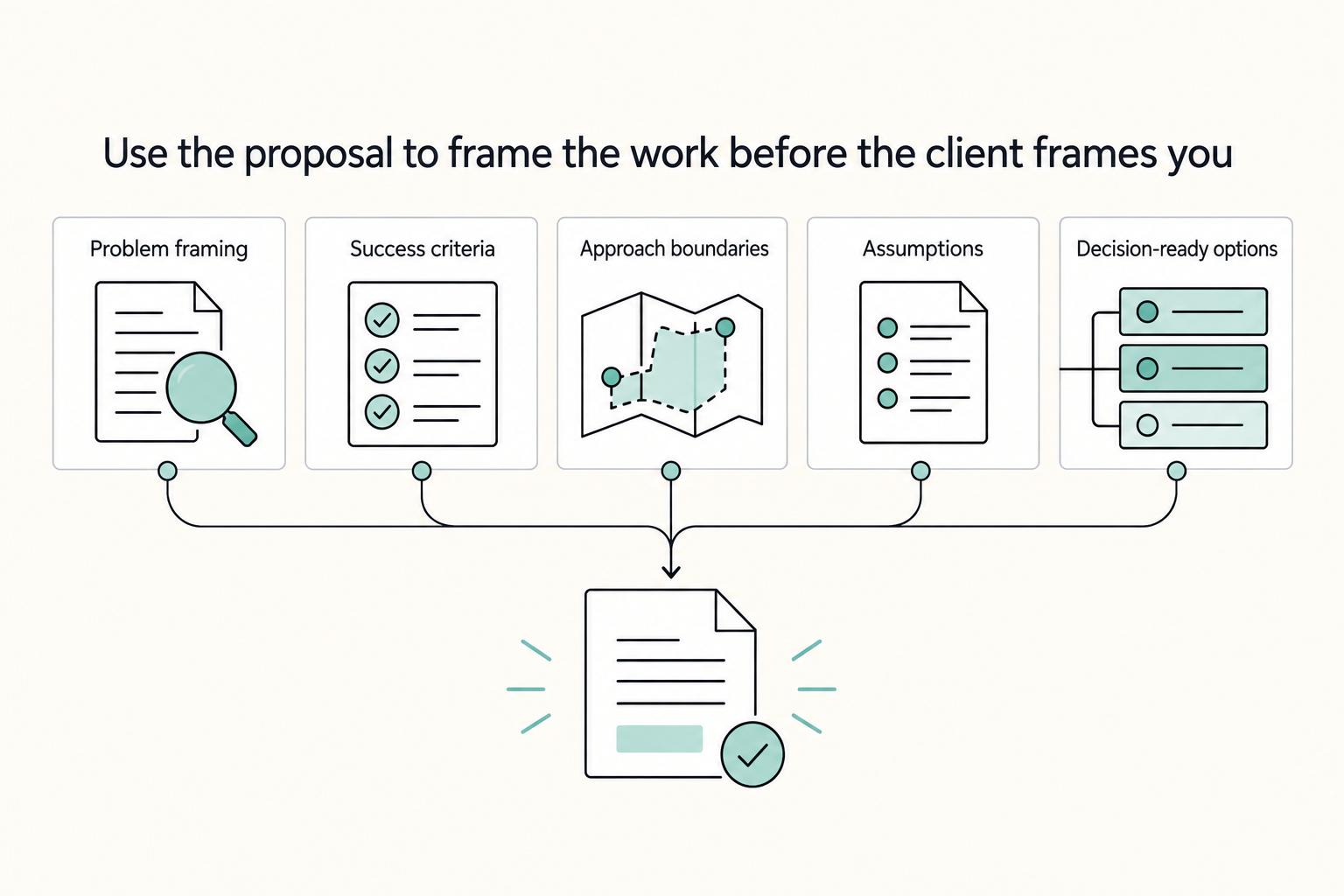
Use the proposal to frame the work before the client frames you#
Your proposal should make a decision easy, not just present a price. Write it so a third party can see the problem, the boundaries, and the choice.
| Proposal element | What to include |
|---|---|
| Problem framing | define the business problem in the client's language |
| Success criteria | state what success looks like in observable terms |
| Approach boundaries | say what is included and what is not |
| Assumptions | list dependencies (access, approvals, assets, response times) |
| Decision-ready options | provide 2-3 scoped options with clear tradeoffs in depth, timing, or involvement |
Before you send it, check that each of those points is explicit enough for a third party to follow. If assumptions are missing, scope confusion usually shows up later as "we thought that was included."
Onboard with reusable artifacts, not goodwill#
Your kickoff should convert confidence into operating clarity. Keep onboarding light, but document the basics you can reuse on every project.
- Working norms: cadence, review windows, file handling, and what "done for review" means.
- Communication protocol: where urgent requests go, where routine updates live, and expected response windows.
- Escalation path: what happens when approvals, timing, or dependencies slip.
- Responsibility map: who owns inputs, approvals, implementation, and signoff.
Onboarding is complete when these artifacts are sent, acknowledged, and easy for both sides to find.
| Engagement stage | Weak signal you send | Strong signal you send | Practical consequence |
|---|---|---|---|
| Sales | Generic proposal, vague scope, no assumptions | Problem framed, assumptions stated, options presented | More trust in judgment, less price-only comparison |
| Kickoff | Casual handoff, unclear contacts, no norms | Written norms, protocol, escalation path, responsibility map | Faster alignment, fewer avoidable misunderstandings |
| Delivery updates | Task dump or silence | Short PPP updates tied to outcomes and blockers | Client sees control, not just activity |
| Change requests | Immediate yes or vague pushback | Acknowledge request, restate scope, show impact, offer next step | Better scope control with less friction |
Report progress with a simple PPP rhythm#
Use PPP: Progress, Plans, Problems. Keep updates short and decision-oriented.
Example weekly note: Progress: draft homepage copy delivered; feedback incorporated on sections 1-3. Plans: final revision Thursday; handoff Friday pending legal review. Problems: testimonial approvals missing, which may move publication by two business days.
This format keeps attention on outcomes and blockers, not activity noise.
Clarify scope changes with a boundary pattern#
When a new request appears, do not default to yes or no. Use one pattern: acknowledge the request, restate current scope, explain time or cost impact, then offer a decision path.
Example: "Yes, we can add that. It sits outside the current scope focused on the launch page. If you want it included now, I'll send a change note with revised timing. If not, I can hold it for phase two."
This is the upward application in practice: consistent signals that teach clients how to work with you effectively.
If you want a deeper dive, read GDPR for Freelancers: A Step-by-Step Compliance Checklist for EU Clients.
Dimension 3: The Outward Application - Leading a Team of Peers#
To lead peers well, make expectations executable: define the outcome, assign ownership, clarify decision rights, and standardize handoffs. In the outward application, your day-to-day job is to turn high standards into a working system your subcontractors can follow without guesswork.
Run kickoff as a working agreement#
Your kickoff is successful only when everyone leaves with the same operating map in writing:
| Kickoff element | What to put in writing |
|---|---|
| Shared outcome | what finished, useful work must achieve for the client |
| Role boundaries | who owns strategy, production, review, implementation, and signoff |
| Decision rights | who makes final calls on scope, direction, approach, and timeline changes |
| Handoff rules | what must travel with work before the next specialist accepts it |
| Review workflow | where feedback lives, who consolidates it, and what counts as approved |
| Escalation path | what happens when a blocker is unresolved past the agreed window |
A one-page RACI chart is usually enough if each decision has one accountable owner. After kickoff, have each person restate their owner areas, dependencies, and approval path. If two people believe they have final say, fix it immediately.
Delegate outcomes, not just tasks#
Use the brief style that matches the work. If judgment is required, write an outcome brief, not just a task list.
| Field | Task brief | Outcome brief |
|---|---|---|
| Desired result | Often implied or missing | Explicit business/result target |
| Constraints | Minimal (tool, deadline) | Clear limits (scope, brand, legal/client rules, timeline) |
| Quality definition | "Done" = completed steps | "Done" = agreed quality bar met and review-ready |
| Owner | Person assigned to execute | Person accountable for delivery quality and handoff readiness |
| Feedback loop | Ad hoc comments across channels | Single review path, consolidated feedback, clear revision cycle |
Use a hybrid brief only when certain steps are truly non-negotiable. Otherwise, over-specifying process reduces ownership and slows expert contributors.
Add light risk controls to keep delivery consistent#
When multiple specialists contribute, prevent instruction drift with three controls:
- Keep one source of truth: one active brief and one communication hub
- Consolidate client feedback through one owner before it reaches the team
- Enforce handoff gates: no start from verbal-only changes, and no acceptance without required context or files
This keeps communication quality high and reduces avoidable rework from conflicting directions.
Reinforce performance with specific recognition#
Recognition should reinforce the decisions and behaviors that improved delivery, not just effort. In client updates, name concrete contributions such as identifying a risk early, clarifying a requirement, resolving a blocker, or improving a draft under constraints.
That approach builds trust and accountability because your team sees what "good" looks like in practice. Keep feedback precise and consistent: generic or contradictory notes can hurt performance.
You might also find this useful: How to Manage a Remote Team of Subcontractors.
Conclusion: You Are the Architect of Your Reputation#
The next move is not simply to believe the principle. It is to make your expectations visible in how you work. Expectations can shape behavior, behavior can shape outcomes, and outcomes can shape the reputation clients and collaborators attach to your name.
A practical way to apply this is across the three directions used in this guide. Inward, your standards can affect the quality of your own decisions and follow-through. Upward, client expectations are shaped by how clearly you frame scope, ownership, and communication. Outward, peers can rise or stall based on the level of clarity, confidence, recognition, and challenge you create around the work. The opposite risk is just as practical: low expectations can mean fewer opportunities, weaker assignments, skepticism, and lower engagement. That is where the Golem effect can start to show up.
If you want a usable close, do these three things this week:
- Personal standards: update your Personal Performance Charter and Wins Dossier, then use them before pricing, negotiation, or difficult reviews. Checkpoint: if your next decision is based on evidence of past performance rather than mood, you are using the tool correctly.
- Client expectation-setting: tighten your proposal, onboarding notes, and review process so the client sees outcome, constraints, owner, and approval path in writing. Red flag: if key instructions still live in scattered messages or verbal calls, rework is more likely.
- Peer-team execution: use a one-page RACI chart and an outcome brief for every collaborator, then verify owner areas and handoff requirements in a repeat-back. If two people think they both approve the same thing, fix it before production starts.
The payoff can be steadier execution, cleaner decisions, and fewer avoidable surprises over time. The FAQ next covers practical edge cases so you can apply this without guessing. For a step-by-step walkthrough, see Why the Protégé Effect Helps Freelancers Learn by Teaching.
Frequently Asked Questions
What is the most common mistake people make when applying the pygmalion effect in management?
A common mistake is trying to project high expectations outward before building any inward evidence base. Start by updating your Wins Dossier with recent results, client praise, solved problems, and decisions you handled well, then review it before pricing, hiring, or giving feedback. That matters because expectation effects are a form of self-fulfilling prophecy: your expectations shape your behavior, and your behavior shapes outcomes. If your own standard is vague or unstable, your signals to clients and subcontractors will be vague too, which weakens trust and follow-through.
How can you use it during a sales negotiation?
Use confident clarification instead of defending your fee or discounting too quickly. A reusable line is: “The current price is tied to [primary outcome]. If you need a different budget, we can adjust scope to [adjusted scope] while protecting [must-keep result]. Which outcome matters most right now?” This approach ties price to a specific outcome instead of treating the work like interchangeable labor. If the client leaves the exchange knowing the outcome, the tradeoff, and the decision they need to make, you have set a clear expectation instead of sending a low-value signal.
What does this look like with a subcontractor in practice?
Use outcome-based delegation, not task dumping. Give a short brief that states the goal, deadline, constraints, and definition of done, then ask for explicit acceptance: “Please reply with your approach, risks you see, and what you need from me by your target date.” That matters because goal setting works better when goals are specific, accepted, and paired with feedback. If the subcontractor cannot repeat back the expected outcome and handoff standard, you have not actually conveyed a high expectation.
Is there a risk of setting expectations too high?
Yes, especially when your expectations are unclear, unrealistic, or misaligned with how the other person understands the role. Set a stretch target only after you confirm capability, acceptance, and the feedback rhythm, such as a midpoint review or first-draft check. That caution is grounded in research: expectation effects are real in work settings, but they are not uniform across every context or person. If you raise the bar without clarifying what success looks like, engagement can drop because the signal feels confusing rather than supportive.
How do you counter the Golem effect if a client already treats you like a commodity?
You may not reverse that with one speech. Re-scope one part of the work around a business result, shift to early updates that show decisions and risks, and force approval points into writing so the client sees you managing outcomes rather than waiting for instructions. | Signal type | What you say | What the client learns | |---|---|---| | Commodity signal | “I can do whatever you need. Just send tasks.” | You are a pair of hands | | Strategic-partner signal | “To deliver [primary outcome], I need decision owner, success criteria, and approval timing.” | You manage outcomes and constraints | | Boundary signal | “If scope changes to [new request], we should adjust timeline, fee, or both.” | Your process has standards | This works because low expectations can lead to lower-value behavior over time. If the client still ignores clear scope, owner, and approval language after a few cycles, treat that as a decision signal, not a communication problem.
Does this actually have evidence behind it, or is it just a mindset idea?
It has workplace evidence behind it, but you should use it as a management choice, not a guarantee. One meta-analysis of work-organization studies reported 13 effect sizes with an overall effect size of d = 0.81, and related research also documents the negative side, where low expectations can hamper performance. What matters in practice is that words alone are not the mechanism. The effect shows up through observable behavior like the goals you set, whether the other person accepts them, and whether you give timely feedback that shows progress against the goal.
Try a related tool
Researched and edited by the Gruv editorial team. Gruv builds cross-border billing, payouts, and finance-operations software for global businesses.
Sources
Includes 5 external sources outside the trusted-domain allowlist.
- academia.edu/21119428/Implanting_pygmalion_leadership_sty...trusted
- clame.nyu.edu/virtual-library/E08IC5/312499/HowManagerMoti...trusted
- pmc.ncbi.nlm.nih.gov/articles/PMC6141855trusted
- aonl.org/news/Study-shows-how-to-reduce-handoff-commu...external
- apa.org/pubs/journals/releases/bul-bul0000025.pdfexternal
- cipd.org/uk/knowledge/evidence-reviews/performance-fe...external
- cipd.org/uk/knowledge/evidence-reviews/trust-psycholo...external
- crccasia.com/2024/08/27/pygmalion-effect-and-why-managers...external
Educational content only. Not legal, tax, or financial advice.
Related Posts

GDPR Compliance Checklist for Freelancers Working With EU Clients
Start by separating the decisions you are actually making. For a workable **GDPR setup**, run three distinct tracks and record each one in writing before the first invoice goes out: VAT treatment, GDPR scope and role, and daily privacy operations.

What to Do If You've Been Misclassified as an Independent Contractor
Treat this as a protection problem first, not a label debate. If your work was treated as an independent contractor arrangement even though the relationship functioned differently, your first goal is to protect pay, rights, and records while you choose the least risky escalation path. You can do that without making accusations on day one, which often keeps communication open while you document what happened.
How to Manage a Remote Team of Subcontractors
To work with remote subcontractors without creating avoidable legal risk, make sure your contracts and day-to-day behavior tell the same story. A common structure is one MSA for the standing relationship and one SOW for each engagement. Keep management focused on outcomes, not on controlling how the work gets done.