
Quick Answer
Yes, a mark-to-market election pfic can shift an eligible holding away from default treatment, but only if the shares qualify as marketable stock and the election is made on Form 8621 on time. Under MTM, yearly appreciation is taxed as ordinary income, while loss treatment is limited by unreversed inclusions. When earlier years were filed without a valid election, a purging step is usually required before relying on ongoing MTM reporting.
Check Whether You Can Move Out of Section 1291 Treatment#
If you hold stock that may be a PFIC, the core question is simple: can you move out of default Section 1291 treatment and into an election path you can document and manage?
A Passive Foreign Investment Company (PFIC) is a foreign corporation that meets the passive-income or passive-asset tests under section 1297. When people talk about the mark-to-market election for a PFIC, they usually mean the section 1296 election. It is available only for eligible marketable PFIC stock. If you do nothing, Section 1291 is the default. That means current-year ordinary-income treatment on allocated amounts, a deferred-tax mechanism tied to prior years, and possible continuing PFIC taint unless you make a purging election.
First, confirm you can use MTM#
Start with marketability. If you cannot show the stock is marketable for section 1296 purposes, MTM is not available. Section 1296 applies only to marketable stock, generally PFIC stock regularly traded on a qualified exchange or other market. The current regulation includes a minimum trading-frequency rule of at least 15 days during each calendar quarter.
If the shares trade on a qualified exchange or other market and you can verify regular trading, MTM may be available. If the shares are private, thinly traded, or marketability is unclear, do not assume eligibility. Treat it as unresolved until you verify the exchange rules.
Document the evidence now, not later. Keep the ticker, exchange name, broker records or screenshots showing where the shares trade, and fund documents identifying the listed share class.
Can I use MTM?#
| Decision point | If yes | If no | What to verify |
|---|---|---|---|
| Marketable stock status | MTM may be available under section 1296 | MTM is not available on current facts | Confirm qualified exchange status and regular trading, including the 15 days during each calendar quarter rule where applicable |
| Fund reporting availability | QEF may also be available if the fund provides the needed annual statement | QEF may be impractical or unavailable, so MTM may become the realistic election path if the stock is marketable | Look for a PFIC Annual Information Statement or Annual Intermediary Statement |
| First year vs prior year ownership | First-year ownership can allow a timely election from the start | Prior-year ownership may leave you in section 1291 until a purging step is completed | Confirm acquisition date, prior filings, and whether a prior election was made on Form 8621 |
Next, check whether QEF is actually available#
Do not treat QEF as a preference call. In practice, it generally requires fund-provided information to make and support the election, typically through a PFIC Annual Information Statement.
| Item | Article guidance |
|---|---|
| PFIC Annual Information Statement | QEF generally requires fund-provided information to make and support the election, typically through this statement |
| Annual Intermediary Statement | Form 8621 instructions require keeping it for section 1295 election years |
| Forms 8621 and attachments | Form 8621 instructions require keeping copies for section 1295 election years |
| Summary materials | Do not assume you can rebuild QEF inputs from summary materials |
For section 1295 election years, Form 8621 instructions also require keeping copies of Forms 8621, attachments, and PFIC Annual Information Statements or Annual Intermediary Statements.
Check the fund provider site, investor portal, or administrator resources for that statement. If you cannot obtain it, do not assume you can rebuild QEF inputs from summary materials. If the statement is available and usable, QEF remains an option. If not, and the shares are marketable, MTM may be the workable path.
Keep the MTM mechanics in view as you compare paths. Under section 1296, annual appreciation over adjusted basis is included each year as ordinary income, and losses are limited to unreversed inclusions for that stock.
Then check timing and taint before you file#
Once you know whether QEF is actually available, the next gate is timing. An election you could have made is not the same as one you made on time.
| Situation | Article guidance |
|---|---|
| MTM election timing | MTM must be made by the return due date, including extensions |
| QEF election timing | QEF timing is also tied to the return due date, including extensions |
| First PFIC year inside the filing window | You may be able to make a timely election from the start |
| Prior-year ownership without the election | Section 1291 exposure may already exist, and Section 1291 treatment continues unless a purging election is made |
Form 8621 instructions tie both MTM and QEF timing to the return due date, including extensions.
If this is your first PFIC year and you are still inside the filing window, you may be able to make a timely election from the start. If you owned the PFIC in a prior year without the election, Section 1291 exposure may already exist. Excess distributions are allocated across the holding period. Only the current-year portion is included as ordinary income in the current year, and the current-year tax is increased by the deferred tax amount. IRS guidance also states that Section 1291 treatment continues unless you make a purging election.
That is the taint issue in practice: prior-year non-election can carry forward. If your facts point there, evaluate deemed sale or deemed dividend purging routes before you switch regimes.
Short action checklist#
- Gather ticker, exchange, broker statements, acquisition date, year-end value, tax basis, and any prior Form 8621 filings.
- Confirm whether the fund provides a PFIC Annual Information Statement or Annual Intermediary Statement.
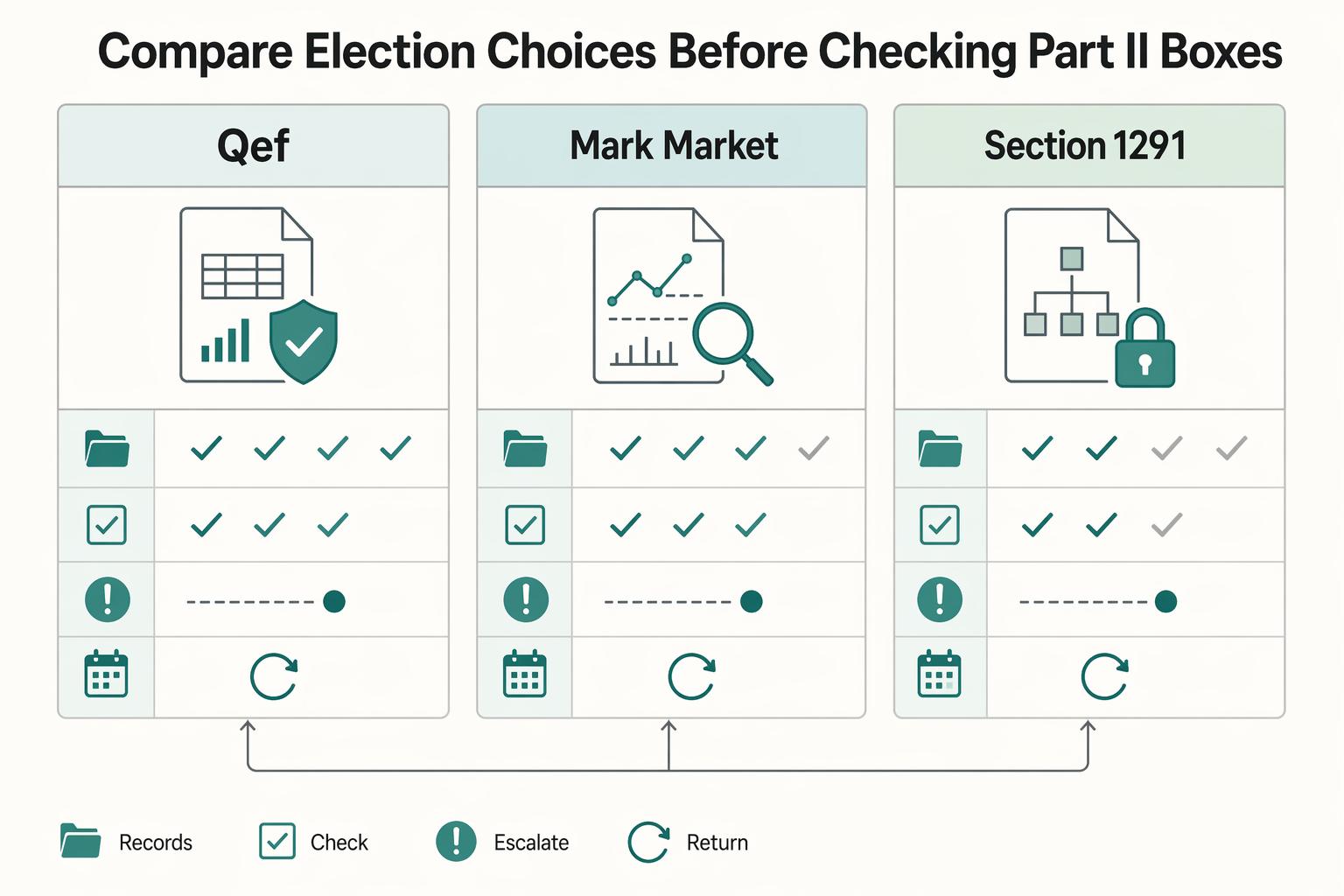
- Pick a provisional path: MTM candidate, QEF candidate, or Section 1291 with possible purging.
- Calendar the Form 8621 deadline based on your return due date, including extensions.
- Talk to a qualified advisor if marketable status is unclear, prior-year ownership exists, or purging requirements are uncertain.
If you want a deeper dive, read the digital nomad tax guide.
Scenario A: The Default Disaster (Section 1291)#
If no QEF or section 1296 election is in place, treat the holding as Section 1291 by default until you confirm otherwise. Under this path, excess distributions and any gain on sale go through a special excess-distribution process, not a standard capital-gain flow.
The computation runs in order:
- A distribution is an excess distribution only to the extent it is above 125% of your average distributions for the 3 preceding taxable years.
- Gain on sale is treated as if it were an excess distribution.
- The excess amount is allocated ratably by day across your full holding period.
- Only the current-year allocated portion is included in current-year gross income as ordinary income.
- Portions allocated to prior PFIC years are computed using the highest section 1 or 11 rate for each applicable year. The current-year tax is increased by the deferred-tax amount, with section 6601 interest treatment on the prior-year allocated tax.
| Trigger | IRS treatment | Practical effect on your return |
|---|---|---|
| Distribution exceeds the 125% lookback threshold | Treated as an excess distribution | You need 3 years of prior distribution history to identify the excess piece |
| Sale of PFIC stock at a gain | Gain treated like an excess distribution | Do not assume normal capital-gain treatment; allocation and special computation apply |
| Amount allocated to prior PFIC years | Highest section 1 or 11 rate for each year, plus section 6601 interest treatment | Expect a retrospective tax-and-interest computation |
This is the default path when you did not have a QEF or section 1296 election in place. Keep the records you will need to rebuild the math, especially acquisition-date details and multi-year distribution history. Because Form 8621 asks for acquisition-date details and prior-year distribution history, missing broker or fund records can make cleanup harder.
That is the core contrast with Scenario B. Section 1291 is a backward-looking tax-and-interest computation. MTM is annual reporting based on year-end value and basis.
We covered this in detail in Making a Section 962 Election for Individual CFC Shareholders.
Scenario B: The MTM Control (Mark-to-Market Election)#
Use section 1296 when you have eligible, marketable PFIC shares and the records to support the election year after year. Done properly, for elected years it turns the issue into a recurring annual valuation and basis exercise instead of deferring everything to a later Section 1291 reconstruction.
First, scope it correctly. This applies only to PFIC stock that qualifies as marketable stock under the section 1296 rules, generally stock regularly traded on a qualified exchange or other market. For filing, the election is made on Form 8621 (Part I and Part IV), and you file a separate Form 8621 for each PFIC.
Follow the same sequence each year:
- Determine fair market value at year-end.
- Compare year-end fair market value to adjusted basis.
- If fair market value is higher, include the excess in gross income as ordinary income.
- If fair market value is lower, an ordinary loss may be allowed, limited to unreversed inclusions for that same stock.
- Adjust basis: increase it for amounts included in income and decrease it for allowed deductions.
| Annual MTM workflow | What you report | Why it improves planning certainty |
|---|---|---|
| Confirm shares still qualify as section 1296 stock | Ongoing eligibility support for marketable PFIC stock | Prevents MTM treatment on ineligible shares |
| Check year-end fair market value against adjusted basis | Current-year ordinary income if fair market value exceeds basis | Moves gain recognition into the current year |
| If fair market value is lower, test unreversed inclusions | Ordinary loss deduction, limited to unreversed inclusions | Prevents overstating deductible losses |
| Update basis and keep support | Revised basis schedule; value of shares held at year-end is a Form 8621 data point | Keeps next year's filing and eventual sale math cleaner |
Do not overgeneralize this election. MTM does not automatically remove prior PFIC taint. Section 1291 can still apply to earlier periods unless you complete a separate purging path, where Form 8621-A may be relevant.
Mini-checklist for annual execution:
- Keep your year-end broker valuation, basis rollforward, prior Form 8621 filings, and evidence supporting marketable-stock status.
- Give your preparer, for each fund, the year-end value, adjusted basis, and unreversed-inclusions history.
- Escalate to an advisor before filing if eligibility is unclear or your loss treatment depends on prior inclusions you cannot substantiate.
You might also find this useful: A Deep Dive into Form 8621 (PFIC Reporting) for US Expats.
Treat MTM as an Eligibility and Documentation Decision#
Treat this as an eligibility and documentation decision. You can manage an MTM approach as an annual process only when eligibility and records are clear.
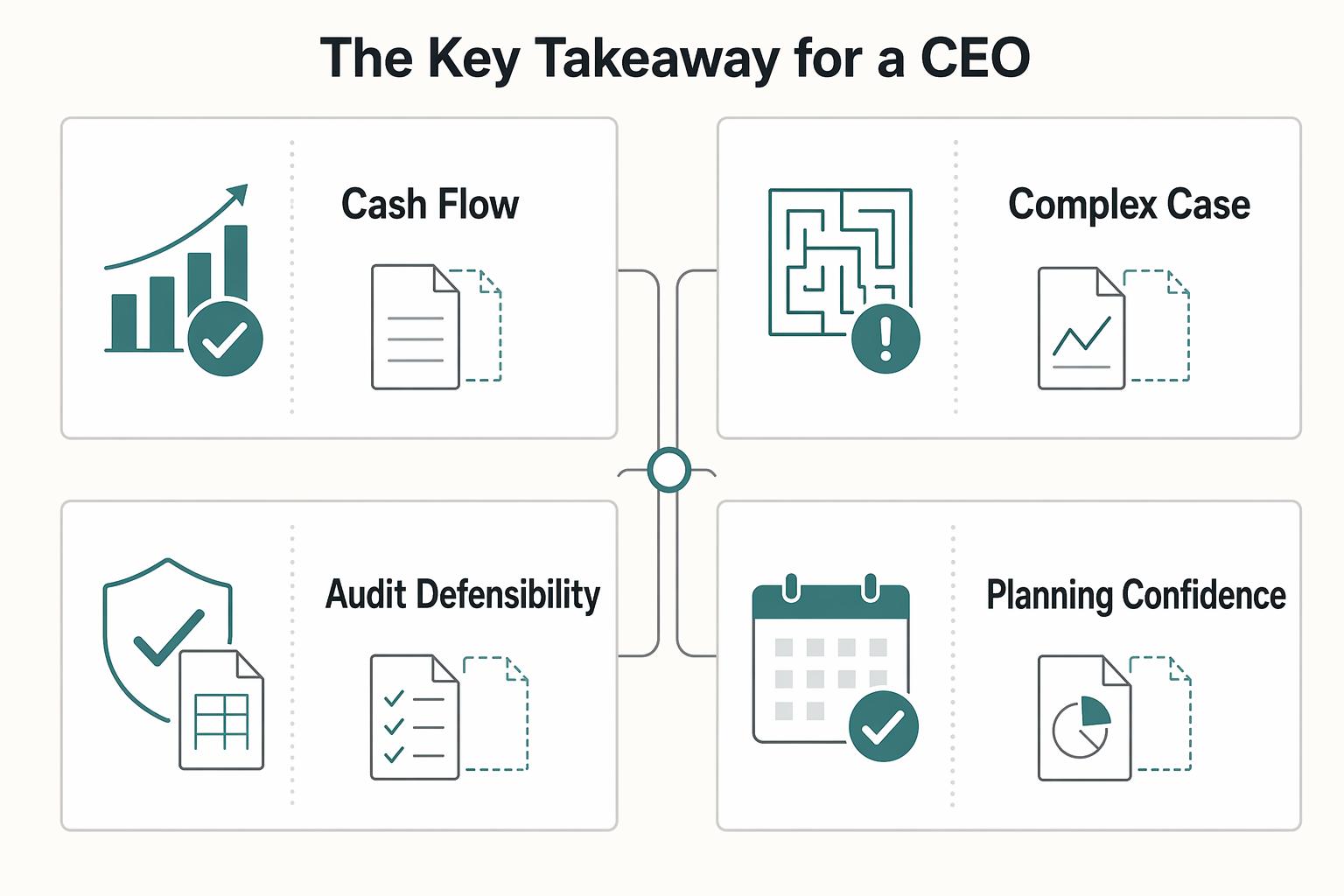
| Decision factor | Default PFIC treatment | MTM path |
|---|---|---|
| Cash-flow predictability | Can be driven by excess-distribution events and the records you can reconstruct | Depends on annual value, basis, and clear eligibility support |
| Compliance complexity | Historical ownership and record quality drive workload | Ongoing eligibility support and record quality drive workload |
| Audit defensibility | Depends on complete support for ownership and filings | Depends on complete support for eligibility and annual filings |
| Planning confidence | Lower when ownership history and records are unclear | Improves only when eligibility and records are clear |
The first gate is eligibility. MTM depends on whether the PFIC stock is marketable for this purpose, and if it is not, you cannot make the election.
The second gate is documentation quality. If key records are incomplete, escalate before you file.
Also, do not assume a foreign corporation automatically removes PFIC exposure. In the attribution framework described here, ownership can be attributed at 50 percent or more value. In the described case of a foreign corporation 100% owned by a US person, the owner still had PFIC reporting and taxation exposure and had to file Form 8621 as if directly owning the PFIC.
Use the MTM path only when eligibility is clear and your records are complete. Escalate to a qualified advisor before filing if eligibility is unclear, Form 8621 history is incomplete, or attribution questions are in play.
For a step-by-step walkthrough, see What Is a Qualified Electing Fund (QEF) for PFICs?.
Before you file Form 8621, keep a clean residency timeline in the Tax Residency Tracker to organize your records.
Critical Action for Late Filers: The 'Untainting' Election#
If you did not make the MTM election when needed, your practical starting point is usually untainting. You generally cannot move prior-tainted shares into section 1296 treatment until you make a valid purging election.
What these terms mean#
| Term | Meaning |
|---|---|
| Tainted (plain language) | Your PFIC shares still sit in section 1291 treatment from earlier years |
| Purging election | A section 1298(b)(1) election that clears continuing PFIC taint, using either a deemed sale or deemed dividend route |
| Deemed sale election | You are treated as if you sold the PFIC shares at fair market value on the qualification date; gain is handled as a section 1291 excess-distribution event, and deemed-sale loss is not recognized |
| Unreversed inclusions | Cumulative prior MTM inclusions minus prior MTM deductions for that stock; this amount limits MTM loss treatment |
How to execute the transition#
- Confirm MTM eligibility first.
MTM is only for marketable stock under section 1296, including regular trading on a qualified exchange, with a baseline of at least 15 days during each calendar quarter.
- File the purging step in the correct place.
A timely purging election is made on Form 8621. Form 8621-A is only for late purging elections, including cases after the 3-year timing boundary tied to the return due date, as extended. Late purging elections generally include interest on the amount due.
- Run the purge computation before MTM year mechanics.
Handle the deemed-sale amount under section 1291 rules, then apply annual MTM mechanics for section 1296 years.
- Reset your starting point and continue under MTM.
After a valid purge, track annual fair market value versus adjusted basis under section 1296. MTM gains are ordinary income, and MTM losses are limited by unreversed inclusions.
Compare your paths#
| Path | Eligibility | Filing burden | Tax treatment pattern | Operational risk |
|---|---|---|---|---|
| Late MTM with purging election | Stock must qualify as marketable stock under section 1296; late filer also needs a valid purging step | Form 8621 for timely purge; Form 8621-A only for late purge; deemed-sale amount treated under section 1291 rules | Pre-election gain handled under section 1291 deemed-sale rules, then annual MTM | Higher if basis history, trading support, or prior filings are incomplete |
| Stay in default PFIC regime | Default path unless another valid path is in effect | Section 1291 framework remains the default unless an exception path is in effect | Section 1291 continues to apply | Can increase later cleanup burden if older years must be reconstructed |
| QEF when available | Separate exception path from default rules, only if available for your holding | Separate election path from the default framework | Not default section 1291 treatment while validly in effect | Higher if assumed without support |
Your decision checklist#
- You generally need to untaint first if you held the PFIC in a prior year without a valid election and now want MTM.
- MTM is not available if the stock fails the marketable-stock rules.
- Escalate before filing if basis history is incomplete, prior
Form 8621filings are missing, or trading support is weak. - Escalate if you are past the 3-year late-election boundary and may need
Form 8621-Awith interest computations. - Escalate if prior excess distributions, partial dispositions, or attribution issues make the section 1291 history hard to rebuild.
Can you just start MTM this year and leave old years alone?#
Usually no for prior-tainted shares. Prior PFIC taint continues until you make a valid purging election. That is why late filers usually need the purging step before they move into section 1296 treatment.
What if the deemed sale produces a loss?#
A deemed-sale loss is not recognized under the regulations. You still need to decide based on eligibility, filing posture, and the forward-year compliance burden.
Related: A Deep Dive into PFIC Rules for US Expats Investing Abroad. If this election changes how you run cross-border money flows, talk to Gruv to confirm a compliance-first setup for your case.
Frequently Asked Questions
Can I use MTM?
Decision point; If yes; If no; What to verify Decision point: Marketable stock status; If yes: MTM may be available under section 1296; If no: MTM is not available on current facts; What to verify: Confirm qualified exchange status and regular trading, including the 15 days during each calendar quarter rule where applicable Decision point: Fund reporting availability; If yes: QEF may also be available if the fund provides the needed annual statement; If no: QEF may be impractical or unavailable, so MTM may become the realistic election path if the stock is marketable; What to verify: Look for a PFIC Annual Information Statement or Annual Intermediary Statement Decision point: First year vs prior year ownership; If yes: First-year ownership can allow a timely election from the start; If no: Prior-year ownership may leave you in section 1291 until a purging step is completed; What to verify: Confirm acquisition date, prior filings, and whether a prior election was made on Form 8621
Can you just start MTM this year and leave old years alone?
Usually no for prior-tainted shares. Prior PFIC taint continues until you make a valid purging election. That is why late filers usually need the purging step before they move into section 1296 treatment.
What if the deemed sale produces a loss?
A deemed-sale loss is not recognized under the regulations. You still need to decide based on eligibility, filing posture, and the forward-year compliance burden. Related: A Deep Dive into PFIC Rules for US Expats Investing Abroad. If this election changes how you run cross-border money flows, talk to Gruv to confirm a compliance-first setup for your case.
Try a related tool
Researched and edited by the Gruv editorial team. Gruv builds cross-border billing, payouts, and finance-operations software for global businesses.
Sources
- ecfr.gov/current/title-26/chapter-I/subchapter-A/part...trusted
- ecfr.gov/current/title-26/chapter-I/subchapter-A/part...trusted
- federalregister.gov/documents/2016/04/08/2016-07300/inversions-a...trusted
- irs.gov/instructions/i8621trusted
- irs.gov/forms-pubs/about-form-8621trusted
- law.cornell.edu/uscode/text/26/1296trusted
- law.cornell.edu/uscode/text/26/1291trusted
- sec.gov/Archives/edgar/data/2046656/0001213900260043...trusted
Educational content only. Not legal, tax, or financial advice.
Related Posts

Digital Nomad Taxes in 2026 With a Defensible Filing Plan
With digital nomad taxes, the first move is not optimization. It is figuring out where you may be taxable, where filings may be required, and what proof supports that position.

PFIC Rules for US Expats Investing Abroad
Start with compliance, not optimization. Screen PFIC risk before you buy, rebalance, or add cash. A common costly mistake is buying a familiar local fund first and checking PFIC classification later.
Form 8621 PFIC Reporting for US Expats Without Guesswork
Form 8621 is hard because filing can turn on three moving parts at once: your ownership status, your election posture, and what happened during the year, even if you did not sell. If you treat this as only a sale-or-no-sale question, you can miss a real filing trigger.