
Quick Answer
For a solo consultant, the Innovator's Dilemma is the opening created when large consulting firms are too optimized for big, slow, high-margin work to adopt simpler, faster, AI-enabled alternatives. That rigidity lets independents compete by being agile, niche-focused, outcome-based, and centered on human strengths like diagnosis, empathy, and creative solution design.
Why the Innovator's Dilemma Leaves an Opening for Independents#
The disruption convulsing the consulting industry isn't just another challenge; it's a structural shift that reveals the core vulnerability of large, established firms. Understanding this vulnerability is the key to unlocking your most significant opportunity as an independent professional.
The phenomenon at play is what Harvard professor Clayton Christensen famously termed the Innovator's Dilemma. It's a paradox where market leaders often fail not because they do things wrong, but precisely because they do everything "right." They excel at sustaining innovation - making their existing services better for their most profitable customers. For the big firms, this means optimizing their entire business model for massive, long-term transformation projects with Fortune 500 clients. The pyramid structure, the billable hour, the vast overhead - it's all perfectly tuned for that high-margin work.
This intense focus, however, becomes a set of blinders. It makes them dismiss disruptive innovations - simpler, faster, technology-driven alternatives that initially appeal to smaller niches. AI-powered analytics, specialized advisory subscriptions, and agile, outcome-based projects are often seen as low-margin distractions that threaten to cannibalize their core business.
This institutional paralysis creates a market vacuum that you, as a Business-of-One, are perfectly positioned to fill. You have no legacy model to protect, no massive overhead to feed, and no revenue model that punishes agility. They are the incumbent, burdened by their own success. You are the agile disruptor their business model was never designed to compete with. This is your playbook to exploit that advantage.
Part 1: Become the 'Anti-Commodity' in the Age of AI#
Being the disruptive alternative isn't about being a cheaper version of a large firm; it's about fundamentally reframing your value in an era where AI can produce answers on demand. The very innovation that threatens the traditional consulting model is your key to differentiation. You must deliberately position yourself as the 'anti-commodity' by mastering the strategic and emotional layers of client work that algorithms cannot touch.
The Anti-Commodity Framework#
Your defensibility lies in doubling down on the skills that are uniquely, durably human. Instead of competing on tasks that are rapidly being automated - data analysis, research synthesis, report generation - you must improve your practice to focus on three premium-value domains:
- Complex Problem Diagnosis: AI can analyze the what, but you provide the why. This is the ability to look past the surface-level symptoms a client presents and identify the deeper, often hidden, root causes of their challenges. It requires intellectual curiosity, pattern recognition across disparate fields, and the courage to question a client's initial assumptions.
- Stakeholder Empathy and Alignment: Lasting change in any organization is a human endeavor. This skill involves handling the complex web of relationships, fears, and political incentives that drive stakeholder behavior. AI cannot build trust in a skeptical leadership team, mediate a conflict between department heads, or inspire a discouraged team to embrace a new vision. You can.
- Creative, Cross-Domain Solution Synthesis: AI is a powerful tool for optimizing within known constraints, but true innovation comes from connecting ideas from entirely different worlds. This is your ability to borrow a concept from behavioral economics, a framework from software development, and a lesson from military strategy to forge a novel solution that a machine, trained only on industry-specific data, would never conceive.
Shift from "Provider of Answers" to "Trusted Strategic Partner"#
This new focus requires a tactical shift in how you engage clients from the very first conversation. Stop being an order-taker and become a peer-level strategist. You improve the relationship by changing the questions you ask.
| Instead of Asking This... | Ask This to Become a Strategic Partner... |
|---|---|
| "What report do you need me to create?" | "What critical decision are you unable to make right now?" |
| "What are the project requirements?" | "What outcome are you struggling to achieve, and what has stopped you so far?" |
| "Can you give me the data?" | "Who are the key people whose perspectives we need to understand to make this succeed?" |
This shift from inputs to outcomes redefines your role. You are no longer a pair of hands to be managed; you are a strategic mind to be consulted. Your value is in formulating the important, clarifying questions that technology cannot yet ask.
Conduct a "Vulnerability Audit" of Your Services#
To make this transition concrete, honestly assess where your current offerings stand. This exercise will identify which parts of your business are most at risk of commoditization and where you need to build your new competitive advantage.
- List Your Core Activities: In one column, list the top 5-7 activities or deliverables you currently sell (e.g., "Market Research Report," "Financial Modeling," "Project Management").
- Assess AI Vulnerability: In the next column, rate each activity as High, Medium, or Low in terms of its vulnerability to being automated by AI in the next 18 months.
- Create a Replacement Strategy: For every "High" vulnerability item, brainstorm a higher-value, empathy-driven advisory service that uses the output of that automated task as a starting point.
Your goal is not to abandon the task but to move up the value chain. Instead of selling the "Market Research Report," you sell "Go-to-Market Strategy & Risk Assessment," which uses AI-generated research as an input for deep strategic guidance. This is the practical path to building a practice that AI makes stronger, not obsolete.
Part 2: The Business Architecture That De-Risks Your Operations#
Moving up the value chain is only half the battle. Many talented independents falter not from a lack of expertise, but from neglecting the architecture of their business. Building a bulletproof operational model isn't about bureaucracy; it's about deliberately de-risking your operations so you can focus on high-value client work with complete peace of mind.
Escape the Billable Hour Trap#
The first and most critical step is to break free from the pricing model that keeps you a commodity. The billable hour chains your income to your time, punishes efficiency, and forces you to sell your work in the smallest, most easily compared increments. Abandoning it is your first act of disruption. High-value strategic partners sell outcomes, not hours.
Here are three powerful alternatives to build your practice around:
| Model | How It Works | Best For... |
|---|---|---|
| The Productized Service | A fixed-scope, fixed-price solution for a recurring client problem. (e.g., a "90-Day Go-to-Market Audit" for a set fee). | Creating predictable revenue, streamlining delivery, and providing clients with absolute clarity on cost and deliverables from day one. |
| The Value-Based Retainer | Your fee is directly tied to a specific business outcome or KPI. You might receive a monthly fee plus a performance bonus for achieving a 10% increase in lead conversion. | Aligning your success directly with the client's financial interests, justifying premium fees, and cementing a true partnership role. |
| The Advisory Subscription | Clients pay a recurring monthly or quarterly fee for ongoing access to your strategic guidance, sounding board calls, and expert oversight. | Building a stable, recurring revenue base from multiple clients, creating high-margin offerings, and serving clients who need continuous guidance. |
Address "Second-Order" Risk Head-On#
When you leave a large firm, you inherit 100% of the compliance and administrative burden. These "second-order" risks - the ones clients don't see but can derail your business - are now your sole responsibility. Mastering them builds a resilient operation.
- Legally Sound International Contracts: Your contract is your single most important defense. Ensure every agreement clearly defines the scope of work, payment terms, intellectual property ownership, and governing law. A critical clause must establish your status as an independent contractor, not an employee, for tax and liability purposes.
- Flawless Cross-Border Invoicing: When providing B2B services to clients in other countries, especially within the EU, you must understand mechanisms like the VAT Reverse Charge. This shifts the responsibility for reporting VAT from you (the supplier) to your client (the buyer). Your invoice must not charge VAT but should clearly state "Reverse Charge Applies" and include your client's valid VAT number.
- Diligent Tax Residency Tracking: The freedom to work from anywhere creates a significant compliance risk. Most countries have a "183-day rule," where spending more than that threshold in a year can make you a tax resident. Carefully track your days in each country to avoid the catastrophic risk of double taxation or non-compliance.
Structure Your Finances Without a Corporate Safety Net#
Without a corporate safety net, your personal and business finances must be impeccably structured. A "Fortress Balance Sheet" provides the stability and confidence needed for long-term success.
- Establish Separate Accounts: The first rule is to open a dedicated business bank account. Do not run your business through your personal account. This is foundational for clean bookkeeping, professional image, and protecting your personal assets.
- Automate Your Tax Savings: This is the most powerful financial habit you can build. Create a separate savings account labeled "Tax." With every single payment you receive, automatically transfer a set percentage (e.g., 25-40%, depending on your local tax rates) into this account. This single action transforms tax season from a moment of panic into a simple administrative task.
- Source Your Own Benefits: You are now your own HR department. Early replace the benefits your former employer provided. This means researching and securing high-quality global health insurance, disability coverage, and establishing a dedicated retirement savings plan. This early approach to your financial health is a hallmark of a truly sustainable career.
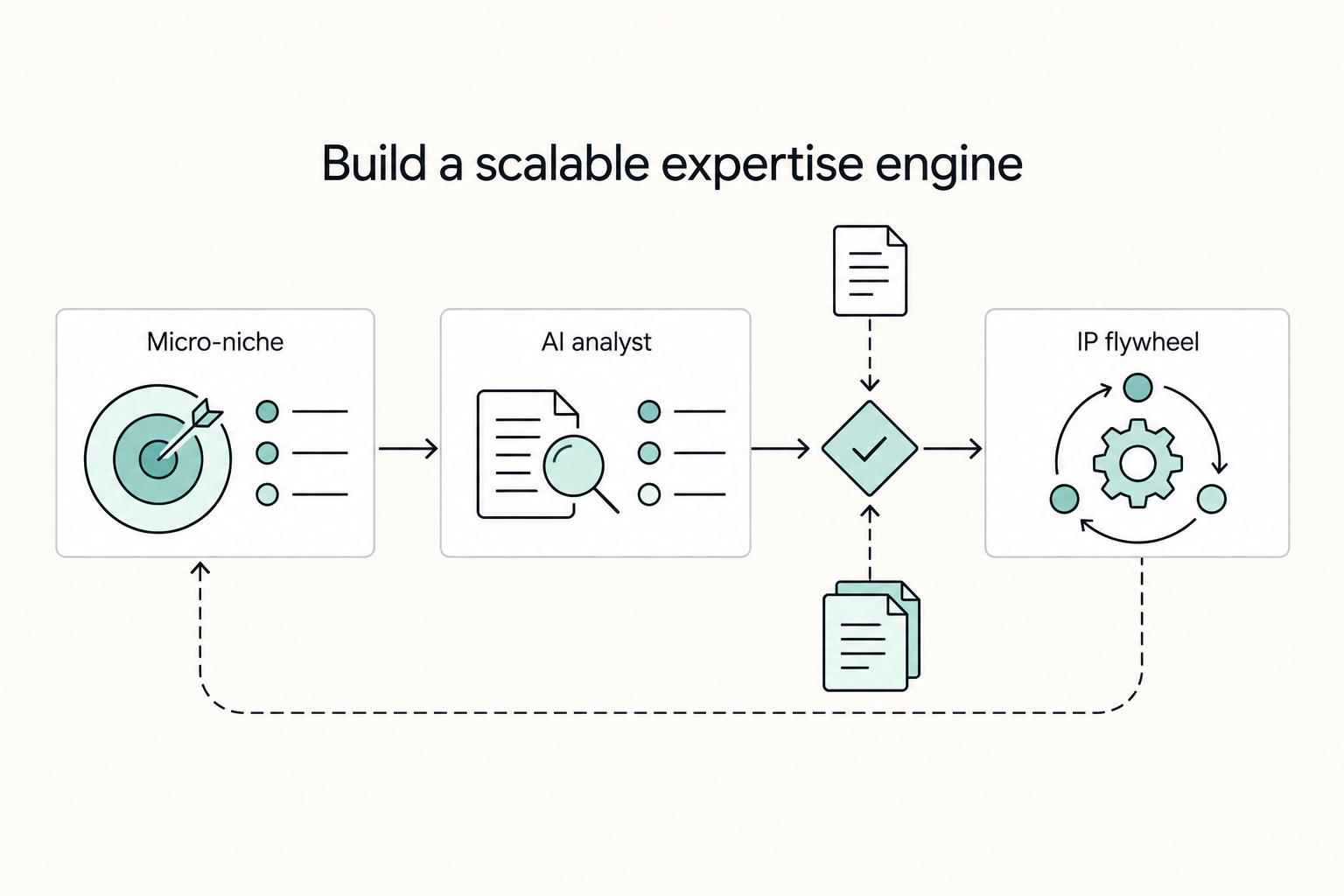
Part 3: Build a Scalable Expertise Engine#
A fortress balance sheet gives you the stability to weather any storm; a scalable expertise engine is what allows you to break free from the linear relationship between hours worked and revenue earned. This is how you transition from being a high-performing consultant to the CEO of your own intellectual property-driven enterprise.
Use AI as Your Personal Analyst Team#
The fear that AI will replace high-level consultants is misplaced. It will, however, replace consultants who work like machines. The true opportunity is to reframe AI not as a competitor, but as your own personal, on-demand analyst team - a force multiplier that handles the 80% of work that supports your 20% of genius.
Integrate these workflows immediately to free up your time for strategic client engagement:
- Market Synthesis: Use prompts like, "Act as a senior market analyst. Synthesize the top five strategic challenges and opportunities discussed in the attached earnings call transcripts from the last quarter. Present the output in a table."
- Competitive Analysis: Feed the AI a competitor's website and ask it to, "Analyze this company's go-to-market strategy, target audience, and core value proposition. Identify three potential gaps in their offering that my services could exploit."
- Administrative Lift: Drastically reduce your non-billable time by asking AI to, "Draft a professional Statement of Work for a 3-month brand strategy project, including objectives, deliverables, a phased timeline, and a payment schedule of 50% upfront and 50% on completion."
Build Your Intellectual Property Flywheel#
The most successful solo professionals understand that their most valuable asset isn't their time - it's their repeatable methodology. You must stop trading your expertise exclusively on a 1-to-1 basis and begin packaging it for 1-to-many distribution. This "IP Flywheel" is the key to building leveraged income streams.
Follow this three-step process to turn your project work into scalable assets:
- Document Your Process: After every successful client engagement, carefully document the exact steps, frameworks, and checklists you used to achieve the result.
- Sanitize and Generalize: Remove all client-specific, confidential information. Abstract your process into a generic, teachable framework. Give it a compelling name, like "The 5-Step Channel Partner Launchpad."
- Package for Scale: Transform this sanitized framework into products you can sell repeatedly. This could be a €500 paid webinar, a €2,000 self-paced video course, or a downloadable diagnostic toolkit. This creates revenue while you sleep and powerfully demonstrates your expertise.
Dominate a "Micro-Niche"#
In a world of generalists, specialists command a premium. The single fastest way to make yourself immune to commoditization is to stop being "a marketing consultant" and become "the go-to expert on go-to-market strategy for B2B FinTech companies entering the Southeast Asian market." Owning a micro-niche makes you the only logical choice for a specific, high-value client.
This is about more than just marketing; it's about building a powerful, specific reputation. As author Dorie Clark puts it, "What do people say about you when you leave the room? That's the essence of your brand." By dominating a micro-niche, you take control of that narrative, making sure that when a specific, urgent problem arises, your name is the first - and only - one that comes to mind.
Conclusion: Your New Dilemma is How to Manage Success#
The Innovator's Dilemma is not a threat to you; it's a filter. It is filtering out the commoditized, the inefficient, and the consultants who are unwilling to adapt. By following this playbook - differentiating your human value, de-risking your business operations, and dominating your niche - you move from being a potential victim of disruption to its primary beneficiary.
This new position creates a set of higher-quality problems. These are not anxieties about survival; they are the strategic challenges of scale and intentionality. When you successfully escape the gravitational pull of the traditional consulting model, you must consciously design what comes next. Otherwise, you risk building a new cage for yourself, just one of your own making.
The challenges you will now face are not about finding work, but about shaping it:
- The Capacity Dilemma: Success will bring you to a point where your time is fully subscribed. The strategic response is to lean into your IP flywheel. Ask yourself: How can I use my fully-booked advisory work as the R&D for my next scalable product? You shift from being the practitioner to being the architect of your expertise.
- The Focus Dilemma: Opportunity will come from every direction once you establish yourself as an authority. Many of these opportunities will be good, but they will not be great. Managing success means developing the discipline to say "no" to anything that dilutes your focus on the very micro-niche that gave you your power.
- The Value Dilemma: With demand outstripping your supply, you have earned the authority to redefine your value. You must have the confidence to command rates that reflect the outcomes you deliver, not the time it takes. This allows you to be more selective, take on only the most compelling projects, and create the financial space to invest back into your business. This is the true endgame of escaping the innovator's dilemma: pricing power.
Frequently Asked Questions
How can an independent consultant exploit the innovator's dilemma?
Independent consultants exploit it by doing what large firms cannot do well: move fast, specialize deeply, and sell outcomes instead of hours. They can use AI to deliver insights quickly, serve micro-niches large firms ignore, and offer agile, value-focused engagements. That makes the solo consultant the disruptive alternative they cannot easily build.
What are the biggest risks of going independent?
The biggest risks are income volatility, compliance and legal risk, and isolation or burnout from wearing every hat in the business. The article recommends reducing those risks with a deliberately structured balance sheet, 6+ months of living expenses saved before resigning, and careful handling of contracts, taxes, and insurance.
How do I price my services when clients can use AI alternatives?
Price insight and outcomes, not hours. If work is framed as hourly labor, it is easier to compare with faster AI tools, so shift to project-based fees, monthly retainers, or productized services.
What does the 'consultant of the future' business model look like?
The consultant of the future uses a hybrid model built for resilience and scale. It combines a high-touch advisory service for a specific micro-niche, a leveraged IP flywheel of scalable products, and an AI-powered operations hub for research and administrative work.
How do I build a 'de-risked' practice from day one?
Build the operational foundation early. That includes using a legal entity like an LLC to separate liabilities, opening dedicated business bank accounts, automating tax savings, securing professional liability insurance, and using strong contracts for every engagement.
Should I be worried about AI replacing my consulting job?
AI is more likely to strengthen a capable consultant than replace one. It can automate research and administrative tasks, but it cannot replace strategic thinking, stakeholder empathy, complex diagnosis, or creative problem-solving.
What's the first step to moving away from the billable hour?
Start with one productized service. Identify a repeatable engagement with a clear outcome, package it as fixed-scope and fixed-price, and define exactly what the client receives so the conversation shifts from time to results.
Researched and edited by the Gruv editorial team. Gruv builds cross-border billing, payouts, and finance-operations software for global businesses.
Sources
Includes 3 external sources outside the trusted-domain allowlist.
Educational content only. Not legal, tax, or financial advice.
Related Posts

GDPR Compliance Checklist for Freelancers Working With EU Clients
Start by separating the decisions you are actually making. For a workable **GDPR setup**, run three distinct tracks and record each one in writing before the first invoice goes out: VAT treatment, GDPR scope and role, and daily privacy operations.

Digital Nomad Health Insurance Comparison for Long-Stay Moves
Use focused time now to avoid expensive mistakes later. Start with a practical `digital nomad health insurance comparison`, then map your route in [Gruv's visa planner](/tools/visa-for-digital-nomads) so we anchor policy checks to your real plan before pricing pages pull you off course.
Crossing the Chasm for Freelancers Without Operational Chaos
If clients already want your work, demand is not the main problem anymore. The bottleneck is whether your business can stay dependable as volume, stakes, and scrutiny rise. For many freelancers, this stage is really the shift from being impressive to being consistently low risk.