
Quick Answer
For benefits payable from January 2024 onward, the Government Pension Offset no longer reduces Social Security spousal and survivor benefits, because the Social Security Fairness Act repealed GPO and WEP. Expats with pensions from work not covered by U.S. Social Security may see higher benefits, but not everyone is affected. Check your SSA record, recent notices, and deposit history, and file now if you never submitted a spouse or survivor claim.
The Government Pension Offset for Expats: A Landmark Repeal Changes Everything#
simple. GPO and WEP are no longer the main problem. Your job now is to confirm your own benefit status with SSA, because the fix is not the same for everyone and you should not assume every case was corrected automatically.
For many readers, this is the biggest shift in this area in years. The Government Pension Offset, or GPO, used to reduce or wipe out Social Security spousal and survivor benefits for people receiving a non-covered pension. The Windfall Elimination Provision, or WEP, adjusted certain worker benefits on your own record. The Social Security Fairness Act of 2023, signed on January 5, 2025, repealed both rules, and SSA says they no longer apply for benefits payable from January 2024 onward.
That matters to some expats because SSA explicitly includes people whose work was covered by a foreign social security system among those who may see benefit increases. If you receive a foreign government pension or another foreign pension tied to work where U.S. Social Security taxes were not withheld, you may be in scope. The key word is may. Not every expat gets more, and a foreign pension by itself does not guarantee eligibility.
| Issue | Before repeal | Now |
|---|---|---|
| Main planning concern | Risk that GPO or WEP would reduce benefits | Verify whether SSA updated your record correctly |
| Spousal or survivor claim decision | Some people did not apply because GPO could eliminate benefits | Recheck eligibility and file if you never applied |
| Own retirement benefit view | Possible WEP reduction on your worker record | Confirm payment amount for months payable from January 2024 |
| Best operator posture | Defensive planning around reductions | Verification and optimization based on actual SSA status |
Use a practical checkpoint here. Look at your current SSA payment and any notices you received after February 25, 2025, when SSA began adjusting affected cases. Most affected beneficiaries started seeing new monthly amounts in April 2025 for their March 2025 benefit, and SSA reported over 3.1 million payments sent by July 7, 2025. If your record still looks unchanged, do not guess. Check whether you ever filed, what type of benefit you claimed, and whether SSA has your pension information on file.
The most common failure mode is assuming repeal means automatic payment in every situation. It does not. SSA says the action required depends on your situation, and Congressional Research Service guidance is clear that people who had not applied before must file to receive benefits. That matters most if you skipped a spouse's or surviving spouse's claim because GPO would have eliminated it. There is also a timing tradeoff. Some new claimants above full retirement age may receive only limited retroactive adjustments under normal filing rules, not a blank check back to January 2024.
So the headline change is real, but the work is still yours. First, understand what changed. Then confirm whether SSA already acted on your case, and focus on the claim, records, and timing issues that still decide what you actually receive. If you want a deeper dive, read the digital nomad tax guide.
The Old Risk: Understanding GPO and WEP#
Before 2024, the core risk was coverage, not geography: if your pension came from work that did not pay into U.S. Social Security, SSA could reduce certain Social Security payments under the old GPO/WEP framework.
Many expats missed this because they focused on who paid the pension, not how the underlying job was covered. SSA's historical test was narrower: pensions from jobs that did not pay into Social Security. For benefits payable for December 2023 and earlier, SSA says it reduced payments through GPO and WEP.
| Rule | What triggered it | Which benefit it reduced | Why expats were often surprised |
|---|---|---|---|
| GPO | A pension from non-covered work in situations SSA evaluated under GPO | Certain Social Security benefits could be reduced under the pre-2024 rules | People often treated a pension's country or employer label as the deciding factor, instead of coverage history |
| WEP | A pension from non-covered work in situations SSA evaluated under WEP | Certain Social Security benefits could be reduced under the pre-2024 rules | People expected a standard result from their earnings record and missed how non-covered work could change it |
| Shared issue | Work that did not pay into Social Security | SSA used both provisions to reduce some payments before January 2024 | Cross-border careers mix U.S. and foreign systems, so non-covered status was easy to misread |
A practical expat scenario: if part of your career was in a foreign public-sector role and you later claimed U.S. Social Security, that combination was a clear signal to review the old rules. It did not automatically mean a reduction, but it was enough to require a careful coverage check.
Your best checkpoint was always documentation: did that job actually pay U.S. Social Security tax? Where a totalization agreement assigned coverage to the other country, the proof is a Certificate of Coverage (for example, IT/USA 4 in Italy cases). That record often explains why a later pension was treated as non-covered.
The old mistake was treating "foreign pension" and "non-covered pension" as the same thing. They are not. Totalization agreements are designed to avoid dual Social Security taxation on the same earnings, so the coverage trail matters more than the pension payer's nationality.
That is the historical map. Next, we move to the current rule set and what you should do now. Related: Japan Digital Nomad Visa 2026 Planning Runbook.
The New Reality: The Social Security Fairness Act of 2025#
Your planning baseline has changed: if WEP or GPO reduced your Social Security because of a non-covered pension, repeal is now the default for benefits payable after December 2023.
| Benefit type | Before repeal | After repeal |
|---|---|---|
| Your own retirement or disability benefit | WEP could reduce your benefit calculation if you also had a non-covered pension | For benefits payable after December 2023, SSA says those reductions no longer apply |
| Spouse or surviving spouse benefit | GPO could reduce the benefit by two-thirds of the pension, sometimes to zero | For benefits payable after December 2023, that offset no longer applies |
| Non-covered pension from foreign-system work | Could still trigger reduction review when the work was not covered by U.S. Social Security | You are not excluded from relief just because the work was under a foreign social security system |
What changed#
H.R. 82 (the Social Security Fairness Act of 2023) was signed on January 5, 2025, and repealed both WEP and GPO for benefits payable after December 2023. The old rules still apply to months before January 2024. If your benefit was already reduced, SSA says it will add the reduction back to your monthly payment and repay amounts withheld since January 2024.
| Milestone | Date/period | Article detail |
|---|---|---|
| Social Security Fairness Act signed | January 5, 2025 | H.R. 82 repealed both WEP and GPO |
| New rule applies | Benefits payable after December 2023 | SSA says those reductions no longer apply |
| Old rule still applies | Months before January 2024 | The old rules still apply |
| If benefits were already reduced | Since January 2024 | SSA says it will add the reduction back to your monthly payment and repay amounts withheld |
Confirm the current SSA processing status directly with the Social Security Administration.
Who is affected#
This is not universal. SSA says only people who receive a pension based on work not covered by Social Security may see increases. That can include people whose work was covered by a foreign social security system.
What is still not automatic for you#
Automatic adjustment is not the same as automatic claiming. If you never filed for a spouse or surviving spouse benefit because GPO would have erased it, you may still need to file now, and retroactivity for some retirement and survivor claims is generally limited to six months before the month you apply. Your job from here is verification and claim follow-through, not penalty-avoidance modeling.
| Situation | Action | Limit/reminder |
|---|---|---|
| Never filed for a spouse benefit because GPO would have erased it | You may still need to file now | Automatic adjustment is not the same as automatic claiming |
| Never filed for a surviving spouse benefit because GPO would have erased it | You may still need to file now | Automatic adjustment is not the same as automatic claiming |
| Some new retirement claimants | Apply instead of assuming automatic payment | Retroactivity is generally limited to six months before the month you apply |
| Some new survivor claimants | Apply instead of assuming automatic payment | Retroactivity is generally limited to six months before the month you apply |
You might also find this useful: A Guide to the 'Windfall Elimination Provision' for US Expats.
Your Action Plan: Verifying Your Restored Benefits#
Your next move is a three-part check: confirm you were in the previously affected profile, verify your record reflects changes from January 2024 forward, and file any claim you never submitted.
Start with a yes/no profile check#
If you answer yes to all three, proceed to record and claim review.
| Screening question | If yes | If no |
|---|---|---|
| Do you receive, or expect to receive, a pension based on work not covered by U.S. Social Security? | Continue | This change may not affect your benefits |
| Was that pension tied to foreign-system or government work instead of U.S. Social Security-covered work? | Continue | You may not be in the group that sees an increase |
| Are you eligible for U.S. Social Security on your own record, or as a spouse or surviving spouse? | Proceed to verification | You may not have a current claim to restore, but keep your records ready |
- Do you receive, or expect to receive, a pension based on work not covered by U.S. Social Security?
Yes: continue. No: this change may not affect your benefits.
- Was that pension tied to foreign-system or government work instead of U.S. Social Security-covered work?
Yes: continue. No: you may not be in the group that sees an increase.
- Are you eligible for U.S. Social Security on your own record, or as a spouse or surviving spouse?
Yes: proceed to verification. No: you may not have a current claim to restore, but keep your records ready.
SSA is explicit that increases are not universal; people who may see increases are those with a pension based on work not covered by Social Security.
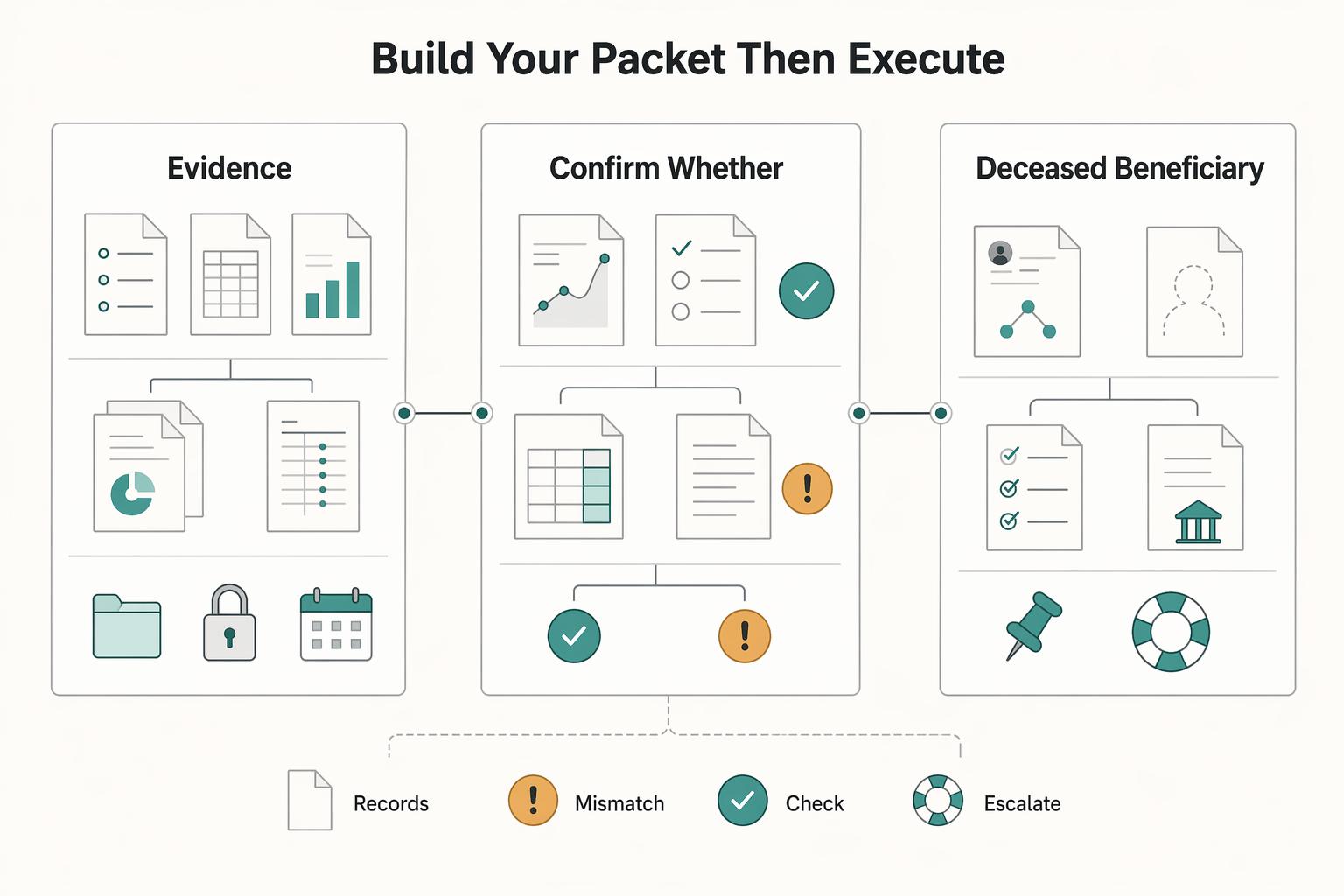
Build your packet, then execute#
Use this checklist to reduce back-and-forth and keep outputs clear.
| Task | Why it matters | What to prepare | Common error to avoid |
|---|---|---|---|
| Review your current SSA record and payment history | Confirms whether prior WEP/GPO-related reductions appear removed | Current benefit amount, older SSA notices/statements showing prior reductions | Checking only the latest payment and skipping pre-repeal comparison |
| Confirm whether you ever filed spouse/survivor claims | Automatic adjustment is not the same as filing a claim you never submitted | Claim history, prior application dates, notes on why you did not file | Assuming automatic correction created a new claim for you |
| Organize non-covered pension documentation | Helps resolve mismatches in case handling | Pension statements, employer details, employment dates, contribution records | Submitting documents without clear dates, employer names, or pension source labels |
| Check for deceased-beneficiary amounts due | Some cases require a separate submission workflow | If relevant, locate SSA-1724-F4, complete it, and upload supporting documents | Skipping this because the beneficiary is deceased |
Operational checkpoints: the law was signed on January 5, 2025, and SSA began adjusting monthly payments on February 25, 2025, with repayment framing back to January 2024 for affected cases. Also, treat older WEP-only screening pages as historical context, not your final post-repeal decision rule.
Target outputs:
- Reviewed record: you verified whether the current amount and any repayment align with post-January 2024 treatment.
- Submitted claim where needed: you filed any spouse/survivor claim that was never submitted.
- Organized documentation packet: you keep one dated file of statements, notices, account screenshots, and contact logs.
Escalate to a pro if any of these apply:
- Your payment appears inconsistent, and the escalation threshold still needs official source-record verification.
- Your pension history spans multiple countries, mixed public/private service, or unclear coverage status.
- You cannot confirm whether spouse, survivor, or deceased-beneficiary claim status is open, closed, or never filed.
Immediate objective: verify corrections, file any missed spouse/survivor claims, and maintain a clean audit trail for fast follow-up.
For a step-by-step walkthrough, see How to Obtain 'Proof of Life' (Certificado de Fe de Vida) for a Foreign Pension.
Strategic Shift: From Defensive Planning to Offensive Optimization#
Your compliance fire drill is over; your job now is coordinated income design and risk control across benefits, pensions, taxes, and currency exposure.
| Decision area | Old posture | New posture | Primary risk now | Recommended default |
|---|---|---|---|---|
| Income sequencing | Delay decisions because value felt uncertain | Sequence confirmed income sources as one system | Funding core costs from the wrong source and creating avoidable tax or liquidity pressure | Build one cashflow map by payer, currency, timing, withholding, and expected net |
| Household claiming coordination | Treat spouse/survivor decisions as low priority | Recheck household claiming choices using current records | Filing off assumptions, old notices, or incomplete history | Review both partners together, then file only after records are complete |
| Cross-border tax interaction | Focus only on whether income is payable | Focus on where each stream is taxed and how withholding is credited | Double taxation, missed credits, or reporting mismatch | Map each stream to the relevant country return before final claiming choices |
| Currency and liquidity management | Ignore FX and account routing | Manage payout currency versus spending currency intentionally | Forced conversion at poor rates and cashflow gaps | Keep a spending-currency buffer and route deposits to match planned use |
Start with income sequencing. Put every stream on one page: source, currency, payment schedule, expected net, and whether the amount is fixed or variable. Use that to decide what covers essential monthly costs versus discretionary spending.
For household claiming, make it operational. Review now: each partner's current benefit record, prior spouse/survivor application history, and key eligibility timelines. Document before choosing: prior applications or notices, marital-status records, and a simple dependency view showing how much the household relies on each payment.
Do not assume every pension is broadly diversified. One cited pension-fund example includes mandatory limits of 30% equity and 20% foreign assets, with a concentration outcome of 84% of AuM in local bonds. If your plan has similar constraints, treat it as a concentration risk in your income design.
Use this advanced-checklist before final decisions:
- FX exposure: payout currency, landing account, conversion timing, and rate rule. Confirm the current rate rule with the provider before relying on it.
- Residency-country tax treatment: treatment of each income stream and withholding relief path. Confirm the current tax treatment with the relevant tax authority or advisor.
- Estate/beneficiary alignment: beneficiary designations, account titling, and local succession interaction. Confirm the current estate and beneficiary rules with a qualified legal advisor.
Involve a specialist when cross-border tax outcomes conflict, when spouse/survivor coordination remains unclear, or when a wrong assumption would create material household downside.
We covered this in detail in What is 'sovereign immunity' and how it affects suing a foreign government client.
Conclusion: Verify your record and keep a clean paper trail#
Your job now is not to relearn old GPO math. It is to verify that SSA applied the current rule to your record and to keep a clean paper trail if something still looks wrong. For benefits payable for January 2024 and later, SSA says WEP and GPO no longer apply. Reductions belonged to December 2023 and earlier.
Treat this as an operational shift from uncertainty to monitoring. Check your latest SSA notice and your bank deposits against what you should be receiving now, especially if your benefit was previously reduced and may now include restored monthly amounts or repayment of amounts withheld since January 2024. If you never applied because an old reduction would have wiped out the value, recheck that decision under current SSA guidance. Not everyone will see an increase; SSA indicates changes are tied to non-covered pensions. One practical red flag is that SSA still hosts older foreign-pension WEP material, including a screening tool. Do not rely on an outdated page without cross-checking the current Fairness Act and government-and-foreign-pensions guidance.
What you do now is straightforward. Confirm the payment amount on your record. Compare it with recent deposits. Keep your pension award letter, recent pension statements, SSA notices, and any older WEP or GPO correspondence in one file, and document the date, contact channel, and summary of any correction request. If the case involves a deceased beneficiary, use Form SSA-1724-F4 and upload the supporting documents SSA requests. If your benefit history is inconsistent, the pension involves cross-border details, or you cannot tell whether your eligibility path changed under the new rule, consider bringing in a qualified cross-border adviser before you assume the record is correct or spend against a payment increase.
This pairs well with our guide on A Guide to Schedule B (Interest and Ordinary Dividends) for US Expats.
Frequently Asked Questions
Is the government pension offset expats issue actually resolved now?
Yes, for benefits payable from January 2024 and later. SSA says WEP and GPO no longer apply, and amounts withheld since January 2024 may be restored where applicable. But you should still check your SSA notices and deposits because not every case was corrected automatically.
How does a foreign pension affect my Social Security now?
A foreign pension does not reduce your benefit under SSA's current rule just because it came from work not covered by U.S. Social Security. If you have not applied yet, SSA says your benefit will not be reduced for that reason. Keep your pension award letter and recent statements in case SSA asks how the pension was classified.
What was the difference between GPO and WEP?
They were separate reduction rules under the old system. GPO affected certain spousal and survivor benefits, while WEP affected certain worker benefits on your own record. For benefits payable from January 2024 forward, SSA says neither rule applies.
How was the old GPO reduction handled?
Before the repeal, SSA reduced some spousal and survivor benefits tied to pensions from jobs that did not pay into Social Security. Those older rules still matter only for benefits payable for December 2023 and earlier. For current-period benefits, that offset no longer applies.
Do Totalization agreements still matter after the repeal?
Yes. They still help address dual Social Security taxation and benefit gaps when a career spans countries. If coverage is assigned to the United States, a Certificate of Coverage is the proof that you and, where relevant, your employer are exempt from the foreign country's Social Security taxes.
What should I gather before asking about a Totalization issue?
Gather recent pay slips, employer details, dates worked in each country, U.S. and foreign tax or contribution records, and any prior certificate requests. If the case involves Italy, the article notes the certificate example IT/USA 4. If the employer and local adviser disagree on coverage, escalate before contributions are paid twice.
What if my benefits still look reduced or a repayment is missing?
First, assemble your latest SSA notice, benefit statement, bank deposits, pension award letter, and any older WEP or GPO correspondence. Then ask SSA to verify whether your record still reflects a pre January 2024 reduction. Escalate if your filing history is unclear or the amount still looks materially wrong.
What if the person who should have received the repayment has died?
Use Form SSA-1724-F4 to claim possible amounts due in the case of a deceased beneficiary. Gather the death certificate, your authority to act, SSA notices, and payment history before submitting. The article notes that some deceased-beneficiary cases require a separate workflow.
Can I submit Certificate of Coverage requests online without concern?
You can request certificates online if you are an employer or self-employed, but you should treat it as a real document submission. SSA says web transmission cannot be guaranteed against interception or decryption, so keep local copies of everything you send. The article lists help for those forms at (410) 965-7306, Monday through Friday, 8 a.m. to 3 p.m. Eastern U.S. time.
Try a related tool
Researched and edited by the Gruv editorial team. Gruv builds cross-border billing, payouts, and finance-operations software for global businesses.
Sources
Includes 1 external source outside the trusted-domain allowlist.
- congress.gov/bill/119th-congress/house-bill/1/text/eastrusted
- congress.gov/crs-product/IF13181trusted
- dni.gov/files/documents/Global%20Trends_2025%20Repor...trusted
- irs.gov/pub/irs-access/p2104_accessible.pdftrusted
- ssa.gov/prepare/government-and-foreign-pensionstrusted
- ssa.gov/benefits/retirement/social-security-fairness...trusted
- kitces.com/blog/social-security-fairness-act-windfall-e...external
Educational content only. Not legal, tax, or financial advice.
Related Posts

Digital Nomad Taxes in 2026 With a Defensible Filing Plan
With digital nomad taxes, the first move is not optimization. It is figuring out where you may be taxable, where filings may be required, and what proof supports that position.

Japan Digital Nomad Visa 2026: Six-Month Planning Runbook
Treat this as your operating model: identify the right mission first, commit to one route, and keep dated records before you make irreversible plans. That is what keeps the rest of your timeline, paperwork, and decisions coherent.
How US Expats Should Handle the WEP Repeal
**Short answer:** WEP no longer reduces your own Social Security benefit calculation for benefits payable from January 2024 onward. That can matter if you worked in a job tied to a foreign social security system or another pension arrangement where Social Security taxes were not withheld.