
Quick Answer
A tax credit reduces the tax you owe, while a tax deduction reduces your taxable income. Both can lower your tax bill or affect your refund, but they work at different points in the return. With the same dollar amount, a credit usually has a more direct effect, while a deduction's value depends on your tax calculation.
Start here if you want fewer tax mistakes this year#
Start with the core distinction: a tax credit reduces the tax you owe, while a tax deduction reduces taxable income. Both can lower your tax bill or increase your refund, but they work at different points in the calculation, so they are not interchangeable.
| Checkpoint | What to verify | If unclear |
|---|---|---|
| Eligibility | Check eligibility first | If eligibility is unclear, pause optimization and get professional help before filing |
| Support | Confirm what you can support | If your records cannot support the claim, pause optimization and get professional help before filing |
| Authority | Use the IRS credits-and-deductions page and the Tax benefits eligibility chart | If authority is unclear, pause optimization and get professional help before filing |
| Official source | If a claim cannot be traced to an official source, treat it as unverified | Verify legal research against an official edition |
If you are comparing tax benefits, definitions are only the first step. The practical risk is usually eligibility and claim readiness. Check eligibility first, confirm what you can support, then compare the options that apply to your situation.
Use an authority-first checkpoint before you estimate savings: the IRS credits-and-deductions page and its Tax benefits eligibility chart for families and individuals at a glance. Recheck current-year guidance each cycle, since the IRS notes that the Inflation Reduction Act of 2022 introduced new and extended credits and deductions.
Treat source quality as a control, not a formality. IRS bulletin synopses are not authoritative interpretations, and FederalRegister.gov says legal research should be verified against an official edition. If a claim cannot be traced to an official source, treat it as unverified.
Use that standard early. If eligibility is unclear, authority is unclear, or your records cannot support the claim, pause optimization and get professional help before filing.
For more on one specific credit, read What is the 'credit for prior year minimum tax' (Form 8801)?.
Tax deduction vs tax credit at a glance#
Classify the item first. A deduction reduces taxable income, and a credit reduces the tax you owe. Both can lower your tax bill and affect refund outcomes, but they do not work at the same step of the return.
| Comparison point | Tax deduction | Tax credit | Practical note |
|---|---|---|---|
| Where applied | Reduces Taxable Income | Reduces Tax Owed | Deduction examples: Standard Deduction, Itemized Deduction. Credit examples: Earned Income Tax Credit (EITC), Child Tax Credit (CTC). |
| How it affects the return | Lowers income before tax is calculated | Is subtracted from tax owed | They reduce taxes at different steps in the return. |
| Refund potential | Can reduce tax and may improve refund outcomes indirectly | Depends on the credit; some are refundable | EITC is refundable. Do not assume every credit is. |
| Common limits | First fork is often Standard Deduction vs Itemized Deduction | Credits have their own eligibility tests; some include income gates | The IRS notes EITC applies if you earn under a certain income level. Check each credit's eligibility separately. |
| Claim process at filing | Claimed when you file your return | Claiming is process-sensitive at filing | In software, credits depend on eligibility interview answers. On paper, required credit forms must be completed and attached. |
| Common failure mode | Skipping qualification checks | Skipping eligibility checks or claim steps | This can lead to missed eligible credits or deductions. |
Most avoidable mistakes start when people skip eligibility or filing-process checks. Use the table in order: classify the item correctly, confirm eligibility, then complete the steps needed to actually claim it.
If a valid credit and deduction are competing for your time, check credit eligibility first, because credits are subtracted from tax owed.
You might also find this useful: A Guide to Claiming the American Opportunity Tax Credit as an Expat.
Why the same dollar amount can save very different amounts#
Equal face amounts do not produce equal tax savings. A credit reduces Tax Liability directly, while a deduction reduces Taxable Income, so a deduction's value depends on how your tax is calculated.
A simple side-by-side example#
| Item claimed | Where it applies | Immediate effect | Likely tax result |
|---|---|---|---|
| $500 deduction | Taxable Income | Lowers income subject to tax by $500 | Savings depend on your tax calculation |
| $500 credit | Tax Liability | Lowers tax owed by $500 | Cuts your bill by $500 |
| Nonrefundable credit | Tax Liability | Can reduce tax owed to zero | If credit exceeds tax owed, the excess does not create a refund |
The mechanics are different even before advanced planning. In EY's example, $50,000 income with a $1,000 deduction becomes $49,000 taxable income, while a $500 credit reduces a $1,500 liability to $1,000.
What changes the result before you do any advanced planning#
Before you compare savings, lock three inputs so you are not comparing rough guesses:
| Input | Why it matters | Grounded detail |
|---|---|---|
| Filing status | Affects deduction mechanics | In EY's 2022 example, the standard deduction ranged from $12,950 (single) to $25,900 (married filing joint) |
| Total income | Can limit claims | It can limit what deductions or credits you can claim |
| Refundable vs nonrefundable credit | Changes cash outcome | Nonrefundable credits can reduce tax to zero, but excess credit does not pay out |
Do not finalize expected savings until those filing inputs are complete, consistent, and verified for the tax year you are filing.
For a step-by-step walkthrough, read Can I Claim the Foreign Tax Credit for Taxes Paid to a 'Blacklisted' Country?.
Refundable and nonrefundable credits change your real outcome#
If cash flow matters, this distinction comes first. Nonrefundable credits can reduce tax owed to zero, while refundable credits can still pay out when the credit is larger than your tax bill.
| Credit | Grounded takeaway | If tax owed is already zero | First checkpoint |
|---|---|---|---|
| Earned Income Tax Credit (EITC) | IRS identifies EITC as refundable for moderate- and low-income taxpayers | Excess can come back as part of your refund | Use IRS Publication 596 and the EITC Assistant to check eligibility |
| Child Tax Credit (CTC) | IRS FS-2023-09 describes CTC as nonrefundable and liability-reducing; treatment can vary by tax year | Under that IRS fact sheet, it can reduce liability to zero but not create a leftover refund | Confirm current-year IRS rules and qualifying child details, including the IRS excerpt that notes under age 17 |
| American Opportunity Tax Credit (AOTC) | IRS lists it as an education credit; other guidance describes it as partially refundable | Part of the credit may still matter when liability is low, but current-year rules control | Verify current-year education-credit instructions and qualified education expense support |
| Lifetime Learning Credit (LLC) | IRS lists it as an education credit | Do not assume it creates cash back | Check current-year IRS instructions before treating it as a refund source |
That is why EITC deserves an early review for eligible filers. The IRS points taxpayers to Publication 596 and the EITC Assistant. It also notes that many eligible workers do not claim EITC and can miss thousands of dollars every year.
Use a simple order of operations: validate refundable credits first, then apply nonrefundable credits that can still reduce tax to zero. Do not rely on a credit's name or on last year's assumptions. Credit types and amounts can vary by tax year, so check current-year IRS forms and instructions before you file.
We covered this in detail in Child Tax Credit for U.S. Expats: Eligibility, FEIE, and Filing Checks.
Decide in this order to avoid missed credits and weak deductions#
For cross-border filers, sequence can matter more than cleverness. A practical order is to decide credit vs deduction, apply Form 1116 correctly if needed, clear excluded-income conflicts, then complete Schedule SE.
| Step | Decision | What to confirm before moving on |
|---|---|---|
| 1 | Foreign taxes: credit vs deduction | If foreign taxes were paid or accrued on income also taxed by the U.S., decide whether to take a foreign tax credit or an itemized deduction for those taxes. |
| 2 | If credit, file Form 1116 correctly | Use Form 1116 to claim the credit, with a separate form for each income category and only one category box checked per form. |
| 3 | Remove excluded-income conflicts | Do not claim a foreign tax credit for taxes on income you exclude; if you do, one or both elections may be considered revoked. |
| 4 | Finalize self-employment treatment | Complete Schedule SE using net self-employment earnings; that information is used for both tax due and Social Security benefit calculations. |
This sequence can help reduce avoidable errors. The IRS notes that taking foreign income taxes as a credit is usually more advantageous than taking them as a deduction. But not every foreign tax qualifies for the credit, even when the four baseline tests are met. If a foreign tax item is unusual, escalate it instead of forcing it into the credit bucket.
Before filing, confirm each foreign tax item is treated consistently and that Form 1116 category splits are complete. If your FTC setup is the weak point, review A Deep Dive into the Foreign Tax Credit (Form 1116) before you file.
You may also want A Deep Dive into France's 'Crédit d'Impôt Recherche' (CIR) Tax Credit.
Scenario recommendations for globally mobile freelancers#
When several moving parts are in play, use the same order every time: test the credit first, test the deduction second, and pause self-filing when key sourcing facts are unclear.
| If this is you | Prioritize this | Verify this before filing | Common mistake |
|---|---|---|---|
| U.S. freelancer abroad paying foreign income tax on income also taxed by the U.S. | Test the Foreign Tax Credit (Form 1116) before treating those taxes as an itemized deduction | Figure tax both ways before filing. Confirm the tax is potentially creditable, the income is foreign source, and no credit is claimed on excluded income. | Claiming the same qualified foreign taxes as both a credit and a deduction |
| You excluded foreign earned income or housing costs | Recheck credit eligibility before claiming the Foreign Tax Credit | Do not claim a credit for taxes on income you exclude. | Taking a credit on excluded income |
| You have foreign income in more than one Form 1116 category | Keep Form 1116 filings separated by category | Use a separate Form 1116 for each income category and check only one category box per form. | Combining categories on one form or checking multiple boxes |
| A foreign tax appears close to qualifying but treatment is uncertain | Validate eligibility before claiming the Foreign Tax Credit | Some foreign taxes are disallowed even when general tests appear to be met. | Assuming every foreign tax is automatically creditable |
Where the foreign tax choice usually lands#
When the same income is taxed by both the U.S. and a foreign country, the default starting point is usually the credit. The IRS says it is generally better to take the credit than deduct qualified foreign taxes. But you may be able to choose either a credit or an itemized deduction for those taxes.
Then pressure-test the setup. The credit only reduces U.S. tax on foreign source income, some foreign taxes are disallowed even when they appear close to qualifying, and you generally choose either credit or deduction for all qualified foreign taxes. Run the return both ways before filing.
If you claim the credit, Form 1116 discipline is essential: separate form per income category, one category box per form, and no credit for taxes tied to excluded income. For a deeper walkthrough, see A Deep Dive into the Foreign Tax Credit (Form 1116). If you later identify additional creditable foreign taxes, individuals generally have 10 years to file a refund claim.
A practical filing order before submission#
Do not optimize this in one pass. First, confirm which income is foreign source and whether any income was excluded. Next, figure your tax both ways: claiming the credit and claiming the deduction. If you claim the credit, finish with Form 1116 category checks before you file.
Cross-border traps most comparison posts skip#
The deduction-vs-credit call is only one part of cross-border risk. In the same review cycle, check offshore reporting too: FBAR (FinCEN Form 114) and Form 8938 are separate filing tests, and filing one does not replace the other.
FBAR and Form 8938 are separate tests#
| Item | FBAR | Form 8938 |
|---|---|---|
| Filing channel | Filed directly with FinCEN (separate from the IRS) | Attached to your annual tax return and filed by that return's due date, including extensions |
| Core trigger | Aggregate foreign financial account value exceeds $10,000 at any time during the calendar year | Report specified foreign financial assets when total value exceeds the applicable threshold |
| Threshold design | One aggregate account-value trigger | Threshold depends on filing status and whether you live in or outside the U.S. |
| Threshold examples | $10,000 aggregate at any time | U.S. unmarried or MFS: $50,000 / $75,000; U.S. MFJ: $100,000 / $150,000; outside U.S. unmarried or MFS: $200,000 / $300,000; outside U.S. MFJ: $400,000 / $600,000 |
| Easy checkpoint to miss | Whether the aggregate foreign account value exceeded $10,000 at any time during the year | Whether foreign assets were acquired or sold during the tax year |
You may need FBAR, Form 8938, or both. A finished credit or deduction position does not clear information-reporting requirements by itself.
Keep tax-benefit and reporting checks together#
A practical approach is to run tax-benefit and reporting checks from the same account inventory and the same tax-year records. Before filing, confirm:
| Reporting check | Form | What to confirm |
|---|---|---|
| FBAR threshold | FBAR | Whether foreign financial accounts cross the $10,000 FBAR aggregate test at any point in the year |
| Form 8938 threshold | Form 8938 | Which Form 8938 threshold applies for your residency and filing status |
| Asset activity | Form 8938 | Whether any foreign assets were acquired or sold during the tax year |
| Return filing requirement | Form 8938 | Whether an income tax return is required for the year, because if no return is required, Form 8938 is not required even when assets exceed the threshold |
If any answer is unclear, the return is not ready yet. In cross-border filings, strong tax math and complete reporting checks have to go out together. Related reading: The Most Overlooked Tax Deductions for Freelancers.
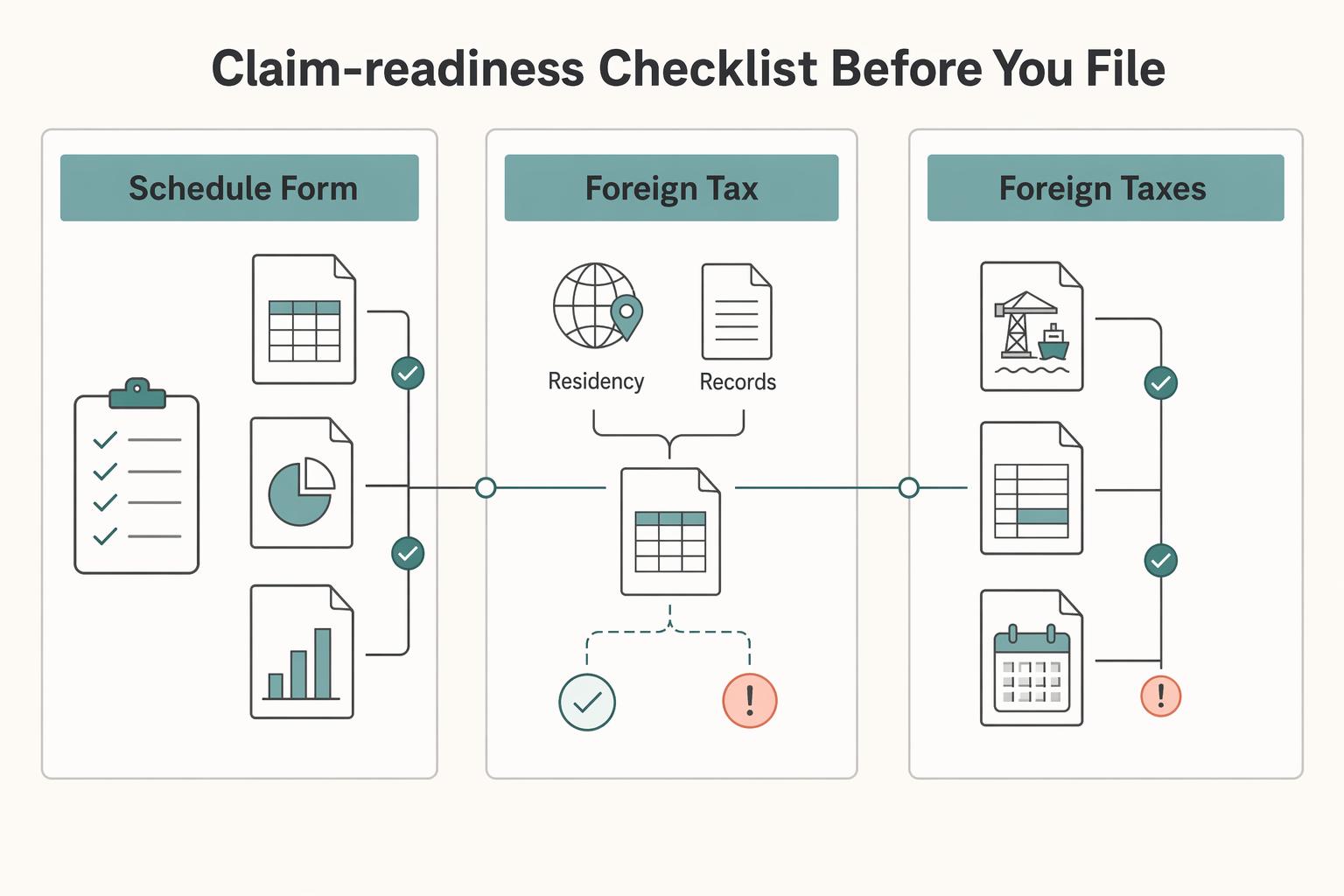
Claim-readiness checklist before you file#
A return is only ready when each major claim traces back to support, calculations, and a clear eligibility position. If you cannot explain how a number got onto the return, treat it as unfinished. Use one pre-filing checklist that ties documents to each claim type.
| Claim area | Verify before filing | Support to keep with the return file | Stop sign |
|---|---|---|---|
| Schedule SE (Form 1040) | Net earnings from self-employment reconcile to your books and return totals | Workpapers that support your net self-employment earnings calculation and return tie-out | You cannot explain how net self-employment earnings were derived |
| Foreign Tax Credit (Form 1116) | Use a separate Form 1116 for each income category, check only one category box per form, and report amounts in U.S. dollars except where Part II says otherwise | Form 1116 worksheets by income category and U.S.-dollar calculation workpapers | You are claiming credit for taxes on excluded income, or you cannot show why the tax is credit-eligible |
| Foreign taxes as an itemized deduction on Schedule A | For the same foreign taxes, confirm you are taking a deduction instead of a credit and that your filed path is consistent | Schedule A/Form 1116 comparison worksheet and filed-path tie-out | The same foreign taxes are effectively used twice |
For Form 1116, category discipline is the key control. The credit is meant to reduce double taxation on foreign-source income taxed by both the U.S. and a foreign country or U.S. territory. But you cannot claim a foreign tax credit for taxes on income you excluded, and some foreign taxes are disallowed even if the four qualifying tests are met. If you need a deeper FTC form check, read A Deep Dive into the Foreign Tax Credit (Form 1116).
Use one final gate before you file: if eligibility or sourcing is still uncertain, stop and escalate for advisor review. High-priority escalations include returns that mix excluded foreign earned income with an FTC claim on that same income, and cases where dividend-related holding-period support is unclear. There is generally a 10-year window to claim a refund for additional creditable foreign taxes, but that is not a reason to file a weak position now.
Need the full breakdown? Read FEIE vs Foreign Tax Credit for High-Earning US Expats.
If timeline assumptions that affect sourcing are still fuzzy, run a quick timeline pass in the Tax Residency Tracker before locking your filing assumptions.
Escalate early when these red flags appear#
Some issues are not worth pushing through on your own. If any of these apply, pause and escalate before filing rather than forcing a position you cannot support.
| Red flag | Why it needs escalation | What to assemble before review |
|---|---|---|
| You are unsure whether foreign taxes qualify for the Foreign Tax Credit | The tax must meet four qualifying tests, and some foreign taxes are disallowed even when those tests are met | Foreign tax statements, proof of payment/accrual, and notes on the type of tax paid |
| You are unsure about FBAR (FinCEN Form 114) or Form 8938 | FBAR is filed with FinCEN (not the IRS), and Form 8938 does not replace FBAR. You may need Form 8938, FBAR, or both based on each form's thresholds | Account statements showing year-end and highest balances, a foreign-asset list, and a threshold check |
| Your foreign taxes could be claimed as a credit or deduction | The IRS allows either path and says the credit is usually more advantageous, but you cannot claim a Foreign Tax Credit (Form 1116) for taxes on income you excluded | Foreign tax statements, proof of payment/withholding, excluded-income elections, and a saved credit-vs-deduction comparison |
| You are filing Form 1116 and income categories are mixed or unclear | Form 1116 requires separate forms by income category, with one category box checked per form | A draft Form 1116 by category, supporting schedules, and category-level workpapers |
Two hard-stop checks:
- If foreign accounts exceeded $10,000 aggregate at any time during the calendar year, review FBAR filing before you submit.
- If you are using Form 1116, use separate forms by income category and check one category box per form. Escalate if excluded foreign earned income or housing costs are involved, since claiming the credit can affect those elections.
Use your Gruv records to make tax decisions faster and cleaner#
Use Gruv records to speed prep and make your tax position easier to support, but do not treat platform data alone as complete filing proof.
| Gruv artifact | Best tax use | Monthly checkpoint | Common failure mode |
|---|---|---|---|
| Ledger-backed transaction history | Support income and expense totals before building return numbers | Check date, amount, currency, client, and category against bank or card activity | Using platform totals that do not match settled cash because of timing, reversals, or fees |
| Invoice and payment evidence | Support what was billed, when, and whether it was paid | Keep invoice, payment confirmation, and related client note or contract together | Invoice with no payment proof, or payment with no matching invoice trail |
| Payout status trails | Reconcile earned amounts to actual deposits | Review paid, pending, failed, and reversed payouts before month-end close | Reporting gross activity without explaining why the bank received less |
| Tax profile records, where enabled | Keep payer and identity details organized for filing prep | Save the version used for filing and note profile changes during the year | Assuming profile fields replace underlying tax forms or source documents |
For many self-employed filers, the key filing checkpoint is Schedule SE (Form 1040). The IRS says you must pay self-employment tax when net earnings are $400 or more, and Schedule SE is used to figure that tax. The same Schedule SE information is also used by the Social Security Administration to figure benefits, so record accuracy affects more than one filing season.
A practical monthly close keeps this manageable: export your ledger, tie payouts to bank deposits, investigate failed or reversed payouts, and store invoice plus payment proof together.
Do not wait until deadline week to rebuild records. If your income trail does not reconcile, fix that before you finalize return inputs. That makes Schedule SE calculations, including the employer-equivalent portion deduction of self-employment tax, cleaner.
Choose certainty over cleverness#
Use one conservative order for your own review: validate high-impact credits first, optimize deductions second, then run a final compliance check. Think of it as error control, not a search for the most aggressive outcome.
When source authority is unclear, slow down before you rely on it. FederalRegister.gov can help you find documents, but its prototype is not the official legal edition, and its XML view does not provide legal or judicial notice. If a FederalRegister.gov page matters to your filing position, verify it in the linked official PDF on govinfo.gov. If the document type is "Proposed Rule," treat it as proposed rather than final.
Use the same standard for policy summaries. A section-by-section outline can show what is being discussed, including headings like Sec. 110002 (standard deduction), Sec. 110004 (child tax credit), and Sec. 110005 (qualified business income deduction). It does not, by itself, confirm what you can claim on a filed return.
Use that same standard at the end of the process. Before filing, run this closeout checklist:
- Confirm your inputs are complete and internally consistent.
- Validate each major credit you plan to claim and keep the support you used.
- Finalize deduction support so the records match what you file.
- Check for contradictions, double counting, or positions you cannot document.
- Escalate uncertain items instead of taking an aggressive position.
If you cannot clearly explain a claim and produce the document trail behind it, do not rely on it yet. Finish in this order, verify legal sources through official versions, and escalate unresolved points before you file.
Frequently Asked Questions
What is the difference between a tax deduction and a tax credit in one sentence?
A tax deduction reduces your taxable income, while a tax credit reduces the tax you owe. That is the core difference.
Which usually saves more, a credit or a deduction with the same dollar amount?
Equal dollar amounts do not create equal tax savings. A credit reduces tax liability directly, while a deduction lowers taxable income, so the result depends on your filing status, total income, and how your tax is calculated.
Do tax credits always increase my refund?
No. Some credits are refundable and some are not, so a credit may lower what you owe without creating extra cash back.
What is the difference between refundable and nonrefundable credits?
A refundable credit can still pay out when the credit is larger than your tax bill. A nonrefundable credit can reduce your tax liability to zero, but excess credit does not create a refund by itself.
How should freelancers decide whether to focus on credits or deductions first?
Start by confirming eligibility, support, and filing inputs before estimating savings. Then test the credit first and the deduction second on your actual return instead of assuming one always wins. If key facts are unclear, pause self-filing and get professional help before filing.
What records should I keep before claiming deductions or credits?
Keep records that support eligibility, calculations, and the filing steps for each claim. Useful records include workpapers, invoice and payment evidence, payout status trails, and comparison worksheets that tie the filed position to the return. If your records cannot support the claim, pause optimization and get professional help before filing.
When should I stop self-filing and talk to a tax professional?
Stop self-filing when eligibility is unclear, authority is unclear, or your records cannot support the claim. Escalate when foreign tax treatment, Form 1116 category handling, FBAR, or Form 8938 is unclear.
Researched and edited by the Gruv editorial team. Gruv builds cross-border billing, payouts, and finance-operations software for global businesses.
Sources
Educational content only. Not legal, tax, or financial advice.
Related Posts

Do I Have to Pay State Taxes While Living Abroad as a Digital Nomad?
Living abroad does not end `state income tax` exposure by itself. The first decision is practical: choose a filing position your facts can support, then build records that support the same story all year.

A Deep Dive into the Foreign Tax Credit (Form 1116)
If you paid qualifying foreign income taxes and still owe U.S. tax, start with the Foreign Tax Credit and Form 1116. A credit usually beats a deduction because it offsets tax dollar for dollar. Do not start entering numbers until you decide whether you are taking a credit, an itemized deduction, or an exclusion. If you use the [Foreign Earned Income Exclusion](https://www.irs.gov/individuals/international-taxpayers/foreign-earned-income-exclusion) or the foreign housing exclusion, remove the excluded income and related foreign taxes from the credit path first.
A Guide to the Qualified Business Income (QBI) Deduction for Freelancers
**You can classify your Section 199A path in one focused session, then move with confidence instead of guessing.** Treat this as an operating manual for the QBI deduction if you freelance. Classify first, optimize second. That order matters even more when you work across borders, where documentation and residency rules can vary by jurisdiction.