
Quick Answer
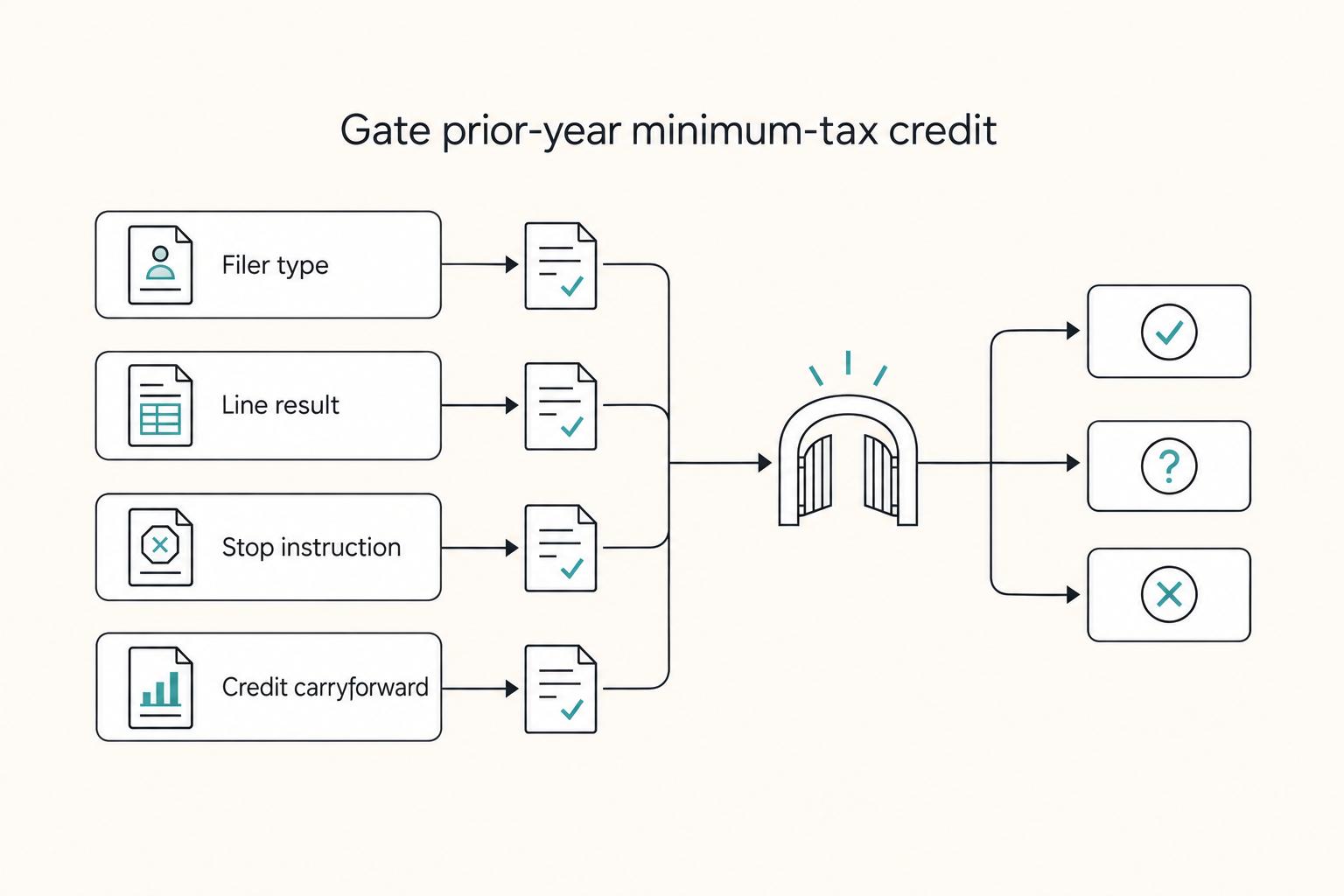
It is a tax credit that may let individuals, estates, and trusts use prior-year AMT against current-year regular tax when the prior AMT came from deferral items. You compute it on Form 8801, report any allowed amount on Schedule 3 (Form 1040) or Schedule G (Form 1041), and keep any unused amount as a carryforward for future years. If line 21 is zero or less, stop and follow the instructions.
Start here if Form 8801 feels confusing#
Start with one question: claim the credit now, carry it forward, or pause and escalate before you file. This article focuses on Form 8801 and the credit for prior year minimum tax. It is for individuals, estates, and trusts, and it covers the prior-year AMT credit plus any carryforward. The minimum tax credit is allowed only for AMT caused by deferral items.
Quick scope checks before you go deeper#
- If you are filing for a corporation, use Form 8827, not Form 8801.
- File Form 8801 only if line 21 is more than zero.
- If the form path tells you the amount is zero or less and to stop, stop and follow the instructions.
- If credit is allowed, it flows to Schedule 3 (Form 1040) or Schedule G (Form 1041), and any unused amount should be tracked for future years.
Use this guide as a decision tool, not a substitute for the IRS instructions when your facts are complicated. The rest of the article follows the order that usually works best: define the credit, confirm who files, decide whether to claim or carry forward, gather documents, complete the form cleanly, then check common failure points. If your situation expands into broader expat filing issues, handle that separately with Digital Nomad Taxes in 2026 With a Defensible Filing Plan.
Before you start, treat this form as a cross-year reconciliation exercise. Keep year-specific support for each amount, especially carryforward amounts you may use in future years. Confirm where each number belongs before you post it to your return, and the rest of the workflow gets easier.
For another step-by-step tax walkthrough, see Child Tax Credit for U.S. Expats: Eligibility, FEIE, and Filing Checks.
Define the credit before you touch any tax software#
Start with the right mental model: this is a credit calculation with carryforward tracking, not a refund request. That framing makes the form easier to follow and cuts down on bad guesses in tax software.
Start with the three terms that matter#
- Credit for prior year minimum tax: A special minimum tax credit against your regular tax when prior-year AMT may now be usable.
- Alternative Minimum Tax (AMT): The amount by which tentative minimum tax exceeds regular tax.
- AMT credit carryforward: Any unused minimum tax credit that Form 8801 tracks for future years.
A simple signal helps. If you are not liable for AMT this year but paid AMT in one or more prior years, you may be eligible to claim the credit by completing and attaching Form 8801.
That signal matters because it keeps you from asking the wrong question. The question is not just, "Did I ever pay AMT?" It is whether prior-year AMT now supports a current-year credit under the form's calculation path.
Use the right workflow, not software autopilot#
Form 8801 is for individuals, estates, and trusts to compute the current-year credit and any carryforward. If credit is allowed, it flows through your return path, for example Schedule 3 on Form 1040 or Schedule G on Form 1041. Any unused amount should be kept as a recorded carryforward for future years.
If Form 8801 tells you to review prior worksheets or instructions before you complete a later part, stop and verify first.
Treat software as a calculator after you identify the source documents and destination lines. Review imported prior-year data before you rely on it.
Use a simple routine: identify the source line on the prior-year form, identify the current-year source line, complete Form 8801 in order, and only then let the amount move to the return.
If you want a deeper dive, read The 'First Year Election' for US Tax Residency: A Deep Dive.
Know who files and where it lands on your return#
This is a path check, not a software guess. Before you work the numbers, make sure Form 8801 belongs on your return and that you can trace the credit to the correct destination line.
| Filer | Attach Form 8801 to | Report credit at |
|---|---|---|
| Individuals | Form 1040, Form 1040-SR, or Form 1040-NR | Schedule 3 (Form 1040), line 6b |
| Estates | Form 1041 | Form 1041, Schedule G, line 2c |
| Trusts | Form 1041 | Form 1041, Schedule G, line 2c |
Form 8801 applies to individuals, estates, and trusts. Attach it to Form 1040, Form 1040-SR, Form 1040-NR, or Form 1041, and report the computed credit on Schedule 3 (Form 1040), line 6b, or Form 1041, Schedule G, line 2c.
Eligibility is conditional, not automatic. IRS Topic 556 says you may be eligible if you are not liable for AMT this year but paid AMT in one or more prior years, and then you should complete and attach Form 8801. If your prior-year AMT or carryforward records are unclear, pause and confirm them before you continue. Also follow Form 8801's hard stop on line 21. If line 21 is zero or less, stop and see instructions. Keep line 26 as your carryforward record for future years.
A clean tracing habit helps here. Before you file, note three things on your working copy: the amount that feeds Form 8801, the final Form 8801 result line, and the exact line on the return where that result belongs. If any one of those three is missing, you are not ready to file. That sounds basic, but it catches mistakes before filing.
Decide quickly whether to claim now, carry forward, or escalate#
Make this decision from the form's line math, not from memory. Your goal is to sort the file into one of three outcomes early: claim now, carry forward, or pause for review.
Use this 4-step sequence#
- Confirm prior-year AMT inputs first.
Start with the required prior-year source: 2024 Form 6251, line 11, or 2024 Schedule I (Form 1041), line 54. If you cannot trace that amount to filed records, stop and verify before continuing.
- Run Form 8801 in order.
Complete the form from source documents so the minimum tax credit and any carryforward are calculated from the correct-year inputs.
- Apply the current-year limit.
Form 8801 also uses 2025 Form 6251, line 9, or 2025 Schedule I (Form 1041), line 52. The claim-now amount is capped by the smaller-of test: line 21 or line 24.
- Choose the outcome.
If the allowed amount is positive and traceable, report it on Schedule 3 (Form 1040), line 6b, or Form 1041, Schedule G, line 2c. If some credit is unused, keep the carryforward record for next year, including the carryforward to 2026 shown on the form. If the Form 6251 to Form 8801 path is unclear, escalate instead of guessing.
The value of this sequence is that it forces the decision late enough to be accurate, but early enough to avoid wasted work. You are not trying to solve every tax issue first. You are trying to determine whether the file supports a current-year claim, only a carryforward, or neither until someone reviews it.
Outcome table#
| Outcome | Trigger | Main risk if forced incorrectly |
|---|---|---|
| Claim now | Inputs reconcile, Form 8801 is complete, and allowed credit is the smaller of line 21 or line 24 with a positive result | Overclaiming by skipping the cap or using the wrong AMT input |
| Carry to next year | Form 8801 leaves unused credit after current-year limits | Losing support for a future claim if carryforward records are weak |
| Pause and get professional review | Form 6251/Form 8801 interaction is unclear, amounts do not reconcile, or Form 2555 instructions may apply | Filing with the wrong current-year credit or carryforward |
Escalate early when the path is not clean#
Some files are not worth forcing through on your own. If the Form 6251 interaction is unclear, treat that as a review case.
If cross-border items may change the computation, consider professional review. Form 8801 instructions explicitly flag Form 2555 dependencies for some entries. Also follow the form's hard stop. If the checkpoint amount is zero or less, stop and see instructions.
If you cannot clearly trace each number to a filed line, pause instead of guessing. Escalation is not giving up. It is how you avoid a wrong current-year credit and an even worse carryforward record for the next year.
Related: A Guide to the UK's 'Split Year Treatment' for Tax Residency.
Assemble the document pack before running Form 8801#
Gather the files before you calculate. A clean, tax-year-labeled folder makes the rest of the process faster and lowers the odds of mixing years, drafts, or support documents.
Pre-fill checklist to start with#
Nothing here spells out a mandatory starter packet for Form 8801, so treat this as a working checklist:
- Prior-year Form 8801 (if available)
- Current-year Form 6251 (if applicable)
- Current-year return documents, such as Form 1040 or Form 1041
Use consistent names, for example 2024 Form 8801 filed.pdf and 2025 Form 6251 draft.pdf, so you do not mix years or draft and final versions. If you work across a portal, local files, and tax software, pull one version of each document into a single working folder before you start.
The goal is not fancy organization. It is making sure you do not have to ask yourself midway through the calculation whether you are looking at the filed form, a draft, or an export with incomplete updates.
Add review-path documents when present#
- Schedule D (Form 1040)
- Schedule D (Form 1041)
- Qualified Dividends and Capital Gain Tax Worksheet
Keep these in the same folder if they are part of your return. It's not established that they automatically change the Form 8801 math, so do not assume that. Treat them as return context to review, not automatic triggers, and keep those supporting schedules nearby so you can check them quickly during Form 8801 prep.
Add cross-border support when relevant#
If your return includes Form 2555, keep the support behind it in the same pack. For physical presence, the IRS standard is 330 full days in a qualifying 12-month period, and those days do not have to be consecutive. For bona fide residence, the standard is an uninterrupted period that includes an entire tax year. Living abroad for one year alone does not automatically establish that status.
These FEIE-related thresholds do not, by themselves, establish Form 8801 eligibility or credit amount here.
If you are claiming a Foreign Tax Credit, include the full Form 1116 set and records. Form 1116 is prepared by income category, with one category box checked per form, and amounts are reported in U.S. dollars except where Part II allows otherwise. Keep Publication 514 with that file if you used it in preparation, but do not treat it by itself as a Form 8801 rule source.
The point of collecting these items is separation, not blending. You want all related records available, but you do not want one form's support to stand in for another form's rules. Keeping them together in one pack helps you review the whole return. Clear labels keep cross-border support from substituting for Form 8801 support.
Operator checkpoint#
Do not start the calculation until the forms you plan to rely on are in one folder with clear tax-year labels. If records are fragmented across tools, email, and old PDFs, pause and consolidate first.
A short cover note in that folder helps more than you might expect. Even a plain text note with lines like "prior-year source verified," "current-year source pending," and "supporting record found" can keep you from redoing work or skipping a missing item. You are building a small evidence chain, not just collecting attachments.
You might also find this useful: Can I Claim the Foreign Tax Credit for Taxes Paid to a 'Blacklisted' Country?.
Fill Form 8801 in a clean order and avoid line-jumping#
Form 8801 works best when you complete it in sequence. Resolve each conditional branch before moving on, and transfer results to your return only after line 25 is final.
Work top to bottom, then post#
Complete Form 8801 first, not the return schedule first. If the form directs you to Part III, Tax Computation Using Maximum Capital Gains Rates, complete Part III and carry line 55 to line 11. If that condition does not apply, do not force Part III into the process.
This ordering helps prevent path errors in software or manual prep. The safer order is always the same: finish the form, resolve the conditional path, confirm the final result line, then post it to the return.
Keep prior-year and current-year AMT inputs separate#
Mixing these can break carryforward logic, so label the source lines before you start entering data.
- Prior-year checkpoint: Form 8801 line 16 uses 2024 Form 6251 line 11, or 2024 Schedule I (Form 1041) line 54.
- Current-year checkpoint: Form 8801 line 23 uses 2025 Form 6251 line 9, or 2025 Schedule I (Form 1041) line 52.
If you are using software, do not assume the labels inside the program match the labels you need for verification. Write the form year and line number next to each source amount in your workpapers. That habit makes it much easier to catch common errors: pulling the wrong year and pulling a number from the wrong form line that happens to look similar.
Respect the stop condition and the credit gate#
Line 21 is a real stop, not a suggestion. If the amount is zero or less, do not continue as if a current-year credit is available. When you do reach the credit result, line 25 must be the smaller of line 21 or line 24.
Overclaims happen when expectations override the form flow. The form is the rule set. If it tells you to stop, stop. If it caps the credit, use the cap.
Line map for clean handoffs#
| Source | Destination | Verify before moving on |
|---|---|---|
| 2024 Form 6251 line 11, or 2024 Schedule I (Form 1041) line 54 | Form 8801 line 16 | Confirm this is the prior-year AMT source |
| Part III line 55 (if required) | Form 8801 line 11 | Use only when Form 8801 sends you to Part III |
| 2025 Form 6251 line 9, or 2025 Schedule I (Form 1041) line 52 | Form 8801 line 23 | Confirm this is the current-year AMT source |
| Form 8801 line 25 | 2025 Schedule 3 (Form 1040) line 6b, or Form 1041 Schedule G line 2c | Confirm line 25 is the smaller of line 21 or line 24 |
| Form 8801 line 26 | 2026 carryforward records | Keep a record for future-year use |
Clean finish check#
Do not leave the result only on Form 8801. Verify the posted amount on Schedule 3 (Form 1040) line 6b or Schedule G (Form 1041) line 2c, and retain line 26 as your carryforward record for the next year.
Before you mark the form done, compare the final amount posted on the return with Form 8801 line 25 one more time. Then save the carryforward note at the same time, not later. Waiting until next year to reconstruct line 26 makes the trail harder to verify.
Related: FEIE vs Foreign Tax Credit for High-Earning US Expats.
Handle cross-border cases without over-claiming#
When Form 8801 sits alongside cross-border filings, keep the rule sets separate and reconcile them deliberately before you file. The main risk is not that one form cancels another. It is that separate rules get blended, and the return ends up over-claimed by assumption.
Keep FEIE and foreign tax credit work in separate lanes#
FEIE and Foreign Tax Credit work may show up in the same year, but they are separate regimes. FEIE qualification tests are specific. The physical presence test is based on time in foreign country or countries, 330 full days during any 12-month period. The bona fide residence test is different and is not met automatically just because you lived abroad for one year.
If FTC is also in play, keep its mechanics separate. Form 1116 requires a separate form for each income category, and amounts are reported in U.S. dollars except where Part II says otherwise.
Use this quick check before filing:
- Confirm your FEIE qualification basis first.
- Confirm Form 1116 is separated by income category.
- Confirm FTC amounts are translated into U.S. dollars where required.
Also keep two points clear: excluded foreign earned income is still reported on your U.S. return. And for the physical presence test, missing the days still fails the test regardless of the reason.
A practical sequence helps in mixed-fact years. First confirm the cross-border forms on their own terms. Then verify Form 8801 through its own instructions. You do not want to bounce back and forth between regimes and let one unfinished calculation contaminate another.
Do not treat one cross-border checklist as proof that every checklist is complete#
Different filing tracks can apply in the same year. Completing one track does not automatically mean another track is complete.
A practical way to prevent overlap errors is to keep separate support folders:
- Form 8801 support: records used to prepare that form.
- FEIE/FTC support: records used to support FEIE qualification and Form 1116 preparation.
- Other cross-border support (if applicable): records used for those separate filing tracks.
That separation also makes review easier. If someone else checks your return, they should be able to open the Form 8801 folder and see only the items needed for that path, then open the FEIE/FTC folder for those obligations. Clean separation cuts down on missed issues and false assumptions.
Federal conclusions do not automatically answer every other filing layer#
If you also have separate filing questions, review that layer separately instead of assuming a federal conclusion carries over.
If multiple cross-border tracks intersect and your facts are unclear, a professional review can be a useful risk-control step before filing.
That kind of review is especially useful when your federal return is technically complete but the facts still feel messy. The goal is not to rebuild the whole return. It is to confirm that you have kept each regime in its own lane and that nothing in one file quietly changes how another file should be read.
Need the full breakdown? Read A Deep Dive into the Foreign Tax Credit (Form 1116).
Avoid the most expensive mistakes#
The expensive Form 8801 mistakes are usually process failures, not exotic tax theory. Focus on eligibility gates, dependency checks, and carryforward records.
Do not assume prior-year AMT means a current-year credit#
Prior-year AMT is a starting point, not proof that you can claim a credit this year. Form 8801 depends on specific source-line inputs, so bad line mapping can distort the result early.
Also treat line 21 as a hard gate. If the combined amount is zero or less, the form says to stop and see the instructions. Do not force an amount onto Schedule 3 (Form 1040) line 6b or Schedule G (Form 1041) line 2c just because you expected a credit.
A useful check here is expectation bias. If you go into the form trying to prove that a credit exists, stop signals and mismatches are easier to overlook. If you go into it trying to verify whether the form allows a credit, problems are easier to catch in time.
Capital gains and dividends can change the Form 8801 path#
This is a common place where an otherwise clean filing path turns messy. If the capital gain or dividend conditions apply, Form 8801 requires Part III before you enter line 11. The standard line 11 path is not always the right one.
For estates and trusts, this dependency is explicit in related filings. Schedule D (Form 1041) has prerequisites, and the IRS instructions require Form 8949 before Schedule D lines 1b, 2, 3, 8b, 9, or 10. Missing those steps can flow into a wrong Form 8801 result.
The practical lesson is to verify the upstream schedule before you trust the downstream credit. If a capital gain or dividend path applies, complete that path first, confirm the related schedule is supportable, and only then carry the result into Form 8801. Otherwise you may spend time reconciling a credit that was wrong from the start because the supporting computation was incomplete.
Protect carryforward records like a required filing input#
Carryforward tracking is not optional. The IRS directs you to keep a record of the carryforward amount for future years, and the current form labels line 26 as the credit carryforward to 2026.
Keep at least:
- The filed Form 8801
- The source Form 6251 or Schedule I (Form 1041)
- Any Schedule D or Form 8949 support used in the calculation path
- A short note with the carryforward amount and tax year target
Do not treat a blog summary or search snippet as complete eligibility guidance, especially when Section 53 details are not fully visible. Use summaries to decide whether to proceed or escalate, not to assume full eligibility.
Think of the carryforward file as part of next year's required input. If it is weak, next year's return starts weak. A missing carryforward record can force you to rebuild old work from incomplete files, which is when avoidable errors get baked into later returns.
This pairs well with our guide on A deep dive into the 'Additional Child Tax Credit' (Form 8812).
Run a pre-file and post-file verification checklist#
Use a two-step control. Reconcile key Form 8801 amounts to source lines before filing, then verify reporting and carryforward records after filing.
Pre-file reconciliation#
Before you trust the result, confirm the cross-year inputs are mapped correctly:
- Line 16 must trace to 2024 Form 6251 line 11, or 2024 Schedule I (Form 1041) line 54.
- Line 23 must trace to 2025 Form 6251 line 9, or 2025 Schedule I (Form 1041) line 52.
- Line 25 must be the smaller of line 21 or line 24.
- If line 21 is zero or less, stop and review the instructions.
- If a key value in your file cannot be traced to a specific form line, pause and resolve it before you submit.
This is an internal process control, not a slogan. It stops numbers that merely look right from getting filed without a clear source trail.
A simple way to run this check is to mark each line in your workpapers as source verified, destination verified, or needs review. If any key amount is still in the needs-review bucket, the file is not ready. That approach is boring, but boring is exactly what you want for carryforward work.
Check the reporting destination#
Once Form 8801 reconciles, verify that the credit posts to the correct return line:
- 2025 Schedule 3 (Form 1040) line 6b, or
- Form 1041 Schedule G line 2c.
Then confirm carryforward tracking. Line 26 is the credit carryforward to 2026, line 21 minus line 25, and Form 8801 tells you to keep a record because it may be used in future years.
Do not assume e-file output or a return summary page is enough proof. Open the actual return page and verify the amount where it belongs. Then make sure the carryforward note reflects the final filed number, not an earlier draft value.
Post-file retention#
Keep a clean filing package so next-year prep starts with verified inputs:
- Filed Form 8801
- Source Form 6251 or Schedule I (Form 1041)
- Filed Form 1040 or Form 1041 page showing the credit entry
- A one-line carryforward note with tax year, line 26 amount, and "carryforward to 2026"
- Any capital gain or dividend path support used in your calculation
The goal is to preserve the evidence chain now so you do not have to rebuild carryforward amounts from memory later. If you amend other parts of the return later, revisit this package as well. Even if the Form 8801 result does not change, you want the retained file to match the final filed story of the return rather than an earlier version you no longer rely on.
Related reading: How to Handle the 'Kiddie Tax' for Your Child's Investment Income.
Before you file, run your cross-border admin checks in one place with Gruv's tools hub.
Make your next move with confidence#
At this point, the decision should come from traceable form evidence: claim now, carry forward, or stop and escalate. If you cannot tie the number to prior-year AMT amounts, your current Form 8801, and the exact return line, you do not have a filing decision yet.
Use this close-out check before you file:
- Confirm the computed credit on
Form 8801. - For a 2025 filing path, map
Form 8801line 25 toSchedule 3 (Form 1040)line 6b orSchedule G (Form 1041)line 2c. - Record line 26 carryforward to 2026 and save it with a clear year label for next year.
Treat gaps as a hard stop, not a guess. If line 21 on Form 8801 is zero or less, stop and follow the instructions before you push anything to the return. The same caution applies in mixed-fact years. If Form 2555 is in play, Form 8801 directs you to the instructions for the amount to enter.
Keep the state layer separate from the federal credit mechanics. California residency is facts and circumstances, and the FTB does not issue written residency opinions for a specific period. So unresolved residency facts still warrant review even when your federal credit math is complete.
For broader planning context, use Gruv's state-tax residency guide for digital nomads and the digital nomad tax guide as companion reads. If AMT, cross-border filings, and residency facts are all in play, paying for one expert review before filing can be cleaner than repairing a weak paper trail later.
One last practical reminder: the real output here is not only the current-year credit amount. It is a complete filing trail that shows how you reached that amount and what, if anything, carries into the next year. If you finish with a posted credit, a saved carryforward record, and a file that another reviewer could follow without guessing, you have done the job correctly.
If your AMT, cross-border, and state facts intersect in the same tax year, request a scoped review via contact.
Frequently Asked Questions
What is the credit for prior year minimum tax in plain English?
It is a credit tied to AMT you paid in an earlier year. The question is whether that prior-year AMT can reduce tax in a year when you are not liable for AMT now. It is different from calculating this year's AMT.
Who should file `Form 8801` and who usually should not?
Form 8801 is for individuals, estates, and trusts. The article points to eligibility when you paid AMT in prior years and are not liable for AMT this year. Corporations use Form 8827 instead, and unclear edge cases should be reviewed before filing.
Can I claim this credit in a year when I still owe AMT?
Do not assume the credit applies the same way if you still owe AMT this year. The article frames eligibility around taxpayers who are not liable for AMT this year but paid AMT in prior years. If you still owe AMT, treat it as a careful review case instead of forcing an answer in software.
Where do I report the credit and the carryforward on my return?
After completing Form 8801, report the allowed credit on Schedule 3 (Form 1040) line 6b or Form 1041 Schedule G line 2c, depending on the return. Keep line 26 as your carryforward record for future-year use.
Is this treated like a refund, a credit, or both?
Treat it first as a credit tied to prior-year AMT. Form 8801 calculates the credit and any carryforward, not a standalone refund request. It can affect your overall tax result, but the form itself is a credit calculation.
What should I do if I cannot use the full credit this year?
Do not force the numbers. Retain Form 8801, the prior-year AMT support, and line 26 as your carryforward to 2026. If the path is unclear, stop, review the instructions, or escalate.
Do globally mobile freelancers need extra review when `Form 2555`, `Form 8938`, or `FBAR` are also in play?
Yes, especially if Form 2555 is involved. The article notes that FEIE tests are strict, including 330 full days in a 12-month period for the physical presence test and an uninterrupted period that includes an entire tax year for bona fide residence. It also says this does not provide Form 8938 or FBAR thresholds or specific interaction rules with Form 8801, so treat those as separate review items.
Researched and edited by the Gruv editorial team. Gruv builds cross-border billing, payouts, and finance-operations software for global businesses.
Sources
Educational content only. Not legal, tax, or financial advice.
Related Posts

Digital Nomad Taxes in 2026 With a Defensible Filing Plan
With digital nomad taxes, the first move is not optimization. It is figuring out where you may be taxable, where filings may be required, and what proof supports that position.

Do I Have to Pay State Taxes While Living Abroad as a Digital Nomad?
Living abroad does not end `state income tax` exposure by itself. The first decision is practical: choose a filing position your facts can support, then build records that support the same story all year.

The Freelance Payment Penalty: A Modeled Audit of Platform Fees, FX Spreads, and Payout Delays
The money rarely disappears through a single, easy-to-spot fee. The real loss is stacked. A marketplace takes its commission, a processor adds a charge for international cards, a bank or payment company converts the currency at a spread, a platform holds the funds before release, and a wire sheds a little to intermediaries on the way in. Each layer looks defensible on its own, but the worker feels the combined result as a smaller deposit and a later payday.