
Quick Answer
Yes. The berne convention international copyright framework gives original expression baseline protection across member states without mandatory filing, through national treatment and no-formalities rules. It does not provide one court, one remedy set, or automatic payment recovery, so you still need clear contracts, reliable creation records, and a jurisdiction-led enforcement plan. Check WIPO membership status first, then route complaints to the party that can actually disable access.
What Berne covers and where local law controls remedies#
If a cross-border client uses your work without paying, the first problem is not just nonpayment. It is legal mismatch: different countries, different procedures, and different remedies. The Berne Convention gives you baseline copyright recognition across member countries, but it does not create a single global enforcement system or recover payment for you.
In practice, Berne means your original work is protected without formalities like copyright registration, and other member countries must treat your work like they treat local authors' works. Protection in a member country is also independent of the protection status in your country of origin. WIPO administers the convention, and WIPO status listings (as of August 2025) show 182 members.
| What this section covers | What this section does not cover |
|---|---|
| Copyright protection for your expression in Berne member countries | Invoice collection or guaranteed payment recovery |
| Baseline cross-border recognition principles | Uniform global enforcement steps, damages, or deadlines |
| Why local law controls remedies where you bring the claim | Trademark, patent, tax, or worker-classification rules |
Use Berne alone when the issue is straightforward unauthorized use and you mainly need recognition that your work is protected in another member country. Add contract terms, evidence controls, and local counsel when the outcome turns on payment enforcement, IP transfer or license scope, or local filing and procedure rules. That matters because assignment and licensing terms often have country-specific formal requirements.
Before moving to the next section, confirm:
- your work is protectable expression, not just an idea, method, or procedure
- your use case is genuinely cross-border
- you understand that remedies are governed by the law of the country where protection is claimed
If you want a deeper dive, read A Guide to the 'Safe Creative' Registry for Copyright Protection.
What is the Berne Convention? Your Automatic Global IP Shield#
For cross-border client work, the practical value of Berne is simple: your original work can be recognized for copyright protection in other member countries without filing first in each one. That gives you a baseline legal footing, not a single global court, guaranteed payment, or one uniform enforcement process.
Berne covers works and authors' rights. In practice, that means protectable expression can qualify for protection, and some countries may require fixation in material form for certain works. Raw facts are not protected as such. Mere news of the day and miscellaneous facts are also outside Berne protection.
The three rules that matter in practice#
National treatment: If your work qualifies under Berne's connection rules, such as author nationality or first publication in a Contracting State, another member country must protect it. At minimum, it must treat it as it treats local authors' works.
Automatic protection: Copyright cannot be conditioned on formalities like filing or registration. Your rights can exist without those steps, even though some countries still run voluntary registration systems that may matter procedurally.
Independence of protection: Protection in one member country does not depend on whether protection exists in the work's country of origin. If you enforce abroad, the law of the country where protection is claimed controls outcomes there.
| Principle | What it gives you | What it does not give you |
|---|---|---|
| National treatment | Baseline treatment comparable to local authors if Berne connection rules are met | Identical remedies, deadlines, or court procedure across countries |
| Automatic protection | No filing or registration prerequisite for copyright to exist | Uniform evidence rules or enforcement timelines across countries |
| Independence of protection | A claim abroad is not automatically blocked by home-country protection status | An override of local law where you bring the claim |
What counts as enough protection#
Berne also sets minimum protection floors. A core example is the general minimum term of life of the author plus 50 years, with at least 25 years for certain photographic works and works of applied art. Those are baseline floors, not proof that all countries use the same term details or remedies.
| Example mentioned | Minimum floor | Article note |
|---|---|---|
| General minimum term | Life of the author plus 50 years | Baseline floor |
| Certain photographic works | At least 25 years | Baseline floor |
| Works of applied art | At least 25 years | Baseline floor |
Before you rely on Berne in a dispute, confirm that the countries involved are current Berne members on WIPO's status listings, and confirm whether local law requires fixation. Then keep a clean evidence trail for what you created and what rights were licensed or assigned in your contract.
When Berne is enough and when it is not#
Berne is often enough to answer the first question: "Can my original work be protected in the client's country at all?" It is usually not enough when the dispute turns on contract terms such as ownership transfer, license scope, or payment release, or on local enforcement mechanics.
| Situation | Article guidance | Details |
|---|---|---|
| Straightforward unauthorized use | Use Berne alone | Mainly need recognition that your work is protected in another member country |
| Need cross-border recognition | Berne's baseline protection may be enough to start | Question is whether your original work can be protected in the client's country at all |
| Dispute turns on ownership transfer, license scope, or payment release | Usually not enough | Pair Berne with tighter contract language, stronger evidence retention, and country-specific legal strategy |
| Outcome depends on payment enforcement, local filing, or procedure rules | Add contract terms, evidence controls, and local counsel | Assignment and licensing terms often have country-specific formal requirements |
Use this rule: if you mainly need cross-border recognition, Berne's baseline protection may be enough to start. If you may need fast proof, clear transfer records, or payment-linked IP control, pair Berne with tighter contract language, stronger evidence retention, and country-specific legal strategy.
If assignment timing is unclear in your client terms, review Work for Hire vs. Assignment of Rights: A Freelancer's Guide to Owning Your IP before any dispute starts. You might also find this useful: A deep dive into the 'choice of law' and 'jurisdiction' clauses for international freelance contracts.
Are Your Digital Assets Really Covered? A Modern Professional's Checklist#
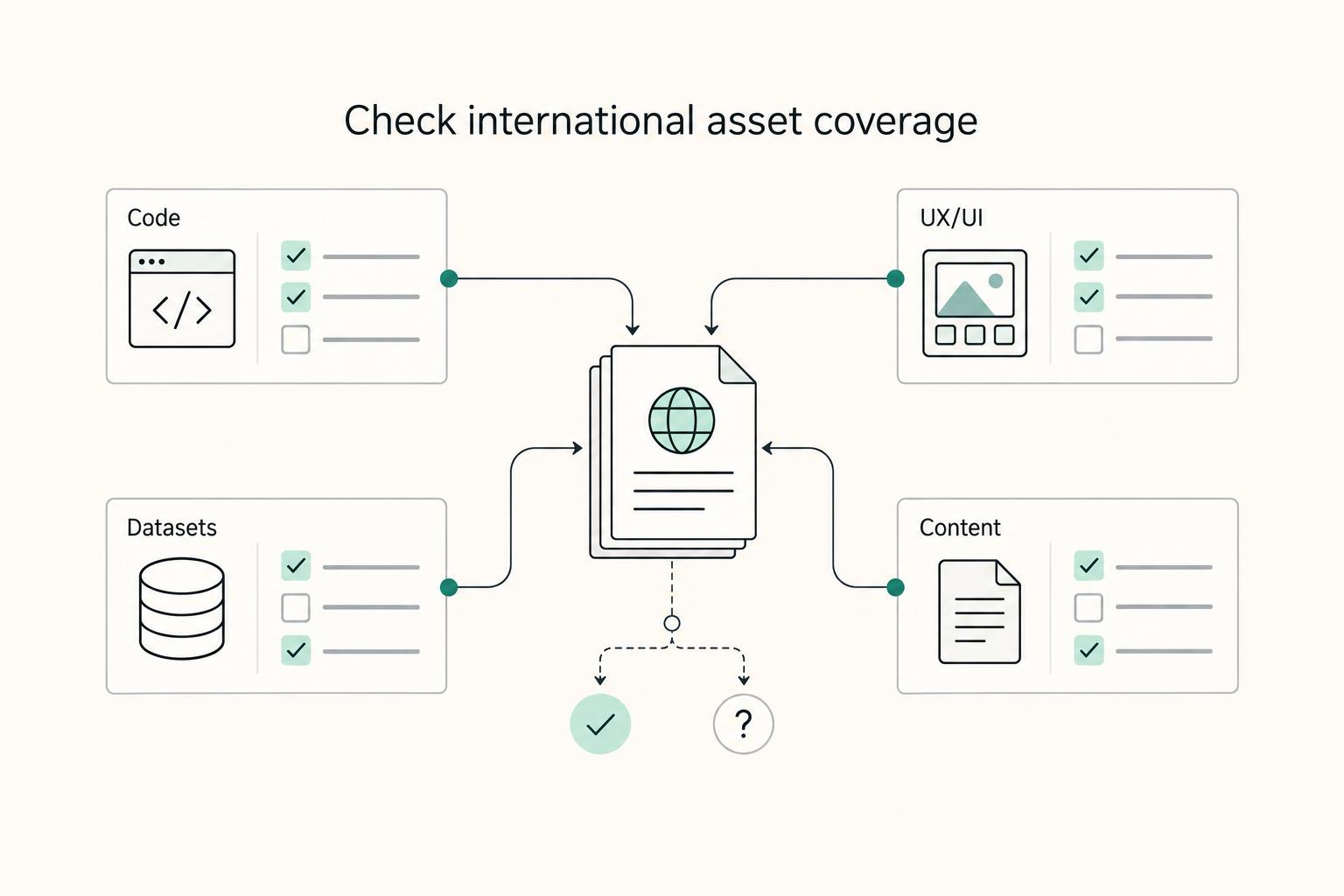
Most digital assets are covered only to the extent of your original expression. Your original code, written content, and creative selection or arrangement of data can be protected. Original screen designs may also be protected, but UI/design treatment can depend on local law. The underlying idea, method, function, or raw facts usually are not.
For mixed deliverables like a SaaS product, assess coverage asset by asset. Separate code, interface screens, datasets, and content instead of treating the whole project as a single asset. That gives you a cleaner line between what Berne can support and what you need to control through contract terms.
| Asset | Protected expression | Common non-protected element | What evidence to retain |
|---|---|---|---|
| Code and software | Your specific source/object code and original written implementation (computer programs are commonly protected works). | The feature idea, high-level logic, method of operation, or mathematical concept as such. | Git history, dated commits/tags, build/release records, and a list of pre-existing code, libraries, or client-provided materials. |
| UX/UI and visual design | Original visual expression in layouts, icons, illustrations, wireframes, screen compositions, and styling choices (with scope depending on national rules for applied art/design). | Generic patterns, purely functional placement, standard controls, or choices dictated only by technical constraints. | Design-file version history, exported screens/artboards, style guides, dated mockups, and iteration notes. |
| Datasets and databases | Creative selection or arrangement of contents, labels, taxonomy, or structure when those choices are intellectual creations. | Raw data, underlying facts, news-style factual items, or the material itself. | Dataset snapshots, schema versions, data dictionaries, inclusion/labeling rules, cleaning notes, and source records. |
| Content assets | Articles, scripts, ad copy, ebooks, course materials, illustrations, technical drawings, and other written/visual expression. | Topics, facts, procedures, methods, or a bare idea. | Dated drafts/finals, editorial history, publication/delivery records, and acceptance trail. |
Berne's coverage of literary and artistic works is broad, but the idea-expression boundary still controls. Copying your files, compositions, or text can raise a copyright issue. Building a similar function with different expression may be a harder claim.
Datasets are a common edge case. A compilation may be protected for its selection or arrangement, but that does not automatically protect the underlying data. If your value is mostly in access to facts or records, contract scope, access controls, and confidentiality terms may matter more than copyright alone.
UI-heavy disputes need an early local-law check. The extent of protection for applied art and industrial designs is left to national legislation, and remedies are governed by the country where protection is claimed.
Before delivery#
- Code: Save a dated repo snapshot, identify third-party or pre-existing components, and state transfer timing clearly in the contract.
- UI: Export final screens plus working-file history, and separate creative choices from purely functional requirements.
- Datasets: Freeze the delivered version, document selection or arrangement choices, and retain source-material records.
- Content: Keep dated drafts and finals, plus the delivery and acceptance trail.
- Escalate early: Tighten your contract language and involve local counsel when rights depend on assignment timing, mixed IP categories, open-source obligations, confidential data, or country-specific UI/design treatment.
We covered this in detail in The 'Friday the 13th' Lawsuit: A Copyright Lesson for Every Freelancer.
How to Transform "Automatic Protection" into an Ironclad Defense#
Automatic rights are most useful when you can prove ownership, timeline, and scope quickly. Build each project around four controls: Evidence, Notice, Contract, and Delivery.
| Action | Why it matters | Common failure to avoid |
|---|---|---|
| Evidence: keep dated creation records, version history, and delivery records for each asset | Shows when the work was fixed, what you created, and what existed before client access | Relying on one platform log, losing access to a shared workspace, or mixing your work with third-party or client materials |
| Notice: add a consistent ownership notice in files, headers, metadata, or comments where practical | Protection is automatic, but clear notice can reduce avoidable ownership disputes | Treating notice as legally required everywhere, or using inconsistent owner names across files and invoices |
| Contract: define ownership, any pre-payment license, and the exact transfer trigger | Helps prevent "we thought we already owned it" disputes | Vague "full rights included" language or unstated assignment timing |
| Delivery: control what ships, when it ships, and what unlocks final release | Keeps acceptance, payment, and asset transfer aligned | Sending editable source files, high-res finals, or broad repo access before payment clears |
Evidence first#
Start at fixation. In practice, your earliest saved file, recorded draft, or line of code can be the cleanest checkpoint for your timeline. Preserve that checkpoint so your timeline is clear.
For code, keep dated commits and tags, build or release records, and a list of pre-existing libraries or client-provided materials as part of the broader record set. For design, keep version history, exported artboards or screens, dated mockups, and iteration notes. For written content, keep drafts, finals, and document metadata. Then pair your creation records with delivery records: what was sent, when, and under what payment status.
Do not assume raw history alone will carry a dispute. Your file set should answer three questions fast: what you created, when you created it, and what the client received.
Notice reduces avoidable arguments#
Copyright protection does not depend on filing paperwork or using a © symbol. Notice still helps because it can make ownership harder to blur later.
Use one internal notice standard across deliverables, and keep the owner name aligned with your contract and invoices. If you need public-facing notice wording, leave that wording as a checklist item until it has been checked against the relevant platform, client policy, or local counsel advice.
Contract language decides the hard moments#
Cross-border conflicts often involve payment, reuse, and scope disputes. State ownership clearly, define whether there is any license before full payment, and tie assignment or transfer to a specific trigger.
Use ownership-retention language when nonpayment risk is real or deliverables are high value. Use license-until-paid language when a client needs limited use before final payment. Be explicit about scope, especially where use could involve reproduction, adaptation, or public display.
For source-heavy projects, add acceptance and payment gates before final transfer. If source files or production assets can be exploited immediately, do not release them before acceptance and cleared payment. If your deal depends on assignment versus work-for-hire structure, resolve that at kickoff and align the terms with your IP framework, including Work for Hire vs. Assignment of Rights: A Freelancer's Guide to Owning Your IP.
Delivery is where good terms often break#
Strong terms often fail at delivery. Send review copies, staged exports, or limited-access versions first, and hold final source or production assets until the contract trigger is met.
Keep a simple release log per milestone: asset, date, format, purpose, and payment status. That helps turn automatic protection into a dispute-ready record if ownership, timeline, or scope is challenged later.
For a step-by-step walkthrough, see Copyright Considerations for Freelance Photographers in the Age of AI. Before you send your next client agreement, draft a rights-first clause set with the Freelance Contract Generator.
What to do when your work is copied abroad#
When your work is copied abroad, a practical first move is to preserve evidence, then send the complaint to the party that can actually disable access. Berne gives you automatic protection and baseline treatment across member countries, but enforcement still follows the law of the country where you seek protection. It does not create one global court or one automatic global takedown system.
Use these quick definitions before you start:
- Infringement claim: you allege someone used a copyright owner's exclusive rights without authorization.
- Evidence preservation: you keep digital proof in a form that stays usable and credible.
- Takedown request: a notice of claimed infringement sent to a service provider.
- Jurisdiction: the court's legal authority over the parties and dispute.
- Chain of custody: your record of who handled evidence, when, and why.
Step 1. Secure the record before you make noise#
As a practical sequence, preserve evidence before outreach because online content can change quickly. Build your evidence pack early:
| Evidence item | What to capture |
|---|---|
| Infringing pages or listings | Full screenshots of each infringing page, listing, post, or repository view, with URL and date visible where possible |
| Identifiers | Exact URLs, account names, product IDs, and visible seller or operator details |
| Your source materials | Source files, drafts, version history, commit logs, release records, and dated finals that show creation and scope |
| Publication trail | When you first published, delivered, invoiced, or licensed the work |
| Rights documents | The contract, statement of work, license terms, and any clause tying transfer or use rights to payment or acceptance |
| Chain of custody | What you collected, file names, timestamps, storage location, and who accessed the folder |
Capture each item in a way that keeps the record usable later. Use this checkpoint before you send anything: can an outsider verify what was copied, what you owned, and when each event happened? If not, fix that first.
Step 2. Notify the right actor first#
Do not default to contacting the infringer first. If the content is on a platform or marketplace with a copyright process, that can be a direct route because the platform can disable access. If an intermediary says it does not host the content, route the complaint to the actual host or site operator.
Before filing, check whether an exception could apply, especially where the platform asks you to consider fair use, public domain, or similar exceptions. Use this notice outline and include only what you can verify:
- The exact infringing material and where it appears
- A good-faith statement that the use is not authorized
- An accuracy or authority statement under penalty of perjury, where required by that lane
- For a DMCA-style notice, written delivery to the provider's designated agent
Step 3. Pick the enforcement lane that matches the target#
| Lane | Best fit when | Proof typically needed | Likely outcome |
|---|---|---|---|
| Platform policy notice | Content is on a marketplace, social platform, or service with a built-in copyright process | Exact URLs/listing IDs, clear identification of allegedly infringing material, required statements | Removal or disabled access, or routing for platform review |
| Host abuse report | Site is independent and the platform cannot remove content because it does not host it | Evidence pack, infringing URLs, explanation of what the host can disable | Forwarding to operator, host review, or disablement if host controls content |
| Formal legal demand | Case is repeated, off-platform, or high-impact | Full evidence pack, ownership or license documents, timeline, requested remedy, jurisdiction analysis | Negotiation, evidence-preservation measures, local counsel action, or court-driven next steps |
Step 4. Know when self-help ends#
Consider escalating to cross-border IP counsel when one or more triggers appear. These include an anonymous operator, copying across multiple countries, failed self-help notices, material business harm, or the need for formal evidence-preservation measures. If you are considering a U.S. civil infringement action for a U.S. work, registration or preregistration is generally required before suit.
Your handoff packet should include the evidence folder, chain-of-custody notes, source and publication trail, the governing contract or license, every notice sent and response received, and a short chronology of countries, platforms, hosts, and business impact. That packet is what turns automatic protection into an enforceable case. Related: How to claim 'copyright' for your self-published book.
Conclusion: From Treaty to Strategy#
Treat Berne as your baseline, not your full playbook. It sets an international floor (including national treatment and a no-formalities rule), but your practical leverage comes from three things: ownership evidence, written rights allocation, and a country-specific escalation path.
Keep copyright and trademark in separate lanes. Use copyright for copied expressive work. Use trademark for names, logos, and other source identifiers.
On prevention, build your proof set now. Keep version history, dated exports, publication records, invoices, and the contract that states who owns what. Your record should let a third party confirm who created the work, when it existed, who held rights, and what was copied.
On contracts, make rights allocation explicit and signed. For U.S. ownership transfers, unsigned or informal language is a risk point, so do not rely on verbal terms. For execution help, use Work for Hire vs. Assignment of Rights: A Freelancer's Guide to Owning Your IP and How to Copyright Your Creative Work as a Freelancer.
On enforcement, choose your path based on where you are claiming protection, then follow that jurisdiction's rules and forum options. For U.S. works, civil infringement suits generally require preregistration or registration before filing. Hand off to qualified IP counsel early when ownership is disputed, contracts are unclear, multiple countries are involved, or copyright and trademark issues are mixed.
| Focus | What you do next |
|---|---|
| Prevent | Maintain a consistent ownership evidence trail across draft, publication, and contract records. |
| Detect | Track copied use, attribution changes, and brand-identifier misuse as separate issue types. |
| Enforce | Escalate by country, claim type, and forum, using the evidence package you already prepared. |
This pairs well with our guide on A guide to the 'Common Law' vs. 'Civil Law' systems for international contracts.
When you are ready to pair IP-safe contracts with cross-border invoicing and payout workflows, explore Gruv for Freelancers.
Frequently Asked Questions
How do you prove your copyright in another country?
Organize proof that shows what was created, when it existed, who owned rights under written terms, and what was allegedly copied. A concrete marker from the source is a copyright notice (©) with the author name and publication year. If a work was not written down, recorded, or otherwise fixed in material form, that can block copyright for certain works.
Does copyright protect your software code internationally?
Computer programs are listed as works protected by copyright. Ownership can still depend on employment status and written agreements, including commissioned-work terms, so confirm ownership terms before escalating a dispute.
Do you still need registration if your work is already protected?
It depends on jurisdiction. For U.S. issues, Title 17 separates notice, deposit, and registration (401) from ownership and transfer (201). Verify jurisdiction-specific filing requirements and legal effects before you act.
What are moral rights, and when should you raise them?
Moral rights protect your personal link to the work, including attribution and integrity. Raise them when your authorship is denied or your work is changed in a way that harms your reputation. Keep records of the original and altered versions so you can show what changed.
Does copyright cover your brand name or logo?
If brand names or logos are involved, treat claim classification and enforcement strategy as jurisdiction-specific and confirm with counsel.
Try a related tool
Researched and edited by the Gruv editorial team. Gruv builds cross-border billing, payouts, and finance-operations software for global businesses.
Sources
- ccb.gov/pro-bono-assistancetrusted
- copyright.gov/dmca-directorytrusted
- copyright.gov/international-issuestrusted
- csrc.nist.gov/glossary/term/chain_of_custodytrusted
- europa.eu/youreurope/business/running-business/intelle...trusted
- law.columbia.edu/sites/default/files/2021-07/09-international...trusted
- law.cornell.edu/treaties/berne/5.htmltrusted
- law.cornell.edu/treaties/berne/2.htmltrusted
Educational content only. Not legal, tax, or financial advice.
Related Posts

Work for Hire vs Assignment of Rights for Freelancers
A freelance agreement is not just about price and scope. It decides who controls the rights in the work. If the ownership language is loose, rights can move earlier than you expect, cutting down your control once the work is delivered or used.

How to Copyright Your Creative Work as a Freelancer
Move faster by settling who owns what before signing and keeping the contract, deliverables, and project record aligned from kickoff through filing. Deals usually slow down when those pieces drift apart, not because the legal question is unusually hard.
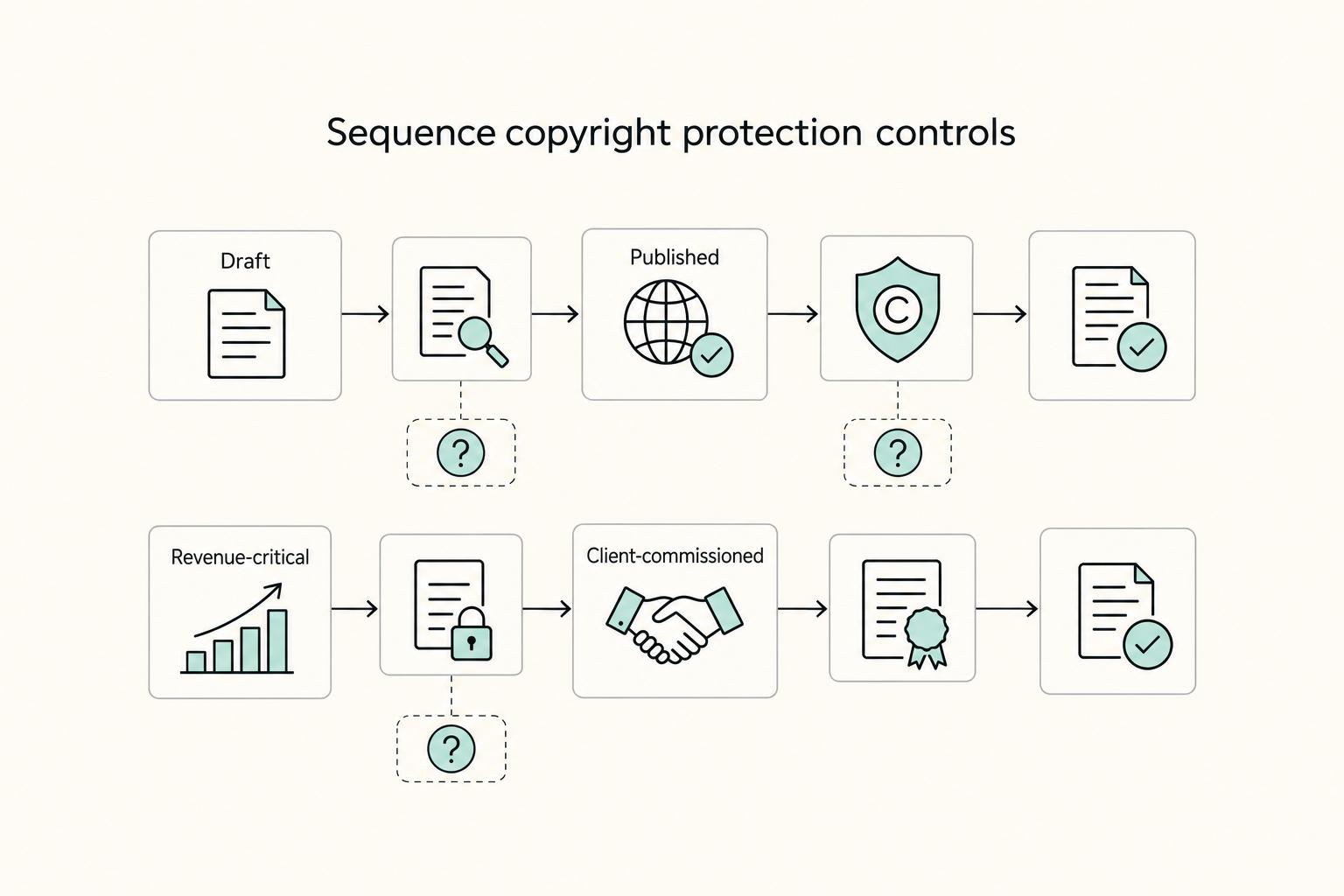
Safe Creative vs. U.S. Copyright Registration: How to Build Proof and Preserve Enforcement Rights
Treat IP as two separate jobs in your workflow: document proof early, then secure enforcement rights when a work becomes commercially important.