
Quick Answer
Yes, but only in limited circumstances under the Foreign Sovereign Immunities Act. If your client qualifies as a foreign state, immunity is the default, so you need a specific FSIA exception, proper service, and a realistic collection path before counting on a U.S. case. For freelancers and consultants, the safer move is usually tighter payment terms, more money up front, or a no-go.
Before you sign a foreign government client#
Use a go or no-go screen before work starts. In a foreign-sovereign deal, you should not count on a later lawsuit to fix payment risk.
This guide is for freelancers and consultants making contract and payment-risk decisions. It is not personal legal advice, and case-specific FSIA strategy should go to licensed counsel. The practical goal is simple: decide whether to proceed, tighten terms, ask for more up front, or walk away.
Contract language helps, but it does not override the statute. FSIA starts from immunity, then opens specific statutory gates, including jurisdiction under 28 U.S.C. § 1330 and service under § 1608; execution limits on foreign-state property under § 1609 are a separate constraint.
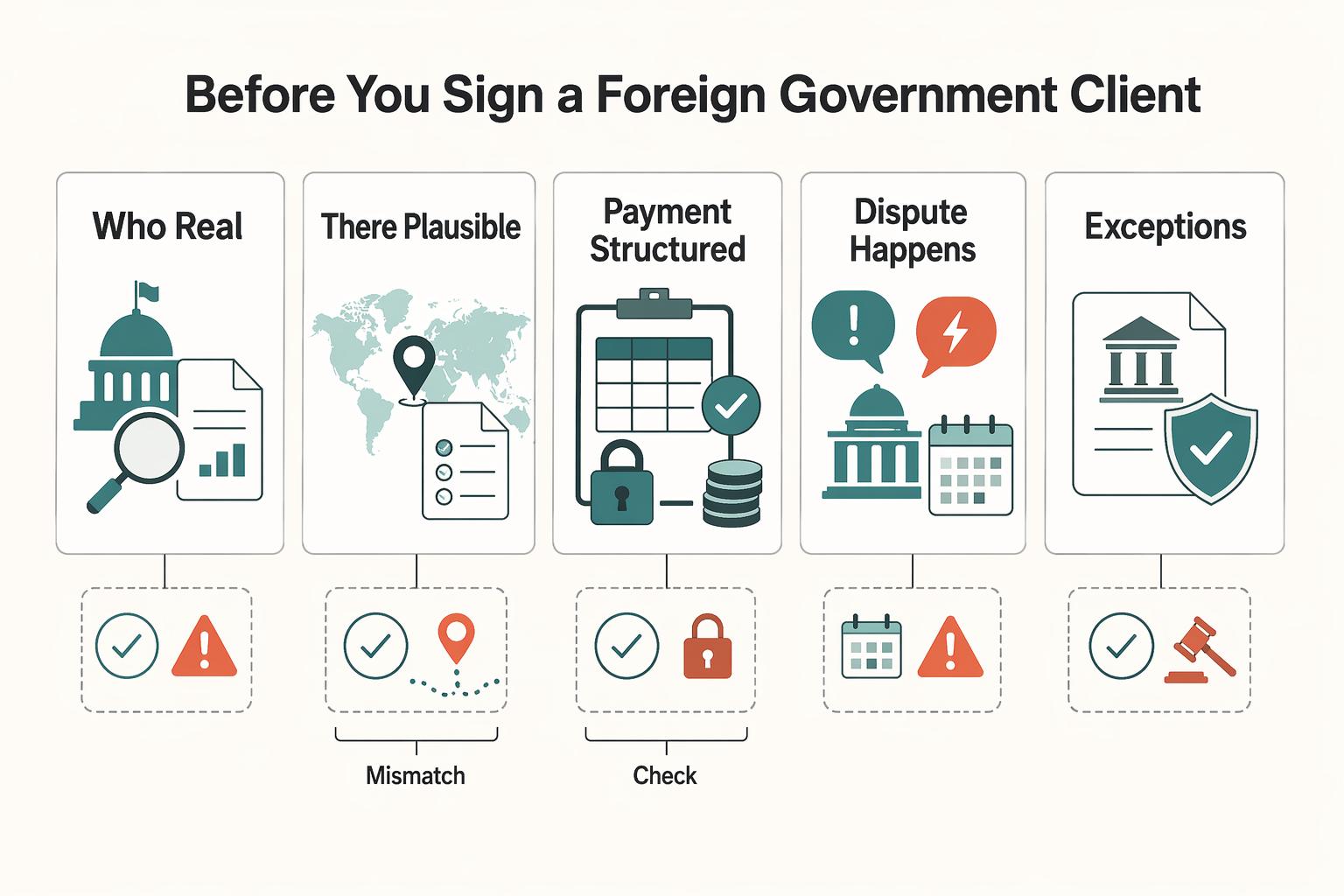
Treat this as a pre-sign decision, not just a litigation decision. A strong statement of work and signed PDF are not enough if you have not confirmed whether the counterparty is a "foreign state" for FSIA purposes, including political subdivisions and agencies or instrumentalities. One common failure mode is treating a government-linked entity like a normal company, then learning your familiar court clause does not do what you expected. Before you start, get clear answers to these checkpoints:
- Who is the real counterparty: ministry, embassy, state-linked instrumentality, or private contractor?
- Is there a plausible FSIA path if the deal breaks down, or are you relying on contract wording alone?
- Is payment structured to cap your exposure before major delivery?
- If a dispute happens, is there a realistic service path and venue, not just a familiar clause?
- If you win, is there a realistic collection path, given foreign-state property in the U.S. is generally immune from attachment and execution unless an exception applies?
Do one verification step early: confirm the legal identity and map it to the FSIA definition before you finalize price and scope. Then pressure-test a procedural gate that is easy to overlook. Under § 1330, personal jurisdiction depends on service under § 1608. If diplomatic-channel service is ever needed, that process follows statutory steps and waiting periods. You do not want to discover that after invoices are overdue.
This guide follows the order that matters in practice: immunity basics, FSIA gates, clause stack, payment structure, dispute path, and collection reality. If you cannot see a credible path across all six, the safer answer is usually to narrow scope, get paid earlier, or decline. Related: A Guide to Small Business Litigation: What to Expect.
Sovereign immunity in plain English#
Start here: if your counterparty is a "foreign state" under FSIA, immunity is the default. Under 28 U.S.C. § 1604, U.S. courts begin from immunity, with exceptions in §§ 1605-1607, so the first question is not "we have a contract, can we sue?" but "does the statute allow this case at all?"
FSIA is the core framework for these cases (28 U.S.C. § 1330 and §§ 1602-1611). Federal district courts can hear a nonjury civil action against a foreign state under § 1330 only when immunity does not apply, and personal jurisdiction depends on both an immunity exception and proper service. Contract terms may still matter, but they do not replace FSIA's statutory gates.
Party type is an early risk check, not a paperwork detail. Under 28 U.S.C. § 1603, "foreign state" includes political subdivisions and agencies or instrumentalities, and agencies or instrumentalities are separate legal entities. Confirm the exact contracting entity before pricing and scope so you know which FSIA path you are actually in.
That classification changes service procedure immediately. Service on a foreign state or political subdivision follows § 1608(a), while service on an agency or instrumentality follows § 1608(b). If the client is state-linked, treat enforceability as a deal-design issue from the start: tighten scope, get more paid earlier, and avoid pricing assumptions that rely on ordinary commercial collection paths.
Where FSIA lets a case proceed and where it stops#
A U.S. FSIA case generally proceeds only if you clear three gates in order: default immunity, exception, then procedure. Start with default immunity under 28 U.S.C. § 1604, test whether an exception in §§ 1605-1607 applies, then confirm the court can proceed under 28 U.S.C. § 1330 with service under § 1608. If you skip that sequence, even a strong contract claim can fail in federal court.
The three gates that matter#
| Step | Gate | Key point | Source |
|---|---|---|---|
| 1 | Immunity exception | District courts have jurisdiction over a nonjury civil action against a foreign state only when immunity does not apply. | 28 U.S.C. § 1330(a); §§ 1605-1607 |
| 2 | Service and personal jurisdiction | Personal jurisdiction depends on service under § 1608, and service errors can stop the case. | § 1330(b); § 1608 |
| 3 | Court handling | § 1330(a) sets the lane as a nonjury civil action, so FSIA's statutory structure controls access to federal court. | § 1330(a) |
- Immunity-exception gate first. Under
28 U.S.C. § 1330(a), district courts have jurisdiction over a nonjury civil action against a foreign state only when immunity does not apply under§§ 1605-1607. - Service and personal jurisdiction second. Under
§ 1330(b), personal jurisdiction depends on service made under§ 1608. Even with an arguable exception, service errors can stop the case. - Court handling third.
§ 1330(a)sets the lane as a nonjury civil action, so FSIA's statutory structure controls access to federal court.
The clearest path in the research so far#
The clearest concrete path is the arbitration exception in 28 U.S.C. § 1605(a)(6), which expressly covers actions "to confirm an award made pursuant to such an agreement to arbitrate." If you have a valid arbitration agreement and later obtain an award, that can support a U.S. court action tied to that award. Keep the limit in view: this is not a blanket waiver, and satisfying § 1605(a)(6) does not by itself guarantee enforcement or collection.
Where service becomes a real risk#
Service is a core FSIA gate, not a formality. The excerpted § 1608(a) text shows an ordered hierarchy for serving a foreign state, with later steps used only if earlier ones fail. One explicit timing marker is 30 days. § 1608(a)(4) is triggered if service cannot be made within 30 days under § 1608(a)(3).
Also, § 1330 states that an appearance by a foreign state does not automatically confer personal jurisdiction for claims outside the §§ 1605-1607 structure.
What to verify before you count on a U.S. case#
Before you treat U.S. litigation as your backstop, have counsel confirm in writing:
- The exact defendant classification under FSIA, including whether it is treated as a foreign state or an agency or instrumentality.
- The specific FSIA exception you plan to invoke, such as
§ 1605(a)(6)for award confirmation. - The service path under
§ 1608, including sequence and required documents.
Do not assume you have a complete exception map or a practice-ready service roadmap for every defendant type. If you cannot map both a plausible exception and a valid service path, treat the litigation route as uncertain and protect yourself through payment terms and deal structure. You might also find this useful: How to Handle Realized and Unrealized Gains/Losses on Foreign Currency.
What the 2025 Supreme Court ruling changed in practice#
The change is narrow but useful. Once an FSIA exception applies and service is proper, courts do not add a separate minimum-contacts test. In CC/Devas (Mauritius) Ltd. v. Antrix Corp. (decided June 5, 2025), the Supreme Court held that FSIA's own framework controls personal jurisdiction under 28 U.S.C. § 1330(b).
That reversed the prior Ninth Circuit approach, where plaintiffs could satisfy an FSIA exception but still lose for not proving traditional minimum contacts. The Supreme Court rejected that extra step and held that FSIA does not require separate proof of minimum contacts once the statute's requirements are met.
For you, this improves predictability on one jurisdiction issue. It does not create a broader right to sue. If your path depends on the arbitration exception in 28 U.S.C. § 1605(a)(6), keep your file focused on FSIA's core gates:
- identify the exact exception you are invoking
- confirm FSIA applies to the defendant
- prove service under FSIA's specialized service rules
The overall risk is still real. Cases can still fail if the asserted exception does not apply or service is defective. This ruling also does not guarantee enforcement or collection after judgment. The practical update is simple: one jurisdictional fight got clearer, but immunity limits and collection risk remain. For related reading, see Form 3520 Playbook: A 3-Step Framework for Foreign Trust Transactions and Foreign Gift Reporting.
Go or no-go checks before you accept the contract#
Use this as a pre-sign screen: if you cannot classify the counterparty, map a plausible FSIA exception plus service path, and set workable payment protection, the practical answer is no-go or paid discovery only. Ask one question early: if payment stops, do you have both a credible legal path and a credible money path?
The four checks that can decide the deal#
| Check | Risk signal | Evidence required | Action |
|---|---|---|---|
| Counterparty type | Government branding is clear, but the named contracting entity is unclear or inconsistent | Exact legal name, entity documents, registered address, and records showing whether it is a separate legal person | Classify under 28 U.S.C. § 1603 before signing. If you cannot tell whether this is a foreign state or political subdivision, or an agency or instrumentality, pause |
| FSIA pathway | Team relies on a U.S. law clause or arbitration without mapping immunity and service | Draft dispute clause, proposed forum, waiver language if any, and counsel memo on a plausible FSIA exception plus service route | Do not rely on clause text alone. If you cannot map a plausible exception plus service route, treat the deal as legally weak |
| Payment security | Back-loaded payments, vague acceptance, or unclear invoice approval or release path | Payment schedule, acceptance triggers, approver chain, procurement path, and written confirmation the structure is payable | Tighten terms before work starts. If a workable structure is not possible, reduce scope or decline |
| Enforcement feasibility | Team assumes judgment equals recovery, but no one can explain the collection path | Written note on likely collection points, including whether relevant U.S. property used for commercial activity may exist, and who assessed it | Price as unsecured risk or walk. 28 U.S.C. § 1609 makes foreign-state property generally execution-immune unless an exception applies |
Ask for a proof pack before signature#
FSIA does not give you a universal pre-sign document checklist. A proof pack can still reduce avoidable authority and contracting failures. At minimum, request:
- Legal entity documents matching the exact contracting name
- Signer authority proof for the person binding that entity
- Procurement-path confirmation showing how the purchase is approved and paid
- A dispute-clause draft aligned to the actual deal structure and government-contract realities
If that pack is incomplete, a limited paid discovery phase for diligence and contract setup is usually safer than full performance.
Verify the service route now#
Do not leave service assumptions for later. Under 28 U.S.C. § 1330, personal jurisdiction depends on an applicable FSIA immunity exception and compliant service, and the service route depends on counterparty type.
Add a checkpoint before signature: have counsel confirm classification, then validate service assumptions against current U.S. Department of State FSIA guidance. Service on a foreign state or political subdivision proceeds under 28 U.S.C. § 1608(a), while agencies and instrumentalities follow a different subsection.
Treat diplomatic-channel service as a later step, not a first move. Under State guidance, 1608(a)(4) follows attempts under 1608(a)(1)-(3), and only after 30 days have passed since attempted service under 1608(a)(3).
Document country and program assumptions#
Do not generalize sovereign-treatment or enforcement assumptions across countries or programs. Write down the assumptions behind your yes, and record who validated each one: U.S. counsel, foreign counsel, procurement, or documents.
If no one can validate a plausible FSIA path and workable payment protection, decline the engagement or keep it to paid diligence only.
For a step-by-step walkthrough, see Brazil's CNPJ for Foreign-Owned Businesses: When It Is Needed and What It Does.
If your checklist says "proceed," turn your negotiated terms into a cleaner first draft before legal review with the freelance contract generator.
Contract terms that protect you when legal recourse is limited#
When your legal recourse may be limited, your contract should do one job well: reduce ambiguity, lock in payment mechanics early, and cap one-sided risk. It cannot automatically override immunity, so draft for practical protection, not assumptions.
Because immunity is the default under 28 U.S.C. § 1604, your terms should assume enforcement may be narrower or slower than in a private-company deal. Then reduce that risk clause by clause.
Draft in the order that actually changes outcomes#
Start with dispute forum and jurisdiction terms early. As one international contracts lawyer put it: "For international contracts, I head straight to the dispute resolution provision." Keep that priority, but do not treat dispute language as a substitute for clear payment terms.
In the same drafting pass, make acceptance criteria, approver roles, invoice-payable events, due dates, currency, and procurement prerequisites explicit in the signed set. If those events are fuzzy, you can deliver the work and still miss a clean payment trigger.
If you use arbitration, draft it with precision. ICC warns that unclear dispute wording creates delay and can compromise the process. State the rules or institution, seat, language, dispute scope, and governing law clearly. LCIA-style scope language that covers "existence, validity or termination" can help avoid threshold fights.
Arbitration can still be useful under FSIA because 28 U.S.C. § 1605 includes an arbitration path, including actions to confirm awards. But it is not a payment guarantee. If the dispute reaches U.S. federal court, 28 U.S.C. § 1330 ties personal jurisdiction to an FSIA exception plus proper § 1608 service. The Supreme Court confirmed in 2025 that FSIA does not add a separate minimum-contacts layer once those requirements are met.
The clause stack to tighten first#
| Clause | Why it matters | Fallback ask |
|---|---|---|
| Dispute Resolution | This clause often drives cost, delay, and process viability. Ambiguity can stall the case before the merits. | Use a recognized institutional baseline and define scope, seat, language, and rules with no internal conflicts. |
| Jurisdiction | Forum choices affect where support, challenge, or enforcement steps occur. Naming a forum alone does not solve FSIA constraints. | Align court-support language with the arbitral seat, or if litigating, name the exact forum and test it against waiver and service realities. |
| Governing Law | It sets the substantive law for contract interpretation and remedies. Misalignment with dispute terms creates avoidable fights. | Use clear law-selection wording and keep it consistent across all contract documents. |
| Termination | It controls whether the client can stop work while leaving completed or in-flight work unpaid. | Preserve payment for completed work, approved costs, and required transition deliverables. |
| Limitation of Liability | One-way caps or uncapped exposure can make the engagement economically unsafe. | Push for mutual limits with narrow, deliberate carve-outs. |
| Indemnification | Indemnity can transfer major claim costs to you, including scenarios tied to the counterparty's conduct if drafted poorly. | Narrow scope to defined claims and party-specific conduct, with clear notice and defense-control terms. |
Watch for asymmetry, not just bad wording#
The main red flag is asymmetry. If the client rejects a neutral dispute mechanism and also broadens your indemnity, treat that as a business-risk signal and reassess price, scope, payment protection, and whether to proceed. Focus on three traps:
- One-way Limitation of Liability where your exposure is broad and theirs is tightly capped
- Vague sovereign-waiver wording. FSIA recognizes explicit or implied waiver in § 1605, but generic submission language may still be weak in context
- Termination rights that allow project stop-work while leaving accepted work, partial work, or noncancelable costs unpaid
Before signing, reconcile legal name, notice details, and dispute terms across the MSA, SOW, PO, and invoice instructions. If forum or seat terms conflict between documents, fix that first. Keep the final signed set, final redline, signer-authority proof, and written payment-approval confirmations together.
If negotiation time is limited, use this order: forum and jurisdiction first, then payment triggers, then termination rights, then liability and indemnity allocation.
Payment design so you do not depend on litigation#
Once the contract is as tight as you can make it, reduce risk through payment structure. For government-linked clients, the practical goal is to cap unpaid exposure before major delivery and treat litigation as a fallback.
Front-load cash before delivery risk grows#
Collect earlier so your risk stays smaller. Cash in advance reduces seller credit risk, while open-account terms shift risk toward you and commonly push payment to 30, 60, or 90 days.
Use a simple structure: meaningful upfront payment, then short milestones tied to clear acceptance events. If the client will not approve any advance, do not slide into full open-account terms by default. Narrow phase one to paid discovery or another tranche you can afford to leave outstanding.
Keep the tradeoff explicit. Upfront terms are harder on buyer cash flow and can cost deals against softer competitors, but they generally reduce unpaid exposure more directly.
Make cross-border flows easy to trace later#
Assume you may need to reconstruct every transfer later. Keep stable invoice IDs, matching payment references, and reconciliation-ready records showing amount due, amount sent, and amount settled.
If available, preserve SWIFT gpi UETR data in your records for end-to-end traceability. If supported, use ISO 20022 remittance fields so payment details are structured instead of buried in free text.
Before the first live invoice, confirm exact sender and beneficiary details and how references are captured. Missing required originator or beneficiary information can cause wires to be rejected or suspended. Even when gpi is fast, with median processing reported at less than two hours, route speed still varies.
Keep status and reconciliation in one operating trail#
A clean payment trail is worth more than a stack of screenshots. Where supported, keep invoicing, receipt tracking, and payouts in one operating flow instead of across scattered emails, PDFs, and bank records. Gruv Virtual Accounts can provide virtual IBANs and local receiving details in 30+ currencies where supported, which can make matching inbound funds cleaner.
For outbound money movement, Gruv states Payouts are compliance-gated and idempotent, with an audit trail from request to completion or failure or retry. Gruv also states payout operations include real-time batch status, item-level breakdowns, and downloadable reconciliation files.
That does not solve immunity issues by itself, but it can give counsel a clearer operating record if a payment dispute escalates.
Related reading: How to Calculate Quarterly Estimated Taxes With US and Foreign Clients.
Your dispute evidence pack and document hygiene#
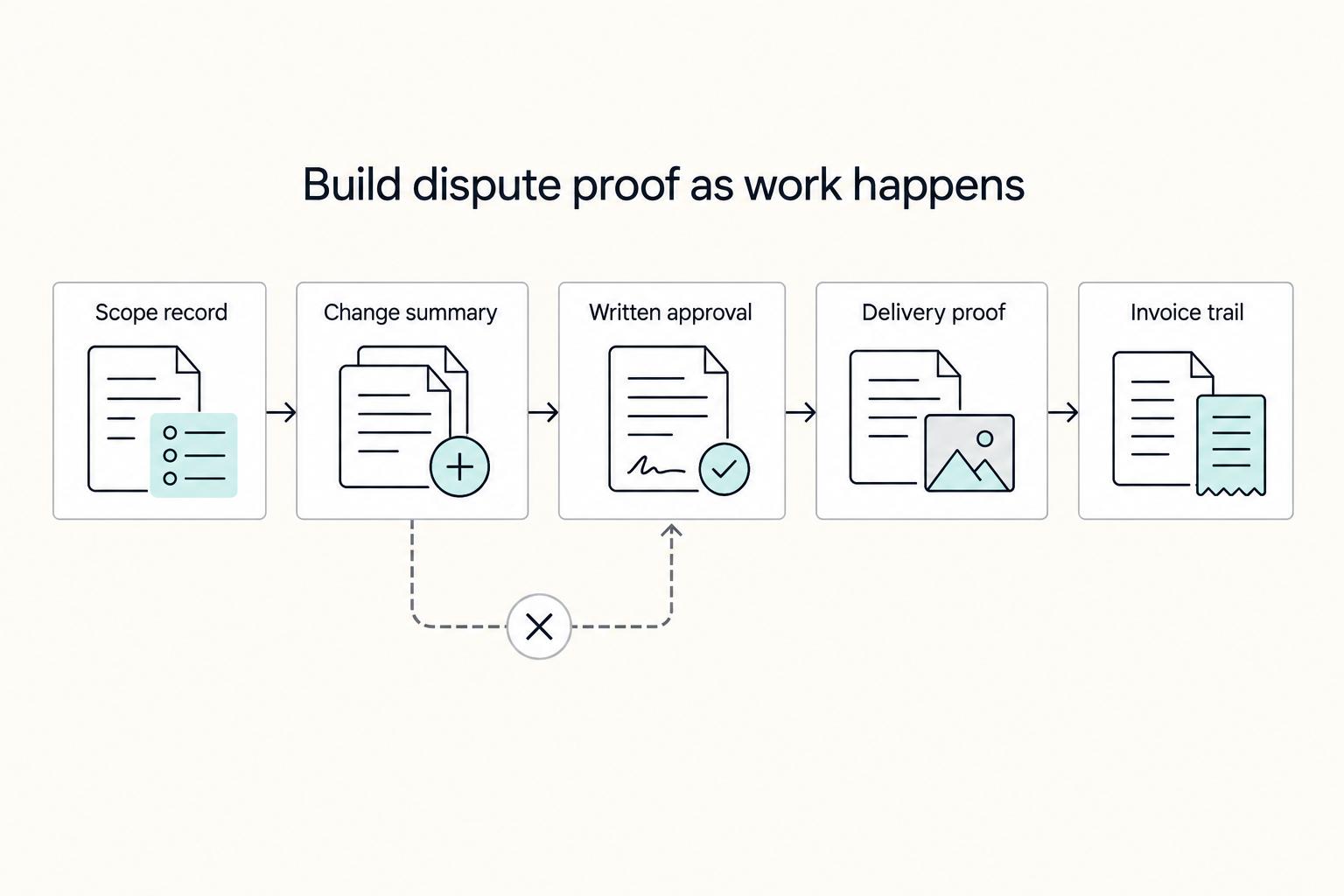
A payment trail helps only if you can show what each record is, who it relates to, and when it was created. Build the dispute file from day one so a procedural gap does not sink you before the merits are even heard.
Start with a minimum file you can hand to counsel quickly#
Keep one indexed folder per engagement and update it as work happens. As a practical baseline, keep:
- the signed contract, all amendments, and the statement of work
- acceptance proof for each milestone or deliverable
- full invoice history, including credited, revised, or reissued invoices
- a dated correspondence timeline showing who said what, in which channel, tied to the related work or invoice event
FSIA does not publish a verbatim checklist like this. This comes down to evidentiary strength: records made at or near the time, by someone with knowledge, and kept in regular practice are easier to rely on. You still need to authenticate what you submit. When document content is disputed, keep originals and execution-trail records so you can prove which version was actually finalized.
Preserve FSIA procedure records as core evidence#
For a federal court case, service proof is central, not administrative. Under 28 U.S.C. § 1330, personal jurisdiction depends on service under § 1608. Keep identity records that show whether the counterparty is the foreign state, a political subdivision, or an agency or instrumentality treated as a separate legal person. Preserve names exactly as they appear across contract documents, signature blocks, invoices, and correspondence.
If service is needed, retain the service-path records relevant to the tier you use: Notice of Suit materials, clerk dispatch records, signed-receipt mail records where applicable, required translations, and transmission notices. If service proceeds through diplomatic channels, keep the certified diplomatic note showing transmission. Also keep proof that earlier FSIA service tiers were attempted before moving to the § 1608(a)(4) route after the 30-day wait referenced in State Department guidance.
Reconcile legal records with payment operations#
Your legal file should match your finance file invoice by invoice. For each invoice event, keep payment confirmation, ledger-style transaction-log entries, and reconciliation snapshots showing amount due, amount received, variance, and date matched.
That organization also supports Rule 26-style disclosures by category and location instead of scattered files. And if you pursue default, FSIA still requires evidence satisfactory to the court, so contemporaneous, traceable records are stronger than summary-only spreadsheets.
If arbitration enforcement is part of the path, keep the arbitration agreement and award in the same pack, including authenticated or certified copies when required.
Before escalation, run an internal evidence audit: can you prove binding terms, performance and acceptance, payment history, and the FSIA procedure steps for this defendant? If any answer is weak, close the gap before filing in federal court or starting arbitration enforcement.
We covered this in detail in FBAR for a Foreign-Owned US LLC and the Filing Path That Works.
Missed payment escalation sequence from day one to filing#
Use a timed, contract-based escalation ladder from the first late payment, then hand off to counsel once your internal steps fail. This keeps pressure credible and preserves the record you need if the dispute moves to arbitration or court.
Start with contract-driven escalation, not emotion#
Run your sequence off the signed terms: reminder, formal notice, any contract cure window, then suspension or termination rights, then dispute activation. This is not a universal legal rule for every sovereign-facing contract. It is a control process that can reduce notice errors and help limit waiver risk. A practical ladder:
- Send a short reminder with invoice number, amount, due date, and payment route.
- Send formal notice exactly as required by the notice clause: recipient, address, and delivery channel.
- If the contract includes a cure period, track the deadline and define what cure requires.
- If nonpayment continues, invoke suspension or termination rights as written and state scope and effective date.
- Activate the contract's dispute venue.
Before each step, verify the exact legal name of the counterparty and keep that name consistent across notices, invoices, and delivery proof.
Tie the next move to the dispute clause#
Once the cure period expires, move under the Dispute Resolution clause instead of improvising. If the clause points to arbitration, preserve the executed arbitration agreement and follow the clause trigger steps.
That matters under 28 U.S.C. § 1605(a)(6): it covers actions to enforce a foreign state's arbitration agreement and actions to confirm awards under that agreement. It does not eliminate the other FSIA gates. If you later proceed in U.S. court, personal jurisdiction still depends on proper service under 28 U.S.C. § 1608 as part of 28 U.S.C. § 1330(b).
If you are using UNCITRAL-style arbitration, treat the notice of arbitration as a real initiation document. Include a demand to refer the dispute to arbitration, correctly identify the parties, and state the relief sought.
When legal pressure is weak, push for a settlement structure that can clear#
If sovereign status is confirmed and forum leverage is limited, a concrete settlement path can be more practical than broad litigation threats. In UNCITRAL arbitration, settlement is procedurally permitted during the case. Ask for exact installment amounts, dates, payment route, and default consequences for a missed installment.
Keep timing expectations realistic. FSIA service is step-ordered, and if service reaches the diplomatic-channel route, process discipline matters. After service is made under § 1608, a foreign state has 60 days to answer.
Set a clean handoff point to counsel#
When internal escalation fails, stop ad hoc legal escalation and hand off a complete record. Include the contract set, invoice and acceptance trail, correspondence timeline, all notices, delivery proof, and a short chronology of each escalation decision.
Your decision log should show when sovereign status was confirmed, which dispute forum controls, whether § 1605(a)(6) is in play, and what service assumptions were checked early. That is what keeps legal review focused and efficient.
Need the full breakdown? Read Government Pension Offset for Expats After Repeal: What to Check With SSA.
Winning a judgment is not the same as getting paid#
Treat this as two separate risk decisions: getting into court and collecting money. Under the Foreign Sovereign Immunities Act, clearing the first gate does not mean assets are reachable for seizure. If the collection path looks weak, do not keep extending unsecured credit.
The FSIA splits litigation and collection into different gates#
The suit-side gate is whether an FSIA exception applies (28 U.S.C. § 1605), with court authority tied to the statute's requirements, including proper service (28 U.S.C. § 1330). That addresses court entry, not payment.
Collection is a separate analysis under 28 U.S.C. §§ 1609-1611. You can be allowed to litigate and still face tight limits on what property can be attached or executed against.
| Question | Main FSIA section | Practical meaning |
|---|---|---|
| Can the case be heard? | 28 U.S.C. § 1605 | You still need an immunity exception. |
| Can the court proceed over the defendant? | 28 U.S.C. § 1330 tied to exception plus proper service | Court authority, not payment recovery. |
| Can assets be reached to satisfy a judgment? | 28 U.S.C. §§ 1609-1611 | Separate, narrower collection gate. |
Where collection gets constrained#
Section 1609 sets the default: foreign state property in the United States is immune from attachment, arrest, and execution. Section 1610 creates limited exceptions, including certain property in the United States used for commercial activity in the United States.
Section 1611 then preserves immunity for some categories even where Section 1610 might otherwise help, including central-bank and military-linked categories. So a judgment does not automatically open state-linked assets to collection.
Before you treat litigation as a payment remedy, get a concrete U.S.-asset path under Sections 1610 and 1611: what property, where it is, and why its use is commercial in the United States. If that cannot be answered with specifics, your collection plan is low confidence.
The pricing decision before more work goes out#
Do not treat legal optimism as credit support. A client may satisfy the suit-side gates but still have no reachable property that fits the execution-side rules.
Use a firm rule. If collection confidence is low, stop extending unsecured exposure. Instead:
- increase upfront payment
- shorten milestones so unpaid work in progress stays small
- require payment before delivery of key outputs
- tighten suspension rights once an invoice is late
This is why stronger upfront payment architecture usually beats later enforcement fights. In this context, contract design is often your real collection strategy.
Red flags that should trigger a hard no#
If core terms stay unclear and you cannot verify them, treat the deal as a hard no until that changes.
- Your verification path is blocked with "Access Denied - WAF Rule Reached" or "Your access has been denied."
- The source pages do not return substantive content, so you cannot confirm key terms from the underlying material.
- You do not yet have a confirmed follow-up path, such as the posted contact-us route on the denied page.
- Core terms remain unverified while access is still blocked.
When those signals appear together, do not fill the gaps with assumptions. Pause, verify, and proceed only once the terms are concrete and checkable.
The practical takeaway for freelancers#
Treat sovereign immunity as a deal-structure and pricing problem first, not a litigation plan. If a project only works because you assume you can sue later in U.S. court, the risk is probably mispriced from day one.
Use a strict yes-or-no rule: proceed only when all three pathways are credible at the same time. You need a real legal path under the Foreign Sovereign Immunities Act, payment terms that limit exposure before disputes, and a plausible collection path if things go wrong. If one pathway is weak, reprice for that weakness or decline the deal.
Use a real go or no-go screen#
A foreign government deal should pass three checks before work starts:
- Legal pathway
Confirm the exact counterparty and signer authority. Under 28 U.S.C. § 1603, a "foreign state" can include a political subdivision or an agency or instrumentality, not only a central government. If entity identity is unclear, your assumptions about immunity, forum, and enforcement are guesswork.
- Procedure pathway
A contract clause is not jurisdiction by itself. Under FSIA, personal jurisdiction requires both an applicable exception and proper service of process under § 1608. After the U.S. Supreme Court decision in CC/Devas (June 5, 2025), there is no extra minimum contacts analysis beyond FSIA's framework, but the exception and service requirements still must be met.
- Money pathway
Assume collection is harder than winning. Section 1609 generally protects foreign-state property in the United States from attachment, arrest, and execution unless a statutory exception applies. A favorable ruling can still leave you unpaid.
Draft for downside control#
Draft first for unsecured-exposure control, not elegant dispute language. Make payment triggers specific, tie deliverables to written acceptance, and avoid open-ended work-before-payment language that lets procurement delay signoff while you keep performing.
Then set the dispute path with realistic expectations. If arbitration is included, treat the arbitration exception as a potential route, not a guarantee. FSIA § 1605(a)(6) can matter for enforcing an arbitration agreement or confirming an award, but it does not automatically resolve immunity, service, or collection constraints.
Keep evidence discipline from day one. Preserve the signed contract, amendments, statement of work, invoice trail, acceptance records, and a dated communication log. If a dispute later turns on entity status, notice, or service steps, missing records will hurt faster than imperfect clause drafting.
When uncertainty should change the deal#
If the legal path is still maybe, change the deal, not your assumptions. Narrow scope, split the work into shorter milestones, or require more cash before major delivery. The practical goal is to reduce what you may need to fight over.
Before signature, use one verification checkpoint: have counsel confirm the likely FSIA path and test service assumptions against current U.S. Department of State guidance, especially if service may need diplomatic channels under § 1608(a)(4) after an earlier step cannot be completed within 30 days. One failure mode is building the full risk plan on a service route that does not fit the actual entity.
If those assumptions stay uncertain, choose no-go. A smaller engagement with cash in hand is safer than a larger one that depends on legal optimism. If you want a deeper dive, read Germany Freelance Visa: A Step-by-Step Application Guide.
When you move forward, set up a payment flow built for traceability and controlled release of funds by reviewing Gruv Payouts.
Frequently Asked Questions
Can you sue a foreign government client in U.S. court?
Yes, but only if an FSIA exception applies because immunity is the default. A contract clause by itself does not override that rule. First confirm whether the counterparty is a foreign state, political subdivision, or agency or instrumentality, then map the claim to a specific FSIA exception.
Did the 2025 Supreme Court decision make sovereign cases easier?
It made one jurisdiction issue clearer, not sovereign cases broadly easy. The Court held that when an FSIA exception applies and service is proper, courts do not add a separate minimum-contacts test. Immunity limits, service requirements, and collection constraints still remain.
If FSIA applies, do I still need proper service of process?
Yes. Personal jurisdiction depends on service under the FSIA service rules, so a valid exception alone is not enough. Some cases may require diplomatic-channel service, and later steps can follow if service under an earlier step is not completed within 30 days.
Should I rely on arbitration language to solve sovereign immunity risk?
No. Arbitration language can help only through FSIA's arbitration path, including actions to enforce an arbitration agreement or confirm an award. Jurisdiction, service, and enforcement still need separate analysis.
Does winning a case guarantee I can collect payment?
No. FSIA separates getting into court from enforcing against property, and foreign-state property is generally immune from attachment, arrest, and execution unless an exception applies. Even with a favorable result, collection can still be limited.
What should I finalize before signing a government-linked client contract?
Finalize the exact contracting entity, the likely FSIA exception path, and the service path before you sign. Also confirm how payment risk will be limited if recovery later proves difficult. If entity classification or service assumptions are still unclear, pause the deal or keep it to paid diligence only.
Try a related tool
Researched and edited by the Gruv editorial team. Gruv builds cross-border billing, payouts, and finance-operations software for global businesses.
Sources
- acquisition.gov/far/49.607trusted
- beta.trade.gov/articletrusted
- beta.trade.gov/articletrusted
- cdn.ca9.uscourts.gov/datastore/opinions/2013/12/09/11-15458%20web...trusted
- congress.gov/crs-product/LSB11363trusted
- ecfr.gov/current/title-22/chapter-I/subchapter-J/part...trusted
- med.uscourts.gov/content/can-clerk%E2%80%99s-office-give-me-l...trusted
- supremecourt.gov/opinions/24pdf/23-1201_8759.pdftrusted
Educational content only. Not legal, tax, or financial advice.
Related Posts

Germany Freelance Visa Application Path for Freiberufler and Gewerbe
Choose your track before you collect documents. That first decision determines what your file needs to prove and which label should appear everywhere: `Freiberufler` for liberal-profession services, or `Selbständiger/Gewerbetreibender` for business and trade activity.
What to Expect in Small Business Litigation as a Freelancer
If you want to reduce avoidable disputes, separate the relationship terms from the project terms. Use an MSA for the standing legal framework and an SOW for the specific work.

The Freelance Payment Penalty: A Modeled Audit of Platform Fees, FX Spreads, and Payout Delays
The money rarely disappears through a single, easy-to-spot fee. The real loss is stacked. A marketplace takes its commission, a processor adds a charge for international cards, a bank or payment company converts the currency at a spread, a platform holds the funds before release, and a wire sheds a little to intermediaries on the way in. Each layer looks defensible on its own, but the worker feels the combined result as a smaller deposit and a later payday.