
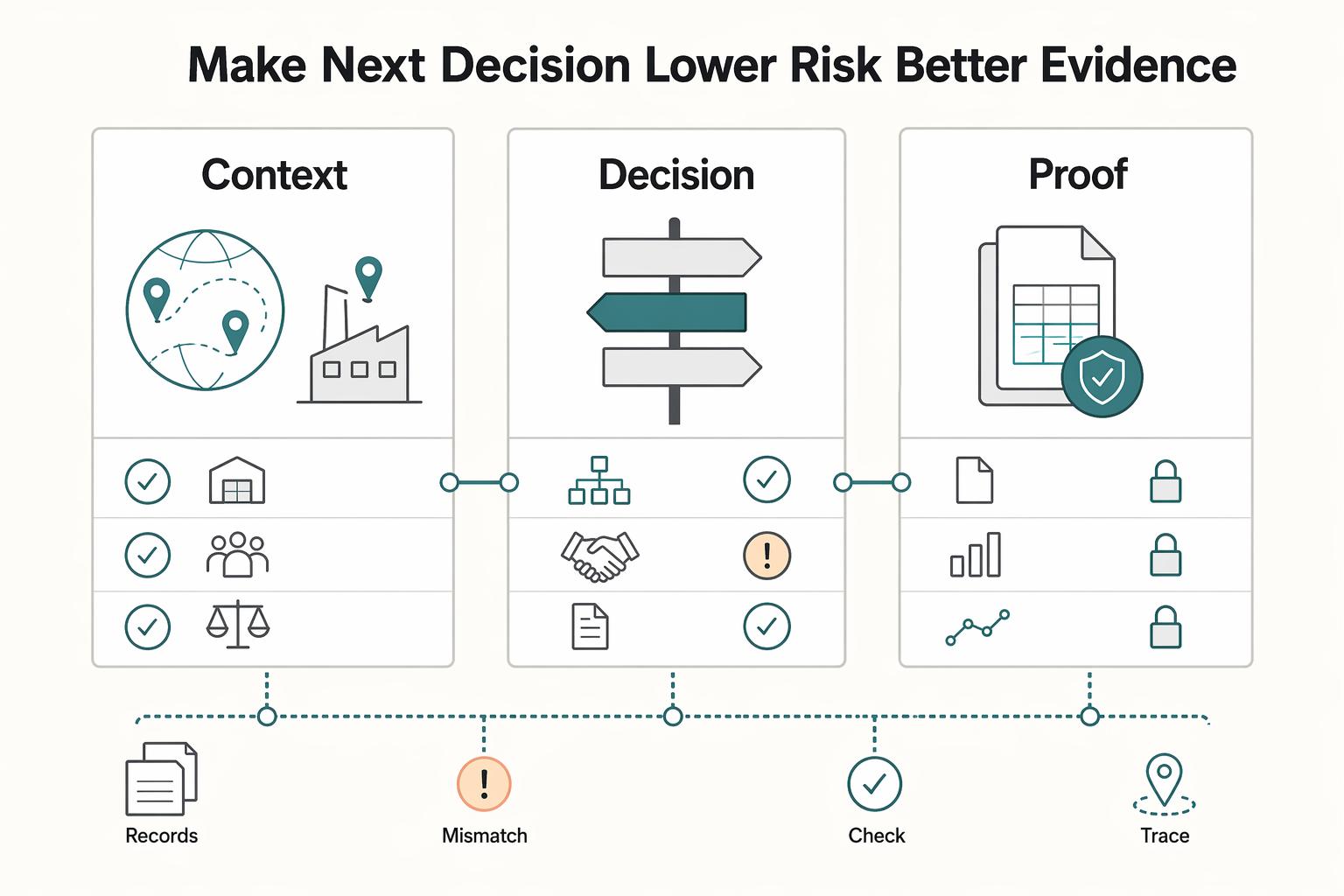
Quick Answer
A permanent establishment can give a source country taxing rights over attributable business profits under an applicable treaty. Common routes include fixed business premises and dependent-agent activity. Individual consultants may instead face a separate independent-services article; the effective treaty and domestic law determine the route.
Start Here With the PE Decision You Actually Need to Make#
A permanent establishment, or PE, is a business-presence threshold used in many income tax treaties. It helps decide whether a source country may tax an enterprise’s business profits and which profits are attributable there. Start with the actual taxpayer, its treaty residence, the income and the country of activity—not a travel-day score.
A freelancer working personally and a foreign company employing a travelling consultant are different taxpayers. Some treaties put an individual’s independent services under business profits; others retain a separate independent-services article with fixed-base or presence tests. Employment income follows another article. Identify the applicable route before applying a PE checklist.
Domestic law establishes a taxing claim; an applicable income tax treaty may limit it for an eligible taxpayer. A model convention is not the signed treaty, and a treaty does not generally create a domestic tax charge by itself. Check treaty residence, entitlement, the relevant article, protocols and any effective modifications. No PE conclusion settles every tax type.
Use this quick triage before you expand or renew anything:
-
Identify the taxpayer and income category.
-
Check the source-country domestic rules and applicable treaty protection.
-
For business profits, examine fixed-place, agent and any treaty-specific deemed/service PE rules.
-
Treat missing facts as an open review question, not a finding that PE already exists.
-
Review needed: a relevant fact or legal question is unresolved; obtain advice before expanding the affected activity. -
Monitor: retain the documented position and its fact-change triggers. -
Confirmed obligation: follow the country-specific filing and payment requirements established by the analysis. -
Contracts showing who can and cannot bind terms.
-
A dated log of where work was performed and by whom.
-
Revenue records by country with service period context.
-
Notes on domestic-law and treaty review.
Do not wait until year-end to organize this. The earlier you capture authority, location, and revenue facts, the easier it is to defend your position later. A common mistake is trying to reconstruct decisions after activity has already scaled.
Your output is a country position with the taxpayer, rules, facts and next action. Keep an unresolved question distinct from a confirmed taxing obligation. That makes the record useful for both commercial planning and the adviser who must reach the legal conclusion.
What Permanent Establishment Means in Plain English#
For treaty business profits, PE commonly connects the enterprise to a source-country taxing right over attributable profits. It is neither a universal corporate-tax test nor a test of an individual’s tax residence. Local income sourcing, withholding and reporting can still need separate analysis.
If you are still pinning down the concept, treat PE as a country-specific trigger rather than a permanent company status. You are testing facts in a place, at a time, under specific domestic law and treaty text.
| Party | What it applies to | Why you care |
|---|---|---|
| Home jurisdiction | Domestic tax rules in your residence country | It can remain relevant while host-country PE exposure is assessed |
| Source or host country | Domestic tax law on local business activity | It may assert taxing rights once PE conditions are met |
| Each contracting state under a treaty | Treaty wording and definitions | The same facts can be treated differently on each side |
The exact treaty controls. Some definitions include construction or services thresholds, special deemed-presence provisions or exceptions. A general fixed-place/agent screen is useful, but it is not exhaustive and does not establish that every treaty uses the same wording.
In practice, two recurring pathways are a fixed place of business and a dependent agent. Do not assume PE exists only in a traditional office setup. Authorities may test arrangements beyond classic bricks-and-mortar facts.
Identify who earned the income. An individual trading in their own name can be an enterprise for treaty purposes; that does not make their income corporate income. A company’s PE exposure concerns the company, while its travelling worker may separately have personal tax, payroll or immigration questions.
For example, IRS Publication 901 describes U.K.-resident independent services performed in the U.S. under the business-profits article, while some other treaty summaries retain a fixed-base approach. Form 8233 instructions also identify treaty-specific presence tests. Do not transplant an employee’s 183-day exemption into every consultant’s PE analysis.
- Save the relevant treaty article excerpt and your domestic-law interpretation note.
- Keep contract clauses showing who can and cannot bind commercial terms.
- Maintain a dated log of where services were delivered and by whom.
- Record the assumption you are using today and what fact change would force a recheck.
Two common PE routes, plus the actual treaty’s other rules#
Two common business-profits routes are a fixed place through which the enterprise’s business is carried on and dependent-agent activity. The applicable text may also contain service or other deemed PE rules. Ask which routes the actual treaty and domestic law contain before deciding a short trip is safe.
For fixed-place review, record a sufficiently stable business location, its availability to the enterprise and the business carried on through it. HMRC’s place-of-business guidance discusses premises at the enterprise’s disposal. Occasional visits to a client’s office are different from an office or desk continuously available for carrying out the enterprise’s business.
For agents, check actual conduct as well as signature authority. Some applicable rules cover a person habitually playing the principal role in contracts routinely concluded without material modification. A foreign manager’s final signature is not a universal safe harbour. Independent-agent exceptions also require the applicable conditions, not simply a contractor label.
- Review a recurring local base or material change in contract activity before expanding it.
- Check the applicable definition and exceptions rather than equating repetition with PE.
- Retain access arrangements, business activities and the negotiation/approval chain.
Capture who developed and agreed the material terms, who approved them, where those people acted and whether the final signer materially changed the deal. Keep that factual record separate from the conclusion about which legal threshold it meets.
Treaty Rules and Local Law Can Point in Different Directions#
Apply domestic rules and treaty limits to the same taxpayer and facts. The analysis can legitimately find a domestic taxing claim restricted by a treaty; that is not automatically a conflict or an error. Record why the treaty applies and what domestic obligations remain.
Treaty protection is conditional, including residence and any limitation-on-benefits or other entitlement rules. If there is no applicable treaty, analyse domestic law without inventing model-convention protection. Check effective dates rather than assuming a new model provision rewrites an older bilateral treaty.
| Step | Check | Result to record |
|---|---|---|
| Taxpayer and income | Individual/company, residence and income category | Which domestic charge and treaty article are relevant |
| Domestic scope | Activity, source and applicable tax rules | Initial taxing/reporting position |
| Treaty entitlement | Residence, eligibility and effective text | Whether a claimed restriction is available |
| Relevant presence tests | Fixed place, agent and special rules/exceptions | Facts supporting each condition |
| Consequences | Attributable profits, returns and separate taxes | Actions and owners, not just a PE label |
The OECD’s 2025 Model update adds commentary on cross-border remote working. It does not make every home office a PE or impose a universal day-count rule. Use the commentary with the effective treaty and the jurisdiction’s approach to interpretation.
In the U.S., domestic effectively connected income rules and applicable treaty PE protection are separate inquiries. A foreign person performing services there can have a domestic trade-or-business issue even when a treaty later limits the tax. Residence, income category and procedural requirements still matter.
Documented: the domestic position and treaty limitation have been analysed together.Advice needed: facts, entitlement or interpretation remain unresolved.Update needed: activity changed since the last supported position.
Ask for advice when the analysis cannot support its conclusion. Do not require domestic and treaty wording to produce identical answers: limiting domestic tax can be the treaty’s purpose.
- Save exact treaty article text and definitions relevant to PE and related tests.
- Keep a short note on how domestic tax law in that country interprets those terms.
- Map your facts in writing to both: key operating facts and which profits could be attributable.
- Recheck when facts change, not only at year-end.
Where Freelancers and Consultants Accidentally Cross the Line#
Consider a fictional foreign consulting company whose employee uses a dedicated host-country desk each week to deliver client projects. The review needs the access agreement, duration, activities and commercial purpose, plus the actual treaty. Repeated use warrants investigation; a calendar count alone does not prove or disprove fixed-place PE.
Now consider a local sales representative who negotiates material terms and secures customer agreement before a director abroad signs without changing them. If the applicable rule covers the principal role leading to routinely unmodified contracts, moving the signature abroad does not answer the agent question. Retain the negotiation trail and analyse the independent-agent exception separately.
Do not assume only formal office presence matters. You can face PE questions without opening a formal office because relevant presence is not limited to office space.
A subsidiary is a separate entity; owning one does not automatically establish its parent’s PE. The parent’s use of premises and the subsidiary’s activities for it can still matter. Review what the parent actually does through that arrangement.
Day counts belong to the exact rule being tested. A construction threshold, service-PE period, individual fixed-base/presence provision and employment exemption can have different periods and aggregation rules. There is no general “under 183 days means no PE” answer.
-
A temporary local helper starts joining negotiation calls.
-
Commercial urgency leads to ad hoc local approvals.
-
Contract language stays narrow while behavior expands.
-
Record changes in premises access and business use.
-
Record changes in negotiation, customer agreement and approval authority.
-
Review the relevant exception and treaty-specific deemed rules.
-
Retain travel logs, contract drafts and dated commercial decisions.
Update the position when actual conduct changes, even if the contract description stays the same. For an individual consultant, recheck their applicable income article and residence position as well; do not infer the company’s corporate-tax treatment from the individual’s travel record.
Use This Five Checkpoint Screen Before Entering a New Country#
Use these checkpoints to prepare a review, not to automate a legal verdict. A “yes” identifies facts to examine, while a missing answer identifies evidence or advice still needed.
| Checkpoint | What to review | Key details |
|---|---|---|
| Fixed place of business in the host country | Stability, access/disposal, actual business activities and applicable exceptions | Dated records of where work happened, who had access, and which contracts were supported from that location |
| Dependent agent authority | Habitual contract conclusion and any applicable principal-role rule; independent-agent conditions | Who agreed material terms and whether foreign approval materially changed them |
| Treaty position vs domestic tax law | Domestic taxing scope plus the effective treaty article and entitlement | Treaty provision reviewed, domestic-law rule reviewed, current result, and known unknowns |
| Taxes in scope now vs later | The actual taxpayer’s income tax, withholding, payroll and indirect taxes separately | One line for each tax type in your country note with owner and status |
| Evidence for source-country review | Whether the file has detailed records, proper registration status, and regular compliance reviews | Records with date, country, and responsible person visible without extra interpretation |
Record the place, access rights, period of availability and work done there. A dedicated workspace and occasional client visits are different fact patterns. Check whether the place is at the enterprise’s disposal and how applicable exclusions work.
- Which services were delivered from there.
- Which contracts were supported from there.
- Which months showed repeated use.
Check who habitually concludes contracts and, where the rule applies, who plays the principal role leading to routinely unmodified contracts. A representative can raise this question without being the final signer. A contractor description does not itself establish independence.
The whole contracting process matters: substantive negotiation, customer agreement, approval and material modification. Save evidence for each stage rather than collecting only the signed contract.
Record domestic taxing scope, treaty eligibility and the actual article used. Separate an individual’s independent-services rules from a company’s business profits and an employee’s employment income. Show how the treaty restricts, rather than automatically expands, the domestic charge.
Name the unresolved question and the evidence needed to resolve it. Guidance and model commentary support interpretation; they do not replace the effective treaty or domestic law.
Track the taxpayer’s income tax and any relevant withholding, payroll and VAT/GST work separately. Lack of income-tax PE does not by itself resolve those other obligations, and an individual’s exposure is not automatically a corporate-tax charge.
A practical step is to keep one line for each tax type in your country note with owner and status. It prevents PE activity from crowding out other obligations that can mature on different timelines.
Plan for authorities to ask for proof, not just intent. Maintain a current file with detailed records, proper registration status, and regular compliance reviews, including contract-signature authority and work-location support. Late filing can create avoidable penalties.
Go: evidence supports monitor posture with named recheck triggers.Conditional go: entry allowed with active controls and near-term review date.Hold: unresolved authority or location facts require escalation first.
Keep one country decision note with the taxpayer, rules, supporting facts, open questions and the next fact change that would require review.
Build a PE Evidence Pack Before You Need It#
Build the evidence pack around the decision it must support. For a presence question, gather premises and activities; for agent review, gather the full contracting chain. If PE is established, attribution is a separate calculation of relevant profits under the applicable rules, not a claim that every local customer invoice is taxable there.
| File section | What to include | Key detail |
|---|---|---|
| Contract and authority records | Signed agreements, approval chains, and a signature-authority matrix by country and entity, where relevant | Who negotiated and agreed material terms, who approved them, what changed and where |
| Operating evidence | Work-location logs and service-delivery records | Date key milestones and tie them to place |
| Legal and tax position file | The treaty article you relied on, your domestic-law analysis against the same facts, and OECD Model Tax Convention material as interpretive context alongside treaty text | Which version you reviewed when model commentary informs your interpretation, including updates that cover Commentary on Article 5 |
| Attribution records | Relevant functions, assets, risks, revenues and expenses under the applicable rule | Do not allocate all customer-country revenue merely because PE exists |
Give each authority change a date and reason. Review is easier later when you can show when the old rule ended and when the new rule began.
Treat timeline quality as a control. If an event cannot be placed in time and country, flag it as incomplete rather than assuming it will be obvious later.
-
Contract renewal cycle.
-
New local representative.
-
Scope expansion in a country.
-
Changes in who can approve or conclude terms.
-
Current: no material fact change since last review. -
Update needed: fact change recorded, interpretation pending. -
Escalate: high-risk fact pattern or unresolved treaty and domestic-law conflict.
This turns the evidence pack from a year-end scramble into a living record that supports decisions while they are still reversible.
Red Flags That Should Trigger Professional Advice Immediately#
| Red flag | Detail |
|---|---|
| Fixed place of business profile | You may have a fixed place of business profile in a host country tied to ongoing local activity |
| Dependent-agent behavior | A local representative functions like a dependent agent by habitually concluding contracts or playing the principal role leading to contract conclusion |
| Treaty and local-law mismatch | Your treaty-based view and local domestic-law interpretation are pulling in different directions |
| Double-taxation relief not confirmed | Your plan depends on double-taxation relief, but eligibility, method, or timing is not confirmed |
These signals identify questions to resolve. They do not by themselves establish a confirmed PE, corporate-tax liability or amount of profit attributable. Preserve the facts and obtain a country-specific conclusion before relying on a proposed structure.
Do not rely on day-count shortcuts alone. There is no universal 30-to-183-day rule that automatically creates or avoids PE. Also, do not assume double-taxation relief applies automatically; some relief rules are context-specific. Confirm the exact mechanics before you call risk controlled.
-
Pause contract changes that increase local authority.
-
Preserve current records before they are edited or deleted.
-
Set a clear owner and date for external review.
-
Maintain a dated memo of your current position and assumptions.
-
Keep contract authority and decision records current by country.
-
Reconcile where work is performed with where revenue is earned.
-
Trigger external review when your footprint, authority model, or country mix changes.
Your posture is easier to defend when records make each tax judgment traceable. Treat PE review as an operating control, not a one-time legal memo.
When work spans countries, keep one country-level record tying together where work happened, who had authority, and where revenue was recognized. If those records sit in separate tools, your position is harder to defend under review.
Separate presence from profit attribution. If a PE is established, prepare the relevant revenue, expense and business-activity evidence for the applicable attribution rules. Customer location and bank-account location alone do not allocate profit.
Use the effective bilateral treaty, protocols/modifications and domestic law as the primary legal record. Label official guidance and model commentary as interpretive material with its version date. A payment tool’s export can support the facts but cannot establish treaty entitlement.
Build this into normal operations:
-
Link each invoice and payout to country, contracting entity, and service period.
-
Keep a live authority register by jurisdiction.
-
Store location evidence for delivery and management activity in the same review trail.
-
Save treaty and domestic-law position notes with date and owner.
-
Reopen the PE screen before new market entry, a new local representative, or new contract authority.
-
Confirm any change in who can approve or conclude terms.
-
Reconcile location logs against contracts active that month.
-
Update country notes where facts changed.
-
Mark unresolved items for escalation before the next sales step.
Make the Next Decision With Lower Risk and Better Evidence#
Start the next review with who earned the income, what activity occurred and which rule applies. Then record the presence conclusion and, if relevant, attribution and filing actions separately. A strong evidence pack supports a conclusion; it is not a substitute for one.
For the fictional consulting company, review the dedicated desk and representative’s real role. For an individual consultant, identify the relevant independent-services or business-profits provision first. Those different starting points prevent a useful PE checklist from becoming an incorrect all-purpose tax test.
For each country, confirm your position against applicable bilateral treaty text and domestic tax law first, then use interpretive materials as secondary context. That is a responsible way to scale when outcomes vary by jurisdiction and fact pattern.
- Confirm taxpayer, income category, domestic scope and effective treaty entitlement.
- Refresh premises, activity and full contracting-process records.
- Review applicable exceptions and special presence rules.
- If PE is confirmed, separately determine attributable profits and filing actions.
- Name unresolved questions and the next review trigger.
One final discipline keeps decisions clean: attach a date, owner, and next review trigger to every country position. That turns a static memo into an active decision record and makes the next review faster and less error-prone. If you need cleaner cross-border records and audit-ready payment trails, use tools that keep exports traceable and reconciliation consistent.
Frequently Asked Questions
What creates a permanent establishment for a freelancer or consultant?
First identify whether your income falls under treaty business profits or a separate independent-services article. Where PE applies, common routes include a fixed place used for the enterprise’s business and dependent-agent activity, with additional treaty-specific rules. A freelancer is not automatically taxed as a company.
Can I create PE without opening an office?
Yes, depending on the applicable definition. A business place at the enterprise’s disposal or qualifying dependent-agent activity may matter without a conventional rented office. Record the actual access, activities and contracting process rather than relying on the premises label.
Does using a local contractor or representative create dependent agent PE risk?
It can, but the label alone is insufficient. Check habitual contract conclusion and any applicable principal-role rule, plus the independent-agent conditions. Moving only the final signature abroad does not necessarily remove exposure.
Does a subsidiary automatically mean I have PE in that country?
No. Ownership alone does not make the subsidiary the parent’s PE. The parent’s actual use of premises and activities carried out on its behalf still need review under the applicable rules.
Do tax treaties always protect me from local taxation?
No. An eligible taxpayer can claim applicable treaty limits, but protection depends on the effective text, residence, entitlement and income category. A treaty generally restricts a domestic taxing claim; it does not erase every filing, withholding or other tax obligation.
What is the difference between PE risk and VAT or GST registration?
PE in this guide concerns income-tax business presence. VAT/GST uses its own establishment and registration rules. Analyse it separately rather than treating “no income-tax PE” as “no local obligations.”
When should I talk to a cross-border tax professional instead of handling this myself?
Get advice when premises use, contract activity, treaty entitlement or the applicable income category is unclear, especially before changing the local operation. Bring dated facts and the effective rules so the advice addresses your actual taxpayer and activity.
Try a related tool
Researched and edited by the Gruv editorial team. Gruv builds cross-border billing, payouts, and finance-operations software for global businesses.
Sources
Includes 2 external sources outside the trusted-domain allowlist.
Educational content only. Not legal, tax, or financial advice.
Related Posts

Digital Nomad Taxes in 2026 With a Defensible Filing Plan
With digital nomad taxes, the first move is not optimization. It is figuring out where you may be taxable, where filings may be required, and what proof supports that position.

The Freelance Payment Penalty: A Modeled Audit of Platform Fees, FX Spreads, and Payout Delays
The money rarely disappears through a single, easy-to-spot fee. The real loss is stacked. A marketplace takes its commission, a processor adds a charge for international cards, a bank or payment company converts the currency at a spread, a platform holds the funds before release, and a wire sheds a little to intermediaries on the way in. Each layer looks defensible on its own, but the worker feels the combined result as a smaller deposit and a later payday.

How to Respond to a Subpoena for Business Records
Move fast, but do not produce records on instinct. If you need to **respond to a subpoena for business records**, your immediate job is to control deadlines, preserve records, and make any later production defensible.