
Quick Answer
Use natural hedging for freelancers as a three-tier operating routine: shape client revenue lanes, lock contract-to-invoice controls, then track compliance triggers before filing season. Keep evidence with each milestone invoice, set hold/convert/spend rules for each currency balance, and maintain a dated travel log plus foreign-account inventory so residency, FBAR, and VAT checks are handled early instead of at year end.
Your Business is More Exposed Than You Think: The Compliance-First Hedging Framework#
For cross-border freelancers, the bigger risk is often not a slow month. It is a preventable process failure that turns into a tax, reporting, or payment problem. In practice, natural hedging is not a trading tactic. It is risk reduction built into how you run the business, and it is typically less flexible than financial hedging tools.
Everyday cash-flow friction is common and often manageable: slow settlement and fee drag. Recent U.S. small-business reporting found 80% of respondents faced payment challenges, with fees and slow settlement among the most cited issues. Those matter, but compliance and operating failures can carry larger legal and tax consequences. Payment-system and settlement failures can also impair market liquidity during volatile periods.
| Risk type | Typical trigger | Impact type | First-line hedge |
|---|---|---|---|
| Income Volatility Risk | Slow settlement and fees | Margin pressure, cash-flow gaps | Liquidity buffer, matching currency inflows and outflows |
| Compliance / Operational Risk | Missed reporting, wrong residency assumptions, payment or settlement failure | Penalties, tax exposure, account friction, legal cleanup | Documented controls, day tracking, filing calendar, account monitoring |
The difference is practical. If you are a U.S. person, FBAR can be triggered when the aggregate value of foreign financial accounts exceeds $10,000 at any time during the year. The due date is April 15 with an automatic extension to October 15. Form 8938 is separate, and both can apply. A common failure mode is checking each account in isolation, missing the aggregate trigger, or assuming one form covers the other. FinCEN maximums are inflation-adjusted, so verify current penalty amounts at filing time. Keep unverified penalty figures out of your checklist until you confirm the current amounts.
Tax residency works the same way. The IRS substantial presence test uses 31 days in the current year and 183 days over a 3-year period. If you do not track days as you travel, you are relying on memory for a rule that can determine your filing status.
This article uses a three-tier roadmap. Tier 1 strengthens your commercial foundation. Tier 2 tightens money movement and records. Tier 3 installs controls that keep an administrative miss from becoming a business-level event. The tiers build on each other: start with stability, then tighten cash handling, then lock down the compliance points that can do real damage. If you want a deeper dive, read A Guide to Currency Hedging for Freelancers.
Tier 1: Fortifying Your Commercial Foundation#
Tier 1 is about getting the commercial base right. You are deciding how revenue stays stable, where growth comes from, and how cash is protected when something breaks. Treat this as an operating framework, not a benchmark.
Build two revenue lanes on purpose#
Do not let your client mix happen by accident. Classify work into two lanes before you accept it: a baseline lane for stability and a growth lane for upside. The goal is not a perfect ratio. It is to avoid accidental concentration and month-to-month chaos.
Use the same decision model for every client or prospect:
- What role does this play in near-term cash flow?
- How repeatable is the work?
- What happens if this disappears next month?
If a client pays well but depends on unpredictable approvals, shifting scope, or one internal champion, treat it as growth risk rather than baseline stability.
Use this as a directional heuristic:
| Portfolio shape | Cashflow stability | Upside | Concentration risk |
|---|---|---|---|
| Mostly baseline lane | Often higher | Often lower | Can rise if too much depends on one client |
| Mostly growth lane | Often lower to medium | Often higher | Can spread across clients, but volatility is higher |
| Deliberate two-lane mix | Can be medium to high | Can be medium to high | More controllable when lanes stay distinct |
Use a quick audit to see whether your portfolio is drifting: review recent invoices and label each line item as baseline or growth. If the labels are unclear, the mix is unclear too.
Extend your service stack without muddying your position#
Add adjacent offers only when they make your core work stronger. Keep this tight: start with a small number of extensions. Examples that stay close to core delivery include:
- A productized service
- A template or tool
- A lighter advisory retainer
Before you launch anything new, run a fit check:
- Does this solve a problem existing clients already raise?
- Can you explain it in one sentence?
- Does it support your core offer instead of competing with it?
- Can you deliver it now with current skills and proof?
If it requires a new audience, a new brand story, and a new sales motion, it is probably dilution.
Turn your cash buffer into an operating policy#
Write the liquidity rule down. A cash buffer is easier to use consistently when you define where reserve cash sits, how it gets replenished, and which events justify using it.
Start by keeping business and personal funds separated. Separating Business and Personal Finances: An Important Step for LLCs
If you have not verified a target reserve range, leave the amount open and focus first on the policy:
- Reserve cash location is fixed.
- Replenishment happens from profitable periods before extra owner draws.
- Drawdowns are limited to predefined events, such as non-payment or an essential operating interruption.
Do not use the reserve to hide chronic pricing or collections problems.
Tier 1 checklist#
- Every active client is explicitly classified as baseline or growth.
- Your stability does not rely on a single payer by accident.
- If you use adjacent offers, at least one supports your core positioning.
- Your reserve policy is written and specific (location, replenishment, drawdown triggers).
- Your recent invoices and contracts match the stability story you are relying on.
You might also find this useful: How to Use a Forward Contract to Hedge a Foreign-Currency Invoice.
Tier 2: Building Financial Integrity#
Tier 2 protects the path from signed client to cleared cash. The aim is simple: remove three avoidable leaks: non-payment, forced FX conversions, and handoff errors that later become tax and reconciliation problems.
Put non-payment controls in a fixed sequence#
Do not improvise collections after an invoice goes overdue. Set the sequence before delivery starts: contract guardrails, staged invoicing, then escalation.
| Control point | Stated detail |
|---|---|
| Contract guardrails | Define scope and exclusions, invoice currency, due date, milestone acceptance criteria, and what happens when approvals stall or scope changes. |
| Staged invoicing | Tie invoices to verifiable deliverables such as signed proposal, kickoff completion, draft delivery, and final handoff. |
| Escalation | Use a preset overdue timeline; in UK B2B cases where the rule applies, escalation can include interest and debt-recovery claims. |
Start with the contract. Define scope and exclusions, invoice currency, due date, milestone acceptance criteria, and what happens when approvals stall or scope changes. Before work starts, you should be able to point to the clause that triggers each invoice and the proof that the milestone is complete.
Then use staged invoices tied to verifiable deliverables, for example, signed proposal, kickoff completion, draft delivery, final handoff. If a dispute turns into a chargeback, you may be asked to submit evidence, and the issuing bank decides whether to reverse payment. Build that evidence pack as you go: signed agreement, approvals, delivery timestamps, revision logs, and invoices.
If payment goes overdue, escalate on a preset timeline. Move reminders from courtesy to consequence by policy. In UK B2B cases where the rule applies, late-payment escalation can include interest and debt-recovery claims. Statutory interest is 8% plus the Bank of England base rate.
| Model | Risk ownership | Dispute handling | Tax and compliance scope | Operational tradeoffs |
|---|---|---|---|---|
| Payment processor | You are often still the merchant of record; confirm who holds transaction risk in your contract | You may be asked to submit evidence when a chargeback is raised | Processing alone does not automatically transfer broader tax liability | More control, with more internal admin in many setups |
| Merchant of Record | The MoR is legally responsible for transaction-level financial, legal, and compliance obligations | The MoR can handle refunds and chargebacks in that model | Can include tax handling and, in some configurations, assumed liability | Lower operational burden if your model and contract fit |
| Product-specific MoR setup | Depends on provider setup and contract terms | Confirm who owns evidence submission, refunds, and notices | Confirm in writing whether tax responsibility is assumed | Can work well for some digital-product sales; do not assume transfer by default |
Use this decision rule: if you want an MoR for liability transfer, verify that the contract explicitly states who owns tax, refunds, and chargebacks.
Use multi-currency accounts as an operating tool, not a feature#
Treat the account as a control point, not just a feature. The core rule is simple: match what you earn to what you spend in that currency whenever practical.
| Action | Use when |
|---|---|
| Hold | You have near-term costs in that currency or no immediate home-currency need. |
| Convert | You must fund home-currency obligations such as owner pay, tax set-asides, or local operating expenses. |
| Spend directly | You are paying suppliers or contractors in that same currency to avoid round-trip conversion. |
For each currency balance, decide in advance when you hold, convert, or spend. Hold when you have near-term costs in that currency or no immediate home-currency need. Convert when you must fund home-currency obligations such as owner pay, tax set-asides, or local operating expenses. Spend directly when paying suppliers or contractors in that same currency to avoid round-trip conversion.
This is about control, not market timing. Wise states you can hold 40+ currencies and funds are not auto-converted, which supports hold-versus-convert timing decisions. If you want a deeper policy, review forex risk before volume grows. If you compare providers, treat savings claims as unverified until you confirm current pricing and terms.
Reduce admin tax by tightening the client-to-cash chain#
Recordkeeping problems often start at handoffs. Treat proposal-to-reconciliation as one continuous chain, because errors usually appear when information is re-entered or passed between tools.
Standardize the same core fields across proposal, contract, invoice, collection, and reconciliation: client legal name, service description, currency, tax treatment, and payment terms. The test is traceability: can you map each bank receipt back to the invoice, contract, and delivered work without guesswork?
This is a tax-control issue, not just an admin preference. HMRC defines digital records as income and expense records created and stored in software. From 6 April 2026, this applies to covered sole traders and landlords with qualifying income over £50,000 under MTD for Income Tax. The IRS allows any system that clearly shows income and expenses, and places the burden of proof on you.
Consolidate where it reduces mismatches. You do not need one all-in-one stack, but you do need one source of truth for terms and one reliable path into your books.
Tier 2 checklist#
- Write one payment policy covering contract terms, milestone triggers, reminder timing, and jurisdiction-specific escalation.
- Choose
payment processororMerchant of Recordfrom contract-level risk ownership, not marketing labels. - Set a per-currency policy: hold, convert, or spend locally.
- Assign one owner (person or system) for data continuity from proposal through reconciliation.
- Review monthly: overdue invoices, dispute evidence completeness, FX balances, and broken record links.
If Tier 2 is running cleanly, the next step is not more payment tooling. It is tighter control over the compliance points that can hurt you most. We covered the continuity side of this in detail in Build a One-Page Business Continuity Plan for a Natural Disaster.
Tier 3: Turn compliance risks into controls with named owners#
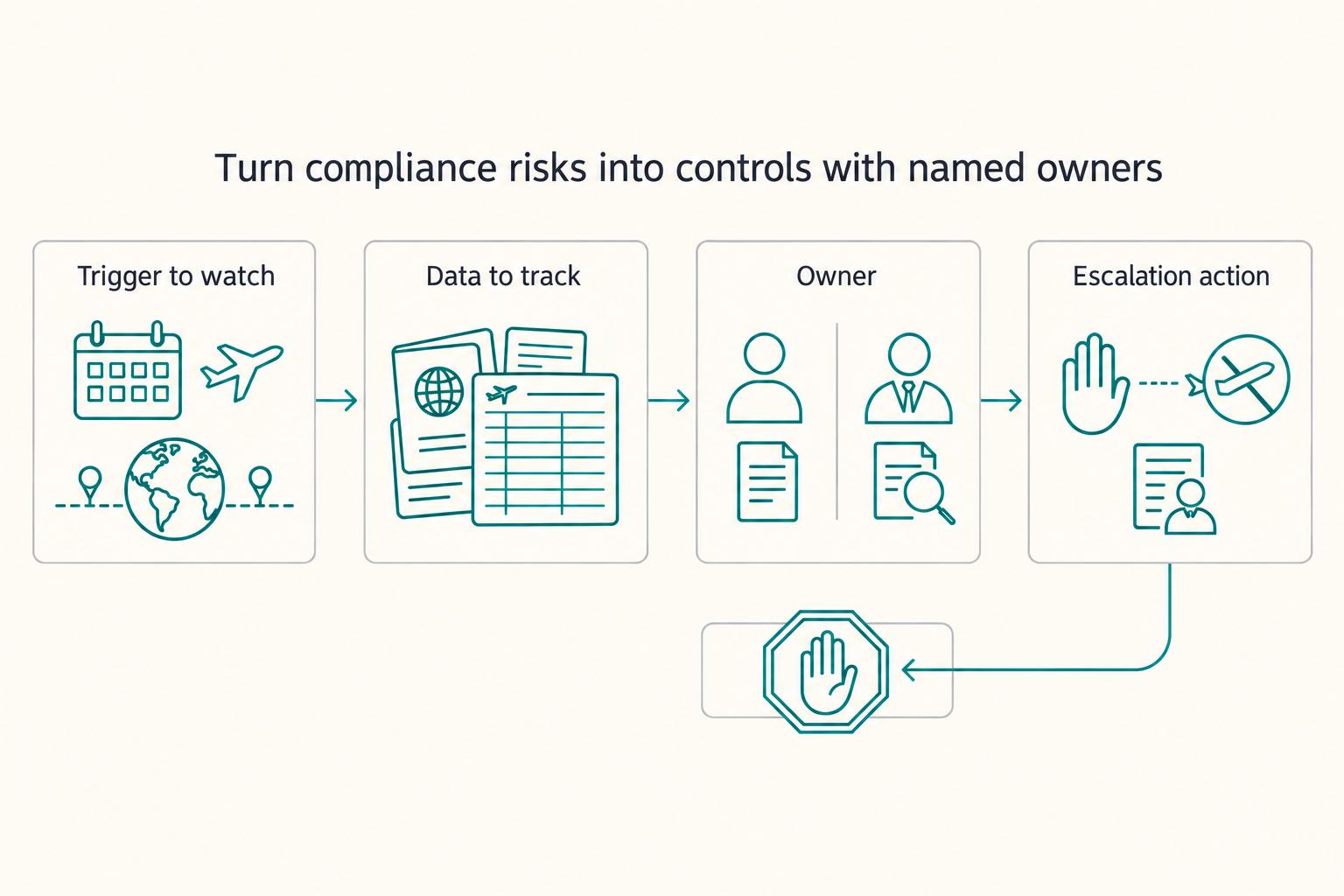
Once Tier 2 is stable, the main residual risk is compliance drift, not collections. At this tier, treat each risk as a control with a clear trigger, tracked data, a named owner, and a defined escalation step.
Tax residency and FEIE day tracking#
Do not leave travel records to year-end reconstruction. For FEIE, the physical presence test is 330 full days during any period of 12 consecutive months. A full day is 24 consecutive hours beginning and ending at midnight. Those qualifying days do not need to be consecutive, but if you miss the requirement, you fail the test regardless of reason. FEIE also depends on meeting the tax-home condition.
| Rule | Article detail |
|---|---|
| Physical presence test | 330 full days during any period of 12 consecutive months. |
| Full day | 24 consecutive hours beginning and ending at midnight. |
| Qualifying days | Do not need to be consecutive. |
| Tax-home condition | FEIE also depends on meeting the tax-home condition. |
Use this control model:
- Trigger to watch: FEIE day count tightening against the 330-day/12-month test; for non-IRS residency or visa limits, keep each jurisdiction-specific limit marked for advisor confirmation.
- Data to track: arrival and departure by country, local dates, travel purpose, and FEIE-eligible full days.
- Owner: you own the source log; your advisor reviews and confirms treatment.
- Escalation action: if your FEIE window tightens or any verified non-IRS limit is near, pause discretionary travel changes and get advisor review before the next move.
Keep supporting records such as travel confirmations and dated logs, and remember that FEIE requires filing a return that reports the income.
Foreign account reporting and aggregation alerts#
Do not run foreign-account reporting as a filing-season scramble. Run it as an ongoing inventory process and escalate early. Because the filing threshold, deadline, penalty amounts, and in-scope account-type rules are not provided here, mark those fields as unverified until advisor confirmation.
Use this control model:
- Trigger to watch: new account opened, signature authority added, beneficial relationship changed, balances nearing an advisor-confirmed reporting threshold, or residency pattern changes.
- Data to track: institution, jurisdiction, legal owner, account identifier (masked), authority type, open and close dates, and highest observed balance backed by saved statements or exports.
- Owner: you own accountability; a bookkeeper can maintain inventory; a qualified advisor validates scope and filing treatment.
- Escalation action: hand off immediately when any trigger fires, rather than waiting for return prep.
Invoice and VAT liability controls#
For cross-border invoices, aim for consistent treatment and a defensible audit trail. Country-specific VAT ID validation rules, reverse-charge wording requirements, and penalty details are not provided here, so mark those requirements as unverified until advisor confirmation.
| Control point | Manual invoicing | Compliance-automated invoicing |
|---|---|---|
| VAT ID validation | Define a check step and retain proof when advisor guidance says validation is required | Configure the same check and evidence retention when your system supports it |
| Required reverse-charge language | Use advisor-approved wording for the country and treatment in scope | Apply the same advisor-approved wording via configured rules |
| Audit trail quality | Keep dated versions and supporting records | Keep system logs, version history, and supporting records |
| Error risk | Depends on process discipline and review cadence | Depends on rule setup quality and exception escalation |
Use this control model:
- Trigger to watch: any cross-border B2B invoice or unclear client tax status.
- Data to track: client legal name, billing country, tax status, VAT ID (if applicable), service description, invoice currency, and saved validation or version evidence.
- Owner: finance ops or you.
- Escalation action: send to a qualified tax advisor when country treatment is unclear, reverse-charge handling is uncertain, or your system cannot apply the required setup cleanly.
At Tier 3, natural hedging becomes operational resilience. Serious errors are harder to make and easier to catch early.
Related: A guide to currency options for 'hedging' against forex risk.
Turn this section into a live control by tracking travel exposure in one place with the Tax Residency Tracker.
Conclusion: Run the three tiers as one operating routine#
This is not a one-time tactic. Treat it as an operating routine that makes revenue swings, payment friction, and compliance gaps less likely to catch you off guard.
The pattern in this three-tier approach is straightforward: stabilize revenue, tighten the path to cash, then install controls around the rules that can create the biggest problems. That is what turns risk reduction from a good intention into something you can actually run.
Tier 1. Run a weekly checkpoint on clients and outstanding invoices#
Start with what you can control now: revenue stability. You may not eliminate the feast-and-famine cycle, but you can improve income-flow control by changing how you manage delivery and clients. Use a weekly checkpoint for client concentration, renewal timing, signed scope, and outstanding invoices so you act before a gap becomes a cash-flow problem.
Tier 2. Confirm currency and payment terms before work starts#
Next, tighten your payment and currency process. Late or frozen payments are a real operating risk. One cited FSB study of more than 4,000 firms reported 62% had been subject to them. Before work starts, confirm who pays, invoice currency, settlement destination, payment terms, and any automatic conversion so the invoice-to-settlement path is clear.
Tier 3. Keep complete records to cut avoidable compliance risk#
Then reduce avoidable compliance risk by keeping complete, consistent records. Keep your dated travel log, account inventory, statements or balance exports, and invoice records in one system so review periods do not turn into a scramble. If you track penalty exposure internally, mark penalty examples as unverified until figures are confirmed.
Turn these three tiers into one reusable client onboarding and payment-risk checklist. That is how this framework becomes practical: better decisions earlier, cleaner evidence, and fewer avoidable surprises.
For a step-by-step walkthrough, see A Guide to Functional Currency for Your Business.
If you want your risk checklist tied to day-to-day money movement, review Merchant of Record for Freelancers to see if it fits your setup.
Frequently Asked Questions
What is a natural hedge against residency exposure?
It is an operating habit, not a product. You track where you are before a tax rule surprises you. In your compliance calendar, set a review trigger for each country where you spend meaningful time, and keep jurisdiction-specific day-count rules marked for advisor confirmation because tests vary by jurisdiction. If you have U.S. exposure, track days against the substantial presence test (31 days in the current year and 183 days across a weighted 3-year lookback using 1/3 and 1/6 prior-year weights) in a dated travel log, then get advisor review before you cross any alert point.
How should you handle foreign-account reporting without turning it into a year-end scramble?
Run it as a recurring process, not a once-a-year memory exercise. Your payment checklist should track account inventory, masked identifiers, legal owner, open and close dates, and supporting documents. If you have U.S. filing exposure, track the FBAR trigger (aggregate qualifying foreign accounts above $10,000 at any point in the year), the due date (April 15), and the automatic extension (October 15); for other jurisdictions, keep the threshold, deadline, and extension fields marked for advisor confirmation before filing.
Is client diversification enough on its own?
No. Diversification helps reduce customer concentration risk, but it does not cover residency exposure, reporting risk, or invoicing compliance errors. If one client starts to dominate your revenue, add pipeline targets and renewal checkpoints while keeping your compliance calendar and payment checklist active.
What should your invoicing workflow do for cross-border work?
It should produce consistent treatment and a defensible evidence trail. Under EU VAT rules, invoices are generally required for most B2B supplies, but member-state rules can differ, so your checklist should capture client legal name, billing country, tax status, VAT ID when relevant, service description, invoice currency, and validation evidence. If you still edit invoice language manually each time, fix that first to reduce avoidable errors.
How is natural hedging different from derivatives?
The difference is where the control sits. Natural hedging reduces risk through normal operations, while derivatives are separate financial contracts tied to market variables like FX. If your payment data and recordkeeping are not clean yet, tighten those first before considering contracts. | Option | What it is | Best fit use case | Main tradeoff | Immediate next step | |---|---|---|---|---| | Match revenue and costs in the same currency | Operational hedge that reduces currency mismatch during normal work | You earn and spend in the same foreign currency | Usually lower cost, but less flexible when cash flows do not align | List top revenue currencies next to top expense currencies | | Multi-currency account | One account structure that can hold or manage multiple currencies without repeated conversion | You invoice internationally and want control over conversion timing | Can reduce forced conversions, but costs and features vary by provider and corridor | Identify where auto-conversion happens today and which currencies you actually need to hold | | Derivatives (forwards, options, and similar contracts) | Separate contracts whose value is linked to FX movements | You have defined exposure, enough volume, and can manage contract complexity | More flexible, but more complex and not suitable for every freelancer | Seek specialist advice only after your operating data is reliable |
How does a multi-currency account actually help day to day?
It lets you hold funds in the original currency instead of converting every payment immediately. In your payment checklist, map who pays you in which currency, where you hold funds, and when conversion decisions are reviewed. Then check whether auto-conversion is creating avoidable costs.
Can a strong personal brand count as a hedge?
Yes, but treat it as a moat, not a guarantee. A stronger brand can improve differentiation and reduce reliance on one acquisition channel, but it does not fix weak contracts or weak collections. If inbound is inconsistent, document proof you already have, such as case studies, testimonials, and repeat-client outcomes, and publish it consistently in one channel.
What records matter most if you want these hedges to hold up under review?
Keep records that show what happened, when it happened, and how you handled it. For most freelancers, that includes invoices, receipts, deposit slips, paid bills, and canceled checks, plus a dated travel log. Record transactions on a regular cadence (ideally daily), and close the biggest evidence gap first.
Try a related tool
Researched and edited by the Gruv editorial team. Gruv builds cross-border billing, payouts, and finance-operations software for global businesses.
Sources
- bis.org/basel_framework/chapter/OPE/10.htmtrusted
- ecfr.gov/current/title-31/subtitle-B/chapter-X/part-1...trusted
- extension.harvard.edu/2024-2025-extension-course-archivetrusted
- home.treasury.gov/system/files/136/archive-documents/A-Financi...trusted
- irs.gov/businesses/small-businesses-self-employed/re...trusted
- irs.gov/individuals/international-taxpayers/substant...trusted
- occ.gov/publications-and-resources/publications/comp...trusted
- occ.gov/topics/supervision-and-examination/capital-m...trusted
Educational content only. Not legal, tax, or financial advice.
Related Posts

How LLC Owners Separate Business and Personal Finances
For an LLC, separating business and personal money is best treated as a weekly habit, not a one-time bank setup. It keeps records cleaner, cuts month-end cleanup, and creates clearer boundaries as the company grows.
Currency Hedging for Freelancers Without Guessing the Market
Treat hedging as a cash-flow control choice, not a bet on FX market movements. The goal is to reduce foreign exchange risk that appears between transaction start and settlement. For freelance work, that means protecting what you keep after payment arrives, conversion happens, and funds are withdrawn.
Foreign Exchange Risk for Freelancers Getting Paid Internationally
Your problem is not just getting a bad rate on payday. It is invoice value drifting between issue and settlement, payouts landing at amounts you couldn't predict, and account choices that create reporting exposure. That is what **forex risk for freelancers** looks like in practice.