
Quick Answer
Start by treating price as an operating control, not a concession move. For loss aversion and freelance pricing, set one serious anchor, keep offers to two or three packages, and document boundaries in the SOW before work begins. Use a mandatory upfront payment checkpoint, then tie the rest to milestones and written approvals. If billing details or required invoice wording are missing, pause sending until they are verified.
Why 'Loss Aversion' is Costing You More Than You Think#
Fear of loss can push freelancers toward short-term pricing choices that feel safe in the moment. In pricing, that often shows up as changing your number too quickly just to avoid hearing "no."
The clearest version is anchoring bias. If a client's last reference point was cheap, your price can feel wrong even when your scope is stronger. In one anecdotal example, if a first designer charged $50, a $500 proposal can sound "too expensive" simply because the first number set the frame.
Your checkpoint is simple. When a prospect pushes back on price, verify what they are comparing you to and whether that comparison matches your actual deliverables, revisions, and timeline.
Negotiation dynamics can create the same distortion. In one negotiation-clinic example, a setup designed for mutual gain still ended in a loss-loss. The role-play had a $75,000 target and a $70,000 salary budget, but total compensation could have reached about $85,000 with other terms included.
A broader lesson applies here too: a tool can be framed as price discovery or risk hedging and still create behavioral and financial downside, especially when protections are weak.
| Common fear-driven pricing move | Actual downside it creates | Risk-aware alternative |
|---|---|---|
| Discount fast to save the deal | A low initial comparison keeps shaping the conversation | Re-anchor with a scoped price and clear inclusions |
| Treat the negotiation as one fixed number | A mutual-gain scenario can still end in loss-loss | Use collaborative negotiating tactics and expand the variables |
| Focus only on immediate upside | You can miss broader behavioral and financial downside | Review terms with both upside and downside risk in view |
A negotiation turns into a loss-loss when both sides fixate on the wrong thing instead of looking for mutual gain. The goal is not to win one quote. It is to make pricing decisions that stay grounded in scope, negotiation quality, and risk tradeoffs over time.
You might also find this useful: How to use 'Nudge Theory' in your proposals and pricing. If you want a quick next step on loss aversion and freelance pricing, try the free invoice generator.
Pillar 1: Mitigate Profit Loss and Recapture Value#
Most profit loss comes from unpriced scope and weak process, not a single bad quote. You see it when deliverables are under-scoped, revisions stay open-ended, approval delays go unpriced, or extra requests get absorbed into the original fee.
Price the result before you price the work#
To reduce underpricing, start with the result the client is buying, not just your hours. A practical value-based workflow you can repeat each week:
- Define the client outcome in plain language.
- Map deliverables to that outcome, separating essential work from optional work.
- Set pricing logic around business impact, not the time estimate alone.
- Stress-test the quote: if revisions, approvals, or support extend, does the fee still protect margin?
Before you send a proposal, confirm the outcome, decision-maker, and approval path in writing. If success is unclear, pricing confidence usually is too.
Hourly billing can feel safer because it is familiar, but it often shifts attention to your rate instead of your judgment and outcomes.
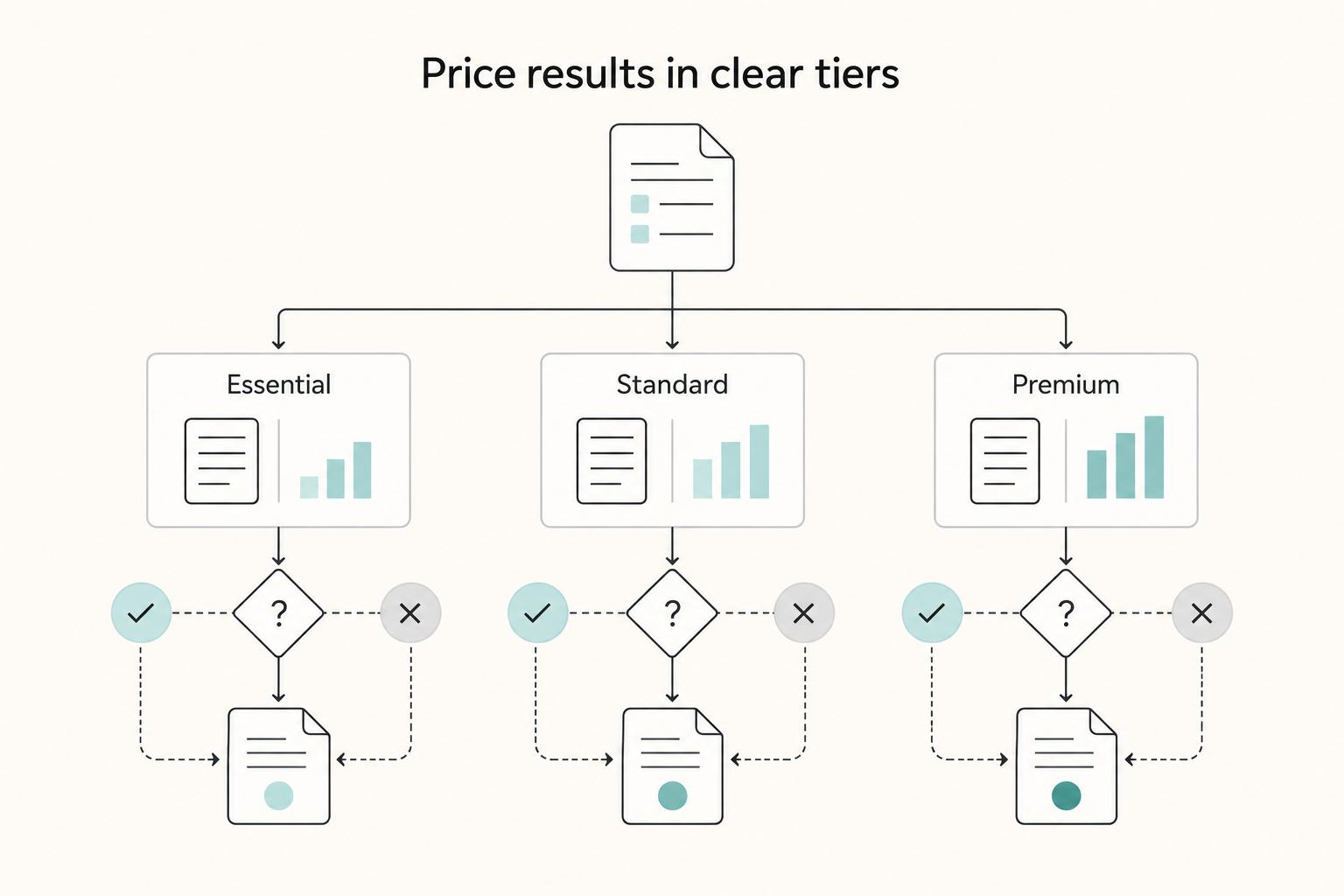
| Package tier | Scope boundary | Support level | Revision policy |
|---|---|---|---|
| Essential | Core deliverable only; add-ons require amendment | Basic delivery communication | Limited revisions; exact trigger defined in SOW |
| Standard | Core deliverable plus agreed support assets | Ongoing support during delivery | Revision rounds tied to milestones in writing |
| Premium | Expanded scope with deeper strategic involvement | Higher-touch support and handoff | Broader revision window, still bounded in writing |
Make scope visible and changes payable#
Your SOW is where margin protection becomes enforceable in practice. If scope is vague, assumptions fill the gaps and you absorb the cost.
Use this checklist in every proposal and SOW:
- In scope: named deliverables, milestones, and what each phase includes.
- Out of scope: items commonly assumed but not included.
- Acceptance criteria: what "done" means for each deliverable.
- Revision triggers: when feedback is a revision vs. new work.
- Approval path: who approves, how approval is recorded, and what happens if approval is delayed.
Watch for quiet expansion: "small tweaks" that become extra rounds, stakeholders, or timeline shifts. Route each scope change through a written change order with updated cost and timeline before additional work starts.
Keep the paper trail: final proposal, active SOW version, written approvals, and amendment history. That protects profit and sets up the next pillar on control.
We covered this in detail in How to Use Performance-Based Pricing for Your Freelance Services.
Pillar 2: Mitigate Control Loss and Command the Engagement#
You keep control by setting operating rules early, then enforcing them consistently. If Pillar 1 protects margin, this pillar protects your focus, your authority, and delivery pace.
Treat onboarding, payment terms, and communication rules as engagement governance, not admin. When they stay informal, clients fill the gaps with assumptions and you end up managing noise instead of progress.
Set authority during onboarding#
Use onboarding to lock in decision flow before production starts. Define the onboarding window based on project scope, then put the rules below in writing.
- Kickoff alignment: confirm business goal, success criteria, current scope, and exclusions.
- Role clarity: name who gives feedback, who consolidates it, and who signs off.
- Decision owners: identify final approver for scope, timeline, and budget changes.
- Channel rules: define which channel is used for formal feedback, urgent issues, and day-to-day questions.
- Escalation path: agree what happens when approvals stall, scope shifts, or blockers threaten delivery.
Your checkpoint is simple: if these items are not written into the SOW, proposal summary, or kickoff notes, your boundaries are still undefined.
Use payment terms to govern commitment#
Payment terms set engagement control points: when work starts, when it advances, and when it pauses. Start with the grounded baseline: 50% upfront payment on all projects.
In your commercial terms, state three items clearly: deposit policy, milestone billing, and pause-work triggers. Use the current deposit policy only after finance or contract records verify it. Tie remaining invoices to named milestones or approvals, and pause work when payment or approvals fall outside agreed terms. Do not start production before the signed SOW and initial payment are in place.
This is also non-payment risk control. Weak contract structure can turn into disputes, including refusal to pay a $20,000 invoice. Keep a project record: signed SOW, invoice schedule, proof of deposit, written approvals, and any pause/restart notices.
Turn communication into working agreements#
Most communication breakdowns come from unclear process. Your SOW should define how work is coordinated, not just what is delivered: approved channels, response-window expectations, feedback format, meeting cadence, and the change-request route.
When feedback arrives outside the agreed route, redirect it to the documented channel. That preserves traceability, protects version control, and stops informal comments from becoming unpaid scope.
| Reactive engagement pattern | Controlled engagement system | Business impact |
|---|---|---|
| Feedback is scattered across email, text, calls, and meetings | One documented channel for formal feedback, with clear use for other channels | Stronger focus protection and fewer missed instructions |
| Approvals depend on whoever responds first | Named decision owner and sign-off path in the SOW | More predictable cycle time and less deadline drift |
| "Quick changes" are handled informally | Change requests go through written amendment before work starts | Higher client trust through visible cost and timeline control |
Once these controls are in place, you stop renegotiating basics on every project. That sets you up for Pillar 3, where the same structure supports compliance-sensitive workflows across cross-border engagements.
If you want a deeper dive, read GDPR for Freelancers: A Step-by-Step Compliance Checklist for EU Clients.
Pillar 3: Mitigate the Catastrophic Loss of Non-Compliance#
Non-compliance risk is a cashflow risk. If you want invoices approved and paid without avoidable delays, run compliance as a system across four points: client onboarding, contract and invoice setup, tax and regulatory filing workflow, and cross-border payment execution.
Do not wait for year-end cleanup or an AP rejection to find gaps. Put checks at kickoff, invoice issue, and a recurring review point so pricing decisions hold up in real operations.
Classify the risk before it blocks payment#
At onboarding, confirm the client's legal billing details, invoice recipient, and required billing language in writing. If reverse-charge VAT handling may apply, verify the wording before work starts and store that confirmation with the project record.
At contract and invoice setup, match every invoice to what was agreed: legal name, billing address, currency, payment route, and required tax language. A correct fee can still be delayed if required fields are incomplete.
In tax and regulatory workflow, keep FBAR-ready records throughout the year. FBAR is the Report of Foreign Bank and Financial Accounts, and filing can be triggered when account maximums exceed a threshold that must be verified from current FinCEN source records before use. Keep records that support maximum account value calculations. Convert non-U.S. currency using the Treasury Financial Management Service rate when available, record values in U.S. dollars rounded up to the next whole dollar, enter 0 if a computed value is negative for item 15, and retain the source when another verifiable exchange rate is used.
In cross-border payment execution, control what you can document: invoice currency, who absorbs fees, and reconciliation between invoiced and received amounts.
| Common compliance miss | Immediate business impact | Control to implement |
|---|---|---|
| Billing details not verified at onboarding | Invoice rejection or AP hold | Collect legal entity, billing contact, address, tax details, and required invoice wording before kickoff |
| Reverse-charge VAT handling confirmed informally | Payment delay while corrections are requested | Validate wording early and keep written confirmation in the project file |
| FBAR records assembled late | Filing friction and weak documentation trail | Maintain statements, maximum-value calculations, exchange-rate source, and retention records during the year |
| Multi-currency handling decided at payment time | Short-paid receipts after conversion/fees | Define currency, payment method, fee allocation, and reconciliation check in writing |
Preventive controls to keep#
Use one checklist on every engagement:
- Client onboarding: collect billing entity, country, invoice recipient, relevant tax identifiers, and written confirmation of required invoice wording.
- Contract and invoice setup: ensure invoices mirror the SOW, agreed currency, payment terms, and verified tax language.
- Tax and filing workflow: retain statements, maximum account value workpapers, exchange-rate source records, and filing support documents (including Form 114a where relevant). Form 114a is retained by the filer and not sent to FinCEN.
- Review cadence and escalation: run scheduled compliance reviews and escalate unclear filing or cross-border treatment questions to a qualified advisor. In spouse e-filing flow, the BSA E-File process supports one digital signature, and if spouse filing conditions are not met, separate FBAR filings may be required.
This pillar protects the other two: your margin (Pillar 1) and your control of delivery (Pillar 2). When compliance steps are explicit and repeatable, pressure from loss aversion turns into decision rules you can execute.
For a step-by-step walkthrough, see How to apply 'Game Theory' to your freelance pricing and negotiations.
Your Pricing Isn't Just a Number; It's Your Risk Management Strategy#
Treat your price as a risk-management control, not a tactic to win a fast yes. When pricing is reactive, you usually increase the three losses that matter most in this article: profit loss, control loss, and compliance risk.
Pricing psychology can help, but it is not a shortcut. Before you send a proposal, define what is included, what is excluded, what triggers a change, which billing details you need at onboarding, and which invoice fields or tax wording must be verified before you send.
Framing and anchoring still matter, but they work best when your offer reduces uncertainty instead of masking it.
| Area | Reactive pricing decisions | Risk-managed pricing decisions |
|---|---|---|
| Scope handling | Quote quickly, clarify later | Define inclusions, exclusions, revision limits, and change triggers in the SOW |
| Payment protection | Focus only on the rate | Set payment terms in the proposal and confirm billing contact, entity, currency, and payment route at onboarding |
| Client control | Negotiate ad hoc in email/chat | Require written approval for scope changes and maintain one approved proposal + SOW version |
| Compliance workflow | Review paperwork after sending | Run an invoice pre-send check for legal name, currency, required wording, and filing or tax requirements verified from current source records |
Fear the right things by setting triggers before client conversations. If scope moves, issue a change order. If billing data is incomplete, pause the proposal or invoice. If a jurisdiction-specific requirement is unclear, verify the current rule and document it before submission.
Use this checklist on every engagement:
- Terms: payment timing, approver, invoice currency, fee responsibility
- Scope boundaries: deliverables, exclusions, revision count, change trigger
- Documentation: approved proposal, signed SOW, onboarding details, invoice record
- Compliance checks: legal entity name, billing address, required wording, and any current threshold or filing rule verified from source records before use
Related: How to Calculate Your Billable Rate as a Freelancer.
Frequently Asked Questions
Is fear of tax penalties a form of loss aversion?
It can be. Loss aversion is the tendency to avoid losses more strongly than we pursue gains, so fear can push rushed decisions. In this section, the practical move is to use a proposal checklist: set your anchor intentionally, keep offers to 2 or 3 options, and pause when client behavior raises red flags.
How do I build a pricing process that accounts for loss aversion and freelance pricing?
Use one repeatable sequence: set your first serious number on purpose, present 2 or 3 well-defined packages, and vet client behavior before the proposal goes out. That helps you avoid the common trap of opening too low and getting stuck in an underpriced pattern.
How should I use anchoring bias without sounding pushy?
Set the first serious number on purpose instead of letting an old rate or a client budget do it for you. In practice, present your strongest package first and keep the menu to 2 or 3 clear options, because too many choices can stall decisions. Also avoid pressure-heavy urgency tactics, which may drive action but can feel pushy.
What contract terms do the most work against scope creep?
This grounding focuses on pricing behavior, not legal contract requirements. The practical guardrail here is to keep package boundaries clear and avoid adding extra options that blur scope.
Should I choose hourly or value-based pricing?
There is no single model that is always best. The grounded guidance is to avoid low anchors, keep choices simple, and use a pricing format you can explain clearly without opening the door to underpricing.
How do I handle multi-currency projects without guessing?
Treat uncertain cost outcomes as unknown until verified, and keep your pricing decisions focused on clear anchors, simple offers, and client risk checks before you send a proposal.
What are the early warning signs that I am discounting for the wrong client?
Watch behavior more than promises. If a client pushes urgency, avoids clear decisions, or keeps asking for more and more options, tighten your process before you lower price. Loss aversion can make you ignore yellow flags, so use a simple rule: no proposal leaves until your package choice and pricing anchor are clear.
What should I review right before sending a proposal or invoice?
Before sending, check your anchor, keep the offer set to 2 or 3 options, and confirm the client’s behavior matches what they are promising. If red flags are still present, pause and fix the process before you send. Treat these answers as a checklist. The final step is to review anchor strength, choice simplicity, and client-risk signals together before the client ever sees the number.
Try a related tool
Researched and edited by the Gruv editorial team. Gruv builds cross-border billing, payouts, and finance-operations software for global businesses.
Sources
Includes 1 external source outside the trusted-domain allowlist.
- ash.harvard.edu/wp-content/uploads/2007/01/Full_Disclosure.pdftrusted
- bsaefiling.fincen.gov/docs/XMLUserGuide_FinCENFBAR.pdftrusted
- fincen.gov/reporting-maximum-account-valuetrusted
- fincen.gov/filing-spousetrusted
- ir.lawnet.fordham.edu/cgi/viewcontent.cgitrusted
- som.yale.edu/programs/phd/overview/marketing/yale-marketi...trusted
- web-docs.stern.nyu.edu/marketing/Website/Marketing%20Science%20Prog...trusted
- 2025.cswimworkshop.org/wp-content/uploads/2025/06/2025-CSWIM-Procee...external
Educational content only. Not legal, tax, or financial advice.
Related Posts

GDPR Compliance Checklist for Freelancers Working With EU Clients
Start by separating the decisions you are actually making. For a workable **GDPR setup**, run three distinct tracks and record each one in writing before the first invoice goes out: VAT treatment, GDPR scope and role, and daily privacy operations.
How to Calculate a Freelance Rate You Can Actually Get Paid On
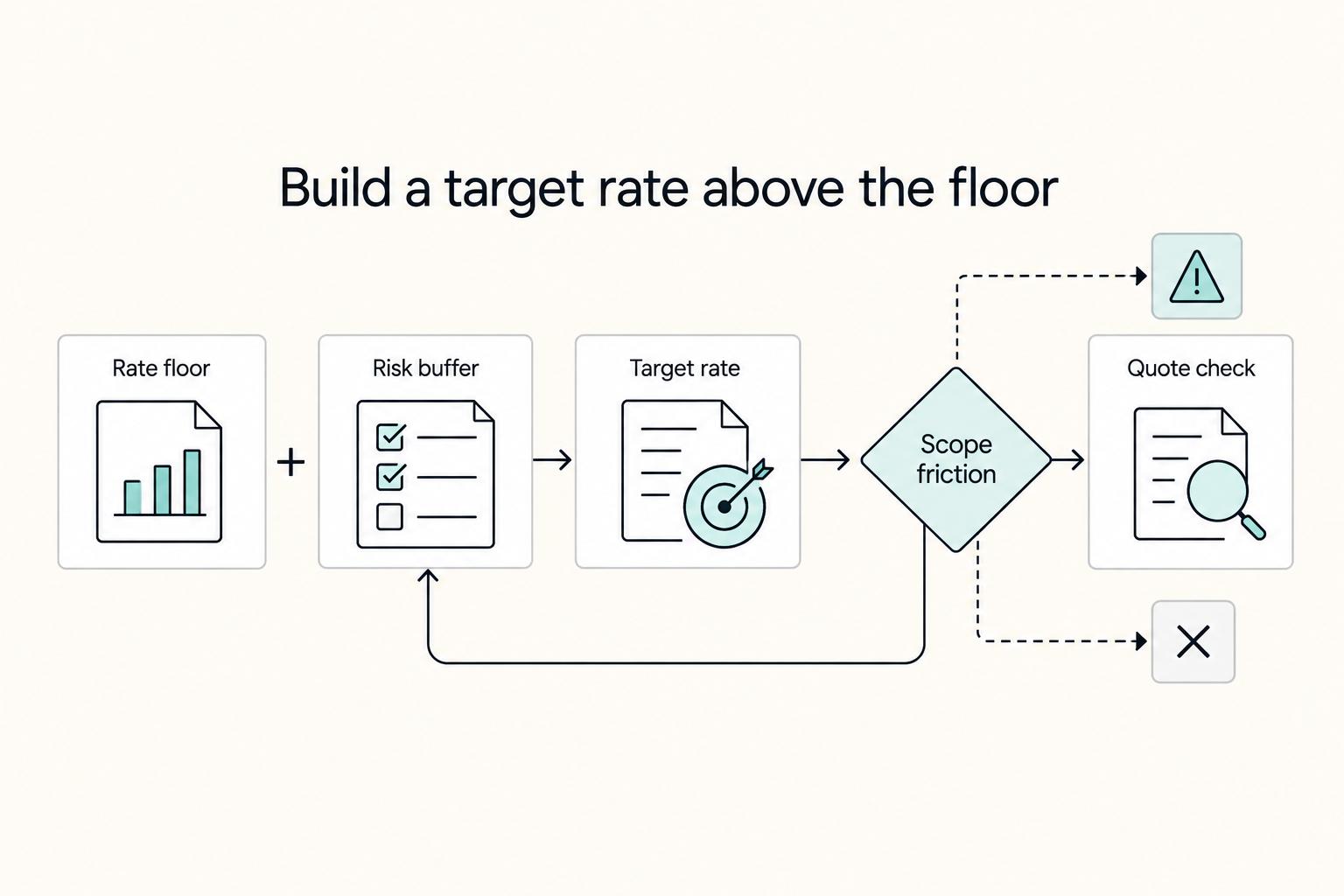
A workable rate is not the neat number a calculator produces. It is the number that still works after you account for real billable capacity, non-client time, scope drift, and the gap between sending an invoice and receiving cleared cash. Start with hourly math even if you do not plan to bill hourly, then turn that number into a quote with clear `payment terms`.
Using Nudge Theory in Freelance Proposals and Pricing
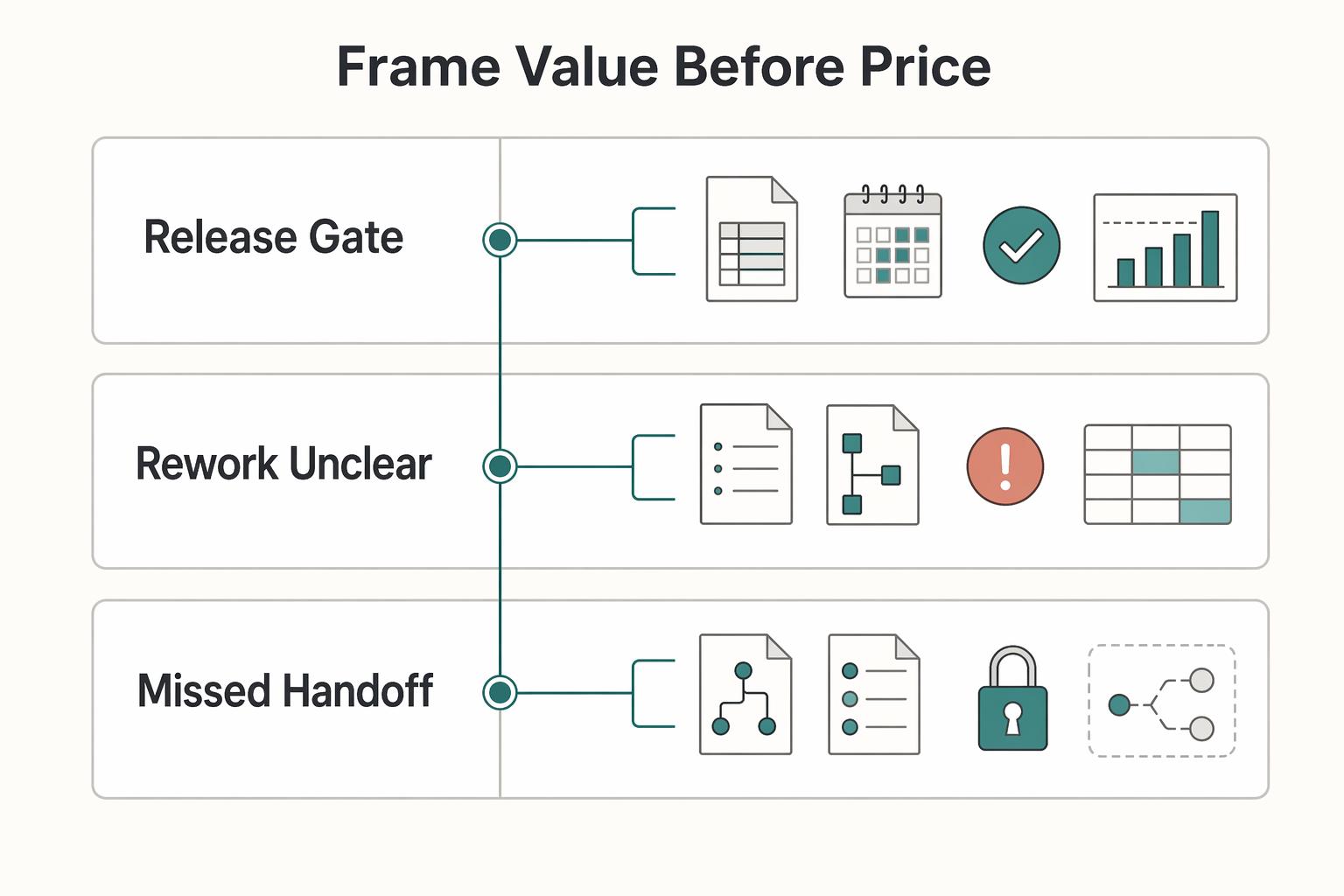
Treat pricing as protection, not just persuasion. In a solo business, price design helps protect your cashflow, your boundaries, and the odds that work gets approved and paid with less friction.