
Quick Answer
A tailored force majeure clause can help freelancers allocate extraordinary disruption risk. Define the event and prevention or impediment threshold, notice, mitigation and temporary relief. Preserve earned-payment duties and agree WIP, advance refunds, termination and handover. Routine client delays may need a separate clause. Relief depends on the signed wording and governing law.
Decide What Disruption Your Contract Should Cover#
A tailored force majeure clause allocates risk when an extraordinary disruption affects a specific contractual obligation. Whether it grants relief depends on the event, negotiated threshold, notice and governing law.
Read the threshold in your actual clause. Some clauses require prevention; others cover a qualifying impediment. Increased costs or a routine delay do not automatically excuse performance. Explain which obligation the event affects and why the required work cannot proceed under the agreed test. The wording and governing law determine the relief.
What should you check before you sign?#
Use three filters before you sign.
- What qualifies
Use events you can map to your real delivery risks. For international work, model clauses can include prolonged telecom, information-system, or energy breakdowns, and labor disruptions. Government orders or similar external disruptions may also be covered, depending on governing law and clause wording. If a cloud outage, client-side incident, or government action affects delivery, you should be able to point to wording that clearly fits.
- How notice works
Treat notice as a core requirement, not an admin detail. Define who gets notice, the required method, and expected timing. If the wording is broad, for example, "prompt" notice, set an internal rule in advance and keep evidence ready, such as outage notices, official orders, vendor status updates, ticket logs, and written client notifications.
- What happens next
Pre-agree the outcomes so you are not negotiating during a disruption. That can mean suspension, revised deadlines, contract modification, or termination of unperformed work. Also define payment treatment for work already approved or completed instead of assuming it.
| Drafting point | Weak boilerplate | Strong freelancer-safe intent |
|---|---|---|
| Trigger clarity | "Acts of God and similar events" | Specific events tied to how you actually deliver |
| Notice mechanics | "Notify promptly" | Written method, recipient, and timing expectations |
| Payment treatment | Silent on completed work | States how approved/completed work is billed and paid |
| Post-event options | Silent after delay | Clear path to pause, modify scope, or end unperformed portions |
The ICC 2020 model covers qualifying events that prevent or impede performance; it does not universally require absolute impossibility. It combines a general test with listed events carrying rebuttable presumptions. A list entry alone is insufficient: inability reasonably to avoid or overcome the effects still matters. The model applies when incorporated or used in your agreement, not automatically because a client is overseas.
For a related example, see A deep dive into the 'force majeure' clause when your client is in a politically unstable region.
Draft Triggers, Notice and Outcomes Together#
A good clause should read like a decision rule, not a dramatic event list. It should tell you what qualifies, what does not, what proof is required, and how payment and ownership are handled if work pauses or ends.
Choose a threshold appropriate to the project and define the affected obligations. A prevention standard is a possible negotiated choice, not the only legal formulation. Allocate routine delivery risks separately: an ordinary broken laptop may call for backup equipment, while loss of the only authorized client environment may call for a client-dependency extension.
Should this trigger be in the clause?#
Before you add a trigger, run both tests.
- Inclusion test
For a general event test, address these three points. If you adopt a model with presumptions for listed events, keep its burden-of-proof structure clear:
- outside reasonable control
- not reasonably foreseeable at signing
- effects could not reasonably be avoided or overcome
- Exclusion test
Usually do not include the trigger if it is mainly:
- routine equipment failure, staffing gaps, weak subcontractor management, or poor backup planning
- cost increase, inconvenience, or delay where performance is still possible
- a subcontractor problem without evidence satisfying the agreed test for both your performance and the subcontractor’s disruption
If you write broad phrases like "any outage" or "any cyber event" without causation language, you blur force majeure with normal operational risk.
How should you draft the three modern risk buckets?#
For infrastructure outages, identify the project’s critical systems and the disruption threshold you choose. If relief requires prevention, show that the outage blocked the required systems or communications; if it permits a qualifying impediment, explain that impact. Preserve provider notices, tickets, timestamps, failed access and attempted workarounds.
| Risk bucket | Clause focus | Threshold or evidence |
|---|---|---|
| Infrastructure outages | Prolonged breakdowns of transport, telecommunications, information systems, or energy that are actually critical to the project | Show impact meeting the negotiated prevention or impediment threshold; preserve logs, provider notices and mitigation attempts |
| Client incidents and dependencies | Separate qualifying security disruption from late approvals or revoked access controlled by the client | Record the blocked task and instruction; apply the force majeure or client-delay clause that actually fits |
| Geopolitical or regulatory disruption | Use concrete categories such as compliance with law or governmental order, sanctions, expropriation, seizure, requisition, or nationalisation | Tie the event to the affected obligation and chosen threshold; higher costs alone do not establish relief |
For client incidents, distinguish an extraordinary external event from a client-controlled dependency. Revoked access, late approvals or a voluntary shutdown may belong in a separate client-delay clause with an extension and agreed standby or restart costs. A security incident does not automatically excuse either party. Identify which event meets the chosen threshold and preserve the written access or shutdown instructions.
For geopolitical or regulatory disruption, name the risks relevant to the project, such as sanctions or government orders. Identify which obligation is blocked or impeded under your chosen test, and whether the required action has become unlawful. A more expensive route or less profitable project is not automatically grounds for relief.
What separates boilerplate from defensible drafting?#
| Drafting point | Weak boilerplate | Defensible clause language |
|---|---|---|
| Trigger definition | "Acts of God and events beyond control" | Named events plus: outside reasonable control, not reasonably foreseeable, and effects cannot reasonably be avoided or overcome |
| Causation | Silent | Identify the specific obligation and the negotiated prevention or impediment threshold |
| Notice | "Prompt notice" | Written notice without delay, named recipient/method, affected obligations, expected duration, mitigation steps, supporting records |
| Payment treatment | Silent or inconsistent | States what remains payable for approved/completed work and whether payment duties are carved out or preserved |
| Ownership outcome | Silent | States ownership of paid deliverables, rights in unpaid/incomplete work, and any temporary license during suspension |
Specify the notice obligation and its consequences. Do not assume every late notice destroys all relief. Under the ICC model, delayed notice changes when relief takes effect; a different contract can set different consequences. Send through the required channel promptly, retain delivery evidence and update the facts without waiting for a complete incident report.
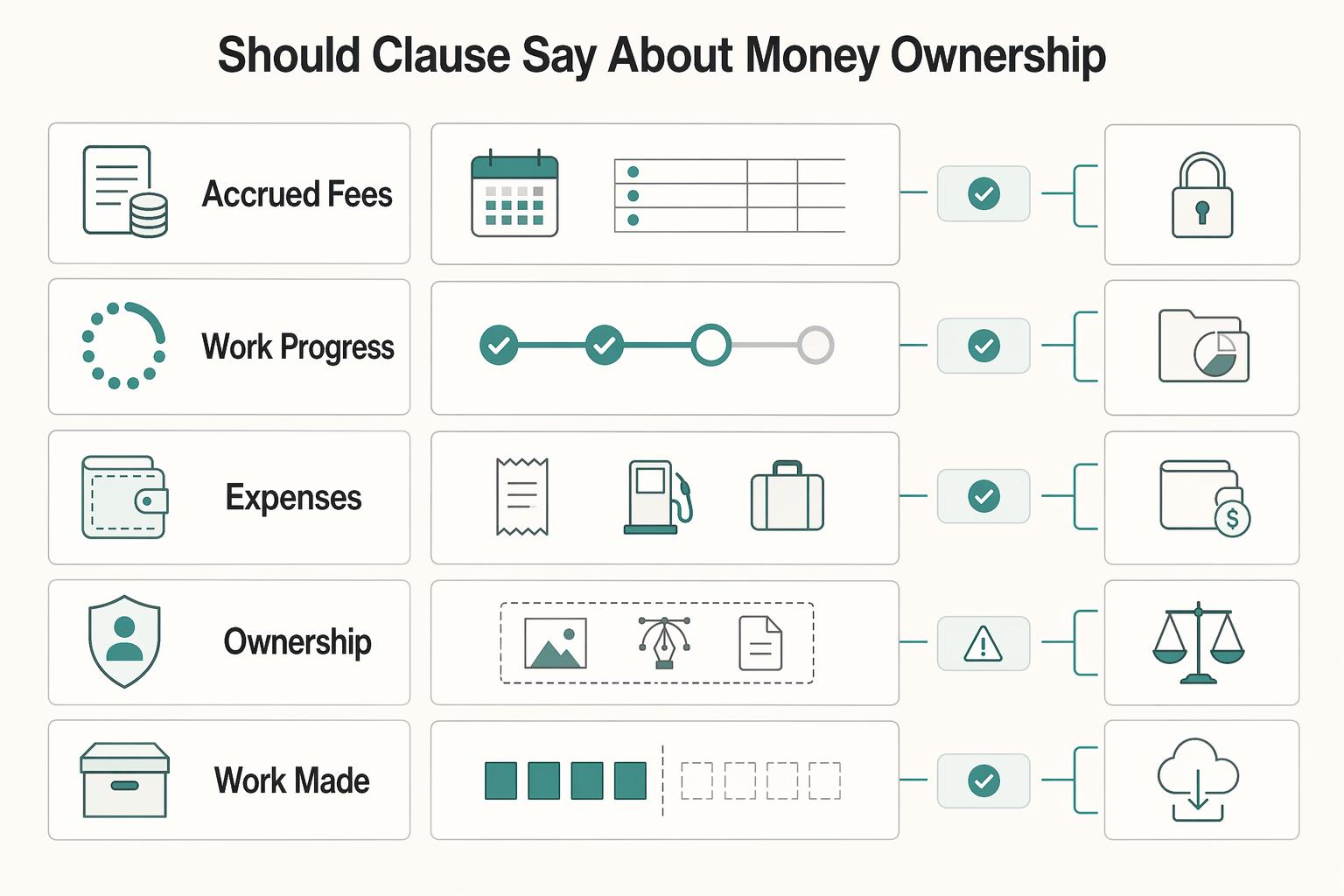
What should the clause say about money and ownership?#
Do the money and handover work in the same clause set, not as an afterthought.
| Issue | What to state in the contract |
|---|---|
| Accrued fees | State which earned fees remain payable, their contractual due date, and whether unrelated payment duties are excluded from disruption relief |
| Work in progress | Whether partial work is billable by milestone value, time-and-materials value, or acceptance only |
| Expenses | Whether non-cancellable third-party costs incurred before notice are reimbursable |
| IP ownership | Keep force majeure language consistent with the contract's IP clause so one clause does not override the other by accident |
| Work-made-for-hire check (US) | Under U.S. law, valid work-made-for-hire status affects initial ownership; commissioned freelance work needs statutory category fit and an express signed agreement, not just a label |
| Suspension access | Whether the client may use paid deliverables during a pause and what happens to repo or account access on termination |
Illustrative payment allocation: a $6,000 project has a $2,000 accepted first milestone and a second milestone billable only on acceptance. The client has paid a $3,000 advance when disruption ends the project. If the contract also reimburses $300 of approved non-cancellable costs, earned charges total $2,300 and the remaining $700 advance is refundable. Unaccepted work is not automatically worth a percentage of the milestone. Agree any separate WIP valuation in writing and avoid charging costs already included in the fee twice.
Invoke Relief and Agree the Temporary Plan#
When disruption hits, your job is to protect relief and preserve trust at the same time. The defensible sequence is simple: verify trigger fit, send contract-compliant notice, document causation and mitigation, then propose a temporary operating path.
How do you invoke the clause in practice?#
- Confirm trigger fit before you invoke force majeure
Read the actual clause and match the event, affected obligation and required threshold. Show that this event caused the disruption rather than merely coincided with an existing delay. Under New York law, the Kel Kim judgment illustrates narrow interpretation: inability to obtain required insurance did not fit the listed events or their catch-all. That case does not turn every freelance contract into the same event list.
- Send notice exactly as the contract requires
Use the contract’s recipient, method and timing. State the event, start date, affected obligations, impact, mitigation and relief requested. Send an initial notice with reliable facts and a date for the next update; do not delay notice while preparing options. Check the clause’s actual consequences for late or undelivered notice rather than assume all relief survives or all relief is lost.
- Document operational impact so a third party can verify it
Tie the event to blocked performance, not general disruption. Keep records as they happen: access failures, outage logs, revoked credentials, written instructions, and task-level impact notes.
- Propose a temporary operating path
Offer a temporary plan alongside, or shortly after, the initial notice. Continue unaffected work where required. A scope reduction, price change or reassignment needs the contractual right or the other party’s agreement; invoking force majeure alone does not rewrite the statement of work. Set an update date and document how resumed performance will be scheduled.
What should the notice say, and what should it avoid?#
What to say
- Clause reference and invocation basis.
- What happened, when it started, and which obligations are blocked.
- What you already tried to avoid or overcome the impact.
- What temporary relief you are requesting and when you will update next.
What to avoid
- Blame language or an adversarial tone.
- Broad claims like "everything is impossible" unless that is true.
- Statements that prematurely concede breach while legal excuse is still being evaluated.
What evidence do you need to prove the event, causation, and mitigation?#
| Proof category | Keep this | Why it matters |
|---|---|---|
| Source of event | Official notices (government/provider/client), dated screenshots/PDFs, source URL | Shows the event existed and when it started |
| Proof of inability to perform | Revoked-access emails, failed-login logs, outage notices, timestamped service failures tied to specific tasks | Shows the event caused non-performance |
| Proof of mitigation attempts | Support tickets, alternate-access attempts, resequencing proposals, workaround communications | Shows you tried to avoid or overcome consequences |
Preserve the signed contract version, original notices, delivery receipts, logs and dated client instructions. A timestamped email helps prove what was sent, but it does not automatically satisfy a notice clause requiring another method. Send through the agreed channel and keep evidence of receipt where the clause or law requires it.
Keep sale-of-goods rules in their proper scope. The CISG and UCC sales provisions are not automatic authority for a freelance services agreement. Use the contract’s governing law and actual relief clause for this analysis.
Which commercial path does the contract actually support?#
Once notice is out and the evidence trail is clean, choose the commercial path the contract actually supports.
| Path | When it fits | What to confirm |
|---|---|---|
| Pause | The disruption is temporary and the contract allows suspension or extension | What remains payable for completed or invoiced work |
| Reduce scope | Only part of the work is blocked | Obtain an agreed scope and price amendment unless the contract already supplies the right |
| Reassign or resequence | Priorities can shift without breaking deal economics | Document the revised sequence in writing |
| Terminate | An express duration or deprivation-of-benefit termination test is met | Check accrued fees, reimbursable expenses, handover duties, access controls, and IP terms in the contract |
Example: a client’s required environment is unavailable for three days, but research can continue offline. Notice identifies the blocked deployment task, records failed access and proposes research now with deployment after recovery. If the client requests a smaller final deliverable, record the new scope and fee separately. Do not treat that request as an automatic effect of the outage.
Use the Freelance Contract Generator to organize a draft, then check the event threshold, notice, payment and IP terms together. A generator does not establish that a particular event qualifies or that the chosen wording is enforceable.
Close the Project With Payment and Handover Records#
If the temporary path from Part 2 no longer works, treat termination as a controlled process, not an improvised email thread. Force majeure does not automatically cancel the contract. The clause text controls whether obligations are suspended, excused for the impediment period, terminated, or split across those outcomes.
How do you off-board the project cleanly?#
- Confirm the legal end state first
Read force majeure, termination, notice and payment clauses together. Check the duration or other termination test and whether a further notice is needed. The ICC model’s 120-day default is a model term that parties can alter; it is not a universal freelancer deadline. Resume and notify when the impediment ends unless the contract has validly ended.
- Issue a dispute-resistant final invoice checklist
Build the invoice from records, not memory. For each line item, include:
- Scope map: statement of work, milestone, change order, or time record.
- Contract basis: clause reference supporting the charge.
- Acceptance status: delivered, accepted, pending acceptance, or interrupted by the event.
- Reimbursables: separately itemized and marked as approved where applicable.
- Due date: use the agreed payment deadline or applicable statutory rule; an internal review or closeout checklist does not postpone an existing payable.
Where UK commercial late-payment rules apply, agreed periods are usually within 60 days for business transactions and 30 for public authorities. A longer business period must be fair. Without an agreed date, payment becomes late 30 days after invoice receipt or provision of the goods or services, whichever is later. These rules do not automatically apply to every international client.
- Separate deliverable transfer from IP transfer
Under U.S. law, copyright generally starts with the author, with valid work-made-for-hire status as an important exception. File delivery and copyright ownership are separate. A voluntary transfer ordinarily needs a signed writing by the owner or authorized agent. Read the existing assignment or license: if rights have already vested, unpaid invoices do not automatically take them back. A payment-conditioned assignment operates according to its agreed condition; work-made-for-hire ownership is not postponed merely because payment is late.
- Document completion with two records
Create:
Delivery log: asset name, version or folder, send date, channel, and receipt confirmation.Access-revocation record: each repo, workspace, or system, action taken, timestamp, and notification recipient.
What should your handover record cover?#
| Asset category | Transfer condition | Proof of delivery |
|---|---|---|
| Final deliverables | Perform the agreed delivery duties; apply a payment condition only if the contract supports it | Dated asset list and delivery receipt |
| Unpaid or incomplete work | Follow interim delivery and return duties; label WIP; retain only what you are entitled to retain | WIP status and contract basis for any retained files |
| Source code and editable masters | Deliver if included in scope under the agreed conditions; identify pre-existing or third-party material separately | Repository transfer or archive receipt plus rights schedule |
| Client credentials, data and access | Return client property, transfer account control safely and revoke your own access when authorized | Ownership-change confirmation and access log; no lockout of client-owned systems |
What should the closing message include?#
Use one neutral message with four parts:
- Legal confirmation: clause reference plus prior notice reference.
- Financial next step: final invoice attached with due-window language.
- Handover confirmation: what was delivered, with the delivery log attached.
- Professional sign-off: brief regret about circumstances, appreciation, and willingness to resume if conditions later allow.
We covered this in detail in Limitation of Liability Clause for Freelance Software Developers.
Check the Clause Before the Next Signature#
A clause earns its place only if it is operational. It should define the impediment test, require prompt written notice, and state what happens during a temporary block. It should also spell out what is paid, delivered, or withheld if the project cannot continue.
Tailor the event test to the actual dependencies, then negotiate the consequences while both parties can still plan. Routine client delay, ordinary equipment failure and extraordinary disruption may need different clauses. Keeping those routes clear helps avoid an unsupported suspension or a closeout dispute.
Does your current clause pass a quick checkpoint?#
Run a yes or no check on your current clause:
- Trigger test
Does the clause identify the affected obligation, its prevention or impediment threshold, and the control, foreseeability and mitigation requirements it actually uses?
- Notice rule
Does it require written notice without delay, and do you already know the channel, recipient, and supporting records you would send? If notice is late, relief timing can shift.
- Temporary effect
Does relief last only while the qualifying impediment affects the relevant performance, with a process to notify the other party when work can resume?
- Payment terms
Does it expressly state what happens to payment for completed work, approved expenses, and partially performed milestones? Do not assume payment is always excused or always preserved.
- Suspension and end-state
Does it state whether the non-affected party can suspend related obligations after notice, and how prolonged impediments are handled under your contract's termination wording?
If any answer is "no," revise before your next signature. Start with trigger and payment wording, then tighten notice and suspension or termination mechanics. If you need help rewriting the clause itself, use this Gruv guide on drafting for pandemics and geopolitical events.
For a step-by-step walkthrough, see How to Write a Limitation of Liability Clause for a Freelance Contract.
If you want your contract protections and payment operations to stay aligned as you grow cross-border, review Gruv for Freelancers to see what coverage is available for your setup.
Frequently Asked Questions
Does a freelancer need a force majeure clause?
It can help allocate extraordinary disruption risk, particularly where the project depends on client systems or international access. Tailor the trigger, notice and consequences to the work and governing law. Routine client delays may need a separate dependency clause.
Does an outage automatically excuse delivery?
No. Match the outage to the agreed event test and show its effect on the specific obligation, including available workarounds. Some clauses require prevention and others permit a qualifying impediment. Continue unaffected work where required.
Can I reduce scope after sending notice?
Only if the contract grants that right or the client agrees. Notice does not itself amend the deliverables or price. Put the revised scope, fee and delivery dates in an amendment.
What happens to a client advance when the project ends?
Apply the agreed earning and refund terms. In the example here, a $3,000 advance less $2,000 of earned work and $300 of separately approved costs leaves $700 refundable. Do not automatically bill unaccepted milestones or charge included expenses again.
Can I withhold all files until payment?
Check the contract and existing rights. A valid payment condition can govern release, but unpaid fees do not automatically reverse vested copyright or authorize withholding client property. Follow delivery, return and access duties separately.
Does force majeure automatically terminate the agreement?
No. Apply the contract’s duration or other termination test and required notice. Temporary relief can end when the qualifying disruption ends. Model-clause deadlines apply only as agreed.
Try a related tool
Researched and edited by the Gruv editorial team. Gruv builds cross-border billing, payouts, and finance-operations software for global businesses.
Sources
Includes 4 external sources outside the trusted-domain allowlist.
- copyright.gov/circs/circ30.pdftrusted
- law.cornell.edu/uscode/text/17/201trusted
- law.cornell.edu/uscode/text/17/202trusted
- gov.uk/late-commercial-payments-interest-debt-recoveryexternal
- iccwbo.org/wp-content/uploads/sites/3/2020/03/icc-force...external
- iccwbo.org/business-solutions/model-contracts-clauses/i...external
- openjurist.org/70/ny2d/900external
Educational content only. Not legal, tax, or financial advice.
Related Posts

The Freelance Payment Penalty: A Modeled Audit of Platform Fees, FX Spreads, and Payout Delays
The money rarely disappears through a single, easy-to-spot fee. The real loss is stacked. A marketplace takes its commission, a processor adds a charge for international cards, a bank or payment company converts the currency at a spread, a platform holds the funds before release, and a wire sheds a little to intermediaries on the way in. Each layer looks defensible on its own, but the worker feels the combined result as a smaller deposit and a later payday.

How to Respond to a Subpoena for Business Records
Move fast, but do not produce records on instinct. If you need to **respond to a subpoena for business records**, your immediate job is to control deadlines, preserve records, and make any later production defensible.

A US Expat's Guide to Investing in UCITS ETFs to Avoid PFIC Issues
The real problem is a two-system conflict. U.S. tax treatment can punish the wrong fund choice, while local product-access constraints can block the funds you want to buy in the first place. For **us expat ucits etfs**, the practical question is not "Which product is best?" It is "What can I access, report, and keep doing every year without guessing?" Use this four-part filter before any trade: