
Quick Answer
Yes - file Form 8288-B right after contract signing when the standard holdback on amount realized is likely above your projected tax on gain. Send written notice to the buyer on the day of or day before transfer, because that notice controls whether pending-application timing is available. Withholding still occurs at closing, so confirm buyer and seller TINs, proof of filing, and who will handle Forms 8288 and 8288-A before funds are released.
Phase 1: Confirm status, estimate exposure, and decide on a withholding certificate#
Treat FIRPTA withholding as a pre-listing cash-flow decision, not a closing surprise. It is a required prepayment collected by the buyer, not your final U.S. tax bill. Before you reach contract stage, confirm your status, estimate exposure, and decide whether a withholding-certificate application belongs in your plan.
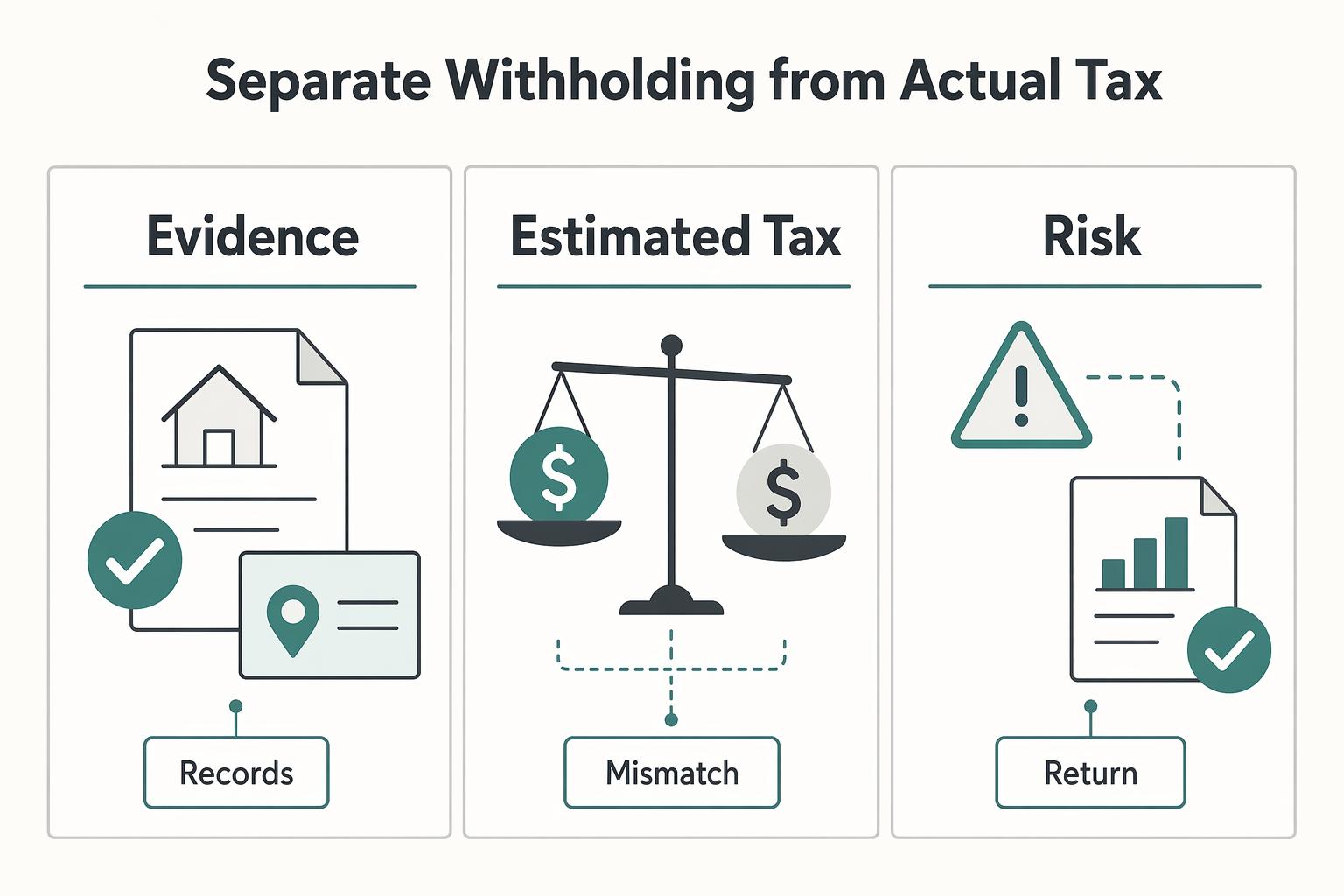
Separate withholding from actual tax#
Start here, because this is where many sellers misread the risk. If you are treated as a foreign person selling a U.S. real property interest, the buyer (transferee) must withhold 15% of the amount realized. That withholding is transaction-driven, and buyers may default to it because they can be liable if it should have happened and did not.
Your actual tax liability is separate. It is tied to tax on gain when you file the U.S. return for the sale. Those numbers can differ, and withholding does not remove the return-filing obligation. If withholding is higher than the tax on gain, the excess is generally recovered through the return process, and eligible transactions may use certificate mechanics to reduce withholding earlier.
Use at-risk capital as a planning term, not an IRS legal term. It means cash that may be tied up because required withholding can be disconnected from what you expected to receive at closing.
| Planning line | How to fill it in | Your figure |
|---|---|---|
| Gross sale / amount realized | Verified contract sale price and other closing consideration | Amount pending closing record review |
| Estimated gain | Estimate from purchase records, improvements, and selling costs, reviewed before contract | Amount pending seller/adviser record review |
| Estimated tax | Estimated gain × current rate pending official IRS/source/adviser verification | Amount to confirm using the current IRS rate |
| At-risk capital | Expected withholding minus estimated tax | Amount pending withholding and estimated tax review |
If that at-risk capital is meaningful for your liquidity, make the certificate decision before listing, while you still have time to gather records and set expectations.
Confirm whether you are treated as foreign or U.S.#
Status is your first control point. IRS rules define a foreign person to include nonresident alien individuals and specified foreign entities. A transferor treated as non-foreign can provide a non-foreign status certification so withholding is not required. Do this status check before listing.
| Situation | What to confirm |
|---|---|
| Treated as a U.S. person | Confirm you can document it |
| Individual status is not obvious | Verify whether you are treated as a nonresident alien for U.S. tax purposes |
| Ownership is through a foreign corporation, partnership, trust, or estate | Assume added review |
| Plan to claim non-foreign status | Verify you can provide the required certification |
| Status is mixed, recently changed, or uncertain | Escalate to a qualified tax advisor before listing |
Make Form 8288-B your main decision checkpoint#
If you expect a 15% holdback to exceed your likely tax on gain, your main decision point is usually a withholding-certificate application on Form 8288-B. This is the IRS process to reduce or eliminate withholding when the facts support relief.
Timing and completeness drive outcomes. IRS says it generally acts within 90 days of a complete application, and completeness includes TINs for all parties. That makes the pre-listing work straightforward: prepare early, then file quickly after contract execution.
Before contract stage, verify these points:
- Your TIN status is ready.
- Your gain estimate is supportable from records.
- Buyer-side and escrow contacts are identified.
- You are prepared to give written notice to the transferee on the day of, or day before, transfer if you filed.
Keep the execution point clear. With a timely pending 8288-B at disposition, withholding is still required, but immediate remittance to the IRS is not.
Treat exemptions as secondary and conditional#
Exemptions can help, but only when the facts and documents line up exactly. Treat them as a verified exception, not a fallback assumption.
| Use exemption when | Cannot rely on exemption when |
|---|---|
| Buyer acquires for residence use and verified conditions are met, including the IRS-listed $300,000 threshold path | Buyer is an investor or residence intent is unclear |
| Buyer's occupancy intent meets the 50% test during each of the first two 12-month periods | You cannot document the required conditions |
| You have confirmed current rule branch and thresholds before closing | Team is assuming eligibility without verification |
There is also a regulation-cited reduced-rate path tied to residence-use conditions and an amount realized not exceeding $1,000,000, where 10% is cited. Verify current paragraph (b)(2) conditions before relying on that rate. For broader context, read the digital nomad tax guide.
Phase 2: The Proactive Execution (Your Under-Contract Project Plan)#
Once the contract is signed, speed matters. Your goal is to keep withholding compliant while avoiding a remittance to the IRS before the certificate decision if the rules allow that path.
Execute immediately after contract signature#
Your trigger is the signed purchase agreement. Once that happens, do not wait for closing week. Run this sequence right away:
| Action | Key detail |
|---|---|
| File Form 8288-B | As early as practical after contract signing |
| Submit a complete package | Keep the IRS's general 90-day processing window in play |
| Include core deal fields | Expected transfer date, contract price, and adjusted basis |
| Support tax-liability position | If maximum tax liability is below required withholding, include a supportable estimate and the records behind it |
| Verify third-party facts in writing | Attach that party's written verification signed under penalties of perjury |
If you track timing internally, keep it explicit: file 8288-B early, then mark the processing window as pending until it is confirmed from current official IRS, source, or qualified tax adviser records.
Build your filing checklist by document type#
A thin package invites delay and can be rejected if requested information is not provided promptly. Build the file by document type so each part of the reduction request is easy to support.
| Document group | Include | Why it matters |
|---|---|---|
| Contract evidence | Signed purchase agreement, expected transfer date, contract price | Supports core Form 8288-B transaction fields |
| Basis support | Purchase closing statement, capital improvement records, adjusted basis support | Supports gain and tax-liability position |
| Tax estimate support | Calculation showing why maximum tax liability is below required withholding, plus prior U.S. return history tied to the property for the prior 3 years if applicable | Supports the reduction request |
| Identity and tax ID details | Your TIN, buyer TIN, legal names, ownership/entity details | Supports completeness and matching |
If basis records, prior return history, or tax-status facts are incomplete, escalate before filing rather than sending a partial package.
Lock role ownership and handoffs#
This goes more smoothly when each party knows exactly what they own before closing pressure builds. That is especially true if basis records are incomplete, prior return history is thin, or tax-status facts need extra review.
| Party | Responsibility |
|---|---|
| You (transferor) | Provide facts, records, signatures, and notices |
| Buyer (transferee/withholding agent) | Remains responsible for withholding compliance and may be liable if withholding is missed |
| Escrow/title/closing attorney (settlement side; may be a qualified substitute in defined contexts) | Handles closing mechanics and may have withholding-related responsibilities, depending on role |
| Tax preparer/advisor | Prepares the 8288-B package, confirms sign-off authority, and responds quickly to IRS follow-up |
Use a written communication protocol after filing#
After filing 8288-B, move the deal into a written notice process. That is what keeps the closing team aligned if the certificate is still pending when you reach disposition.
- Send written notice to the buyer and escrow or closing contact that you applied for a withholding certificate.
- Share proof: filed 8288-B copy, submission proof, and a short cover note with the property, buyer, expected closing date, and withheld amount pending IRS action.
- Obtain written confirmation from the buyer or closing side that notice was received, withholding still applies at disposition, and remittance and reporting timing will follow current IRS rules.
As a baseline, Form 8288 is generally due by the 20th day after disposition. If a timely 8288-B was pending at disposition, withholding still applies. Reporting and payment are due within 20 days after the IRS mails the certificate or denial.
Bring in a specialist before closing when risk is critical to execution#
Do not wait for closing week if the file is fragile. Escalate before closing if any of these apply:
- Basis records are incomplete, reconstructed, or disputed.
- Tax status is uncertain.
- Ownership is through a foreign entity, trust, estate, or mixed structure.
- Your filing depends on third-party fact verification for key items.
Before you go under contract, tighten your documentation workflow with the W-8 Form Generator so your tax profile is ready for escrow and advisor review. Related: 183-Day Rule Explained: Stop the Tax Myths Before They Cost You.
Phase 3: The Controlled Closing (Managing the Final Mile)#
By closing, this is an execution job. Run the withholding process as a checklist. Confirm written notice, confirm how withholding will be handled, and confirm who files what before funds move. The buyer is generally the withholding agent, and missed withholding can leave the buyer liable.
Closing checklist before you sign#
Do not let these items get scattered across email threads. Send one dated packet to the settlement side and copy the buyer, and buyer's counsel if applicable.
- Cover note with property, transfer date, contract price, seller name, buyer name, and confirmation that Form 8288-B was filed
- Proof of filing plus a copy of the filed Form 8288-B application
- Written notice to the buyer that a withholding certificate was applied for, sent on the day of or day before transfer
- Instructions for both paths: certificate received before closing vs. certificate still pending
- Forms 8288/8288-A reporting path, including buyer and seller TIN status
- Timing line: Form 8288 is generally due by the 20th day after disposition; if 8288-B was submitted on or before disposition and is pending, withholding still applies at transfer, and reporting/payment are due within 20 days after the IRS mails the withholding certificate or denial
- Release trigger language for when the IRS mails the withholding certificate or denial
- If a closing attorney/title company is acting as a qualified substitute in a permitted context, the required penalties-of-perjury statement about possession of the certification
Who gets notice and what must be confirmed#
At minimum, written notice that a withholding certificate was applied for must go to the buyer (transferee) on the day of or day before transfer. You can also copy the buyer's attorney, the settlement contact handling closing statements or wires, and your tax preparer if they are supporting closing.
Keep the message focused on four points. State that Form 8288-B was filed. State that withholding still applies at transfer if the certificate is pending. State that pending-application timing treatment is being used, if applicable. State who is responsible for Forms 8288/8288-A and handling the withheld amount.
Before closing, get written acknowledgment confirming receipt, buyer withholding-agent understanding, and filing responsibility.
Closing path and release trigger#
| Situation | Required action before funding | Where withheld funds are handled | Next trigger |
|---|---|---|---|
| Withholding certificate received before closing | Deliver certificate to buyer/settlement side and confirm reporting instructions | Handled based on the certificate and closing instructions | Close and report under certificate terms |
| Form 8288-B timely filed and still pending at closing | Confirm buyer received required written notice by day of/day before transfer; confirm withholding still occurs at transfer; confirm pending-application timing treatment | Document handling in closing instructions while IRS action is pending | IRS mails certificate or denial; reporting/payment due within 20 days after mailing |
| No timely application, or filing proof cannot be verified | Do not use pending-application timing treatment; follow standard path | Handled under standard withholding/reporting process | Form 8288 generally due by 20th day after disposition |
Compliance-first cash-flow framing#
Treat this as a process question, not an aggressive timing play. If timely filing and notice are documented, withholding still applies but reporting and payment timing can follow the pending-application rule. If they are not documented, the default Form 8288 timeline usually controls.
Escalate immediately in closing week if any of this appears#
Closing problems are usually obvious before they become expensive. Escalate immediately if any of the following shows up:
- Conflicting instructions on pending-certificate handling
- Missing or unprovable Form 8288-B filing confirmation
- No clear owner for Forms 8288 and 8288-A
- Missing buyer or seller TIN
- Settlement statement does not clearly show withheld amount handling
- Unresolved disagreement on who handles withheld funds pending IRS action
- Late switch to an exception theory without written support
If any item is unresolved, involve a qualified tax professional before closing. For a step-by-step walkthrough, see How to Apply for a Withholding Certificate to Reduce FIRPTA.
Conclusion: You Are in Command of Your Capital#
Treat FIRPTA withholding as a withholding rule, not your final tax outcome. Under IRC section 1445, withholding applies to the amount realized at disposition, and your final U.S. tax liability is determined later on your U.S. return.
Assess: Confirm whether FIRPTA applies to your deal. Pressure-test the general 15% withholding against your expected maximum tax liability. Verify that buyer and seller TINs are ready for Forms 8288 and 8288-A. If your documentation is incomplete, closing risk rises.
Execute: Choose and document the remittance path before closing. If you apply for a withholding certificate on Form 8288-B, file a complete package and notify the transferee in writing on the day of or the day before transfer. A pending 8288-B does not remove withholding at closing. It changes when withheld funds are reported and paid.
Control: Confirm responsibilities and deadlines in writing. The buyer is generally the withholding agent, so get alignment on Forms 8288 and 8288-A. Confirm the standard Form 8288 timing of the 20th day after disposition. Also confirm the alternate timing when a timely 8288-B is pending, which is 20 days after the IRS mails the certificate or denial notice. Confirm how excess withheld funds may be released or credited, and retain Form 8288-A for your return credit.
Use this pass/fail close-readiness check before funds move:
- Pass: 8288-B status is clear, filed if applicable, and supported by complete documents.
Fail: application status is unclear, missing, or dependent on unresolved records.
- Pass: buyer and escrow/settlement instructions are in writing and consistent.
Fail: instructions are verbal, incomplete, or conflicting.
- Pass: your excess-funds path is clear, including any potential release path and the return-credit path.
Fail: no one can state how funds may be released or how credits are claimed.
If your deal includes entity ownership, partnership, trust, or corporate structures, special transaction mechanics, or unresolved documentation gaps, escalate to a qualified tax professional now.
You might also find this useful: How to Invest in Real Estate as a Digital Nomad.
If your sale involves cross-border payout timing or compliance handoffs, use Contact Gruv to confirm the right operational setup for your case.
Frequently Asked Questions
How do you know whether you are a foreign person for this sale?
Do not guess based on where you live or which documents seem familiar. Confirm your FIRPTA "foreign person" status with the IRS or a qualified tax adviser before closing instructions are locked. If your status is mixed or recently changed, get a qualified determination before closing instructions are locked. Gather your status records and get written professional confirmation before signing final closing documents.
What is a withholding certificate?
Treat certificate steps as unconfirmed until you verify current official IRS instructions. Do not run closing operations on informal assumptions or verbal guidance. Document your intended filing path, notify the settlement side in writing, and keep proof of delivery and receipt.
Is FIRPTA withholding your final U.S. tax bill?
Do not assume withholding alone proves your final U.S. tax result. Confirm your final U.S. tax treatment with a qualified tax adviser. Plan for cash-flow risk and keep complete transaction support files organized so your final filing position is defensible.
Who is the withholding agent, and what should you confirm at closing?
Do not assume responsibility is clear unless it is confirmed in writing by the parties handling closing. If responsibility is unresolved, treat that as a compliance risk. Get written confirmation of who is handling withholding, filing, and remittance, and escalate immediately if instructions conflict.
How should you verify timing rules and avoid stale guidance?
Verify timing rules against current official legal text before you rely on them. FederalRegister.gov is not the official legal edition and does not provide legal or judicial notice, so check the official PDF on govinfo.gov. Keep the processing window and remittance deadline fields marked pending until they are confirmed from current official IRS, source, or qualified tax adviser records.
Try a related tool
Researched and edited by the Gruv editorial team. Gruv builds cross-border billing, payouts, and finance-operations software for global businesses.
Sources
Educational content only. Not legal, tax, or financial advice.
Related Posts

Digital Nomad Taxes in 2026 With a Defensible Filing Plan
With digital nomad taxes, the first move is not optimization. It is figuring out where you may be taxable, where filings may be required, and what proof supports that position.

183-Day Rule Tax Myths That Trigger Residency Filing Mistakes
If you are a mobile freelancer or consultant, start here: the "183 day rule tax" idea is not a single universal test. It is a shortcut phrase people use for different residency rules that do not ask the same question. If you mix federal and non-federal residency logic, you can create filing risk even when your travel calendar looks clean.
How to Invest in Real Estate as a Digital Nomad
**Run anything with money and moving parts like an operations system (cash, docs, delegation, and controls), not a "passive income" vibe.** Real life stress-tests weak spots. You change time zones, a client pays late, and something breaks at the worst moment. As the CEO of a business-of-one, your job is to build a setup that keeps working when you are not available on demand.