
Quick Answer
For an advance-fee retainer, evergreen funding means replenishing the remaining advance at a stated trigger. Specify the trigger, restoration target, notice deadline and permitted pause. Because evergreen can also mean automatic renewal, write funding and duration terms separately.
How an Evergreen Clause Works in a Retainer Agreement#
In an advance-fee retainer, evergreen funding means restoring the client's remaining advance when it reaches an agreed trigger. Define both the trigger balance and the amount to restore it to. A $1,000 trigger and a $3,000 target do different jobs: one starts the request; the other determines its amount.
This guide is for freelancers and consultants billing ongoing services against an advance. Law-firm trust-account examples illustrate the workflow, but professional conduct rules do not automatically apply to ordinary freelance retainers. The fee type, refund rights and account treatment need to fit the actual service and jurisdiction.
The word evergreen can also describe automatic contract renewal. Say retainer replenishment explicitly when you mean funding. An agreement can include both features, but the initial deposit, balance trigger, top-up target, notice deadline and permitted pause must be written separately from the contract's duration.
Those funding and duration decisions often determine where disputes start. If they are vague, your invoice process and delivery plan drift apart. If they are clear, both sides can see what happens next without interpretation. You should come away with four practical outputs:
- A clause blueprint for funding, drawdown authorization, replenishment, pause rights, and closeout.
- Decision rules for when this model fits and when it does not.
- Negotiation scripts for common objections.
- A monthly control checklist so billing and delivery follow the same record.
Use the article in order. Decide fit first, set money mechanics second, then draft language and operating checkpoints. That order keeps you from polishing wording before the commercial terms are stable. If you want a quick next step, Try the SOW generator.
Separate replenishment from automatic renewal#
Keep these terms separate in every draft and redline. Auto-renewal addresses contract duration. Do not assume it also covers funding continuity.
A renewal clause specifies the next term, cancellation deadline and notice method if neither side ends the agreement. Put those dates on a calendar. Renewal alone does not authorize a new debit or define how much advance funding must be held.
Check whether delivery obligations continue during a funding shortfall and how suspension interacts with renewal and termination. A renewed term does not itself create a right to stop work; that right depends on the agreed terms and applicable law.
Keep duration edits and funding edits in separate review threads, obtain explicit approval for each, then incorporate both into the final signed text. A comment approving renewal is not a signed amendment to payment terms. State any precedence between the agreement, SOW and billing schedule.
Decide when an evergreen retainer is the right model#
Replenishing an advance can suit continuous work with changing priorities. Fixed deliverables may be easier to fund through milestones or a one-off advance. These are payment choices, not universal definitions of traditional retainers: fixed-scope work can also use replenishment, and an availability fee is a different fee arrangement.
For lawyers, ABA Model Rule 1.15(c) places advance legal fees and expenses in trust until earned or incurred. The Model Rule is a reference, not a substitute for the jurisdiction's adopted rules; do not assume an ordinary freelancer must use an IOLTA account.
| Signal | Replenishing advance, often with hourly billing | Milestone payments or one-off advance |
|---|---|---|
| Scope pattern | Continuous work with changing priorities | Defined deliverables and acceptance points |
| Forecast accuracy | Monitor actual burn as estimates change | Use estimates tied to each deliverable |
| Project duration | Can suit an ongoing engagement | Can suit a bounded phase; duration is a separate term |
| Payment design | Trigger and target restore a remaining advance | Agreed milestone charges or drawdown; define funding for any additional work |
- If work is continuous and hours are hard to predict, consider hourly billing against a replenishing advance.
- If scope and acceptance are clear, compare milestones or a one-off advance; replenishment is still possible if the agreement needs it.
- If procurement resists a large deposit, consider a smaller advance with more frequent billing and a defined exposure cap. Confirm the client can approve top-ups promptly.
- If the contract renews automatically, define renewal notices separately from funding duties and payment authorization.
Replenishment adds monitoring and funding requests but can avoid exhausting the advance unexpectedly. A one-off advance is simpler to collect, yet needs a plan for work beyond it. Neither structure guarantees uninterrupted delivery or client payment.
In continuous advisory work, priorities may shift, so a fixed deliverable schedule can become outdated quickly. In a fixed implementation phase, acceptance points may be clearer, so fixed-scope payments can be easier to administer and explain.
If the client cannot support balance monitoring or repeated approvals, use a bounded phase with agreed upfront or milestone payments. Revisit replenishment through a signed amendment before extending scope; early delivery does not authorize new funding duties.
If you are undecided, test the model with one limited phase. Keep the same clause set and controls, but apply them to a narrower scope window. That gives both sides real execution data before committing to a broader ongoing arrangement. Related: How to Price an IT Staff Augmentation Project.
Set the money mechanics before you draft language#
Agree on payment mechanics first. Clause polish comes second.
Agree the contract currency, expected burn, initial deposit, trigger balance, restoration target and payment window. Also define treatment of outstanding invoices, unbilled work, expenses, transfer fees and credits. A trigger is not necessarily the target, and a top-up must not charge again for an invoice already paid from the advance.
Drafts break down when one field is implied rather than written. A balance floor without a notice path causes confusion. A replenishment trigger without a clear due event invites argument. A drawdown right without invoice linkage creates disagreement.
If helpful, document one sequence for each cycle:
- Record work and expenses, then issue the invoice on the agreed cycle.
- Apply the authorized amount from the advance to that invoice and record the remaining balance.
- Check the trigger and forecast exposure between invoices, not only at month-end; send the required top-up notice.
- Record funds actually received and allocated, keeping a request or pending transfer separate from receipt.
- Confirm the next work block is permitted under the funding, notice and service terms.
A one-page billing schedule can list invoice timing, notice recipients, drawdown documentation, replenishment triggers, and late or partial payment handling.
Keep trigger labels and notice labels consistent across the contract and schedule. If the contract says one term and the schedule uses another, reviewers may ask which one controls. Keep terms identical and keep document precedence explicit.
Name who issues the invoice and notice, records drawdown, and confirms replenishment. A solo consultant may hold all three roles; a team should give each step one accountable owner.
Worked example: an initial $3,000 advance pays a $2,000 earned-fee invoice, leaving $1,000. If the trigger is at or below $1,000 and the target is $3,000, request $2,000, not another $3,000. A $1,200 partial top-up produces a $2,200 balance and leaves $800 outstanding on the request. The invoice is already paid; the top-up restores funding for future work. Track unbilled work separately so it is neither ignored nor deducted twice.
Draft the clause blocks that prevent ambiguity#
To reduce ambiguity, split payment language into named blocks tied to clear events. That makes reviews and dispute handling easier from the signed text.
| Block | Include | Event link |
|---|---|---|
| Funding | Initial amount, currency, account treatment and receipt condition | When funded work may begin |
| Drawdown authorization | Earned fees and agreed expenses; invoice linkage and dispute process | Amount applied to each invoice |
| Replenishment | Trigger, target, calculation, notice method and payment window | Request amount and continuation conditions |
| Suspension and termination | Warning, permitted pause scope, cure period, ending rights and continuing duties | Who acts, when and what work remains required |
| Refund and closeout | Final earned charges, permitted deductions, unused advance, timing and records | Reconcile and return amounts due |
Illustrative funding wording to adapt with the rest of the agreement: Client provides a USD 3,000 advance. Consultant applies documented earned fees and agreed expenses to invoices. When the remaining advance is at or below USD 1,000, Consultant sends a written request to restore it to USD 3,000, identifying the balance and calculation. Replenishment is due within five business days after receipt of the notice. These amounts and timings are examples, not legal minimums.
Complete the example with the notice address, receipt definition, business-day calendar and payment allocation rules. Specify any contractual warning and cure period before pausing affected new work, what duties continue, and when unused funds are returned after final reconciliation. A replenishment clause is not permission to charge a saved card or bank account automatically; obtain the separate payment authorization required for the chosen method.
Use event-based start and pause language, not vague terms like timely payment. Define the start event, notice steps, and pause condition in the clause text.
- Vague: Client will replenish as needed, and Consultant may pause for late payment.
- Specific: State the trigger and target amounts, how the request is calculated, the notice recipient and deadline, and the warning and cure steps that permit a defined pause. Identify resumption conditions and continuing obligations.
Before signature, run one consistency check across all five blocks. Trigger terms, notice method, and document names should match exactly.
Check outcome verbs against the whole agreement. A discretionary pause can coexist with continuing duties if the scope is explicit. Resolve wording that requires the same affected work to continue while another clause says it must stop.
A practical review sequence helps. First review the clause blocks in isolation. Then read them against the SOW and billing schedule. Last, read them in final order as a single narrative from first invoice to closeout.
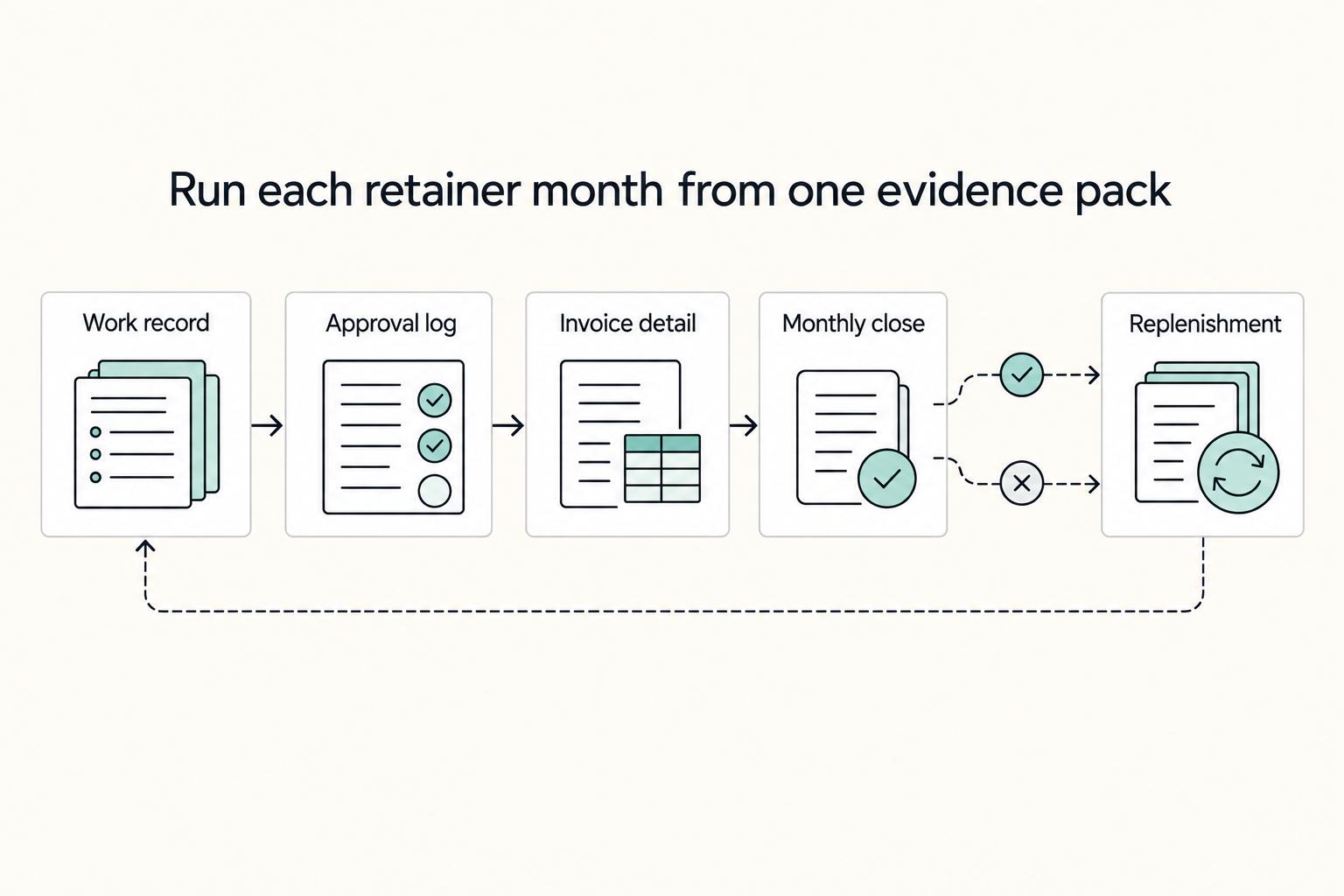
Run monthly operations with an evidence pack#
A clean record makes payment decisions easier and keeps billing and delivery aligned.
| Control | What to confirm or record | Artifact or reference |
|---|---|---|
| Opening balance | Confirm carried balance | Ledger snapshot used to calculate it |
| Invoice total | Issue the monthly invoice with line items that match contract charge scope | Monthly invoice |
| Drawdown event | Record date and amount drawn | Drawdown authorization reference |
| Replenishment status | Mark full, partial, or unpaid | Related notice |
| Closing balance | Calculate post-drawdown and post-payment balance | Cycle-close record |
| Unbilled and committed work | Estimate charges accrued since the invoice and work due before payment can arrive | Work log and funding forecast; avoid double-counting billed charges |
Assign an owner to each control in the table. Keep the monthly close, but also check exposure when a large work request arrives or burn accelerates.
Store proof artifacts in a fixed order so anyone can rebuild the timeline quickly: invoice, payment confirmation, ledger or balance snapshot, then client notices tied to the retainer agreement.
Use consistent labels in every cycle file. A stable label pattern makes retrieval easier during a dispute and reduces the chance that one critical notice is buried in a chat thread.
Prewrite failure branches before they happen, and anchor each branch to contract terms:
- Partial replenishment: confirm receipt, state the remaining amount and any agreed due date, and follow the contract's work-continuation terms.
- Late replenishment: send a reminder that references the original notice and confirms the next contract step defined in the agreement.
- No replenishment: follow the suspension and escalation steps written in the contract, including any notice requirements.
Before an affected new work block, reconcile any material balance discrepancy and confirm the contract permits continuation. Finance checks amounts; delivery checks the work and notice obligations. A missing filing label can be corrected without inventing a suspension right or stopping unrelated work.
Set the trigger early enough to cover expected work during the payment window. For example, $200 of daily billable work over five business days uses $1,000 before any extra delay. A $1,000 trigger leaves no delay buffer at that burn rate. Negotiate a larger buffer, a work cap or faster funding, and revisit it when scope changes.
Record authorized exceptions with their amount, affected work, revised due date and expiry. Confirm whether the exception requires an amendment or can use an existing waiver provision. Do not create an open-ended grace period through informal delivery promises.
Handle cross-border realities before they become payment disputes#
Cross-border deals turn into payment disputes when key terms are vague. Treat currency, replenishment completion, and reconciliation records as contract terms, not informal preferences, so assent is clear from the written record.
Many disputes in cross-border engagements come down to what counts as payment completion. Write one definition and apply it consistently so both sides read the ledger the same way.
Set one contract currency and label it clearly.#
Use one stated currency code (for example, USD or EUR) for invoices, minimum balance checks, and replenishment tracking. If payment arrives in another currency, state which conversion event controls ledger credit.
Define completion by cleared funds.#
Agree what counts as receipt for funding purposes: for example, funds posted and available in the designated account, credited in the contract currency. Distinguish that event from a transfer instruction. This is a negotiated condition, not a universal rule determining when every payment obligation is discharged.
Standardize payment references and reconciliation notes.#
Use a stable transfer reference and allocate it to the relevant funding request or invoices, including split or batch payments. Record transfer ID, value date, sent amount and currency, credited amount, fees and the conversion basis. Specify who bears any shortfall.
Add a settlement-variability caveat.#
Allow for transfer and FX delays when setting the buffer and payment deadline. Pending money is not an available balance, and receipt does not make every payment immune from reversal or chargeback. Keep any reversal adjustment visible in the ledger.
Add a licensure-scope caveat when relevant.#
For regulated services, check where the client and provider are located and which activities require authorization. The replenishment clause does not grant a licence or establish a multi-jurisdiction safe harbor. Obtain advice appropriate to the actual service.
If funding is short at the deadline, follow the agreed notice, cure and permitted suspension steps. Confirm continuing duties before pausing. For lawyers, ABA Model Rule 1.16 illustrates why nonpayment does not automatically permit immediate withdrawal: warning, tribunal requirements and protection of client interests can matter under adopted local rules.
In practice, this section is about shared definitions and mutual assent. One side may treat transfer initiation as completion, while the other treats posted funds as completion. If you do not define the event in writing, both interpretations can sound reasonable, and disputes become hard to resolve quickly.
Keep the cross-border note set compact and repeatable. You do not need long narratives. You need one invoice record, one transfer reference, one reconciliation note, and one clear status at checkpoint.
Spot funding-control gaps early#
Review these gaps before signing and when exceptions recur. They can cause disputes; they do not prove a client will fail to pay.
| Red flag | Why it matters | Response |
|---|---|---|
| Payment terms are not conspicuous or clearly assented to | If key payment terms are hard to find or not clearly accepted, enforcement is harder | Keep those terms clear and mutually agreed up front |
| Vague consequences for missed payment | These gaps can create disputes and slow enforcement | Define timing, methods, billing, lawful interest or fees, notices, cure periods and permitted suspension or termination |
| Pay as needed language without a concrete retainer replenishment clause | Payment timing, accepted methods, trigger events, and consequences for missed payment should be explicit | Define the balance trigger and top-up target; obtain separate authorization before automatic debits |
| Repeated exceptions to the billing schedule | Repeated waivers can blur the agreed process | Track exceptions and define what happens if revised dates are missed |
| No defined enforcement path for nonpayment | Unplanned responses can conflict with service duties | Set the response path in advance, including when to use suspension or termination rights tied to nonpayment |
If required replenishment is still missed under the agreed terms, consider pausing additional billable work under those suspension or termination rights. You can also use these red flags as review triggers in monthly close and escalate when the same pattern keeps recurring.
The goal is to catch drift while the record is still clean. A useful discipline is to tag each exception by type: timing, authorization, scope, or notice. That helps you see whether the same failure mode is recurring.
Repetition in one category usually means clause language and operating practice are out of sync.
Negotiate terms without killing the deal#
Offer a smaller deposit, shorter invoice cycle or firmer agreed funding checkpoint as alternatives. Confirm the client's approval lead time first, and exchange each concession for a workable control.
Use one fallback package at a time so tradeoffs stay visible:
Fallback package A: lower initial retainer deposit#
Reduce the upfront ask but keep trigger and checkpoint language clear. Tradeoff: less buffer means tighter balance monitoring.
Fallback package B: shorter invoice cycle#
If prepay size is the blocker, shorten billing intervals so funding decisions happen in smaller steps. Tradeoff: tighter date discipline is required.
Fallback package C: stricter minimum-balance enforcement#
Keep the deposit structure and consistently apply the agreed notice and cure process. Tradeoff: delivery must be able to limit the affected new work when the contract permits a pause, while fulfilling continuing duties.
Match package to buyer context:
| Buyer context | Likely negotiation pressure | Better opening package | Continuity control to keep |
|---|---|---|---|
| Client with formal approval steps | Process and wording friction | Lower initial deposit or shorter cycle | Notice and cure steps define when affected new work may pause |
| Client asking for flexibility | Timing and funding flexibility | Shorter cycle with explicit trigger | Trigger, target and permitted continuation remain explicit |
Use risk-and-continuity language for objections:
- If they say we do not prepay: We can lower the initial deposit and shorten billing intervals, but we still need a defined replenishment trigger so work does not run ahead of funded balance.
- If they say legal rejects evergreen language: We can adjust renewal wording while keeping funding terms explicit, including minimum balance and pause conditions.
Agree the monitoring burden before signature. Lower entry funding needs more frequent checks. If a checkpoint is missed, use the signed response path; do not assume every shortfall permits immediate suspension.
A common negotiation mistake is stacking concessions at once. If you lower the deposit, loosen trigger wording, and allow broad timing exceptions in one pass, you remove the controls that make the model useful. Make one concession, hold the counterbalance, and confirm the revised clause text immediately.
If the client asks to remove replenishment entirely, move to a simpler prepay structure that still protects continuity. It is better to use a cleaner model both sides can execute than to keep evergreen language that neither side is ready to operationalize.
Cover the legal backbone beyond payment terms#
Once payment terms are set, tighten the rest of the legal backbone so a payment dispute does not spill into a broader contract dispute. Clear boundaries matter most when the relationship is under stress.
- Termination: define notice, cure, ending rights, handover and final payment or refund steps.
- Liability: negotiate applicable limits and exclusions with attention to local law; a clause does not eliminate every claim.
- Responsibility: state service scope, client dependencies and who approves additional work.
- Document consistency: align the retainer, SOW, billing schedule and MSA, with explicit precedence.
- Disputes: define escalation, handling of disputed charges and the agreed resolution process.
Use the same core terms across payment and dispute language. If key terms are named differently across sections, interpretation risk increases when clarity matters most.
At closeout, reconcile opening funds, received top-ups, earned charges, expenses and credits. If $2,200 remains before a final $700 earned charge, the unused advance is $1,500 before any other permitted adjustments. Give the client the calculation and return amounts due on the agreed and lawful timetable. Do not assume calling a payment a retainer makes every unused balance nonrefundable.
Sanity checks before signature and first invoice#
Resolve material contradictions in funding, authorization, notice and closeout terms before signing or taking the related payment. Correct minor administrative gaps promptly without treating every missing artifact as a reason to stop all work.
Pre-sign checklist#
- Map core clauses across the SOW, retainer agreement, and invoicing terms: payment trigger, authorization step, pause condition, termination trigger, renewal language, and notice requirements.
- Confirm each event has one trigger and one action across all documents, with no conflicting wording.
- If there is a Master Services Agreement, confirm the same events there or make document precedence explicit.
- Sign and store one final execution version with a clear table of contents and date so everyone works from the same text.
Confirm notice recipients and methods across the final documents, including how receipt is established and who receives an escalation if the primary contact is unavailable.
Resolve conflicting recipients or receipt rules before relying on a notice to trigger a deadline.
First-cycle checklist#
- Send the first invoice on the agreed cycle.
- Execute any payment authorization step exactly as written and log who approved it and when.
- Confirm payment is received and posted.
- Record an audit trail in order: invoice, payment confirmation, balance snapshot, and client notice.
Treat the first cycle as a dry run for every future cycle. Do not optimize for speed yet. Optimize for clarity and record quality, then carry that structure forward.
If the first cycle exposes ambiguous language, agree a written correction before relying on it for the next funding decision. Keep the original transaction record and amendment history; do not silently rewrite signed terms.
Verification checkpoint before work continues#
Test three clauses together: payment, renewal, and termination. Renewal language should not override payment or termination mechanics elsewhere in the signed set.
Ask two readers to identify the same trigger, amount, deadline and next permitted action. Resolve material differences before starting the affected work. This drafting check helps reveal ambiguity; it does not establish legal enforceability.
Repeat that check after amendments to payment, renewal or termination. A change to the funding window can require a different buffer or notice calendar.
Conclusion#
An evergreen clause works when the contract text and day-to-day execution match. The minimum balance, replenishment process, and termination conditions need to be written clearly and followed the same way each cycle.
A one-off advance may be drawn down without a standing top-up duty. Replenishing funding instead specifies when and to what level the balance must be restored. Choose the mechanism around the work and approval process rather than relying on the label retainer.
Use this closeout checklist before your next signature round:
- Record the initial advance, trigger, target, currency, calculation and notice deadlines.
- Obtain clear assent in the executed agreement; separate initials can aid clarity but are not a universal validity requirement.
- Before funded work starts, confirm the required agreement and advance conditions are met, subject to any applicable continuing duties.
- Store invoices, allocations, funding requests, actual receipts and notices with the balance record.
When clients ask for concessions, negotiate from these controls rather than from ad hoc promises. Stay flexible on commercial entry terms, and stay strict on thresholds, top-up mechanics, and termination language so delivery and payment remain aligned.
Run the first cycle with the agreed records, check exposure between invoices, and adjust future terms through an authorized amendment when the buffer proves too small.
Frequently Asked Questions
What is an **evergreen clause retainer** in plain terms, and how is it different from a **traditional retainer**?
Here, evergreen funding means replenishing an advance when its remaining balance reaches a stated trigger. Other retainers can be one-off advances, availability fees or milestone arrangements. The word evergreen can also refer to renewal, so identify the fee model and funding duties expressly.
What is the difference between an **Evergreen clause** and an **auto-renewal clause**?
Replenishment controls the advance balance; renewal controls the contract's duration. A contract may have both. Write separate trigger amounts, payment deadlines, renewal dates and cancellation notices, and do not treat renewal approval as permission for an automatic debit.
What should every **retainer agreement** include to make a **retainer replenishment clause** enforceable?
Define the initial advance, trigger, target, calculation, authorized charges, notice and payment deadlines, permitted pause, termination and refund handling. Align these with the SOW and MSA. Enforceability depends on assent, applicable law and the actual terms; a checklist cannot guarantee it.
How should freelancers set a practical **minimum balance requirement** without scaring off clients?
Estimate the work likely to accrue while a top-up is approved and received, then add an agreed delay buffer. Separate that trigger from the restoration target. At $200 per workday and a five-day payment window, $1,000 covers only that window, leaving no extra buffer. Recheck the estimate when scope or burn changes.
What happens if the client misses replenishment, and when should I invoke a **work suspension right** or **Termination**?
Record the shortfall and use the contract's reminder, warning and cure process. Pause only work the terms and applicable law permit you to pause, and confirm continuing duties. Termination is a separate decision with its own notice, closeout and refund steps; regulated professionals may face additional restrictions.
Is an **Evergreen retainer** workable for cross-border clients with **Foreign exchange (FX) exposure** and transfer delays?
Yes, if currency, FX basis, fees, receipt conditions, references and allocation rules are explicit. Set the funding buffer around realistic approval and transfer delays. A pending transfer and a partial payment should have distinct ledger statuses; neither silently becomes full replenishment.
Try a related tool
Researched and edited by the Gruv editorial team. Gruv builds cross-border billing, payouts, and finance-operations software for global businesses.
Sources
Includes 3 external sources outside the trusted-domain allowlist.
Educational content only. Not legal, tax, or financial advice.
Related Posts
How to Price an IT Staff Augmentation Project
IT staff augmentation pricing depends on the roles, billed units, available capacity and responsibilities you are selling. Start with a staffing and cost model. Broad provider ranges mix periods, roles and inclusions, so they cannot establish a defensible quote for your engagement.

The Freelance Payment Penalty: A Modeled Audit of Platform Fees, FX Spreads, and Payout Delays
The money rarely disappears through a single, easy-to-spot fee. The real loss is stacked. A marketplace takes its commission, a processor adds a charge for international cards, a bank or payment company converts the currency at a spread, a platform holds the funds before release, and a wire sheds a little to intermediaries on the way in. Each layer looks defensible on its own, but the worker feels the combined result as a smaller deposit and a later payday.

How to Respond to a Subpoena for Business Records
Move fast, but do not produce records on instinct. If you need to **respond to a subpoena for business records**, your immediate job is to control deadlines, preserve records, and make any later production defensible.