
Quick Answer
Yes, many solo founders with incorporated businesses should review D&O coverage because limited liability does not erase personal exposure for leadership decisions made as a director or officer. It becomes more relevant if you control client funds, sign company contracts, choose key vendors, or make leadership statements others rely on. It complements, not replaces, E&O or general liability.
Does D&O Insurance Apply to a One-Person Company?#
Usually, yes. If you run an incorporated solo business, the corporate veil can protect you from many company debts and obligations. It does not eliminate personal exposure for decisions you make as a director or officer.
The key distinction is simple: limited liability protects the entity when corporate formalities are respected, and courts generally presume against veil piercing. That does not stop someone from bringing a personal management-liability claim based on alleged wrongful acts in how you ran the company.
| Exposure type | What the claim is about | Where D&O fits |
|---|---|---|
| Company debt or unpaid operating obligations | The business owes money under its own contracts or obligations | Usually outside D&O unless tied to alleged wrongful acts in management |
| Bodily injury or property damage from operations | Someone is hurt, or property is damaged through operations | Typically CGL territory, not D&O |
| Management wrongful act liability | Alleged breach of fiduciary duty, misrepresentation, or misuse of company funds | Core D&O lane, subject to policy wording and exclusions |
In a one-person company, you still wear the management hat. For corporations, Section 141(a) is a common statutory anchor for board-directed management. Even if that board is just you, director duties of care and loyalty still matter.
Before you rely on any policy, confirm two things. First, the insuring agreement should cover wrongful-act allegations against directors or officers. Second, the claims-made timing has to work for your situation. Then read the exclusions closely: standard forms commonly exclude fraud and personal profiting, and the wording varies by insurer and jurisdiction. Related: A Guide to Key Person Insurance for Small Agencies.
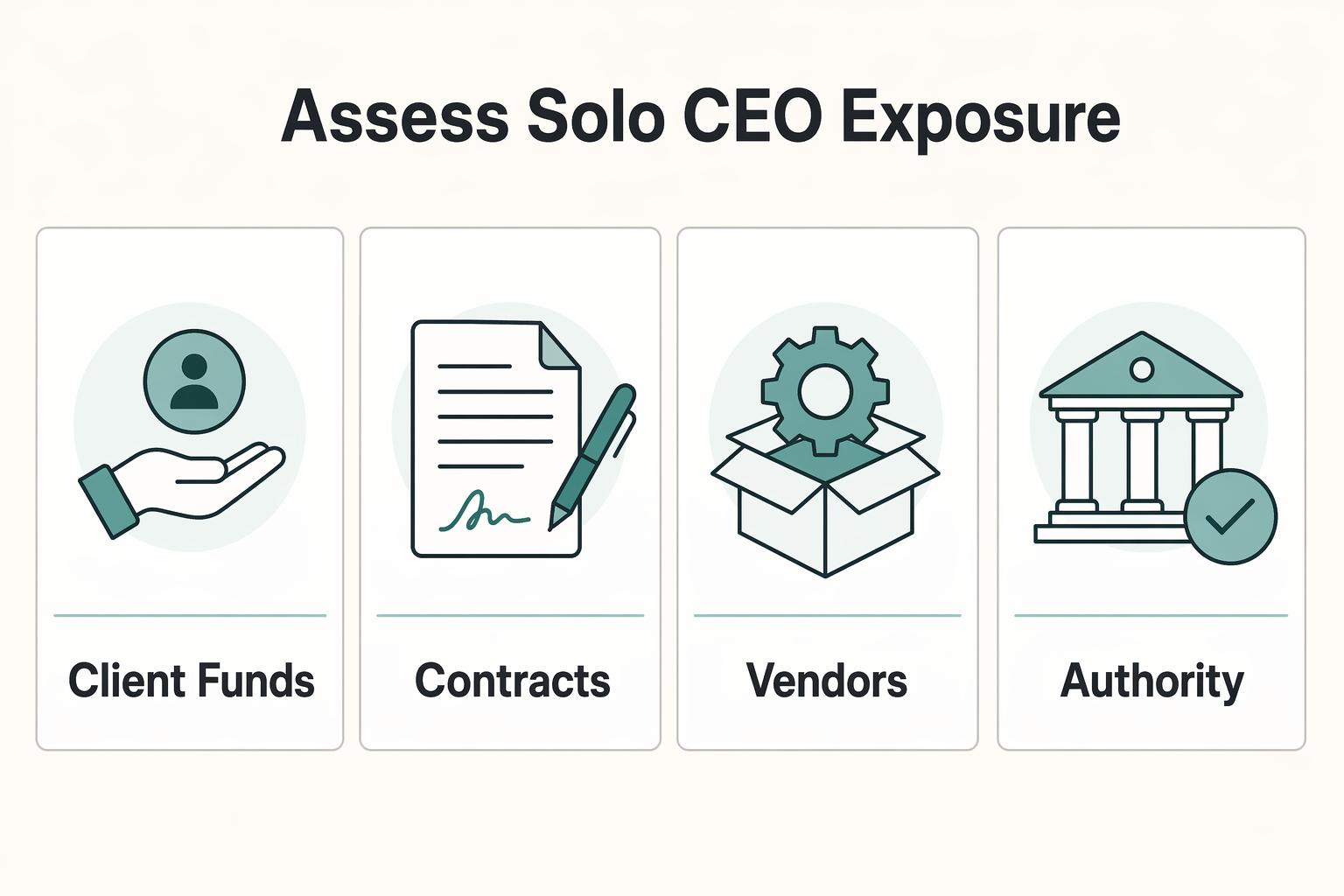
Step 1: Assess Your Exposure to Wrongful-Act Allegations#
If two or more prompts below are a clear yes, move D&O review up your near-term list. The real question is whether someone could frame your decisions, approvals, or representations as a wrongful act tied to your leadership role.
Start by separating the business activity from the allegation. That makes it easier to see whether you are dealing with management exposure, service exposure, or both.
| Business activity | Typical claimant | Alleged wrongful act | Primary policy likely to respond (D&O / E&O / both) |
|---|---|---|---|
| You control client funds or a six-figure project budget | Client or vendor | Mismanagement of funds, poor oversight, failure to perform due diligence | D&O, sometimes both |
| You sign company contracts | Client, vendor, or other counterparty | Misrepresentation of company capability or authority | D&O, sometimes both |
| You select key vendors or subcontractors | Client or vendor | Duty-of-care allegations tied to weak due diligence | D&O, sometimes both |
| Other parties rely on your governance or authority statements | Counterparty | Alleged misrepresentation in your leadership role | D&O, sometimes both |
Use each prompt the same way: review the decisions you make, the representations you give, and the records you could produce later.
- Do you control client money or a project budget that is not yours?
When you control money that is not yours, a dispute can be framed as a fiduciary-duty issue, not just a bad outcome. The allegation often turns on oversight, diligence, and whether you documented your decisions. Self-audit: Decisions: vendor approvals, reallocations, payment timing, emergency substitutions. Representations: that funds were monitored, vendors were vetted, spend matched plan. Records: approval emails, budget versions, vendor comparisons, and notes showing why decisions were reasonable at the time.
- Do you sign contracts that bind the company?
Signing a contract is a management act. In a later dispute, the focus may be less on service quality and more on whether you misrepresented company capability or authority. Self-audit: Decisions: scope, staffing assumptions, subcontractor dependence, delivery dates, feasibility. Representations: team size, technical capability, prior results, internal controls. Records: final contract set, proposal versions, assumption notes, and internal review showing you checked whether promises were realistic.
- Do you choose vendors or subcontractors for key work?
Vendor-selection failures can be alleged as duty-of-care failures when due diligence looks weak. Self-audit: Decisions: vendor selection criteria, fallback options, approval thresholds, and escalation points. Representations: why a vendor was selected, what checks were completed, and where known risks remained. Records: comparison notes, diligence checklists, risk flags, and approval trails.
- Are you making leadership statements that others rely on?
Disputes can turn on alleged misrepresentation when others rely on what you said about company capability, governance, or authority. Self-audit: Decisions: what is disclosed, what is omitted, and who approves final materials. Representations: governance structure, decision authority, and key company information provided to counterparties. Records: cap table versions, financial summaries, diligence responses, draft decks, and written corrections when statements change. In the UK, this deserves extra discipline. Core director duties under the Companies Act 2006 apply even with one director, and directors must follow the company constitution, including the Articles of Association.
Practical trigger: if you answer yes to client-funds control, contract authority, vendor-selection authority, or high-stakes leadership representations, move coverage review ahead of routine insurance housekeeping.
Boundary note: whether a claim falls under D&O, E&O, or both depends on policy wording, exclusions, and jurisdiction. Use this checklist to flag exposure, then confirm applicability through licensed counsel and broker review of the actual policy forms.
If your checklist shows weak contract and process controls, tighten your service paperwork first with the Freelance Contract Generator.
Step 2: Deconstruct Your Coverage - The Three Layers of Your Corporate Shield#
Once you know the exposure, ask how the policy responds in practice. The issue is often not just whether you have D&O, but which of Side A, Side B, or Side C responds and who has to fund costs first.
| Coverage layer | Who it protects | When it is triggered | Typical claim scenario | Who pays first | Where coverage disputes commonly arise |
|---|---|---|---|---|---|
| Side A | You as an individual director/officer | Your company cannot or will not indemnify you | You are personally named for an alleged wrongful act in a leadership role, and the company does not fund defense/indemnity | Insurer pays covered individual loss under form terms | Whether indemnification was truly unavailable, whether allegations fit a covered claim, and whether conduct exclusions apply |
| Side B | Your company (reimbursement) | Your company indemnifies you first, then seeks reimbursement | Your company advances defense or pays covered amounts for you in a management-liability claim | Company pays first, then insurer reimburses (often with retention) | Whether payments were indemnifiable, retention application, and notice or consent compliance |
| Side C | Your company as an entity | The company itself is named in a covered claim | The entity is sued directly or alongside you | Insurer pays covered entity loss under entity grant and form terms | Whether the claim is within entity-coverage scope (for example, securities-only vs broader wording) and how claim definitions are applied |
Side A#
Side A is your personal backstop when the company cannot or will not indemnify you. That can include legal non-indemnifiability, financial inability, or refusal.
Solo-owner interpretation: if you run the company day to day, "company cannot indemnify" can be a cash-flow problem as much as a legal one. Side A is the layer most directly tied to protecting you when company funds are tight.
Side B#
Side B reimburses the company after it indemnifies you. It is not first-dollar personal protection.
Solo-owner interpretation: Side B can still matter, but it may require the business to absorb defense or settlement costs first. For a solo operation, that timing risk matters.
Side C#
Side C is entity coverage when the company is named. Scope varies by form. Some policies are narrower, often public-company securities-claim focused, while others are broader, often private-company forms. Claim definitions can also narrow outcomes, including how securities claims and investigations are treated.
Solo-owner interpretation: if claims are likely to name your company directly, Side C wording can determine whether entity defense costs are actually funded.
What to verify before you rely on it#
Use your actual policy documents, not the summary. The practical test is simple: map one realistic claim to each side and note who writes the first check. That is usually where "covered in theory" and "fundable in practice" split apart. Then confirm the following:
| Area | What to confirm |
|---|---|
| Policy form and entity scope | form type: private/public; Side C scope: all claims / securities claims / other |
| Exclusions | conduct exclusion wording; other key exclusion wording and carve-backs |
| Retention or deductible treatment | which sides carry retention; who bears retention: organization vs individual |
| Defense arrangement and settlement control | duty to defend vs reimbursement; consent and settlement authority terms (including within retention) |
| Jurisdiction fit and indemnification framework | governing corporate law and indemnification limits for your entity jurisdiction |
| Claims-made reporting window | notice/reporting window and any extended reporting provisions |
For a step-by-step walkthrough, see What is Cyber Liability Insurance and Do Freelancers Need It?.
D&O vs. E&O: Sort Each Allegation by Role First#
Start with a role test. If the allegation is about how you led the company, start with D&O. If it is about the professional service you delivered, start with E&O. The common mistake is assuming one policy will absorb both tracks cleanly.
The role-based split you can use immediately#
D&O responds to alleged wrongful acts in your leadership capacity, including management decisions and fiduciary-duty allegations. E&O responds to your professional services. As a consultant, one dispute can involve both roles.
| Claim trigger | Who is accused | Likely starting lane | Potential overlap question |
|---|---|---|---|
| Alleged misrepresentation of company capabilities to win the contract | You as a company decision-maker | D&O-framed allegation | Whether parts of the allegation also target service delivery |
| Alleged failure in professional services | You as the service provider | E&O-framed allegation | Whether parts of the allegation also target leadership conduct |
| Alleged mismanagement of project funds | You in a leadership or management role (and sometimes the company) | D&O-framed allegation | Whether service and management facts are bundled together |
Claim-mapping walkthrough for overlap#
Mixed allegations can happen. A client may say your service work caused loss, while also claiming you misrepresented company capabilities or mismanaged project funds. That may not fit neatly into one bucket.
| Role bucket | Example allegation | Handling note |
|---|---|---|
| Service-provider conduct | your service work caused loss | start with the service role and the E&O wording |
| Leadership conduct | you misrepresented company capabilities | start with the leadership role and the D&O wording |
| Both | a client may say your service work caused loss while also claiming you misrepresented company capabilities or mismanaged project funds | treat mixed allegations as a coordination issue early, not late |
Map each allegation by role - service-provider conduct, leadership conduct, or both - and handle coordination early, not late.
Coordination framework before a dispute#
Read the core definitions side by side: professional services in the E&O form and wrongful acts in the D&O form. Then use that role map to classify allegations consistently from the start.
In one securities-settlement study, outcomes were influenced by D&O insurance amount/structure and settlement pressure, not only the underlying merits. Treat that as a caution: outcomes do not always track the facts cleanly.
Buyer checklist#
Do not rely on either policy in isolation until you have checked how the two forms fit the way you actually operate. Before you bind, confirm:
| Checkpoint | What to confirm |
|---|---|
| Role alignment | professional services and wrongful acts match how you actually operate |
| Scenario check | you can classify allegations like capability misrepresentation and project-fund mismanagement by role |
| Overlap plan | mixed allegations are mapped into service-conduct and leadership-conduct components early |
| Outcome realism | you are not assuming settlement terms will always mirror the merits |
For a related insurance-risk perspective, see A guide to 'media perils' insurance for journalists and bloggers.
Conclusion: D&O Isn't an Expense - It's Your License to Lead#
Treat D&O as part of your operating risk stack, alongside your entity setup and other core controls. If your day-to-day work includes leadership calls, a dispute may focus on those decisions. That includes ordinary choices such as approving contracts, overseeing funds, committing to vendor or partner terms, and making compliance calls. The goal is to know your protection boundaries in advance so you can move quickly and deliberately.
- Depending on your policy terms and jurisdiction, it may help protect your personal balance sheet when a dispute targets leadership decisions.
- It may preserve decision speed under pressure because key coverage questions are clarified before a dispute.
- It can also signal disciplined risk management to counterparties.
Carry one practical caution into renewal: do not assume broader legal reforms will make your policy fit or that pricing will work out on its own. In advocacy testimony in Maryland dated February 17, 2025, on SB584/HB113, the witness argued there was no objective evidence that tort-law limits improved insurance availability or affordability. That argument referenced a 2024 update and a 2023 Review of Law and Economics article. Whatever your view on that debate, the operating lesson is the same: verify your own quote and policy wording rather than relying on broad assumptions.
Before you buy or renew, validate fit against your current risk profile, then have a qualified broker confirm key terms in writing. You might also find this useful: A Guide to 'Reps and Warranties' Insurance in M&A.
When you want clearer payment flows and audit-ready records to support your broader risk plan, review Gruv's Merchant of Record for freelancers.
Frequently Asked Questions
Do you need D&O insurance as a solo consultant or freelancer?
If you run an incorporated business and act as a director or officer, this exposure can apply to you. It sits alongside E&O and commercial general liability, not instead of them. If a claim targets your leadership decisions rather than only your service delivery, D&O is the policy family to review.
What is the difference between D&O and E&O insurance?
Use a role test. If the allegation is about how you led the company, handled governance, or made management decisions, start with D&O. If it is about the professional service you delivered, start with E&O. General liability is built for non-professional negligence exposures, so do not assume it will absorb either category.
What does Side A D&O coverage protect?
Side A protects directors and officers when the company cannot indemnify them. For a solo founder, it is often the most relevant layer when personal assets could be exposed because the company cannot fund indemnification. Read it together with Side B and Side C, and confirm the actual wording in the quoted form.
How do you choose a directors and officers d&o insurance policy?
Start with a screening checklist and have each point broker-verified in writing. Confirm how the form defines wrongful acts, how claim timing and reporting work, which exclusions could create real gaps, how defense costs and counsel selection are handled, whether limits fit your dispute profile, and whether the form fits your jurisdictions. Also verify the exact claim-reporting period in the quoted wording.
What are common D&O claims against private companies?
Common D&O claims against private companies usually track who can challenge your decisions at your current stage. Claimants can include customers, vendors, suppliers, competitors, employees, investors, other stakeholders, and government bodies. Employment-related allegations can target both the company and its officers, and investor-related conflict allegations are also a common pattern.
Try a related tool
Researched and edited by the Gruv editorial team. Gruv builds cross-border billing, payouts, and finance-operations software for global businesses.
Sources
- academia.edu/2746059/On_the_classification_of_compound_ve...trusted
- bu.edu/bulawreview/files/2024/11/MIAZAD.pdftrusted
- corplaw.delaware.gov/delaware-way-business-judgmenttrusted
- delcode.delaware.govtrusted
- federalreserve.gov/boarddocs/SupManual/cbem/200904/4000.pdftrusted
- law.cornell.edu/wex/piercing_the_corporate_veiltrusted
- law.upenn.edu/live/files/102-bakergriffith157upalrev755200...trusted
- legis.delaware.gov/json/BillDetail/GenerateHtmlDocumenttrusted
Educational content only. Not legal, tax, or financial advice.
Related Posts
Canada Digital Nomad Visa Planning for Visitor Status and Work Permits
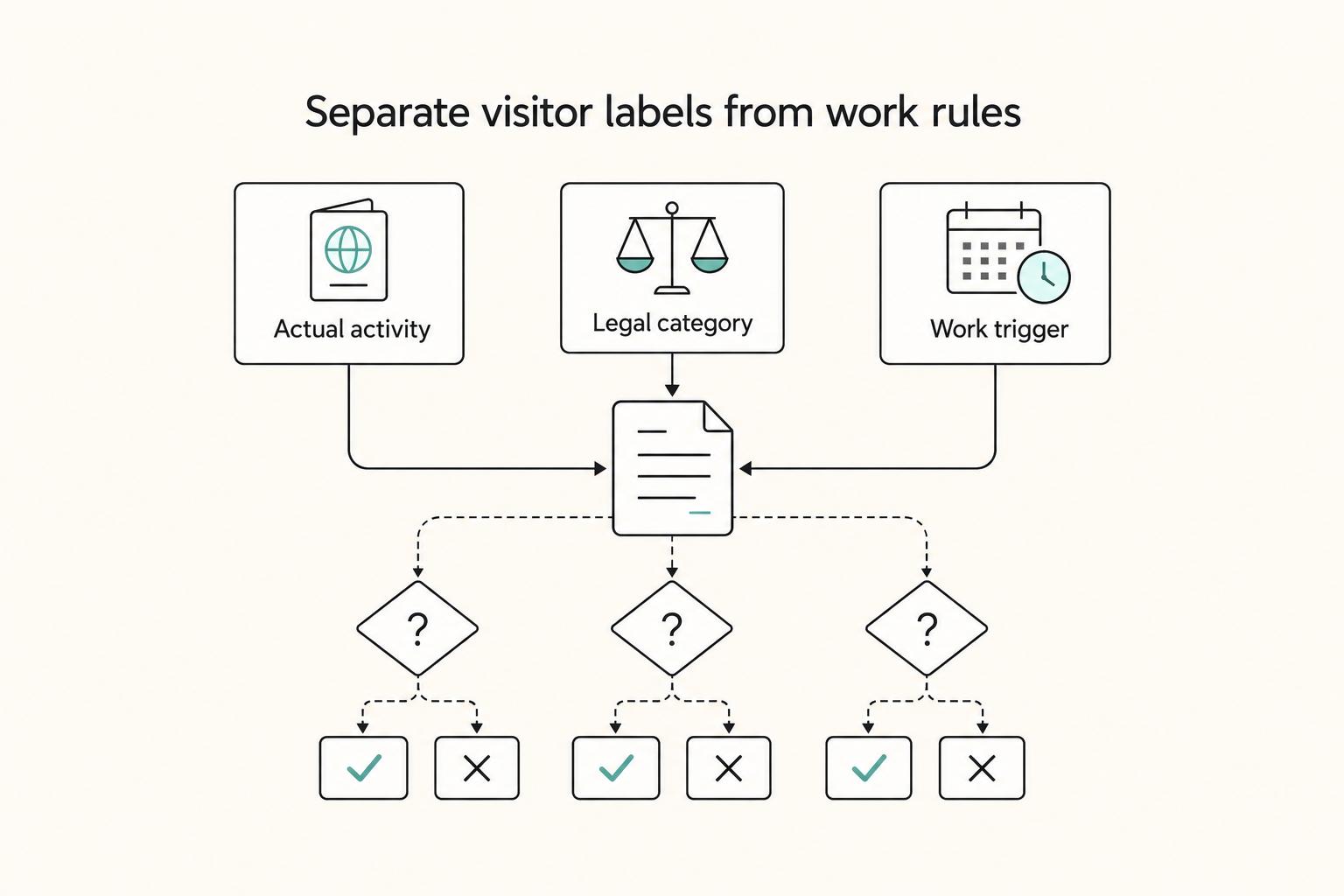
The phrase `canada digital nomad visa` is useful for search, but misleading if you treat it like a legal category. It is shorthand for existing Canadian status options, mainly visitor status and work permit rules, not a standalone visa stream with its own fixed process. That difference is not just technical. It changes how you should plan the trip, describe your purpose at entry, and organize your records before you leave.
A Guide to Key Person Insurance for Small Agencies
If one founder, rainmaker, or delivery operator drops out, your agency can lose revenue, delivery capacity, and client confidence fast. That risk is common, not an edge case. In small-business research, 71% of surveyed firms reported they were very dependent on one or two people. That makes continuity planning a core operating decision, not optional paperwork.

The Freelance Payment Penalty: A Modeled Audit of Platform Fees, FX Spreads, and Payout Delays
The money rarely disappears through a single, easy-to-spot fee. The real loss is stacked. A marketplace takes its commission, a processor adds a charge for international cards, a bank or payment company converts the currency at a spread, a platform holds the funds before release, and a wire sheds a little to intermediaries on the way in. Each layer looks defensible on its own, but the worker feels the combined result as a smaller deposit and a later payday.