
Quick Answer
Conway’s Law observes that a system’s structure reflects the designing organization’s communication structure. For a software engagement, map one recent change to its actual interface owners and decisions. Confirm the affected dependencies, scope unresolved ones explicitly, and propose a client-authorized ownership pilot when the same boundary repeatedly causes friction.
Compare the software boundary with the decision path#
Use Conway's Law before you scope. If the architecture you are proposing depends on communication paths the client does not actually have, delivery risk is likely already present, even if the backlog looks tidy.
Conway’s Law describes how a system’s structure reflects the communication structure of the organization designing it. Melvin Conway’s own account traces the idea to his 1968 publication. For software delivery, compare the interfaces you need to build with the people who must agree on their meaning. A reporting line alone does not tell you who actually designs or approves an interface.
| Communication pattern | Likely architecture pressure | Immediate scoping response |
|---|---|---|
| One team owns several closely related capabilities | Direct design discussions may support a cohesive implementation | Consider a modular monolith when deployment and operational needs fit; team size does not dictate it |
| Separate teams design interacting capabilities | Interfaces need agreement between those designers | Scope interface contracts, integration work and owner review; separate teams do not automatically require microservices |
| Desired architecture conflicts with actual communication routes | Structural tension in delivery is likely | Mark the mismatch as a named risk before estimating |
Use the article in three steps:
Diagnose the client first#
Ask how a real change moves from request to release, and note who must talk to whom for that to happen. Your checkpoint is simple: can you name the owners, reviewers, and blockers around the boundary you are about to build? If ownership is vague or approvals are shared across several groups, do not bury that uncertainty in a generic buffer. Call it out in scope, because unclear communication lines can show up as interface ambiguity and integration friction.
Tighten your own business-of-one#
As a solo developer, use the same mapping exercise to find lost context between your own tools and the client’s decisions. This is an analogy for workflow improvement, rather than evidence that one person’s folder structure determines the software architecture. Trace a recent job and simplify repeated copying, unclear approval and conflicting versions.
Reshape communication on purpose when needed#
The Inverse Conway Maneuver means shaping team and communication boundaries to support a desired architecture. Thoughtworks described it in its 2014–2015 Radar entry. A freelancer can propose a contained ownership or interface change to the client’s decision makers; changing reporting lines requires their authority and a supported transition plan.
If you manage several specialists, How to Manage a Global Team of Freelancers is a useful companion on the people side.
Start with one change similar to the work you are estimating. Reconstruct its technical dependencies and actual decision path so discovery addresses the unknowns that could change cost or delivery.
Map a recent change before committing to its dependencies#
Investigate the communication dependencies that could change your estimate. If an owner or interface is unknown, state the assumption and propose bounded discovery for that dependency; independent work can proceed when its own inputs are clear.
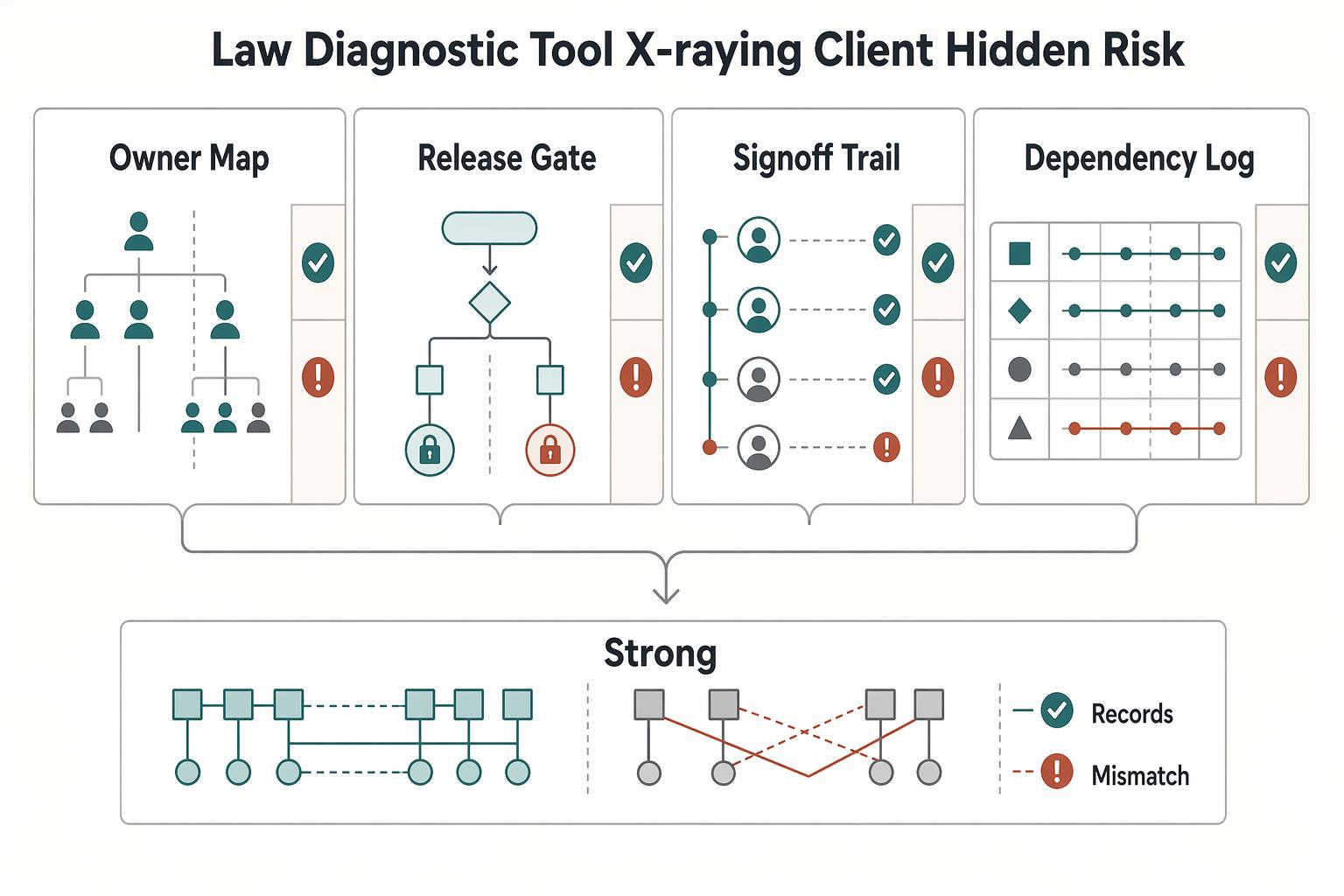
| Artifact | What to verify | If missing |
|---|---|---|
| Owner map | Who can approve requirements, approve or reject changes, and sign off release for this scope | If ownership is shared, rotating, or disputed, log it as an open assumption |
| Approval path | Evidence that a change was proposed, reviewed, approved or disapproved, and recorded | Confirm the decision path and record unresolved assumptions |
| Signoff trail | A visible record of who signed off and when for the boundary | Confirm the release process appropriate to the actual engagement |
| Dependency log | Teams, vendors, components, repos, environments, and data owners that can block delivery, with a technical identifier and accountable contact | Qualify or investigate the affected interface assumption |
Ask the client for one recent change and trace it from request to release. Use the owner map, approval path, signoff trail and dependency log to distinguish known commitments from unresolved dependencies. They are practical project records, not four documents mandated by Conway’s Law.
Owner map: confirm accountable people, not team labels#
Ask who can approve requirements, who can approve or reject changes, and who signs off release for this scope. If ownership is shared, rotating, or disputed, log it as an open assumption.
Approval path: verify decision records, not verbal process#
Confirm how the relevant change was proposed, reviewed and decided. A ticket, release record or explicit approval message can show the path. If the team works informally, confirm the responsible person and record the current agreement for this scope.
Signoff trail: confirm a real release decision exists#
Identify who can accept or release the affected work and which additional reviews the engagement requires. A named client acceptance owner may be enough for a small delivery; a regulated production change may require several distinct approvals.
Dependency log: name each dependency and owner before promising interfaces#
List teams, vendors, components, repos, environments, and data owners that can block delivery. For each item, include a technical identifier and an accountable contact.
If evidence is missing, scope uncertainty directly#
Use concrete proposal language: “The integration estimate assumes the payments team owns the refund API, provides its contract and test access, and names a release approver. The first discovery task is to confirm those inputs. If the contract changes, we will revise the integration estimate before implementing that dependency.” Apply the client’s actual security and release requirements to the affected work.
| Evidence quality | What you can verify | Delivery risk read | Scope posture | Decision |
|---|---|---|---|---|
| Strong | Named owners, evidenced approval path, clear signoff trail, dependency log with accountable contacts | Lower hidden coordination risk | Estimate build work with normal change controls | Proceed |
| Mixed | Some ownership is clear, but records or dependency ownership are incomplete | Moderate risk of approval drag and interface surprises | Add a bounded discovery phase and keep assumptions explicit in writing | Proceed with controls |
| Weak | Ownership is disputed or verbal, records are missing, dependencies are vague or unowned | High risk of rework, blocked release, and scope disputes | Qualify the affected delivery commitment; offer bounded discovery to resolve its inputs | Investigate affected dependency |
Record which missing fact could change implementation, price or release. A small client may confirm a decision in a shared ticket; it need not reproduce a large company’s approval process.
Example: a refund change crosses three ownership boundaries#
Suppose a client asks you to add partial refunds. The checkout team owns the user interface, the payments team owns the refund API, and finance owns the accounting export. The last change waited three days because each group expected another to decide what “refund complete” meant. Creating another microservice would leave that disagreement intact.
| Boundary | Decision needed | Pilot agreement |
|---|---|---|
| Checkout → payments | Request amount, allowed refund states and retry behavior | Payments owns the API contract; checkout implements against agreed examples |
| Payments → finance | Which event represents a settled refund or a failed attempt | Finance and payments agree event meaning and reconciliation fields |
| Implementation → release | Who accepts the complete customer/refund outcome | Named delivery owner coordinates acceptance; required specialist checks remain |
A contained pilot could put the partial-refund workflow under one delivery owner while retaining the payments and finance teams’ specialist responsibilities. They jointly settle the interface meaning, record sample requests/events and decide which changes need renewed review. The freelancer estimates the UI and integration work after that agreement, listing any unresolved settlement behavior as a discovery task.
For the next two comparable changes, record waiting time for decisions, reopened interface questions and defect/reconciliation results. Fewer handoffs help only if the required knowledge and checks still reach the design. If one owner becomes overloaded or errors increase, adjust the responsibility split rather than treating the pilot as proof that centralization always works.
Part 2: Treat your solo workflow like a small system#
For solo work, keep the current scope, client decisions and release status easy to find. This improves coordination with collaborators and clients; it does not make workflow hygiene a literal architectural law.
| Step | Core action | Checkpoint |
|---|---|---|
| Audit one real job end to end | Pick one recent project and trace it from intake to release | From one record, can you see what is current, who decides, and whether the work is actually done? |
| Separate automation from manual approval | Use automation to enforce consistency; keep human review for judgment calls | If you use code-owner rules, confirm each owner is a real, reachable reviewer |
| Run a repeatable governance cadence | Use the same checkpoints on every engagement: intake, pre-build, pre-release, and closeout | Confirm your documented information still shows both what was planned and what was actually done |
Step 1: Audit one real job end to end#
Pick one recent project and trace it from intake to release. For each stage, capture only these four entities, then apply the matching action:
| Entity | What to capture | Action |
|---|---|---|
| Workflow state | Current stage label | Standardize one shared legend |
| Handoff point | Where work moves tools or contexts | Integrate or collapse duplicate transfers |
| Approval owner | Named person for go/no-go | Standardize explicit ownership before build |
| Artifact location | Where the current record lives | Mark the current authoritative record; retain needed history |
Work from a single source of truth. Include a status legend, a current-version marker, a named contact path, and a clear pending vs final flag. A practical legend is: Proposed, In Progress, Resolved, Complete. Checkpoint: from one record, can you see what is current, who decides, and whether the work is actually done?
| Weak habit | Likely delivery friction | Operating rule |
|---|---|---|
| Scope lives across inbox, chat, and notes | Version conflict and missed changes | Keep active scope in one authoritative record |
| Status labels change by project | Pending vs final confusion | Reuse one status legend across jobs |
| Approval is implied, not assigned | Late rework or blocked release | Name one approval owner before implementation |
| Final artifacts are mixed with drafts | Release uncertainty | Mark one current version and explicit final state |
Step 2: Separate automation from manual approval#
Use automation to enforce consistency, and keep human review for judgment calls.
| Automate | Keep manual |
|---|---|
| Tests and required status checks | Scope changes |
| Reviewer requests for owned code areas | Release decisions |
| Routine merge gating | Client-facing commitments |
If you use code-owner rules, make sure each owner is a real, reachable reviewer, not a placeholder.
Step 3: Run a repeatable governance cadence#
Use intake, pre-build, pre-release and closeout as practical checkpoints where they fit the engagement. Confirm the current scope, decisions made, unresolved dependencies and actual delivery result. Use existing project records rather than creating a second approval bureaucracy.
If handoffs keep multiplying, use How Gall's Law Helps Independent Professionals Build Systems That Last as a companion lens before adding more process.
Test an ownership change that supports the architecture#
Use this when your intended design keeps failing at handoffs, escalations, or approval bottlenecks. If communication structure is shaping the system, change communication and ownership boundaries first, then ask teams to deliver the architecture.
| Step | Action | Anchor or signal |
|---|---|---|
| Set the target architecture in one sentence | State the boundary you want, what stays outside it, and who should be able to ship inside it without waiting on other teams | Use one recent delayed or failed change as the anchor example |
| Name the org pattern blocking that target | Map one real request-to-release path and mark every team touch, approval stop, and escalation point | Diagnose delivery friction, not just the org chart |
| Test one boundary change, not a full redesign | Move one ownership boundary so routine design decisions need fewer cross-team negotiations | Document intended team type and main interaction mode on each side of the boundary |
| Define success signals before rollout | Replace vague goals with observable signals | Capture a simple before-state in workshop notes |
Run this as a focused workshop on one product area, one service boundary, or one request-to-release path that already shows friction.
Step 1: Set the target architecture in one sentence#
Set the target architecture in one sentence. State the boundary you want, what stays outside it, and who should be able to ship inside it without waiting on other teams.
Use one recent delayed or failed change as the anchor example so the discussion stays evidence-based.
Step 2: Name the org pattern blocking that target#
Name the org pattern blocking that target. Diagnose delivery friction, not just the org chart: interdependent teams, coordination problems, repeated escalation, slow pace, high feature costs, approval drag, or handoff delay.
Map the request-to-release path and mark team touches, decisions and waiting time. Check whether the delay comes from communication boundaries, missing skills, excessive workload or a technical dependency. A delay alone does not prove that a reorganization is needed.
Step 3: Move one ownership boundary to reduce cross-team negotiations#
Test one boundary change, not a full redesign. Move one ownership boundary so routine design decisions need fewer cross-team negotiations.
Team Topologies distinguishes stream-aligned, enabling, complicated-subsystem and platform teams, with collaboration, service consumption and facilitation as interaction modes. For this pilot, name the responsibilities and interaction on each side of the boundary. Labels alone do not create the skills, capacity or interface agreement needed to make it work.
| Blocking pattern | Boundary change to test | Tradeoff or failure mode | What to monitor |
|---|---|---|---|
| Split ownership of one product area | Assign one team end-to-end ownership for that area | New bottleneck if key skills are missing, or shadow authority remains | Handoff count, reopened interface decisions, who gets pulled into routine changes |
| Interdependent teams for ordinary changes | Reduce shared surface area or regroup work around a cleaner boundary | Short disruption during responsibility transfer; hidden dependencies can persist | Handoff delay, coordination issues, pace of small changes |
| Repeated escalation for design decisions | Push routine decisions to the owning team with one clear exception path | Inconsistent decisions if criteria are unclear; informal gatekeeping can survive | Escalation frequency, approval drag, feature cost trend |
Step 4: Define success signals before rollout#
Define success signals before rollout. Replace vague goals with observable signals: fewer escalations, fewer teams per normal change, less waiting between handoffs, and fewer costly feature requests caused by boundary confusion.
Capture a simple before-state in workshop notes so later decisions are based on measured friction, not memory.
Phased rollout with guardrails#
With the client’s authorization, pilot one boundary for a defined delivery period. Name the routine decision owner, the exceptions needing specialist review and where decisions are recorded. Preserve required security, legal and operational review; direct communication can continue without becoming a competing source of approval. Narrow or reverse the pilot if handoff delay worsens, incidents increase or responsibility becomes unclear.
If your target state also requires cleaner service boundaries, read A Guide to Microservices Architecture for SaaS Applications. If the change depends on clearer cross-team operating rhythms, use How to Manage a Global Team of Freelancers as the companion playbook.
Choose a change you can observe#
You do not need a grand redesign to act on this. You need three concrete moves, in order: diagnose coordination risk from one real change, fix one blockage in your own delivery path, and test one ownership adjustment where decisions keep bouncing.
Before you start, trace one recent change from request to release and gather the records that show how decisions moved. If that path is hard to reconstruct, treat the gap as discovery work instead of assuming the boundary is already clear.
Diagnose client risk from a real change#
Take one recent feature, bug fix, or integration change and trace it from request to release. Write down who asked for it, who owned the boundary, and which teams had to coordinate for it to land. Then compare that path to the module or product area that changed.
Name the routine decision owner and necessary handoffs. When those remain uncertain, qualify the affected estimate and resolve them through discovery. An incomplete org chart or missing historical ticket does not by itself prevent all useful implementation.
Fix your own delivery path before you prescribe theirs#
Run the same test on yourself. Follow one job from inbound request to shipped work and mark every pause caused by split notes, inboxes, approvals, or unclear ownership. If your proposal lives in one place, client comments in another, and release decisions in chat, your delivery will reflect that fragmentation.
Your verification point is whether one view of the work shows the current owner and the next decision. If you cannot tell what is blocked without searching across tools and messages, you likely have a hidden queue. Fix that before you recommend process changes to anyone else.
Choose a structural change you can monitor#
When the same boundary causes repeated negotiation, propose one clear owner for that area first. If the issue is wider, use the Inverse Conway Maneuver deliberately: define the target architecture, analyze the current structure, and ask for a restructuring plan that includes a timeline and a communication strategy. Then implement in phases and monitor it, rather than changing everything at once.
| Decision factor | Broad reorg | Small boundary change |
|---|---|---|
| Disruption | Can be higher, because role and communication changes may spread across more teams | Can be lower when you contain the change to one contested area |
| Reversibility | May be harder to unwind once reporting lines and ownership move widely | May be easier to revisit after a pilot period |
| Decision clarity | Can clarify many decisions if designed well, but may blur ownership during transition | Can clarify one decision path faster when one owner is explicit |
If your evidence points to one recurring coordination problem, a smaller move is often easier to test first. If the mismatch appears across several boundaries and leadership is prepared for phased change, a broader reorg may be justified.
Bring one recent change record to the next scoping discussion. Name the affected interface and decision owner, separate assumptions from confirmed inputs, and propose one improvement with a review date. The microservices architecture guide is useful when that discussion also involves deployment and service boundaries.
The CI/CD guide covers automated delivery checks and release workflows when those are part of the boundary you are improving.
Frequently Asked Questions
How does this apply if you work alone?
For a solo developer, mapping intake, implementation and client approval can expose lost context and duplicated work. That is a useful workflow analogy. Conway’s Law itself concerns correspondence between a designing organization’s communication and the system it produces; it does not establish that scattered personal notes cause a particular architecture.
Can you use this during client discovery?
Yes. Ask for one recent change and trace who requested it, who approved it, who implemented it, and who had to coordinate across boundaries. If the client cannot show that path clearly, treat the uncertainty as discovery work in scope instead of promising a clean delivery plan.
What should you verify instead of trusting the org chart?
Verify the real decision path: who owns the boundary, who approves routine changes, and which teams must talk for interfaces to work correctly. A title box tells you less than one concrete example from request to release.
What is a practical example of the Inverse Conway Maneuver?
One product area is split across multiple teams, so ordinary changes trigger negotiation and escalation. Instead of a broad reorg, move that area to one clear owner for a pilot period and track whether handoffs and reopened interface decisions change.
Is Conway's Law a rule, or just a useful lens?
Treat it as an observation about correspondence between communication and system design. It can guide investigation, but it does not predict the ideal architecture or prove that every delay requires a team change. Examine actual interfaces, skills, workload and decision paths.
Does remote-first work differently from co-located work here?
Distributed teams can communicate effectively through explicit interface contracts, direct owner contact and recorded decisions. Co-location can still leave approvals or dependencies unclear. Compare those working conditions on the project rather than choosing an architecture solely from office location.
What are the limits of this approach?
It will not tell you the perfect org design. The stronger use is iterative: map current teams and communication channels, test one small boundary change, and keep evidence on whether friction changes.
What is the easiest mistake to make with a client?
Committing to architecture before ownership, approvals, and dependency paths are verified. That can leave you estimating a clean boundary that the client cannot actually support.
Researched and edited by the Gruv editorial team. Gruv builds cross-border billing, payouts, and finance-operations software for global businesses.
Sources
Includes 3 external sources outside the trusted-domain allowlist.
Educational content only. Not legal, tax, or financial advice.
Related Posts
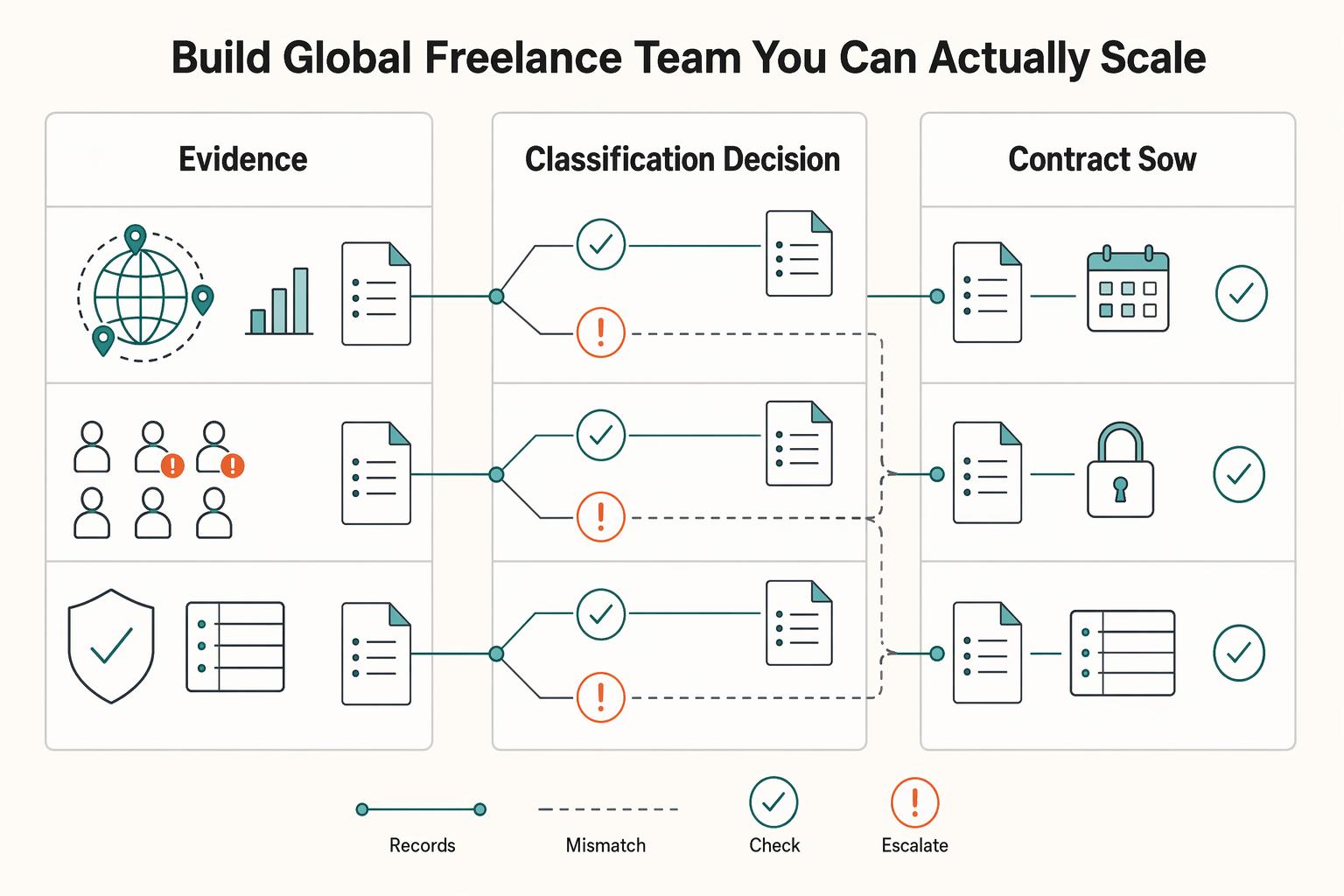
How to Manage a Global Freelance Team Without Compliance Gaps
If you want to manage a global freelance team without constant cleanup, use the same intake-to-payout process for every engagement and save an artifact at each gate. Common failure points are instinct-based classification, vague scope, and payments approved in chat with no audit trail.

Microservices Architecture for SaaS Without Finance and Compliance Surprises
Choose your operating model before you choose your decomposition pattern. For most early products, that means a modular monolith with clear domain boundaries, not a full microservices setup on day one. The reason is practical. Every new service adds cognitive load, failure points, and maintenance cost, so the split pays off only when your team and controls are ready.

The Freelance Payment Penalty: A Modeled Audit of Platform Fees, FX Spreads, and Payout Delays
The money rarely disappears through a single, easy-to-spot fee. The real loss is stacked. A marketplace takes its commission, a processor adds a charge for international cards, a bank or payment company converts the currency at a spread, a platform holds the funds before release, and a wire sheds a little to intermediaries on the way in. Each layer looks defensible on its own, but the worker feels the combined result as a smaller deposit and a later payday.