
Quick Answer
Attorney-client privilege protects confidential communications with your lawyer when you are seeking legal advice, not every document connected to a dispute. In this piece, protection is stronger when the exchange stays private, includes only necessary participants, and keeps legal questions separate from business strategy. The practical safeguard is a pre-send four-step check on audience, purpose, content, and handling before you email, chat, or share files.
The Foundations: Understanding Attorney-Client Privilege#
Attorney-client privilege protects your confidential communications with your lawyer when you are seeking legal advice. It does not cover every document connected to a legal issue. In day-to-day client work, that usually means a private email, call, or direct message about a contract risk, payment dispute, or compliance concern.
The practical point is simple: your lawyer needs the full facts to give sound advice. The privilege is yours as the client. That also means your handling of the communication can waive it, especially if you share it beyond the people needed for that legal discussion.
The four conditions that usually guide it#
In practice, privilege is generally stronger when you can answer yes to all four of these questions. If one answer is weak, the claim is usually harder to defend:
| Question | Grounded signal | Article note |
|---|---|---|
| Is it a communication? | Calls, emails, chat messages, voice notes, or document comments sent for legal review | Privilege is communication-focused |
| Is it between privileged participants? | You and your lawyer, plus people necessary to the legal exchange, such as legal staff | Adding nonessential people "for visibility" can undermine confidentiality |
| Did you intend confidentiality and act that way? | A private thread, limited recipients, controlled sharing | A general team channel or a broad meeting list points the other way |
| Is the purpose legal advice or legal services? | "Does this indemnity clause expose me under New York law?" | "Here is our weekly status, budget, and launch plan" is a business update |
- Is it a communication?
Privilege focuses on communications: calls, emails, chat messages, voice notes, or document comments sent for legal review. Example: "Please review this master services agreement for liability and governing law risk."
- Is it between privileged participants?
Usually that means you and your lawyer, plus people necessary to the legal exchange, such as legal staff. Risk point: adding nonessential people "for visibility" can undermine confidentiality.
- Did you intend confidentiality and act that way?
Confidentiality shows up in behavior: a private thread, limited recipients, controlled sharing. A general team channel or a broad meeting list points the other way.
- Is the purpose legal advice or legal services?
"Does this indemnity clause expose me under New York law?" is a legal question. "Here is our weekly status, budget, and launch plan" is a business update, even if counsel is copied.
Why the forum matters in cross-border work#
Cross-border work can make this less automatic, not more. If your matter could end up in a U.S. dispute, the governing privilege rule can depend on the forum. Federal common law generally applies, but in civil cases, state law can govern when state law supplies the rule of decision. Cross-border facts do not make that issue disappear. A foundational Supreme Court case, Upjohn (449 U.S. 383), involved foreign-subsidiary conduct.
What this does not protect#
A common mistake is thinking that once a fact reaches a lawyer, the fact itself becomes protected. It does not. Privilege protects the communication, not the underlying facts. Signed contracts, invoices, statements of work, timelines, and payment history are still business records, even if shared with counsel, unless another protection applies.
It also does not cover business-only communications just because a lawyer is included. Copying counsel on operational updates does not automatically protect the thread. Related but separate, work-product protection covers certain materials prepared in anticipation of litigation.
| Scenario | More likely protected | More likely not protected |
|---|---|---|
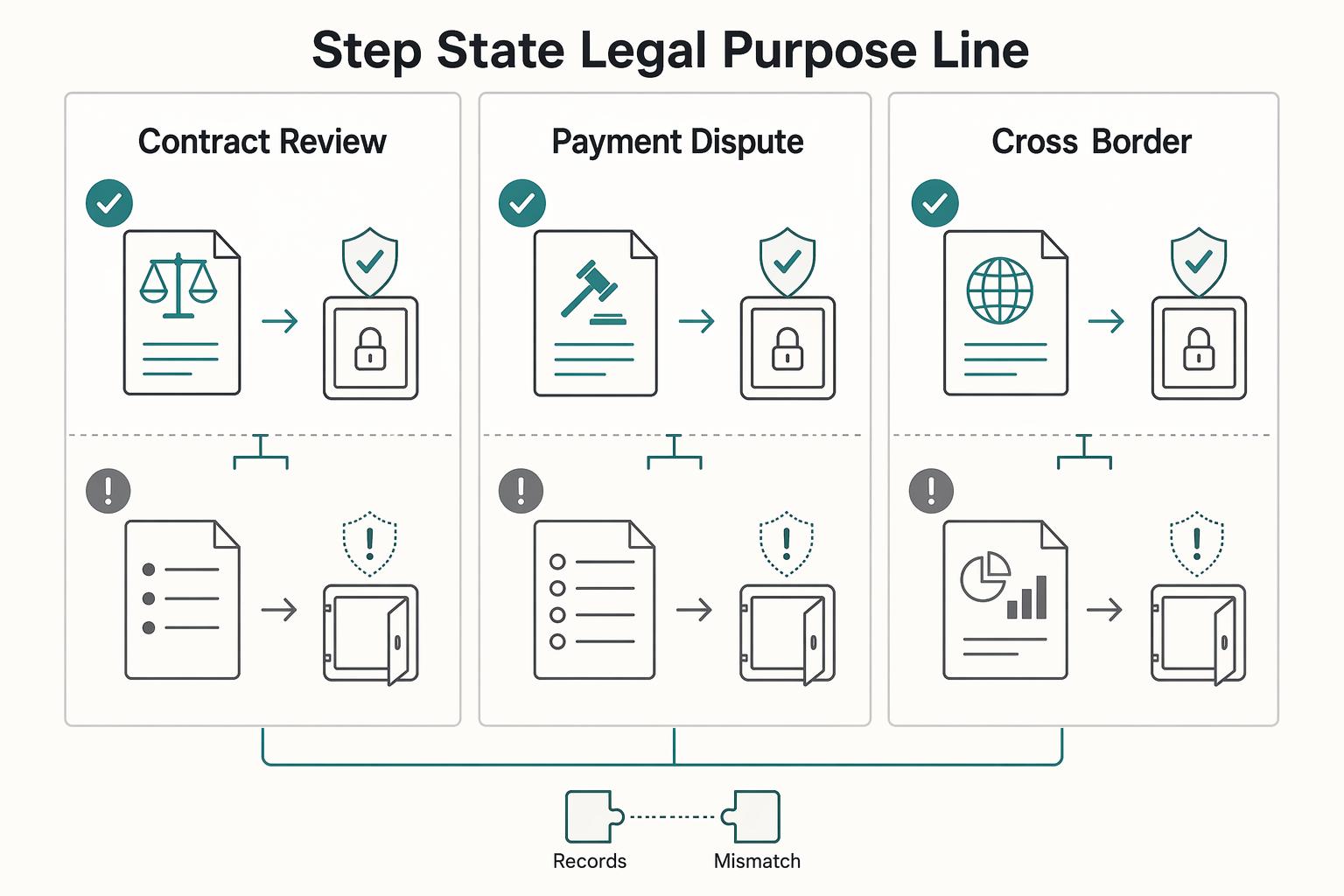
| Cross-border contract email | Private request for legal analysis of liability, governing law, or regulatory exposure in a draft | Mixed thread with sales, delivery, or client contacts discussing commercial or operational points |
| Payment dispute call | Private call with counsel to assess legal options after nonpayment | Project call with nonessential attendees where legal and operational issues are discussed together |
| Messaging app exchange | Direct message to counsel asking whether a termination notice meets contract requirements | Shared Slack or WhatsApp message tagging counsel while discussing both legal and business operations |
| Existing business records | Message to counsel requesting legal analysis of a signed SOW | Assuming the SOW, invoices, or delivery logs became privileged just because counsel received them |
Before you send anything, do one final check: Who is included? Why are you contacting counsel now? Are you actually keeping it confidential in sending, storage, and sharing? If one answer is weak, privilege is less dependable.
Related: A Guide to Choosing and Working with a Small Business Lawyer.
The Digital Minefield: Protecting Privilege in Your Daily Operations#
Privilege risk often comes from convenience, not conflict. The habits that create exposure are familiar: reply-all, mixed chat threads, inherited drive permissions, and broad assistant access. Keep legal requests limited to people counsel actually needs, and keep legal discussion separate from routine business traffic.
If a dispute reaches litigation, digital social-media investigations can extend well beyond major networks into obscure forums and app communities. Investigators may preserve posts, photos, videos, and metadata in analyst reports, and online material can be selectively framed to challenge credibility.
A practical check is not just "Is this tool secure?" but "Can I explain why each recipient, viewer, or editor was included for legal advice?"
"Necessary participant" is usually narrower than "helpful." In freelance or cross-border work, that can include a translator needed for a legal call, a finance lead needed to supply invoice history in a dispute, or a co-founder jointly instructing counsel. People added mainly for visibility or convenience can increase exposure.
| Area | High-risk convenience move | Safer protocol | Main risk signal |
|---|---|---|---|
| Reply-all or forward counsel's message to broader business contacts | Keep a private legal thread; send a separate business summary in your own words | Extra recipients can weaken confidentiality | |
| Chat platforms | Ask legal questions in mixed project or group channels | Use a dedicated private channel or direct message limited to needed participants | Legal purpose can get blurred with operational chatter |
| Cloud storage | Store legal drafts in shared drives with inherited or broad link access | Use a restricted folder with named access and periodic permission checks | Overbroad access can undercut confidentiality controls |
| Assistant access | Give full mailbox visibility or paste lawyer emails into general AI chats | Limit delegated access to admin tasks and keep legal text out of general AI tools | Additional viewers and stored chat records can increase exposure |
Email protocol#
Email is easy to overshare in, so tighter controls help. A high-risk move is forwarding counsel's exact message for alignment. A safer move is to start a new message with only the operational takeaway, without circulating counsel's legal analysis.
Treat email as a record that could surface later in litigation. Before you send, check recipients, thread history, and auto-complete errors so old participants do not stay on a legal exchange by accident.
Chat platform protocol#
Mixed channels are efficient for project work and risky for legal questions. Posting legal issues in general Slack, Teams, WhatsApp, or project groups can make it harder to show a clear legal purpose and a controlled audience. Use a private legal channel or a direct message limited to the people needed for that legal discussion.
Remember that digital investigations can search broadly across platforms and preserve content with metadata. Keep messages factual and avoid casual phrasing that could be misread if excerpted later.
Cloud storage protocol#
With storage, permissions are often the risk point. Uploading lawyer-commented drafts into folders with inherited team access or open-link sharing can create avoidable confidentiality exposure. Keep legal files in restricted folders with named access only, and review permissions before upload.
It also helps to separate legal commentary from ordinary business records. That way, when you need to share business documents, you are less likely to expose legal discussion at the same time.
Assistant and AI protocol#
Delegation is useful, but this area needs tighter boundaries. Broad assistant inbox access or pasting lawyer communications into a general AI chat expands the audience and can create records you did not intend to create. Limit assistant permissions to admin tasks, and keep legal communications in areas they cannot access.
AI output is not the same as privileged legal advice from licensed counsel, and AI conversations may be subpoenaed as evidence. Treat AI as an admin aid, not a place to paste sensitive legal communications. Use this quick check every time:
- Who can see this right now, including inherited access and old thread participants?
- Is each person included because counsel needs them for legal advice?
- Is this clearly a legal request, or is it mixed with routine business discussion?
- If this record surfaced later, would your confidentiality choices be defensible?
If privilege objections arise around digital records, promptly meet and confer and request a privilege log explaining the claimed protections.
You might also find this useful: What is 'sovereign immunity' and how it affects suing a foreign government client.
The "Two Hats" Test: Distinguishing Legal from Business Advice#
If you want privilege to hold up, separate legal interpretation from commercial judgment. When you ask about rights, obligations, exposure, or compliance, privilege is more likely, depending on context. When you ask for a business call, it is often treated as business advice, even if a lawyer is copied.
That is the practical dual-purpose issue. Courts do not apply one unified formula to mixed legal and business communications. The D.C. Circuit has applied a "significant purpose" approach in some contexts. The Second Circuit is often cited for a "predominant purpose" framing. The Supreme Court did not resolve that split when it dismissed In re Grand Jury on January 23, 2023. The safest move is still the same: separate legal asks from commercial discussion so the record shows what you were actually seeking.
Use a quick filter before you send#
Before you write, ask one question: Am I asking counsel to interpret legal risk, or to help make a business choice? Legal requests usually sound like this: What does this indemnity clause expose me to? Does this scope change affect payment terms under our contract? What claims or defenses do I have if the client does not pay?
| Legal advice example | Business advice example |
|---|---|
| "What does this indemnity clause expose me to?" | "Should I offer a discount?" |
| "Does this scope change affect payment terms under our contract?" | "What concession keeps this deal alive?" |
| "What claims or defenses do I have if the client does not pay?" | "How hard should I push in negotiation?" |
Check your first two lines. If they do not state the legal issue clearly, the thread may be mixed. Also remember that copying a lawyer does not create privilege by itself, and broader distribution can trigger waiver analysis.
Split the communication, not just the subject line#
A better subject line helps, but it does not fix a mixed message. The stronger move is to separate the communications themselves.
- Email 1 (counsel + only necessary participants)
Subject: Request for legal advice re MSA liability clause Body: brief facts, attached draft, numbered legal questions, decision deadline.
- Email 2 (business stakeholders)
Subject: Commercial options for MSA response Body: pricing, relationship considerations, fallback positions, approval questions in your own words.
This does more than improve wording. It clarifies purpose, limits recipients, and reduces the chance that counsel's analysis gets forwarded into a broader business thread.
| Freelancer scenario | More likely privileged | More likely not privileged | Safer handling |
|---|---|---|---|
| Contract redlines | Asking counsel to assess indemnity, limitation of liability, IP ownership, or termination risk | Asking whether the deal is worth it or which pricing concession to trade | Send the draft with specific legal questions in one message; discuss commercial fallback terms separately |
| Scope changes | Asking whether new work is inside the signed SOW or creates amendment risk | Asking whether to absorb extra work to preserve the relationship | Send original SOW, change request, and facts summary to counsel only |
| Payment dispute | Asking what remedies, notice rights, or defenses apply under the contract | Asking how hard to press without losing future business | Keep legal analysis in one thread; keep settlement posture in a separate business thread |
| Negotiation strategy | Asking whether a proposed clause creates legal exposure | Asking what opening number, discount, or sequencing gets signature faster | Separate clause-risk analysis from bargaining tactics |
Mixed-purpose threads are where risk rises#
This is where things usually get messy. A mixed thread does not always lose protection entirely, but courts may scrutinize whether obtaining legal advice was a significant or predominant purpose. That is harder to defend later, especially when sales, ops, or finance recipients were added for convenience. The safer move is to separate the discussion from the start and keep the audience tight.
Also watch for role shifts from counsel. If the conversation turns into "from a business perspective," treat that as your cue to split the thread.
Use this script when you want to be explicit:
I am requesting legal advice on my rights, obligations, and risk under this contract. Please advise on legal exposure, the clauses that matter most, and legal options for response. I will send business and negotiation questions separately.
For a step-by-step walkthrough, see What to Do When a Client Asks for a Discount.
Your Action Plan: A 4-Step Checklist to Protect Every Legal Conversation#
The pattern is practical, not jurisdiction-specific: make the legal purpose obvious, limit the audience, and separate legal discussion from business traffic. Use this 60-second check before you send any legal message in email, chat, or shared docs. If any step fails, fix it first.
| Step | Pass | Fail |
|---|---|---|
| Check the audience first | You send counsel your question and include only the one teammate who has the key project facts | You post the legal question in a shared client Slack channel with subcontractors and general ops contacts |
| State the legal purpose in line 1 | The first line asks for legal advice on a defined issue | The first line is a general "thoughts?" request mixing legal and commercial points |
| Trim content to what supports the legal question | You send the relevant clause, a short facts summary, and restricted document access | You attach the full project archive or use open-link access to "anyone with the link" |
| Label it and lock it down | The message is labeled and sent with restricted recipients, a private channel, or named document access | The message is labeled but widely shared, broadly CC'd, or posted in a general workspace room |
Step 1. Check the audience first#
Start with the audience. Review recipients, channel members, and document permissions, and ask: Does each person need access to this legal discussion?
Pass (freelance, cross-border): you send counsel your question and include only the one teammate who has the key project facts. Fail: you post the legal question in a shared client Slack channel with subcontractors and general ops contacts.
Quick checkpoint: if a call or channel is being recorded or auto-transcribed, move the legal discussion to a private, controlled channel first.
Step 2. State the legal purpose in line 1#
If the legal purpose is buried, the record can be harder to interpret later. Open with a direct legal ask so the purpose is clear without inference. If you also need business input, split it into a separate message.
| Situation | Weak phrasing | Strong phrasing | Split legal and business? |
|---|---|---|---|
| Contract review | "Can you look at this MSA?" | "I'm requesting legal advice on indemnity, limitation of liability, and termination risk in this MSA." | Yes, if you also want pricing or concession advice |
| Payment dispute | "Client is late again. Thoughts?" | "Please advise on my legal options and exposure under this contract's payment terms." | Yes, if you also want negotiation posture advice |
| Cross-border term request | "Is this okay for the Germany client?" | "Please advise on legal risk in this data-sharing term and whether to sign as drafted." | Yes, if you also want delivery or relationship strategy |
Pass: the first line asks for legal advice on a defined issue. Fail: the first line is a general "thoughts?" request mixing legal and commercial points.
Step 3. Trim content to what supports the legal question#
More context is not always better. Think in lifecycle checkpoints (create, view, transmit, store, and destroy), then send only the facts, draft language, and attachments needed to answer the legal question. For documents, confirm access is limited to named people who need it.
Pass: you send the relevant clause, a short facts summary, and restricted document access. Fail: you attach the full project archive or use open-link access to "anyone with the link" for convenience.
Also treat rough transcripts cautiously when precision matters.
Step 4. Label it and lock it down#
A label can help show intent, but it only helps if your handling matches it. Use a clear confidentiality label, then pair it with restricted recipients, a private channel, or named document access. Labels support intent. They do not create privilege by themselves.
Pass: the message is labeled and sent with restricted recipients, a private channel, or named document access. Fail: the message is labeled but widely shared, broadly CC'd, or posted in a general workspace room.
Use this micro-script before sending:
I am requesting legal advice on my rights, obligations, and risk regarding [issue]. This message is intended to be confidential and shared only with those necessary to obtain legal advice. Please advise on legal exposure, key clauses or facts, and legal options. I will send business or negotiation questions separately.
If you are relying on a local exception, confirm it with counsel first.
If you want a cleaner starting point before legal review, draft your client terms in a structured format with the Freelance Contract Generator.
Conclusion: Protect Privilege Through Routine Handling Before You Send#
The rule is simple: protect privilege through routine handling, not labels. In the minute before you send, forward, upload, invite, or reply, keep the communication confidential and focused on legal advice.
Before you share anything with counsel, or share counsel's advice onward, run the same check every time:
- Confirm confidentiality. Limit the audience to people needed for the client-lawyer exchange, and use controlled access settings.
- Confirm legal purpose. If the message mixes legal and business asks, split it so the legal request is clear and primary.
- Confirm sharing boundaries. Avoid forwarding counsel's original analysis unless counsel confirms it is appropriate for your matter. When others need a decision, send a separate business summary instead.
- Confirm handling discipline. A "privileged" label can show intent, but protection depends on confidential legal communication and tight circulation.
If the matter touches more than one jurisdiction, verify local privilege treatment with counsel before you share internally or with third parties.
Make this a pre-send habit. On your next legal communication, run the checklist before you hit send.
For related compliance workflow guidance, see What to do when a client refuses to sign a W-9 or provide a TIN. When you're ready to tighten the rest of your legal and operations workflow, review Gruv Tools.
Frequently Asked Questions
How do you reduce the risk of accidentally waiving attorney-client privilege?
You reduce the risk by preventing over-sharing and fixing mistakes quickly if they happen. In US federal contexts, Rule 502 looks at whether you took reasonable steps to prevent disclosure and then promptly rectify an error. The practical move is to check recipients, channel members, and document permissions before sending. If you mis-send, stop further sharing and contact counsel promptly.
Does copying extra people on an email automatically break protection?
Not automatically in every jurisdiction, but adding non-essential third parties can compromise confidentiality. A narrow exception may apply when the third party is necessary to the lawyer-client relationship, such as an interpreter. The practical move is to keep only the people needed for legal advice on the thread, and move everyone else to a separate business message.
How do you tell legal advice from business advice?
Use the request itself as the test. Questions about legal rights, obligations, exposure, contract terms, or compliance risk are typically legal advice. Questions about pricing, timing, or commercial strategy are typically business advice. A label does not turn business content into legal content. Put the legal ask in line one and send business questions separately, even if the same lawyer is involved.
Can you forward your lawyer’s email to a partner, client contact, or accountant?
Forwarding is risky because it expands the audience for a confidential legal communication. A safer move is often to send your own short summary of the business implications without forwarding counsel’s original wording or attachments. Do not auto-forward. Draft a new note focused on the decision that needs to be made.
Does labeling an email “Privileged” make it protected?
No. Protection depends on confidential legal content and context, not the label by itself. A label may help signal intent, but pair it with restricted access and a specific legal question.
What is the crime-fraud limit?
Privilege does not apply when legal advice is sought to further crime, fraud, or equivalent misconduct. This is a misuse limit, not a rule that every difficult fact pattern loses protection. If the issue involves possible fraud or similar misconduct, stop casual messaging and get direct counsel review before writing more.
Do the same rules apply across borders?
No. The governing rule can change by forum and claim, and UK and EU frameworks do not map one-to-one with US rules. For example, UK guidance distinguishes legal advice privilege and litigation privilege, and EU competition-investigation scope is narrower as to who qualifies. The practical move is to verify the governing jurisdiction before sharing and ask local counsel who can be included. | Communication | Primary purpose | Participants | Channel | Safer handling step | | --- | --- | --- | --- | --- | | “Please advise on my liability under this indemnity clause.” | Legal advice | You, your lawyer, one necessary fact holder | Private email or restricted document | Keep facts tight and access limited to named people | | “Should we lower price to save the deal?” | Business decision | You, sales or ops, lawyer copied | Broad email thread or team chat | Split legal questions into a new legal-only message | | Forwarding counsel’s contract analysis to a partner | Re-sharing legal advice | Adds a non-essential third party | Email forward | Send your own business summary instead of forwarding the original | | Matter involving EU competition regulators | Jurisdiction-sensitive legal advice | You and an independent external EU-qualified lawyer | Controlled legal channel | Confirm applicable scope before sharing with in-house teams or wider internal groups |
Try a related tool
Researched and edited by the Gruv editorial team. Gruv builds cross-border billing, payouts, and finance-operations software for global businesses.
Sources
- commons.stmarytx.edu/cgi/viewcontent.cgitrusted
- eur-lex.europa.eu/legal-content/EN/TXT/PDFtrusted
- insight.dickinsonlaw.psu.edu/cgi/viewcontent.cgitrusted
- jolt.law.harvard.edu/digest/against-an-ai-privilegetrusted
- law.cornell.edu/wex/attorney-client_privilegetrusted
- law.cornell.edu/rules/fre/rule_502trusted
- le.fbi.gov/file-repository/cjis_security_policy_v5-9-3_...trusted
- media.cadc.uscourts.gov/opinions/docs/2014/06/14-5055-1499662.pdftrusted
Educational content only. Not legal, tax, or financial advice.
Related Posts

Germany Freelance Visa Application Path for Freiberufler and Gewerbe
Choose your track before you collect documents. That first decision determines what your file needs to prove and which label should appear everywhere: `Freiberufler` for liberal-profession services, or `Selbständiger/Gewerbetreibender` for business and trade activity.
Choosing a Small Business Lawyer for Cross-Border Freelance Work
If you run a business-of-one, reactive legal help often catches problems after key decisions are already made. A general-counsel-style partner helps before commitments lock in and gives you ongoing oversight of contracts, structure, compliance, payment terms, and ownership language.

The Freelance Payment Penalty: A Modeled Audit of Platform Fees, FX Spreads, and Payout Delays
The money rarely disappears through a single, easy-to-spot fee. The real loss is stacked. A marketplace takes its commission, a processor adds a charge for international cards, a bank or payment company converts the currency at a spread, a platform holds the funds before release, and a wire sheds a little to intermediaries on the way in. Each layer looks defensible on its own, but the worker feels the combined result as a smaller deposit and a later payday.