
Quick Answer
Yes, an IGA is the legal route that determines how your foreign bank handles FATCA reporting: under Model 1, information moves through the partner jurisdiction; under Model 2, a reporting institution sends data to the IRS on Form 8966. Your practical move is to confirm the institution’s status, keep your U.S. TIN and ownership details accurate, and reconcile those records with your FBAR and Form 8938 drafts before filing.
What a FATCA IGA Is and Which Reporting Route Applies#
If you hold accounts outside the US, start with one practical question: what reporting route does your bank use where it operates? A FATCA intergovernmental agreement, or IGA, can set that route and give it legal footing in the bank's home jurisdiction.
FATCA generally requires foreign financial institutions and certain other foreign entities to report relevant U.S.-linked account information. In some countries, direct reporting can conflict with local privacy or data-protection rules. IGAs create a government-to-government route that helps remove those domestic-law conflicts and reduce operational burden for institutions in partner jurisdictions.
Model 1 and Model 2#
| Point | Model 1 IGA | Model 2 IGA | Where to verify |
|---|---|---|---|
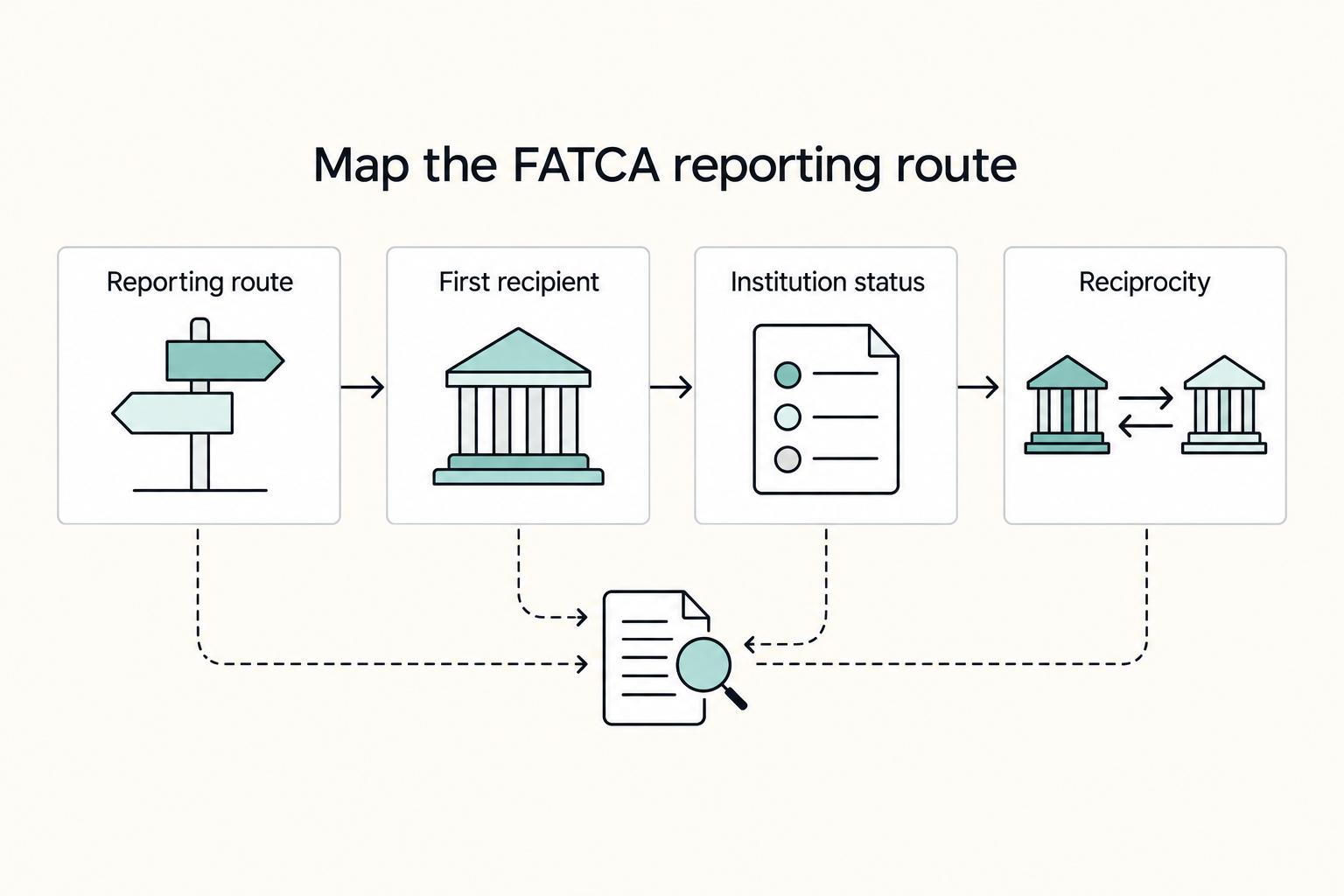
| Reporting route | Institution reports specified information to the partner jurisdiction, which then reports to the IRS on an automatic basis | A Reporting Model 2 institution reports U.S. accounts to the IRS, to the extent permitted | IRS FATCA governments page; Form 8966 instructions |
| Who receives first | Partner jurisdiction | IRS | Treasury list of jurisdictions treated as having an IGA in effect |
| What this changes for your documentation workflow | Local classification and account records are usually the first checkpoint before onward exchange | Institution-level IRS registration and reporting setup matter more | Ask the institution how your account is classified and keep the written response |
| Institution status check | Start with jurisdiction IGA status | Reporting Model 2 FFIs must register with the IRS and agree to an FFI agreement | IRS monthly GIIN list and FFI search/download tool |
| Reciprocity | May be reciprocal or nonreciprocal | Do not assume reciprocity | Confirm against current jurisdiction materials |
FATCA also includes withholding consequences in Chapter 4 contexts. IRS instructions reference 30% of a withholdable payment in that context, but confirm current scope before applying that figure to your situation.
What this means for you now#
Start with a simple working framework:
- Map each account by country, institution, and likely IGA route.
- Verify records at the source: jurisdiction IGA status, plus GIIN status if the institution says it is a registered FFI.
- Align institution records with your own U.S. disclosures so your filings and account data do not drift apart.
If a bank cannot clearly tell you whether it reports under Model 1 rules or as a Reporting Model 2 FFI, treat that as an early issue and get the answer in writing. For related guidance, see FBAR and FATCA Reporting for US Expats.
Step 1: Map Your Compliance Footprint#
Do this once, and do it in a way you can reuse. A solid account map will support Form 8938 prep, bank follow-ups, and the verification work in Step 2. The point is to build a usable record now instead of reconstructing details at filing time.
Form 8938 is attached to your annual return and filed by that return's due date, including extensions, so build your map with that filing context in mind. First, confirm the basic scope. Form 8938 applies when you are a specified person, meaning a specified individual or specified domestic entity, and you have an interest in specified foreign financial assets required to be reported. If you do not need to file an income tax return for the year, you do not need to file Form 8938.
Build one row per account#
Use a spreadsheet or secure document. Give each foreign financial account, and any other foreign financial assets you track for filing, its own row.
| Field | What to record |
|---|---|
| Institution | Legal name of the bank, broker, or other foreign financial institution |
| Country | Jurisdiction where the account is maintained |
| Account or asset type | Deposit, custodial, or other foreign financial asset |
| Entity type | Bank, brokerage, or other institution type |
| Account owner type | Individual, joint, or entity-owned |
| Reporting status notes | Any institution-provided tax or reporting status notes, or unclear if not confirmed |
| Documentation status | Statements, opening docs, tax forms, and any unresolved requests |
| Tax-year changes | Closed, acquired, sold, or other notable changes during the year |
| Maximum value checkpoint | Highest value supported by your records |
For each row, keep the source records with the map. That usually means the latest statement, year-end statement, account opening confirmation, and any tax-documentation request notice.
Match the map to Form 8938 checkpoints#
Your map should mirror what Form 8938 asks. Structure it so you can answer the number of deposit accounts in Part V and the maximum value of all deposit accounts. It should also show whether foreign deposit or custodial accounts were closed during the tax year, and whether foreign assets were acquired or sold during the tax year.
| Checkpoint | What the map should show |
|---|---|
| Part V deposit accounts | Number of deposit accounts |
| Deposit account values | Maximum value of all deposit accounts |
| Closed during the tax year | Whether foreign deposit or custodial accounts were closed during the tax year |
| Acquired or sold during the tax year | Whether foreign assets were acquired or sold during the tax year |
| Possible exclusions | Mark possible exclusions; some accounts are excluded, including financial accounts maintained by a U.S. payer |
Just as important, mark possible exclusions instead of assuming every account belongs on Form 8938. IRS guidance says some accounts are excluded, including financial accounts maintained by a U.S. payer.
Prioritize first-pass review#
Do not review every row with the same intensity. Start with the rows most likely to create confusion later:
| Priority issue | Article detail |
|---|---|
| Reporting status | unclear reporting status in your records |
| Documentation | incomplete or outdated documentation |
| Tax-year changes | closures, acquisitions, or sales |
| Ownership | joint or shared-ownership accounts |
| Possible exclusions | accounts you think may be excluded, but without clear support |
Keep one boundary clear from the start: filing Form 8938 does not replace FinCEN Form 114, or FBAR, when FBAR is otherwise required.
If totals look close to filing thresholds, flag those rows now. IRS materials cite an aggregate value exceeding $50,000 as a baseline for certain taxpayers. Form 8938 instructions also include $50,000 at year-end or $75,000 at any time for specified domestic entities. In Step 2, you will verify how those thresholds apply and tie them back to the supporting records row by row.
Step 2: The Pre-Compliance Checklist#
This is where the paper trail either holds together or starts to break. Your goal is simple: make each institution's record of you match what you plan to file. Before filing season, your bank records, your account map, and your draft filings should tell one consistent story.
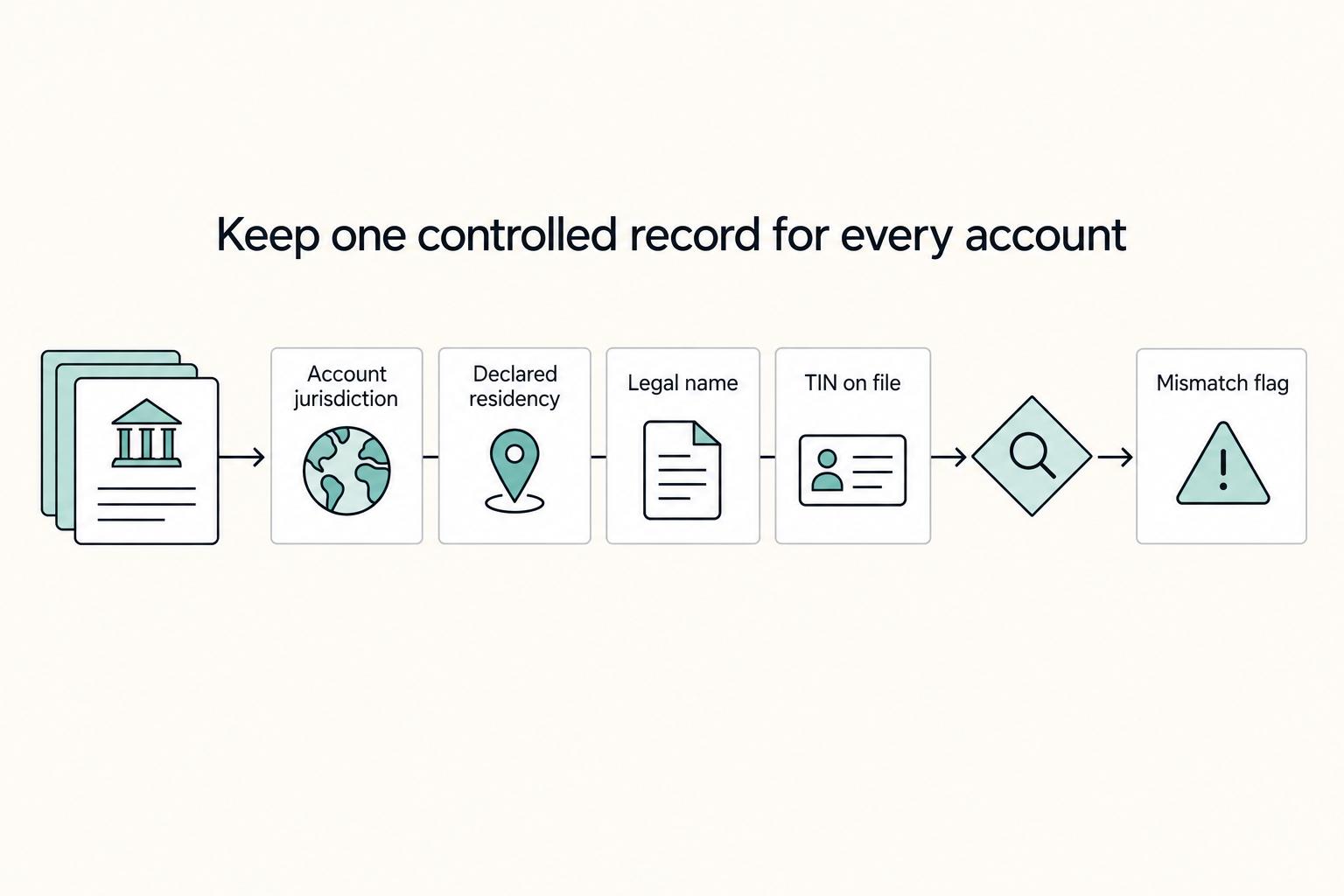
Confirm identity and tax data at every institution#
Start with a bank-by-bank verification pass. For each institution, confirm:
| Field | What to confirm | Evidence |
|---|---|---|
| Legal name | Legal name | Written reply, secure-message confirmation, or portal screenshot |
| Address | Address | Written reply, secure-message confirmation, or portal screenshot |
| U.S. TIN | U.S. TIN | Written reply, secure-message confirmation, or portal screenshot |
| Account number | Account number | Written reply, secure-message confirmation, or portal screenshot |
| Ownership status | Account ownership status, individual versus entity | Written reply, secure-message confirmation, or portal screenshot |
| Tax form status | Whether a valid Form W-9 is on file | Written reply, secure-message confirmation, or portal screenshot |
These are core FATCA data points, so mismatches here create avoidable risk. Ownership status matters too, because account-holder treatment follows who is listed or identified as the holder or owner.
Save evidence for each check. A written reply, secure-message confirmation, or portal screenshot is enough if it is clear and dated. Add three fields to each Step 1 row: verified date, who confirmed, and evidence saved. If W-9 status is unclear, mark it unresolved rather than guessing.
If your map shows Model 1, reporting goes through the partner jurisdiction before the IRS. If it shows Model 2, reporting goes directly to the IRS on Form 8966. The route changes, but the basic control does not. Your identity and account data still need to be correct.
Match bank records to your own filing records#
Treat this as record matching, not memory. For each account, line up:
- owner
- account number
- open or closed status during the year
- balance or value support in your records
Keep FBAR as a separate comparison track, not a substitute for other filings. Confirm the current FBAR threshold from official/source records or adviser records before using it in a checklist.
Current IRS FBAR guidance says FinCEN Form 114 is required when aggregate foreign account value exceeds $10,000 at any time in the calendar year. It is due April 15, with an automatic extension to October 15. IRS materials also state that FBAR and Form 8938 have different reporting thresholds.
Use this checkpoint: for every account in your map, can you clearly explain why it is or is not on your FBAR draft, and why it is or is not on your Form 8938 draft? If not, fix the records before you file.
Reconcile the financial story#
Once the names and account details are aligned, reconcile the activity. Your income sources, account movements, entity distributions, and filing positions should fit one coherent narrative.
Tag material inflows and outflows in your map or statement notes, such as client income, internal transfer, capital contribution, distribution, sale proceeds, or loan. Then make sure your tax records support each tag. Keep supporting documents for cross-account movements and client payments.
Potential breaks include duplicate accounts after bank migrations, closed accounts still sitting in your records, or frequent internal transfers that are not documented as internal. The standard is not polished prose. It is a clear, supportable record trail.
Treat documentation requests as time-sensitive risk control#
Bank documentation requests are not admin noise. When an institution asks for a Form W-9, corrected name and TIN, or updated holder details, respond quickly and log everything. Form W-9 is used to provide your correct TIN to a requester filing IRS information returns.
If you fail to provide a valid W-9, or you fail to provide a correct name and TIN combination when requested, recalcitrant account-holder treatment can apply. That does not mean every missed request leads to immediate closure, but it is a real control point. In some situations where withholding cannot be applied because of foreign law, regulations can require closure, blocking, or transfer.
Use a simple request log for each institution:
- date received
- documents sent
- delivery method
- reference number
- acknowledgment received
If the institution's classification does not match your understanding, or your filing treatment is unclear, pause and escalate to a qualified tax professional before you send conflicting information. By the end of this step, each account row should be marked verified, follow-up needed, or escalated.
For a deeper dive, read Digital Nomad Taxes in 2026 With a Defensible Filing Plan. Before you file, document your country-by-country facts in one place so your bank records and reporting decisions stay consistent: Track your tax residency evidence.
Keep Records Aligned, Document What You Verified, and Escalate When Unclear#
This gets manageable once you treat it as record alignment instead of a guessing exercise. The goal is straightforward: keep key identity, account, and tax-year details aligned across institution records, your FBAR, and Form 8938 when Form 8938 applies.
That shift can reduce avoidable mismatch risk and decision fatigue. Keep one current account inventory, keep your tax-year records current, and run one pre-filing reconciliation before you file.
| Reactive approach | Strategic approach |
|---|---|
| Bank profile data | Update only after a request arrives |
| Account inventory | Rebuild from old emails at filing time |
| Filing prep | Prepare forms from memory |
| Documentation habit | Minimal saved proof |
| Likely operational outcome | More follow-up and repeated uncertainty |
A useful final check is to go back to the Form 8938 prompts that cover much of the practical work. Count the number of deposit accounts. Confirm whether foreign deposit or custodial accounts were closed during the tax year, and whether foreign assets were acquired or sold. If required, Form 8938 must be attached to your annual return and filed by that return's due date, including extensions. FBAR remains a separate filing track.
If thresholds or classification are not clear, stop self-diagnosing and escalate to a qualified cross-border advisor. That is the practical default here: keep records aligned, document what you verified, and escalate when classification or threshold decisions stop being straightforward.
Related: A guide to the Foreign Account Tax Compliance Act (FATCA) for individuals.
If FATCA, FBAR, and account reporting timelines still feel fragmented, run a final numbers sanity check before you submit: Use the FBAR calculator.
Frequently Asked Questions
Why is my foreign bank asking for my U.S. tax ID?
One practical reason may be tax-identification matching. Form 8938 explicitly includes a taxpayer identification number (TIN) field. Confirm your legal name, address, and U.S. TIN against the institution’s request, and save evidence for each check (screenshot, secure message, or written confirmation).
Does my bank in a specific country report my account to the IRS?
Maybe, but verify it from current official/source records before relying on it. This section does not provide a complete current country list, and both jurisdiction IGA status and institution reporting status can matter. If an entity is involved, verify classification first. In the IRS Model 1 IGA FAQ scenario, a disregarded entity must register separately from its owner and should not be reported by the owner as a branch.
What happens if I do not respond to a bank request for my U.S. tax information?
Treat it as time-sensitive, but do not assume one missed reply automatically means closure or a fixed account status. A practical risk is unresolved tax-ID information that can trigger follow-up requests and filing friction. Respond promptly, log the request trail, and escalate if the institution’s position conflicts with your documented facts.
What information should I compare against my own filings?
Compare fields you can verify directly, not assumptions about every field an institution may transmit. Form 8938 includes a TIN field and asks whether foreign deposit or custodial accounts were closed during the tax year, so confirm TIN, ownership, and open or closed status against your records. Then reconcile bank records, your account map, your FBAR draft, and your Form 8938 draft against supporting evidence.
If I file Form 8938, am I done?
No. IRS instructions state that filing Form 8938 does not relieve you of FBAR filing when FBAR is otherwise required. Keep FBAR, FinCEN Form 114, as a separate track. If Form 8938 applies, attach it to your annual return and file it by that return’s due date, including extensions.
When do Form 8938 thresholds or edge cases mean I should stop self-diagnosing?
Stop early when thresholds, status, or classification are unclear. IRS materials cite a baseline $50,000 aggregate value threshold for certain taxpayers, note higher thresholds in other cases, and state specified domestic entity thresholds of $50,000 at year-end or $75,000 at any time. If you are unsure whether you are a specified individual, a specified domestic entity, or how multi-country facts affect treatment, get qualified review before filing.
Do I need Form 8938 if I am not filing a U.S. income tax return for the year?
Generally, no. IRS guidance says that if you do not have to file an income tax return for that tax year, you do not need to file Form 8938 for that year. The next step is to confirm your return-filing status first, then separately confirm whether FBAR still applies.
Is FATCA the same as CRS?
No, they are separate regimes. This FAQ is about Form 8938 boundaries and related FATCA/IGA reporting questions, and it does not determine CRS treatment. If CRS is in play, review A Guide to the 'Common Reporting Standard' (CRS) for Nomads and escalate when residency facts conflict.
Try a related tool
Researched and edited by the Gruv editorial team. Gruv builds cross-border billing, payouts, and finance-operations software for global businesses.
Sources
Includes 2 external sources outside the trusted-domain allowlist.
- ecfr.gov/current/title-26/chapter-I/subchapter-A/part...trusted
- ecfr.gov/current/title-26/chapter-I/subchapter-A/part...trusted
- irs.gov/businesses/corporations/fatca-governmentstrusted
- irs.gov/businesses/corporations/frequently-asked-que...trusted
- uscode.house.gov/view.xhtmltrusted
- gov.uk/government/publications/uk-us-automatic-exch...external
- news.admin.ch/en/nsbexternal
Educational content only. Not legal, tax, or financial advice.
Related Posts

Digital Nomad Taxes in 2026 With a Defensible Filing Plan
With digital nomad taxes, the first move is not optimization. It is figuring out where you may be taxable, where filings may be required, and what proof supports that position.
Common Reporting Standard (CRS) for Digital Nomads: Self-Certification and Data Mismatch Risk
The Common Reporting Standard, or CRS, is a reporting framework, not a tax. In practice, your exposure often comes from inconsistent identity or tax residency data across institutions, not from CRS itself.
FATCA for Individuals and the Form 8938 Filing Decision
If you work across borders, use modern fintech, and build wealth in multiple currencies, financial complexity is normal. What often sits in the background is the fear of a U.S. tax compliance misstep. One of the main concerns is the Foreign Account Tax Compliance Act, or FATCA, and its name alone can create uncertainty.