
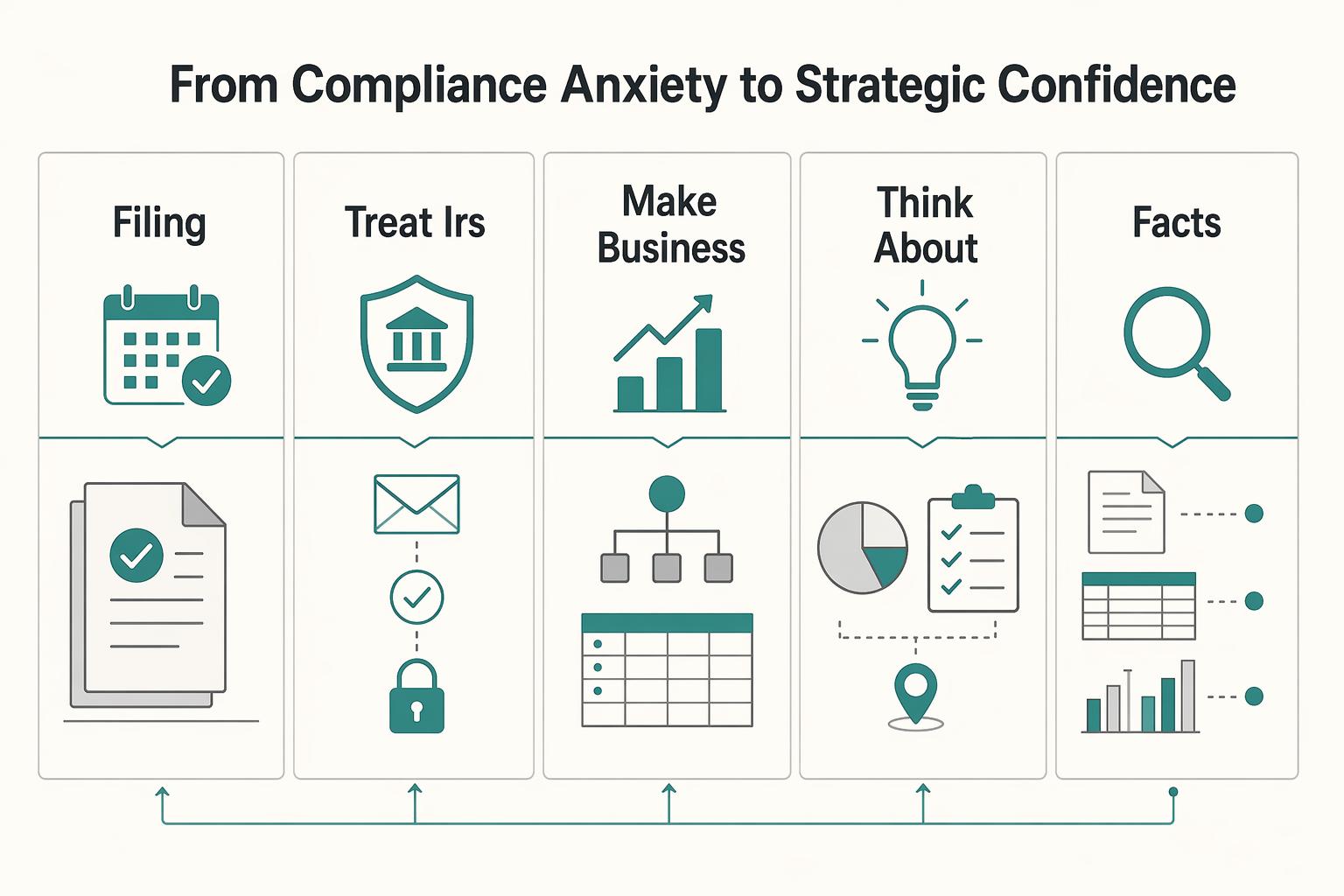
Quick Answer
An enrolled agent is a federally authorized tax practitioner who can represent taxpayers before the IRS, and you should hire one when your issue involves IRS notices, cross-border filings, back taxes or unfiled returns, or a major move or transaction before it happens. An EA can also coordinate planning, return preparation, and IRS-facing communication in one place.
Your On-Demand Chief Compliance Officer: The Enrolled Agent#
If you have cross-border income and still file with the IRS, an Enrolled Agent, or EA, can be a practical first partner for federal tax compliance and IRS-facing issues. U.S. citizens and resident aliens are taxed on worldwide income, so earning abroad does not remove IRS obligations.
In plain terms, an EA is a federally authorized tax practitioner who can represent taxpayers before the IRS after meeting IRS enrollment requirements. EA status is earned by passing a three-part IRS exam or through qualifying former IRS experience. EAs must complete 72 hours of continuing education every 3 years. In practice, that means one professional can handle planning, return preparation, and direct IRS representation in one place.
| Credential | Core scope | Best use case | Escalate when |
|---|---|---|---|
| EA | Federal tax planning, return prep, and IRS representation rights | Cross-border filings, late or amended returns, IRS notices, audit or collection contact | The issue becomes a court-driven strategy or broader legal dispute |
| CPA | State-licensed accounting professional; may provide tax, accounting, and advisory services | You need tax support plus books, statements, or ongoing accounting operations | You need court-focused legal strategy |
| Tax Attorney | State-bar licensed lawyer; may handle tax controversy within broader legal practice | High-stakes disputes, legal exposure, settlement or legal positioning | The issue is routine compliance work without legal complexity |
Use one quick filter before you hire. A PTIN is not the same as a credential with broad IRS representation rights. Any paid preparer can have a PTIN, but representation can be limited for some preparers, including in appeals and collections. If IRS representation is part of your plan, confirm credentials in the IRS directory, verify EA status with the IRS Office of Enrollment when needed, and ask how they handle Form 2848 to formally authorize representation. If a dispute moves to U.S. Tax Court, nonattorneys must separately meet Tax Court admission requirements.
Once you know who can actually represent you, map where your cross-border risk sits. If you want a deeper dive, read our guide to a defensible 2026 filing plan.
Why Your Success Creates Your Biggest Risk: The Global Professional's Compliance Minefield#
The main risk is overlap across systems, not one isolated mistake. If you earn across borders, move frequently, and use foreign accounts, a monthly recordkeeping habit keeps your facts usable when filing decisions are later reviewed.
This section does not define specific residency tests, immigration limits, U.S. foreign-account reporting triggers, or permanent-establishment tests. Treat each area as a separate review and confirm what applies to your facts.
| Trigger | What you must track | What breaks if missed |
|---|---|---|
| Potential local tax-residency questions | Entry and exit dates, lease periods, home and family ties, where work was performed | You may take a local filing position that later needs correction |
| Potential U.S. foreign-account reporting questions | Account list, ownership status, monthly statements, balance support records | Your U.S. filing package may be incomplete or harder to support |
| Potential immigration stay-limit questions | Passport records, visa terms, travel bookings, work-authorization details | You can appear aligned in one process but misaligned in another |
| Potential permanent-establishment questions | Contract-signing authority, where services are delivered, fixed-base usage, local team footprint | You can create tax, payroll, or contract risk without noticing early |
Keep the rulebooks separate#
A travel tracker can support immigration records, but it is not a complete tax file. You still need evidence for where work was performed, how you were paid, and how each account is owned.
When IRS representation or IRS filing positions are in scope, bring in an enrolled agent. EAs are authorized to represent taxpayers before the IRS and are generally unrestricted by taxpayer type, tax matter, and IRS office.
What to monitor monthly#
Build the evidence pack every month so decisions rest on records, not memory. At a minimum, track:
| Monthly item | What to keep |
|---|---|
| Travel days | Log border crossings and reconcile them with your calendar and travel records. |
| Account balances | Save monthly statements and maintain a current account and ownership list. |
| Income source records | Keep invoices, contracts, and payment records with notes on client location and work location. |
| Entity or client footprint | Review where you signed, where work was managed, and whether you used a fixed base or local support. |
Keep the underlying support, not just a summary. If a filing question comes up later, you will need the statements, contracts, dates, and ownership details behind your timeline.
For a related documentation workflow, see What Is a Legal Hold and When Should You Issue One?.
Your Shield and Ambassador: The Role of the Enrolled Agent#
The practical benefit of an EA is control. When your EA handles IRS-facing communication, you stop improvising responses and start managing facts. You still own the records and factual timeline, but your EA can represent you before the IRS, coordinate responses, and help keep your position consistent across returns, notices, and supporting documents.
If you respond alone, you have to decide what the IRS is asking, what to send, and how to frame your facts under pressure. With an EA, that work can be centralized. Your return position can tie back to facts you documented earlier, and notice response becomes less reactive.
What an EA actually does for you#
An enrolled agent is a federally recognized tax practitioner with authority to represent taxpayers before the IRS. Like CPAs and attorneys, EAs generally have unlimited IRS practice rights, unrestricted by taxpayer type, matter type, or IRS office.
For you, that usually changes three things:
- Notice response: You provide the full notice and records, and one professional can manage the IRS-facing reply.
- Return-position consistency: Responses can be aligned with filed returns and supporting documentation.
- Case coordination: One person can track the issue, facts, and communication flow.
The boundaries still matter. This authority covers IRS matters. It does not automatically extend to every non-IRS legal or regulatory issue. It also does not guarantee a specific IRS outcome.
EA, CPA, and tax attorney compared#
| Professional | IRS representation scope | Cross-border tax depth | Best fit for a freelancer with international income |
|---|---|---|---|
| EA | Unlimited practice rights before the IRS | Varies by practitioner; international specialization is not automatic | You want tax-focused filing support and IRS notice representation |
| CPA | Unlimited practice rights before the IRS | Varies by practitioner or firm | You want tax support integrated with bookkeeping or accounting work |
| Tax attorney | Unlimited practice rights before the IRS | Varies by practitioner | You need tax help where legal analysis may be central |
Choose based on relevant experience, not title alone.
Credential checks that affect your risk#
The practical point is risk control. EA status is the highest credential awarded by the IRS, and EAs must follow ethics standards and continuing education requirements (72 hours every three years). Confirm current status directly through the IRS "Verify the status of an enrolled agent" checkpoint.
Common misconceptions and the corrected action#
| Misconception | Corrected action |
|---|---|
| If I hire an EA, I can hand off everything. | Hand off IRS communication, but keep supplying complete records and factual clarifications quickly. |
| Any EA, CPA, or attorney will be equally strong for international freelancer issues. | Ask directly about hands-on experience with foreign income, foreign accounts, and multi-country filing facts. |
| I should answer the IRS first, then hire help if needed. | If the notice touches international facts, send the full notice and records to your professional before any response. |
The recurring theme is simple: you can delegate the IRS-facing work, but you cannot outsource the facts.
Related: The Best Accounting and Tax Advisors for US Expats.
Four triggers for bringing in an EA#
Bring in an EA before the facts and response path get messy. Use this four-trigger rule: IRS notice, complexity jump, back taxes or unfiled returns, or a major move before it happens. EAs have IRS-granted representation rights and are generally unrestricted in which taxpayers, tax matters, and IRS offices they can handle.
| Trigger | Urgency | Typical documentation needed | Support pattern |
|---|---|---|---|
| IRS notice received | High | Full notice packet, envelope, related returns, records tied to the notice, fact timeline | EA can represent you before the IRS and is often a strong first call for IRS response coordination; co-management may be needed for accounting reconstruction or legal risk |
| Complexity threshold crossed | Medium to high, ideally before filing | Foreign account statements, ownership docs, contracts, compensation records, foreign filings, residency timeline | EA often leads IRS-facing and filing coordination; some cases need CPA or tax attorney input |
| Back taxes or unfiled returns | High | Prior notices, wage or income records, bank records, foreign income support, bookkeeping files, prior drafts | EA can often lead catch-up filing and IRS communication; co-management may help when books are incomplete or facts are disputed |
| Major move or transaction ahead | Medium, time-sensitive before execution | Draft agreements, ownership or entity docs, basis records, relocation dates, payroll or compensation terms | EA may be sufficient for tax planning scope; some transactions need CPA support or legal drafting support |
IRS notice arrives#
Signal: You receive an IRS letter or notice. Immediate action: Before you respond, have your EA review the full packet where possible. Share every page and, if available, the envelope. Pull the return and source records for the year involved, and confirm who owns the response path. Before relying on representation, use the IRS "Verify the status of an enrolled agent" checkpoint and confirm your advisor is current on IRS ethical and continuing-education requirements.
Initial response checklist:
- Save the full notice packet as one file, including inserts and page numbers.
- If possible, pause direct calls or written responses until your EA sets a response plan.
- Pull the filed return, workpapers, and supporting records for that tax year.
- Delegate the response path: who replies, what goes first, and what you must provide.
Why delay increases risk: Early direct replies can create inconsistencies your EA later has to unwind. Delay can also raise the odds of incomplete records and a weaker fact narrative.
Complexity threshold crossed#
Signal: Your situation now includes foreign accounts, foreign business ownership, cross-border compensation, or filings across multiple countries. If you suspect a reporting threshold may apply, complexity is likely in play.
Immediate action: Build one complete file: a country-by-country timeline, account list, ownership details, compensation documents, and copies of foreign returns filed or expected. Ask your EA to map obligations and filing order, not just prepare forms.
Why delay increases risk: A common failure mode is partial compliance, not one obvious error. Dates, forms, and positions can drift across countries and filings when records stay fragmented.
Back taxes or unfiled returns#
Signal: One or more returns were not filed, were late, or tax is due and cannot be paid immediately. Immediate action: Use realistic resolution paths: a catch-up filing plan, a payment path, and an IRS representation strategy based on records you can support. Start record recovery right away.
Why delay increases risk: Evidence degrades over time, and reconstruction gets harder. You are not promised a specific outcome, but earlier organization usually gives your EA a stronger, more consistent case to manage.
Major move or transaction ahead#
Signal: You are about to change entity structure, sell an asset, relocate, or trigger compensation events, for example vesting, exercise, or payout. Immediate action: Bring your EA in before signing, closing, payroll processing, or funds movement. Use a short pre-transaction review to confirm timing, documentation, and filing interactions while options are still open.
Pre-transaction checklist:
- Draft agreement or term sheet
- Ownership and entity documents
- Cost basis and acquisition records
- Expected dates for move, closing, vesting, exercise, or payout
- Any foreign tax advice or local filing assumptions already in play
Why delay increases risk: After execution, options narrow quickly. You can still report events, but you lose flexibility to shape documentation and timing cleanly before facts harden.
For a step-by-step walkthrough, see Choosing Between a CPA, Enrolled Agent, and Tax Attorney.
Before your first EA consult, map your travel and filing footprint in the Tax Residency Tracker. That gives your advisor facts to work from instead of guesswork.
How to vet an EA before you sign#
The right EA should be able to map your facts into a clear filing and response path on the first call. Unlimited practice rights before the IRS confirm representation authority. They do not confirm fit for your cross-border profile.
1) Screen for specialization using your real case#
Start the call with your facts, not a generic "expat" label: where you lived by date, income types, entity setup, state exposure, and any IRS notice or unfiled year. Then ask them to restate your case in their own words and outline what is in scope.
Look for whether they separate your case into federal filing, IRS representation if needed, state residency or source-income treatment, and missing documents that could change the answer. Be cautious if they stay broad, avoid specifics, or move to pricing before they can map scope.
If your facts include California, ask how they would handle part-year resident versus nonresident treatment. Then ask when they would use Form 540NR and a workday sourcing approach (CA Workdays / Total Workdays = % Ratio).
If they cannot explain your case structure clearly, treat that as a not-a-fit result and keep looking.
2) Test technical fit with evidence requests#
Use this intake checklist on the first call.
- Ask which federal, IRS, and state filings they believe are in scope this year.
- Ask which documents they need first to confirm that view.
- Ask who will actually prepare and review your file.
- Ask how notice handling works outside filing season.
- Ask what happens if your matter expands beyond their scope.
Prefer answers that are specific and conditional on records. Be cautious if someone gives firm conclusions before reviewing dates, filing history, notices, and source records.
| Decision criterion | What to confirm | Choose this if... |
|---|---|---|
| Scope fit | They map your federal, IRS, and state issues from your facts | your case has multiple moving parts and they can map them clearly |
| Communication protocol | They define response timing, notice workflow, and point of contact | you need predictable communication while traveling or across time zones |
| Document handling | They provide a concrete request list and upload process | you want fewer document gaps and less back-and-forth |
| Year-round planning cadence | They specify when to update them after moves or transactions | your facts change during the year |
| Representation readiness | They explain how they step in for IRS matters and what they need | you already have IRS contact risk or an active notice |
3) Validate operations and credentials before signing#
Verify EA status yourself using the IRS enrolled-agent status page. That tells you whether the credential is current. It does not measure quality, responsiveness, or fit.
| Check | What to confirm |
|---|---|
| EA status | Verify EA status yourself using the IRS enrolled-agent status page. |
| File ownership | Confirm in writing who owns your file day to day. |
| Engagement scope | Confirm in writing what the engagement includes and excludes. |
| Handoff process | Confirm in writing how handoff works if your matter moves outside agreed scope. |
| Actual file owner | If the person on the call is not the file owner, ask for the actual owner's name and role before onboarding. |
Before you sign, confirm in writing who owns your file day to day, what the engagement includes and excludes, and how handoff works if your matter moves outside agreed scope.
If the person on the call is not the file owner, ask for the actual owner's name and role before onboarding.
You might also find this useful: How to Choose a Tax Preparer for Your Freelance Business.
Turn tax work into a year-round operating practice#
Confidence comes from process, not from hoping tax season goes well. The shift is to treat tax as a year-round operating practice with clear ownership, clear response steps, and review before key decisions.
| Current behavior | Better default | Immediate next step |
|---|---|---|
| You gather records only when filing starts | Keep a monthly record cadence for items reported on your return, plus IRS correspondence | Set one storage location and a recurring monthly admin block |
| You treat IRS notices as ad hoc tasks | Follow the notice instructions, respond through the stated channel, and keep copies of all correspondence | Define notice intake, response drafting, and record storage now |
| You make business changes first and ask tax questions later | Run a short tax review before non-routine changes | Add a pre-decision tax check before new structures, moves, or major transactions |
| You think about estimated tax once a year | Manage estimated tax across all four IRS payment periods | Calendar April 15, June 15, Sept. 15, and Jan. 15 (following year) |
Use this EA operating model for a business-of-one:
| You own | Your EA owns | Escalate when |
|---|---|---|
| Complete records, timely answers, and early alerts when facts change | Return prep or review, estimated-tax oversight, and IRS representation after Form 2848 is in place | You need legal advice, then bring in a tax attorney |
Two guardrails keep this clean. If you want IRS representation on audits, collections, or appeals, use Form 2848. The return's third-party checkbox is not enough for compliance representation. Even with a paid preparer, you remain responsible for return accuracy.
Use this execution checklist to keep the process running:
- Set a communication rhythm: monthly records check, quarterly payment review, pre-filing review.
- Define scope in writing: filings, notices, estimates, and what triggers extra work.
- Keep support records, not just summaries, and retain them for at least 3 years in standard cases.
- Schedule planning touchpoints before major decisions, not after.
This pairs well with our guide on UK Non-Dom Tax Status: Self Assessment Steps and What You Must Verify.
Before you close this out, if FBAR may apply, run a quick exposure check with the FBAR Calculator and use the result to set your next compliance action.
Frequently Asked Questions
What does an enrolled agent actually mean for you?
It means you can hire a federally authorized tax practitioner who has earned the privilege of representing taxpayers before the IRS. In practical terms, that gives you IRS representation and tax-process support. The IRS also describes EA status as the highest credential it awards.
Should you hire an EA or a CPA?
Choose the advisor who can explain your facts, filing scope, and response steps without guessing. For IRS representation, both EAs and CPAs generally have unrestricted practice rights, so fit and specialization should decide. If your CPA stays broad instead of mapping scope, move the work to an EA.
Should you hire an EA or a tax attorney?
Use an EA when the job is filings, corrections, notices, and administrative IRS representation. Escalate to a tax attorney when you need legal advice. If the risk is legal-position strategy, start with attorney review.
Is an EA the right fit for expat or cross-border compliance work?
Sometimes. The key question is whether the EA can show real cross-border individual-tax execution and not just a general tax background. Ask them to define scope, list the records they need, and confirm which current rules and deadlines they will verify before advising you.
How do you verify that someone is really an EA?
Verify current status through IRS records and ask how they qualified. EA status can come from passing a 3-part IRS exam or through qualifying former IRS experience, and enrollment includes a suitability review tied to tax compliance and criminal background checks. EAs must also complete 72 hours of continuing education every 3 years.
Any 2026 credential-check caveat you should know?
Yes. Treat older exam-process details cautiously because the IRS says detailed EA FAQ content applies to the prior Prometric testing window, with administration shifting to PSI beginning March 1, 2026, and scheduling for the 2026 EA-SEE cycle opening May 1, 2026. The practical step is to confirm status from current IRS sources instead of relying on old website copy.
What should you confirm before you sign with any advisor?
Get the basics in writing before you commit. Confirm active credentials, exact scope, who owns communication, and how fees change if the matter expands. Also confirm who actually owns your file and how handoff works if the matter moves outside the agreed scope.
Try a related tool
Researched and edited by the Gruv editorial team. Gruv builds cross-border billing, payouts, and finance-operations software for global businesses.
Sources
Educational content only. Not legal, tax, or financial advice.
Related Posts

Digital Nomad Taxes in 2026 With a Defensible Filing Plan
With digital nomad taxes, the first move is not optimization. It is figuring out where you may be taxable, where filings may be required, and what proof supports that position.

Best Accounting and Tax Advisors for U.S. Expats: Pick the Right Support Level
**Pick the support level that matches your compliance surface area, then evaluate providers on written scope and form coverage.** The common failure mode for most U.S. expats is not "forgetting to file." It is hiring the wrong help model, under-scoping what you actually need, and finding the gap when IRS filings and related reporting obligations hit the critical path. You run a business-of-one, and your tax workflow is part of the system.

How to Choose a Tax Preparer for Your Freelance Business
**Choose a tax preparer for freelancers by ranking compliance controls ahead of speed and price, then shortlist only candidates who can show strong documentation habits.**