
Quick Answer
Use Amara's Law to time adoption rather than to reject innovation. The practical move is to filter short-term hype with a risk check, then test long-term platform value with portability and ecosystem signals. In this framework, you decide from evidence in your workflow, data exposure, and exit clarity, then choose a full rollout, a limited pilot, or a defer decision.
Why new tools create a decision problem for solo operators#
Most solo operators do not have a tool shortage. They have a decision problem. After the 2025 AI surge, that pressure is hard to ignore. New products launch constantly, almost every app now ships with some AI-assisted feature, and the pitch is usually the same: faster work, less admin, better output.
The trouble starts after you sign up. You paste client notes into a new assistant, then spend extra time checking whether the summary dropped important context. You turn on an AI drafting feature in your inbox, then rewrite half the message because the tone is off. You add one more app to save time, but now your files, tasks, and client conversations live in three places.
For a business-of-one, that is not a minor annoyance. It means more review work, more distraction, more uncertainty about whether outputs are reliable, and more dependence on a tool you have not really pressure-tested.
That is where Amara's Law becomes useful. It is the simple observation that people tend to overestimate what a new technology will do in the short term and underestimate what it may change in the long term. That describes the current AI moment. In 2025, AI dominated headlines and keynotes, but the reality on the ground still included hallucinations, bias, failed pilots, and lower-than-expected returns for many businesses.
The goal is not to reject new tech. It is to slow down enough to make cleaner calls before you adopt it. The next two sections turn that into two practical checks. One is a short-term risk filter for tools that promise immediate gains. The other is a long-term platform filter for technology that may actually matter over time.
Related: What is 'Conway's Law' and how it affects software development.
Amara's Law: A Critical Framework for Managing Risk#
Use Amara's Law to sort risk before you judge any new tool: most decisions create either immediate operational risk (what can hurt your workflow now) or long-horizon strategic risk (what can reduce your control later).
Immediate risk is about day-to-day execution: added review load, integration friction, and compliance exposure when sensitive client data moves into a new system. Strategic risk is about future position: you skip a capability that later becomes standard, or you adopt deeply and lose flexibility because your records and process become hard to move.
That second category is not theoretical. In a 2035-focused Elon University/Pew canvassing, more than 500 experts were split on how much control people will retain over essential AI-influenced decisions. For you, that means long-term adoption choices are also control choices.
Classify the tool before you judge it#
Use one triage rule to start: if a tool needs your client data, message history, files, billing records, or core calendar, treat it as immediate operational risk first.
If a tool is mainly about a capability that could reshape how your market works over time, treat it as strategic risk. Some tools are both. An AI layer inside a CRM, for example, can create review and compliance burden now, then portability and control issues later if your client history is hard to export or audit.
Use the hype pattern as a decision aid#
You do not need official phase labels. Watch the signal, then match your posture.
| What you are seeing | Signal to watch | Practical business impact | Recommended action |
|---|---|---|---|
| Early launch noise | Polished demos, waitlists, thin operating detail | High uncertainty in real client workflows | Observe only; do not connect sensitive data yet |
| Peak promises | Urgent claims, FOMO messaging, vague proof | Highest risk of wasted setup and rework | Run one narrow test with a defined exit path |
| Friction appears | More user caveats, clearer limits, better docs | Failure modes become visible, reliability still uneven | Test only low-stakes tasks you can verify quickly |
| Operational maturity | Less buzz, clearer usage patterns, stronger docs | Value is clearer, lock-in risk becomes central | Adopt selectively; check exportability, review controls, and integration burden |
As the pattern shifts, the risk shifts: early stages mostly threaten focus and operations; later stages can threaten autonomy if your data and workflow are trapped in one vendor.
A practical checkpoint is evidence quality. If adoption claims cite research, make sure you can inspect the method and publication trail. The Elon/Pew page includes a methodology section and a full 173-page report. A 2023 medical informatics paper on PMC includes a DOI (10.1186/s12911-023-02162-y). That is the level of traceability worth relying on.
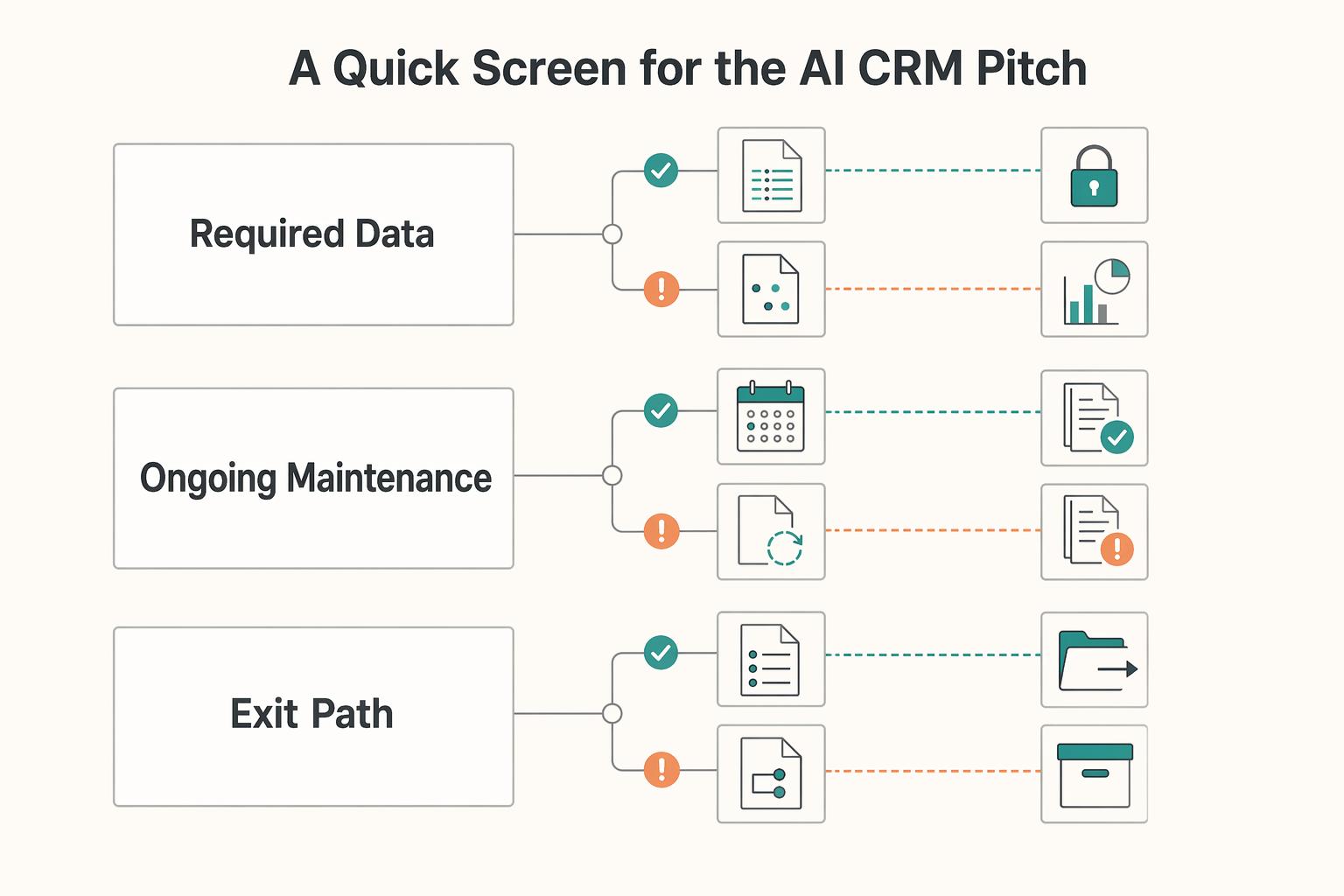
A quick screen for the AI CRM pitch#
Before you run a trial, check three things:
| Check | What to review | Warning sign |
|---|---|---|
| Required data | Whether it requires broad client history to be useful | Pause and review compliance exposure first |
| Ongoing maintenance | Whether it adds reconciliation and review work across your stack | Promised efficiency may disappear |
| Exit path | Whether contacts, notes, and activity history are easily exportable in usable form | Treat that as a strategic warning |
If you handle EU client data, use a stricter checklist like GDPR for Freelancers: A Step-by-Step Compliance Checklist for EU Clients.
If your answers are mostly near-term concerns, handle this as an operational risk decision first, then move to the next filter workflow.
If you want a deeper dive, read A guide to 'Bullet Journaling' for freelancers.
The "Hype Filter": Sidestepping Short-Term Tech Traps#
Run these three pass/fail screens before any signup or integration work. If a tool fails one, pause it and protect your time, client work, and exit options.
Does it fix a real pain now?#
Pass only if the tool solves a current business problem you can name in plain terms.
| Tier | Definition | Examples | Decision signal |
|---|---|---|---|
| Tier 1 | Work stops or risk jumps if nothing changes | Lost files; broken invoicing; unrecoverable client messages; unsafe data handling | With partial proof, pilot not full adoption |
| Tier 2 | Ongoing drag that costs you money or reliability each week | Repeated follow-up misses; onboarding delays; recurring calendar errors; monthly cleanup loops | With partial proof, pilot not full adoption |
| Tier 3 | Nice-to-have polish | Better summaries; prettier dashboards; minor speedups on already-short tasks | Tier 3 alone is a fail |
Decision rule: Tier 3 alone is a fail. Tier 1 or Tier 2 with partial proof is a pilot, not full adoption.
A polished demo is not enough. Strong performance in a familiar context can fail when moved somewhere else, so test one messy real example from your workflow, not the vendor's sample.
What does connection really cost?#
Pass only if you can describe the operational cost and risk before signup.
| Area | What to verify | Risk note |
|---|---|---|
| Data access | What data must the tool ingest (email, files, calendar, notes, billing)? | More access increases exposure and review burden |
| Security posture | What published security/privacy material can you directly review? | If you cannot inspect it yourself, do not treat the claim as settled |
| Policy fit | Which client or legal obligations apply, and exactly where will you verify each one? | If key compliance specifics are still unverified, treat that as unresolved risk, not a pass |
| Handoff impact | What new review, correction, or reconciliation work appears after setup? | Extra cleanup can erase the promised efficiency |
If you handle EU client data, use a stricter check like GDPR for Freelancers: A Step-by-Step Compliance Checklist for EU Clients. Also watch for "clean average" results that hide local failures in edge cases.
Can you leave without damage?#
Pass only if exit is practical, documented, and reversible.
- Exportability: Can you pull core records out in usable formats?
- API access: If needed, can other tools read and move data without manual re-entry?
- Reversibility: If you disconnect next month, what breaks, what stays readable, and what cleanup is on you?
Feature novelty is not a substitute for autonomy. If export/API/exit details are unclear, fail it or keep scope very small until verified.
| Outcome | Pain test | Connection test | Exit test | Decision |
|---|---|---|---|---|
| Adopt now | Clear Tier 1 or Tier 2 problem | Costs and obligations are visible and manageable | Export and exit path are clear | Use for a narrow live case |
| Pilot later | Real problem, but only partly proven | Some unknowns still need checking | Exit path looks possible but untested | Test on low-stakes work you can verify quickly |
| Skip | Mostly Tier 3 convenience | Unknown data or policy impact | Weak export, unclear API, or hard to reverse | Do not connect it to core operations |
For a step-by-step walkthrough, see A guide to 'Scenius' and building a creative community.
The "Platform Filter": Spotting Foundational Tools for Long-Term Autonomy#
Use this filter to decide what belongs in your core stack. Treat a tool as platform-like only if its value grows without shrinking your control.
Four tests worth applying before you commit#
1. Capability test: does it change what you can deliver, or only speed up what you already do? Favor tools that support a meaningfully different way to deliver work, not just a faster version of today's task list. If the gain is mostly convenience, keep it in a limited role.
2. Portability test: can you move data and workflows without friction? Check this before deep setup: usable exports, clear API or webhook docs, and outputs you can reuse elsewhere. If export quality, handoff, or rebuild steps are unclear, treat that as lock-in risk.
3. Network test: does support reduce dependency risk, not just signal popularity? Look past buzz. Verify implementation help, practical integrations, maintained documentation, release notes, and clear deprecation behavior so you are not tied to one vendor path.
4. Continuity test: does it still hold up if your business changes? Pressure-test the tool against growth or a service shift. If it remains useful when your delivery model evolves, it is a stronger foundation; if not, keep adoption shallow.
| Indicator | Product-like tool | Platform-like tool |
|---|---|---|
| Capability | Improves task speed | Supports a broader delivery model |
| Portability and exit | Limited export/handoff clarity | Clear export, integration, and exit path |
| Integration flexibility | Narrow or one-way connections | Practical two-way connections you can extend |
| Network and continuity | Momentum without operational depth | Ongoing support signals and lower single-vendor exposure |
When these signals look strong, move to the next section's matrix and score tools side by side before committing. For related decision framing, see A deep dive into the 'choice of law' and 'jurisdiction' clauses for international freelance contracts.
Putting the Matrix to Work: A Real-World Tech Decision#
When a new AI client communication tool asks for access to your email, intake forms, and project updates, treat the default decision as pilot with guardrails until evidence is strong enough for full adoption. You are not trying to predict the whole market. You are deciding whether this tool is safe, useful, and reversible for your business right now.
Use the matrix below to make that call from observable signals, not hype.
| Question | Evidence to collect | Risk implication | Provisional decision |
|---|---|---|---|
| Does it solve a real workflow constraint, or just point to a trend? | Name one recurring bottleneck in your current process (for example: missed follow-ups, slow intake, unclear status updates). Ask the vendor to show that exact workflow. | Trend-only evaluation can hide the real decision in front of you and lead to poor choices. | Defer unless the tool clearly resolves a repeated current bottleneck. |
| What sensitive information would pass through it? | List the actual data involved, then verify where data is submitted or connected and whether security details are provided on official, secure pages. | Sensitive-data handling is a gate, not a nice-to-have. If you cannot verify handling, risk is immediate. | Pilot with guardrails only for low-sensitivity use with limited access; otherwise defer. |
| Is the supporting proof from sources you should trust? | Check provenance of claims about research, certifications, or public-sector alignment. A .gov site is an official U.S. government source, and database inclusion alone is not endorsement. | Weak provenance can make a risky purchase look justified when it is not. | Defer when key claims rely on secondary summaries or unclear source origin. |
| Can the vendor explain what the system actually does? | Ask for documentation that separates AI, machine learning algorithms, and the specific technique used. | If method and limits are unclear, you cannot assess failure cases or review burden. | Pilot with guardrails only if capability and limits are clearly documented. |
| Is there architecture-level documentation, not just feature copy? | Request architecture-level docs (or equivalent technical overview), plus export documentation and a sample export. | Feature claims describe outcomes; architecture evidence shows data flow and decision points. | Defer if architecture and export evidence are unavailable before setup. |
| Can you reverse the adoption? | Test exit early: sample export, attachment handling, and readability/usability of records in another tool. | For a solo operator, hidden exit friction turns into direct rework. | Adopt now only if the exit path is concrete and readable; otherwise pilot or defer. |
What this usually means in practice#
For this kind of tool, you will often land on pilot with guardrails first. Start narrow: one internal inbox, one low-risk client segment, or one non-sensitive intake flow. Expand only after you verify security handling, source provenance, and reversibility.
A copyable decision output#
Decision: Pilot with guardrails Why: Solves a real follow-up bottleneck, but sensitive-data handling, evidence provenance, and exit path are not fully verified. Conditions before expansion: Architecture documentation reviewed, sample export tested, key claims checked for official provenance, low-sensitivity use only. Review cadence: Keep the review interval pending until it is verified against the pilot scope, security and evidence records, and exit-path requirements before expansion.
You might also find this useful: A guide to 'Moore's Law' and its impact on the tech industry.
Conclusion: Run both filters on your next software choice#
You do not need to chase every launch, and you do not need to ignore real change. A more useful stance is practical: use the Hype Filter as defense and the Platform Filter as offense, then make each tool earn its place in your business.
That habit matters in ordinary stack decisions, not just big strategic bets. When you are choosing a meeting assistant, CRM, invoicing app, client portal, or AI writing tool, run the same two checks every time. First, ask whether the tool solves a real problem now without adding hidden switching costs, messy data handling, or new dependency risk. Then ask whether it supports a longer shift you actually want, such as cleaner records, better portability, or fewer fragile manual steps across your work.
This is the practical value of Amara's Law for a business-of-one. It helps you steer the middle course. You do not get pulled into short-term hype, but you also do not assume the status quo will hold just because the first wave disappointed. That second mistake is easy to make after noisy tools fall short. If the pitch is loud but you still cannot verify the export options, documentation quality, or where your core records live, defer. If the near-term use is modest but the tool improves portability and fits how your business is likely to operate over time, a guarded pilot may be worth it.
So the next move is simple. Put your next software choice through the same matrix before you adopt, delay, or reject it. If you keep making tech decisions this way, your stack is more likely to stay deliberate, switching pain can stay lower, and your business is more likely to stay under your control.
This pairs well with our guide on A deep dive into the 'governing law' clause for a contract between a US freelancer and an Asian client.
Frequently Asked Questions
What are some modern examples of Amara's Law?
Start by asking whether a new tool solves a concrete problem this month before you treat it as a long-term platform shift. Amara's Law points to a common pattern: heavy early attention and unrealistic forecasts, followed by disappointment when early expectations are not met, while longer-term impact can still grow quietly. A modern example is rapid video-meeting adoption (Zoom and Microsoft Teams): near-term continuity gains were clear, but longer-term tradeoffs included Zoom fatigue and more after-hours calls.
What is the difference between Amara's Law and the Gartner Hype Cycle?
Amara's Law is a heuristic: people tend to overestimate short-term effects and underestimate long-term effects. Treat Amara's Law and the Gartner Hype Cycle as separate lenses rather than interchangeable models. | Comparison point | Amara's Law | Gartner Hype Cycle | | --- | --- | --- | | Purpose | A heuristic about how people misjudge short-term and long-term impact | A separate framework for technology-cycle analysis; review on its own terms | | How to use it | Ask whether near-term hype is driving your timing or masking slower structural change | Use its own guidance on its own terms, not as a one-to-one translation of Amara's Law | | Common misreading | Treating it like a precise forecasting rule | Treating it as identical to Amara's Law or as a direct buy/wait instruction by itself |
Is Amara's Law always right about new technology?
No. It is an observation, not a precise rule, and even where AI benefits are significant, implementation can be difficult. A practical checkpoint is to assess what stage of the cycle you are in before making role-impact bets. When expectations are running ahead of results, pilot in limited, lower-risk workflows first and expand only when outcomes hold up.
What should you do after reading this?
Write down one of three decisions for the tool in front of you: adopt now, pilot with guardrails, or defer. Then use the matrix from the previous section and set a review date, because the point is not permanent caution. It is better timing.
Try a related tool
Researched and edited by the Gruv editorial team. Gruv builds cross-border billing, payouts, and finance-operations software for global businesses.
Sources
- cs.columbia.edu/technical-reportstrusted
- elon.edu/u/imagining/surveys/xv2023/the-future-of-hum...trusted
- ll.mit.edu/sites/default/files/publication/doc/2022-10/...trusted
- oecd.org/content/dam/oecd/en/publications/reports/201...trusted
- openknowledge.worldbank.org/bitstreams/2ffa3b04-d3eb-4d27-8da9-654838bd9...trusted
- pmc.ncbi.nlm.nih.gov/articles/PMC12779661trusted
- pmc.ncbi.nlm.nih.gov/articles/PMC12897712trusted
- revisor.mn.gov/bills/93/2023/0/HF/2310/versions/ccr/0trusted
Educational content only. Not legal, tax, or financial advice.
Related Posts

GDPR Compliance Checklist for Freelancers Working With EU Clients
Start by separating the decisions you are actually making. For a workable **GDPR setup**, run three distinct tracks and record each one in writing before the first invoice goes out: VAT treatment, GDPR scope and role, and daily privacy operations.
Bullet Journaling for Freelancers Who Need a Reliable Weekly System
If you want a bullet journal to run client work, follow-ups, and business admin, treat it as a working notebook, not a craft project. The goal is simple: one place where weekly planning, daily action, and loose notes stop competing with each other.

The Freelance Payment Penalty: A Modeled Audit of Platform Fees, FX Spreads, and Payout Delays
The money rarely disappears through a single, easy-to-spot fee. The real loss is stacked. A marketplace takes its commission, a processor adds a charge for international cards, a bank or payment company converts the currency at a spread, a platform holds the funds before release, and a wire sheds a little to intermediaries on the way in. Each layer looks defensible on its own, but the worker feels the combined result as a smaller deposit and a later payday.